Category Archives: Archaeology

Bread stamp with Temple Menorah discovered near Acco

The Israel Antiquities Authority announces the discovery of a stamp used to identify baked products from an excavation near the coastal town of Acco (Akko; Acre). The stamp dates to the 6th century A.D. (the Byzantine period). The suggestion is made that it may have been used by a baker who made kosher bread for the Jews in the area.
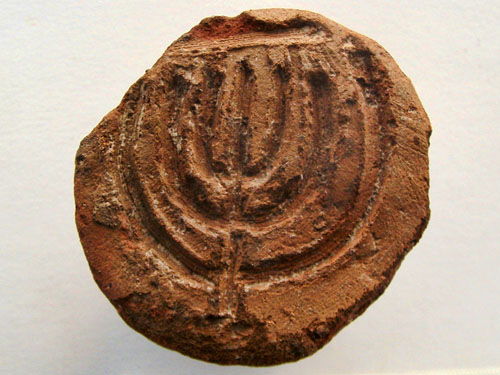
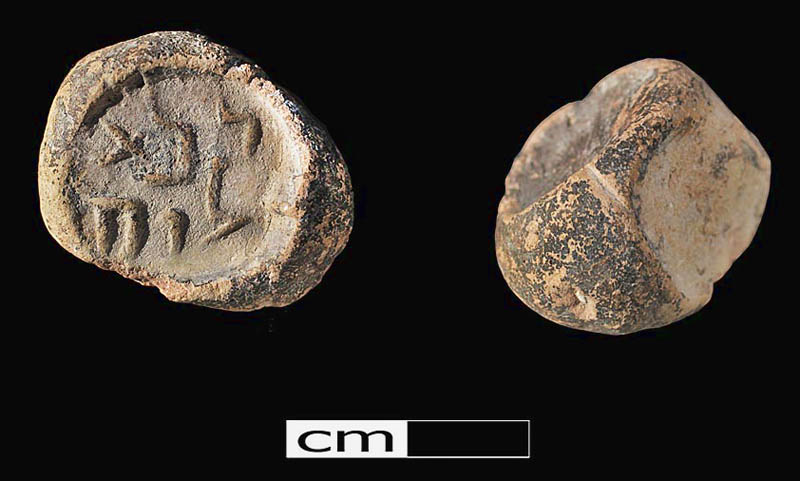
Bread stamp discovered at Acco. Photo: Dr. Danny Syon, courtesy IAA.

Bread stamp discovered near Acco. Photo: Dr. Danny Syon, courtesy IAA.

The IAA news release says,

According to Gilad Jaffe and Dr. Danny Syon, the directors of the excavation on behalf of the Israel Antiquities Authority, “A number of stamps bearing an image of a menorah are known from different collections. The Temple Menorah, being a Jewish symbol par excellence, indicates the stamps belonged to Jews, unlike Christian bread stamps with the cross pattern which were much more common in the Byzantine period”. According to Syon, “This is the first time such a stamp is discovered in a controlled archaeological excavation, thus making it possible to determine its provenance and date of manufacture. The stamp is important because it proves that a Jewish community existed in the settlement of Uza in the Christian-Byzantine period. The presence of a Jewish settlement so close to Akko — a region that was definitely Christian at this time — constitutes an innovation in archaeological research”. The excavators add, “Due to the geographical proximity of Horbat Uza to Akko, we can speculate that the settlement supplied kosher baked goods to the Jews of Akko in the Byzantine period”.

The stamp is engraved with a seven-branched menorah atop a narrow base, and the top of the branches forms a horizontal line. A number of Greek letters are engraved around a circle and dot on the end of the handle. Dr. Leah Di Segni, of the Hebrew University of Jerusalem suggested this is probably the name Launtius. This name was common among Jews of the period and also appears on another Jewish bread stamp of unknown provenance. According to Dr. Syon and Gilad Jaffe, “This is probably the name of the baker from Horbat Uza.”
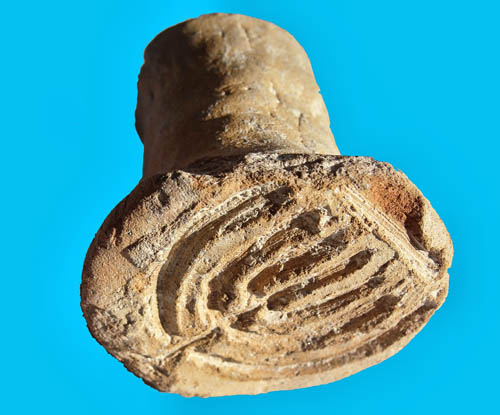
Bread stamp discovered at Acco. Photo: Dr. Danny Syon, courtesy IAA.

Bread stamp discovered at Acco. Photo: Dr. Danny Syon, courtesy IAA.

Dr. David Amit, who has made a study of bread stamps, adds,

“A potter engraved the menorah image in the surface of the stamp prior to firing it in a kiln, whereas the owner’s name was engraved in the stamp’s handle after firing. Hence we can assume that a series of stamps bearing the menorah symbol were produced for Jewish bakers, and each of these bakers carved his name on the handle, which also served as a stamp. In this way the dough could be stamped twice before baking: once with the menorah — the general symbol of the Jewish identity of Jewish bakeries, and the private name of the baker in each of these bakeries, which also guaranteed the bakery’s kashrut.

The full IAA report is available at a temporary link here.

English Bible versions commonly translate the Hebrew menorah by the word lampstand. The King James Version’s candlestick is no longer used because we know that candles were not in use in Bible times (cf. Revelation 1:12).

The seven-branched lampstand is probably the best known symbol of the tabernacle and temple, and of Jews generally. The first biblical reference to the menorah is in the account of the building of the tabernacle.

“Then you shall make a lampstand of pure gold. The lampstand and its base and its shaft are to be made of hammered work; its cups, its bulbs and its flowers shall be of one piece with it.  “Six branches shall go out from its sides; three branches of the lampstand from its one side and three branches of the lampstand from its other side.  (Exodus 25:31-32 NAU)

As a parallel, one might think of the hot cross buns commonly eaten on Good Friday in many Christian communities.

HT: Joseph Lauer
Bust of king from Hellenistic Period found in Turkey

The country of Turkey now occupies the territory of ancient Asia Minor. It is filled with Greek and Roman ruins — especially in the western area and along the Mediterranean coast. Archaeological excavations are active in the country.

Today’s Zaman, a Turkish newspaper, reported on January 4 the discovery of the relief bust of a king from the Hellenistic period. We are given no hint regarding the identity of the king. We know that Alexander of Macedon crossed Asia Minor in the 4th century B.C. From that time the Greeks had a great influence on the country. Later, in the Roman period this would be the territory visited by Paul on his preaching journeys.

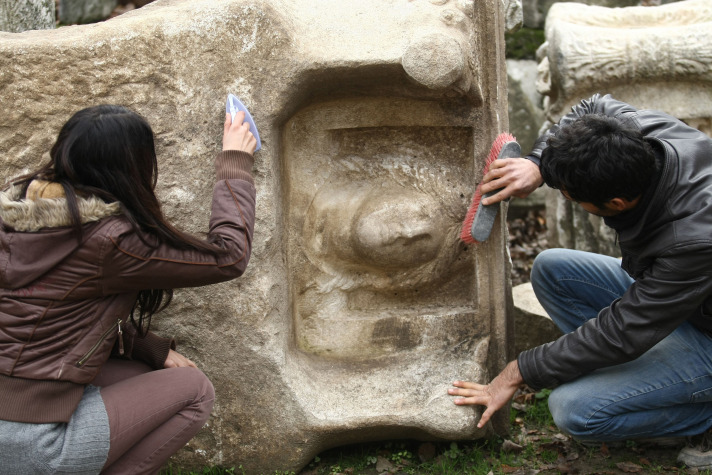
Relief bust of Hellenistic king discovered in Turkish excavation.

Relief bust of Hellenistic king discovered in Turkish excavation. Today's Zaman.

Today’s Zaman says,

A 2,000-year-old relief bust of a king was discovered during excavations in ancient Stratonikeia in Muğla’s Yatağan district.

Dr. Bilal Söğüt, a professor of archeology at Pamukkale University and head of the excavations, told the Anatolia news agency that they found a street in the ancient city which began with a gate and was lined with columns. During their excavations, they also discovered the bust of a king dating back to the Hellenistic period. The bust, which is one-and-a-half meters tall and nearly two meters wide, features depictions of bull heads and the figure of a goddess, Söğüt said.

“The depictions of bull heads on the bust represent wealth and power. It was in this region that we previously found a racing chariot. The discovery of 1,500-year-old mosaics here was another welcome breakthrough for us,” he said.

Stratonikeia is located in the southwestern region of Turkey. The excavation is under the direction of professor from Pamukkale, a site known as Hierapolis in the New Testament (Colossians 4:13).

The entire article may be read here.

New theory on rare Second Temple “seal”

Recently we reported the discovery of a rare Second Temple inscription seal here. The original announcement said the inscription was inscribed with an Aramaic inscription which could be translated “Pure for G-d.”

Rare Second Temple Inscription Seal. IAA photo by Vladimir Naykhin.

Rare Second Temple Inscription Seal. IAA photo by Vladimir Naykhin.

It is not surprising to learn that not all scholars agree with the reading. The Israeli newspaper Ha’aretz calls attention to the theory of Prof. Shlomo Naeh, of the Hebrew University’s Talmud department, who says the inscription calls attention to the type of sacrifice purchased for offering.

Naeh also believes the object is related to Temple worship and purity, but reads the inscription differently, as “Dakar a Leyehoyariv.” Dakar in Aramaic means ram and a stands for aleph, the first day of the week, when the priestly order of Yehoyariv was on duty in the Temple.

Thus, the object was used in Temple worship, but not how Reich and Shukron believe it was, says Naeh. To ensure the purity of animal sacrifices offered in the Temple — and to maintain an economic monopoly, Naeh believes — pilgrims had to buy their offerings in the Temple courts. They gave money to a treasurer who would exchange it for a token inscribed with the type of sacrifice they had purchased and the date.

Like Reich and Shukron, Naeh supports his theory with a mishnaic verse citing the existence of such tokens. With regard to Reich and Shukron’s interpretation, he said: “Purity was very fluid; the touch of an impure person was enough to make the object impure, so it is unlikely such a seal existed.”

He also said the object could not be a seal because it lacked a hole for a thread or a handle to affix it to another object.

The full article in Ha’aretz may be read here.

2011 in review — according to WordPress

The WordPress.com stats helper monkeys prepared a 2011 annual report for this blog.

Here’s an excerpt:

London Olympic Stadium holds 80,000 people. This blog was viewed about 270,000 times in 2011. If it were competing at London Olympic Stadium, it would take about 3 sold-out events for that many people to see it.

Click here to see the complete report.

Personal Note: Thanks to the readers who keep me going. You are literally scattered all over the earth. Your interest is appreciated. We are thankful for anyone who has been instructed or encouraged.

Please forgive our failure to answer all of the requests for info and photos. We do as many as we can, but to borrow from and paraphrase Jesus, “Sufficient unto the day are the Emails thereof.”

“Gibeon, for the king” bulla discovered

The Temple Mount Sifting Project, Jerusalem, announced yesterday the discovery of a clay bulla bearing the name of the biblical city of Gibeon. The name of Gibeon (GB’N) occurs with LMLK (for the king).

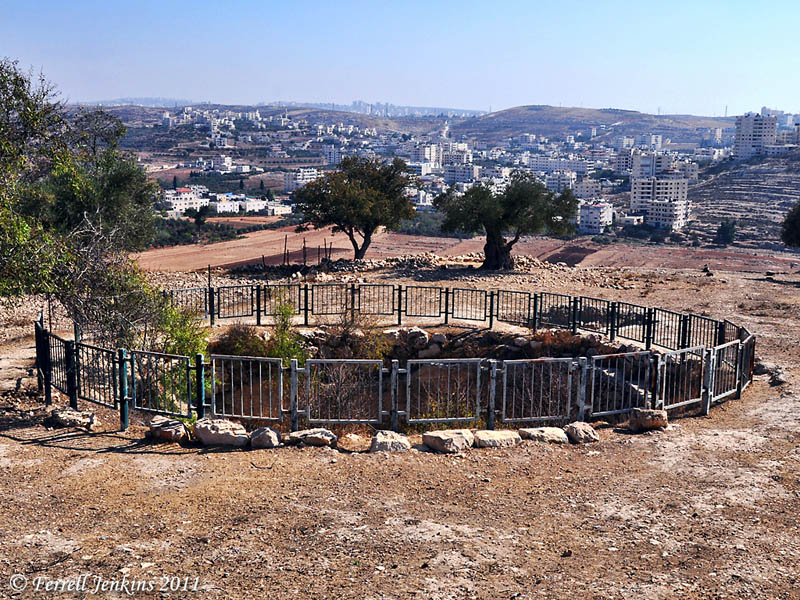
The Pool of Gibeon. Photo by Ferrell Jenkins in 2011.

The Pool of Gibeon at El-Jib. Photo by Ferrell Jenkins in 2011.

Gabriel Barkay summarizes his report of this discovery.

A small fragment of a clay bulla was discovered in the wet sifting carried out at Tzurim Valley National Park, the site of the Temple Mount Sifting Project. The bulla carries an Ancient Hebrew inscription: “[g]b’n/lmlk“, i.e. “Gibeon, for the King”. The bulla originates from the eastern slope of the Temple Mount, descending into the Kidron Valley. The bulla belongs to a group of bullae which were called by N. Avigad “Fiscal Bullae”.

Presently we know more than 50 bullae of this type. They comprise two groups, one with names of cities in the kingdom of Judah, and the other with names of royal officials. All the fiscal bullae known until now come from the antiquities market, and our bulla is the first one to come from a controlled archaeological project. This bulla enables us to fully illuminate and discuss the entire phenomenon of the fiscal bullae.

Barkay says the known bullae,

include names of 19 different cities of Judah, and dates of the reign of one of the Judean kings, usually in hieratic numerals, as well as the particle lmlk, “for the king”.

He says,

The fiscal bullae represent a taxation system from the different Judean cities, based on yearly taxes, which probably replaced the previous one, reflected in the royal Judean jars and their seal impressions, from the time of King Hezekiah.

The discovery of the fiscal bulla with the name of Gibeon from the slope of the Temple Mount, authenticates all the other fiscal bullae, and enables us to study a variety of subjects connected to the history of Judah in the 7th century BCE.

Two brief reports on the Project may be read here.

Name of Gibeon is not new. This is not the first time the name of Gibeon has been discovered from the past. During the excavations conducted by James Pritchard for the Museum of the University of Pennsylvania and the Church Divinity School of the Pacific between 1956 and 1962, over 25 inscription were found with the name Gibeon. In fact, this is how Pritchard first knew with certainy that the Arab town El Jib was to be identified as Gibeon.

Some of the inscribed jar handles discovered by Pritchard’s excavation at El Jib are displayed at the University of Pennsylvania Archaeological Museum in Philadelphia.

Gibeon is an important town in Biblical history. The first Biblical reference is in Joshua 9.

Recently I have been scanning a few slides I made at Gibeon in 1970 and 1976. Hopefully I will be able to provide some comparison photos for you to see the vast difference between then and now.

The Temple Mount Sifting Project began after it was discovered that the Moslems in control of the Temple Mount, where the Dome of the Rock is located, were dumping debris from work they were doing on the Temple Mount. This project has been underway for more than two years. A temporary building has been erected in Tzurim Valley National Park for the sifting project.

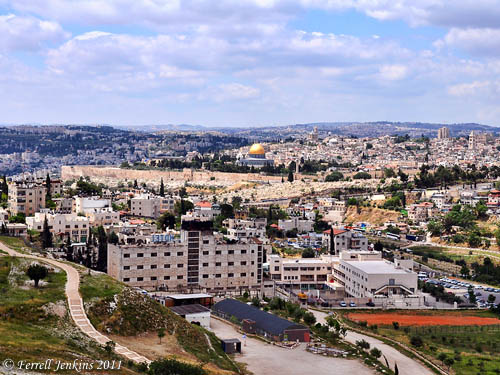
The photo below was made from Mount Scopus. Here we see the temporary building of the Temple Mount Sifting Project in the foreground. The slope of the Mount of Olives is on the left (east). The Kidron Valley begins to the right of the buildings in the center of the photo and continues south under the eastern wall of the Old City of Jerusalem which you can see clearly in this photo. Click on the photo for a larger image.

Jerusalem from Mount Scopus. The Temple Mount Sifting Project building is in the foreground. Photo by Ferrell Jenkins.

Jerusalem from Mount Scopus. The Temple Mount Sifting Project building is in the foreground. Photo by Ferrell Jenkins.

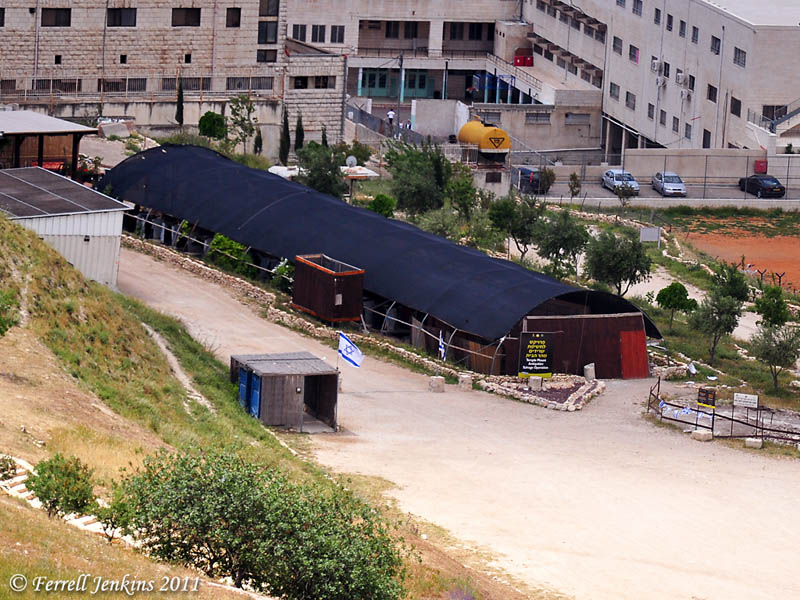
The next photo is a closeup of the building used by The Temple Mount Sifting Project. Some wonderful pieces have been discovered from the first temple period, as well as other periods, as a result of the work done here.

View from Mount Scopus of the Temple Mount Sifting Project building. Photo by Ferrell Jenkins.

View from Mount Scopus of The Temple Mount Sifting Project building. Photo by Ferrell Jenkins.

Gordon Franz has an interesting article by Stephanie Hernandez about participation in the TMSP on his Life and Land site here.

Perhaps in the days to come we will be favored with a photo of the new bulla with the name of Gibeon on it. In the mean time, see how many times you can find the word Gibeon or Gibeonite/s in the Bible.

Discovery of rare Second Temple inscription announced

Announcement was made by the Israel Antiquities Authority in Jerusalem today of the recent discovery of an inscribed “seal” bearing a shortened version of the name of God (Yahweh).

The small fired clay object was discovered from the soil collected during the recent excavations at the southwest corner of the temple mount enclosure which we mentioned here about a month ago.

"Pure for G-d" Inscription Seal. IAA photo by Vladimir Naykhin.

"Pure for G-d" Inscription Seal. IAA photo by Vladimir Naykhin.

A portion of the press release by the IAA reads,

Layers of soil covering the foundations of the Western Wall, c. 15 meters north of the southwestern corner of the Temple Mount, were excavated beneath Robinson’s Arch in archaeological excavations of the Israel Antiquities Authority in the Jerusalem Archaeological Garden. On top of these layers, dating to the first century CE (the late Second Temple period), was paved the Herodian street which was the main road of Jerusalem at that time. From the very start of the excavations in this area the archaeologists decided that all of the soil removed from there would be meticulously sifted (including wet-sifting and thorough sorting of the material remnants left in the sieve). This scientific measure is being done in cooperation with thousands of pupils in the Tzurim Valley National Park, and is underwritten by the ʽIr David Association. It was during the sieving [sifting] process that a tiny object of fired clay, the size of a button (c. 2 centimeter in diameter [about 3/4 of an inch]) was discovered.

The Aramaic inscription, consisting of two lines, has the word for pure, a preposition and a shortened form of the word for G-d. Jews do not write the name of God. Many of our English versions of the Bible use the word LORD for the translation of the Tetragrammaton YHWH. The short form on this object has only YH.

The excavators, Elie Shukron and Ronny Reich, explain,

“The meaning of the inscription is “Pure for G-d”. It seems that the inscribed object was used to mark products or objects that were brought to the Temple, and it was imperative they be ritually pure. This stamped impression is probably the kind referred to in the Mishnah (Tractate Shekalim 5: 1-5) as a “חותם” (seal). To the best of our knowledge, this is the first time that such an object or anything similar to it was discovered in an archaeological excavation and it constitutes direct archaeological evidence of the activity on the Temple Mount and the workings of the Temple during the Second Temple period”.

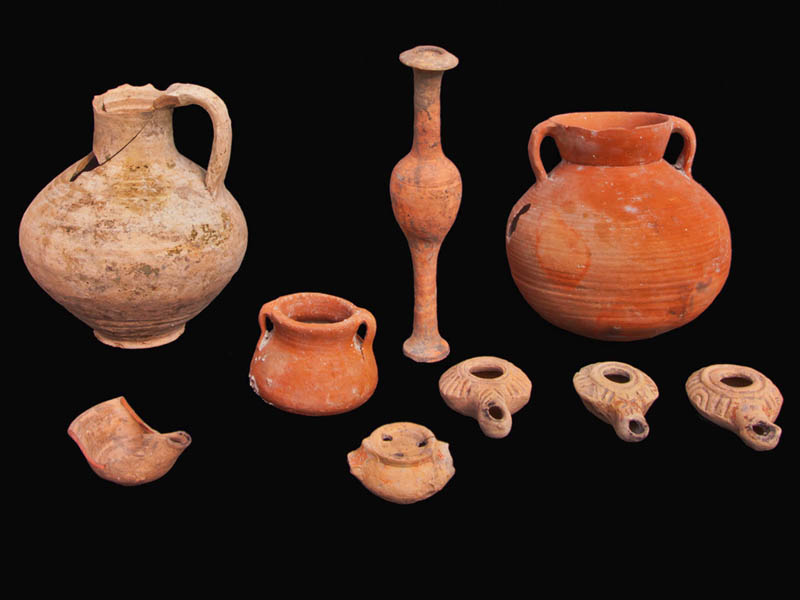
Other artifacts dating to the Second Temple period included some from the Hasmonean Period. In the photo below you will see “oil lamps, ceramic cooking pots and a fusiform juglet [the object in the top middle] that may have contained oils and perfume.” Coins minted in the days of Alexander Jannaeus (102-76 B.C.) and John Hyrcannus (135-104 B.C.) were also discovered.

The complete IAA Press Release may be read here.

Second Temple (Hasmonean Period) vessels. IAA photo by Vladimir Naykhin.

Second Temple (Hasmonean Period) vessels. IAA photo by Vladimir Naykhin.

Just a suggestion. Perhaps a seal such as the one mentioned above would have been used in the case mentioned by Jesus in the Sermon on the Mount.

So if you are offering your gift at the altar and there remember that your brother has something against you, leave your gift there before the altar and go. First be reconciled to your brother, and then come and offer your gift.  (Matthew 5:23-24 ESV)

HT: Joseph Lauer

Dead Sea Scrolls exhibition in Times Square, New York

Are you traveling to New York in the next few months? The Dead Sea Scrolls: Life and Faith in Biblical Times exhibition at the Discovery Times Square building in New York City is worth a visit.

Gordon Franz, a Bible teacher and archaeologist, has written about the exhibition on his Life and Land blog here. Gordon is known to the regular readers of this blog. We have called attention to several of his articles, especially those about “cracked pot archaeology.”

In addition to giving the details about the exhibition and how to get a $5 discount on your ticket, Franz tells you how to access his 39-page guide which he has written specifically from a Christian perspective. Actually, it should be helpful for any serious student of the Bible.

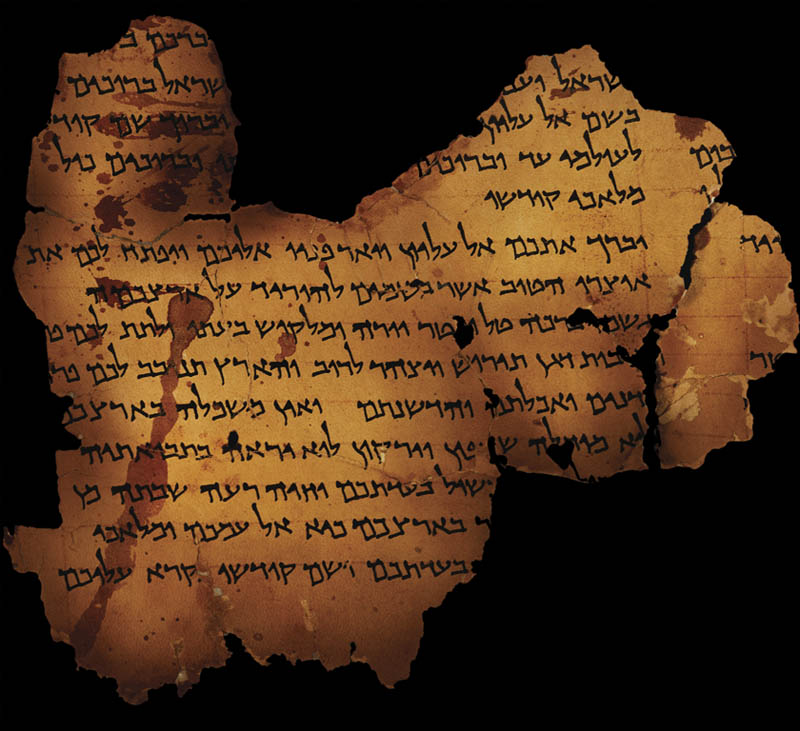
War Scroll displayed at the Discovery Times Square in New York City.

War Scroll displayed at the Discovery Times Square in New York City.

This exhibition is much more than a few fragments of the Dead Sea Scrolls. Artifacts, ossuaries, pottery, lamps, seals, and a stone from the wall build around the Temple Mount are included among the 500 items on display. The exhibition is on loan from the Israel Antiquities Authority. The exhibition runs until April 15, 2012. After that it moves to Philadelphia’s Franklin Institute for a few months beginning in May.

Dead Sea Scrolls - Life and Faith in Biblical Times display

Dead Sea Scrolls - Life and Faith in Biblical Times display.

If you have the opportunity to visit this exhibition, you should read Gordon’s guide written from a Christian perspective. His guide will be helpful to anyone interested in Bible life and times, even if you don’t get to visit the exhibition. The link to the guide is located at his Life and Land website here.

Thanks to Gordon Franz for giving me a heads-up on his guide.

Lystra — Barnabas is Zeus and Paul is Hermes

G. Walter Hansen comments on the religious life of Galatia and the importance of Zeus and Hermes to the people who lived there.

Zeus was the most widely worshipped god in Galatia; temples to Zeus were ubiquitous. Zeus was often linked with other gods. In the territory of Lystra there are carvings and inscriptions which show Zeus accompanied by Hermes. An inscription found near Lake Sugla is a dedication to Zeus of a sundial and a statue of Hermes. The names of the dedicators are Lycaonian. A stone altar near Lystra is dedicated to “the Hearer of Prayer [presumably Zeus] and Hermes.” A relief near Lystra depicts Hermes with the eagle of Zeus. In Lystra a stone carving shows Hermes with two other gods, G and Zeus. (Gill and Gempf, The Book of Acts in its First Century Setting, Vol. 2: Graeco-Roman Setting, 393)

This evidence, says Hansen, provides the setting for the events of Paul and Barnabas at Lystra. Luke describes the reaction of the Lystrans when they saw Paul heal a lame man.

When the crowds saw what Paul had done, they raised their voice, saying in the Lycaonian language, “The gods have become like men and have come down to us.”  And they began calling Barnabas, Zeus, and Paul, Hermes, because he was the chief speaker.  The priest of Zeus, whose temple was just outside the city, brought oxen and garlands to the gates, and wanted to offer sacrifice with the crowds.  (Acts 14:11-13 NAU)

Bruce reminds us that “Zeus was the chief god in the Greek pantheon; Hermes, the son of Zeus by Maia, was the herald of the gods” (The Book of the Acts, NICNT, 292).

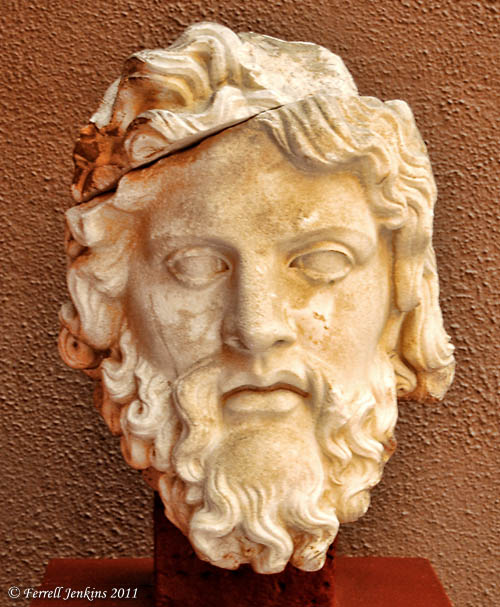
Our photo of Zeus is of a bust displayed in the archaeological museum at Ephesus.

Bust of Zeus in the Ephesus Museum. Photo by Ferrell Jenkins.

Bust of Zeus in the Ephesus Museum. Photo by Ferrell Jenkins.

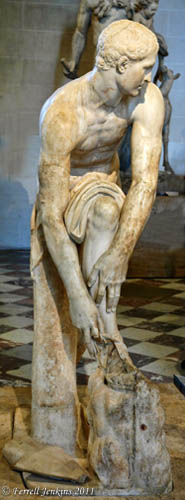
Paul was called Hermes because he was the chief speaker. Hermes was the messenger of the gods. How appropriate that our word hermeneutics, coming from the name Hermes, is used to describe the important work of interpreting the Scriptures. I have heard some speakers make fun of the word and then proceed to say that a certain phrase in the Scripture means … ! The photo below shows Hermes tying on his sandal in preparation for delivering a message. Some may recognize Hermes as the Latin Mercury, who is used as the symbol for the floral industry.

Hermes Putting on Sandal. Louvre. Photo by Ferrell Jenkins.

Hermes Putting on Sandal. Displayed in the Louvre. Photo by Ferrell Jenkins.

The King James Version used the Latin terms Jupiter and Mercurius in Acts 14:12. Bruce says this is “due to an old and foolish fashion of replacing Greek proper names by their Latin equivalents in English translations from the Greek.”

Identifying Lystra

Biblical sites are identified several ways. A few sites have been known for millennial. For example, Jerusalem (earlier Jebus, 1 Chronicles 11:4-5; and Salem, Genesis 14:18), Damascus, Athens, and Rome.

Some scholars have identified sites on linguistic grounds. For example, Edward Robinson identified biblical Bethel with Beitin in 1938. This proposal had been generally accepted until David Livingston suggested, in the last few decades, that Bethel should be identified with el- Bireh. Some names have remained virtually unchanged. Modern Anata is thought to be biblical Anathoth (Jeremiah 1:1). I note that the Syrian town of Ribleh is identified with biblical Riblah (2 Kings 25:6). After all these centuries only one letter is different.

Other sites are identified on the basis of inscriptions. Such is true of Gezer, Thyatira, and Lystra. This brings me to my topic today.

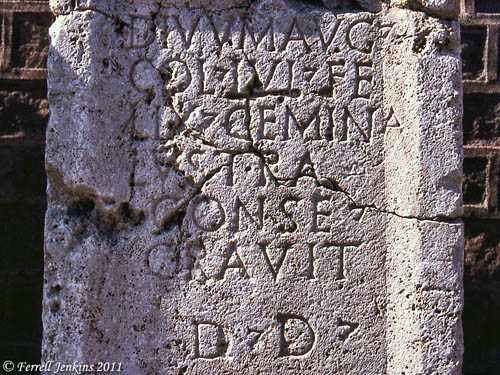
The identification of Lystra was made by J. R. S. Sterrett in 1855 on the basis of a Latin inscription found at the site. The inscription is now displayed at the archaeological museum in Konya (biblical Iconium).

Inscription with the name Lystra. Photo by Ferrell Jenkins.

Inscription with the name Lystra. Photo by Ferrell Jenkins.

The inscription includes the full Roman name Colonia Iulia Felix Gemina Lustra. See Mark Wilson, Biblical Turkey, 173. We called attention to this inscription, with a photo of the entire stone as it is displayed at Konya more than four years ago, during the first month of this blog, here.

The brethren of Lystra and Iconium spoke well of young Timothy at the time Paul chose him to join his preaching party.

Paul came also to Derbe and to Lystra. And a disciple was there, named Timothy, the son of a Jewish woman who was a believer, but his father was a Greek,  and he was well spoken of by the brethren who were in Lystra and Iconium. (Acts 16:1-2 NAU)

I have failed to say recently that archaeological mounds (tells) in Turkey are identified by the Turkish word höyük (pronounced who-youk).

Herod the Great didn’t do it all

Archaeologists in Jerusalem announced yesterday a new discovery that changes popular thinking about the building of the walls around the Temple Mount. It is not much of a surprise. We already knew that the Roman Street found at the SW corner of the wall dates to the period just before the destruction of Jerusalem by the Romans in A.D. 70. The last paragraph of the press release mentions that what was found was in harmony with the account of Josephus.

I have understood John 2:20 to be saying that work on the temple precinct was continuing as late as A.D. 26/27. That is a major reason this is not a surprise.

Then the Jewish leaders said to him, “This temple has been under construction for forty-six years, and are you going to raise it up in three days?” (John 2:20 NET)

Here is a portion of the press release issued by the Israel Antiquities Authority. I am leaving it full width for easier reading.

— • —

Professor Ronny Reich of the University of Haifa and Eli Shukron of the Israel Antiquities Authority: A ritual bath exposed beneath the Western Wall of the Temple Mount shows that the construction of that wall was not completed during King Herod’s lifetime.

Who built the Temple Mount walls? Every tour guide and every student grounded in the history of Jerusalem will immediately reply that it was Herod. However, in the archaeological excavations alongside the ancient drainage channel of Jerusalem a very old ritual bath (miqwe [mikve]) was recently discovered that challenges the conventional archaeological perception which regards Herod as being solely responsible for its construction.…

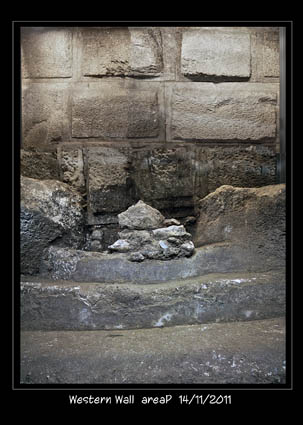
In an excavation beneath the paved street near Robinson’s Arch, sections of the Western Wall’s foundation were revealed that is set on the bedrock — which is also the western foundation of Robinson’s Arch — an enormous arch that bore a staircase that led from Jerusalem’s main street to the entrance of the Temple Mount compound.

According to Professor Reich, “It became apparent during the course of the work that there are rock-hewn remains of different installations on the natural bedrock, including cisterns, ritual baths and cellars. These belonged to the dwellings of a residential neighborhood that existed there before King Herod decided to enlarge the Temple Mount compound. The Jewish historian Josephus, a contemporary of that period, writes that Herod embarked on the project of enlarging the compound in the eighteenth year of his reign (that is in 22 BCE) and described it as “the largest project the world has ever heard of.”

When it was decided to expand the compound, the area was confiscated and the walls of the buildings were demolished down to the bedrock. The rock-cut installations were filled with earth and stones so as to be able to build on them. When the locations of the Temple Mount corners were determined and work was begun setting the first course of stone in place, it became apparent that one of the ritual baths was situated directly in line with the Western Wall. The builders filled in the bath with earth, placed three large flat stones on the soil and built the first course of the wall on top of this blockage.

While sifting the soil removed from inside the sealed ritual bath, three clay oil lamps were discovered of a type that was common in the first century CE. In addition, the sifting also yielded seventeen bronze coins that can be identified. Dr. Donald Ariel, curator of the numismatic collection of the Israel Antiquities Authority, determined that the latest coins (4 in all) were struck by the Roman procurator of Judea, Valerius Gratus, in the year 17/18 CE. This means that Robinson’s Arch, and possibly a longer part of the Western Wall, were constructed after this year – that is to say: at least twenty years after Herod’s death (which is commonly thought to have occurred in the year 4 BCE).

This bit of archaeological information illustrates the fact that the construction of the Temple Mount walls and Robinson’s Arch was an enormous project that lasted decades and was not completed during Herod’s lifetime.

This dramatic find confirms Josephus’ descriptions which state that it was only during the reign of King Agrippa II (Herod’s great-grandson) that the work was finished, and upon its completion there were eight to ten thousand unemployed in Jerusalem.

— • —

If you wish to see the complete press release click here.

Below are a few of the photos provided by the IAA. The first shows the lowest course of the wall resting on bedrock.

The first course of the wall resting on the bedrock. Photograph: Vladimir Naykhin.

The first course of the wall resting on the bedrock. Photograph: Vladimir Naykhin.

The next photo shows one of the coins dating to the time of Roman Procurator Valerius Gratus in the year A.D. 17/18. He was procurator A.D. 15-26, and followed by the better known Pontius Pilate (A.D. 26-36).

A coin of the Roman procurator Valerius Gratus, which helped in dating the construction of Robinson’s Arch.

A coin of the Roman procurator Valerius Gratus, which helped in dating the construction of Robinson’s Arch. Courtesy IAA.

The third photo shows some of the workers excavating the area.

Archaeologists working at bedrock below Robinson's Arch. Photo: IAA.

Archaeologists working at bedrock below Robinson's Arch. Photo: IAA.

After writing my post, I see that Todd Bolen accuses the IAA of being “desperate for headlines.” See his comments here.

HT: Joseph I. Lauer