Author Archives: Ferrell Jenkins

Preparing for a Trip to Israel

Occasionally I get a request from someone planning their first trip to Israel asking for suggestions on books to help them prepare for the trip.

There are some excellent books we suggest for your study before and during the tour. Below is a list of books which we recommend for your use. Begin with The Holy Land by Murphy- O’Connor. It will take you a while to read and mark the book. You will enjoy the book much more once you return home and begin to use it as a resource. Of course, this is true of many of the books listed here.

  • Baly, Denis. Basic Biblical Geography (Fortress) paperback. Brief introduction. Any books by Baly can be helpful.
  • Beitzel, Barry J. The Moody Atlas of Bible Lands (Moody). A complete atlas of Bible lands.
    Dyer, Charles H. and Gregory A. Hatteberg. The Christian Traveler’s Guide to the Holy Land. Broadman and Holman, 1998.
  • Eyewitness Travel Guides. Jerusalem & the Holy Land. DK Publishing. This book has beautiful plans of the buildings.
  • Frank, Harry Thomas (ed.). Atlas of the Bible Lands (Broadman). Concise atlas; good maps.
  • Hoppe, Leslie J. A Guide to the Lands of the Bible. Liturgical Press., 1999. Cover Israel, Jordan, and other areas.
  • Miller, Max. Introducing the Holy Land. This book is out of print, but you might be able to locate a used copy.
  • Murphy-O’Connor, Jerome. The Holy Land (Oxford), paperback. Excellent.
  • Page, Charles R. and Carl A. Volz, The Land and the Book (Abingdon).
  • Ullian, Robert, ed. Israel: Past and Present. A beautiful guide to the 16 top archaeological sites in Israel. Overlays illustrate how the sites might have looked in ancient times.
  • Vos, Howard F. The Wycliffe Historical Geography of Bible Lands (Hendrickson). This is the completely revised 2003 edition. The book was originally published in 1967, edited by Pfeiffer and Vos. Excellent.

The books we have listed above are not typical travel books, but accurate, scholarly books. Some are in a popular style. Travel books can be helpful, however. Many sites you visit will offer small booklets about those places.

If you can only buy three books, I suggest Murphy-O’Connor, Eyewitness Travel Guides and Hoppe.

Some of the popular travel guides that provide good info include: Let’s Go Israel, Fodor’s, Lonely Planet, and Rough Guides. The last two guides are intended primarily for individual travelers, but I find them helpful.

You may order any of these books from Amazon by going to our Biblical Studies Info Book Store here.

Internet Sites. What web pages would be helpful for the first time (or repeat) traveler? Obviously I suggest Ferrell’s Travel Blog and the BiblePlaces Blog by Todd Bolen. You will need to use the search box to search for posts dealing with places you plan to visit.

Go to the Biblical Studies Info Page here. Click on Bible Places. There you will find many links to specific places in Israel and other countries. I suggest you also go to the Scholarly Page and check the Archaeology section and the Blogs. Todd Bolen’s BiblePlaces is an excellent source. You will likely find good information and photos from the places you plan to visit.

The books may be ordered at a discount from Amazon at the Biblical Studies Info Bookstore. Perhaps some of our readers with experience in traveling to the Bible lands will add some additional suggestions in comments.
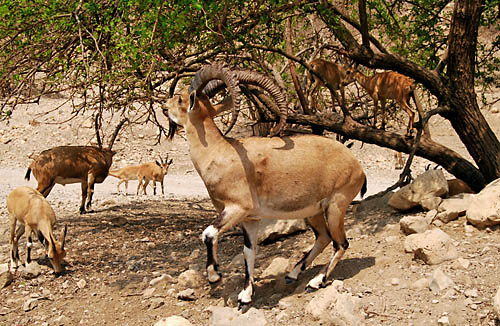
Ibex at En Gedi near the Dead Sea. Photo by Ferrell Jenkins.

Ibex at En Gedi near the Dead Sea. Photo by Ferrell Jenkins.
BU archaeologist discovers evidence of ancient Egyptian shipping

BU Today has an update here on the work of Professor Kathryn Bard in Egypt. This new article reports on a discovery first made by Bard five years ago. A video of some of the artifacts soon to go on display in the Egyptian Museum is included.

The team discovered seven caves at Wadi Gawasis containing relics dating back 4,000 years. The first pieces ever recovered from Egyptian seagoing vessels, they offer a tantalizing glimpse into an elaborate network of Red Sea trade.

Best known for its exports of gold, incense, ebony, elephant ivory, and exotic animals, the exact location of the port city Punt remains a mystery; Bard believes it was in present-day eastern Sudan. Inscriptions discovered more than a century ago indicate that Egyptian pharaohs mounted naval expeditions to Punt as far back as the Old Kingdom (2686 –2125 B.C.), and Bard’s findings give credibility to the legend in the form of stelae, limestone slabs installed in niches outside of the second cave.

King Solomon of Israel sought to make use of the Red Sea for shipping, but his plan does not appear to have been successful.

King Solomon also built a fleet of ships in Ezion-geber, which is near Eloth on the shore of the Red Sea, in the land of Edom. And Hiram sent his servants with the fleet, sailors who knew the sea, along with the servants of Solomon. They went to Ophir and took four hundred and twenty talents of gold from there, and brought it to King Solomon. (1 Kings 9:26-28 NAU)

Here is a photo I made at Eilat in the Red Sea (Gulf of Eilat/Aqaba).

Fish and coral in the Red Sea at Eilat. Photo by Ferrell Jenkins.

Fish and coral in the Red Sea at Eilat. Photo by Ferrell Jenkins.

HT: Joseph Lauer

More on the Magdala Excavation Project

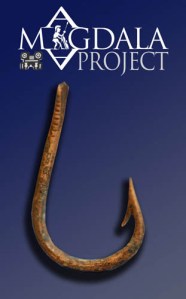
Fishhook from the 2008 Magdala Project dig.

Fish-hook from the 2008 Magdala Project dig.

The Magdala Project blog is giving some info on the current excavations at the site of Magdala on the west short of the Sea of Galilee. Reports include information on the first century synagogue, a 2006 preliminary report, and ship iconography as portrayed on mosaics of the first to third centuries AD.

Several nice photos are included on the blog including one of a fish-hook discovered  from the 2008 Magdala Project dig, and a stone anchor from the 2007 season.

The article by K. C. Hanson on “The Galilean Fishing Economy and the Jesus Tradition” is extremely helpful for those seeking to understand the role of the disciples of Jesus who were fishermen.

The photo of the fish-hook  provides a nice illustration of a text from Matthew 17:24-27.

When they came to Capernaum, the collectors of the two-drachma tax went up to Peter and said, “Does your teacher not pay the tax?” He said, “Yes.” And when he came into the house, Jesus spoke to him first, saying, “What do you think, Simon? From whom do kings of the earth take toll or tax? From their sons or from others?” And when he said, “From others,” Jesus said to him, “Then the sons are free. However, not to give offense to them, go to the sea and cast a hook and take the first fish that comes up, and when you open its mouth you will find a shekel. Take that and give it to them for me and for yourself.” (Matthew 17:24-27 ESV)

We have mentioned Magdala several times. Check here, and use the Search box for other references.

HT: Bible Places Blog

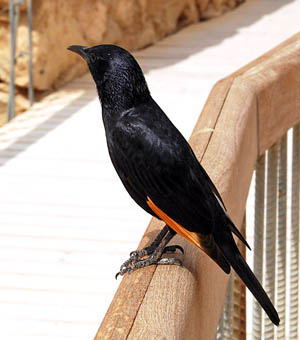
Tristram’s Grackle at Masada

Tristram's Grackle at Masada. Photo by Ferrell Jenkins.

Tristram's Grackle at Masada. Photo by Ferrell Jenkins.

Henry B. Tristram wrote The Natural History of the Bible in 1868. In 1884 he wrote Fauna and Flora of Palestine. I have not personally used his books, but I have seen numerous quotations from them in sources describing the plants, animals, and birds of Palestine.

A bird commonly seen at Masada, along the shore of the Dead Sea, is named for Tristram. This black bird with some distinctive orange feathers is known as Tristram’s Grackle, or Tristram’s Starling.

Thanksgiving Day – 2009

Oh give thanks to the LORD, for he is good, for his steadfast love endures forever! (Psalm 107:1 ESV)

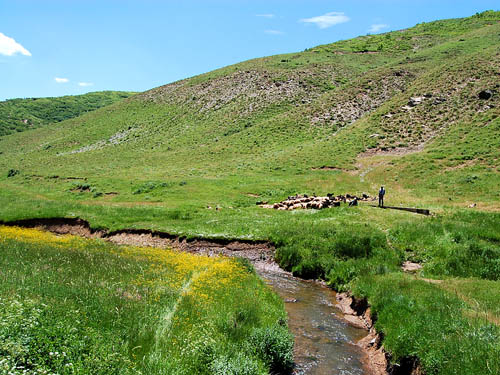
Shepherd with sheep in the Land of Ararat. Photo by Ferrell Jenkins.

Shepherd with sheep in the Land of Ararat. Photo by Ferrell Jenkins.

Jabbok River valley inhabited and irrigated for millennia

A recent report by Dutch researchers calls attention to the relation of the irrigation, especially that in the Zerqa River triangle of Jordan, to population and the nature of the communities.

You can make major discoveries by walking across a field and picking up every loose item you find. Dutch researcher Eva Kaptijn succeeded in discovering – based on 100,000 finds – that the Zerqa Valley in Jordan had been successively inhabited and irrigated for more than 13,000 years. But it was not just communities that built irrigation systems: the irrigation systems also built communities.

Archaeologist Eva Kaptijn has given up digging in favour of gathering. With her colleagues, she has been applying an intensive field exploration technique: 15 metres apart, the researchers would walk forward for 50 metres. On the outward leg, they’d pick up all the earthenware and, on the way back, all of the other material. This resulted in more than 100,000 finds, varying from about 13,000 years to just a few decades old. Based on further research on the finds and where they were located, Kaptijn succeeded in working out the extent of habitation in the Zerqa Valley in Jordan over the past millennia.

Read the longer report here.

The Zerqa River is known as the Jabbok in the Bible. It is probably best known as the place where Jacob met with Esau as he returned from Paddan Aram, and where his name was changed to Israel (Genesis 32).

The same night he arose and took his two wives, his two female servants, and his eleven children, and crossed the ford of the Jabbok. (Genesis 32:22 ESV)

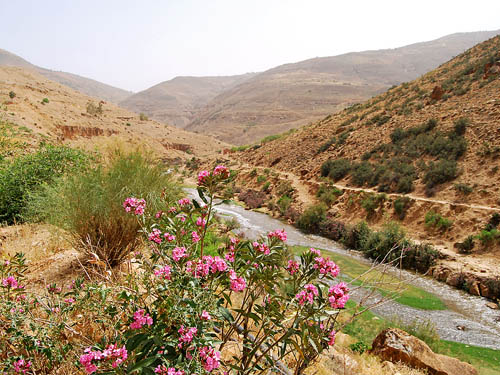
Jordan utilizes the water of the Jabbok (Zerqa) for irrigatation, especially in the Jordan Valley. This photo which I made last year shows the Jabbok a few miles from the Jordan Valley. The mountains are in the Biblical land of Gilead. Before the river reaches this point much of the water has been caught in reservoirs for use by the Jordanians.

The Jabbok (Zerqa) River near the Jordan Valley. Photo by Ferrell Jenkins.

The Jabbok (Zerqa) River near the Jordan Valley. Photo by Ferrell Jenkins.

HT: Biblical Paths.

Unique Archaeology Map of the West Bank and East Jerusalem

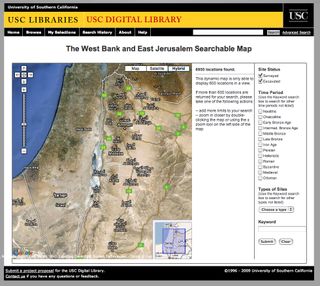
Suzanne Muchnic, of the Los Angeles Times, reports on a new online map that will be of interest to students of the archaeology of Palestine. Here is a portion of that report.

A searchable map detailing 40 years of Israeli archaeological work in the West Bank and East Jerusalem, developed for the USC Digital Library, has won the 2009 Open Archaeology Prize from the American Schools of Oriental Research.

Project leaders Lynn Swartz Dodd of USC and Rafi Greenberg of Tel Aviv University are expected to accept the award on behalf of an international team composed of Americans, Israelis and Palestinians.

The West Bank and East Jerusalem Digital Map

The digital map apparently won the approval of jurors because it offers a body of information previously unavailable to the public about sites surveyed or excavated since 1967, when Israel occupied the West Bank and East Jerusalem.

USC’s website is part of an effort to establish a framework for the disposition of the region’s cultural heritage in the event of a peace agreement between Israel and Palestine. Interactive satellite maps on the website show about 7,000 archaeological locales, including Shiloh, where the original tabernacle of the Hebrews is thought to have been located, and the Qumran caves, where the Dead Sea scrolls were found.

The public can access the West Bank and East Jerusalem Archaeology Database at http://digitallibrary.usc.edu/wbarc. Users must have Google Earth to get full use of the information.

Read the complete article in The Los Angeles Times. A UCLS news release may be read here.

This is a remarkable map. It includes only sites in the West Bank and East Jerusalem that have been surveyed or excavated. A search may be made by archaeological period, or by type: burial, cave, cistern, winepress, synagogue, mikveh, tell, etc.

I have added a link to this map on the Biblical Studies Info Page under Scholarly/Archaeology.

This video features Lynn Swartz Dodd and Ran Boytner discussing the importance of this project.

Earlier we reported here on the interactive map of the Dead Sea by A.D. Riddle and David Parker showing the history of change. We look forward to more material of this sort in the years to come as scholars make their information available to the wider public.

HT: Joseph Lauer.

Missing the professional meetings in New Orleans

Normally I would have been in attendance at some of the annual professional meetings being held this year in New Orleans. I have another extended trip planned in December and thought it best not to try to afford to attend the professional meetings. I am speaking of the ETS, NEAS, SBL, and the ASOR meetings.

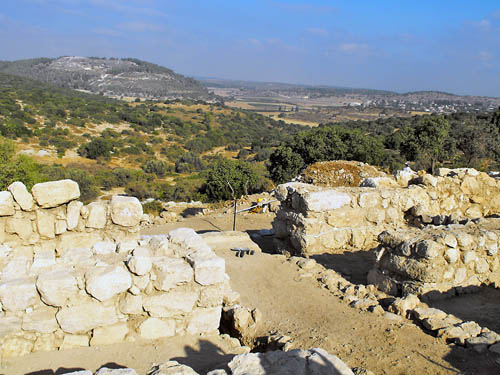
There will be a lot of good reports coming from these meetings in some of the other blogs. Earlier in the year we reported on our friend Luke Chandler who was working in the excavation at Khirbet Queifaya, a site that overlooks the Valley of Elah, and possible associated with the account of David and Goliath in 1 Samuel 17. Luke has been attending the ASOR (American Schools of Oriental Research) meetings. We are not surprised that he reports first on the sessions devoted to Khirbet Queifaya. He provides a summary of the sessions here. Thanks, Luke.

View from Khirbet Queifaya toward Azekah. Photo by Luke Chandler.

View from Khirbet Queifaya toward Azekah. Photo by Luke Chandler.

Earthquakes still a problem in the Middle East

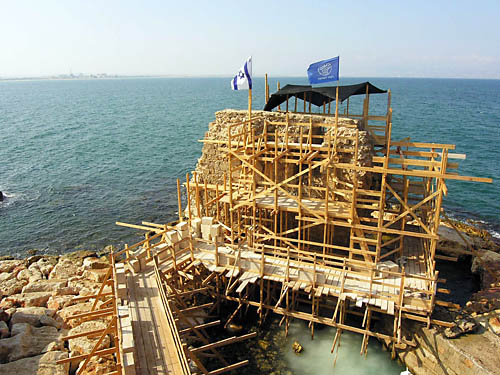
The Israel Antiquities Authority and the National Commission for UNESCO say that “Heritage sites in Israel are in danger of being destroyed in the event of natural disasters.” The meeting of international experts took place in the Crusader fortress at Akko.

Jerusalem, Masada, Caesarea … are they here to stay? The Israel Antiquities Authority and the Israel National Commission for UNESCO (the United Nations Education, Scientific and Cultural Organization) have warned today (Wednesday) that the heritage sites in Israel are at risk of destruction in the event of natural disasters and being vandalized by man.

Not only Israel, but Jordanian sites such as Petra are in danger of earthquake damage. Other sites in Israel, such as Ashkelon and Caesarea, are in danger of erosion and collapse. Then, there is always the problem of vandalism.

Repairing the wall of the Crusader Fortress at Akko. Photo: IAA.

Fortifying the wall of the Crusader Fortress at Akko. Photo: IAA.

The complete report may be read here. The report included this photo showing repair being made on the walls of Akko.

Akko (or Acre) is known in the many English versions of the Bible as Acco (Judges 1:31). In New Testament (Roman) times the city was call Ptolemais (Acts 21:7).

The Great Rift runs all the way from northern Syria through Lebanon, Israel, the Arabah, and into eastern Africa. In Israel the area is called the Jordan Valley or the Dead Sea Rift, It is not surprising that earthquakes are mentioned frequently in the Bible. The prophet Amos dates his visions to “two years before the earthquake” (Amos 1:1). The earthquake he makes reference to must have been so memorable that everyone would know what he was talking about. Zechariah (14:5) also calls attention to this earthquake in the days of Uzziah king of Judah.

Jesus, in predicting the fall of Jerusalem to the Romans, said, “and in various places there will be famines and earthquakes” (Matthew 24:7; see Luke 21:11).

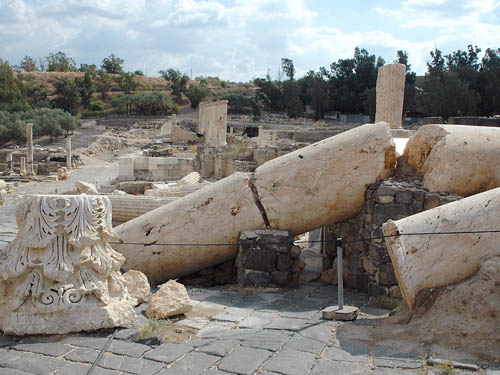
We have a wonderful example of the power of an earthquake in the Jordan Valley at the site of Bethshan [Bet-she’an, Beth-shean], about 25 miles south of the Sea of Galilee. The city was destroyed by an earthquake in A.D. 749. This photo shows the evidence brought to light during recent archaeological excavations in the city.

Earthquake damage at Beth-shean in the Jordan Valley. Photo by Ferrell Jenkins.

Earthquake damage at Beth-shean in the Jordan Valley. Photo by Ferrell Jenkins.

HT: Joseph I. Lauer

Bible Mapper — Version 4 now available

Several times, including here, I have called attention to David Barrett’s Bible Mapper program. Version 3 remains a free program, but Barrett has now published version 4. The cost is $37. The web site describes Bible Mapper in these words,

Bible Mapper is a fully interactive, highly accurate Bible mapping system that helps you quickly and easily create customized maps of the Holy Lands or study a particular period and aspect of Bible history.

Based on my limited use of Version 3 I will say that the learning curve is fairly high, but the result can be gratifying. I have made several maps to teach specific portions of scripture, or the movement of certain characters.

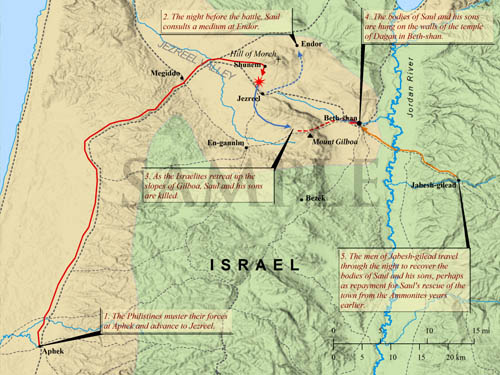
There are many new features in version 4, including a gallery of 35 ready made maps. Take a look at the gallery when you check the web page. Complete information is available here. The map below is a reduced one from the gallery. The sample maps in the gallery are full size, but they all have the word SAMPLE on them — until you buy the registration key and unlock them on your computer. The 35 maps, even without the program, is worth the $37 it will cost you.

The Battle at Mount Gilboa. Bible Mapper.com.

The Battle at Mount Gilboa. Bible Mapper.com.

The maps in the ESV Study Bible were made with Bible Mapper.

HT: Todd Bolen, Bible Places Blog.