Yearly Archives: 2012

Acts 17 — Photo Illustrations

Paul came to Thessalonica on his second journey (A.D. 50-53; Acts 17).

Now when they had passed through Amphipolis and Apollonia, they came to Thessalonica, where there was a synagogue of the Jews. (Acts 17:1 ESV)

Thessalonica (called Thessaloniki now) is in biblical Macedonia. The area is still known as Macedonia, but is not to be confused with the modern country by that name. It is marked on maps of Greece as FYROM (former Yugoslav Republic of Macedonia). I know too little about the dispute to make any comments.

Paul wrote two letters to the church at Thessalonica while he was at Corinth. Aristarchus, a Macedonian of Thessalonica accompanied Paul on the voyage to Rome (Acts 27:2). When Demas forsook Paul he went to Thessalonica (2 Timothy 4:10).

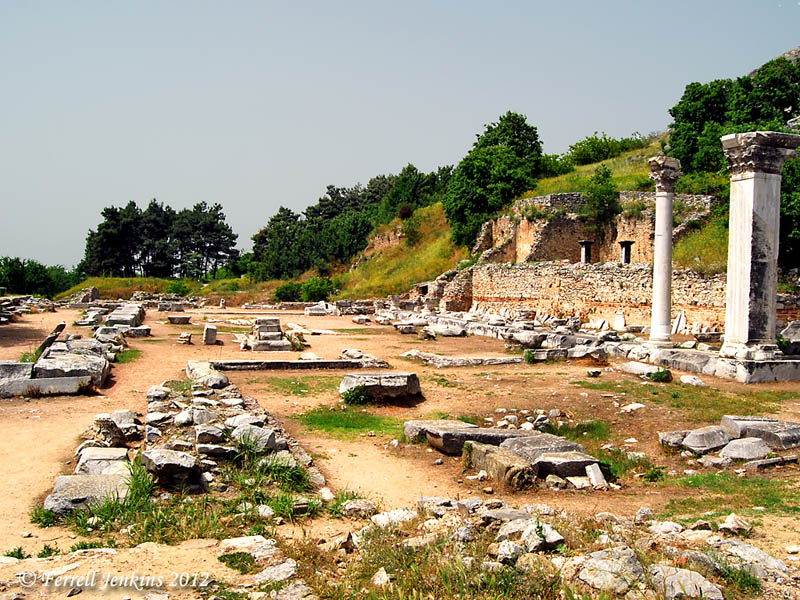
The photo below shows excavated ruins of the 2nd-3rd century A.D. Roman Forum in the center of the modern city of Thessalonica. Fant and Reddish comment on the Forum:

Extensive, ongoing excavations are being conducted in this area. Likely the same site was the location for the Hellenistic agora as well. The forum originally covered two extensive terraces. The forum originally covered two extensive terraces. The one to the north contained a large courtyard surrounded on four sides by two-story stoas; to the rear of the stoa on the east side stood the odeion, originally a theater for music and performances, later converted into an arena for gladiatorial contests. (A Guide to Biblical Sites in Greece and Turkey, 137).
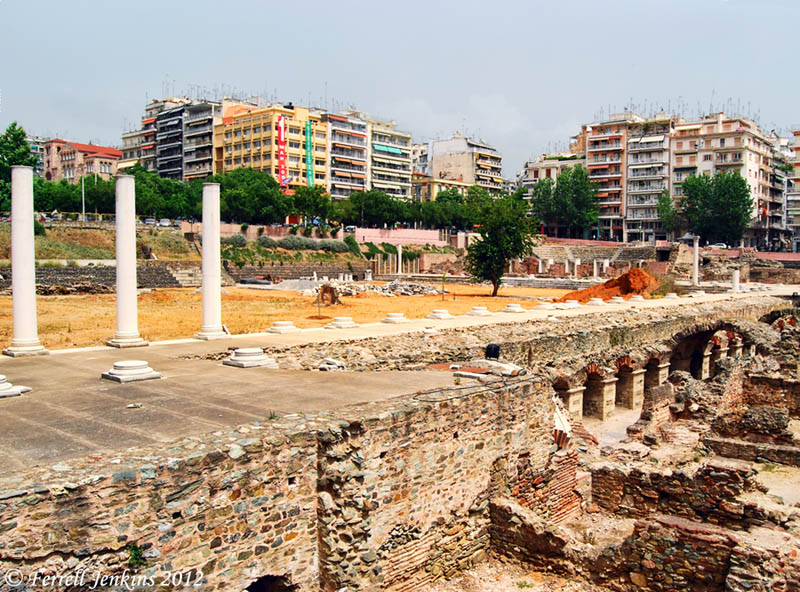
Roman forum in the center of Thessalonica. Photo by Ferrell Jenkins.

Roman Forum in the center of Thessalonica. Photo by Ferrell Jenkins.

I think if you click on the photo to enlarge it, you will see the odeion to the right of the image.

There are several posts about Thessalonica on this blog. Just put the word Thessalonica in the Search Box. You will also find posts about Amphipolis, Berea, and Athens.
New discoveries at Paphos, Cyprus

The Cyprus Mail reports the results of archaeological work in the agora at ancient Paphos, Cyprus, by the Institute of Archaeology of the Jagiellonian University, Kraków, Poland.

One of the significant discoveries during the August/September excavations was a small tablet with the name of an official on it in the Greek language. According to the article, the Greek inscription reads,

Seleukos, son of Agoranomos (market administrator) Ioulios Bathylos.

Architectural remains from the Roman period were also uncovered in the same area as the Greek inscription.

The short article maybe read here.

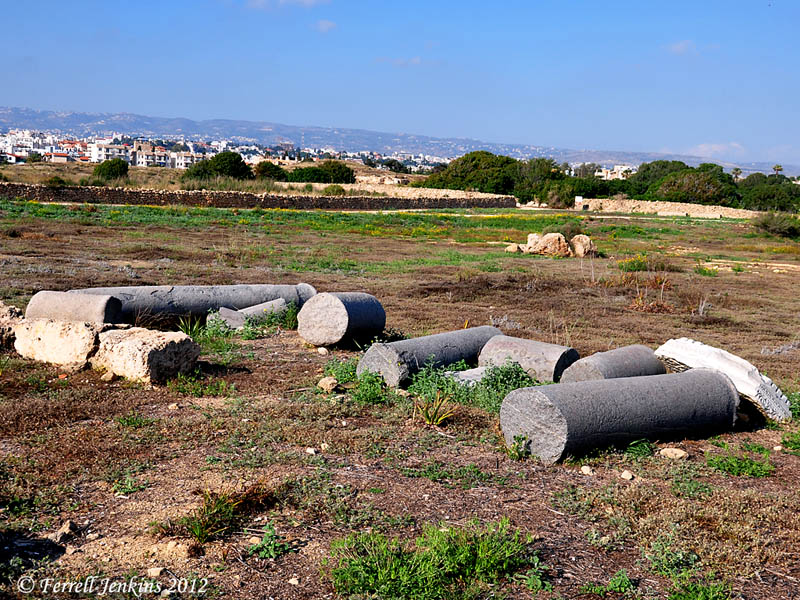
The photo below shows a few fallen columns in the mostly unexcavated agora in mid-May, 2012.

Ancient agora at Paphos, Cyprus. Photo by Ferrell Jenkins.

Ancient agora at Paphos, Cyprus. Photo by Ferrell Jenkins.

Barnabas, Saul, and John Mark arrived at Paphos after crossing the length of the island of Cyprus on the first missionary journey. It was here that Saul’s name was changed to Paul.

 6 When they had gone through the whole island as far as Paphos, they came upon a certain magician, a Jewish false prophet named Bar-Jesus.
7 He was with the proconsul, Sergius Paulus, a man of intelligence, who summoned Barnabas and Saul and sought to hear the word of God.
8 But Elymas the magician (for that is the meaning of his name) opposed them, seeking to turn the proconsul away from the faith.
9 But Saul, who was also called Paul, filled with the Holy Spirit, looked intently at him
10 and said, “You son of the devil, you enemy of all righteousness, full of all deceit and villainy, will you not stop making crooked the straight paths of the Lord?
11 And now, behold, the hand of the Lord is upon you, and you will be blind and unable to see the sun for a time.” Immediately mist and darkness fell upon him, and he went about seeking people to lead him by the hand.
12 Then the proconsul believed, when he saw what had occurred, for he was astonished at the teaching of the Lord. (Acts 13:6-12 ESV)

HT: Jack Sasson

Visiting the Lynn H. Wood Archaeological Museum

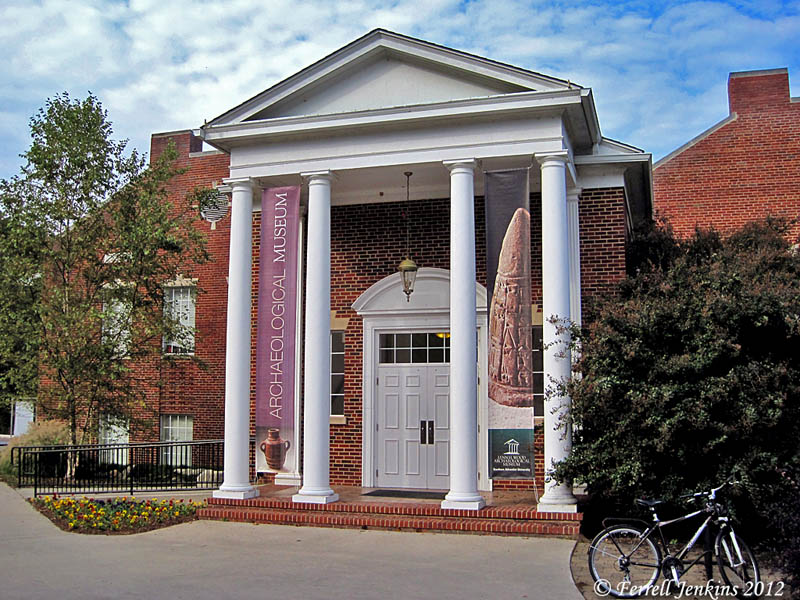
You might never expect to find an excellent archaeological museum nearly hidden in the woods of eastern Tennessee. But that is what you will find at the Lynn H. Wood Archaeological Museum on the campus of  Southern Adventist University in Collegedale, Tennessee.

When we arrived on campus we asked a student the location of the Museum. After walking up a long series of steps that some students were skipping up (ah, youth!), we asked two other students. Each of them offered to show us. And, neither had been to the Museum. Everyone on campus that we spoke with was friendly and helpful.

Inside Hackman Hall is housed a wonderful educational exhibit.

The Lynn H. Wood Archaeological Museum is located in this building.

The Lynn H. Wood Archaeological Museum is located in this building.

A few years ago William G. Dever gave his research library of nearly 3000 volumes and a large collection of archaeological artifacts to Southern. The artifacts are built into an award-winning exhibition under the title Vessels in Time: A Journey Into the Biblical World. Archaeology Professor Dr. Michael G. Hasel serves as curator of the Museum.

Iron Age IIA (1000-900 B.C.) Pottery in the Lynn H. Wood Museum.

Iron Age IIA (1000-900 B.C.) Pottery in the Lynn H. Wood Museum.

The exhibits follow a chronological order from the early days in Mesopotamia to New Testament times.  Each display has a good timeline which coordinates the archaeological periods with the Biblical record. The photo above shows some pottery from the Iron Age IIA (1000-900 B.C.). This is the period of the United Kingdom (or Monarchy). The bowl on the left has been slipped and shinned. The accompanying information explains that during this period vessels were sometimes dipped “into red watery clay” to create the colored slip. The bowl was then hand burnished with a stone like the one shown above it.

Three examples of dipper juglets from the period are shown:

  1. A Phoenician import.
  2. A simple local juglet.
  3. A black-slipped, burnished juglet.

There is a nice model of Solomon’s Temple in the same room.

If your travels take you anywhere near Chattanooga, Tennessee, I suggest you take time to drive a few miles east to Collegedale and visit the Lynn H. Wood Archaeological Museum.

Full information about the Museum including visiting hours may be found here.

Beauties and Perils of Travel in the Fall

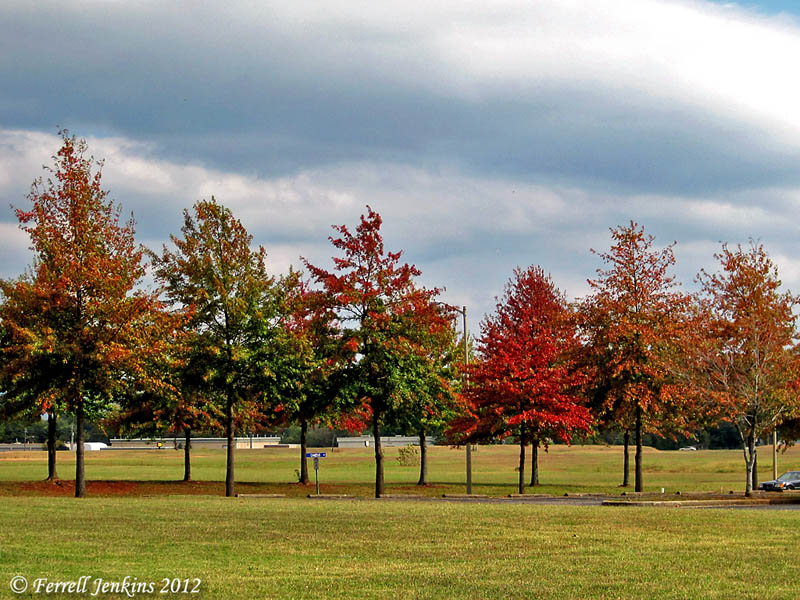
The leaves have only begun to change in North Alabama, but they are beautiful to a Florida transplant of more than four decades.

Fall Leaves in North Alabama. Photo by Ferrell Jenkins.

Fall Leaves in North Alabama. Photo by Ferrell Jenkins.

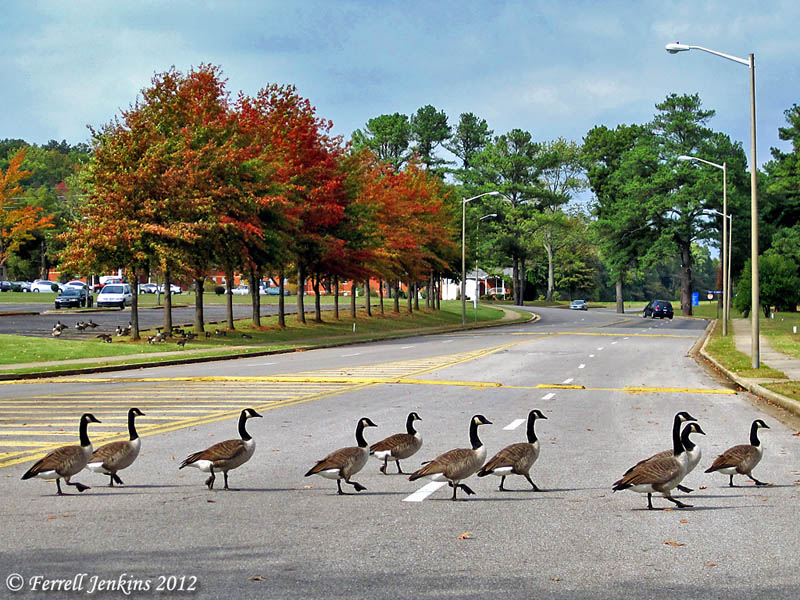
There are perils of driving at this time of the year. I am not a bird watcher, but I do watch for geese crossing the street. The best I can tell, from a few minutes on the Internet, these are Canadian Geese.

Geese in North Alabama. Photo by Ferrell Jenkins.

Geese in North Alabama. Photo by Ferrell Jenkins.

Fall of the year

During a break between two speaking engagements, we visited some of our family in Scottsville, Kentucky. Leaves were already showing some color, and the pleasant afternoon was perfect to visit the town square to see some of the decorations for the Fall Festival.

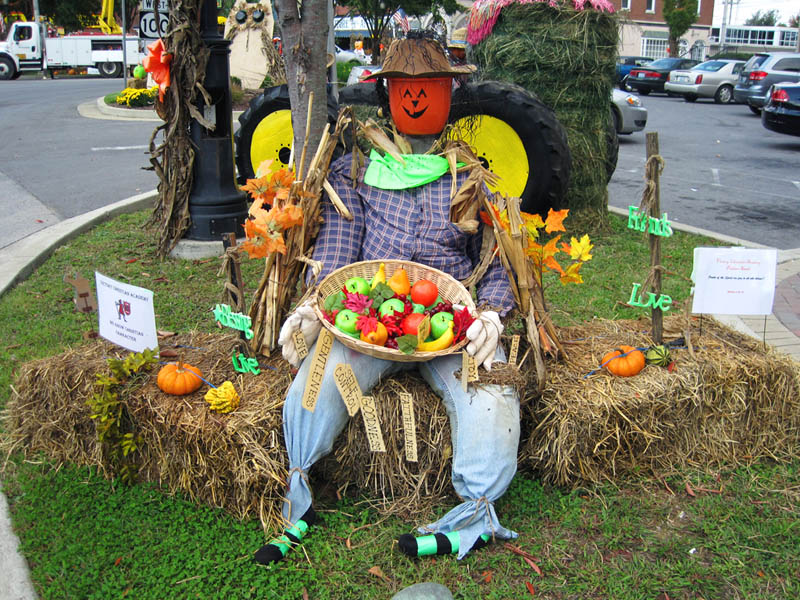
I was pleased to see some wholesome decorations, like this one from a local school emphasizing the fruit of the spirit (Galatians 5).

Fall Festival at Scottsville, Kentucky. Photo by Ferrell Jenkins.

Fall Festival at Scottsville, Kentucky. Photo by Ferrell Jenkins.

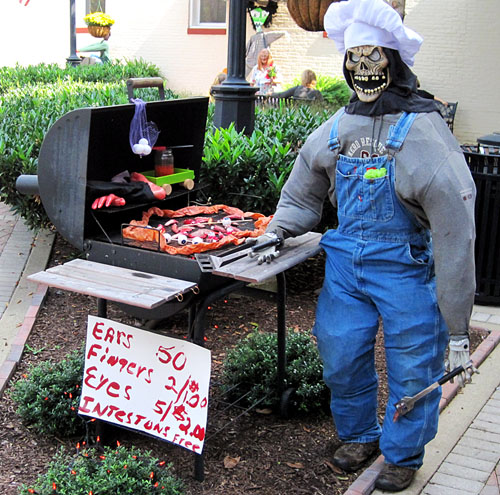
A few of the displays were definitely geared toward Halloween.

Fall Festival at Scottsville, Kentucky. Photo by Ferrell Jenkins.

Fall Festival at Scottsville, Kentucky. Photo by Ferrell Jenkins.

I trust you are enjoying a nice Fall of the year, wherever you may be.

Acts 16 — Photo Illustrations (corrected)

What is the best way to correct a blunder? Shall I totally delete the post and start anew, or shall I edit the existing one? I decided to leave the existing one for the time being and post the correction here.

Forum/Agora. One reader suggests that I have incorrectly identified the forum at Philippi as the agora. Some sources indicate that the forum was primarily used for civic or judicial matters while the agora was considered the commercial center or market place.

My intention was to use both words because they are often used interchangeably. At Philippi, Corinth, and other places, these activities are not far removed from each other. In fact, the Forum at Philippi, and the Agora at Corinth contain a Bema (judgment seat) as well as numerous commercial shops.

I am not at home and do not have access to some of the sources I might normally use to check these things, but I have access to some dictionaries online.

The American Heritage Dictionary gives this definition for forum:

The public square or marketplace of an ancient Roman city that was the assembly place for judicial activity and public business.

The Compact Oxford English Dictionary defines the forum…

(in an ancient Roman city) a public square or marketplace used for judicial and other business.

The Wrong Photo. But my serious blunder was in the photo I labeled as the forum/agora. After publishing it I began to think I had uploaded the wrong photo. A friend has written privately to remind me that I have posted a photo of one of the basilicas at Philippi rather than the forum. I plead guilty. My oversight.

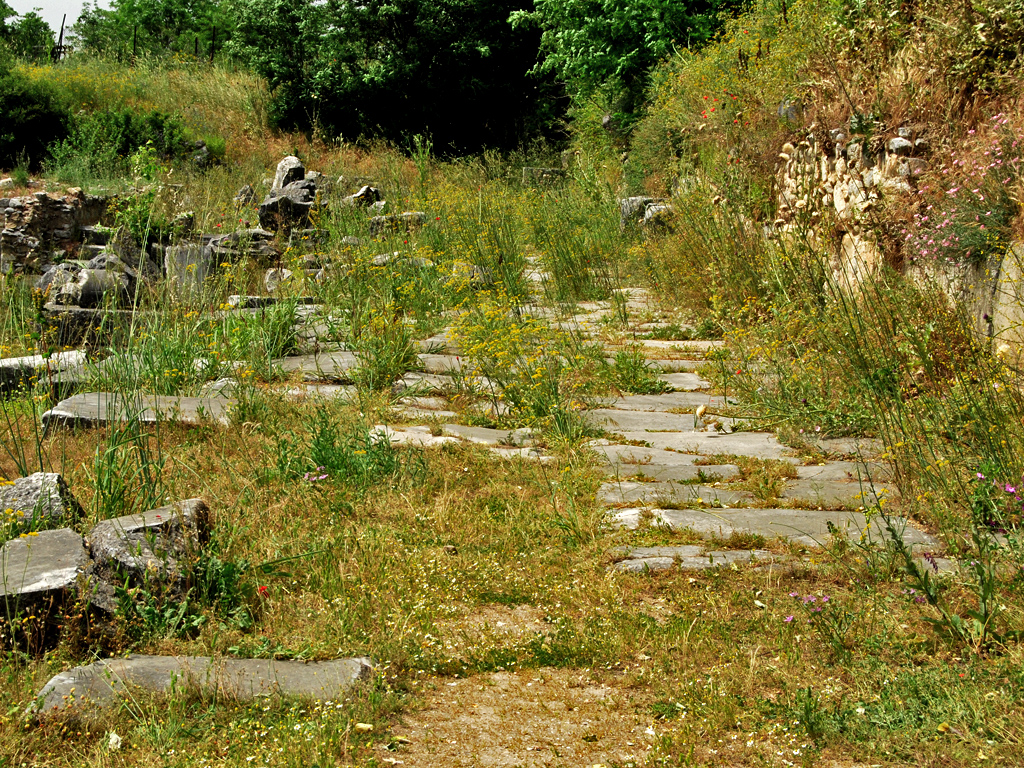
Here is a photo of a portion of the Via Egnatia (the Egnatian Way) in the forum at Philippi. Much of it is covered by several feet of earth. The modern road runs above the ancient one.

A portion of the Via Egnatia in the Forum at Philippi. Photo by Ferrell Jenkins.

A portion of the Via Egnatia in the Forum at Philippi. Photo by Ferrell Jenkins.

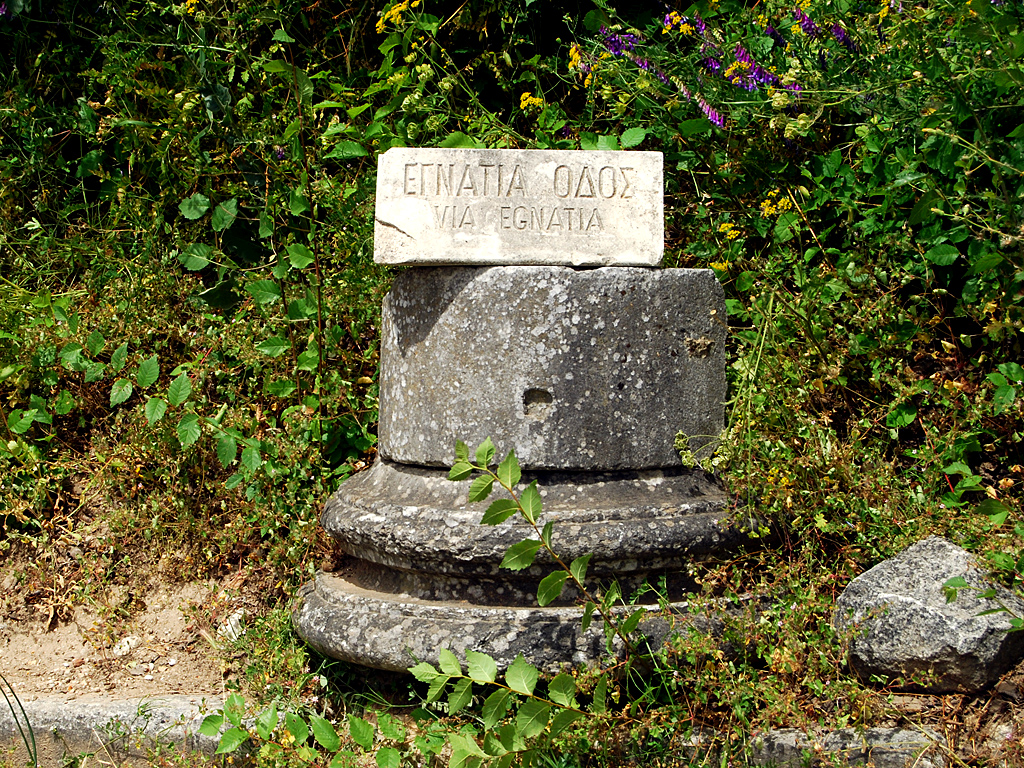
The next photo shows a sign that once sat on the road.

Identifying the Via Egnatia in the Forum at Philippi. Photo by Ferrell Jenkins.

Identifying the Via Egnatia in the Forum at Philippi. Photo by Ferrell Jenkins.

Perhaps later I will post a photo of some of the shops in the forum.

Acts 16 — Photo Illustrations

The Apostle Paul came to Philippi on his second preaching journey. Luke accurately describes the city with these words:

So putting out to sea from Troas, we ran a straight course to Samothrace, and on the day following to Neapolis; and from there to Philippi, which is a leading city of the district of Macedonia, a Roman colony; and we were staying in this city for some days. (Act 16:11-12 NAU)

The photo below shows ruins of the forum (or agora) of the city where much of the activity took place. Portions of the famous Egnatian Way may be seen at the edge of the forum, but partially buried under the earth and modern road on the right. [See correction here.]

Forum of Philippi. Photo by Ferrell Jenkins.

The Forum (Agora) of Philippi. Photo by Ferrell Jenkins.

At Philippi, Paul preached to and baptized Lydia and her household, and the jailer.

Wallace: Fifteen Myths about Bible Translation

Prof. Daniel B. Wallace discusses “Fifteen Myths about Bible Translation.” Wallace is a well known and respected scholar dealing with issues pertaining to the Greek language and Textual Criticism.

Wallace says,

Perhaps the number one myth about Bible translation is that a word-for-word translation is the best kind.

Whatever your current level of knowledge about Bible translations, you are sure to learn something from these “Fifteen Myths” even if you don’t agree with all of them.

Read the full article here.

HT: BibleX

6 year old palm from 2000 year old seed

A few date palm seed were uncovered by Professor Yigael Yadin during his excavation of Masada. Six years ago one of these seed was planted at the Arava Institute in Israel. The seed sprouted, and has grown into a nice little six year old palm.

Yishai Fleisher of EyeOnZionTV interviews Dr. Elaine Solowey at the Arava Institue about this seed and plant. In addition to the information about the palm, I especially like the way Dr. Solowey refuses to fall for some of the speculative journalistic questions.

The photo below shows one of the modern date palms on the southwestern shore of the Sea of Galilee.

Date Palm growing near the Sea of Galilee. Photo by Ferrell Jenkins.

Date Palm growing near the Sea of Galilee. Photo by Ferrell Jenkins.

Jericho is mentioned as “the city of palm trees” in Deuteronomy 34:3.

The righteous are compared to the palm tree.

The righteous flourish like the palm tree and grow like a cedar in Lebanon. (Psalm 92:12 ESV)

HT: Jack Sasson

Acts 15 — Photo Illustrations

James, the Lord’s brother, is one of the prominent characters in Acts 15. In fact, Paul later refers to the events of Acts 15, and speaks of James, Cephas,and John.

and when James, Cephas, and John, who had a reputation as pillars, recognized the grace that had been given to me, they gave to Barnabas and me the right hand of fellowship, agreeing that we would go to the Gentiles and they to the circumcised.  (Galatians 2:9 NET)

In the Armenian Quarter of the Old City of Jerusalem we find the Cathedral of St. James. Murphy-O’Connor says,

Facts and legend are juxtaposed as casually as are artistic creations of different talents and periods. The church is dedicated to St. James the Great, son of Zebedee, who was executed by king Herod Agrippa I in 44 (Acts 12:1-3).

But the building also claims to hold the “patriarchal throne of St James the Less, the brother of the Lord…” (Murphy-O’Connor). This is the James of Acts 15. (It is sometimes difficult for readers to keep all of those named James, John, and Mary, separate when reading the New Testament — not to mention Herod.)

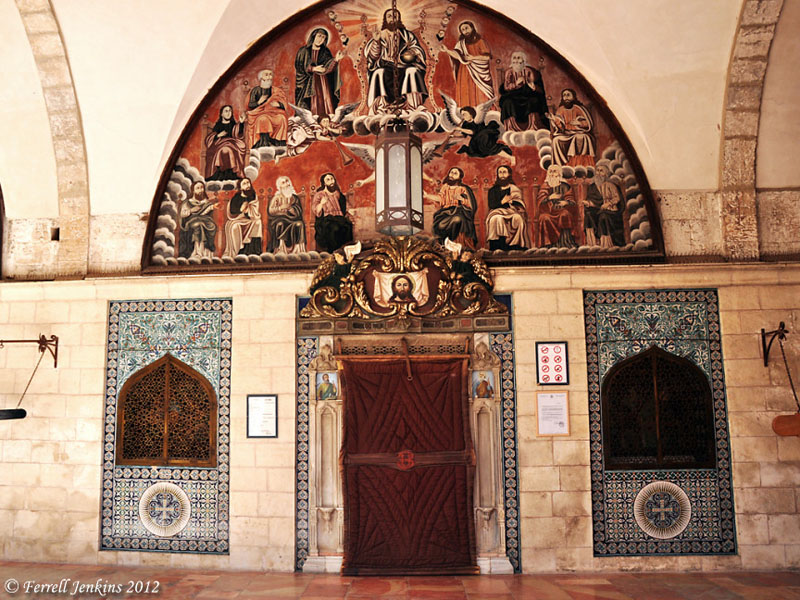
Photos were not allowed inside the building when I was there to observe a service. This photo shows the entrance to the Cathedral.

Entrance to St. James Cathedral in the Armenian Quarter of Jerusalem. Photo by Ferrell Jenkins.

Entrance to St. James Cathedral in the Armenian Quarter. Photo by Ferrell Jenkins.

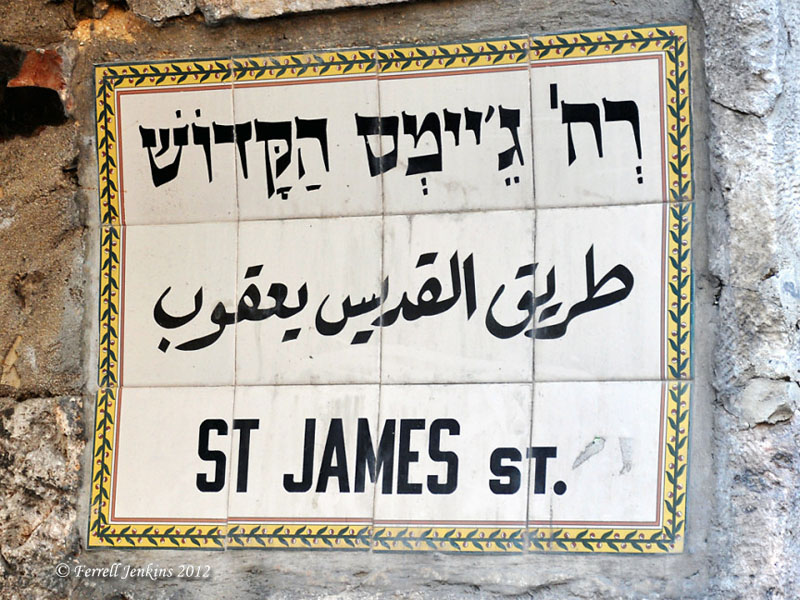
In one of the quietest places in the Old City one comes upon St. James Street.

St. James Street in the Armenian Quarter. Photo by Ferrell Jenkins.

St. James Street in the Armenian Quarter. Photo by Ferrell Jenkins.

Other names of interest in the Armenian Quarter include St. Mark’s Street and Ararat Street. A century ago the Armenians had a large presence in eastern Turkey, where the Mountains of Ararat are located.