Yearly Archives: 2012

Turkey wants British Museum to return sculptures from the Mausoleum of Halicarnassus

According to an article in The Guardian (here), the town of Bodrum in Southwest Turkey wants the British Museum to return several priceless sculptures once associated with the Mausoleum of Halicarnassus in the 4th century B.C.

Human rights legislation that has overturned the convictions of terrorists and rapists could now rob the British Museum of sculptures created for one of the seven wonders of the ancient world.

A Turkish challenge in the European court of human rights will be a test case for the repatriation of art from one nation to another, a potential disaster for the world’s museums.

Halicarnassus is where Mausolus built a gigantic tomb in honor of himself. Leon Mauldin and I visited the site earlier in the year. You may read about our visit (with photos) here. It became known as one of the Seven Wonders of the Ancient World.

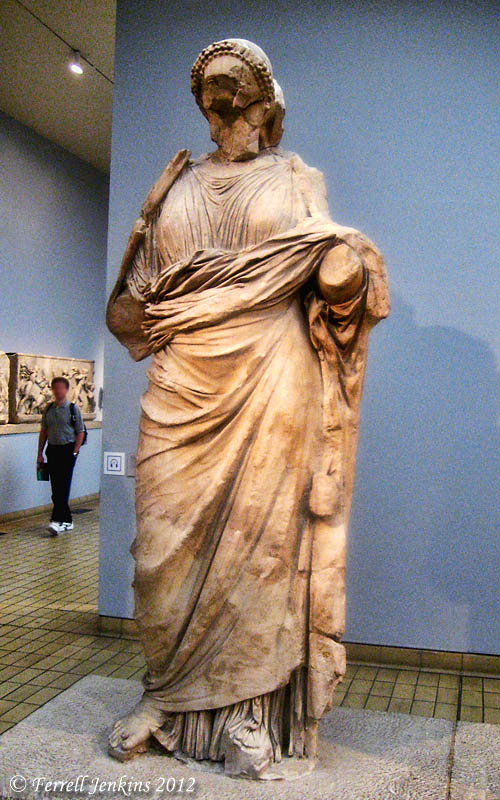
Two of the sculptures that the town of Bodrum wants returned are through to be of Mausolus and Artemisia, his wife. Here is a photo of the marble statue thought to be Mausolus.

Statue of Mausolus in British Museum. Photo by Ferrell Jenkins.

Statue of Mausolus in British Museum. Photo by Ferrell Jenkins.

The next statue is usually identified as Artemisia, wife of Mausolus.

Statues from the Mausoleum of Maussollos - Marble, About 350 B.C

Statue from Halicarnassus, usually identified as Artemisia, the wife of Mausolos. Photo by Ferrell Jenkins.

Another reason to visit the British Museum soon, or Turkey later.

HT: Jack Sasson

A new study guide for those who wish to understand the overall picture of the Bible

How do we deal with the problem of the person who does not know very much about the Bible and gets lost in some of our classes? I recall one time teaching Romans in a church class. I think we were already in chapter 11. A visitor came to the class. Toward the end of the class when I was entertaining questions, the visitor spoke up saying, “I don’t have any idea what you are talking about.” I sympathized with him and mentioned that we had set the stage for the current class over a period of months.

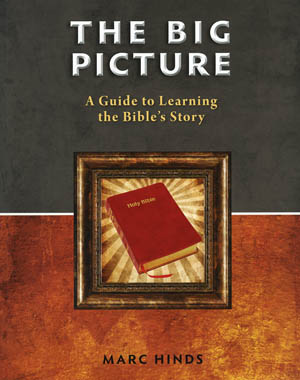
Marc Hinds, a former student of mine at Florida College, understands that many students need a general survey of the Bible. He has provided a solution for this problem in his newly published book by 21st Century Christian. The full name, The Big Picture: A Guide to Learning the Bible’s Story, explains what he is trying to do with this book. The book is suitable for classes of beginners or more advanced learners who haven’t yet understood the overall picture of the Bible.

The Big Picture, by Marc Hinds.

The Big Picture, by Marc Hinds.

In this book of 15 lessons, you will find a brief survey of both the Old Testament and the New Testament. The book is printed in full color with many illustrations, photographs, and maps drawn (by Marc) specifically to illustrate the lesson. This book will be suitable for church classes, or individual home study.

The book may be ordered from 21st Century Christian, other bookstores, or Amazon here: The Big Picture: A Guide to Learning the Bible’s Story.

Limited time bargain on a great Bible atlas

Christianbook.com is offering Carl Rasmussen’s Zondervan Atlas of the Bible for a limited time at the unusual price of $14.99. Click here.

zondervanatlascover01

I can’t promise that it will still be available by the time I get this posted, but you can try.

Update Noon  12-04-12:  I see the price is now $19.99. If you have a a Prime account with Amazon (postage free), or wish to add another item, the price may be better at $22.73 for Zondervan Atlas of the Bible.

This Atlas is an extremely good one. It is well written, accurate, colorful, filled with great photos and helpful maps. Earlier this evening I emailed a notice to folks who have traveled with me recently, or who plan to, with this note:

This is an excellent book for anyone planning a tour to Israel, or anyone who has been. It should be one of your most helpful Bible study tools.

One of the ladies who traveled to Israel earlier this year replied with this note:

That is a great price. I got one before we went. I use it daily as I read and it sure brings the scriptures alive. It is much more so now that we have seen the country.

Acts 25 — Photo Illustrations — Coins of the Rulers

We continue our look at the three chapters describing Paul’s stay at Caesarea Maritima — Acts 24-26. Three civil rulers are mentioned in these chapters. They are known not only from Luke’s account, but in the writings of Josephus.

Rapske says that Caesarea “was the administrative seat of the Roman procurators of Palestine.” He adds that in the time of the Flavians it became a Roman Colony (The Book of Acts in its First Century Setting; Vol. 3, The Book of Acts and Paul in Roman Custody, 155).

After the Romans occupied “Palestine” the Jews had both a religious and a secular tax to pay. The procurators (prefects) were responsible for collecting the taxes for Rome. Coins were minted by various procurators, including Felix and Festus. I have chosen one example from each to show the type of coin current in their time.

Antonius Felix — A.D. 52-59.

Felix is described as a hegemon in the Greek New Testament. Major English versions use the term governor (Acts 23:24, 26; 24:2, 22, 24, 25, 27; 25:14). Hemer says that hegemon is a general word to describe a ruler, “the formal Latin title of these governors of Judaea being procurator or praefectus” (The Book of Acts, 128).

The obverse (head) of the coin of Felix shows two oblong shields and two spears. The inscription is translated “Nero Claudius Caesar–son of Claudius. The reverse (tail) shows a “six-branched palm tree bearing two bunches of dates” with a Greek inscription above and below (Hendin, Guide to Biblical Coins (1987), 117).
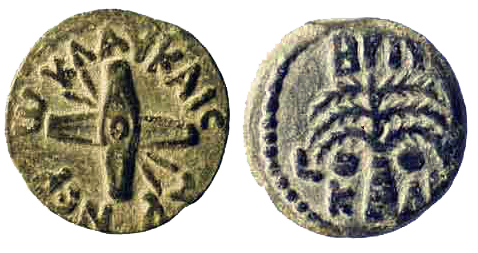
Coin of Roman Procurator Felix.

Coin of Roman Procurator Felix.

Porcius Festus — A.D. 59-61.

Porcius Festus followed Felix as governor or procurator. He is mentioned in each of the three chapters we are discussing. Paul had been left in custody by Felix, and Festus seems to be pleased to get the advice of King Agrippa when he visited Caesarea.

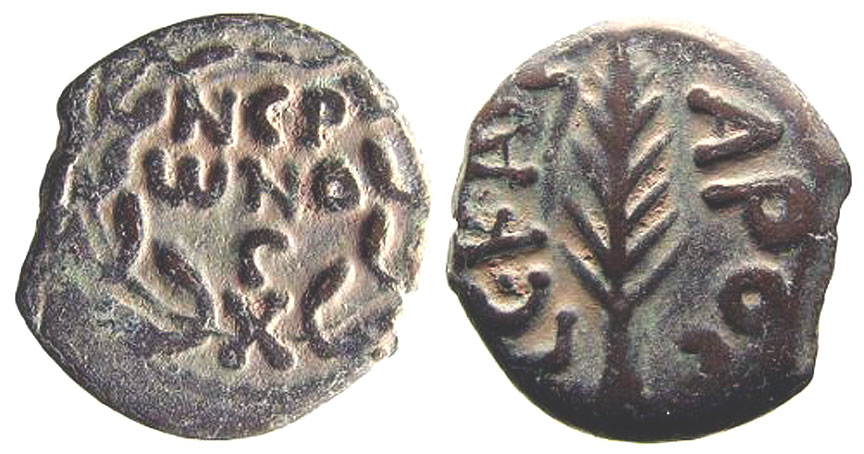
The coin of Festus, struck in A.D. 58, bears a Greek inscription within a wreath on the obverse. At the bottom is an X. The inscription reads NER ONO C (Nero). The reverse shows a palm branch with a Greek inscripton KAIC APOC (Caesar). The date LE means year five (Hendin, 118).
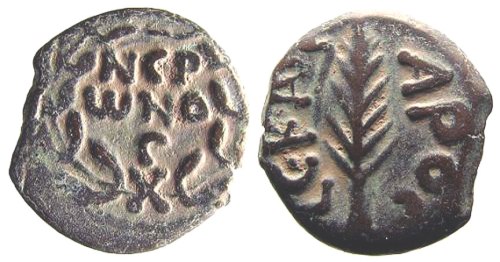
Coin of Porcius Festus.

Coin of Roman Procurator Porcius Festus.

Herod Agrippa II — A.D. 48-70.

Herod Agrippa II was the son of Herod Agrippa I, the grandson of Herod the Great (Acts 12:1, et al.). Agrippa II was the tetrarch of Chalcis and of northern territories. Chalcis was the small but beautiful territory between the Lebanon and Antilebanon mountains. Later he was granted the territories that had been controlled by Philip and Lysanias. Agrippa lived until the end of the first century, and minted coins even to the time of the Roman Emperor Domitian (A.D. 81-96).

According to Hendin, the obverse shows a laureate bust of Domitian facing right. The inscription around it reads DOMITIAMOC KAICAP (Domitian Caesar). The reverse shows Nike standing right. One foot is resting on a helmet. She is writing on a shield that is resting on her knee. The inscription reads ETO KZBA AΓPIΠΠA (Year 27 of King Agrippa). The coin was struck in A.D. 83. (I do not know how best to harmonize the dates associated with the reign of Agrippa II.)
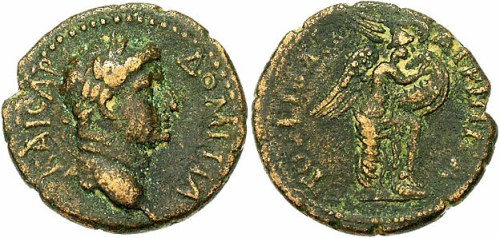
Coin of Herod Agrippa II with image of Domitian. Struck A.D. 83.

The coin above is copied from FORVM ANCIENT COINS.


I have only the original edition of Hendin’s Guide to Biblical Coins, but recommend the newer fifth edition of his book in the event that you have a genuine interest in Biblical coins. From my limited collecting experience, I can say that it is both fascinating and educational.

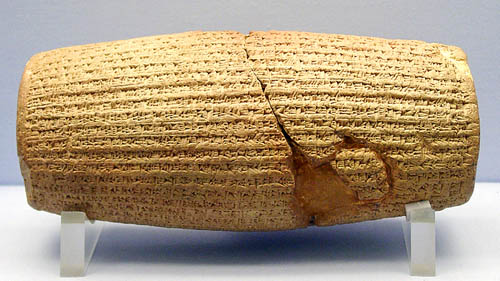
Cyrus Cylinder scheduled for a U.S.A. tour

The British Museum announces that the Cyrus Cylinder will tour to five major U.S.A. museums in 2013. Plan your vacation how.

The Cylinder will travel with an exhibition of sixteen objects under the title ‘The Cyrus Cylinder in Ancient Persia’. The exhibition shows the innovations initiated by Persian rule in the Ancient Near East (550 BC-331 BC). The Persian Empire was then the largest the world had known. It had a huge impact on the ancient world, introducing changes in terms of ethical behaviour as witnessed in the proclamation on the Cyrus Cylinder.
For more information see Artdaily here. A nice photo of the Cylinder is included.

The Cyrus Cylinder is important to Bible students because Cyrus is the Persian king who allowed the Judeans to return to Jerusalem and rebuild the temple.

Now in the first year of Cyrus king of Persia, that the word of the LORD by the mouth of Jeremiah might be fulfilled, the LORD stirred up the spirit of Cyrus king of Persia, so that he made a proclamation throughout all his kingdom and also put it in writing:  “Thus says Cyrus king of Persia, ‘The LORD, the God of heaven, has given me all the kingdoms of the earth, and he has charged me to build him a house at Jerusalem, which is in Judah. Whoever is among you of all his people, may the LORD his God be with him. Let him go up.'” (2 Chronicles 36:22-23 ESV; cf. Ezra 1:1-4).
Cyrus Cylinder.

Cyrus Cylinder in the British Museum. Photo by Ferrell Jenkins.

The U.S.A. schedule is as follows:
  • Smithsonian’s Arthur M. Sackler Gallery and Freer Gallery of Art, Washington D.C., 9th March – 28th April 2013
  • Museum of Fine Arts, Houston, 3rd May – 14th June 2013
  • The Metropolitan Museum of Art, New York 20th June – 4th August 2013
  • Asian Art Museum, San Francisco, 9th August – 22nd September 2013
  • J. Paul Getty Museum at the Getty Villa, Los Angeles, 2nd October – 2nd December 2013
HT: Jack Sasson

Maintaining control of a tour group

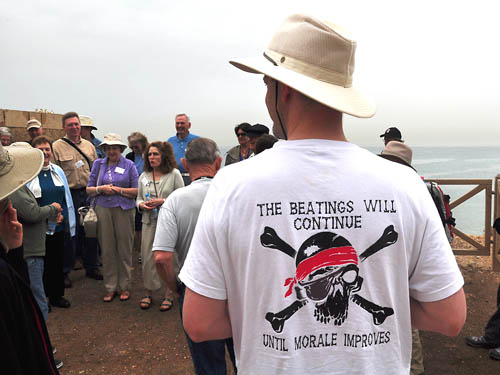
Occasionally I am asked if I ever have any trouble with individual tour members during a tour. The same might be asked about students in a class. After 45 years of directing tours I would have to say that there have been a few people who have given some problems for me or other tour participants. If they give trouble to others, that becomes a problem for me.

Mark, one of my friends, showed up on the first full day of touring with a T-shirt that I suppose he thought might help.

Dealing with trouble during a tour.

One tour member wanted everyone to improve their behavior. Photo by Ferrell Jenkins.

Really, the serious problems have been few and far between. I have become friends with some wonderful people through the years.

The advice of wisdom always works.

A soft answer turns away wrath, but a harsh word stirs up anger. (Proverbs 15:1 ESV)

Acts 24 — Photo Illustrations — Caesarea

The events of Acts 24-26 take place at Caesarea Maritima. Paul was protected by the Romans in Herod’s Praetorium (Palace) for more than two years.

And he [Felix] commanded him to be guarded in Herod’s praetorium. (Acts 23:35b ESV)

When two years had elapsed, Felix was succeeded by Porcius Festus. And desiring to do the Jews a favor, Felix left Paul in prison. (Acts 24:27 ESV)

Caesarea Maritima was a first century Roman capital and seaport. The gospel was first preached to the Gentiles here when Peter came from Joppa to Caesarea to tell Cornelius words by which he could be saved (Acts 10, 11).

Herod the Great built a city on the site of Strato’s Tower and named it Caesarea in honor of Caesar Augustus. It became a center of Roman provincial government in Judea. The city had a harbor and was located on the main caravan route between Tyre and Egypt. This city is called Caesarea Maritima (on the sea) to distinguish it from Caesarea Philippi.

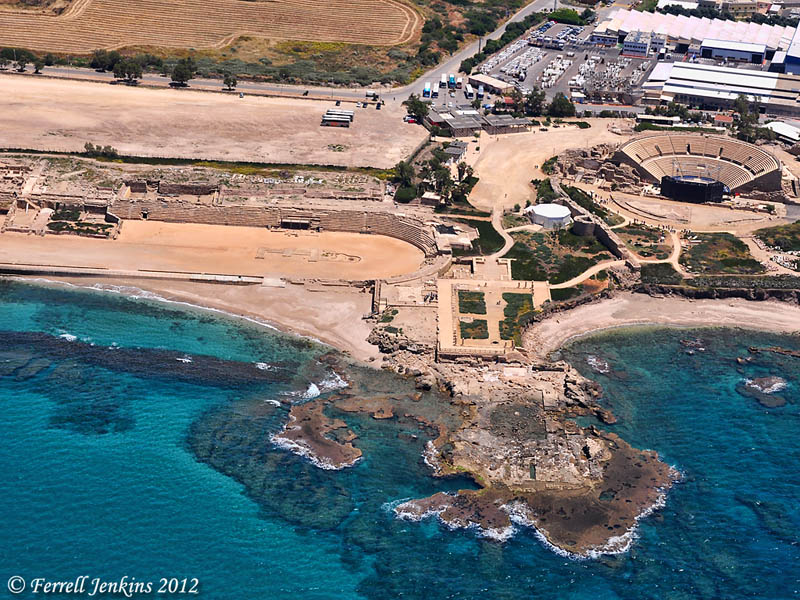
Our aerial photo below shows the Roman theater on the right of the photo. The southern portion of the hippodrome is on the left. The Palace of the Procurators is in the center, extending out into the sea.

Aerial view of Caesarea theater, hippodrome, and Palace of the Procurators. Photo by Ferrell Jenkins.

Aerial view of Caesarea theater (right), hippodrome (left), and Palace of the Procurators (center foreground). Photo by Ferrell Jenkins.

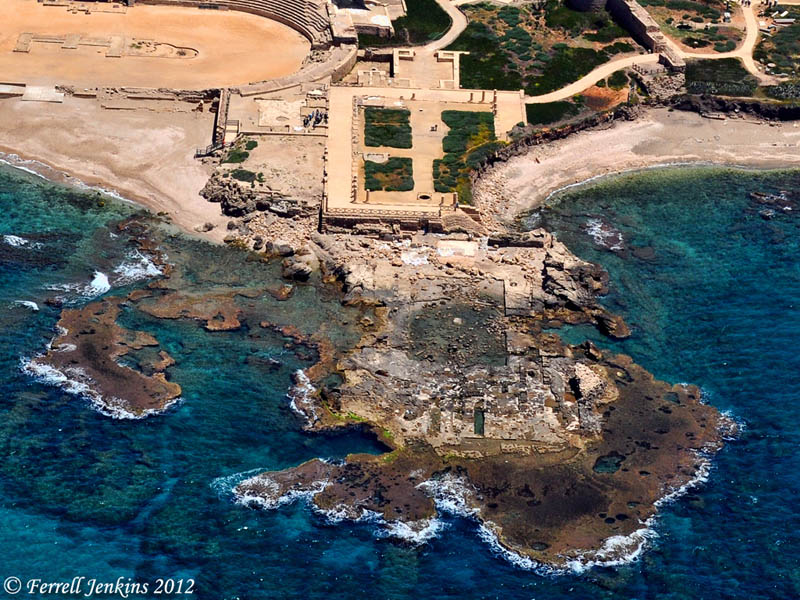
Jerome Murphy-O’Connor explains the rock-cut pool you see in the photos above and below.

From the west colonnade one can look down to the sea shore at a point where its dominant feature is a rectangular rock-cut pool (35 x 18 [meters]). There are channels to the sea on both sides. A square statue base can be discerned in the middle. The colonnades pool was originally the centrepiece of a two-storey building (83 x 51 m) which surrounded it on all sides. Presumably it was here that the Roman procurators lived. Wave action and the activities of stone robbers have ensured that virtually nothing remains. A staircase in the north-east corner gave access to the upper level. (The Holy Land, 5th ed., 243).

Aerial view of the Palace of the Procurators at Caesarea. Photo by Ferrell Jenkins.

Aerial view of the Palace of the Procurators at Caesarea. Photo by Ferrell Jenkins.

Acts 23 — Photo Illustrations — Antipatris

The site of Antipatris was known as Aphek in Old Testament times. It it is the place where the Philistines were encamped when they took the ark of the covenant from the Israelites who had camped at nearby Ebenezer (1 Samuel 4:1).

Antipatris was built by Herod the Great and named in honor of his father.

Herod was also a lover of his father, if any other person ever was so; for he made a monument for his father, even that city which he built in the finest plain that was in his kingdom, and which had rivers and trees in abundance, and named it Antipatris. He also built a wall around a citadel that lay above Jericho, and was a very strong and very fine building, and dedicated it to his mother, and called it Cypros. (Jewish Wars 1:417)

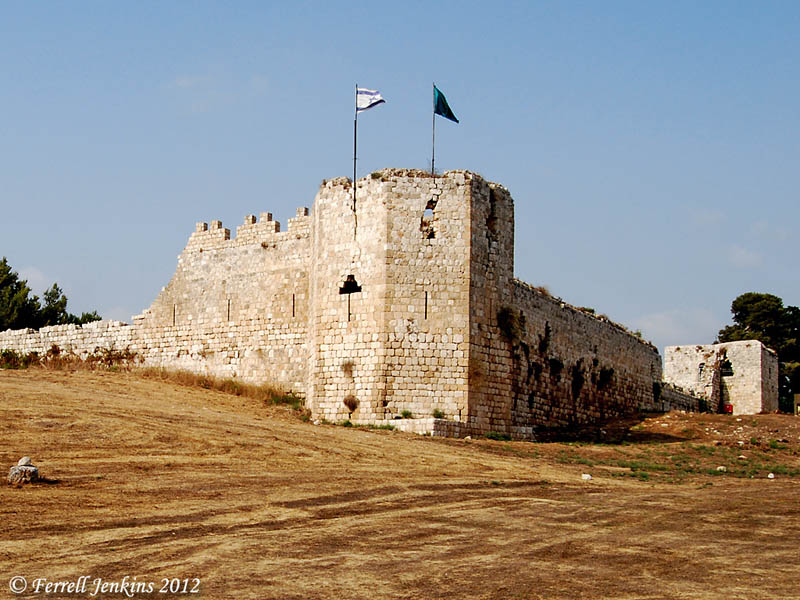
Because Aphek/Antipatris sat on a major south-north and west-east routes, it was dominated by many nations. The dominant feature of the site today is the Turkish fort. Inside are the excavated ruins of buildings from Canaanite to Herodian/Roman times.

Turkish fort at Aphek-Antipatris. Photo by Ferrell Jenkins.

Turkish fort at Aphek/Antipatris. Photo by Ferrell Jenkins.

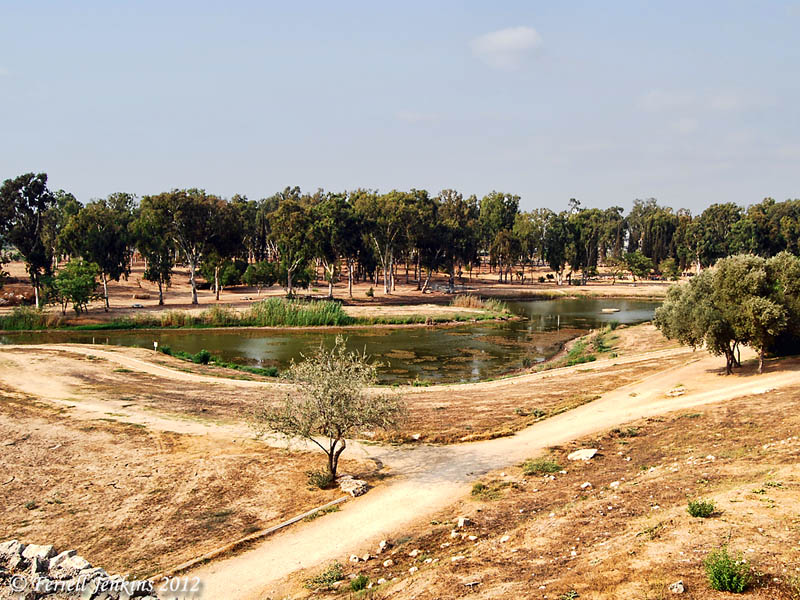
Aphek/Antipatris is known by the modern name Ras el-Ain because it is located at the source of the Yarkon River which flows a few miles into the Mediterranean.

Source of the Yarkon River at Aphek-Antipatris. Photo by Ferrell Jenkins.

Source of the Yarkon River at Aphek-Antipatris. Photo by Ferrell Jenkins.

When a plot was raised against Paul while he was in the Fortress of Antonia in Jerusalem, he was sent by night to Antipatris. The next day he was escorted to Caesarea.

So the soldiers, according to their instructions, took Paul and brought him by night to Antipatris.  And on the next day they returned to the barracks, letting the horsemen go on with him.  When they had come to Caesarea and delivered the letter to the governor, they presented Paul also before him. (Acts 23:31-33 ESV)

From Jerusalem to Antipatris is about 30 miles. From there to Caesarea is an additional 27 miles.

Paul would remain in custody at Caesarea for two years.

Reading the Blogs

Charles Savelle (Bible X) tells about his enjoyable afternoon at Southwestern Baptist Theological Seminary to visit the Dead Sea Scrolls and the Bible Exhibit (Fort Worth).  He describes the entire visit, step by step, including a list of “the scroll fragments and other manuscripts and Bibles” including a list of the Biblical verses included in the scroll fragments. A Qumran simulated dig is part of the exhibit. Charles includes a a hi-res photo of himself standing in a nice replica of a mikvah (ritual bath) at Qumran. Read the complete report here. The exhibit runs through January 13, 2013.

I enjoyed lunch with Charles one day at the recent ETS annual meeting. I find his Bible X blog helpful.

Luke Chandler reports here that a different Dead Sea Scrolls Exhibit is now open at the Cincinnati Museum Center. This exhibit includes about “600 biblically-related artifacts on loan from the Israel[i] Antiquities Authority.” Read more here. This exhibit which runs through April, 2013, has already been in New York and Philadelphia. Check our link to the New York exhibition here. The 39 page guide to the exhibit by Gordon Franz is still available.

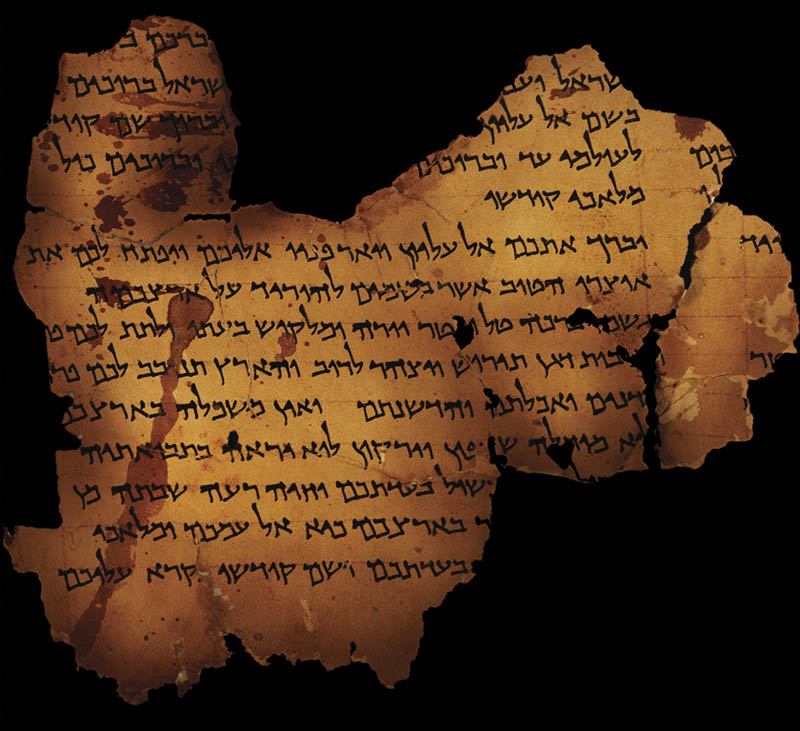
The War Scroll displayed at the Cincinnati Museum.

The War Scroll displayed at the Cincinnati Museum Center.

Luke also comments on a recent comment by Dr. William Dever regarding the lack of evidence for the “Low Chronologyhere.

It was only yesterday that I came caught up with a post by Seth Rodriquez (Wild Olive Shoot)  written the day after the U.S. presidential election. He has some important words for those who may have been disappointed in the outcome of the election. See here.

Professor Maeir on the cease fire and Tell es-Safi/Gath

Earlier in the week at the SBL meeting I visited a few minutes with Prof. Aren Maeir, excavator of Tell es-Safi/Gath. He is back home in Israel, and writes this morning about the cease fire between Gaza and Israel.

Well, thank g-d a cease fire has been declared and that it appears to be holding.

I have heard an unconfirmed report that the Palestinians even shot a missile at Tell es-Safi/Gath! I’ll have to check this out, but perhaps someone in the Hamas does not like what we are finding at the site? (is nothing sacred? 🙂

UPDATE: Uri Kaizer, the warden for the Tell es-Safi/Gath region from the Israel Nature and Parks Authority has informed me that the missile did not hit the site, but rather fell a km or two to the west.

In any case, I pray that things will stay quiet and we can all get back to living our regular lives.

I would be nice if in the future, when describing the period following this last round of fighting, the following could be said: “The land was quiet for forty years”…

Follow his blog here.

You will recognize the last phrase in Maeir’s post as the common refrain from the book of Judges.

So the land had rest forty years. (Judges 3:11a ESV)

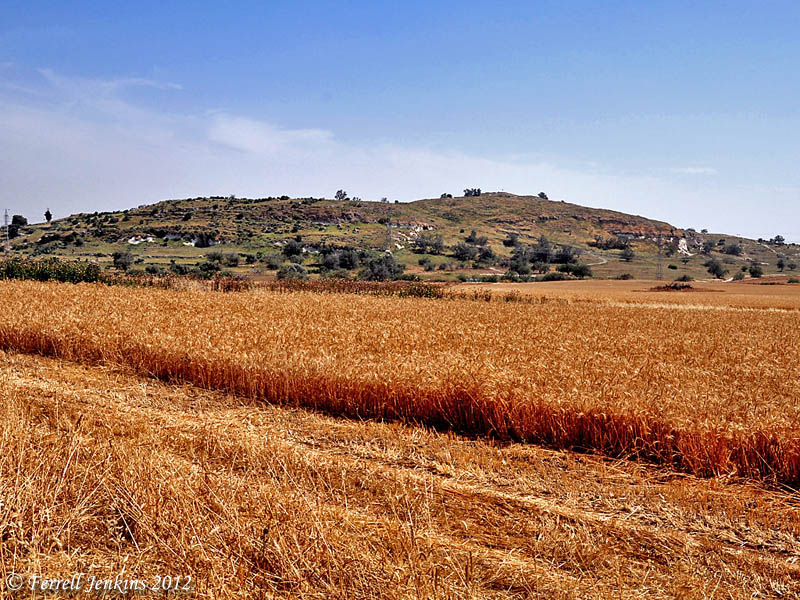
The following photo of Tel es-Safi/Gath shows the abundant wheat fields in the plain to the west of the tel.

Tel es-Safi/Gath with wheat fields in the plain to the west. Photo by Ferrell Jenkins.

Tel es-Safi/Gath with wheat fields in the plain to the west. Photo by Ferrell Jenkins.