Monthly Archives: January 2011

The vineyard of the man lacking sense

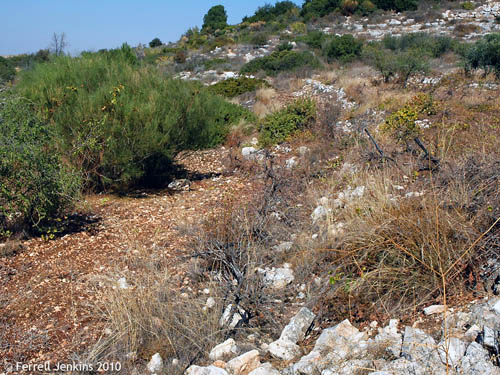
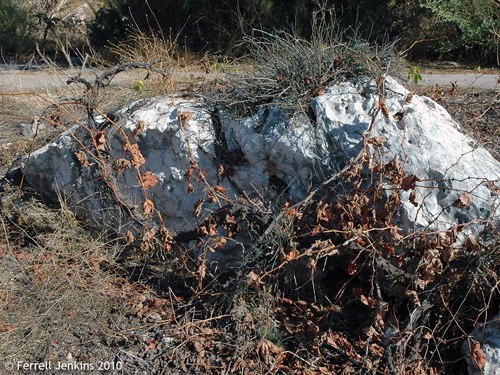
I passed by the field of the sluggard And by the vineyard of the man lacking sense, And behold, it was completely overgrown with thistles; Its surface was covered with nettles, And its stone wall was broken down. When I saw, I reflected upon it; I looked, and received instruction. “A little sleep, a little slumber, A little folding of the hands to rest,” Then your poverty will come as a robber And your want like an armed man. (Proverbs 24:30-34 NAU)

Neglected vineyard at Neot Kedumim. Photo by Ferrell Jenkins.

Neglected vineyard at Neot Kedumim. Photo by Ferrell Jenkins.

A broken stone wall of the vineyard. Photo by Ferrell Jenkins.

A broken stone wall of the vineyard. Photo by Ferrell Jenkins.

These images might also provide some insight into the statement of the Shulammite girl.

Do not stare at me because I am swarthy, For the sun has burned me. My mother’s sons were angry with me; They made me caretaker of the vineyards, But I have not taken care of my own vineyard. (Song of Solomon 1:6 NAU)

Many worthwhile applications may be drawn from the Scriptural truth illustrated by these photos. I hope you will take a little time today to meditate on these things.

Larger photos suitable for use in sermons and Bible classes are available by clicking on the image.

2010 in review — according to WordPress

The stats helper monkeys at WordPress.com mulled over how this blog did in 2010, and here’s a high level summary of its overall blog health:

Healthy blog!

The Blog-Health-o-Meter™ reads Wow.

Crunchy numbers

Featured image

The Louvre Museum has 8.5 million visitors per year. This blog was viewed about 240,000 times in 2010. If it were an exhibit at The Louvre Museum, it would take 10 days for that many people to see it.

In 2010, there were 277 new posts, growing the total archive of this blog to 907 posts. There were 425 pictures uploaded, taking up a total of 40mb. That’s about 1 pictures per day.

The busiest day of the year was October 28th with 1,134 views. The most popular post that day was Prof. Ehud Netzer critically injured at Herodium.

Where did they come from?

The top referring sites in 2010 were blog.bibleplaces.com, biblicalstudies.info, facebook.com, lajupaulk3.blogspot.com, and Google Reader.

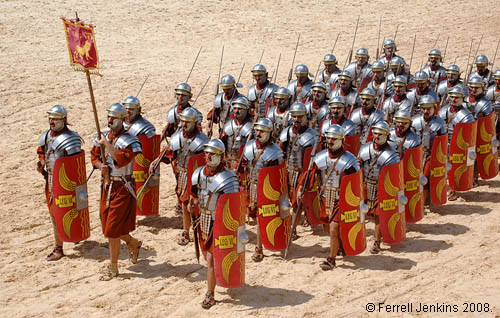
Some visitors came searching, mostly for roman soldiers, roman army, chariots, euphrates river, and roman soldiers pictures.

Attractions in 2010

These are the posts and pages that got the most views in 2010.

1

Prof. Ehud Netzer critically injured at Herodium October 2010
1 comment

2

Roman soldiers and chariot races at Jerash March 2008
5 comments

3

The tabernacle in the wilderness August 2008
5 comments

4

The Corinth Canal March 2008

Traditional baptism site to open in Israel

The traditional site where John the Baptist baptized Jesus has been closed for more than four decades. In the past few years pilgrims and tourists have been able to visit the site known as Bethany Beyond the Jordan from the Jordanian side of the Jordan River.

In those days Jesus came from Nazareth of Galilee and was baptized by John in the Jordan. (Mark 1:9 ESV)

These things took place in Bethany across the Jordan, where John was baptizing. (John 1:28 ESV)

Now word comes, after a year’s delay, that the site will open on the Israeli side.

Kasr al-Yehud, the probable site where John the Baptist baptized his cousin Jesus of Nazareth, will be opened to the public with a special ceremony on January 18 after 42 years as a closed military zone which pilgrims could only visit after coordinating with the Civil Administration for Judea and Samaria. The site is located in the Jordan Valley in the West Bank, but starting on the 18th it will be operated by the jurisdiction of the Israel’s Nature and Parks Authority, after Israeli authorities invested millions of shekels to build facilities there to handle a large number of tourists. The 18th is significant because it is the traditional day when Greek and Russian Orthodox Christians make an annual pilgrimage to the site to celebrate the Feast of the Epiphany. Vice Premier Silvan Shalom, who was instrumental in the project, said he hoped Kasr al-Yehud would become a symbol for cooperation among Israel, Jordan and the Palestinian Authority, as it would be a major attraction for tourists who would also want to visit other Biblical sites in the area. (ICEJ news)

Last May my group visited the Jordan River at the Jordanian site that is suggested as Bethany beyond the Jordan. Construction of a visitor’s center on the Israeli side seemed to be almost finished. That day a group, perhaps mostly military, was at the site, but it was not open to the general public. You can see workers on the steps leading down to the water.
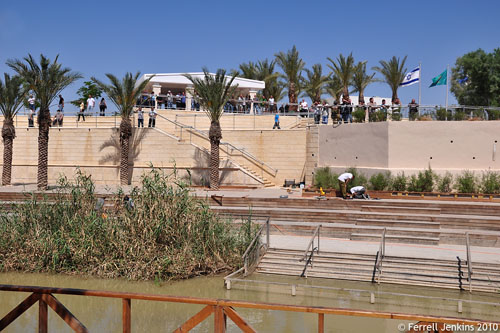
Jordan River baptism site. View from Jordan to the west. Photo by Ferrell Jenkins.

Jordan River baptism site. View from Jordan to the west. Photo by Ferrell Jenkins.

The Israeli visitor’s center is actually in the West Bank, but under Israeli control.

My first trip to the Bible Lands was in April and May of 1967. At that time the western side of the Jordan River was open to tourists. Of course, the site was still in Jordan at the time. Take a look at my group of 19 tour members. It is true that in those days most of the men wore suits, dress shirts and ties, even in the hot weather. The women wore dressy clothes, hosiery and other feminine attire no longer in use.

Just a flash from the past. Take a look at the old photo made on the western bank of the Jordan.
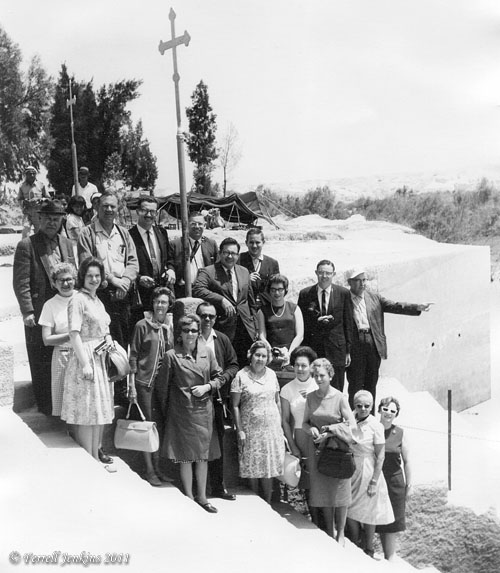
Ferrell Jenkins group at the traditional baptism site on the Jordan River.

1967 group at the traditional baptism site on the west bank of the Jordan River.

Did you notice those purses the women are carrying? In those days that was allowed as a carry-on on the airplanes. Many of the men carried a camera bag of similar size. That was it. No rolling suitcases. Oh, for the good ole days.

HT: BiblePlaces Blog.

Can you identify the hill in our new header?

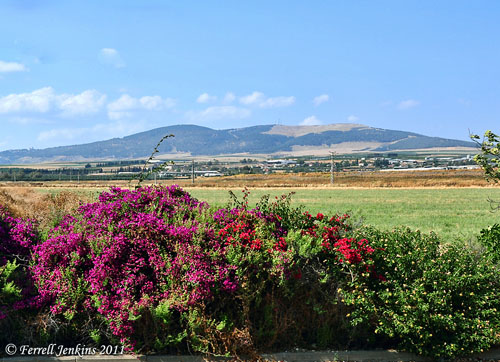
Have you noticed our new header photograph? Can you identify the location? It is a photo of the hill of Moreh mentioned in Judges 7.

I’m sure you know the story. The Israelites were oppressed by the Midianites who lived east of the Jordan River. In fact, the Midianites camped by the hill of Moreh in the Jezreel valley north of the Israelites (Judges 6:33). Gideon and his people camped beside the spring of Harod (Ein Harod). Our photo was made from Ein Harod, looking north toward the hill of Moreh.

Then Jerubbaal (that is, Gideon) and all the people who were with him, rose early and camped beside the spring of Harod; and the camp of Midian was on the north side of them by the hill of Moreh in the valley. (Judges 7:1 NAU)

The Hill of Moreh from En Harod. Photo by Ferrell Jenkins.

The Hill of Moreh from Ein Harod. Photo by Ferrell Jenkins.

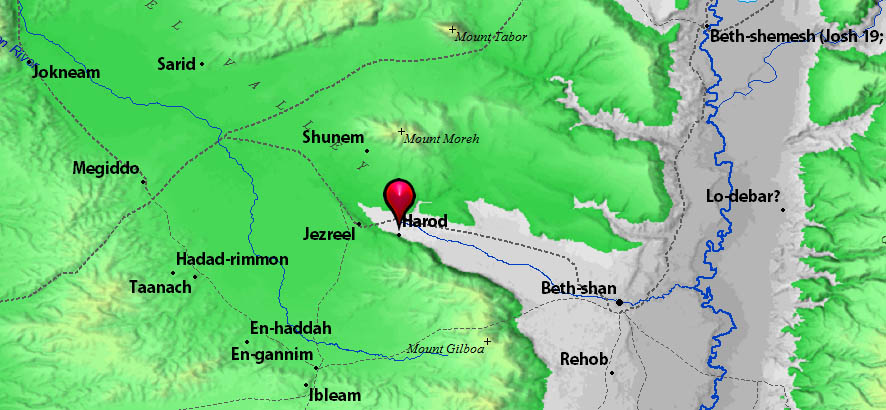
The map below from BibleAtlas.org will help you locate Ein Harod and the hill of Moreh (Mount Moreh). Click on the map for a larger image.

Map showing Ein Harod and Mount Moreh.

Map showing Ein Harod and Mount (hill of) Moreh. BibleAtlas.org

Repairing the ruins of ancient Babylon

The New York Times ran an article by Steven Lee Myers on the current efforts to save the ruins of Babylon.

On the hillside during one of his many visits to the ruins, Jeff Allen, a conservationist working with the World Monuments Fund, said: “All this is unexcavated. There is great potential at this site. You could excavate the street plan of the entire city.”

That is certainly years away given the realities of today’s Iraq. But for the first time since the American invasion in 2003, after years of neglect and violence, archaeologists and preservationists have once again begun working to protect and even restore parts of Babylon and other ancient ruins of Mesopotamia. And there are new sites being excavated for the first time, mostly in secret to avoid attracting the attention of looters, who remain a scourge here.

The entire article is available here. The article is accompanied by a nice 4:12 minute video of the restoration efforts here. According to the reports the reconstructions made by the Sadaam Hussein regime in the 1980s will probably be torn down.

Jim Davila adds this tip at Paleojudaica:

Related, also in the NYT: A Tour of Iraq’s Ancient Sites. Included are a video about the (traditional) tomb of Ezekiel … and a photo of Hebrew inscriptions at the (traditional) tomb of the prophet Nahum, as well as photos and videos of other sites of biblical and related interest.

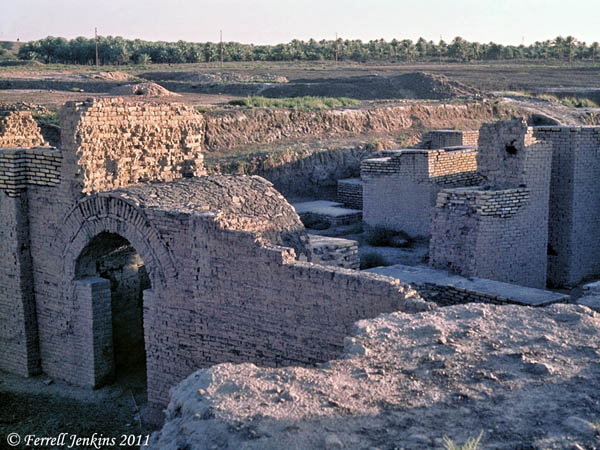
The photo below was made Tuesday, May 12, 1970, and still looks fairly good considering the time lapse and my camera equipment at the time.

Ruins of Ancient Babylon, 1970. Photo by Ferrell Jenkins.

Ruins of Ancient Babylon, 1970. Photo by Ferrell Jenkins.

The prophet Jeremiah spoke about the future of Babylon:

Babylon will become a heap of ruins. Jackals will make their home there. It will become an object of horror and of hissing scorn, a place where no one lives. (Jeremiah 51:37 NET)

We called attention to the UN report of US damage to ancient Babylon here.

HT: Ben Witherington III; Paleojudaica.

Why use a front end loader at an archaeological dig?

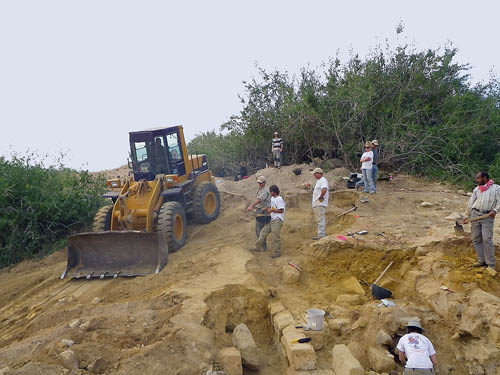
Dr. David Graves reports on the use of a tractor with a front end loader at Tall el Hammam in Jordan. He explains how the tractor is used at the beginning of excavations of a monumental Roman building. See the brief report with a larger photo here. Note especially his reference to “contaminated piles of dirt” and “night diggers.”

David Graves - Roman excavation at Tall el-Hammam

Use of a tractor with front end loader at Tall el-Hammam. Photo by David Graves.

We recently reported on the Tall el-Hammam excavation here.

Where will you travel in 2011?

Many people never travel because they put it off. Some people plan to see a lot of the places in the United States before they travel to a foreign destination. And most of these people never travel anywhere much. I don’t know how many times I have told someone that there is no way to drive to Israel and the other Bible lands. Young couples spend money to take skiing trips and other vacations, but they never think about saving to travel to the Holy Land. Usually they do not go.

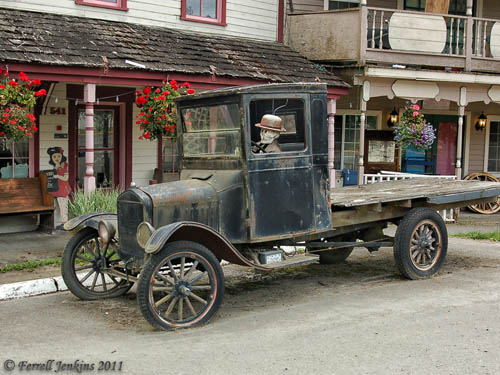
An old truck at Wilkeson, Washington. Photo by Ferrell Jenkins.

An old truck at Wilkeson, Washington. Photo by Ferrell Jenkins.

The Northern Pacific Railroad opened a sandstone quarry in Wilkeson, Washington, in the last quarter of the 19th century. The little town with a population of about 400 is now practically a ghost town and one of the entries near Mount Rainier. There are several old buildings and vehicles left from the last century or earlier.

Wilkeson shows us what can happen to a town, a church, a school, or other organization, or even an individual when we allow the life to ebb away. The guy in the old truck isn’t going anywhere.

Where are you going this year? I hope you will understand this in a spiritual way, as well as thinking about literal travel.

8 Owe no one anything, except to love each other, for the one who loves another has fulfilled the law.
9 For the commandments, “You shall not commit adultery, You shall not murder, You shall not steal, You shall not covet,” and any other commandment, are summed up in this word: “You shall love your neighbor as yourself.”
10 Love does no wrong to a neighbor; therefore love is the fulfilling of the law.
11 Besides this you know the time, that the hour has come for you to wake from sleep. For salvation is nearer to us now than when we first believed. (Romans 13:8-11 ESV)

Wishing you a fruitful and pleasant New Year

The beginning of a New Year gives us an opportunity to correct the mistakes we made in the previous year and try more diligently to do better in the future.

I trust that your New Year will be one of fruitfulness and pleasantness as you seek to honor the Creator of the universe and all men.

A fruit kiosk at the port of Akko (Roman Ptolemais). Photo by Ferrell Jenkins.

A fruit kiosk at the port of Akko (Roman Ptolemais). Photo by Ferrell Jenkins.

1 How blessed is the man who does not walk in the counsel of the wicked, Nor stand in the path of sinners, Nor sit in the seat of scoffers!
2 But his delight is in the law of the LORD, And in His law he meditates day and night.
3 He will be like a tree firmly planted by streams of water, Which yields its fruit in its season And its leaf does not wither; And in whatever he does, he prospers.
4 The wicked are not so, But they are like chaff which the wind drives away.
5 Therefore the wicked will not stand in the judgment, Nor sinners in the assembly of the righteous.
6 For the LORD knows the way of the righteous, But the way of the wicked will perish. (Psalm 1:1-6 NAU)