Yearly Archives: 2010

Report on Khirbet Qeiyafa — the Elah Fortress

Luke Chandler has participated in the excavation at Khirbet Qeiyafa the past two summers. Recently he posted two brief articles on some of the discoveries during the past summer. Read here and here.

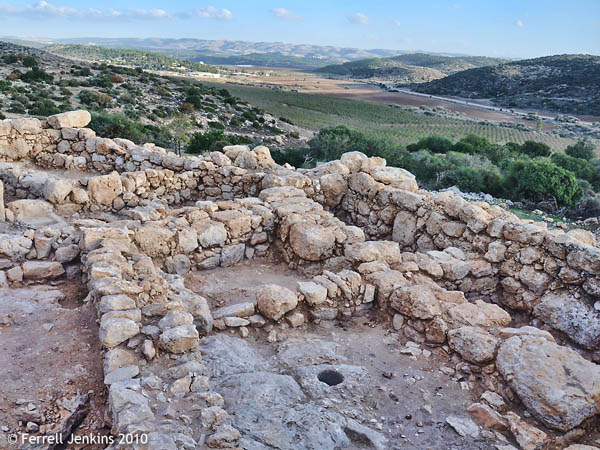
This area is associated with the events of 1 Samuel 17 (David and Goliath).

View to southeast over Elah Valley from Khirbet Qeiyafa. Photo by F. Jenkins.

View to southeast over Elah Valley from Khirbet Qeiyafa. Photo by Ferrell Jenkins.

U.S. Religious Knowledge Survey

During the past week the news media mentioned The Pew Forum’s U.S. Religious Knowledge Survey. This morning the full Survey is available in PDF here.

The warning of the prophet Hosea seems appropriate.

My people are destroyed for lack of knowledge; because you have rejected knowledge, I reject you from being a priest to me. And since you have forgotten the law of your God, I also will forget your children. (Hosea 4:6 ESV)

Roman soldiers in Decapolis

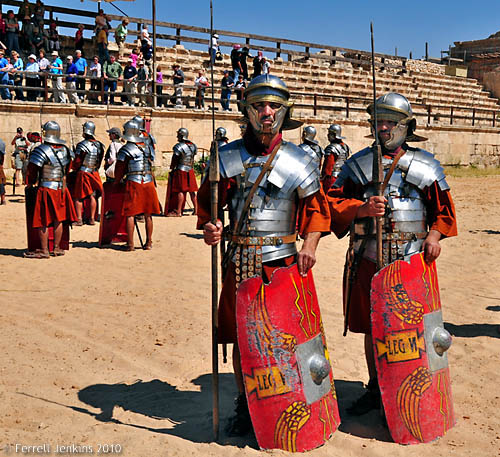
The RACE show at Jerash, Jordan, is a must if you have the opportunity to visit the area. RACE stands for Roman Army and Chariot Experience. You will see actors in authentic dress as armed legionaries, gladiators, and a short chariot race. The show takes place in the Roman hippodrome of Jerash. The view of the city ruins in the vicinity make this a wonderful setting for the performance. Full details may be found here. I have seen the program three times. On the last visit, earlier this year, I thought the performers showed less discipline and the show was not quite as good as on my previous visits.

Jerash was the second largest city of the Decapolis (after Damascus) in New Testament times. People from the Decapolis followed Jesus during His ministry in Galilee (Matthew 4:23-25). When Jesus traveled through the Decapolis he possibly visited the area around Jerash (Mark 7:31).

The photo shows the Roman soldiers of the 6th Legion from the time of the Emperor Hadrian (A.D. 117-138). A visit to this show provides several good photographs to illustrate New Testament times.

Roman soldiers at Jerash, Jordan. Photo by Ferrell Jenkins.

Roman soldiers at Jerash, Jordan. Photo by Ferrell Jenkins.

A larger image, suitable for presentations, is available by clicking on the photo.

A waterfall in the stronghold of En Gedi

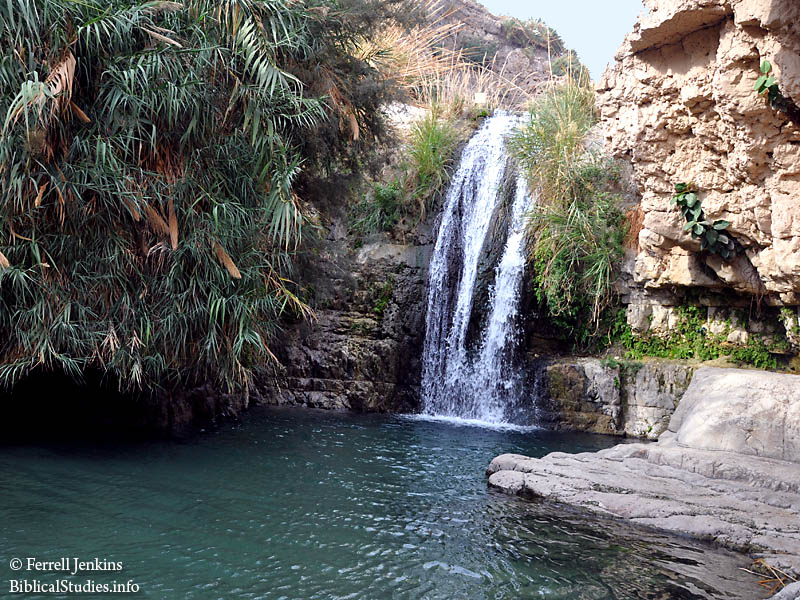
This week I haven’t had time to post much. Today, as I head home, I thought I would share this photo of one of the waterfalls at En Gedi.

Waterfall at En Gedi. Photo by Ferrell Jenkins.

One of the small waterfalls at En Gedi. Photo by Ferrell Jenkins.

This area, on the shore of the Dead Sea, is associated with David and Saul.

David went up from there and stayed in the strongholds of Engedi. (1 Samuel 23:29 NAU)

Five year long ossuary forgery trial may be coming to an end

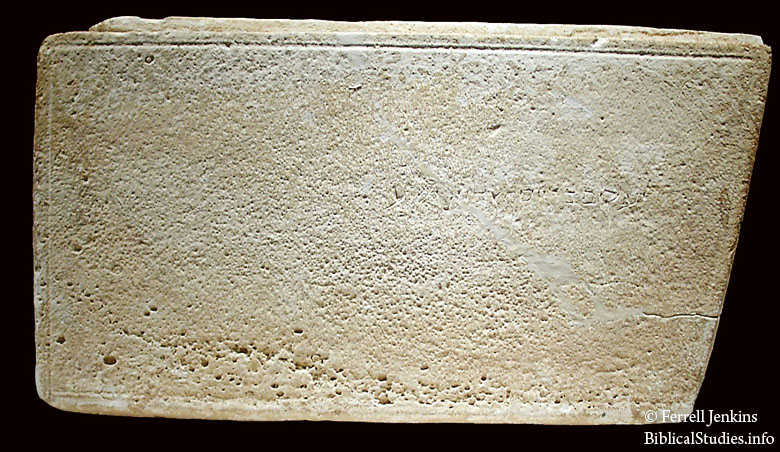
More than five years ago prosecutors in Israel brought charges against Oded Golan for forging the inscription on the ossuary bearing the Aramaic title, “Ya’akov bar Yosef akhui diYeshua” [James the son of Joseph the brother of Jesus].

Matthew Kalman reports that the trial seems to be coming to an end.

The indictment leveled 44 charges of forgery, fraud and deception against Golan and 13 lesser counts against a co-defendant, antiquities dealer Robert Deutsch. The trial of Golan, Deutsch and three other defendants opened at the Jerusalem District Court in September 2005.

Last Sunday, the defense ended its summing up with just two men left in the dock, bringing to an end five years of court proceedings that spanned 116 sessions, 133 witnesses, 200 exhibits and nearly 12,000 pages of witness testimony. The prosecution summation alone ran to 653 pages.

Yet despite the flood of strong scientific testimony, the feeling in the tiny courtroom, where fewer than a dozen people (including only one reporter) have followed the proceedings, was that the prosecution had failed to prove the items were forgeries or that Golan and Deutsch had faked them.

You may read Kalman’s full report here.

The "James" Ossuary. Photo by Ferrell Jenkins.

The "James" Ossuary. Photo by Ferrell Jenkins.

Once the judge issues his decision we still will not have certainty about this artifact.

HT: Joseph I. Lauer

Bible History and Archaeology in Houston area

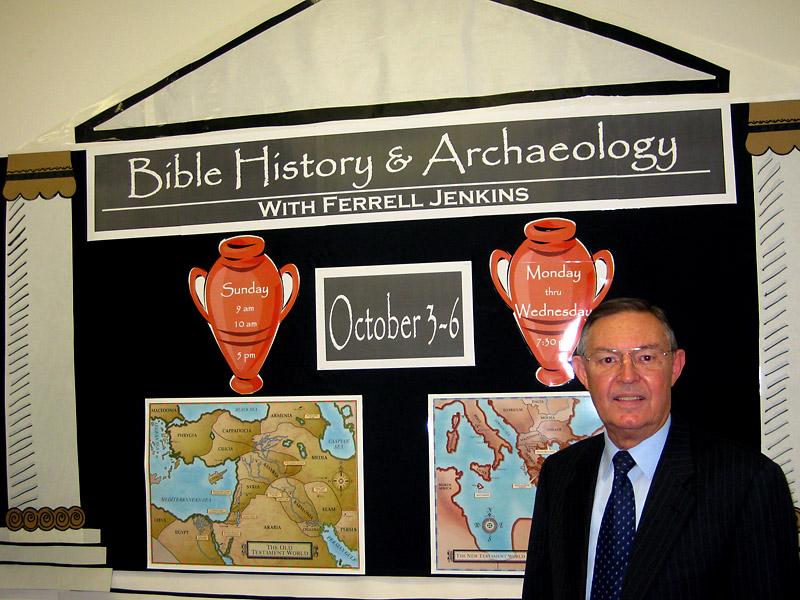
For a few days I am speaking at the Kleinwood Church of Christ in the Houston area on the subject of Bible History and Archaeology. I was favorably impressed with the nice bulletin board that had been prepared at the building, as well as the advertising done in the local paper.

Ferrell Jenkins at Kleinwood Church of Christ.

Ferrell Jenkins at Kleinwood Church of Christ in Houston.

The remaining topics are as follows:

  • Monday at 7:30 — Archaeology and the Nation of Israel
  • Tuesday at 7:30 — Archaeology of the Exile and Return
  • Wednesday at 7:30 — Archaeology and Early Apostolic History

Sarcophagus of the Queen of Adiabene returns to Israel

Haaretz tells the interesting story of the discovery of the return of the sarcophagus of Helena of Adiabene to Jerusalem from Paris.

Nearly 2,000 years passed between the time the coffin of Queen Helena of Adiabene first came to Jerusalem and its recent return there. In an impressive ceremony on September 21, the coffin was put on display in the reopened archaeology wing of the Israel Museum, after having been flown in from France.

In keeping with the customs of the time, the body of the first-century C.E. queen, who was a convert to Judaism, was interred in a stone coffin, a sarcophagus, weighing around 1,200 kilograms. The coffin looks massive, says the French ambassador to Israel, Christophe Bigot, who attended the ceremony, but any careless movement could damage it.

Queen Helena’s sarcophagus wound up in France after it was discovered almost by accident in Jerusalem in 1863, when Louis Felicien de Saulcy was excavating the site called the Tombs of the Kings, in the Sheikh Jarrah neighborhood, not far from the U.S. consulate. On the third day of the dig – which was undertaken after the Ottoman authorities issued a firman, or formal permit, for it — one of the workers stepped on a tile in the floor of a structure. The tile moved, revealing an alcove beneath it that contained the sarcophagus.

De Saulcy, a French military man and the scion of a noble family, turned his attention to archaeological research in the Middle East in the mid-19th century. Hagit Maoz Lin, curator of the Israel Museum exhibition that features the sarcophagus, says that he traveled to Palestine after the death of his first wife, because he was searching for something of interest “in a place fraught with danger.” On de Saulcy’s first trip to Palestine, in 1850, he toured the Dead Sea area and, among other things, falsely identified Sodom and Gomorrah, and drew the first map of Masada and the Roman camps that surrounded it.

The sarcophagus is on loan to the Israel Museum for four months.

Queen Mother Helena of Adiabene came to Jerusalem with her son, King Izates, as a convert to Judaish in A.D. 46. Adiabene was located in northern Mesopotamia east of the Tigris River. During the famine in Judea, mentioned in Acts 11:28-30, the queen sent to Egypt for grain and to Cyprus for dried figs (Josephus, Ant. 20.51).

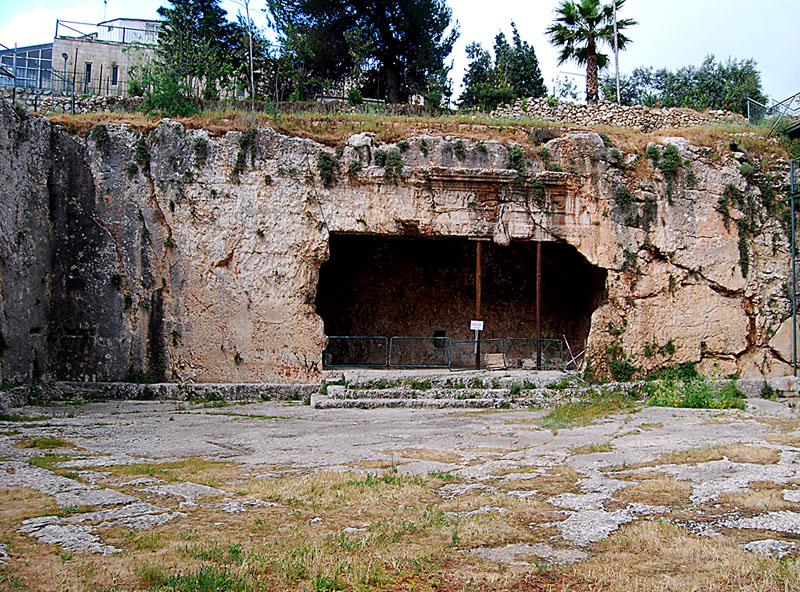
We have written about the Queen of Adiabene and her famous tomb, along with a photo of the rolling stone here. The tomb is no longer open to the public and is badly in need of repair.

The Tomb of the Kings. Photo by Ferrell Jenkins.

The Tomb of the Kings. Photo by Ferrell Jenkins.

You may read the entire article about the sarcophagus and the return of it to Israel here. There is a tiny, poor quality, image with the article.

HT: Joseph Lauer

Explorations in Antiquity Center — change of web site

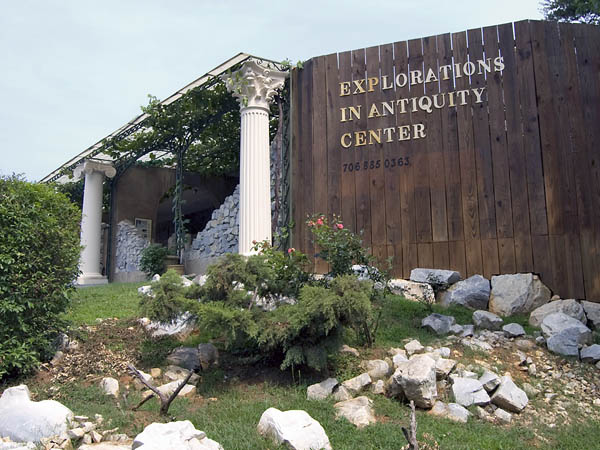
We have called attention to the Explorations in Antiquity Center, LaGrange, Georgia, here, here, here, and here.

Explorations in Antiquity Center. Photo by David Padfield.

Explorations in Antiquity Center. Photo by David Padfield.

Derrick Lewis, manager of EIA, informs us that the website address has changed to http://www.explorationsinantiquity.com. We are pleased to pass along this information.

The Scribe

Baruch, the scribe (Hebrew, sopher), served as the amanuensis or secretary of Jeremiah the prophet.

Then Jeremiah took another scroll and gave it to Baruch the scribe, the son of Neriah, who wrote on it at the dictation of Jeremiah all the words of the scroll that Jehoiakim king of Judah had burned in the fire. And many similar words were added to them. (Jeremiah 36:32 ESV)

A few years back a bulla of the seal of Baruch the scribe was discovered during an archaeological excavation in Jerusalem. A bulla is a piece of hardened clay bearing the impression of a seal.

A scribe working in the synagogue at Masada. Photo by Ferrell Jenkins.

A scribe working in the synagogue at Masada. Photo by Ferrell Jenkins.

A scribe was copying a manuscript in a small room of the synagogue at Masada last May. This was the first time I had noticed a scribe there. In the days prior to the invention of the printing press the scribe played a highly significant role in society.

King of Israel felled by stray arrow

The story is in 1 Kings 22. Ahab, king of Israel (874-853 B.C.), and Jehoshaphat, king of Judah (870-848), decided to try to take back the city of Ramoth-gilead which had fallen under the control of the king of Aram (Syria). Ramoth-gilead is a city of tranjordan, now in the northern part of Jordan near the border with modern Syria.

Ahab was fearful to be seen in battle and disguised himself to avoid attack.

Now an archer shot an arrow at random, and it struck the king of Israel between the plates of his armor. The king ordered his charioteer, “Turn around and take me from the battle line, because I’m wounded.” (1 Kings 22:34 NET)

The king of Israel died and was taken to Samaria for burial.

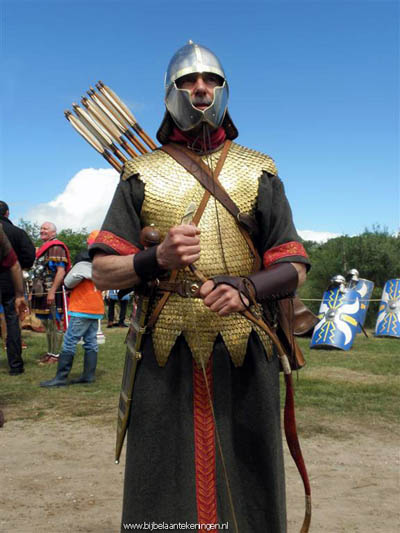
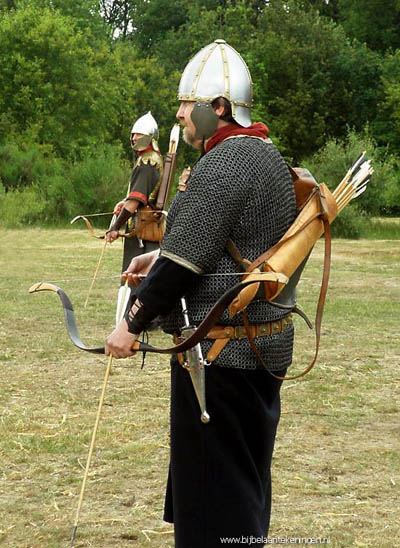
JP van de Giessen, a fellow blogger at Aantekeningen bij de Bijbel, has kindly granted permission for the use of these wonderful photos he made at the Romanfestival in Nijmegen (the Netherlands). He tells me that the festival is organized every two years with many actors. At this festival there were about 100 soldiers, 10 calvary and 120 civilian people (from slave to noble).

JP says the archers he photographed are Persian archers dressed according to the time of the Seleucids (the period between the testaments). They provide great illustrations for a lesson on 1 Kings 22.

Persian archer dressed as at the time of the Seleucids. Photo: JP van de Giessen.

Archer from the time of the Seleucids. Photo: JP van de Giessen.

According to JP, one of the archers he spoke with said he needed a year to create his costume, and another year for his bow and sword.

Archer from time of Seleucids. Photo by archer dressed as at the time of the Seleucids. Photo: JP van de Giessen.

Archer dressed as at the time of the Seleucids. Photo: JP van de Giessen.

More photos may be viewed here. JP van de Giessen holds the rights to these photos, but I think he is pleased when they are used in teaching. Click on the photo for a larger image.