Monthly Archives: November 2010

Water in a dry and weary land

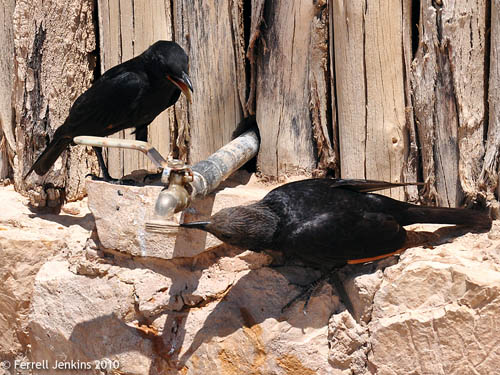
These Tristram’s Grackles, or Tristram’s Starlings, at Masada are trying to get a drop of water from one of the faucets supplying the tourists with lukewarm water during their visit to the site.

Tristram's Grackles at Madada. Photo by Ferrell Jenkins.

Tristram's Grackles at Madada. Photo by Ferrell Jenkins.

Henry B. Tristram wrote The Natural History of the Bible in 1868. In 1884 he wrote Fauna and Flora of Palestine.

A bird commonly seen at Masada, along the shore of the Dead Sea, is named for Tristram. The black bird has some distinctive orange feathers, as you can see in the bird on the right.

Psalm 63 is said to be “A Psalm of David, when he was in the wilderness of Judah.”

O God, you are my God; earnestly I seek you; my soul thirsts for you; my flesh faints for you, as in a dry and weary land where there is no water. (Psalm 63:1 ESV)

View east from the Herodium

During the past few months we have had considerable interest in our aerial photos of Herodium. Today I will share a photo showing the area east of the Herodium. This area is part of the Wilderness of Judea.
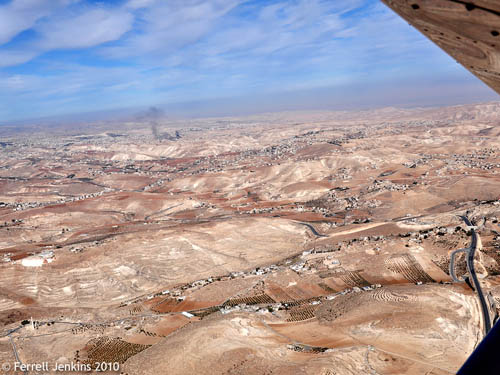
Aerial view east from over the Herodium. Photo by Ferrell Jenkins.

Aerial view east from over the Herodium. Photo by Ferrell Jenkins.

John the Baptist preached in the wilderness of Judea (Matthew 3:3), and Jesus was tempted in the wilderness (Matthew 4:1). This activity was likely in a region to the north of the area shown in this photo.

Jesus spoke to the crowds about John this way:

What did you go out into the wilderness to see? A reed shaken by the wind? (Luke 7:24 ESV)

Bauer describes the wilderness (Greek eremos) of Judea this way:

Of the Judean wilderness, the stony, barren eastern declivity of the Judean mountains toward the Dead Sea and lower Jordan Valley. (BDAG)

The Hebrew word for this wilderness is midbar. Charles F. Pfeiffer said the wilderness of Judea,

is the region of rugged gorges and bad lands in the eastern part of Judah where the land slopes off toward the Jordan Valley. In ancient times this area was infested with wild animals. Except for a brief time during the spring rains the wilderness is arid. (Baker’s Bible Atlas, 201)

Recently I was in a class covering the section of Scripture dealing with the conflict between Saul and David (1 Samuel 23-25).

  • The wilderness of Maon in the Arabah to the south of Jeshimon (1 Samuel 23:24). Jeshimon is another word used to describe the wilderness.
  • The strongholds and wilderness of Engedi (1 Samuel 23:29; 24:1).
  • The stronghold (possibly the area we know as Masada) (1 Samuel 22:4; 25:2).24:22).
  • Ziph, Horesh, Carmel (1 Samuel 23:14-15;

Some of that activity took place within this view, and some took place further to the south. The terrain is much the same. I note that Rainey uses the phrase “steppe land” in several of these references (Sacred Bridge, 148).

Many people who read the Bible in English, without checking into the matter, think of the wilderness as being a place filled with wild growth and underbrush. Jesus’ question to the crowds indicates that no reeds are to be found in the wilderness. In this case a picture really is worth a thousand words.

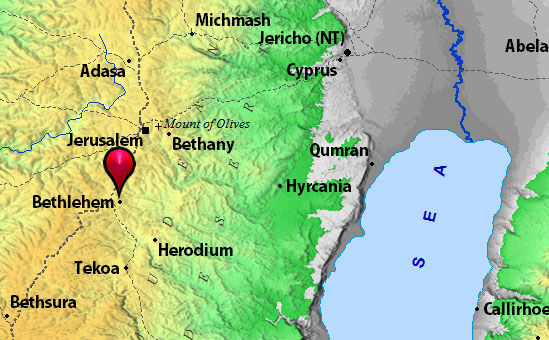
The map from BibleAtlas.org includes the region that we photographed.
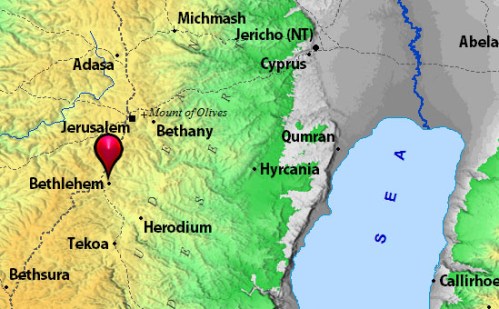
Map to show area east of the Herodium. BibleMapper image from BibleAtlas.org.

Map to show area east of the Herodium. BibleMapper image from BibleAtlas.org.
Riblah — important in Old Testament history

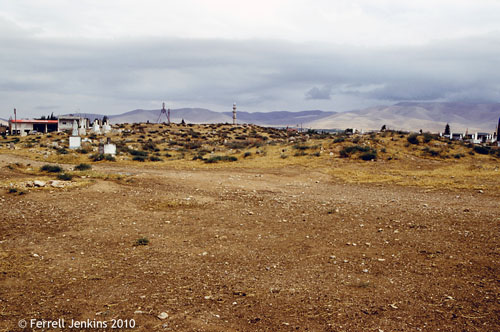
Riblah served as a base of operation for the Egyptian Pharaoh Necho and the Babylonian King Nebuchadnezzar. The city is located on a broad plain about 50 miles south of Hamath (modern Hama in Syria), on the main road between Egypt and Mesopotamia. The Orontes River flows past the site on the west side. On a modern map you will locate Riblah in Syria immediately north of the border with Lebanon.

There is little more than a “country store” at the site today, but the name Riblah is preserved as Ribleh, Syria.

  • Pharaoh Necho imprisoned Jehoahaz, king of Judah, at Riblah. He later took him to Egypt where he died. The date was about 609 B.C. (2 Kings 23:31-34).
  • Zedekiah, puppet king of Judah, tried to escape capture by the Babylonians. He fled Jerusalem but was captured on the plains of Jericho and brought to Riblah. There Nebuchadnezzar passed sentence on him. His sons were slaughtered in his sight and he was bound with brass fetters and taken to Babylon. The date was 586 B.C. (2 Kings 25:5-7; see also Jeremiah 39:5-6; 52:9-10).
  • The officials of Zedekiah were taken to Riblah where they were put to death (2 Kings 25:19-21; see also Jeremiah 52:26-27).

In 2002 a colleague and I spent several days visiting sites in Syria. Riblah was the most difficult to locate. Most folks, after seeing the site, would probably say, “What’s the big deal?”  Even though Riblah is mentioned only these few times in the Old Testament, it’s location makes it important in all movement between the south (Egypt and Israel) and Mesopotamia.

Riblah in the land of Hamath. Photo by Ferrell Jenkins.

Riblah in the land of Hamath. Photo by Ferrell Jenkins.

The slopes of this tell are now used as a cemetery. We know that this would make it difficult to negotiate rights to excavate.

This post was published March 2, 2009, but I had some slides scanned and am able to post a new photo of the tell of Riblah. A photo suitable for use in teaching is available by clicking on the image ago.

A look at copyright basics

The other day, on some source I look at, someone said something like this, “I don’t know anything about copyright.” Earlier this year I had a problem with a blogger who copied my articles and photos, even replacing my copyright notice with his own. Read here, if interested.

WordPress features some of their more successful blogs each day under the title “Freshly Pressed.” One of them caught my eye this morning. It has to do with misconceptions about copyright at it applies to blog posts.

I suggest that everyone who writes a blog, edits a bulletin, prepares presentations, wants to copy a handout, or posts info on a social network take a look at this article on Blogger Basics: Copyright by Deirdre Reid. She also explains Creative Commons.

Some think the solution to the copyright problem is just to label everything as “anonymous.” Not so.

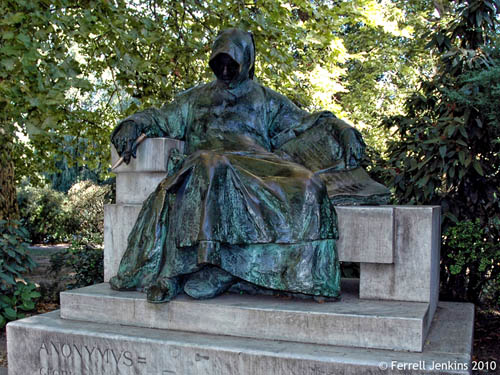
Statue of Anonymous in Budapest. Photo by Ferrell Jenkins.

In Budapest, Hungary, near the entrance of Vajdahunyad Castle, there stands a statue of Anonymous by Miklos Legeti. The statue commemorates a 12th or 13th century unknown chronicler of one of the several rulers named King Bela.

The apostles as gladiators

The apostle Paul compared the work of the apostles to that of gladiators in the arena. In writing to the Corinthians he says,

For I think that God has exhibited us apostles as last of all, like men sentenced to death, because we have become a spectacle to the world, to angels, and to men. (1 Corinthians 4:9 ESV)

As the last event of the day, the gladiator’s who were condemned to death were brought into the arena as a spectacle for the excited crowd. The word spectacle translates the Greek theatron, easy enough for everyone to understand the reference.

Leon Morris (Tyndale New Testament Commentary) calls attention to James Moffatt’s translation of this text.

The imagery is derived from the arena, as Moffatt’s rendering brings out, ‘God means us apostles to come in at the very end, like doomed gladiators in the arena!’

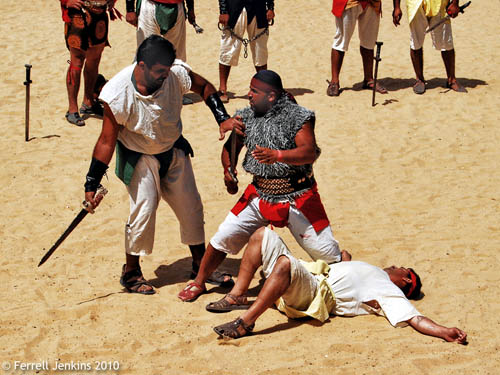
The photo below shows gladiators in the Roman hippodrome at the RACE (Roman Army and Chariot Experience)  show at Jerash, Jordan.

Gladiators in the Roman hippodrome at Jerash, Jordan. Photo by Ferrell Jenkins.

Gladiators in the Roman hippodrome at Jerash, Jordan. Photo by Ferrell Jenkins.

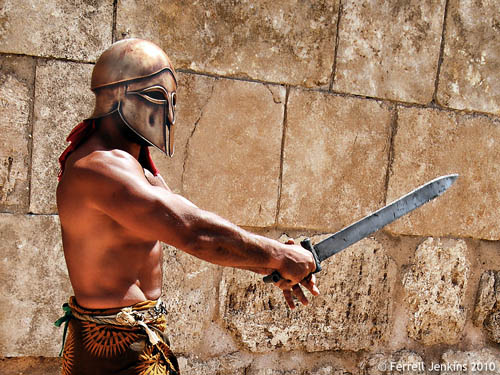
Here is a close up of one of the gladiators.

Gladiator in the RACE show, Jerash, Jordan. Photo by Ferrell Jenkins.

Gladiator in the RACE show, Jerash, Jordan. Photo by Ferrell Jenkins.

Both photos are available in a larger size suitable for use in teaching. Just click on the images.

David Padfield has several photos of gladiators here.

Scientific study of “headless” gladiators

Discovery News reports here on a new study about the “headless” gladiators found in a cemetery at York, England, a few years ago.

Britain’s enigmatic “headless Romans” lost their heads far away from home, according to a multi-isotopic analysis of the 1,800-year-old skeletal remains.

Unearthed between 2004 and 2005 in a cemetery in York, England, the remains belong to 80 individuals, almost all males, who died violently at ages ranging between 19 and 45.

At least 46 of them had been carefully decapitated, with their heads placed by or between their legs or pelvis.

Believed by some to be gladiators, losing their heads after their last fight, the heavily built men were buried in one of the most prestigious cemeteries of York during the 2nd and 3rd century A.D.

A new scientific “multi-isotopic analysis of the skeletal remains” has shown that many of the men were from other parts of Britain and the Roman Empire. It is a fascinating technical study.

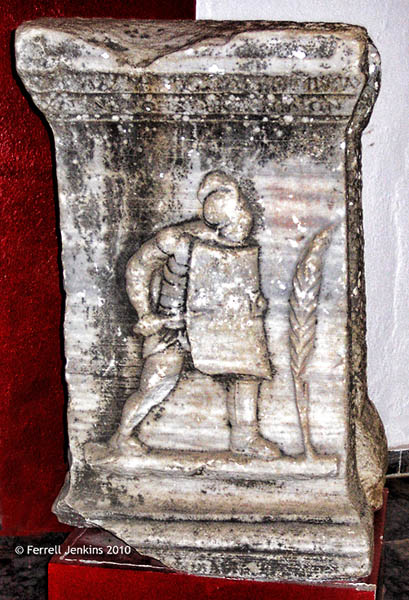
Gladiator at Ephesus. Photo by Ferrell Jenkins.

Gladiator at Ephesus. Photo by Ferrell Jenkins.

The Science Channel web site has a nice video in which Dr. Karl Großschmidt, Medical University of Vienna, discusses the discovery at Ephesus of skeletons belonging to 70 gladiators. Click here to view the video and a second one discussing the weapons used by the gladiators.  Großschmidt thinks that most of the men died in combat before the age of 35.

HT: David Padfield

In a post to follow I will discuss Paul’s use of the gladiator in one of his epistles.

A report today says that Pompeii’s house of gladiators collapsed Saturday morning. Check CNN.

“Lands of the Bible” 2011 calendar

Lands of the Bible 2011 CalendarEveryone who has visited Israel, or those who wish they had, enjoy seeing good pictures of the lands of the Bible. Orange Circle Studio, a leading calendar publisher, produced a beautiful calendar for 2011 using the photographs of Todd Bolen.

A friend sent me a copy of the calendar as a gift. I enjoyed it as soon as I browsed through it, and expect to enjoy it for the next 14 months. I thought some of our readers who appreciate good photos of the Bible land would enjoy the calendar. Todd has a few of the calendars available at a discount price (postpaid). For more information go to the Bible Places Blog, or directly to the order page here.

Attention: Logos users. Please read and help.

Logos Bible Lands collectionIf you use Logos software you are probably aware of pre-publication specials, and community pricing. Please read what Todd Bolen has written here about the Travel Through Bible Lands Collection. Then, help us get enough orders for community pricing to get these books at a reasonable price. I would really like to have the volumes by Tristram.

Royal gardens at Ramat Rachel

Archaeologists working at Ramat Rachel, between Jerusalem and Bethlehem, say they have uncovered an ancient royal garden. They say this will be “the first full-scale excavation of this type of [an] archaeological site anywhere in the pre-Hellenistic Levant.”

According to Prof. Oded Lipschits and graduate student Boaz Gross of Tel Aviv University’s Department of Archaeology, this dig is an unparalleled look into the structure and function of ancient gardens. “We have uncovered a very rare find,” says Prof. Lipschits, who believes that this excavation will lead to invaluable archaeological knowledge about ancient royal gardens in the Middle East.

The discovery, which dates back to the 7th century B.C.E., was recently reported in Quadmoniot, the journal of the Israel Exploration Society, and another paper on the dig is forthcoming in Near Eastern Archaeology.

Read the news release in its entirety here.

The identity of Ramat Rachel with a specific Bible city is not known.

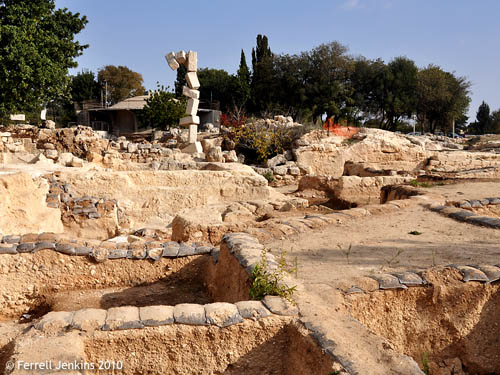
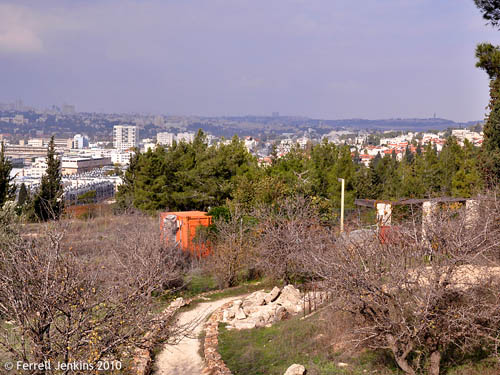
This photo shows some of the excavation area at Ramat Rachel after the 2009 season.

Excavation at Ramat Rachel. Photo by Ferrell Jenkins.

Excavation at Ramat Rachel. Photo by Ferrell Jenkins.

The elevation of Ramat Rachel is about 2684 feet above sea level. This gave the inhabitants a view of the ancient city of Jerusalem which was about 200 feet lower. Even on a less than clear day, you can see the Old City of Jerusalem on the far right of the photo below.

View to north of Jerusalem from Ramat Rachel. Photo by Ferrell Jenkins.

View to the north of the city of Jerusalem from Ramat Rachel. Photo by Ferrell Jenkins.

Ramat Rachel was inhabited from “the last century of the kingdom of Judah (7th century BCE) until the early Muslim reign in Palestine (10th century CE).” The excavators think the royal palace at Ramat Rachel was first built in the days of King Hezekiah (2 Kings 18-20).  More information is available at the excavation web site here.

Sea of Galilee now more than 701 feet below sea level

Arutz Sheva reports that the Sea of Galilee fell 20 centimeters last month.

Despite several periods of rain during the month, the Kinneret’s level fell 20 centimeters [7.87 inches] in October, the Hydrological Service of the Israel Water Authority said Tuesday. The lake’s level is now 213.88 [701.71 ft.] meters below sea level. According to the Service, the Kinneret lost 72 centimeters [28.35 in.] between July and September.

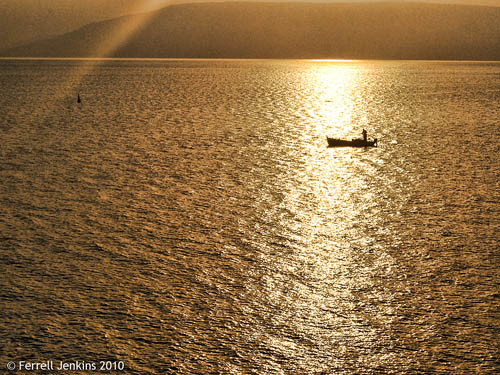
A lone fisherman on the Sea of Galilee at sunrise. View east. Photo by Ferrell Jenkins.

A lone fisherman on the Sea of Galilee at sunrise. View east. Photo by Ferrell Jenkins.

The Sea of Gailee/Kinneret played an important role in the ministry of Christ and His disciples.

When He heard that John had been arrested, He withdrew into Galilee. He left Nazareth behind and went to live in Capernaum by the sea, in the region of Zebulun and Naphtali. This was to fulfill what was spoken through the prophet Isaiah: Land of Zebulun and land of Naphtali, along the sea road, beyond the Jordan, Galilee of the Gentiles! The people who live in darkness have seen a great light, and for those living in the shadowland of death, light has dawned. From then on Jesus began to preach, “Repent, because the kingdom of heaven has come near!” (Matthew 4:12-17 CSB)

HT: Biblical Paths.