
Tag Archives: writing

Choppy Water at Sunset: A View of the Sea of Galilee from the East

Many photos have been made of the sunrise on the Sea of Galilee. I certainly have made my share of them. On a rare occasion I have found my tour group or myself on the eastern shore of the Sea of Galilee at sunset. The photo below was made from En Gev. It illustrates several important things. The water looks choppy. This is more typical in the late afternoon than in the morning. The wind comes from the North East and causes turbulence on the water. That is what you see in this photo. Let me emphasize that this is NOT an AI generated picture..
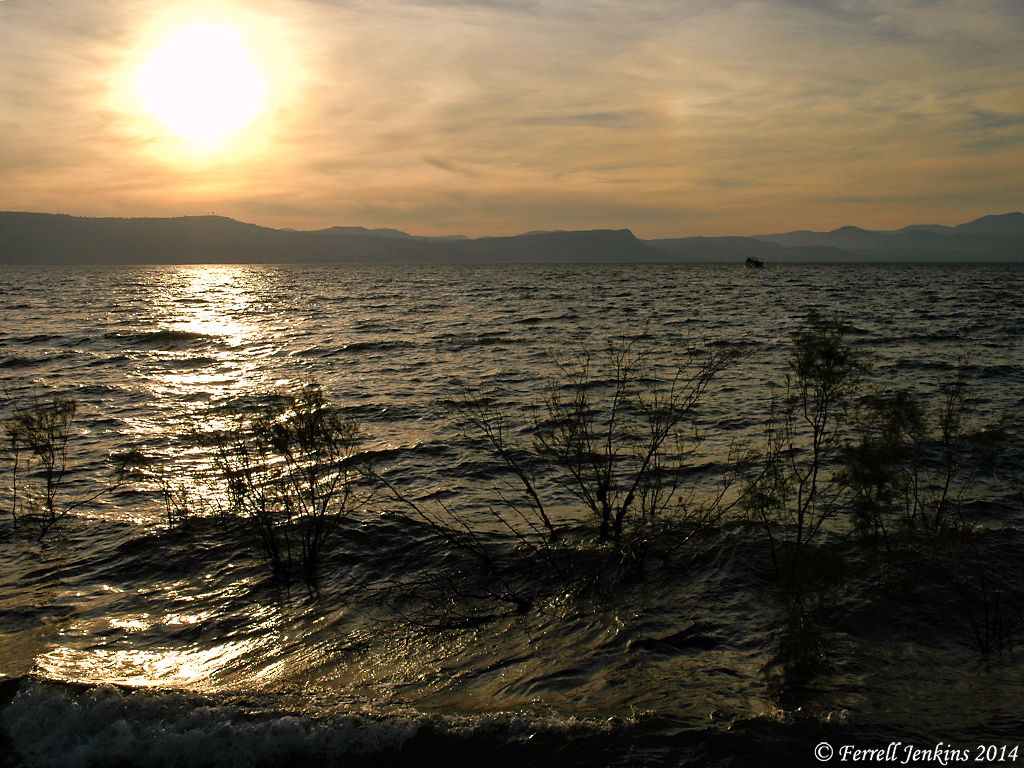
The Sea of Galilee from the east at sunset. The water is choppy.
A view of the Sea of Galilee from the east at sunset. Photo by Ferrell Jenkins.

Something resembling this happened on the occasion when the disciples saw Jesus walking on the water. See Matthew 14, Luke 5 and John 6. Notice that a strong wind was blowing on the sea (John 6:18).

If you have traveled in this region of Israel you will recognize Mount Arbel and the Horns of Hattin in the distance on the western side of the Sea of Galilee (or Kinneret).
Scribes kept important records

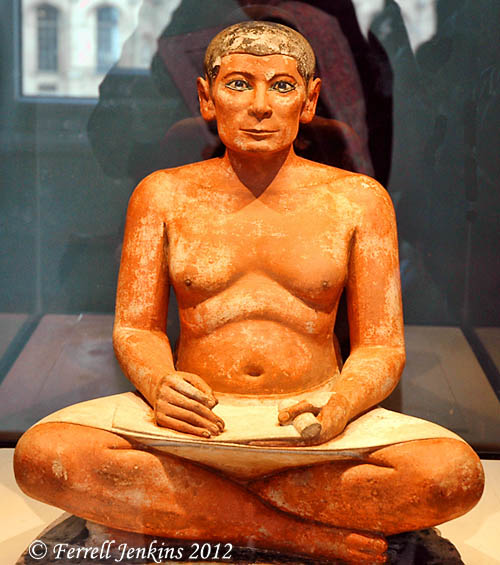
The picture below shows a scribe from ancient Egypt. The statue from Saqqara dates to the 4th or 5th dynasty — about 2600 to 2350 B.C. The limestone statue is painted with encrusted eyes of rock crystal. The statue is on display in the Louvre.

Scribe from Saqqara displayed in the Louvre. Photo by Ferrell Jenkins.

Scribe from Saqqara displayed in the Louvre. Photo by Ferrell Jenkins.

We do not have a great number of examples of writing from ancient Israel, but the Bible is abundant with references to writing and record keeping. The entry on the Hebrew word katab in the Theological Wordbook of the Old Testament says,

katab is the only general word for “write” and it is widely used. Curiously, it is not used in Genesis. Moses wrote on a scroll God’s curse on the Amalekites (Exo 17:14 ). God himself wrote the Ten Commandments (Exo 31:18). Moses also is specifically said to have written the Book of the Covenant (Exo 24:4), the Sinai legislation (Exo 34:27), the names of the leaders of the tribes (Num 17:2-3), the wilderness itinerary (Num 33:2), the law “from beginning to end” (Deut 31:9, 24) and Moses’ final song (Deut 31:22, 24). It is quite possible that the general references of Deut 31:9  and Deut 24 refer to the whole of the Pentateuch (cf. Deut 28:58-61; Deut 29:20-21) although critical scholars refer it only to Deut and question even that.

I think the reference to Moses writing the wilderness itinerary of the Israelites is interesting.

Moses wrote down their starting places, stage by stage, by command of the LORD, and these are their stages according to their starting places. (Numbers 33:2 ESV)

The Scribe

Baruch, the scribe (Hebrew, sopher), served as the amanuensis or secretary of Jeremiah the prophet.

Then Jeremiah took another scroll and gave it to Baruch the scribe, the son of Neriah, who wrote on it at the dictation of Jeremiah all the words of the scroll that Jehoiakim king of Judah had burned in the fire. And many similar words were added to them. (Jeremiah 36:32 ESV)

A few years back a bulla of the seal of Baruch the scribe was discovered during an archaeological excavation in Jerusalem. A bulla is a piece of hardened clay bearing the impression of a seal.

A scribe working in the synagogue at Masada. Photo by Ferrell Jenkins.

A scribe working in the synagogue at Masada. Photo by Ferrell Jenkins.

A scribe was copying a manuscript in a small room of the synagogue at Masada last May. This was the first time I had noticed a scribe there. In the days prior to the invention of the printing press the scribe played a highly significant role in society.