Tag Archives: Syria

More about the Cherubim

To the illustration from Byblos included with W. F. Albright’s article I would like to add a few photographic illustrations that might be helpful in understanding the concept of the Cherub as well as the general concept of composite beasts in the Apocalyptic books of Ezekiel, Daniel,  Zechariah, and Revelation.
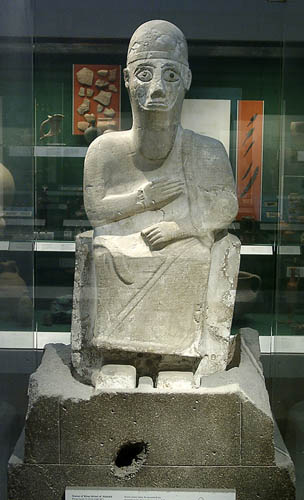
Throne of King Idrimi of Alalakh. Photo by Ferrell Jenkins.

Throne of King Idrimi of Alalakh. Photo by F. Jenkins.

The photo above shows the front of the Statue of King Idrimi of Alalakh, now displayed in the British Museum. An associated cuneiform inscription tells that this king, following a popular revolt, was forced into exile. He went first to Emar on the Euphrates, then to Canaan, where he joined other refugees from Syria and lived with the Hapiru. Seven years later he recaptured the district of Mukish and was acclaimed king of Alalakh.
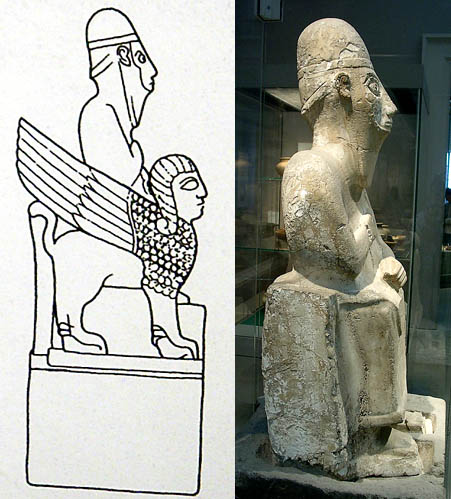
King Idrimi of Alalakh. Photo by F. Jenkins.

King Idrimi of Alalakh. Photo by F. Jenkins.

The drawing on the left (above) shows the suggested reconstruction of the throne of King Idrimi of Alalakh (1570-1500 BC) . Alalakh is located in North Syria, near the Orontes River. Due to political changes, Alalakh, Tell Atshana [Açana], is now in southern Turkey. See The New International Dictionary of Biblical Archaeology or The Biblical World for more information about the excavations at Alalakh.

This photo on the right (above) shows the right side of the statue as it is displayed in the British Museum.
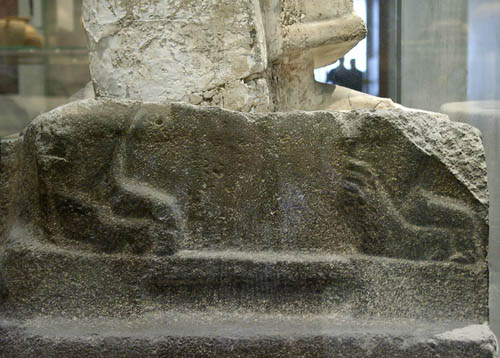
Right side base of throne of the King of Alalakh.

Right side base of throne of the King of Alalakh.

The photo above shows the base of the right side of the statue. The front and hind feet of the “creature” upon which the throne stands are clearly visible.
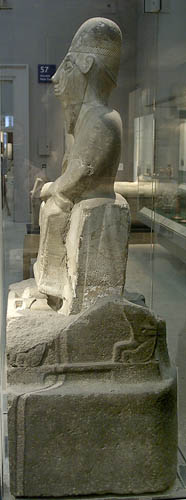
Left side of the throne.

Left side of the throne.

The photo to the right shows the left side of the throne. The front and hind legs of the animal can be seen.

Recall these references from the Bible describing the LORD as riding on a cherub.

And He rode on a cherub and flew; And He appeared on the wings of the wind. (2 Samuel 22:11)

He rode upon a cherub and flew; And He sped upon the wings of the wind. (Psalm 18:10)

These are the living beings that I saw beneath the God of Israel by the river Chebar; so I knew that they were cherubim. (Ezekiel 10:20; see entire chapter)

We are saying that images such as the one discussed here provide an idea of the imagery involved in the biblical description of the cherubim.

Perhaps later we will be able to include some photos of representations of the cherubim upon the ark of the covenant.
Favorite photo of 2008?

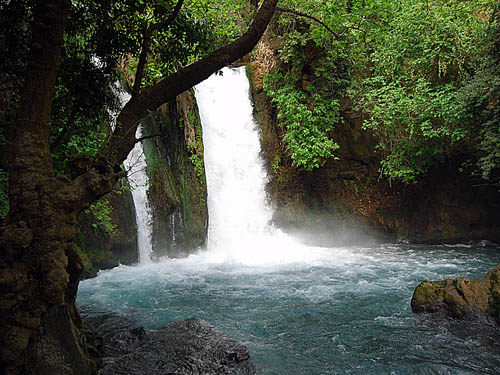
Elizabeth and I were driving from lunch today when I asked her what she thought would be my favorite photo of 2008. That excludes the grandson, of course. After some discussion we both agreed that it was a difficult decision. She suggested the En Gedi waterfall. Good suggestion. We posted one of those photos here. I debated about posting a different view, but then decided to go with another choice.

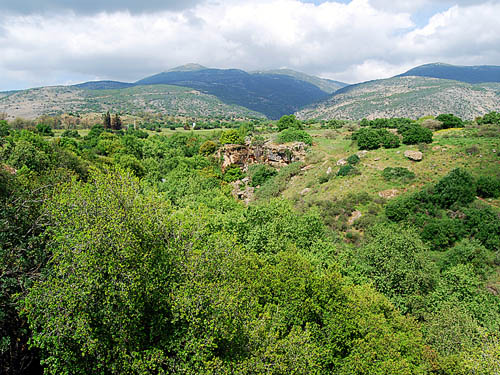
Early in the year I posted a 1984 photo of the Jordan River waterfall here. In April, while my group was eating lunch at Banias, the site of Caesarea Philippi, I broke away with David Padfield to visit the nearby Jordan Waterfall. The fall is also known as the Banias Waterfall. In order for this photo be understood it might be good if I showed you a photo of the surrounding terrain.

The photo below was made from above the waterfall. The waterfall is in the depression to the left of the rocky area; you are seeing the top of large trees. Caesarea Philippi is between the two closest hills. The Banias River begins as a spring there and soon cuts its way into the surrounding earth and rock. It is not really the Jordan until it joins with other sources, including the Dan River.

Vicinity of the Jordan River Waterfall. Photo by Ferrell Jenkins.

Vicinity of the Jordan River Waterfall. Photo by Ferrell Jenkins.

Once we make our way down into the depression among the trees we see the beautiful waterfall.

Jordan River Waterfall. Photo by Ferrell Jenkins.

Jordan River Waterfall. Photo by Ferrell Jenkins.

On my first trip in 1967 it was impossible to visit either the source of the river or the waterfall because it was within Syria. After Israel captured the territory, it became possible to make the visit.

Was this absolutely my favorite photo of 2008? Probably not. I was blessed to visit Israel (twice), Jordan, Turkey, Greece and the Greek islands. There were too many favorites to make a choice.

Matthew uses the term district or region to describe the area Jesus visited with His disciples (Matthew 16:13). The Kings James Version coasts is misleading. Mark’s term is villages (Mark 8:27). It was not far from here that Jesus was confessed as the Christ by Peter.

Jesus went out, along with His disciples, to the villages of Caesarea Philippi; and on the way He questioned His disciples, saying to them, “Who do people say that I am?”  They told Him, saying, “John the Baptist; and others say Elijah; but others, one of the prophets.” And He continued by questioning them, “But who do you say that I am?” Peter answered and said to Him, “You are the Christ.” (Mark 8:27-29 NASB; also read Matthew’s account)

More on Damascus and Paul

It has been my pleasure to visit Damascus several times since 1967. David McClister, a colleague from the Biblical Studies department at Florida College, and I visited the city in May, 2002. We tried to identify the traditional places associated with Saul’s stay in the vicinity. Southwest of the city, within sight of Mount Hermon, and on the road toward Jerusalem, there is a Greek Orthodox chapel marking the site where Jesus spoke to Saul. We drove as far south toward Quneitra in the Golan Heights as the military would allow. We can not be sure that the chapel marks the exact spot, but we know it was nearby.

Off Straight street one can visit the house of Ananias. All we can say with certainty is that this is another of those uncertain traditional places. Luke tells us that Ananias went to the house of Judas where Paul was staying.

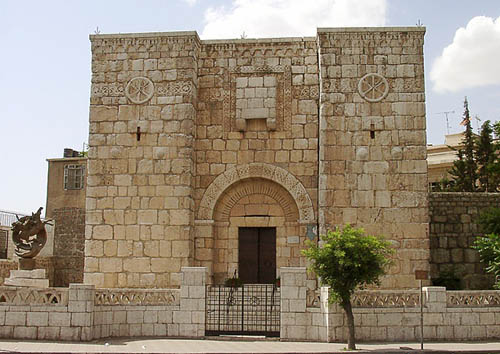
An ancient wall still surrounds much of the old city. A modern chapel is built into the wall to indicate the place where Paul was let down through a window when a plot was made to kill him (Acts 9:25; 2 Cor 11:32-33).

Saul (Paul) in Damascus

Damascus is first mentioned in the Bible at the time of Abraham (Gen. 14:15; 15:2-3). As the capital of Syria, the city had much contact with the kingdoms of Israel and Judah.

All of the New Testament references to Damascus are related to the conversion of Saul of Tarsus (Acts 9; 22; 26; 2 Cor. 11:32; Gal. 1:17). Saul had participated in the stoning of Stephen and was active in the persecution of the disciples of Christ in Jerusalem. He asked the high priest for authority to go to Damascus and seek out men and women who belonged to the Way and bring them bound to Jerusalem.

The Lord appeared to Saul as he approached Damascus and told him to go into the city where he would be told what he must do (Acts 9:6). Saul stayed at a house on the street called Straight. Ananias came to him and told him to arise and be baptized so that his sins might be washed away (Acts 22:16; 9:18). Saul stayed with the disciples for several days and immediately began to proclaim Jesus in the synagogues as the Son of God (9:20).

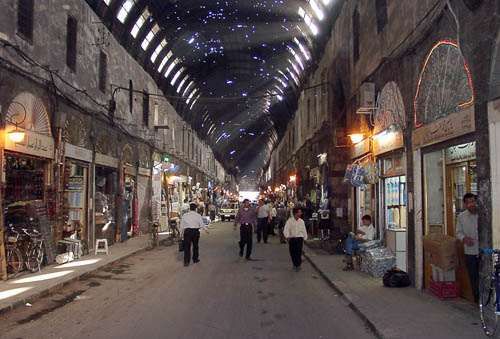
The street called Straight (Acts 9:11), the ancient Via Recta of the Roman city, now lies about 20 feet below the present street which runs the length of the old city, east to west. At the east end of the street a Roman gate has been elevated to the present level and partially restored. A small monumental arch can be seen near the middle of the street.

The photo below is one I made on Straight Street in 2002. This is not the main shopping street in the old city, but is historically significant.

The street called straight in Damascus. Photo by Ferrell Jenkins.

The street called straight in Damascus. Photo by Ferrell Jenkins.

The Rivers of Damascus

Naaman was the commander of the army of the king of Aram (Syria). The biblical text says he was “esteemed and respected by his master” because of the victories he had given the country. Great people often have great problems as well as great acclaim. Naaman was a leper. The term leper is used throughout the Old Testament of a serious skin disease without a cure. Read the full account in 2 Kings 5:1-18.

A young girl who had been taken captive from Israel during one of the raids made by the Arameans was serving as an attendant to Naaman’s wife. She knew of the prophet [Elisha] in Samaria and was confident he could cure Naaman of his leprosy.

When Elisha send a messenger to Naaman to tell him to “Go and wash in the Jordan seven times” the commander was furious. He said,

Are not Abana and Pharpar, the rivers of Damascus, better than all the waters of Israel? Could I not wash in them and be clean?” So he turned and went away in a rage. (2 Kings 5:12 ESV)

These rivers, Abana and Pharpar, flow from the Anti-Lebanon range eastward into the desert. Here is a photo that I made of the Nahr Barada river a short distance west of Damascus (on the outskirts of the city). The river continues to flow through the city of Damascus. The Nahr Barada is often identified with the Abana of the Bible.

The Abanah River near Damascus. Photo by Ferrell Jenkins.

The Abanah River near Damascus. Photo by Ferrell Jenkins.

Naamam was cured of his leprosy only after he dipped in the Jordan seven times. We should not elevate our judgment (opinion) to the point that we can argue with the Lord about what ought to be done. He is the Creator; we are the creature.

Ramoth in Gilead

Ramoth in Gilead (or Ramoth-gilead) was a town in Gilead that was included in the territory of the Israelite tribe of Gad in Transjordan (Joshua 20:8). It was one of the Levitical cities of refuge for the Israelites (Joshua 21:38). The most memorable associated with Ramoth-gilead recorded in the Bible is the battle with Aram (Syria) in which Ahab was killed (1 Kings 22). Elijah sent one of the sons of the prophets to Ramoth-gilead to anoint Jehu as king of Israel (2 Kings 9:1).

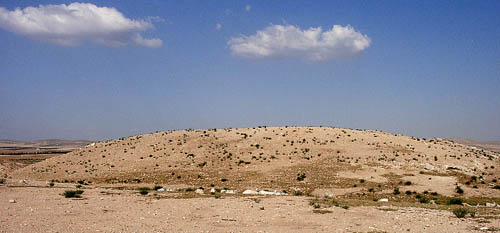
The identity of Ramoth-gilead is uncertain. Two sites are frequently mentioned by scholars: Tall ar-Rumeith and Ar-Ramtha.

Burton MacDonald, in East of the Jordan, says,

There is also archaeological support for choosing Tall ar-Rumeith, situated in the fertile plain area just to the southeast of the junction of the ‘Amman-Damascus and Irbid-Mafraq highways, as the location for Ramothgilead. (page 200)

Paul Lapp excavated at Tall ar-Rumeith in 1967. Little archaeological work has been done at Ar-Ramtha. I have not gone into the Jordanian city of Ramtha, but understand that the mound is covered by the town, thus making it difficult to conduct an excavation.

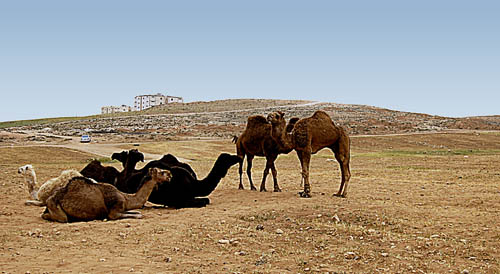
Here is a photo I made at Tall ar-Rumeith in 2002. It is not surprising to see camels here because the desert is near (to the east). From the top of the tell there is a great view looking north across a fertile plain to the border with Syria.

Earlier this year I went back to the site, but found that some modern housing has been built adjacent to the east side of the tell. It appears to be serving as housing for Indian students. I speculate that they attend a nearby university.

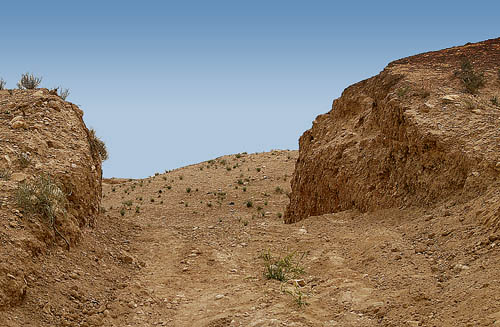
This photo shows a modern trench made to make a road to part of the construction site.

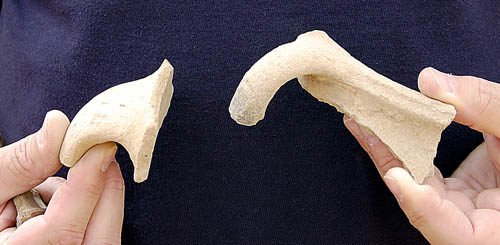
We found some pottery in the road, but can not be certain that it came from the damage to the tell. I did not see any shards along the edge of the cut.

This illustrates a real problem associated with ancient sites in isolated places. In a place like Jordan there are so many sites that it is impossible to excavate, preserve, and guard all of them.

A note on spelling. You may note different spellings of the word describing an archaeological mound. In Israel the term Tel is used. Earlier the term Tell was used throughout the Middle East. In Jordan the term Tall has come into common use.

There is also much variation in the spelling of some of the compound biblical names in scholarly sources, and even in English translation of the Bible. This is illustrated in this post and the previous one on Bethshan.