Tag Archives: Syria

Iron Age Hadad temple found in Jordan

Major news sources are reporting the discovery of a 3,000-year-old Iron Age temple from Khirbet ‘Ataroz near the town of Madaba (close to Mount Nebo and about 20 miles SW of Amman). The head of the Jordanian Antiquities Department said the find dates to the 8th century B.C. (a little shy of the 3,000 years mentioned by the news sources). Here are a few comments from the AP article.

He said the complex boasts a main room that measures 388 square feet (36 square meters), as well as two antechambers and an open courtyard.

The sanctuary and its artifacts — hewn from limestone and basalt or molded from clay and bronze — show the complex religious rituals of Jordan’s ancient biblical Moabite kingdom, according to al-Saad.”

Today we have the material evidence, the archaeological proof of the level of advancement of technology and civilization at that period of time,” he said.

The Moabites, whose kingdom ran along present-day Jordan’s mountainous eastern shore of the Dead Sea, were closely related to the Israelites, although the two were in frequent conflict. The Babylonians eventually conquered the Moabites in 582 B.C.

Archaeologists also unearthed some 300 pots, figurines of deities and sacred vessels used for worship at the site. Al-Saad said it was rare to discover so many Iron Age items in one place.

The article continues,

Among the items on display Wednesday, there was a four-legged animal god Hadad, as well as delicate circular clay vessels used in holy rites. Al-Saad said the objects indicate the Moabites worshipped many deities and had a highly organized ritual use of temples.

The AP report, with small photos of some of the artifacts, may be read here. The typical news reports fail to give adequate information about the discovery. In these cases, we wait for scholarly information.

Below I have a quotation from the revised ISBE giving a brief explanation about Hadad.

An alternative name for Baal, the head of the Canaanite pantheon, whose worship was expressed in fertility rites. The storm-god Hadad is mentioned in Assyrian inscriptions, and called on the monolith of Shalmaneser “the god of Aleppo.” In the Assyrian inscriptions he is identified with the air-god Rimmon. The union of the two names in Zec. 12:11 suggests this identity. (Hovey and Harrison, The International Standard Bible Encyclopedia, Revised (Eerdmans, 1988; 2002). 2:590-591.)

Several thing should be noted by the Bible student.

  • Hadad is the Baal of the Old Testament.
  • Hadad is called the “god of Aleppo.”
  • Hadad is identified with Baal from discoveries at Ras Shamra (Ugarit).
  • The Israelites were warned not to “inquire about” the gods of the nations of Canaan, saying “How did these nations serve their gods?–that I also may do the same” (Deuteronomy 12:30). If you are reading this post you probably know what happened.

A few years ago I visited the archaeological museum in Aleppo. The entrance is decorated with replicas of the god Hadad (think Baal) standing on a bull
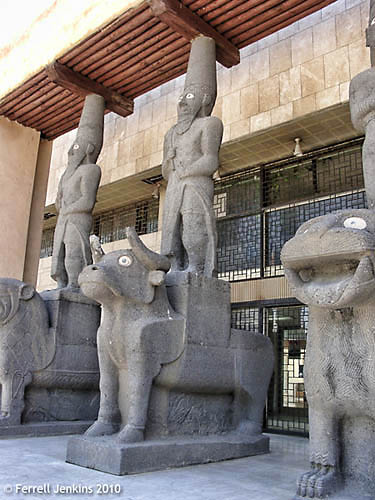
Hadad on a Bull. Aleppo Syria Museum. Photo by Ferrell Jenkins.

Hadad on a Bull. Aleppo Syria Museum. Photo by Ferrell Jenkins.

HT: Joseph Lauer
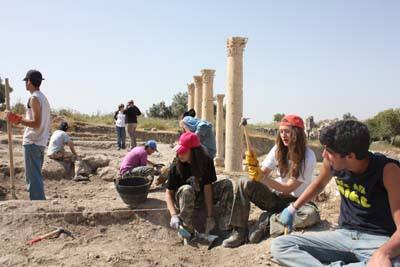
Jodanian students work at Umm Qais

Jordanian students from the International Academy Amman spent a week excavating at Umm Qais. The full article may be read in The Jordan Times here.

Students from the International Academy in Amman work at Um Qais. Photo by Taylor Luck, Jordan Times.

Students from the International Academy in Amman work at Um Qais. Photo by Taylor Luck, Jordan Times.

Umm Qais (a common spelling) is the site of Gadara, one of the cities of the Decapolis. Mendel Nun discovered 16 ancient ports around the Sea of Galilee, including one for the city of Gadara. He describes Gadara:

Gadara, the most magnificent of the Hellenistic towns that circled the Sea of Galilee, was located on the heights of Gilead above the Yarmuk River. The marine suburb and the city’s harbor were located on the southeastern shore of the lake, at Tel Samra (now Ha-on Holiday Village). In form, Gadara’s harbor resembles that of Sussita—a closed basin with an opening to the south—but it is much larger and more luxurious. The central breakwater is 800 feet long and its base 15 feet wide. The promenade was 650 feet long, built with finely chiseled stones, only one of which remains. The 150-foot-wide basin covered an area of 3 acres.

This harbor is superior to the one at Sussita not only because of its size but also because of its facilities. At the center of the promenade are the remains of a tower. Ruins of a large structure—probably the building of the harbor administration—are scattered on the ground near the harbor gate.

Gadara’s maritime character is attested by its coins, which depicted ships of war for some 250 years. The city’s harbor at Tel Samra was almost certainly not only an anchorage for ships. Second-century coins from Gadara commemorate the Naumachia—naval battle games performed for the inhabitants of Gadara. Until recently, researchers assumed that these games took place on the Yarmuk River, which flows into the Jordan just south of the Sea of Galilee; but this does not seem likely, and no remains of a facility of this kind have been found at this site. The large harbor basin at Tel Samra, however, with its 1,600-foot-long combined promenade and breakwater, would surely have been more suitable to accommodate the throngs of spectators as they arrived. In addition, Gadara’s harbor must have been used by thousands of visitors to the famous baths at Hamat Gader, located 5 miles southeast of the sea. The ancient Roman road connecting Beth Shean and Sussita passed near Tel Samra, and the road to Hamat Gader branched off this road. (Mendel Nun. “Ports of Galilee.” Biblical Archaeology Review 25:04; July/Aug 1999)

From Umm Qais (Gadara) one has a great view of the Sea of Galilee and the Yarmuk River valley. We are told that Jesus visited the region of Decapolis.

Then he returned from the region of Tyre and went through Sidon to the Sea of Galilee, in the region of the Decapolis. (Mark 7:31 ESV)

The Gospel of Matthew informs us about the healing by Jesus of two demon-possessed men in the country of the Gadarenes (Matthew 8:28). Mark puts this event in the country of the Gerasenes (Mark 5:1-20). Luke adds that they “sailed to the country of the Gerasenes, which is opposite Galilee” (Luke 8:26).

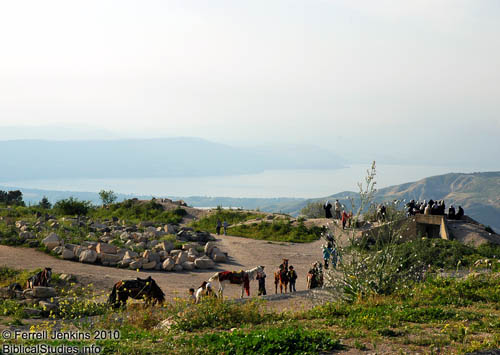
The photo below was made in the late afternoon when citizens of the local Jordanian village came out to enjoy the view. The view across the Sea is not clear, but you can see the entire western coast line. In the right foreground you can see a bunker used by the Jordanians in recent wars in the region. The hill directly across from the bunker is the beginning of the Golan Heights. Prior to 1967 this was in Syria. The Yarmuk River flows into the Jordan River south of the Sea of Galilee. All of the significant rivers of Jordan that flow into the Jordan River have dams on them, thus decreasing the amount of water flowing into the Jordan.

Late afternoon view of the Sea of Galilee from Umm Qais. Photo by Ferrell Jenkins.

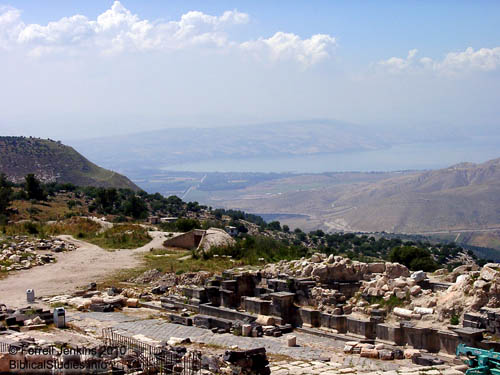
The next photo was made in 2002. It shows a portion of the nymphaeum (attractive water fountain) and the Yarmuk Valley.

The Sea of Galilee from Umm Qais (Gadara). Photo by Ferrell Jenkins.

The Sea of Galilee from Umm Qais (Gadara). Photo by Ferrell Jenkins.

Todd Bolen posted a beautiful, clear photo that also shows the Yarmuk River valley and the nymphaeum here. Note that the nymphaeum had undergone some reconstruction when his photo was made.

HT: Joseph Lauer

Early farming sites uncovered in Syria

The Syrian Department of Archaeology and Museums reports excavations of some farming communities on the Euphrates River in northern Syria dating back to the 10th millennium B.C.

Assistant Director of the Syrian Department of Archaeology and Museums Thaer Yerte said excavations at the site revealed information about the communities that settled on the banks of the Euphrates, uncovering two different areas that include three communal buildings and dozens of circular houses built from limestone and paved with pebbles from the river.

The structures contained various flint tools such as blades, knives, sickles, arrow tips and hatchets, tools used for leatherwork and crafting straw mats, stone mills and pestles, pottery fragments and animal bones and horns, Yerte added.

He pointed out that the first communal building in the site contains a circular hole in the ground 15 meters deep with a diameter of 12 meters, with a clay terrace inside the building containing limestone blocks decorated with engravings of animals, geometrical shapes and the sun. The floor is made of clay tiles painted with lime, while the ceiling is supported by wooden pillars.

The second communal building is circular with a diameter of 7 meters, consisting of five chambers with a square stone support pillar in its center. It contained flint and stone tools, stone pottery, a flint figurine representing a mother goddess, a clay figurine representing a half-human half-animal creature, and ox horns.

The complete article may be read here.

The area in northern Syria and southeastern Turkey along the Euphrates River is known as Paddan-aram in the book of Genesis. This area served as home for several of the biblical patriarchs. See Genesis 25:20; 28:2,5-7; 31:18; 33:18; 35:9,26; 46:15).

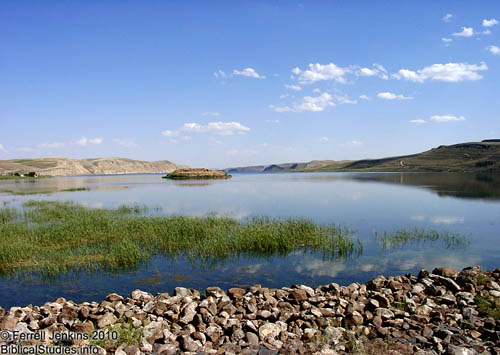
Today’s photo of the Euphrates River was made in northern Syria about 25 miles south of the border with Turkey.

The Euphrates River in northern Syria. Photo by Ferrell Jenkins.

The Euphrates River in northern Syria. Photo by Ferrell Jenkins.

Alexander coins found in northern Syria

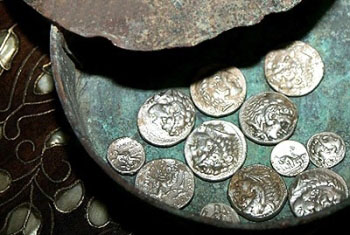
The Global Arab Network, in an article by H. Sabbagh, reports here on the discovery of a collection of Hellenistic coins in northern Syria. The photo shows the coins dating back to the time of Alexander the Great. They were found in the Aleppo district.

Hellenistic coins from discovered in northern Syria.

The coins were found by a local man as he was preparing his land for construction, uncovering a bronze box that contained around 250 coins. He promptly delivered the coins to the authorities who in turn delivered them to Aleppo Department of Archaeology and Museum.

Director of archaeological excavations at Aleppo Department of Archaeology and Museum Yousef Kanjo said the box contained two groups of silver Hellenistic coins: 137 tetra drachma (four drachmas) coins and 115 drachma coins.

One side of the tetra drachma coins depicts Alexander the Great, while the other side depicts the Greek god Zeus sitting on a throne with an eagle on his outstretched right arm. 34 of these coins bear the inscription “King Alexander” in Greek, while 81 coins bear the inscription “Alexander” and 22 coins bear “King Phillip.”

The drachma coins bear the same images as the tetra drachma, with “Alexander” inscribed on 100 of them and “Philip” on 15 of them.

HT: Dr. Claude Mariottini

German Archaeologist: Beneath every footstep in Syria is an ancient civilization

The Global Arab Network reports on a statement made by German archaeologist Markus Gschwind, head of the Syrian-German Archaeology Expedition, here. The report says,

Syria, the land of civilizations and history, is rife with ancient monuments that tell the stories of the many peoples and civilizations that lived in it, whose stories endured in the face of time to tell humanity about their greatness.

“Beneath every footstep in Syria is an ancient civilization,” says Archaeologist Markus Gschwind, head of the Syrian-German Archaeology Expedition working at al-Rafina in Hama. He notes that this saying is repeated around Germany, as most Germans consider Syria the most historically deep-rooted country in the Mediterranean.

In a statement to SANA, Gschwind said that he has been living and excavating in Syria for six years, each day discovering many secrets from the history of mankind.

Gschwind is working at the ancient city of al-Rafina in Hama. Hama is at the site of Biblical Hamath  (2 Kings 14:25; 2 Chronicles 8:4).

My limited visits to Syria have convinced me that the statement by Gschwind is correct. Of course, the same could be said of Israel, Jordan, Turkey, Iraq, et al.

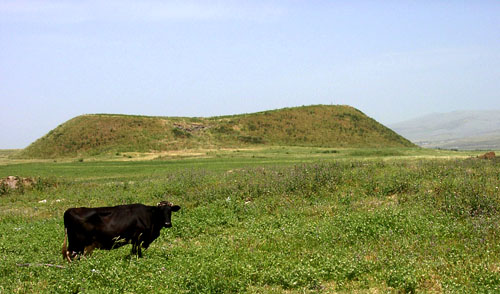
The Assyrian Empire ruled the ancient near east from the battle of Qarqar (853 B.C.) till the battle of Carchemish (605 B.C.) when they were defeated by the Babylonians. Nineveh had fallen seven years earlier. This was the time of the Divided Kingdom period in Israelite history, and Assyria had contact with a numerous biblical kings. Ahab, for example, fought against the Assyrians at Qarqar. Qarqar is north of Hammath. Both are on the Orontes River.

Qarqar on the Orontes. Photo by Ferrell Jenkins.The tell of Qarqar in northern Syria. Photo by Ferrell Jenkins.

HT: Biblical Paths

Mount Hermon

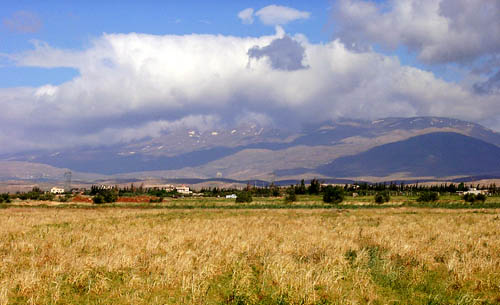
Mount Hermon is the southern end of the Anti-Lebanon mountain range. The mountain is about 20 miles long and has three peaks. At 9,232 feet above sea level it is the highest mountain of Canaan, or Roman Syria, named in the Bible. The mountain now is shared by the countries of Lebanon, Syria, and Israel. The photo below shows mount Hermon from the east, a few miles south of Damascus toward Quneitra. This photo was made the middle of May, 2002. There was more snow on the west side of the mountain in Lebanon than you see here.

View of Mount Hermon from the East. Photo by Ferrell Jenkins 2002.

View of Mount Hermon from the East. Photo by Ferrell Jenkins 2002.

The first biblical reference to Mount Hermon is found in Moses’ account of the Israelite conquest of transjordan (Deuteronomy 3:8). He says that Israel took the land from the hand of two Amorite kings “from the valley of Arnon to Mount Hermon.” The Sidonians, of ancient Phoenicia, called the mountain Sirion, and the Amorites called it Senir (Deuteronomy 3:9). The half-tribe of Manasseh lived in the area of Bashan which is south of Mount Hermon (1 Chronicles 5:23). The Mountain of Bashan is probably a reference to Mount Hermon (Psalm 68:15). Hermon is mentioned in four references in the poetic books of the Old Testament (Psalm 42:6; 89:12; 133:3; Song of Solomon 4:8).

The heavens are yours; the earth also is yours; the world and all that is in it, you have founded them. The north and the south, you have created them; Tabor and Hermon joyously praise your name. (Psalm 89:11-12 ESV)

USA sends ambassador back to Syria

For whatever reason(s) the media seems to have overlooked the decision of the Obama administration to send an ambassador back to Syria. Read a little about the decision at CNN.

Syria is an important country historically and politically. The capital city of Damascus is mentioned as early as the time of Abraham (Genesis 14:15), and there is indication that Abraham had considerable contact with the city. He suggests that Eliezer of Damascus might become his heir in the absence of a natural son (Genesis 15:2).

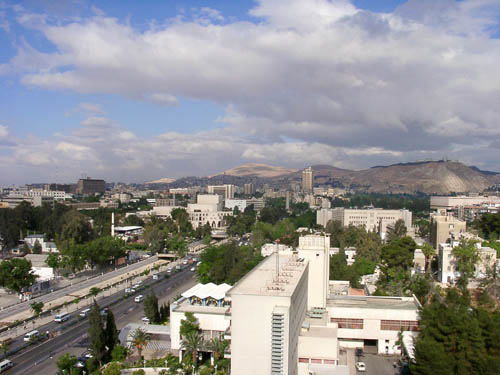
Damascus is situated immediately east of the Anti-Lebanon mountain range on what Rainey calls “the Damascus tableland” (The Sacred Bridge, 32). The River Barada (probably the Abanah of 2 Kings 5:12) runs east from the Anti-Lebanon range through the city of Damascus. The Syrian Desert stretches east of Damascus to the Euphrates River valley. The photo below was made looking west from my hotel balcony to the mountain range. The main part of the city is to the right (north). Go south a few miles and you have a clear view of Mount Hermon.

View of Damascus looking west. Photo by Ferrell Jenkins 2002.

View of Damascus looking west. Photo by Ferrell Jenkins 2002.

The only references to Damascus in the New Testament are those associated with the conversion of Saul of Tarsus (the Apostle Paul). All but two of these are in Acts 9, 22, and 26. The others are in 2 Corinthians 11:32 and Galatians 1:17.

The Syria of today is not the same political entity we read about in the Bible; only the name is the same.

Euphrates River in northern Syria

The photos we post of the Euphrates River are always popular. I suppose this is because of the historic events associated with the river, and because so few people have seen the river. The Euphrates begins in the mountains of eastern Turkey (ancient Urartu/Ararat), flows south through Syria and Iraq before ending at the Persian Gulf.

Some of the great Bible characters are associated with the River, even when it is not named. We can be sure that Abraham crossed the Euphrates when he left Haran and headed south to Canaan (Genesis 11:32 – 12:1-9). I like the account of Jacob fleeing from Laban.

He left with all he owned. He quickly crossed the Euphrates River and headed for the hill country of Gilead. (Genesis 31:21 NET)

This photo was made in northern Syria, northeast of Aleppo in 2002. Here the river is wide because of a series of dams built by the Syrians. This can not be far from the place where the biblical patriarchs crossed the river.

The Euphrates River in northern Syria. Photo by Ferrell Jenkins.

The Euphrates River in northern Syria. Photo by Ferrell Jenkins.

Reminders of Patriarchal Life

The Bible paints a clear picture of the life of the patriarchs, especially Abraham, Isaac, and Jacob. Just type the words tent and tents in your computer Bible search engine. Here are a few things said about the biblical patriarchs. (You need to remove the hits referring to the “tent of meeting” or tabernacle.)

  • Lot and Abraham had flocks and herds and tents (Genesis 13:5).
  • Numerous references mention moving the tent (see Genesis 13:18).
  • Jacob was a peaceful man, living in tents (Genesis 25:27).
  • Even as late as the time of David many were living in tents (2 Samuel 18:17).

The writer of Hebrews describes the faith of Abraham this way:

By faith he lived as a foreigner in the promised land as though it were a foreign country, living in tents with Isaac and Jacob, who were fellow heirs of the same promise. (Hebrews 11:9)

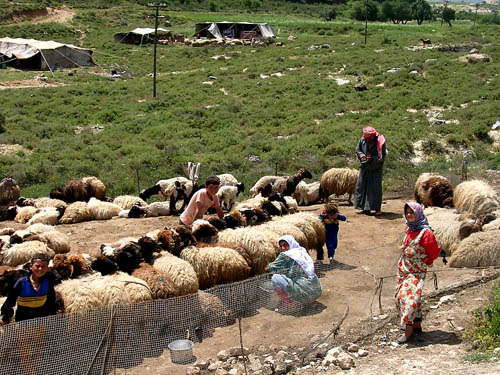
One of the values of travel to the lands of the Bible is to see many customs reminiscent of Bible times. In 2002 I spent nearly a week in Syria with a colleague visiting biblical and historical sites. North of Latakia, almost to the border with Turkey, we saw a settlement of what appeared to be at least three families living in tents. One man was clearly the “patriarch” of the group. Several women were busy working. One was milking the sheep. The tents were spread out over about an acre or more of land.

Shepherd settlement in northeastern Syria. Photo by Ferrell Jenkins.

Shepherd settlement in northeastern Syria. Photo by Ferrell Jenkins.

I think one could envision Abraham and his family in much the same way.

Riblah in the land of Hamath

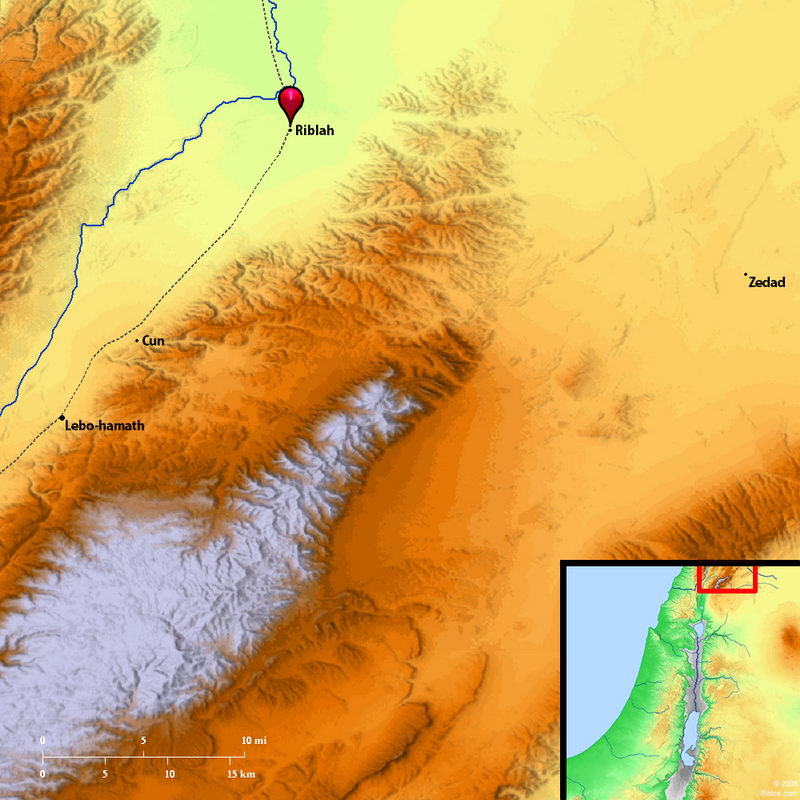
Riblah served as a base of operation for the Egyptian Pharaoh Necho and the Babylonian King Nebuchadnezzar. The city is located on a broad plain about 20 miles south of Hamath (modern Hama in Syria), on the main road between Egypt and Mesopotamia. The Orontes River flows past the site on the west side. On a modern map you will locate Riblah in Syria immediately north of the border with Lebanon.

There is little more than a “country store” at the site today, but the name Riblah is preserved as Ribleh, Syria.

Riblah in the land of Hamath. Courtesy BibleAtlas.org.

Riblah in the land of Hamath. Courtesy BibleAtlas.org.

  • Pharaoh Necho imprisoned Jehoahaz, king of Judah, at Riblah. He later took him to Egypt where he died. The date was about 609 B.C. (2 Kings 23:31-34).
  • Zedekiah, puppet king of Judah, tried to escape capture by the Babylonians. He fled Jerusalem but was captured on the plains of Jericho and brought to Riblah. There Nebuchadnezzar passed sentence on him. His sons were slaughtered in his sight and he was bound with brass fetters and taken to Babylon. The date was 586 B.C. (2 Kings 25:5-7; see also Jeremiah 39:5-6; 52:9-10).
  • The officials of Zedekiah were taken to Riblah where they were put to death (2 Kings 25:19-21; see also Jeremiah 52:26-27).

In 2002 a colleague and I spent several days visiting sites in Syria. Riblah was the most difficult to locate. Most folks, after seeing the site, would probably say, “What’s the big deal?”  Even though Riblah is mentioned only these few times in the Old Testament, it’s location makes it important in all movement between the south (Egypt and Israel) and Mesopotamia.

Riblah in the land of Hamath. Photo by Ferrell Jenkins.

Riblah in the land of Hamath. Photo by Ferrell Jenkins.

The slopes of this tell are now used as a cemetery. We know that this would make it difficult to negotiate rights to excavate.