Tag Archives: Roman Empire

Second century A.D. gold coin found at Bethsaida

“Rare coin bears good tidings for UNO’s Israeli excavations” is the headline for an article by John Keenan in the Omaha World-Herald.

Dr. Rami Arav, of the University of Nebraska Omaha, is the director of the excavation at et-Tell in Galilee. I’m sure it wasn’t necessary for the reporter to say that Arav was excited when Alexis Whitley, one of the volunteers at the dig, found a gold coin dating to the mid-second century A.D.
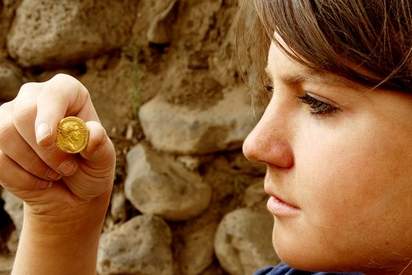
Alexis Whitley - a volunteer from West Virginia University.

Alexis Whitley - a volunteer from West Virginia University.

The coin, which weighs 7 grams, is 97.6 percent gold, Arav said.

The find was unexpected because Bethsaida primarily was home to humble fishermen, he said. Arav said somebody must have been doing good business a little more than 100 years after the birth of Christ.

The gold coin, about three-quarters of an inch in diameter, carries the image of Antoninus Pius, the 15th Roman emperor, who reigned between A.D. 138 and 161.

“Before newspapers, coins fulfilled the job of disseminating information. In our case, Antoninus wanted to announce that the Senate designated him to the position of a consul for the second time. This position was among the highest at Rome.”

Arav thinks this is the first Antoninus Pius gold coin excavated in Israel. I like the fact that he gave credit to the young volunteer who discovered the coin.
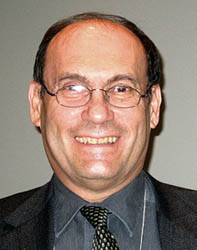
Prof. Rami Arav. Photo by Ferrell Jenkins.

Rami Arav. Photo: F. Jenkins.

“This type of a coin was never sold in the market because it is so rare,” he said. “It may go for as much as people will be able to pay for it.”

For now, the coin — along with the rest of the Bethsaida finds, considered to be the heritage of the State of Israel — will go to the Israel Antiquities Authority. Its ultimate destination probably will be the Israel Museum in Jerusalem, Arav said.

“Bethsaida has already enriched the Israel Museum with a few other outstanding and rare finds.”

The article in its entirety may be read here.

Bethsaida is mentioned in the New Testament as the place where Jesus healed a blind man (Mark 8:22-25). Not everyone agrees with Dr. Arav’s identification of et-Tell as Bethsaida, where he has been working for nearly a quarter of a century. See a previous post about Bethsaida here.

A report of the Bethsaida 2010 excavation is posted here. Photos of coins, including the gold coin, and items associated with fishing are posted under Special Pics. Shai Schwartz has posted 234 photos from the recent excavation in his Picasa album here.

HT: Joseph Lauer, Paleojudaica, Bible Places Blog.
Roman altar excavated at Ashkelon

It happens with regularity in Israel. Someone is building. The builder encounter ancient ruins. The Israel Antiquities Authority is called. (I wonder how many times they are not called.) Construction is halted while an emergency excavation is conducted. Amazing discoveries are often uncovered.

This time it happened at Ashkelon during construction of an Emergency Room at the Barzilai Hospital. Here is the account provided by the IAA.

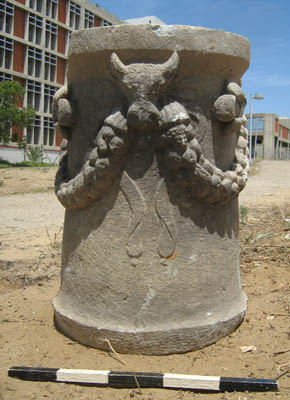
The development work for the construction of a fortified emergency room at Barzilai Hospital, which is being conducted by a contractor carefully supervised by the Israel Antiquities Authority, has unearthed a new and impressive find: a magnificent pagan altar dating to the Roman period (first-second centuries CE) made of granite and adorned with bulls’ heads and a laurel wreaths. The altar stood in the middle of the ancient burial field.

According to Dr. Yigal Israel, Ashkelon District Archaeologist of the Israel Antiquities Authority, “The discovery further corroborates the assertion that we are dealing with a pagan cemetery. It is an impressive find that has survived 2,000 years. The altar is c. 60 centimeters [24 inches] tall and it is decorated with bulls’ heads, from which dangle laurels wreaths. There is a strap in the middle of each floral wreath and bull’s head. The laurel wreaths are decorated with grape clusters and leaves. This kind of altar is known as an “incense altar”. Such altars usually stood in Roman temples and visitors to the temple used to burn incense in them, particularly myrrh and frankincense, while praying to their idols. We can still see the burnt marks on the altar that remain from the fire. The altar was probably donated by one of the families who brought it to the cemetery from the city of Ashkelon”.

Roman altar discovered at Ashkelon. Photo: IAA.

Roman altar discovered at Ashkelon. Photo: IAA.

More information is available from the IAA here.

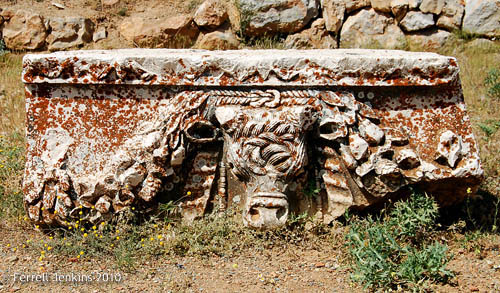
The motif on this altar is common in the Greco-Roman world. The photo below shows a similar bull’s head on what appears to be part of an architectural frieze in the Augustan Imperial Sanctuary at Pisidian Antioch.

From Augustan Imperial Sanctuary at Pisidian Antioch. Photo by Ferrell Jenkins.

From Augustan Imperial Sanctuary at Pisidian Antioch. Photo by Ferrell Jenkins.

The Archaeological Museum in Thessalonica exhibits an altar from the Roman Imperial age (35 B.C.) that, according to the inscription on it, was reused as a pedestal in the temple of Isis in the 2nd century A.D.

Roman Imperial Altar. Thessalonica, Greece, Museum. Photo by Ferrell Jenkins.

Roman Imperial Altar. Thessalonica Museum. Photo: Ferrell Jenkins.

These stones showing garlanded animals remind me of what happened to Paul and Barnabas at Lystra in Lycaonia.

And the priest of Zeus, whose temple was at the entrance to the city, brought oxen and garlands to the gates and wanted to offer sacrifice with the crowds. (Acts 14:13 ESV)

HT: Joseph Lauer and numerous blogs. Note especially the comments on the current religious/political comments by Jim West and Aren Maeir about the Ashkelon altar at Zwinglius Redivivus.

Roman Legions in Jerusalem

Rome gained control over the western Mediterranean in 146 B.C. By 131 B.C. Rome controlled the previous territory of Attalus, king of Pergamum. By 64 B.C., the Roman general Pompey ended the Seleucid dominion in Syria and the territory was annexed as another Roman province. Judea became a part of the Roman province of Syria. The Romans occupied the land they would name Palestine until the 4th century A.D.

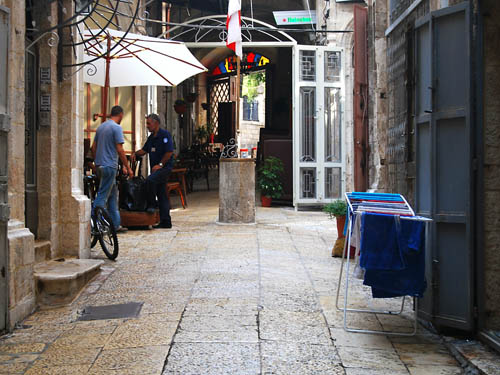
There are numerous tangible evidences of the Roman rule of the country. One Roman column is located inside the Old City at Jaffa Gate. If you enter the Old City through Jaffa Gate, look to the left. I think the first street is Latin Patriarchate. The next “street” is a covered entry to several small businesses. Anyway, if you get to Jaffa Gate you can look down the little streets until you see the Roman Column serving as a lamp-post. (It appears that this was never any higher; not a column, but a post.)

Roman Legions Column near Jaffa Gate. Photo by Ferrell Jenkins.

Roman Legions Post near Jaffa Gate. Photo by Ferrell Jenkins.

Murphy-O’Connor (The Holy Land) says the post honors the Legate of the emperor Septimius Severus, and was erected about A.D. 200. He gives the following reading of the inscription:

M(arco) Iunio Maximo leg(ato) Aug(ustorum) Leg(ionis) X Fr(etensis) — Antoninianae — C. Dom(itius) Serg(ius) str(ator) eius.

The tenth legion participated in the destruction of Jerusalem in A.D. 70, and remained in the city for about 200 years.

Roman Column of Tenth Legion in Jerusalem. Photo by Ferrell Jenkins.

Roman Post of Tenth Legion in Jerusalem. Photo by Ferrell Jenkins.

Longest underground Roman aqueduct

A recent article in Spiegel Online reports on the discovery of “The Ancient World’s Longest Underground Aqueduct.”

Roman engineers chipped an aqueduct through more than 100 kilometers of stone to connect water to cities in the ancient province of Syria. The monumental effort took more than a century, says the German researcher who discovered it.

When the Romans weren’t busy conquering their enemies, they loved to waste massive quantities of water, which gurgled and bubbled throughout their cities. The engineers of the empire invented standardized lead pipes, aqueducts as high as fortresses, and water mains with 15 bars (217 pounds per square inch) of pressure.

In the capital alone there were thousands of fountains, drinking troughs and thermal baths. Rich senators refreshed themselves in private pools and decorated their gardens with cooling grottos. The result was a record daily consumption of over 500 liters of water per capita (Germans today use around 125 liters).

However, when the Roman legions marched into the barren region of Palestine, shortly before the birth of Christ, they had to forgo the usual splashing about, at least temporarily. It was simply too dry.

The article by Matthias Schulz says,

This colossal waterworks project supplied the great cities of the ‘Decapolis’ – a league originally consisting of 10 ancient communities — with spring water. The aqueduct ended in Gadara, a city with a population of approximately 50,000. According to the Bible, this is where Jesus exorcized demons and chased them into a herd of pigs.

The full story may be read here. There are some nice photos and diagrams.

The identification of the “country of the Gadarenes” (Matthew 8:28-34), and the “country of the Gerasenes” (Mark 5:1; Luke 8:26-39), and the exact place where the swine rushed down the steep cliff into the Sea, is a difficult one.  And I don’t have the time to work on it today.

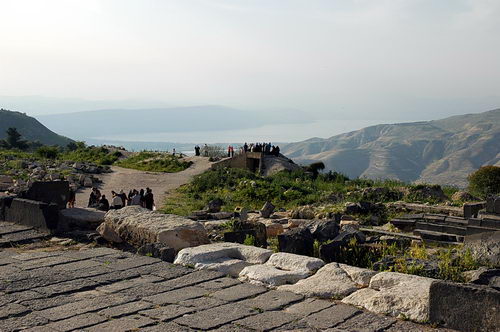
View of Sea of Galilee from Umm Queis. Photo by Ferrell Jenkins.

View of Sea of Galilee from Umm Queis. Photo by Ferrell Jenkins.

We know that Gadara had a port on the Sea of Galilee, and that Roman coins of the city portrayed ships.

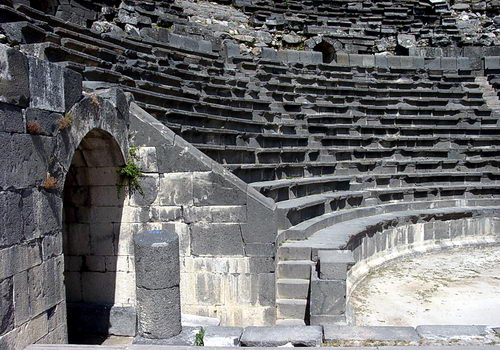
Here is a photo of the Roman theater of Umm Queis. The earliest buildings of this city are made of basalt, the volcanic rock common in the area.

The basalt theater at Umm Queis. Photo by Ferrell Jenkins.

The basalt theater at Umm Queis. Photo by Ferrell Jenkins.

HT: Joe Lauer

The Roman city of Volubilis

Students of the New Testament probably realize that the Roman Empire was vast. Did you know that there are ruins of a large Roman city in Morocco in north eastern Africa? Twice I have taken tours to Volubilis, about 20 miles from Meknes. Most of the ruins in the city date from the second and third centuries A.D. I have a slide from a 1980 tour with the name of the first century emperor Claudius (A,D, 51-54) on it. This was the time of Paul’s journeys (Acts 18:2).

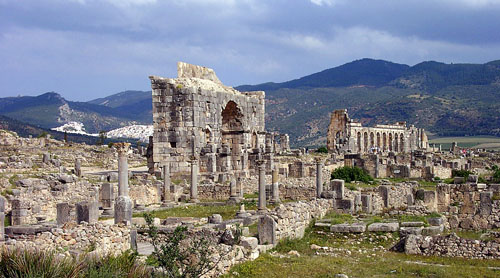
This photo shows the Triumphal Arch dedicated to the Emperor Caracalla and his mother in A.D. 217. The Roman Basilica is visible on the right.

Roman ruins of Volubilis in Morocco. Photo by Ferrell Jenkins.

Roman ruins of Volubilis in Morocco. Photo by Ferrell Jenkins.

Volubilis has been added to the list of World Heritage Sites because “this site is an exceptionally well preserved example of a large Roman colonial town on the fringes of the Empire.”