Tag Archives: museums

Israel Museum set to open in two months

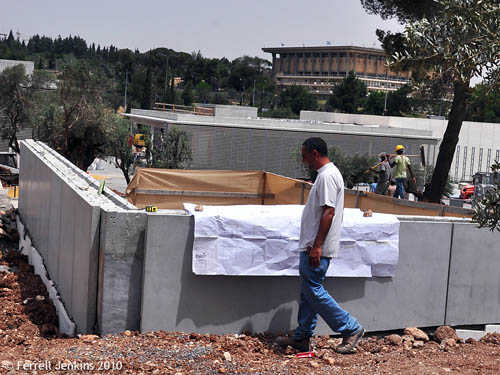
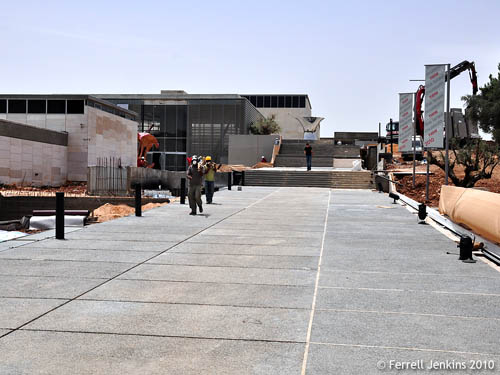
The Bible Places Blog reports here that the Israel Museum, after a lengthy and expensive renovation, is scheduled to reopen July 26. Twice, during the recent trip to Israel, I visited the grounds of the Israel Museum. The last visit to the Second Temple Model was ten days ago. At that time I made a few photos of the work going on outside the museum.

Construction at the Israel Museum - May 17, 2010. Photo by Ferrell Jenkins.

Construction at the Israel Museum - May 17, 2010. Photo by Ferrell Jenkins.

From the outside the Museum looks much the same as before, especially the long, uphill walk to get to the entrance.

Reading the Blueprint at the Israel Museum - May 17, 2010. Photo by Ferrell Jenkins.

Reading the Blueprint at the Israel Museum - May 17, 2010. Photo by Ferrell Jenkins.

The already impressive location of the Museum campus with the Shrine of the Book, the Second Temple Model and the nearby Israeli Knesset building is sure to be even more impressive.

I look forward to my next visit to Jerusalem when I may again see the wonderful exhibits inside the Museum. The great museums of the world with biblical collections, the British Museum, the Louvre, the Metropolitan in New York, the Istanbul Archaeological Museum, the Oriental Institute of the University of Chicago, the University of Pennsylvania, the National Museum in Athens, and the Pergamum Museum in Berlin, allow photographs of their exhibits. It would be great to see the Israel Museum follow the practice of these outstanding museums. Then, only the museums in Amman, Cairo, and Damascus would be out of step.

HT: Bible Places Blog

What is in the basement of the Cairo Museum?

Tourists who visit the Egyptian Museum in Cairo are overwhelmed at the large collection of Egyptian artifacts. In fact, most folks just see a few of the displayed items. Have you ever thought about the basement. Take a look at this video featuring Dr. Zahi Hawass, the flamboyant director of antiquities in Egypt.


Now, if they would only allow the taking of photos in the galleries!
HT: Biblical Paths

A visit to the Siegfried H. Horn Museum

Andrews University in Berrien Springs, Michigan, has long been associated with archaeological work, especially in Jordan. This work is carried out under the name of the Institute of Archaeology.

The interesting history of the Siegfried H. Horn Museum may be read here. The name of Siegfried H. Horn is well known to anyone who had read about biblical archaeology in modern times.

Last week I was at Valparaiso, Indiana, presenting a series of lessons on Bible History and Archaeology. I had long wanted to visit the Horn Archaeological Museum. When we learned that we were slightly more than an hour away, Mark Russell, Steve Wolfgang and I made the trip one morning. The Museum is hopeful of moving into a new facility as soon as the project can be funded. At this time the small museum is open only on Saturday afternoon, but they will open by appointment, as they did for us.

The Siegfried H. Horn Archaeological Museum houses over 8,500 artifacts, but only a small portion of those are on display. There are replicas of a few famous artifacts such as the Black Obelisk of Shalmannessar II and the Moabite Stone

There are significant original pieces from most areas of the Bible world with Mesopotamia and Transjordan being featured. There is a mummified Ibis from Egypt. The Egyptian god Thoth was portrayed with the head of an Ibis. I never see representations of these gods without thinking of Paul’s description of the Roman world prior to the coming of Christ.

Claiming to be wise, they became fools, and exchanged the glory of the immortal God for images resembling mortal man and birds and animals and creeping things. (Romans 1:22-23 ESV)
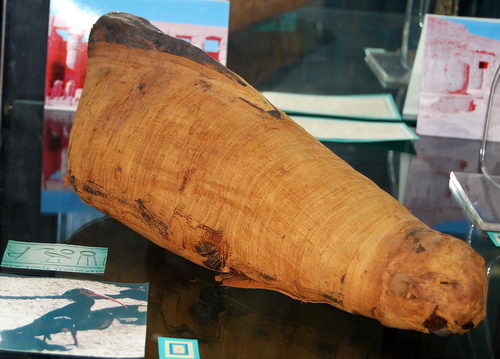
Mummfied Ibis from Egypt. Photo by Ferrell Jenkins.

Mummified Ibis from Egypt. Photo by Ferrell Jenkins.

In the main exhibit hall there is a life-size Bedouin tent. This makes a good background for explaining patriarchal life.
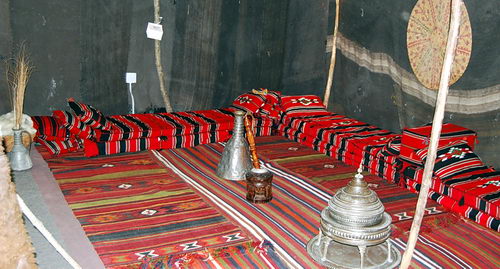
Authentic Bedouin Tent at Horn Museum. Photo by Ferrell Jenkins.

Authentic Bedouin Tent at Horn Museum. Photo by Ferrell Jenkins.

By faith Abraham obeyed when he was called to go out to a place that he was to receive as an inheritance. And he went out, not knowing where he was going. By faith he went to live in the land of promise, as in a foreign land, living in tents with Isaac and Jacob, heirs with him of the same promise. For he was looking forward to the city that has foundations, whose designer and builder is God. (Hebrews 11:8-10 ESV)

Two other things should be mentioned. There are some wonderful models. One that impressed me was of the Roman rolling-stone tomb at Heshbon. The murals covering biblical and modern church history are impressive.

I recommend that anyone traveling in the vicinity of Berrien Springs, or those living within driving distance, take advantage of this opportunity to visit. Bible class teachers would do well to become familiar with this Museum and arrange for their students to see it.

Our thanks to Jody Washburn, an Administrative Assistant at the Institute of Archaeology, for her help in making our visit pleasant.

The Oriental Institute at the University of Chicago

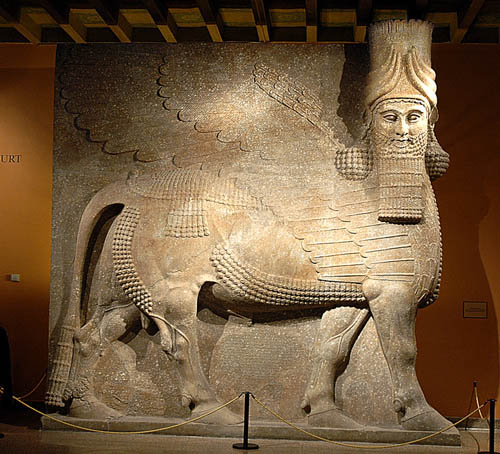
The Oriental Institute at the University of Chicago is one of the great museums of biblically related artifacts in the world. The University of Chicago excavated at the Neo-Assyrian city of Khorsabad from 1928 to 1935. This site was the fortress of King Sargon II (721-705 B.C.).

Assyrian winged bull, OIUC. Photo by Ferrell Jenkins.

Assyrian winged bull, OIUC. Photo by Ferrell Jenkins.

The OIUC web page describes the winged bull this way:

This colossal sculpture was one of a pair that guarded the entrance to the throne room of King Sargon II. A protective spirit known as a “lamassu”, it is shown as a composite being with the head of a human, the body and ears of a bull, and the wings of a bird. When viewed from the side, the creature appears to be walking; when viewed from the front, to be standing still. Thus it is actually represented with five, rather than four, legs.

Sargon II is mentioned only once in the Bible (Isaiah 20:1). There was a time when some critics denied the existence of Sargon II and suggested that the Bible writer made up the name. The great museums, Oriental Institute, British Museum, and the Louvre, have abundant evidence of his existence.

Photography is allowed in the museum.

The museum website will provide all the info you need to plan your visit to the Oriental Institute Museum.

Nineveh in danger of urban sprawl

It is no longer news that the ancient sites of Iraq are in danger of destruction. This has been caused by war, looting, and now urban sprawl. There is an informative article about the threat facing Ninevah (spelled Nineveh in English Bible translations) in The Christian Science Monitor here.

We can be thankful that many of the artifacts of ancient Sumer, Akkad, Assyria, Babylon, et al. are now displayed in the great museums of the world. The reliefs from the palace of the Assyrian king Sennacherib are displayed in the British Museum.

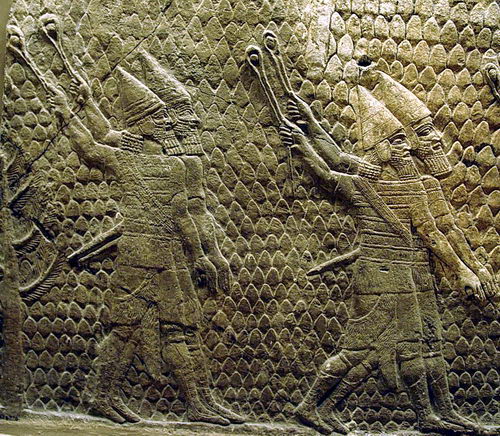
The panel below is a portion showing the Assyrian slingers at Lachish at the end of the 8th century B.C. The Bible says,

Then Sennacherib king of Assyria departed and went home and lived at Nineveh. (2 Kings 19:36)

King Sennacherib had these reliefs carved on his palace walls in Nineveh. Click on the image for a larger one.

Assyrian slingers at Lachish. Photo by Ferrell Jenkins.

Assyrian slingers at Lachish. Photo by Ferrell Jenkins.

The greatness of Nineveh is mentioned in the book of the prophet Jonah.

Arise, go to Nineveh, that great city, and call out against it the message that I tell you. (Jonah 3:1)

It would be nice if world conditions (economic, political, and religious) allowed renewed archaeological excavation of sites such as Nineveh.

HT: Joseph I. Lauer

Nefertiti smuggled from Egypt?

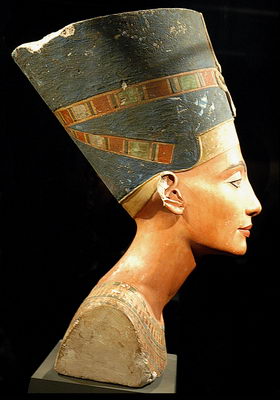
The title tells a lot. “Secret note reveals how Germany smuggled Queen Nefertiti bust from Egypt.” Here are a few excerpts:

Nefertiti bus in Berlin. Photo by Ferrell Jenkins.

Nefertiti bust in Berlin. Photo by Ferrell Jenkins.

German archaeologists cheated Egyptian customs officers in order to smuggle the 3,400-year-old bust of Queen Nefertiti to Berlin, according to a secret document unearthed in archives….

The document is sure to stoke the row between German and Egypt over the removal of antiquities at the beginning of the 20th century.

The document, discovered in the German Oriental Institute, shows that the archaeologist Ludwig Borchardt deliberately hid the true value of the Nefertiti bust when he submitted the inventory of his finds to the Egyptian authorities in 1913….

The agreement was that Germany and Egypt would divide the spoils equally between them. But, says the witness, Borchardt “wanted to save the bust for us”. So it was tightly wrapped up and placed deep in a box in a poorly lit chamber to fool the chief antiquities inspector, Gustave Lefebvre….

It was enough to get Nefertiti out of the country into Germany. Now her long swan-like neck and exquisite features have come to symbolise the join between ancient and modern ideas of feminine beauty. Over half a million visitors a year are drawn to see her at Berlin’s Egyptian Museum.

But Egypt wants Nefertiti back and a document showing that the bust only left the country because of skulduggery could well strengthen Cairo’s case. Zahi Hawass, secretary-general of the Supreme Council of Antiquities in Egypt, has already threatened trouble. “We will make the lives of these (German) museums miserable,” he said.

At the very least Cairo wants Nefertiti back on loan to mark the opening of a new Grand Egyptian Museum, near the pyramid at Giza, in 2012.

For the full print story read here.

Nefertiti was the wife (Queen) of Pharaoh Akhenaten in 14th century B.C. Egypt.

HT: J. T. Lauer

Assyria in Boston

The British Museum probably has the best collection of Assyrian artifacts in the world. The Louvre has a good collection, too. Currently 250 artifacts from the British Museum are on exhibit at the Museum of Fine Arts in Boston. The exhibition runs through January 4. This exhibition was likely timed to coincide with the meetings of the Society of Biblical Literature and the American Schools of Oriental Research in mid-November.

Even if you can’t make it to Boston you might find the web page of interest. Check mfa.org.

The Assyrian Empire ruled the ancient near east from the battle of Qarqar (853 B.C.) till the battle of Carchemish (605 B.C.) when they were defeated by the Babylonians. Nineveh had fallen seven years earlier. This was the time of the Divided Kingdom period in Israelite history, and Assyria had contact with a numerous biblical kings. Ahab, for example, fought against the Assyrians at Qarqar.

One of the famous Assyrian kings was Sargon II. He is mentioned only once in the Bible.

In the year that the commander came to Ashdod, when Sargon the king of Assyria sent him and he fought against Ashdod and captured it. (Isaiah 20:1)

For many years there was no known reference to Sargon II in the Assyrian records. Yet, the prophet Isaiah, writing at the time of the Assyrian captivity of the northern kingdom of Israel, mentions Sargon at Ashdod.

The palace of Sargon was discovered by Emile Botta at Khorsabad in 1843. This was the period of “momumental” discoveries in archaeology. The photo below shows the top half of Sargon (on the left) receiving his minister. I think you will have to go to London to see this one.

Sargon II receives his minister. From the palace in Khorsabad. British Museum. Photo by Ferrell Jenkins.

Sargon II receives his minister. From the palace in Khorsabad. British Museum. Photo by Ferrell Jenkins.