Tag Archives: Ministry of Jesus

The synagogue — a place of study and discussion

The origin of the synagogue is difficult to determine, but it is generally held that it arose during the time of the Babylonian exile. Synagogues did not become common until the intertestamental period. The term intertestamental is used by many writers to describe the period between the close of the Old Testament (about 425 B.C.) and the coming of John the Baptist in the early first century A.D. Others use the term interbiblical, or the longer phrase, between the testaments.

With the destruction of the Temple (586 B.C.), sacrifices ceased. Prayer and the study of the sacred Scriptures, however knew no geographical limitations. The Book of Ezekiel describes the elders of Israel gathering in the prophet’s house (8:1; 20:1-3) (Charles Pfeiffer, Between the Testaments, 59).

In the sixth year, in the sixth month, on the fifth day of the month, as I sat in my house, with the elders of Judah sitting before me, the hand of the Lord GOD fell upon me there. (Ezekiel 8:1 ESV)

In the seventh year, in the fifth month, on the tenth day of the month, certain of the elders of Israel came to inquire of the LORD, and sat before me. And the word of the LORD came to me: “Son of man, speak to the elders of Israel, and say to them, Thus says the Lord GOD, Is it to inquire of me that you come? As I live, declares the Lord GOD, I will not be inquired of by you. (Ezekiel 20:1-3 ESV)

The word synagogue is of Greek origin. It simply refers to a gathering of the people, or a congregation. “The Hebrew word for such a gathering is keneseth, the name used for the parliament in the modern state of Israel” (Pfeiffer, 59).
After the rebuilding of the Temple (520–516 B.C.), the synagogue continued to fill the spiritual needs of the Jews of the Diaspora. There were synagogues in many of the cities visited by Paul: Damascus (Acts 9:2); Salamis (13:5); Antioch of Pisidia (13:14); Thessalonica (17:1); Corinth (18:4); Ephesus (19:8), and others. Only ten families were needed to compose a synagogue.

In 1898 a partial inscription mentioning a “synagogue of the Hebrews” was found at Corinth. It was published by Benjamin Powell in 1903 and identified as having come from the synagogue where Paul preached. McRay says that further study showed that it should be dated considerably later than the time of Paul. (Archaeology and the New Testament, p. 319).
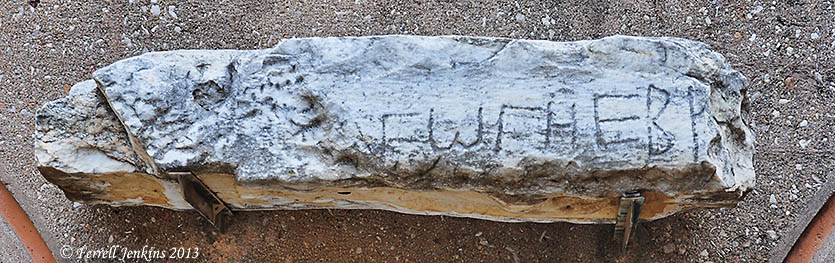
Synagogue Inscription displayed in Corinth Museum. Photo by Ferrell Jenkins.

Synagogue Inscription displayed in Corinth Museum. Photo by Ferrell Jenkins.

A small plaque mounted underneath the inscription at the Corinth Museum reads, “Inscription from a late Roman synagogue.”

One rabbinic tradition has it that there were 480 synagogues in Jerusalem alone. Even the small villages of Galilee had synagogues at the time of Jesus (Mt. 4:23; 9:35).
Jesus withdrew to Ephraim

The raising of Lazarus of Bethany brought much attention to Jesus and His ministry (John 11). According to John’s account, beginning in verse 45, many who saw the sign believed on Him. This caused the chief priests and Pharisees to convene a council. They were concerned about what the Romans might do if Jesus continued His work. Caiaphas, the high priest that year, told the council that it would be better for one man to die than for the whole nation to perish. In fact, John says this was a prophecy that Jesus was going to die for the nation. The text says,

So from that day on they made plans to put him to death. (John 11:53 ESV)

Jesus had other plans. Jesus carefully orchestrated His death. From the beginning of His ministry He spoke of His hour. After the raising of Lazarus he withdrew to a place northwest of Jerusalem on the edge of the wilderness at Ephraim.

Jesus therefore no longer walked openly among the Jews, but went from there to the region near the wilderness, to a town called Ephraim, and there he stayed with the disciples. (John 11:54 ESV)

Jesus would offer Himself as the sacrificial lamb at the time of the Passover. This took intricate planning.

Where is this place called Ephraim?

The identity of this place is complicated, partly because of the obscurity of the place and because of the change of names in the various languages that have prevailed in the territory over the centuries. Let’s try to work through some of the details.

Baal-hazor, where Absalom had sheep shearers, is said to be near Ephraim (2 Samuel 13:23).

The Ephron of 2 Chronicles 13:19 is often identified with Ephraim and the Ophrah of Joshua 18:23. Ophrah was in the tribal territory of Benjamin and near Bethel. Ophrah, which we are equating with Taybeh (tie-BAY), is only 4 miles north-east of Bethel and about 15 miles from Jerusalem.

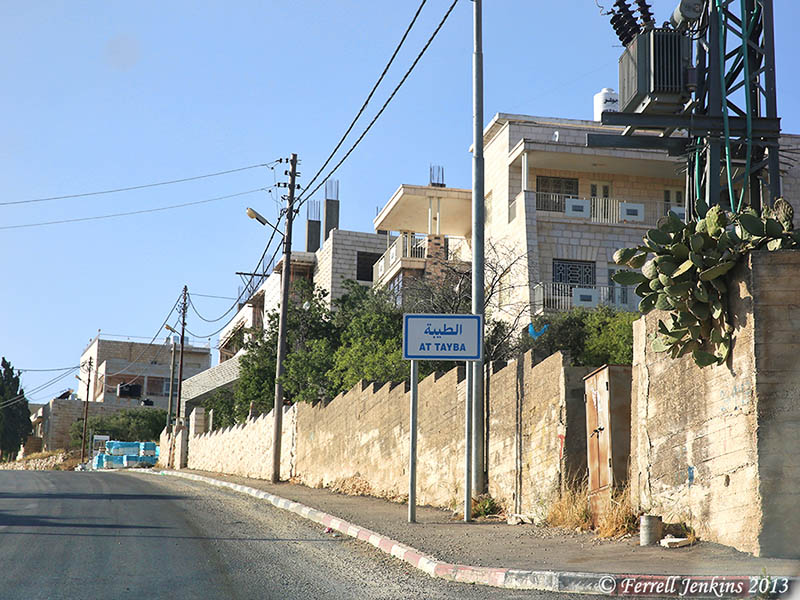
What is the name of Ephraim today? Ephraim is often identified with a Christian Arab town in the West Bank Palestinian territory known as At-Taybe. On Highway 60 a sign points to Taybeh, the spelling I am using. Carta’s Israel Touring Atlas spells it Et-Tayibeh.

Checking the Maps. Taybeh should be reached easily from Highway 60 by taking Highway 449 east at Ofra, and then a smaller road to the village. This is not possible. Ofra is an Israeli settlement, and the road is blocked for those wishing to go to Taybeh. Instead, it is necessary to take Highway 457 east, then 458 north. At the intersection with 449 (east), take the small road to the left to reach Taybeh. Highway 449 leads to the Jordan Valley and Jericho. The paved road is only wide enough for one vehicle at places and is in bad repair.

Entering the Christian village of At Taybe. Photo by Dan Kingsley.

Entering the Christian village of At Tayba. Photo by Dan Kingsley.

Gustaf Dalman says,

This et-Tayibeh, whose ancient name was, according to the villagers’ own recollections, ‘Afra’… (Sacred Sites and Ways, 1935, page 217).

Yoel Elitzur, says there is a surviving tradition that Taybeh was known in the past as Afra. He cites the work of Lydia Einsler from 1893, and then says that he,

…personally heard myself in the village, from speakers of various ages and levels of education. (Ancient Places Names in the Holy Land, 2004, page 268).

Note the similarity in the pronunciation of Oprah, Ephron, Afra, and Ephraim.

A book I have enjoyed for several decades is Eugene Hoade’s Guide to the Holy Land, published by the Franciscan Printing Press in Jerusalem. There is no date in the book, but I have owned it for several decades. Google books lists this book of 823 pages as having been published in 1984.

Hoade says that Taybeh is 869 meters in elevation. This equates to 2851 feet, about 400 feet higher than Jerusalem. He says that Taybeh is,

a Christian village, those inhabitants claim that they have been Christian from the very beginning. There is a flourishing Latin parish (1860): the Rosary Sisters have the Girl’ School since 1908: there is a Greek Orthodox Church, under which is a mosaic. The Greek Catholics built the new church of St. George in 1964, and the Latins are in the process of building a new church, which has a beautiful mosaic in the apse, representing the people meeting Jesus. (page 545)

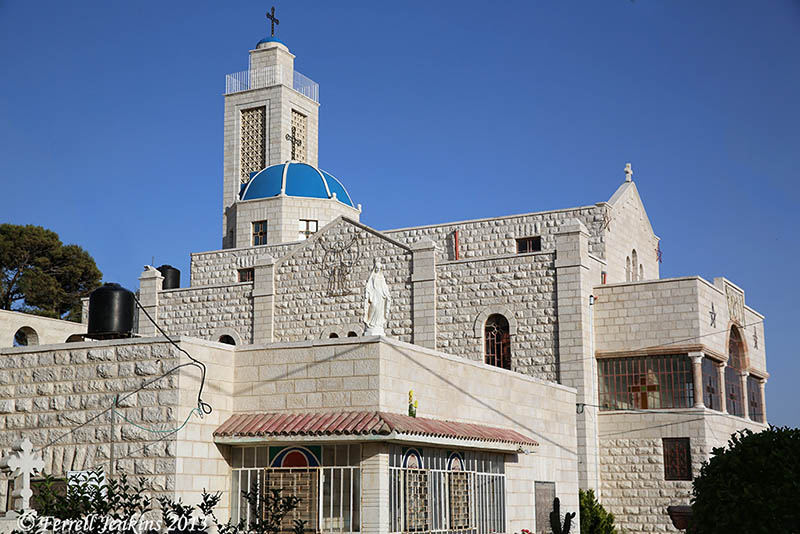
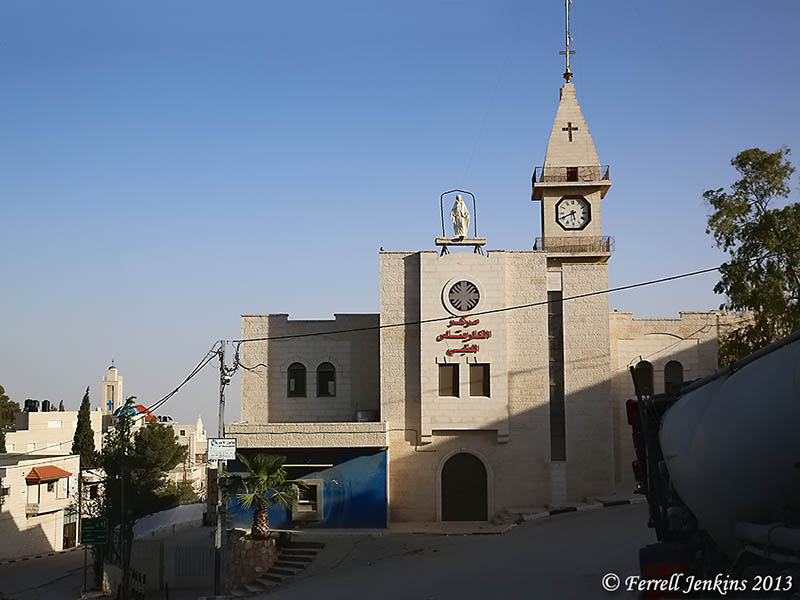
We drove to the top of the hill and the end of the village, turned around, and made a photo of what I think may be the Latin church and school.

The Latin Church at Taybeh. Photo by Dan Kingsley.

The Latin Church at Taybeh. Photo by Dan Kingsley.

The Greek Catholic (Melkite) church of St. George was built in 1964. On the hill behind this church may be found the ruins of a Byzantine church.

Greek Orthodox church at Taybeh. Photo by Dan Kingsley.

Greek-Melkite church at Taybeh. Photo by Dan Kingsley.

From the ridge on which Taybeh is built, the wilderness can be seen to the east. This is similar to the view that many of you have seen from the Mount of Olives, or from the Herodium, when you look to the east. The photo below shows the view east of Taybeh.

Wilderness to the east of Taybeh. Photo by Dan Kingsley.

Wilderness to the east of Taybeh. Photo by Dan Kingsley.

In reading about Taybeh, I have learned that all of the churches keep the Western Christmas and the Eastern Easter.

I have credited all of the photos to my traveling companion Dan Kingsley. Because we had little time to linger, we agreed that Dan would make the photos, sometimes from the car window, and we would share them. I have cropped and enhanced them as needed.

The land of Gennesaret and the travel route west

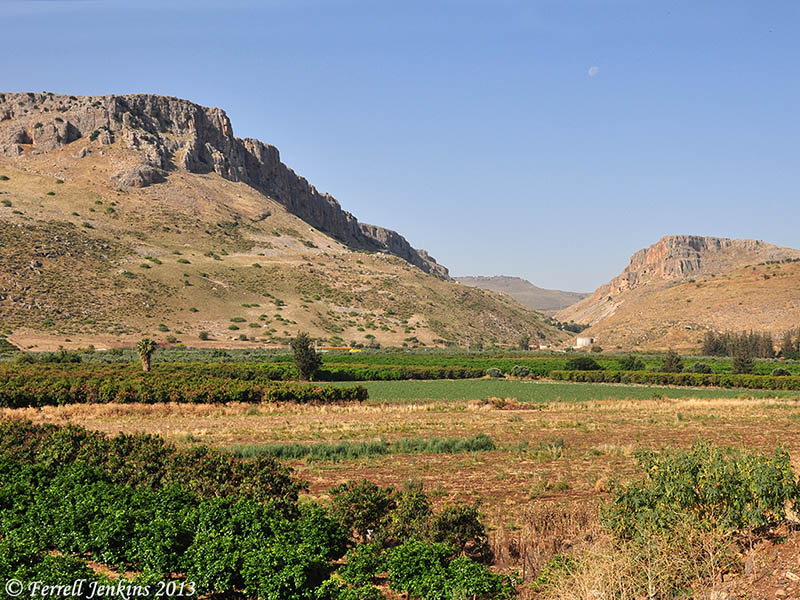
The Sea of Galilee is called the “lake Gennesaret” by Luke (Luke 5:1). The area on the northwest corner of the Sea of Galilee is called the “land at Gennesaret.” In the view below we see the land of Gennesaret and the Via Maris. The travel route here leads to the Beit Netofa Valley and the sites of Khirbet Cana, Sepphoris, Nazareth, Yodfat (Jotapata), and Ptolemais (Akko). Yodfat was fortified by Josephus during the Jewish revolt against Rome. Josephus, commander of the Jewish rebels, surrendered to the Roman Emperor Vespasian at Yodfat.

Mount Arbel and the Plain of Genessaret. Photo by Ferrell Jenkins.

Mount Arbel and the Plain of Gennesaret. Photo by Ferrell Jenkins.

Many of the miracles of Jesus were performed in this area.

When they had crossed over, they came to land at Gennesaret. And when the men of that place recognized Him, they sent word into all that surrounding district and brought to Him all who were sick; and they implored Him that they might just touch the fringe of His cloak; and as many as touched it were cured. (Matthew 14:34-36 NAU)

Does “Abba” mean “Daddy”?

You have heard it many times. Many of the things a preacher reads or hears sound good. So, he repeats it the next time he is speaking on a related topic. Then the members of the congregation begin to repeat it to their friends.

Child holding hand of adult.

But, is it true that Abba means something like daddy or papa?

In a series of posts beginning with the word FactChecker, Glenn T. Stanton  tracks down the origin of this idea to the German Lutheran New Testament scholar Joachim Jeremias in 1971. He also shows that several other reputable scholar responded in a scholarly way to the claim.

One of the sources he cites is a 1988 article by James Barr:

But in any case it was not a childish expression comparable with ‘Daddy’: it was a more solemn, responsible, adult address to a Father.

Ministers should read Stanton’s blog (here) before completing Sunday’s sermon.

And he said, “Abba, Father, all things are possible for you. Remove this cup from me. Yet not what I will, but what you will.” (Mark 14:36 ESV)

For you did not receive the spirit of slavery to fall back into fear, but you have received the Spirit of adoption as sons, by whom we cry, “Abba! Father!” (Romans 8:15 ESV)

And because you are sons, God has sent the Spirit of his Son into our hearts, crying, “Abba! Father!” (Galatians 4:6 ESV)

HT: BibleX

Here and there in Lower Galilee

This morning we set out from Tiberias to reach Khirbet Kana, the likely site of the Cana of Galilee mentioned in John 2. The site along the highway from Nazareth to Tiberias that many tourists visit is the traditional site known as Kafr Kana. Jesus attended a marriage at Cana of Galilee (John 2:1-11), and met the royal official (John 4:46-54).

Traveling as we are, and being extremely tired at night, I have neither the materials or the inclination to go into detail about the matter. Here is a view of the rocky hill located on the north side of the Bet Netofa Valley. The ancient road ran in the valley below the city.

View of Khirbet Kana from the SE. Photo by Ferrell Jenkins.

View of Khirbet Kana from the SE. Photo by Ferrell Jenkins.

This is not the sort of visit one may take lightly. It probably took us 45 minutes in from the main road, and 45 minutes out. (We should have had a Jeep-type vehicle. We spent about an hour walking up one side of the hill and down another. (I hope no one will ask directions!).

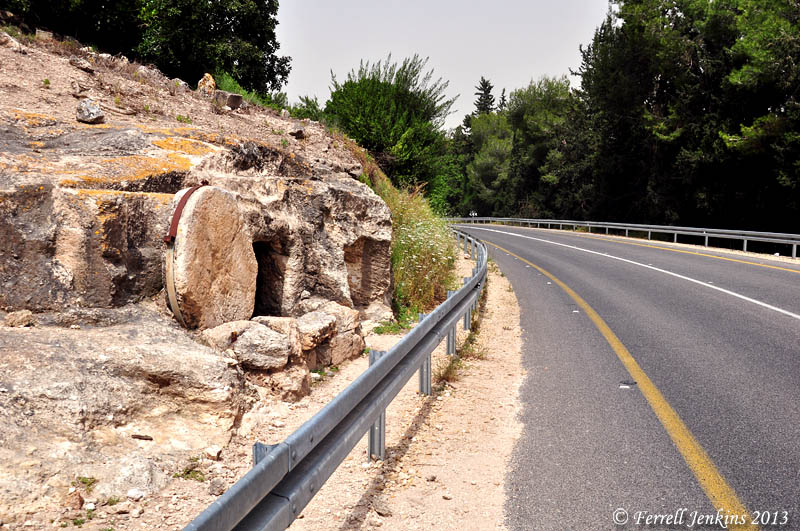
Later we made a short stop at Hannathon (Joshua 19:41), and then through Nazareth and Megiddo Junction to see again the Rolling Stone tomb on the south side of the Jezreel Valley. This tomb can no longer be photographed easily by tourists in a bus. There is no room for the bus to stop. Our little car could pull off the road, and we could get close enough to avoid the new railing that has been installed. This is what it looks like and how close the cars, buses, and trucks, come to it.

Rolling Stone tomb near Jezreel Valley. Photo by Ferrell Jenkins.

Rolling Stone tomb near Jezreel Valley. Photo by Ferrell Jenkins.

We were able to get photos similar to the one you see here.

Another brief stop allowed us to take a photo of Tell Jokneam (Joshua 12:22; 19:11; 21:34). On the way back to our home at the Ron Beach Hotel in Tiberias we visited the possible site of En Dor (En-Dor; 1 Samuel 28:7), where Saul visited the medium of En Dor. Our last stop was at the modern town of En Dor where we visited the En Dor Archaeology Museum. It is a great little museum. More about it later.

Saturday and Sunday around Jerusalem

We have had two busy days. Yesterday we made arrangements to visit the so-called Solomon’s Pools south of Jerusalem, and a few other places in the Bethlehem area. The last time I was at the site was probably in the 70s. This is the sort of place that it would not be advisable to take a large tour group in a bus. Later I plan to show you some of the photos that I made and explain about the sites.

In the late afternoon we went down into the Shephelah to visit Khirbet Qeiyafa, the fortress overlooking the Elah Valley. I did not see many changes since my last visit in 2012.

This morning we visited the Israel Museum. I was just there last week, but enjoyed the time making some additional photos that I had overlooked before. Dan also visited the Herod the Great exhibit.

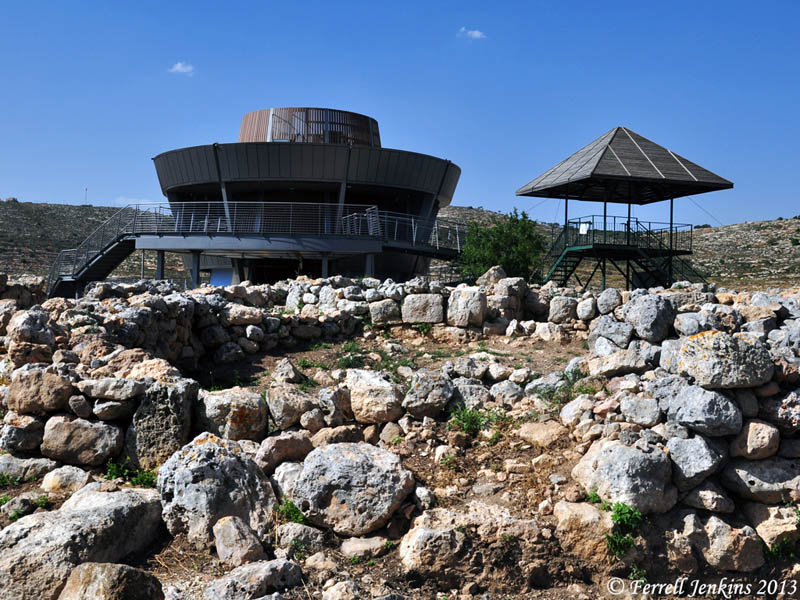
In the afternoon we drove north to Shiloh, the place where the tabernacle rested after the children of Israel entered the promised land (Joshua 18). A new viewing tower has been built, but is not yet ready for visitors. A young lady at the ticket booth/shop said they hope to have it open this month.

The old and new viewing towers at Shiloh. Photo by Ferrell Jenkins.

The old and new viewing towers at Shiloh. Photo by Ferrell Jenkins.

I thought the 27 NIS (about $8) was high for the condition of the site. A few of the older signs are visible, but no new ones. A small brochure was the only help the visitor has. Maybe this will improve with time.

We also visited Taybeh, a possible candidate for the site of Ephraim. This is the place to which Jesus retired prior to his crucifixion (John 11:54).

Jesus therefore no longer walked openly among the Jews, but went from there to the region near the wilderness, to a town called Ephraim, and there he stayed with the disciples. (John 11:54 ESV)

From Taybeh on the edge of the wilderness we continued to the Jordan Valley, then back up to Jerusalem.

The weather. Those who were with me last Sunday in Jerusalem, when it was chilly and rainy, will find it difficult to believe that it was 99 degrees here today with bright sunshine. Last week I had the heat on in the room. Tonight I have on the air.

Temple Mount, Pools, Jericho, Jordan River

Today was a great day for travel in and around Jerusalem. We started the day by visiting the Temple Mount. This is a place filled with Bible history relating to Abraham, David, Solomon, Jesus, and Peter (as well as all of the apostle). It is a place destroyed by the Babylonians (586 B.C.) and the Romans (A.D. 70).

The site has been under Islamic control since the 7th century.

We visited the Pools of Bethesda (John 5) and the Pool of Siloam (John 9).

Yesterday, by the time we visited Masada, Qumran, and Jericho, it was too late to visit the baptismal site on the Jordan River, a site known as Qasr el-Yahud. This site on the Israel side is across from the Jordanian site identified as Bethany beyond the Jordan (John 1:28).

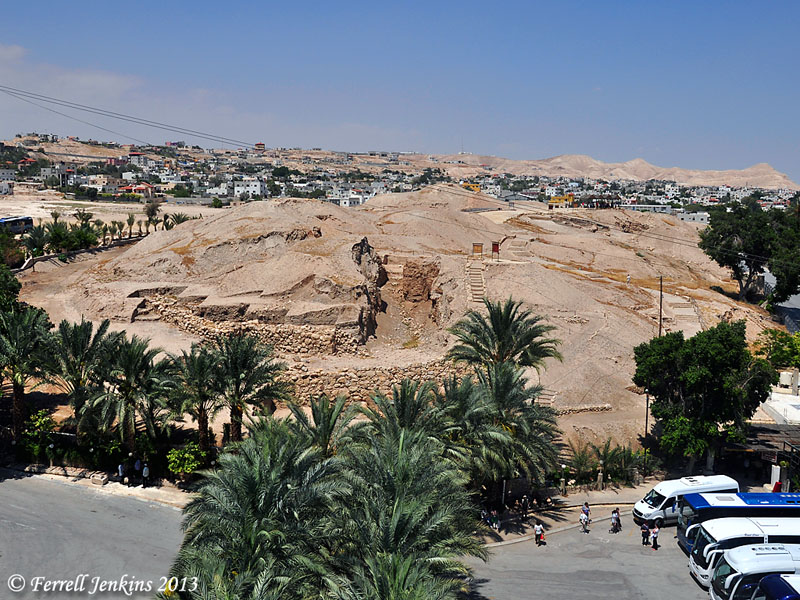
We stopped in Jericho for lunch at the Temptations Restaurant. The restaurant is located on the south end of Tell es-Sultan, identified with Biblical Jericho (Joshua 3-6).

The restaurant has lots of parking space for tour buses and good food. That’s a good combination in the tourist industry. As I was leaving I noticed a sign with the wording “View of Jericho”, and thought I should check it out. It took a climb of 11 flights of stairs to reach the roof. It was worth it for the view which was exceptionally good in all directions.

The view to the north is of Tel es-Sultan. See below. You may notice some wires (cables) across the photo. These are for the cable car that goes up to the traditional Mount of Temptation (Matthew 4).

Jericho (Tell es-Sultan) from the south. Photo by Ferrell Jenkins.

Jericho (Tell es-Sultan) from the south. Photo by Ferrell Jenkins.

Afterwards we visited the Jordan River. On the way back to Jerusalem we stopped by the St. George Monastery in the wilderness of Judea. The monastery building appear to hang on the side of a cliff overlooking the Wadi Qilt. Quite a sight.

We stopped at the Inn of the Good Samaritan (Luke 10:25-37) which now houses many mosaic floors from Jewish synagogues, Samaritan Synagogues, and Byzantine Churches, as well as a few other interesting artifacts.

It was a great day.

Jesus and the Sabbath

The Jews made charges that Jesus broke the Sabbath but they were not able to establish their charge. The basic charge was that Jesus was working in violation of the Mosaic law (Leviticus 23:3). Here is a list of the specific instances of events that took place on the Sabbath. Read the full accounts to see how Jesus responded.

  • Healed a man at the pool of Bethesda (John 5:1-9, 18; Jesus replied to accusations (John 7:21-24).
  • Healed the blind man (John 9:1-14).
  • Answered charges made against His disciples (Matthew 12:1-8; Mark 2:23-28; Luke 6:1-6).
  • Healed a man with a withered hand (Luke 6:6-11).
  • Healed the woman who was bent over (Luke 13:10-17).
  • He questioned the Pharisees regarding healing on the Sabbath and they could not answer Him. He healed the man with dropsy (Luke 14:1-5).
  • He taught in the synagogue in His “home town” on the Sabbath (Mark 6:1-6).

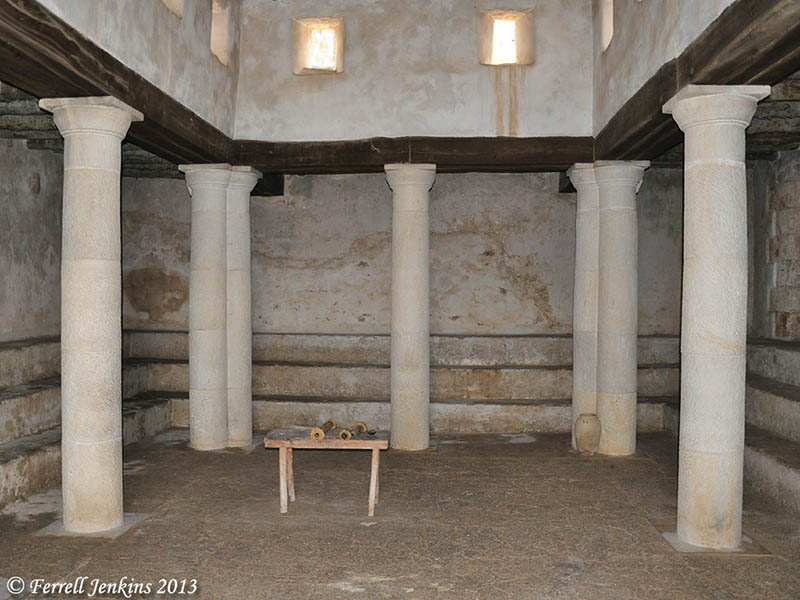
The photo below shows the interior of the model synagogue at the Nazareth Village.

Interior of the Nazareth Village Synagogue. Photo by Ferrell Jenkins.

Interior of the Nazareth Village Synagogue. Photo by Ferrell Jenkins.

The account of Jesus reading in the synagogue at Nazareth is recorded in Luke 4:16-21, with the reaction in the following verses.

And he came to Nazareth, where he had been brought up. And as was his custom, he went to the synagogue on the Sabbath day, and he stood up to read. And the scroll of the prophet Isaiah was given to him. He unrolled the scroll and found the place where it was written, “The Spirit of the Lord is upon me, because he has anointed me to proclaim good news to the poor. He has sent me to proclaim liberty to the captives and recovering of sight to the blind, to set at liberty those who are oppressed, to proclaim the year of the Lord’s favor.” And he rolled up the scroll and gave it back to the attendant and sat down. And the eyes of all in the synagogue were fixed on him. And he began to say to them, “Today this Scripture has been fulfilled in your hearing.” (Luke 4:16-21 ESV)

The land east of the Sea of Galilee

The land of Bashan is located east of the Sea of Galilee and the Hula Valley along the strip of land north of the Yarmuk River as far north as Mount Hermon. Bashan is mentioned no less than 60 times in the Hebrew Bible.

Og is designated as the king of Bashan about 20 times. Bashan is territory given to half of the Israelite tribe of Manasseh (Joshua 17:1). One of the cities of refuge was Golan in Bashan (Joshua 21:27).

Bashan was noted for its cattle, especially bulls (Psalm 22:12; Ezekiel 39:18). The prophet Amos calls the women of Samaria “cows of Bashan” (Amos 4:1). For sure, he was not a very popular prophet.

In recent history Bashan (Golan) was controlled by Syria, but was annexed by Israel in 1981.

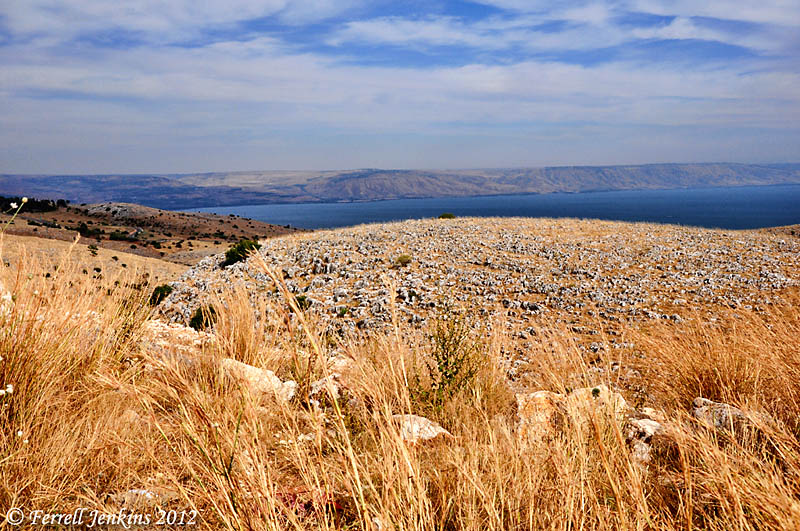
The photo below was made one afternoon as I approached the Sea of Galilee from the north. The view is to the southeast. The visible plateau on the east side of the Sea of Galilee is the southern part of the Golan Heights, the ancient land of Bashan.

The Sea of Galilee from the north. View toward Bashan in the east. Photo by Ferrell Jenkins.

The Sea of Galilee from the north. View toward Bashan in the east. Photo by Ferrell Jenkins.

In New Testament times the same territory, immediately east of the Sea of Galileee, and possibly a little south, was known as the land of the Gadarenes (Mark 5:1; Luke 8:26,37, KJV, NKJV), or the land of the Gergesenes in most modern English versions. These texts record the episode of the healing by Jesus of a man possessed with an unclean spirit. The unclean spirits entered into a herd of swine (pigs) and ran down the steep cliffs, visible in our photo, into the sea (Mark 5:11-13).

When a lot of rain is a good thing

Having watched the rise and fall of the Sea of Galilee (Lake Kinneret) over a period of 45 years, it is exciting to learn that winter storms have pushed the lake to the sharpest December rise in 20 years.

According to an article in Haaretz the lake “is expected to have risen 26 centimeters [9.84″] since heavy rains began Thursday, it sharpest December rise in 20 years. [1991 and 1992]”

As a result of the increased flow in northern streams, the Kinneret’s water level rose sharply, reaching 212.07 meters [695.77 feet] below sea level Saturday morning.

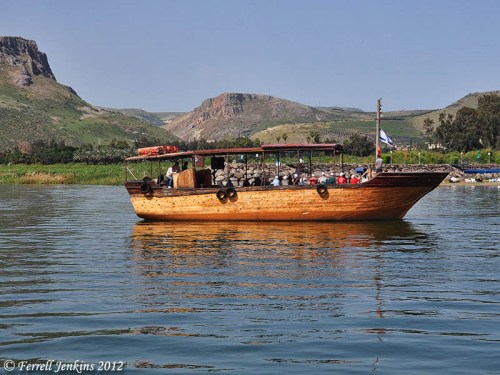
Sightseeing boat on the Sea of Galilee. Photo by Ferrell Jenkins.

Boat on the Sea of Galilee near the Plain of Gennesaret. Photo by Ferrell Jenkins.

And when they had crossed over, they came to land at Gennesaret. (Matthew 14:34 ESV)

Rain also fell as far south as Ashdod and Kiryat Gat, “but failed to affect the Negev this time.” This reminds us of the days of the Patriarchs whose lives were often disrupted by lack of rain in the Negev.

According to the report, almost 20 inches of snow has fallen on Mount Hermon.

If you have an interest in weather conditions in Israel, I suggest Kinneret Bot and the site of the Israel Meterological Service.

Geographer Carl Rasmussen says,

All of us who have traveled in Israel and the surrounding countries are well-aware of the importance of the winter rains for the well-being of the inhabitants of the area, local agriculture, and the water supply in general.

HT: Bible Places Blog; Holy Land Photos’ Blog.