Tag Archives: Ministry of Jesus

The Other Bethlehem – Part 1

Everyone who has studied the earthly ministry of Christ knows that He was born in Bethlehem, the city of David, about six miles south of the ancient city of Jerusalem (Micah 5:2; Matthew 2:1-8; Luke 2:4,15). This village is designated as Bethlehem of Judea or Bethlehem Ephrath.

So Rachel died, and she was buried on the way to Ephrath (that is, Bethlehem), (Genesis 35:19 ESV)

The only reference to Bethlehem in the New Testament apart from the birth account in Matthew and Luke calls Bethlehem a village (kome; John 7:42) and ties it with the prophecy of Micah 5:2.

The other Bethlehem is located in the tribal territory of Zebulun (Joshua 19:15), about 7 miles northwest of Nazareth. For a list of the twelve cities of Zebulun see Joshua 19:10-15.

After the destruction of the temple in Jerusalem (A.D. 70) Bethlehem of Zebulun,

was known under the name of Bethlehem Zoriah — Bethlehem of Tyre — and was the seat of the priestly order of the family of Malchiah. Identified with Beit Lahm in Lower Galilee. (Avraham Negev, ed. The Archaeological Encyclopedia of the Holy Land, rev. ed., p. 58.

Galilean Bethlehem is now a small Jewish moshav, a cooperative agricultural settlement. The photo below shows the entrance to the moshav.
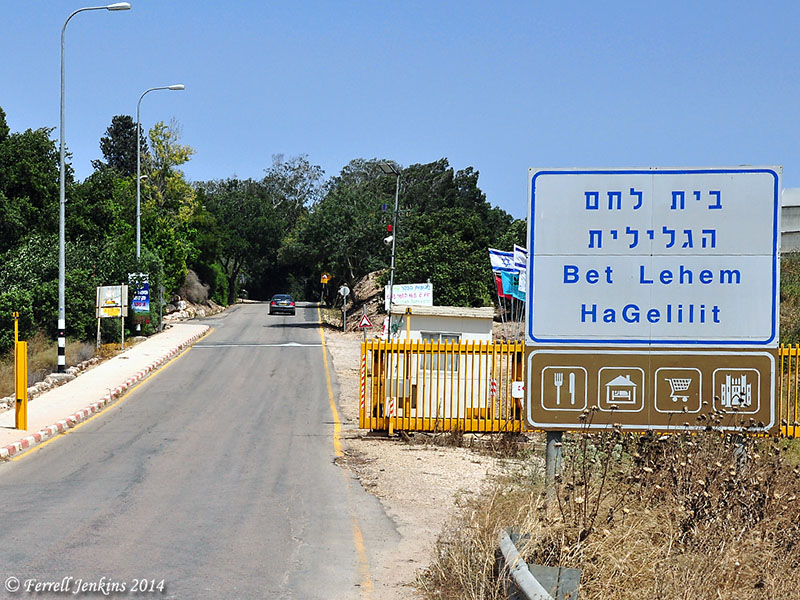
Entrance to the moshav of Beit Lehem HaGelit. Photo by Ferrell Jenkins.

Entrance to the moshav of Beit Lehem HaGelilit. Photo by Ferrell Jenkins.

The small map below shows the location of Galilean Bethlehem.

Map showing Galilean Bethlehem. BibleAtlas.org

Map showing Galilean Bethlehem. New Testament Nazareth would be located at the far right of the map under the “h” in Japh. Credit: Biblos.com.

Could Jesus have been born here? Primarily because of the proximity of Galilean Bethlehem to Nazareth, some scholars have suggested that this was the birthplace of Jesus. National Geographic writer Marisa Larson raises this question in a Feb. 11, 2008, followup to the Dec., 2007, feature “Bethlehem 2007 A.D.”

Larson cites Aviram Oshri, a senior archaeologist with the Israeli Antiquities Authority, as someone who thinks that it was more likely that the historical Jesus was born in Bethlehem of Galilee rather than the Bethlehem of Judea.

“If the historical Jesus were truly born in Bethlehem,” Oshri adds, “it was most likely the Bethlehem of Galilee, not that in Judaea. The archaeological evidence certainly seems to favor the former, a busy center [of Jewish life] a few miles from the home of Joseph and Mary, as opposed to an unpopulated spot almost a hundred miles from home.” In this Bethlehem, Oshri and his team have uncovered the remains of a later monastery and the largest Byzantine church in Israel, which raises the question of why such a huge house of Christian worship was built in the heart of a Jewish area. The Israeli archaeologist believes that it’s because early Christians revered Bethlehem of Galilee as the birthplace of Jesus. “There is no doubt in my mind that these are impressive and important evidence of a strong Christian community established in Bethlehem [of Galilee] a short time after Jesus’ death,” he says. (copied from here, 12/27/14).

Oshri also expressed his views in Archaeology 58:6 (Nov.-Dec. 2005). He says that there is evidence of “a strong Christian community established in Bethlehem [of Galilee] a short time after Jesus’ death.” In fact, the first archaeological evidence is of a sixth century church [building].

Even if Christians of Galilee “revered Bethlehem of Galilee as the birthplace of Jesus” it does not negate the clear historical records of Matthew and Luke regarding the birthplace of Jesus in Bethlehem of Judea and the reason for the couple from Nazareth returning to the ancestral home in Judea.

If the Bible were written by men unaided by the Holy Spirit I think it would be reasonable to place the birth of Jesus in Bethlehem of Galilee and his upbringing in nearby Nazareth. There is an amazing undesigned coincidence here.

  • The Messiah was to be from the tribe of Judah (Genesis 49:10), and of the family of David (2 Samuel 7:11).
  • The birth of the Messiah was prophesied to be in Bethlehem Ephrath (Micah 5:2; Matthew 2:6). This was the Bethlehem of Judea.
  • The couple living in Nazareth were both of the family of David (Matthew 1:20; Luke 1:27,32,69). The legal line is traced through Joseph, and the blood line is traced through Mary in Luke’s account.
  • Joseph and Mary responded to the decree of the emperor Augustus that they return to their ancestral home for registration (Luke 2:1-5).

If Jesus had been born in Galilean Bethlehem, and if the Gospels had been written much later, as most critics claim, then they would have recorded a different story.

The ease with which writers could mix up the two Bethlehems, but did not, provides an  illustration of the amazing accuracy of the Bible.

Beit Lehem HaGelilit is situated on the north side of the western end of the Jezreel Valley.
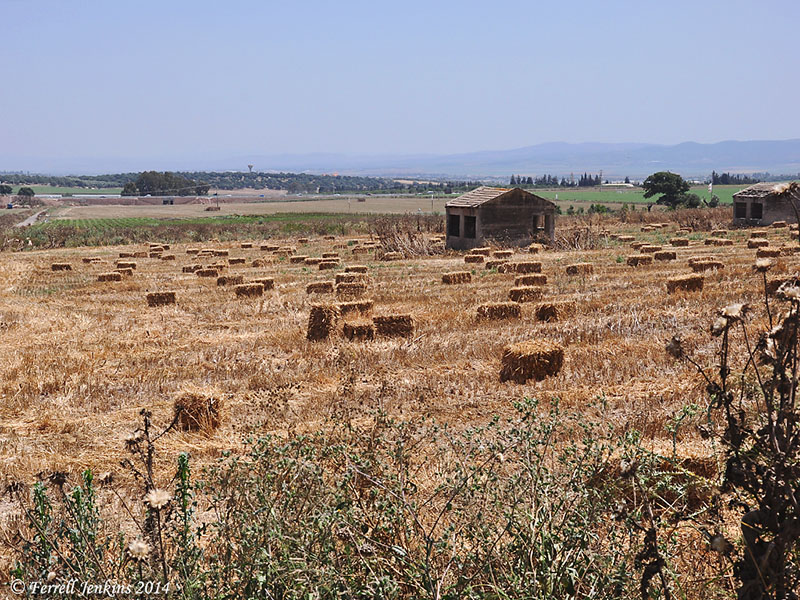
Valley from Beit Lehem HaGelit. Photo by Ferrell Jenkins.

View SE to the Jezreel Valley from Beit Lehem HaGelilit. Photo by Ferrell Jenkins.

On the hills of lower Galilee, to the east and north of Galilean Bethlehem, there are Olive orchards, and cows grazing among the oaks.

Cows graze among the Allon Oak trees at Galilean Bethlehem. Photo by Ferrell Jenkins.

Cows graze among the Oaks at Galilean Bethlehem. Photo by Ferrell Jenkins.

Bethlehem of Galilee may be mentioned one other time in the Bible as the home and burial place of Ibzan the judge (Judges 12:8). The context in which he is mentioned is dealing with various judges of the tribes of Zebulun and Ephraim.

In  a post to follow I plan to share some of the recent history of Galilean Bethlehem.
Jesus visited Jerusalem during Hanukkah

The Gospel of John records more visits to Jerusalem by Jesus than any other of the Gospels. John is the only one to record the visit during the Feast of Dedication.

At that time the Feast of Dedication took place at Jerusalem. It was winter,  and Jesus was walking in the temple, in the colonnade of Solomon. (John 10:22-23 ESV)

BDAG translates the Greek term egkainia as “festival of rededication.” The feast is also known as Hanukkah and the Feast of Lights.

What is he Feast of Dedication? This feast, observed on the 25th of Kislev (roughly our December), had its origin in the period between the testaments. The desecration of the temple by the Seleucid ruler Antiochus Epiphanes took place in 168 B.C. The climax of the Maccabean revolt was the removal of all evidences of pagan worship from the temple. An eight day feast of dedication was observed in 165 B.C., and continued to be observed annually by the Jews.

At Modin, a village north-west of Jerusalem, on the way from Jerusalem to Lod, the Syrians tried to force an old priest by the name of Mattathias to offer a pagan sacrifice. The priest refused but another Jew volunteered to offer the sacrifice. Mattathias killed his fellow Jew and the Syrian officer. As word spread, Mattathias became a national hero. He was of the family of Hasmon (or Asmoneus). Thus began the Hasmoneans.

The discovery of a burial cave at Modin thought to have been used by the Maccabees and/or their descendants was reported in November, 1995. There are Israeli scholars who argue that this is not the true grave of the Maccabees. An article in Haaretz says,

Amit Re’em, an archaeologist of the Israel Antiquities Authority says all the evidence points to the fact that these graves are of Christians and pagans and that this burial site actually belongs to an ancient monastery.

Read the Haaretz article here.

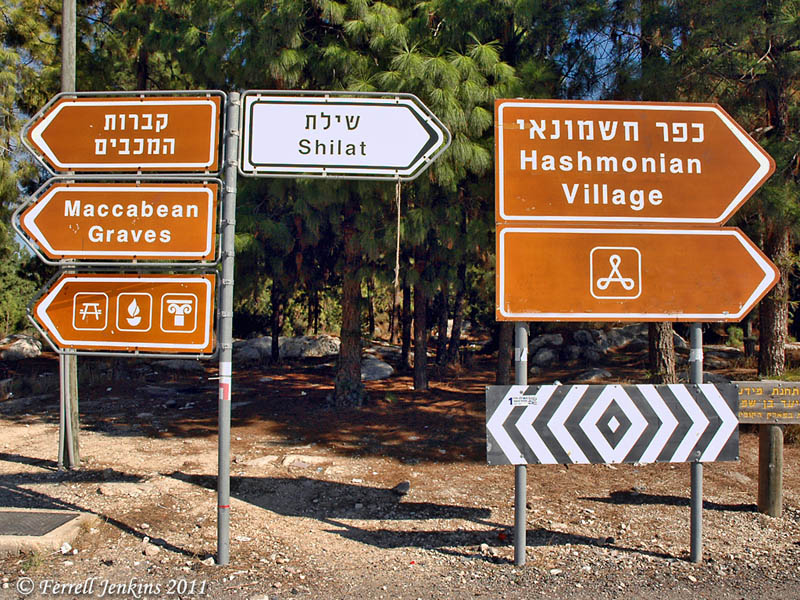
Near Modin, signs point to the Maccabean Graves. Photo by Ferrell Jenkins.

Near Modin, signs point to the Maccabean Graves. Photo by Ferrell Jenkins.

Even though the Feast of Dedication was not a feast authorized by the Mosaic Law, it became part of the Jewish heritage, and Jesus came to Jerusalem at that time — at least once.

Jesus cleansed the Temple on two distinct occasions. The first time is recorded in John 2:14-22. The second account is recorded in Matthew 21:12-13; Mark 11:15-18; and Luke 19:45-48.

• This is a golden oldie from December 24, 2011.

Fishing the Sea of Galilee

In previous posts we have looked at the fish of the Sea of Galilee, ports of the Sea of Galilee, and Tabgha (Heptapegon) which has been called the fishermen’s suburb of Capernaum.

In this post we will concentrate on how the fishing was done.

  • Some fishing was done by casting a hook into the sea (Matthew 17:27).
  • The cast-net could be thrown by an individual fisherman (Matthew 4:18).
  • The seine or dragnet required several workers (Matthew 13:47).
  • The trammel net involved tying together several nets (Mark 1:19-20).

The Hook. I suppose fish hooks are common enough not to need a photo but I will include them in this photo made in the Eretz Israel Museum, Tel Aviv. it shows a cast-net and some fishing hooks in the lower right corner. Note the lead weights on the bottom of the net. Lead weights such as these have been found at various archaeological excavations.

Cast-Net and fish hooks. Eretz Israel Museum. Photo by Ferrell Jenkins.

Cast-Net and fish hooks. Eretz Israel Museum. Photo by Ferrell Jenkins.

The Cast-Net. This photo shows a fisherman casting a net in the warm, shallow water near Tabgha. The cast-net can be thrown from the edge of the water or from a boat.

Fisherman casting a net in the warm water at Tabgha. Photo by Ferrell Jenkins.

Fisherman casting a net in the warm water at Tabgha. Photo by Ferrell Jenkins.

The Seine or Dragnet. In the parable of the net in Matthew 13:47-50, the Greek word for net is sagene. I note that the NAU and the NKJ use the term dragnet, while other versions use the generic net. This is clearly the seine which gathers all kinds of fish that must then be sorted by the fishermen.

I understand about the seine. As a youngster I visited an uncle and aunt who lived near New Hope, Alabama. My uncle set a seine on the Flint River. In the morning he would say, “Let’s go down to the river and see if we have caught anything.” But, I have not seen the seine in use on the Sea of Galilee except in older photos. Here is a photo from the American Colony and Eric Matson collection available from Life in the Holy Land.

Fishermen bringing in a seine (or dragnet). Photo: Life in the Holy Land.

Fishermen bringing in a seine (or dragnet). Photo: Life in the Holy Land.

The next photo is one that I have enhanced from the Eric Matson collection at the Library of Congress.

Fishermen using a seine. Photo: Eric Matson Collection, LOC.

Fishermen using a seine. Photo: Eric Matson Collection, LOC.

A modern adaptation of the seine or dragnet is seen in modern times. I learned that it is called the Purse Seine. The first photo, scanned from a 1992 slide, shows the seine is heavy with the catch of the night.

Fishing boat getting ready to unload a purse seine at Tiberias. Photo by Ferrell Jenkins, 1992.

Fishing boat getting ready to unload a purse seine. Photo by Ferrell Jenkins.

The next photo shows the fishermen getting ready to unload the catch.

Fishing boat using purse-seine on Sea of Galilee - March 1992

Fishing boat using purse-seine on Sea of Galilee – March 1992

The Trammel Net. Nun says that the net being used by the early disciples of Jesus is the trammel net (Mark 1:19-20). This type of net was made by tying together several cast-nets. You can locate many photo illustrations by searching for “trammel nets” in Google. Here is another photo from the Matson collection showing the mending of nets at Ain Geb (En Gev).

Girls of Ain Geb, a Jewish settlement on the east side of the Sea of Galilee. Girls of the settlement mending fishing nets. Photo: Eric Matson collection LOC.

Girls of Ain Geb, a Jewish settlement on the east side of the Sea of Galilee. Girls of the settlement mending fishing nets. Photo: Eric Matson collection LOC.


Tabgha (Heptapegon) – a good place for fishing

Mendel Nun describes Tabgha as “The Fishermen’s Suburb of Capernaum.” Tabgha is a corrupted form of the name Heptapegon which means “seven springs.” Why would someone who lived at Capernaum, like Simon Peter and Andrew (Matthew 4:13-20), think of going west 1½ miles to fish?

Nun explains the importance of Tabgha for fishing.

The springs of Tabgha have great economic importance. In the winter, the warm water draws schools of warmth-loving musht, tropical in origin, to the vicinity. The waters of the springs were once used to operate several flour mills. The Capernaum fishermen stayed in this area during winter and early spring, making Tabgha an important industrial suburb of Capernaum. A small harbour which served the millers and fishermen was found in the nineteen seventies. (The Sea of Galilee and Its Fishermen in the New Testament, 14).

Just a few yards west of the Church of the Primacy, which we showed in the previous post, one of the seven warm springs was flowing freely during our 1992 visit to the site. When the water is high one would not notice this spring.

One of the seven springs at Heptapegon (Tabgha). Photo by Ferrell Jenkins.

One of the seven springs at Heptapegon (Tabgha). Photo by Ferrell Jenkins.

We are not told where Peter and Andrew were fishing when Jesus called them, but Tabgha certainly would be a good place.

As he was walking by the Sea of Galilee he saw two brothers, Simon (called Peter) and Andrew his brother, casting a net into the sea (for they were fishermen). (Matthew 4:18 NET)

As he went along the Sea of Galilee, he saw Simon and Andrew, Simon’s brother, casting a net into the sea (for they were fishermen). (Mark 1:16 NET)

And this would be a good place for the events of John 21, or the earlier account recorded in Luke 5:1-11. Rousseau and Arav (Jesus and His World, 97) conflate these two accounts into one and conclude that John “was written by a different author or editor.” A reading of both texts shows that the one in Luke is at the beginning of the ministry of Jesus when He calls the disciples, and the one is John is at the close of His earthly ministry after His resurrection (21:14).

It would be common for fishermen to stand on the shore or in the edge of the water and cast a net into the warm water where the fish gathered.

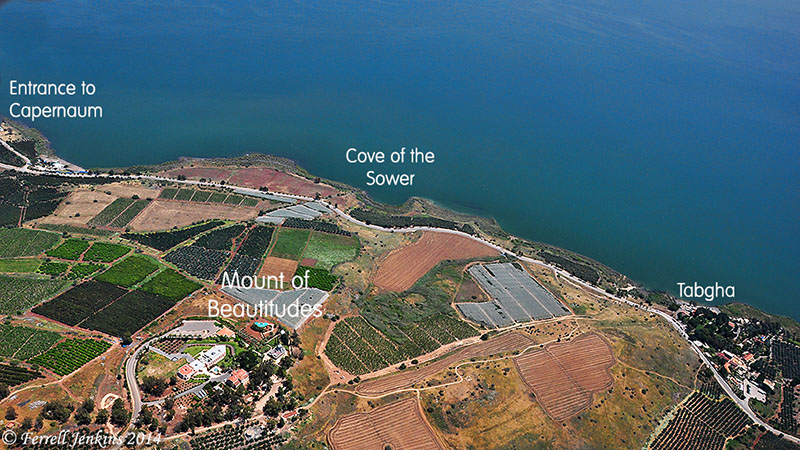
Our final photo this time is an aerial view showing the north shore of the Sea of Galilee from Tabgha on the right (west) to the entrance to Capernaum on the left (east). The traditional Mount of Beatitudes is on the hill above. The distance from the entry to Capernaum to Tabgha is 1.25 mile on a straight line. Add another .4 mile to reach the archaeological site of Capernaum.

North shore of the Sea of Galilee from Capernaum to Tabgha. Photo by Ferrell Jenkins.

North shore of the Sea of Galilee from Capernaum to Tabgha. Photo by Ferrell Jenkins.


Ports of the Sea of Galilee

Mendel Nun contrasts the knowledge of 19th century explorers with what has become known as a result of his work.

Early 19th-century explorers, searching for places where Jesus had walked, attempted to locate the ancient harbors of the Sea of Galilee but failed. Now, after 25 years of searching and researching, we have found them. We have recovered the piers, promenades and breakwaters of the ports. We have also uncovered the ships’ anchors, the mooring stones the sailors tied their ships to, and even the weights fishermen once fastened to their nets. We always knew the harbors must be there, but we had no idea we would find so many remains. (“Ports of Galilee.” BAR 25:04, July/Aug 1999.

In the 1999 article Nun says that we now have only four small ports serving the motorboats, ferries, and fishing boats, but in ancient times there were no less than 16 bustling ports. When the harbors and anchorages were originally built the water level was about 695 feet below sea level. As a result of natural changes about a thousand years ago, the water level gradually rose about 3 feet, but the water level this week is 698 feet below sea level (Kinneret Bot, Dec. 2, 2014).

The first ancient port discovered by Nun was the port of Kursi on the eastern side of the lake in 1970.

Droughts in recent years have brought about changing water levels. We know that the famous Roman boat now displayed at Nof Ginosar was found when the water level was low in 1986. This also allowed the discovery of additional ports.

During the time I have been visiting Israel (since 1967), I have seen these changes in the water level of the lake and have mentioned it in several posts. Here I wish to use Tabgha (Heptapegon = the place of seven springs) as an illustration.

The Church of the Primacy of Peter was built in 1933. A good case can be made for this being the location where Jesus called some of His disciples to become fishers of men (Luke 5:1-11), and where Jesus met His disciples after the resurrection (John 21). The issue of the primacy of Peter over the other apostles is a matter for theological and exegetical study which I think comes up short.

The chapel is built on a large rock called the Mensi Domini (the Lord’s Table) where it is said Jesus prepared breakfast for the disciples.

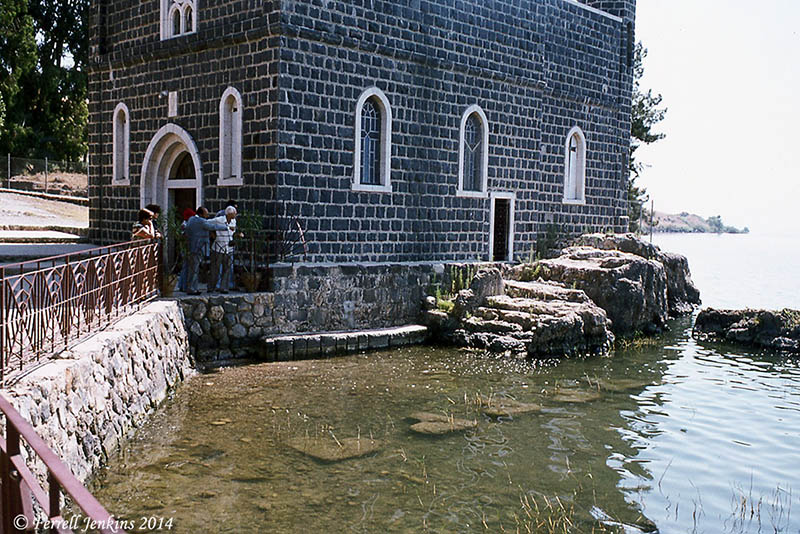
In this 1980 photo you see the water reaching the building.

This photo shows the water level in 1980 at the Church of the Primacy. Photo by Ferrell Jenkins.

This photo shows the water level in 1980 at the Church of the Primacy. Photo by Ferrell Jenkins.

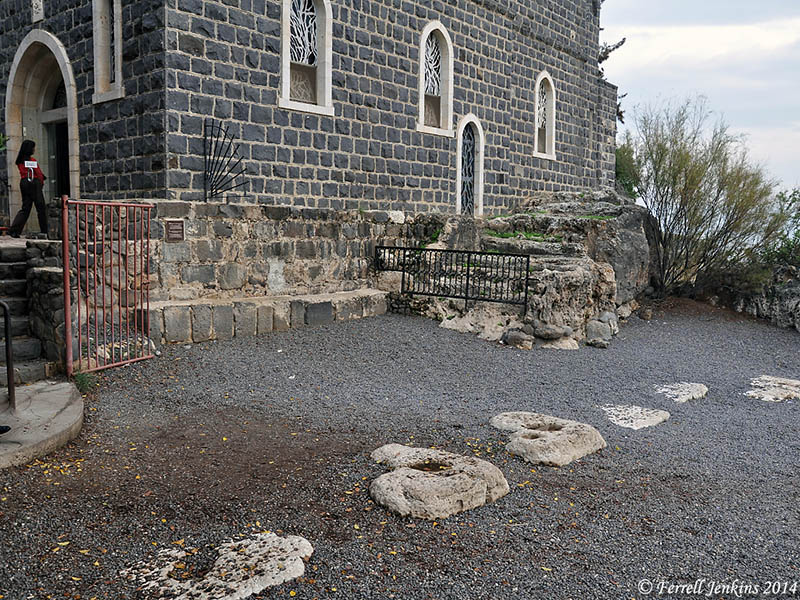
The rock-cut steps were mentioned by Egeria (about AD 383), but we do not know when they were cut. Now take a look at the same location in December of 2009 when the water was low.

The Church of the Primacy in 2009. Photo by Ferrell Jenkins.

The Church of the Primacy in 2009. Photo by Ferrell Jenkins.

Murphy-O’Connor gives this explanation about the heart-shaped stones.

Below the steps, sometimes under water if the lake level is high, are six heart-shaped stones. They are double-column blocks designed for the angle of a colonnade, and never served any practical purpose in their present position. Known as the Twelve Thrones and first mentioned in a text of AD 808, they were probably taken from disused buildings and placed there to commemorate the Twelve Apostles. It takes little insight to appreciate the mental jump from John 21:9 … to ‘You will eat and drink at my table in my kingdom, and you will sit on thrones to judge the twelve tribes of Israel’ (Luke 22:30). – Murphy-O’Connor, Holy Land, 5th ed., p. 319

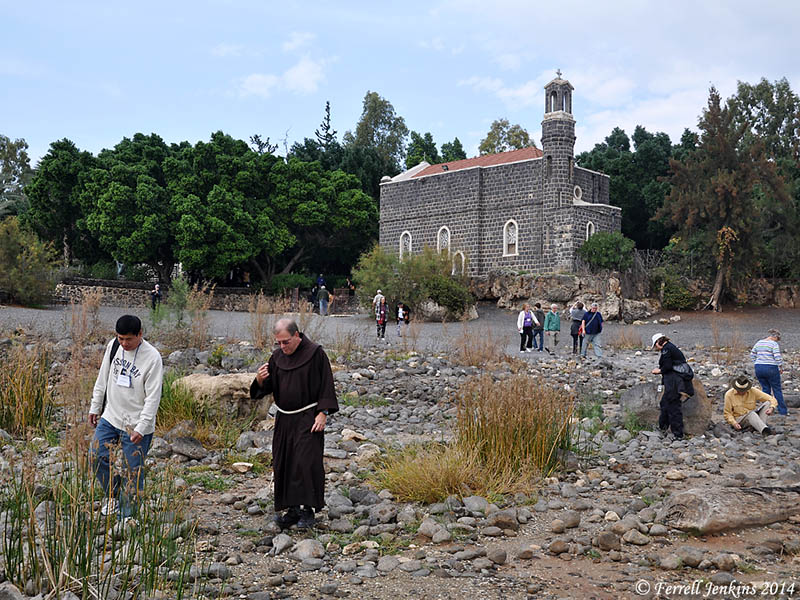
These 2009 photos were made during a personal study trip with Leon Mauldin. While we were enjoying the quietness of the experience a group of tourists came to hunt for a special souvenir rock or shell to take home. I made the next picture from the edge of the water to illustrate how far the water had receded.

View of the Church of the Primacy from the edge of the water. Photo by Ferrell Jenkins.

View of the Church of the Primacy from the edge of the water. Photo by Ferrell Jenkins.

Hopefully this illustration will allow us to see how the harbors that had become lost in time have become known in the past few years.

Fish of the Sea of Galilee

In 1993 Mendel Nun published an article in Biblical Archaeology Review entitled “Cast Your Net Upon the Waters: Fish and Fishermen in Jesus’ Time.” Nun, now deceased, explains the meaning of his name:

For more than 50 years, I have lived at Kibbutz Ein Gev on the shore of the Kinileret [Kinneret], the Sea of Galilee. For much of that time, I have been a fisherman. The Hebrew letter nun (N) means fish in Aramaic. My former name—I was born in Latvia—began with an N. When I became a fisherman, I simply took that first letter as my new surname. (BAR 19:06 (Nov/Dec 1993)

Nun explains that he was continually surprised “at how accurately the New Testament writers reflect natural phenomena on the lake.”

A more detailed source of information by Nun is his 1989 The Sea of Galilee and Its Fishermen in the New Testament.

Nun says there are 18 species of indigenous fish in the Sea of Galilee, and that 10 of those are important commercially. The edible fish are classified as follows:

  • Musht. This group includes the popular Tilapia Galilea, commonly called Saint Peter’s fish.
  • Biny (Barbels). “This group consists of three species of the Carp family.” The two most common species are the Barbus longiceps and the Barbus Canis. Both are used by Jews for Sabbath meals and feasts.
  • Kinneret Sardine. “At the height of the fishing season, tens of tons of sardines are caught every night.” In New Testament times these fish were preserved by pickling. Magdala was known as the center of this industry.

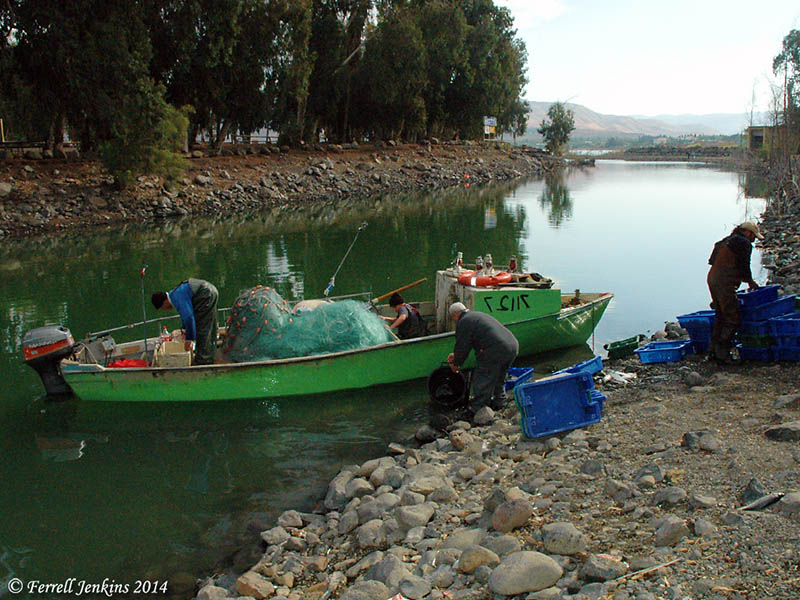
Our first photo shows fishermen unloading their catch of Musht early in the morning. This photo was made where the Jordan River exits from the south end of the Sea of Galilee.

Fishermen coming in from a night of fishing. Photo by Ferrell Jenkins.

Fishermen coming in from a night of fishing. Photo by Ferrell Jenkins.

Fish are unloaded to be taken to restaurants and markets in the area. I have seen this fish for sale in the Old City of Jerusalem.

Fishermen unloading their catch at the outlet of the Jordan River from the Sea of Galilee. Photo by Ferrell Jenkins.

Fishermen unloading their catch at the outlet of the Jordan River from the Sea of Galilee. Photo by Ferrell Jenkins.

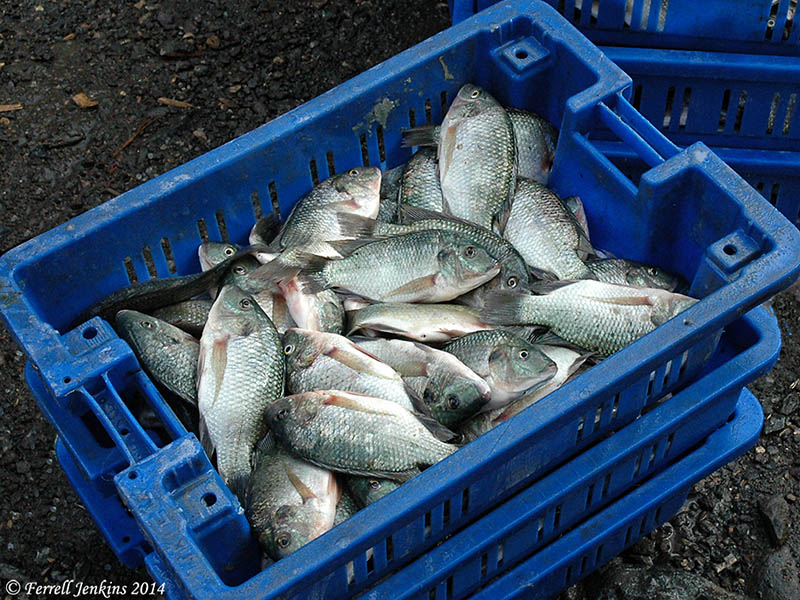
Here is a closeup of one of the containers of Saint Peter’s fish. You can see that these fish would be ideal of pan frying.

Musht (Saint Peter's fish) from the Sea of Galilee. Photo by Ferrell Jenkins.

Musht (Saint Peter’s fish) from the Sea of Galilee. Photo by Ferrell Jenkins.

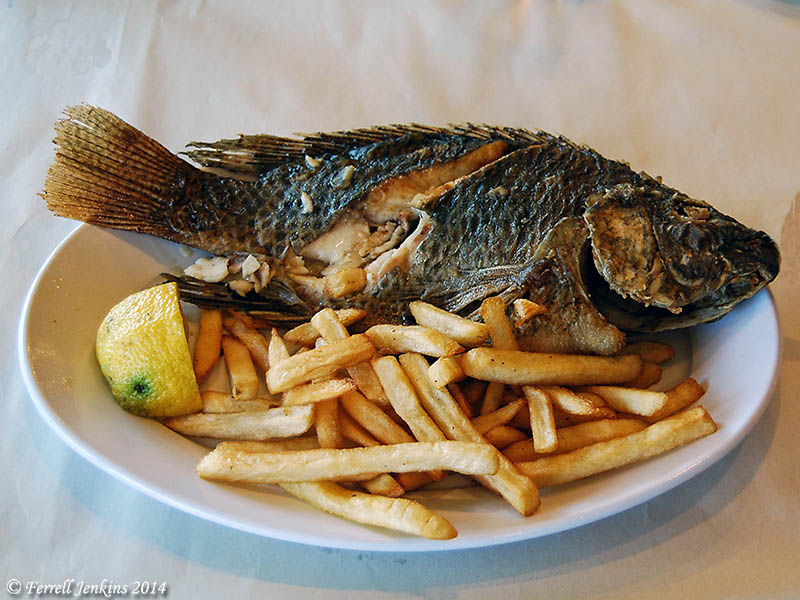
Tourists may have eaten these fish at lunch during their tour of the Galilee region. It makes a good meal, but some tourists use a napkin to cover the eyes while they enjoy eating the fish.

Saint Peter's fish is a common meal at restaurants around the Sea of Galilee. Photo by Ferrell Jenkins.

Saint Peter’s fish is a popular meal at restaurants around the Sea of Galilee. Photo by Ferrell Jenkins.

The next photo, also early in the morning, shows the catch of Biny, a much larger fish than the Musht. The Biny reaches a weight of 6 or 7 kilo (13-15 pounds).

Fisherman at Tiberias Port unloading the catch of Biny. Photo by Ferrell Jenkins.

Fisherman at Tiberias Port unloading the catch of Biny. Photo by Ferrell Jenkins.

In 2010 Israel announced a two year ban on fishing in the Sea of Galilee (see here). I don’t know how vigorously this ban was enforced. I know that in previous years I would see numerous boats heading to port after a night of fishing, but in the past few years this has not been so. Today’s Haaretz reports that the two-year fishing ban has been cut to a four-month annual break.

Instead of a blanket moratorium on fishing in the lake for two years, fishing will be barred only from April 15 to August 15, the spawning season of the lake’s tilapia populations.

The full article may be read here.

Hopefully we will return with some more information about fishing at the time of Jesus and a brief look at some of the New Testament episodes that involve fishing.

Another sunset photo on the Sea of Galilee

In response to our recent post on Sunset from En Gev on the Sea of Galilee here, Randy Myers tried to post an image of a photo he made of a sunset on the Sea of Galilee about two weeks ago.

I contacted Randy and asked permission to post his photo on the blog. It is a beautiful photo with Tiberias in the shadows. The bird in flight adds a really nice touch.

Sunset on the Sea of Galilee. Photo by Randy Myers.

Sunset on the Sea of Galilee. Photo by Randy Myers.

Much of the activity of Jesus during His earthly ministry involved the Sea of Galilee and the various ports on its shore. Here is one example.

After Jesus healed a man with a withered hand on the Sabbath, the Pharisees and the Herodians made a plan to destroy Him.

Jesus withdrew with his disciples to the sea, and a great crowd followed, from Galilee and Judea and Jerusalem and Idumea and from beyond the Jordan and from around Tyre and Sidon. When the great crowd heard all that he was doing, they came to him. (Mark 3:7-8 ESV)

Randy, thanks for sharing this photo with us.


Sunset from En Gev on the Sea of Galilee

Travelers to the Sea of Galilee are always delighted to get a sunrise photo from Tiberias. If you travel around the lake to the eastern shore in the late afternoon you might see two things. Because the winds from the Mediterranean come from the north east you might see the stormy waves on the sea. And you might see a beautiful sunset.

The photo below is made from Kibbutz En Gev. The small village, home to some of the fishing and touring boats that ply the Sea of Galilee, is located in the shadow of the impressive mound of Hippos (Susita).

Sunset from En Gev. Photo by Ferrell Jenkins.

Sunset from En Gev. Photo by Ferrell Jenkins.

The harbor of Hippos (Susita) is located immediately south of En Gev. It is one of 15 or more ancient harbors now known to have existed in the time of Jesus.

Jesus taught the crowds from a boat

What kind of boat did Jesus sit in when he spoke parables to the multitudes gathered around the cove of the sower?

That same day Jesus went out of the house and sat beside the sea. And great crowds gathered about him, so that he got into a boat and sat down. And the whole crowd stood on the beach.  (Matthew 13:1-2 ESV)

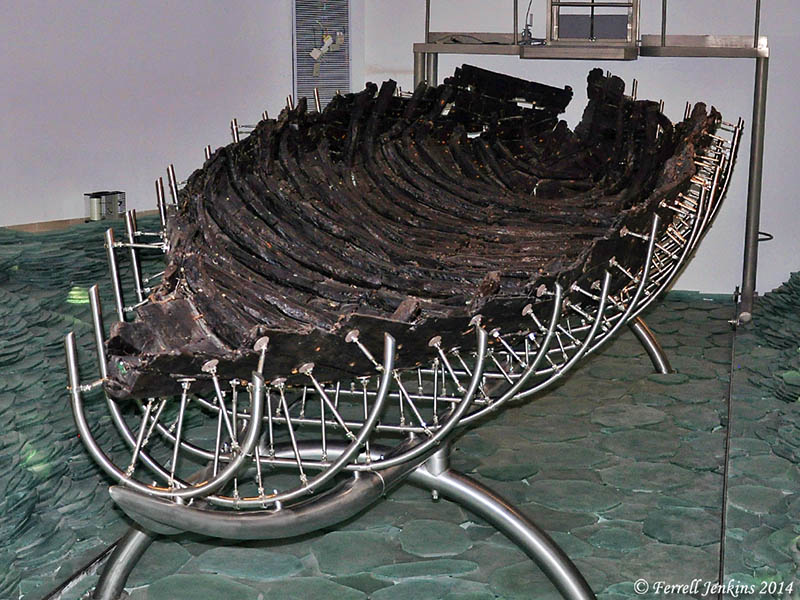
We can not know details about the boat mentioned in this text. Only one boat from the Roman period has been discovered in the Sea of Galilee.

A boat that belonged to the Roman period (dated from the first century B.C. to the first century A.D.) was discovered buried in the mud on the shore of the Sea of Galilee in January, 1986, by two members of the Kibbutz Ginosar. Two years of drought made possible the discovery. The discovery was made south of the Kibutz and north of the Migdal, the traditional site of Magdala (or Tarichea in Greek).

The boat measures 26.90 x 7.55 feet. Shelly Wachsmann, nautical archaeologist for the Israel Antiquities Authority and Museums, says,

The boat was most likely used for fishing and transport of people and cargo. It could have been sailed, or rowed by a crew consisting of four oarsmen and a helmsman. – (An Ancient Boat Discovered in the Sea of Galilee, a brochure once sold at the Museum.)

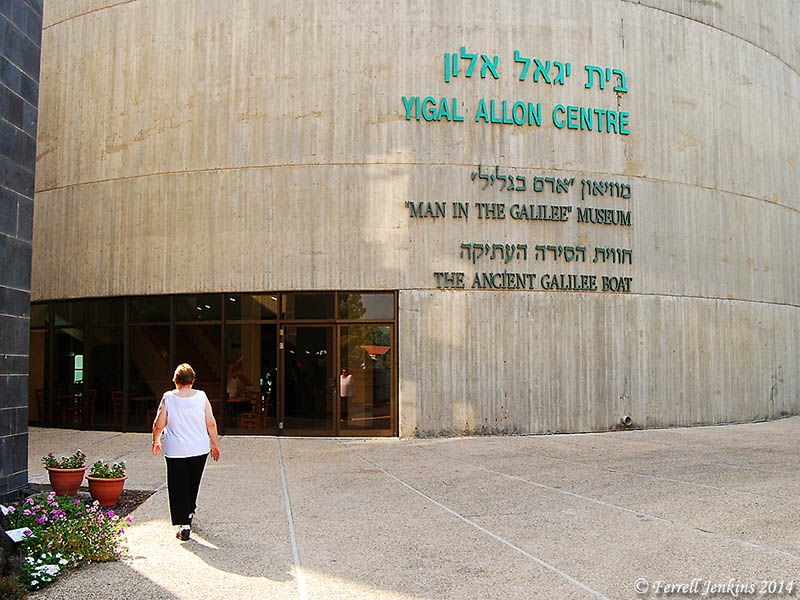
The boat is now displayed in the Yigal Allon Centre at Kibbutz Ginosar.

The Roman boat discovered in the Sea of Galilee in 1986. Photo by Ferrell Jenkins.

The Roman boat discovered in the Sea of Galilee in 1986. Photo by Ferrell Jenkins.

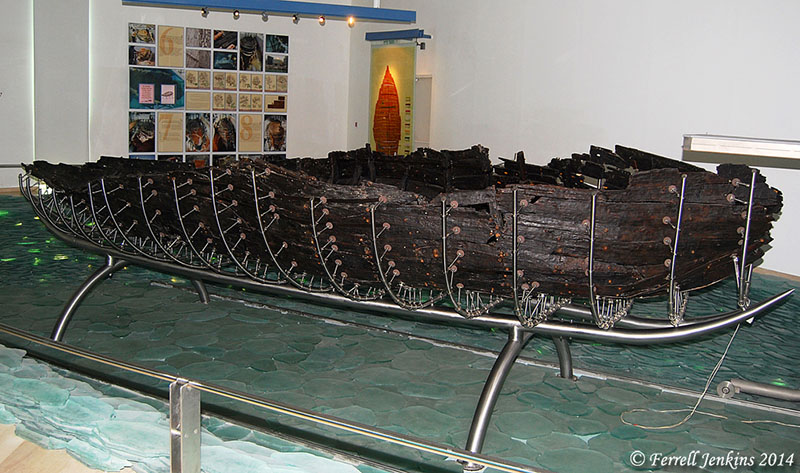
The photo below shows the side view of the boat. The display on the wall informs us that,

The boat is made mostly of oak and cedar, together with other types of wood, some recycled from disused boats. Thus far, laboratory tests have found eleven types of wood in the boat. Some were used to build the hull and others were added in smaller pieces later, to replace missing parts or repair faulty ones. The result is an intricate wooden patchwork vessel.

Twelve, not eleven, trees are shown on the display: Cedar, Tabor Oak, Christ Thorn, Carob, Aleppo Pine, Hawthorn, Plane Tree, Atlantic Terebinth, Sycomore, Laurel, Willow, and Judas Tree.

The Roman boat displayed in the Yigal Allon Museum. Photo by Ferrell Jenkins.

The Roman boat displayed in the Yigal Allon Museum. Photo by Ferrell Jenkins.

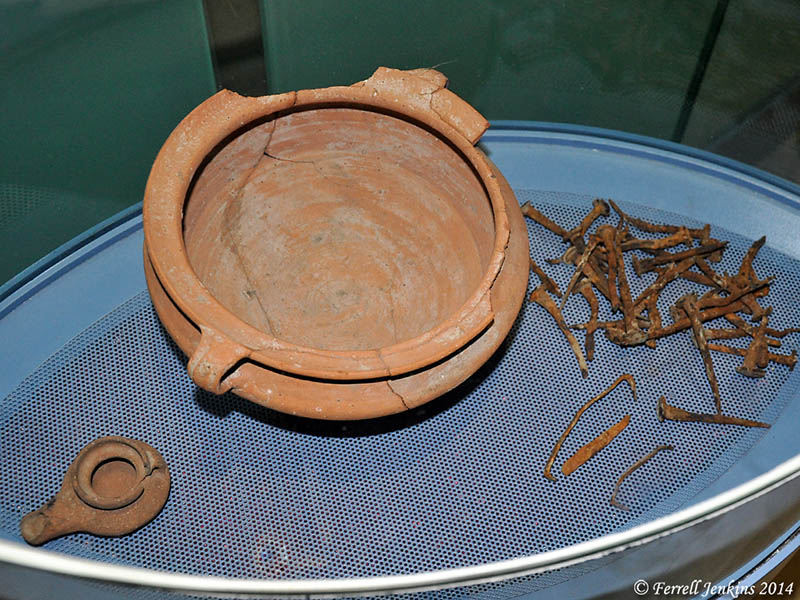
A pottery lamp was found inside the overturned boat, and a cooking pot was found outside the boat near the prow. These vessels, along with some nails from the boat, are displayed at the museum.

Pottery found in association with the boat, and nails from the boat. Photo by Ferrell Jenkins.

Pottery found in association with the boat, and nails from the boat. Photo by FJ.

At first the boat was placed in a tank in a temporary building while the conservation took place. It is now beautifully displayed in the Yigal Allon Centre, a museum at Kibbutz Ginosar on the east shore of the Sea of Galilee.

Entrance to the Yigal Allon Center where the Roman boat is displayed. Photo by Ferrell Jenkins.

Entrance to the Yigal Allon Centre where the Roman boat is displayed. Photo by FJ.

The boat used by Jesus and the disciples would have been larger (John 6:22; Mark 4:38). But on some occasions Jesus had a boat standing ready for Him (Mark 3:9). Perhaps one like this one.

The story of the discovery of the boat is told by Shelly Wachsmann in the Biblical Archaeology Review (14:05; Sept/Oct 1988). This little tidbit might be of interest here:

On Sunday [February 9, 1986], we were startled to read newspaper reports of a wreck from Jesus’ time that had been discovered in the Sea of Galilee. Somehow the news had leaked. By Monday the press was writing in front page stories about the discovery of the “boat of Jesus.”

The media hype was soon overwhelming. The Ministry of Tourism actively promoted the “Jesus connection” in the hope of drawing pilgrims to Israel. In Tiberias, Ultra-Orthodox Jews, fearful that excavation of the boat would promote Christian missionary work, demonstrated against it.

During the Jewish War in Galilee the Roman Emperor Vespasian made headquarters in Tarichea (= Magdala) for a period of time. The Romans engaged the Jews in a fierce naval battle. The outcome was not good for the local residents. I suggest you consult Josephus’ Wars of the Jews, book 3, for details. Notice this brief account of the outcome.

529 but as many of these were repulsed when they were getting ashore, they were killed by the arrows upon the lake; and the Romans leaped out of their vessels, and killed a great many more upon the land: one might then see the lake all bloody, and full of dead bodies, for not one of them escaped. 530 And a terrible stink, and a very sad sight there was on the following days over that country; for as for the shores, they were full of shipwrecks, and of dead bodies all swelled; and as the dead bodies were inflamed by the sun, and putrefied, they corrupted the air, insomuch that the misery was not only the object of pity to the Jews, but to those who hated them and had been the authors of that misery. 531 This was the upshot of the naval battle. The number of the slain, including those who were killed in the city before, was six thousand and five hundred. (Jewish Wars 3:529-531)

The Ginosar about which we speak is on the shore of the region called the land of Gennesaret in the Gospels (Matthew 14:34; Mark 6:53). The lake is called the lake of Gennesaret in Luke 5:1.

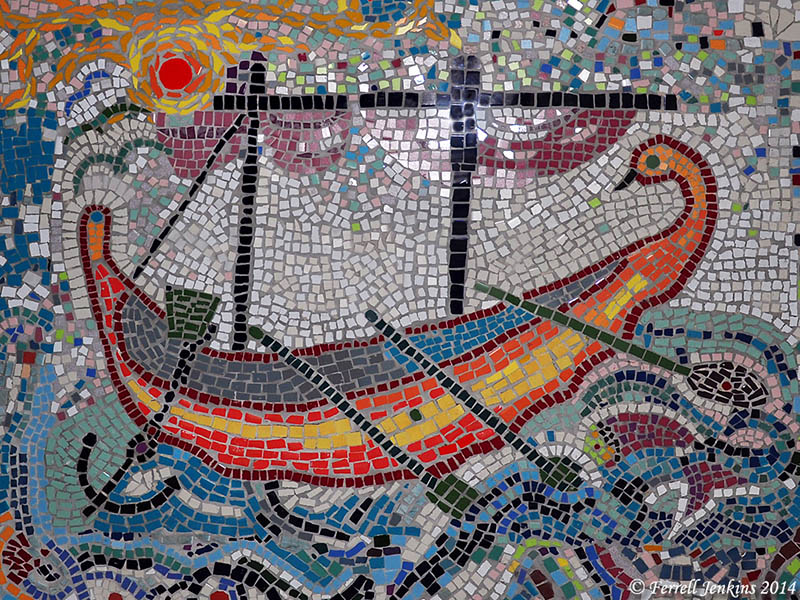
A mosaic with a similar boat had been found earlier at nearby Magdala. The original has been displayed at Capernaum for many years, but it was in poor condition the last time I saw it there. A modern replica, pictured below, may be seen in the Yigal Allon Centre.

Replica of a mosaic discovered at Magdala. Photo by Ferrell Jenkins.

Replica of a mosaic discovered at Magdala. Photo by Ferrell Jenkins.

Boats played an important role in life around the Sea of Galilee in the time of Jesus. They were important in His ministry as well.

Cove of the Sower – from land, sea, and air

Over the past few years I have tried to get some good photos of the Cove of the Sower (also called the Cove of the Parables) and have written about it twice before. Some have suggested that this place on the north shore of the Sea of Galilee would have been the place where Jesus spoke in parables to large numbers who assembled to hear Him.

Read the full account given by Mark in 4:1-20. Here is the way it begins:

Again he began to teach beside the sea. And a very large crowd gathered about him, so that he got into a boat and sat in it on the sea, and the whole crowd was beside the sea on the land. And he was teaching them many things in parables, and in his teaching he said to them: “Listen! Behold, a sower went out to sow. (Mark 4:1-3 ESV)

Parallel accounts may be read in Matthew 13:1-15 and Luke 8:4-10.

B. Cobbey Crisler conducted some experiments at places where the Bible records that large crowds gathered. The attempt was to see if the large number were able to hear a speaker without the aid of modern sound equipment. The places were Kadesh-barnea, Shiloh,  and The Cove of the Sower in Galilee (“The Accoustics and Crowd Capacity of Natural Theaters in Palestine.” Biblical Archaeologist, 1976. Vol. 39. Num. 4).

The study indicated that the Cove of the Sower would allow between 5000 and 7000 people to hear.

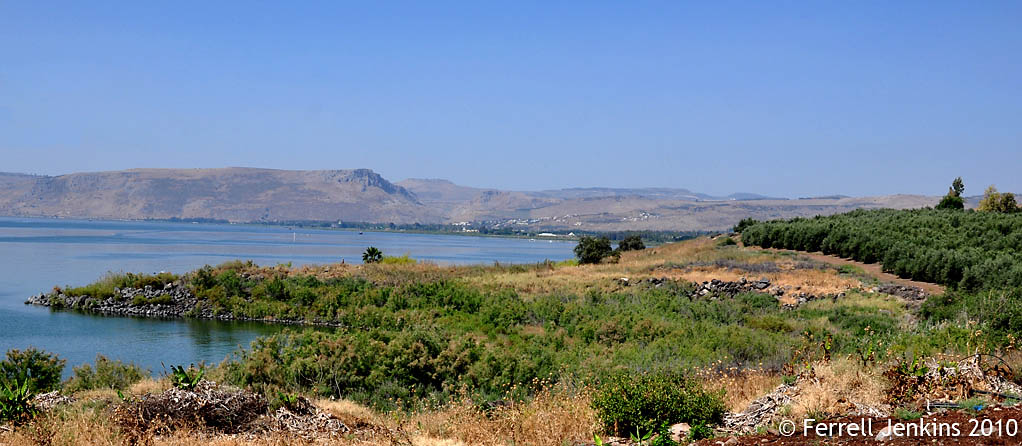
Over the years different crops have been planted in the area, and this makes it difficult to compare older and more recent photos. The highway runs just above the level of the top of the trees seen on the right (north). This photo is made looking west.

The Cove of Sower from top of area. Photo by Ferrell Jenkins.

The Cove of Sower from top of area. Photo by Ferrell Jenkins.

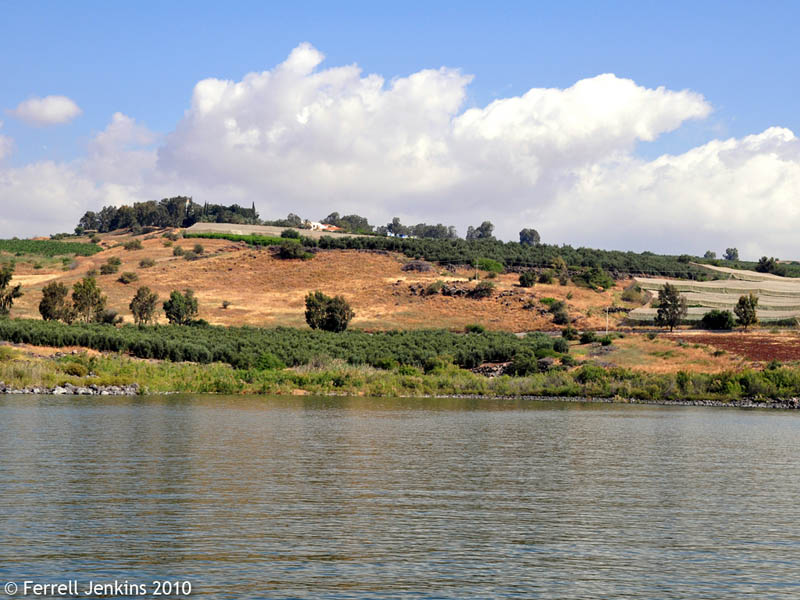
The photo below was made from a boat a short distance south of the shore. You can see the extension of the natural theater stretching up the hill above the trees. Hidden in the clump of trees on the top of the hill, and to the left is the traditional Mount of Beatitudes. This would be a good candidate for the place of the Sermon on the Mount.

Cove of the Sower From the Sea of Galilee by Ferrell Jenkins.

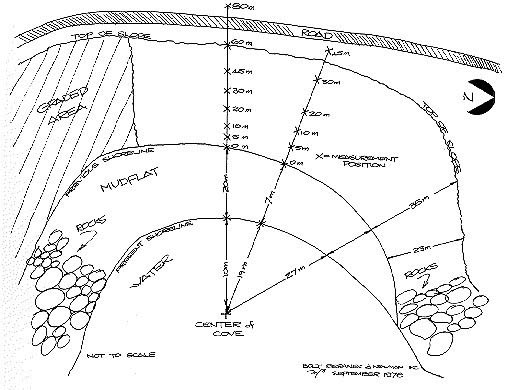
The following sketch from Crisler’s article in Biblical Archaeologist may help you to understand more clearly about the cove.

Cove of Sower sketch from Crisler's article in BA.

The terrain and the crops have changed since Crisler wrote. For those who may be curious, the covered areas are where bananas grow today. Both bananas and citrus trees have been brought to the country since the time of Jesus.

More recently I have been able to make a few aerial photos of the area. The first one was made from above the modern paved road looking down on the cove.

The Cove of the Sower from the air, looking south. Photo by Ferrell Jenkins.

The Cove of the Sower from the air, looking south. Photo by Ferrell Jenkins.

The next aerial view shows the cove and the hill above it from the south.

Aerial View of the Cove of the Sower looking north. Photo by Ferrell Jenkins.

Aerial View of the Cove of the Sower looking north. Photo by Ferrell Jenkins.

I trust that this information and these photos will enhance your understanding of the portions of Scripture mentioned above.