Tag Archives: Ministry of Jesus

Passing through the grainfields

All three of the Synoptic Gospels record the incident of Jesus and His disciples passing through the grainfields on a Sabbath.

On a Sabbath, while he was going through the grainfields, his disciples plucked and ate some heads of grain, rubbing them in their hands. But some of the Pharisees said, “Why are you doing what is not lawful to do on the Sabbath?” (Luke 6:1-2 ESV)

I thought I would put together some photos to help you visualize what happened here. First, we have a photo of a wheat field below Mount Tabor. The photo is made looking north west from near the site of ancient En-dor. The area is famous as the home of the medium visited by King Saul (1 Samuel 28:7).

Wheat field below Mount Tabor. Photo by Ferrell Jenkins.

Wheat field with view NW to Mount Tabor. Photo by Ferrell Jenkins.

Now, imagine the disciples taking grain in their hands.

Picking heads of grain. Photo by Ferrell Jenkins.

Picking heads of grain. Photo by Ferrell Jenkins.

And then rubbing the heads to separate the grain from the chaff.

Rubbing grain to separate the head from the chaff. Photo by Ferrell Jenkins.

Rubbing grain to separate the head from the chaff. Photo by Ferrell Jenkins.

The last two photos were made in the vicinity of Mount Nemrut in eastern Turkey. Larger images, suitable for use in teaching, are available by clicking on the photos.

Archaeology Illustrated by Balage Balogh

His work has been featured on the Discovery Channel and in many scholarly books. A native Hungarian, Balage now creates images of ancient Israel, Egypt, Babylon, Greece, Rome, and other civilizations. He tell the story in these words:

I began working with archaeologists, scholars and experts in the field in the Department of Archaeology at the Hebrew University of Jerusalem, the Albright Institute, the Israel Museum, and universities throughout the United States.  My archaeological illustrations were published in National Geographic Hebrew edition,  A Guide to Jerusalem, The World of the New Testament, The World of the Old Testament, Excavating Jesus, and The Jesus Dynasty among others and many of my illustrations were part of exhibits at the Israel Museum, the Welcome Center in the City of David, Jerusalem, and permanently displayed in the Archaeology Department at the Hebrew University of Jerusalem.

Balage Balogh contacted me with the request that I offer some of his art free of charge on my web sites in exchange for a permanent link. Since I have more readers of the blog than of the web sites I decided to begin here. As time permits I will post a few more of his illustrations here and at the Biblical Studies Info Page and Bible World.

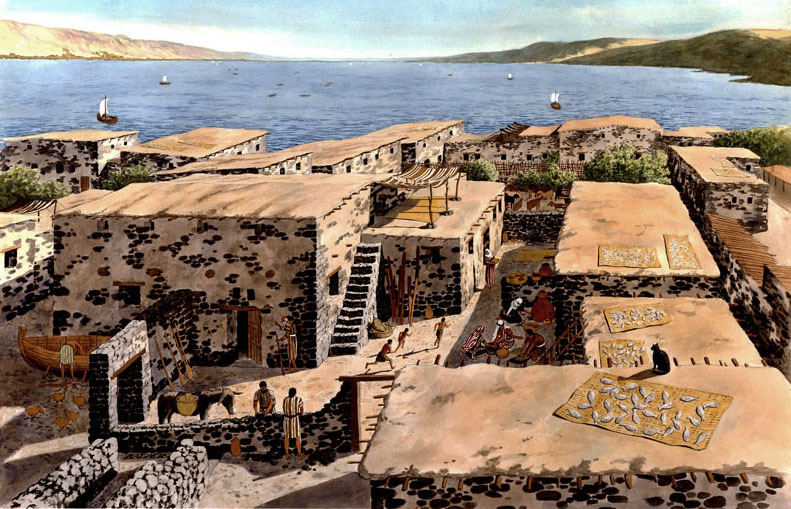
Here is a wonderful drawing of Capernaum at the time of Jesus. One need only know something about the archaeological discoveries of the first century to see the accuracy of this drawing. Notice the basalt stone and the way the roofs are constructed. A larger image is available by clicking on the drawing.

Capernaum at the time of Jesus. Art by Balage Balogh.

Capernaum at the time of Jesus. Art by Balage Balogh.

Take a look at Archaeology Illustrated. Balogh’s work may be purchased for use in presentations or publications. This illustration is © Balage Balogh 2010.

Kinneret Regional Project uncovers synagogue

Several weeks ago I added a link to the Kinneret Regional Project on the Bible Places page of the Biblical Studies Info Page. My intention was to write about the project and show a photo of Tel Kinneret (Kinrot; Arabic Tell el-‘Oreme) on the northwestern shore of the Sea of Galilee.

Now word comes of the discovery of a fourth century synagogue at Horvat Kur, about a mile northwest of Tel Kinneret. The press release here says that the discovery “adds new evidence [along with the synagogues at Capernaum, Chorazin, Kh. Hammam, and Magdala] for a very tight net of synagogues in a relatively small area on the Northwestern shores of the Lake of Galilee.”

Todd Bolen created a map using Google Earth to identify Horvat Kur, Tel Chinnereth (Kinneret), Tabgha, Mount of Beatitudes, Cove of the Sower, and Capernaum. This great resource for studying the ministry of Christ may be accessed at the Bible Places Blog.

Earlier I mentioned that the day in early May when my group took a boat ride on the Sea of Galilee was a great one for making photos. I caught this wonderful view of Tel Kinneret from the boat. The buildings on the shore below the tel belong to Pilgerhaus Tabgha, a guesthouse operated by the German Association of the Holy Land.
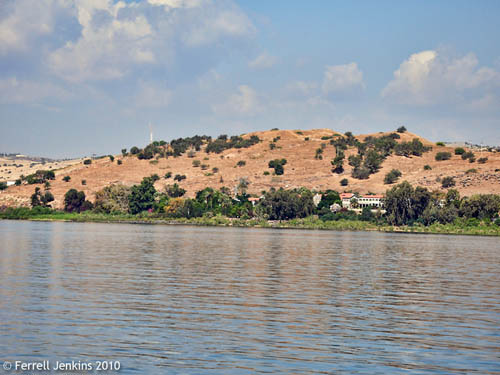
Tel Kinerot from the Sea of Galilee. Photo by Ferrell Jenkins.

Tel Kinneret from the Sea of Galilee. Photo by Ferrell Jenkins.

From the Kinneret Regional Project site you may download several good resources. The 2004 report by Pakkala, et al., begins with this description of Tel Kinneret.

The site boasts remains from the Chalcolithic to the Ottoman period. In its heyday in the Early Iron Age, i.e. the 11th/early 10th century BCE, Kinneret developed into a regional center, controlling the surrounding region and becoming one of the most important urban sites of the country.

The body of water that we commonly call the Sea of Galilee is known as the Sea of Chinnereth in the Old Testament (Numbers 34:11; Joshua 13:27). Chinnereth is listed as one of the fortified cities of the tribe of Naphtali in Joshua 19:35.

I think most tourists to Galilee overlook Tel Kinneret. They are excited about having seen the Roman boat at Nof Ginosaur, and the guide is beginning to tell them about Taghba, Capernaum, or the Mount of Beatitudes. Or it may be because the site is obscured from the highway by the electric power station below it.

HT: Joseph I. Lauer

Reaching 400,000

Moments ago someone recorded hit number 400,000 for this blog. Your words of appreciation are greatly appreciated. In the past few weeks, while traveling on the West Coast, numerous people told me they found the posts helpful. The comments left on the blog, and the Emails received are also appreciated.

400,000 hits at ferrelljenkins.wordpress.com.

Ferrell's Travel Blog recorded his number 400,000 this evening.

As a marker of this milestone I am posting a photo I think many of you will be able to use in the Bible classes you teach. Click on the photo for a larger image suitable for use in PowerPoint.

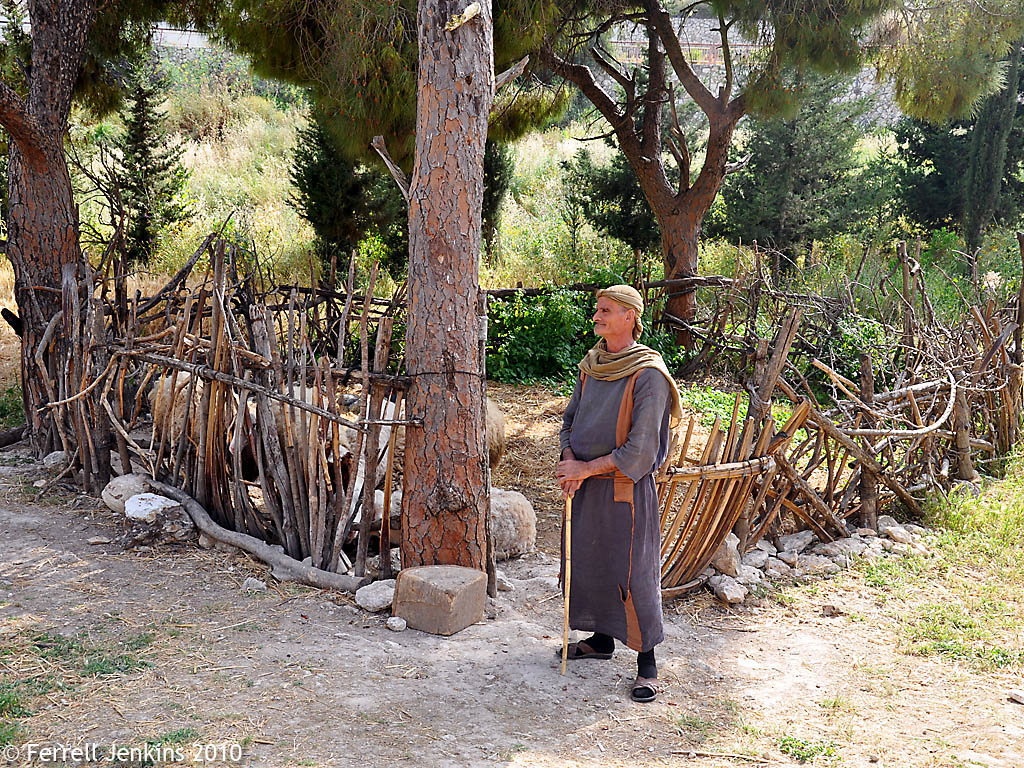
Shepherd and sheepfold at Nazareth Village. Photo by Ferrell Jenkins.

Shepherd and sheepfold at Nazareth Village. Photo by Ferrell Jenkins.

This photo might be used in teaching any of the texts mentioning the sheepfold (Genesis 49:14; Numbers 32:16; Judges 5:16; 1 Samuel 24:3; 2 Chronicles 32:28; Psalm 28:13; Psalm 78:70).

It provides a good illustration of the teaching of Jesus in John 10.

“Truly, truly, I say to you, he who does not enter by the door into the fold of the sheep, but climbs up some other way, he is a thief and a robber.  “But he who enters by the door is a shepherd of the sheep. “To him the doorkeeper opens, and the sheep hear his voice, and he calls his own sheep by name and leads them out. (John 10:1-3 NAU)

A view of Capernaum

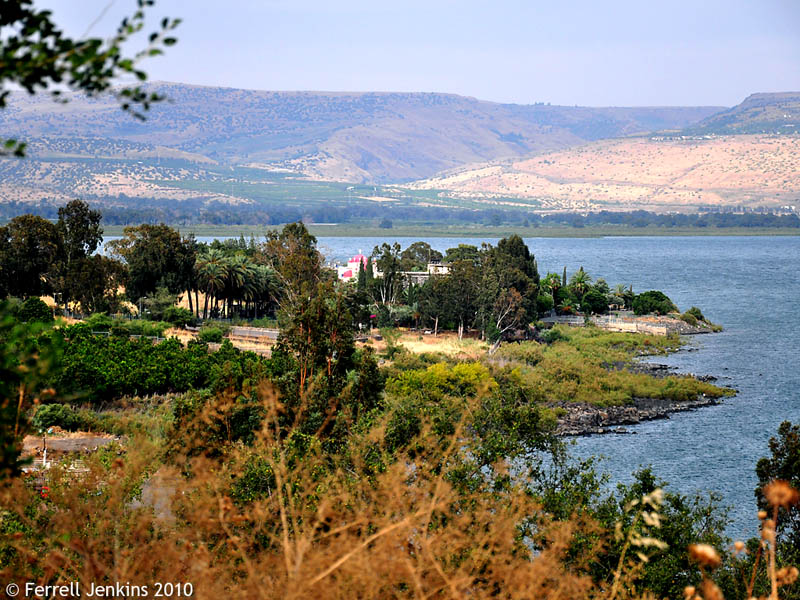
Looking back over the photos I have taken in the past three weeks, I noted this unusual one of Capernaum from the hill above, up toward the Mount of Beatitudes. This photos shows the northeast corner of the Sea of Galilee with a portion of the plain of Bethsaida visible.

Capernaum became the Galilean center for the ministry of Jesus.

And leaving Nazareth he went and lived in Capernaum by the sea, in the territory of Zebulun and Naphtali, (Matthew 4:13 ESV)

Capernaum from the Hill Above. Photo by Ferrell Jenkins.

Capernaum from the Hill Above. Photo by Ferrell Jenkins.

On this afternoon, May 15, the sky was fairly clear. The eastern shore of the Sea of Galilee is visible. Those are dried thistles in the foreground of the photo.

Tomorrow is our last day in Jerusalem. Perhaps we will be able to post something late in the day before departing for home.

The Cove of the Sower

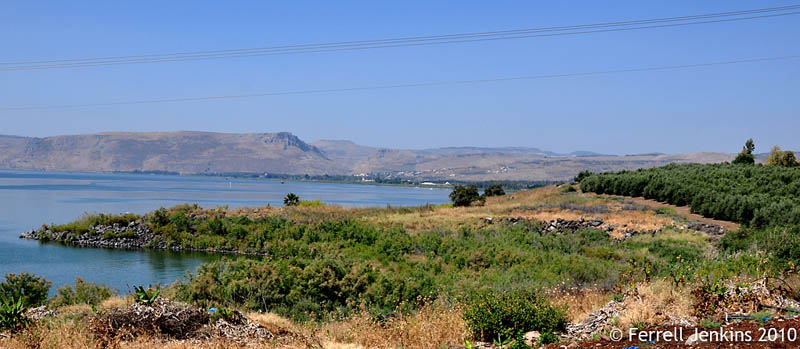
A few times before I have tried to get some good photos of the cove of the sower, and wrote about it in August, 2008. Saturday I put forth some extra effort to make a good photo at the spot on the north end of the Sea of Galilee called the Cove of the Sower. Some have suggested that this would have been the place where Jesus could speak to large numbers who assembled to hear Him.

Read the full account given by Mark in 4:1-20. Here is the way it begins:

He began to teach again by the sea. And such a very large crowd gathered to Him that He got into a boat in the sea and sat down; and the whole crowd was by the sea on the land.  And He was teaching them many things in parables, and was saying to them in His teaching,  “Listen to this! Behold, the sower went out to sow. (Mark 4:1-3)

Read the parallel accounts in Matthew 14:1-15 and Luke 8:4-10.

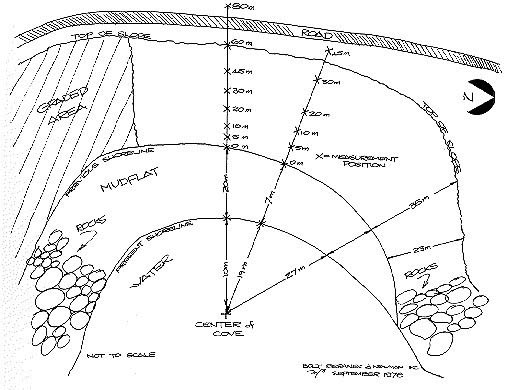
B. Cobbey Crisler conducted some experiments at places where the Bible records that large crowds gathered. The attempt was to see if the large number were able to hear a speaker without the aid of modern sound equipment. The places were Kadesh-barnea, Shiloh,  and The Cove of the Sower in Galilee. I suggest you read the entire article (“The Accoustics and Crowd Capacity of Natural Theaters in Palestine.” Biblical Archaeologist, 1976. Vol. 39. Num. 4.

The study indicated that the Cove of the Sower would allow between 5000 and 7000 people to hear.

Over the years different crops have been planted in the area, and this makes it difficult to compare older and more recent photos. The highway runs just above the level of the top of the olive trees. This photo is made looking west.

Cove of the Sower by Ferrell Jenkins

Cove of the Sower. Photo by Ferrell Jenkins

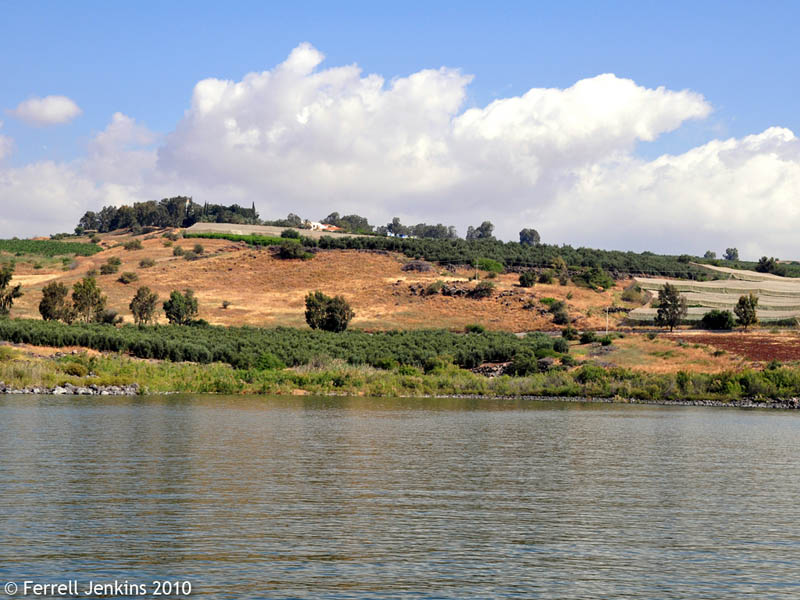
A couple of weeks ago I made the following photo from a boat a short distance south of the shore.

Cove of the Sower From the Sea of Galilee by Ferrell Jenkins.

Cove of the Sower From the Sea of Galilee. Photo by Ferrell Jenkins.

The following sketch from Crisler’s article in Biblical Archaeologist may help you to understand this better.

Cove of Sower sketch from Crisler's article in BA.

Cove of Sower sketch from Crisler's article in Biblical Archaeologist.

The terrain and the crops have changed since Crisler wrote.

Friday in lower Galilee

Today we drove from Tiberias past the Horns of Hattin, a site where the Crusaders thought Jesus spoke the beatitudes, through the Bet Netofa Valley to Sepphoris.

Sepphoris is an interesting site with a history dating from the Iron Age to modern times. The site has seen a considerable amount of archaeological excavation. Much of the work has been under the direction of my Temple Terrace neighbor, Dr. James Strange of the University of South Florida.

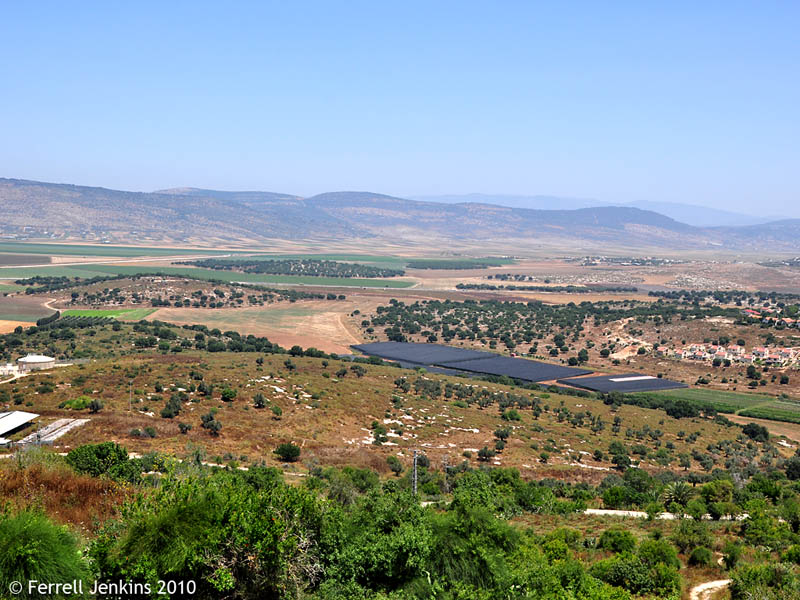
When I asked Elizabeth to select today’s photo, she picked the one I made of the Bet Netofa valley from atop the fortress at Sepphoris. This valley served as a main travel route from Nazareth, Sepphoris, Yodfat, and Cana to the cities around the Sea of Galilee. We think that Jesus must have used this route as he traveled from Nazareth to Capernaum.

And he went down to Capernaum, a city of Galilee.  (Luke 4:31a ESV)

Across the valley to the north is the location of Yodfat, the home of Josephus, and Khirbet Kanna, thought to be the site of Cana of Galilee (John 2). Click on the photo for a larger image.

View of the Bet Notofa Valley north of Zepphoris. Photo by Ferrell Jenkins.

View of the Bet Netofa Valley north of Zepphoris. Photo by Ferrell Jenkins.

We also visited Bethlehem of Galilee, a McDonald’s, and made some photos of Tel Megiddo before returning to our hotel on the shore of the Sea of Gailiee.

After dinner we sat for a while on the deck overlooking the sea. The Sea of Galilee is located in a rift nearly 700 feet below sea level. The heat can be oppressive during the day in this basin. In the evening a pleasant breeze flows in the area; it can even feel cool. I thought of the Biblical text that speaks of Jesus healing the sick and oppressed after sunset.

That evening at sundown they brought to him all who were sick or oppressed by demons. (Mark 1:32 ESV)

The Scriptures are amazing, aren’t they. The Book and the Land blend together to reveal a wonderful harmony and a magnificent Savior.

The Jordan River today

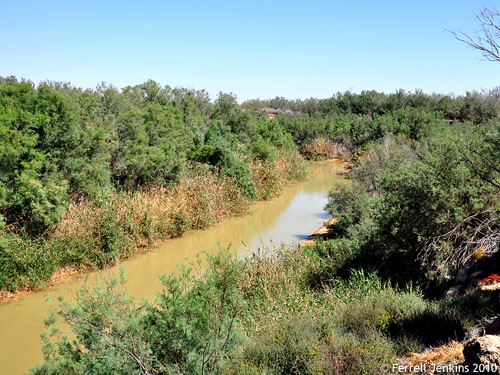
Today we returned to the Jordan Valley (Roman Perea) to a site designated Bethany Beyond the Jordan in the country of Jordan. Enough evidence was presented to easily convince various religious orders to build new churches in the area. The site on the west bank of the Jordan that I visited in 1967 has been closed to the general public since June of 1967 I think.

You will see by the photo that I made this morning that the river is extremely low. Just last evening I read the article from The Jerusalem Post by way of the Bible Places Blog about the study that says the river will be dry by next year.

Jordan River at Bethany Beyond the Jordan. Photo by Ferrell Jenkins.

Jordan River at Bethany Beyond the Jordan. Photo by Ferrell Jenkins.

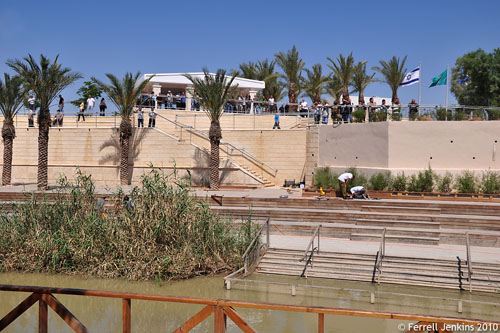
Now that Jordan is seeing many tourists come to the eastern side of the river, Israel is preparing to open the site on the western side of the river. There were several people on the Israel side today where construction continues.

Jordan River Baptism Site in Israel and Jordan. Photo by Ferrell Jenkins.

Jordan River Baptism Site in Israel and Jordan. Photo by Ferrell Jenkins.

In spite of the fact that the river water is reported to be mostly sewage, several were being baptized, or dipping themselves, in the water when we were there.

These things took place in Bethany beyond the Jordan, where John was baptizing. (John 1:28 NAU)

We also visited Mount Nebo and Madaba before traveling south about 4 hours to Petra for the night.

The Roman Army & Chariot Experience in Jerash

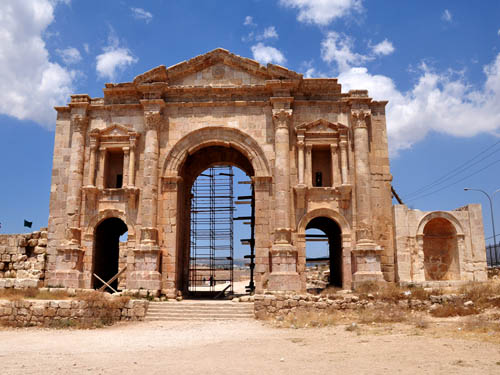
Jerash was one of the cities of the Decapolis in New Testament times. The impressive Roman ruins include a monumental arch, a hippodrome, s theater, a well-preserved cardo, and numerous byzantine churches. The Roman Emperor Hadrian visited Jerash about 130 A.D.

Hadrian's Monumental Arch at Jerash. Photo by Ferrell Jenkins.

Hadrian's Monumental Arch at Jerash. Photo by Ferrell Jenkins.

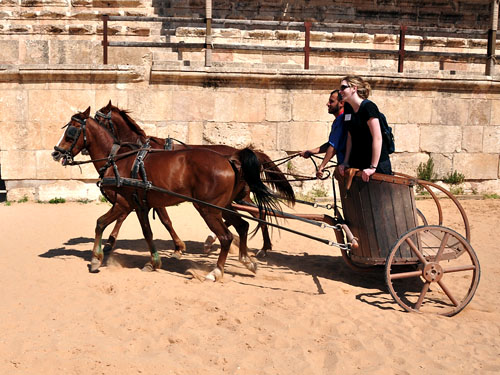
We crossed from Israel into Jordan at the Sheik Hussein bridge a few miles south of Bethshean. Our plan was to be at the 11 a.m. RACE (Roman Army Chariot Experience) at Jerash. Because it took a little longer at the bridge, we had to attend the 2 p.m. show. The show was good, but the sun was already to the back of the performers. This caused the photos to be less than ideal. After the show I made a few photos in the Hippodrome with the sun over my shoulder. One of the young ladies in our group decided she would like to ride in the chariot. See for yourself.

Erin gets a chariot ride at Jerash. Photo by Ferrell Jenkins.

Erin takes a chariot ride at Jerash. Photo by Ferrell Jenkins.

When Jesus traveled through the Decapolis He possibly visited the area around Jerash (Mark 7:31).

A great day in Galilee

After breakfast our group walked to the dock in Tiberias and boarded a boat for a ride on the Sea of Galilee. At first it appeared that it might be a bit hazy on the sea. However, as we moved along the sky cleared and it turned out to be a wonderful day for photographs and teaching about the sites associated with the ministry of Jesus.

A few of the tour members have been to Israel before, but for most of them it is the first trip. It doesn’t matter how many times one comes here he/she always learns something new.

I had arranged earlier with our tour guide and tour company to have a demonstration of cast net fishing on the sea and to sail past the Cove of the Sower, the name given to the site where Jesus taught from a boat to people sitting on the shore.

Again he began to teach by the lake. Such a large crowd gathered around him that he got into a boat on the lake and sat there while the whole crowd was on the shore by the lake. (Mark 4:1 NET)

The view of the traditional Mount of Beatitudes (Matthew 6-7) was tremendous. The appearance of the hill has changed over the years. Trees have grown up around the church. A larger building, painted a light color, has made the site less aesthetically appealing. The hillside is filled with agricultural projects. Did Jesus really speak the Sermon on the Mount here? If it wasn’t here, it could not have been far away. The precise spot matters little.

The Mount of Beatitudes. Photo by Ferrell Jenkins.

The Mount of Beatitudes. Photo by Ferrell Jenkins.

Click on the photo for a larger image.

We turned west and sailed to Nof Ginosar in the land of Gennesaret (the English equivalent).

After they had crossed over, they came to land at Gennesaret and anchored there. (Mark 6:53 NET)

As we approached the shore I noticed one of the ships with an interesting figurehead of a bird, and captured this photo of the Via Maris, the road that leads from Migdal (Magdala) eastward.

The Via Maris from the Sea of Galilee at Nof Ginosar. Photo by Ferrell Jenkins.

The Via Maris from the Sea of Galilee at Nof Ginosar. Photo by Ferrell Jenkins.

The Sea of Galilee is extremely low. The area where you see the blue shade and cabanas now serves as a beach. A few years ago it was covered with water.

We did a lot more today, but that’s it for tonight. Everyone in the group appears to be in good health and enjoying the experience.