Tag Archives: Ministry of Jesus

The Via Dolorosa – the way of suffering

The day of the crucifixion of Jesus was an incredible day in history. Early in the morning Jesus was transferred from Caiaphas, the Jewish High Priest, to Pontius Pilate, the Roman military governor. When Pilate learned that Jesus was from Galilee, he sent Him to Herod Antipas. Herod quickly sent Him back to Pilate. Under pressure from the religious leaders, Pilate delivered Jesus to be crucified. The numerous events from the last day prior to the crucifixion of Jesus are recorded in the New Testament (Matthew 26-27; Mark 14-15; Luke 22-23; John 18-19).

As early as Byzantine times Christians began to follow the final steps of Jesus on specified days. Over the centuries many changes were made in the route and the stops. The traditional Via Dolorosa, as known today, was fixed in the 18th century.

Jerome Murphy-O’Connor says,

The Via Dolorosa is defined by faith, not by history. (The Holy Land, 5th edition, 37)

He continues,

The present Way of the Cross has little chance of corresponding to historical reality… (38)

According to tradition, the fifth station of the cross is where Simon of Cyrene (modern Libya) was compelled to bear the cross of Jesus. Some of the stations of the cross are not mentioned in the New Testament, but this one is.

As they led him away, they seized Simon of Cyrene, who was coming in from the country. They placed the cross on his back and made him carry it behind Jesus. (Luke 23:26 NET; cf. Matthew 27:32; Mark 15:21)

Via Dolorosa in Jerusalem. Station V. Simon of Cyrene is compelled to carry the cross of Jesus. Photo by Ferrell Jenkins.

The Via Dolorosa in Jerusalem. Station V. Simon of Cyrene is compelled to carry the cross of Jesus to Golgotha. Photo by Ferrell Jenkins.
Reclining in the Upper Room

Each of the Gospels tell us something about the last supper Jesus ate with His disciples prior to the crucifixion. Matthew says,

Now on the first day of Unleavened Bread the disciples came to Jesus, saying, “Where will you have us prepare for you to eat the Passover?” said, “Go into the city to a certain man and say to him, ‘The Teacher says, My time is at hand. I will keep the Passover at your house with my disciples.'”  And the disciples did as Jesus had directed them, and they prepared the Passover.  When it was evening, he reclined at table with the twelve. (Matthew 26:17-20 ESV)

Both Mark and Luke inform us that the room was a “large upper room furnished” (Mark 14:15; Luke 22:12). Leon Morris comments on these arrangements.

The householder would show them a large upper room furnished. This last word is literally ‘spread’ and probably means that there would be couches ready with coverings spread over them (Moffatt translates ‘with couches spread’). They followed instructions and prepared the meal. (Morris, Luke: An Introduction and Commentary. Tyndale New Testament Commentaries, 323.)

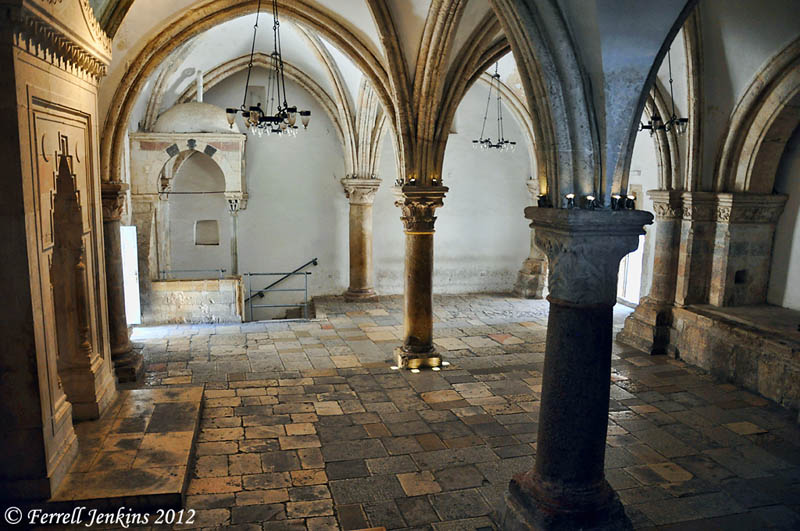
There is in the portion of the Old City of Jerusalem called Mount Zion (which really isn’t) a room known as the Cenacle (Latin) or the Room of the Last Supper. The tradition goes back further, but the building as we see it today dates back to the time of the Franciscans in 1335 A.D. (Murphy-O’Connor, The Holy Land).

The traditional room of the Last Supper (the Cenacle) on Mount Zion, Jerusalem. Photo by Ferrell Jenkins.
The traditional room of the Last Supper on Mount Zion. Photo by Ferrell Jenkins.
Jim Fleming has specialized in recreating the world of the Bible for modern students. He says,

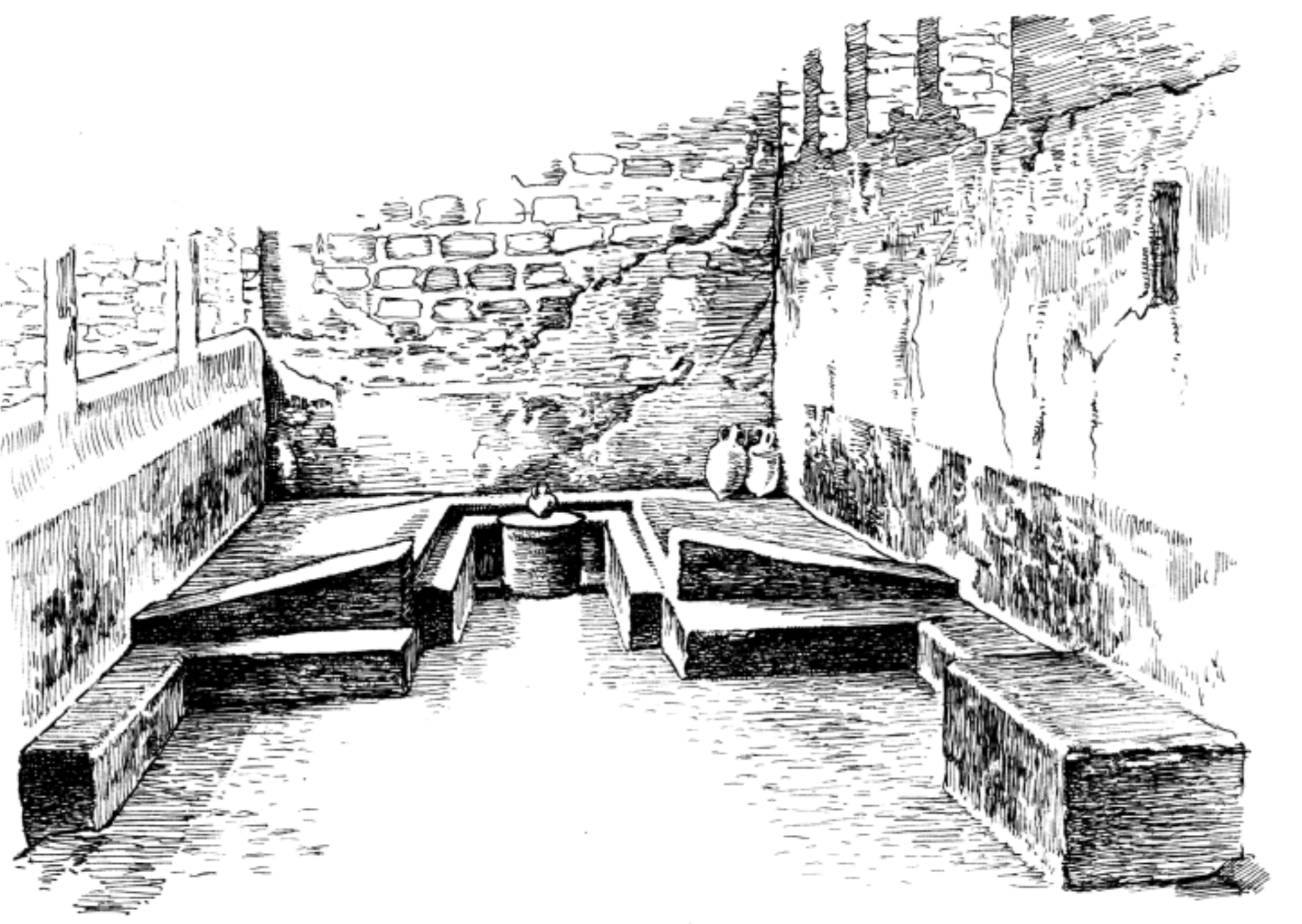
Rather than picturing small round or rectangular standing tables, these words would have called to mind a room with a large U-shaped triclinium dining table with cushions.

Persons lying down to eat would recline around the outside of the table with the upper body supported on their left elbow. At large tricliniums the food was served from the center of the U-shaped table. (The World of the Bible Replicas)

Here is a drawing of a typical Roman triclinium.

Triclinium (1000 Bible Images).

Triclinium. Credit: 1000 Bible Images.

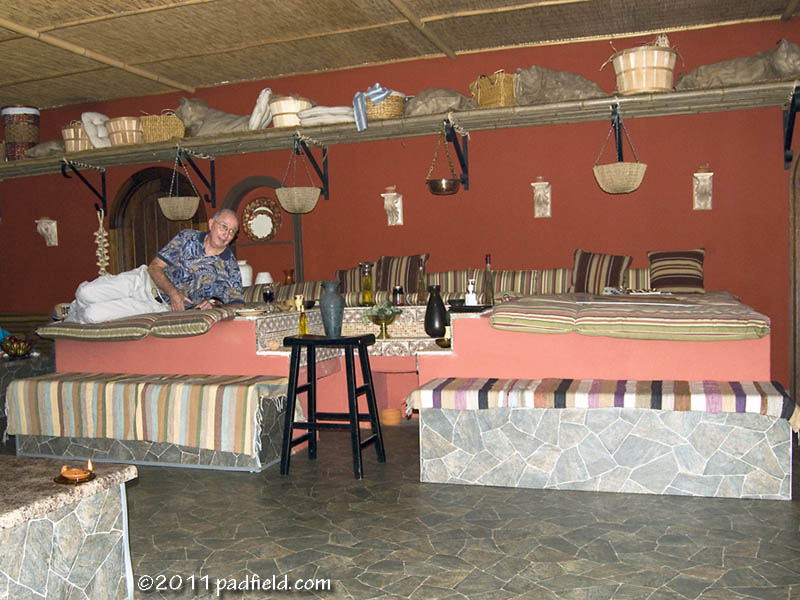
And here is a photo of a reconstructed triclinium at the Explorations in Antiquity Center in LaGrange, Georgia [Take the kids with you.]. The photo is courtesy of David Padfield.

Triclinium at Explorations in Antiquity Center. Photo by David Padfield.

Triclinium at Explorations in Antiquity Center. Photo by David Padfield.

Some of our English versions correctly use the term recline, reclined, or reclining, in the passages relating to eating meals in New Testament times. The KJV and the NKJV use “sat down” or similar terminology. Knowing that the concept of reclining is not understood by modern readers, some translations use a dynamic equivalent such as “took his place at the table” (CEB; NET, with a note of explanation).

Remember what you have learned here the next time you come across one of these references in your reading of the New Testament.

For a summary of the last week of the ministry of Jesus prior to the crucifixion, see here.

Plants growing in the Sea of Galilee

A member of the Biblical Flora group asks,

I was wondering if anyone knew what kind of water plants grew in the Sea of Galilee. Reeds, seaweeds, water lilies…anything like that?

Here is a slide that I made in June, 1980, at the northeast corner of the Sea of Galilee. I am not aware of the technical names of the plants, but it certainly shows a nice variety. Perhaps some other list member will be able to provide more information.

More recently, much of this area has been cleared for recreational use.

A secluded place on the NE corner of Sea of Galilee. Photo by Ferrell Jenkins.
A secluded place on the NE corner of Sea of Galilee. Photo by Ferrell Jenkins.
When I made this photo I was thinking of the text in Mark which speaks of Jesus and His disciples going by boat to a desert (Greek, eremos) or secluded place.

And they went away in the boat to a desolate place by themselves. (Mark 6:32 ESV)

The reference may be to the land area (cf. Mark 6:35), but it provides a good illustration of the type of place that could be reached by boat.

Those with an interest in Biblical Flora might enjoy being part of the group. Click here for information. J.P. van de Giessen is the list moderator.

The synagogue at Chorazin

The ancient synagogue at Chorazin has been partially reconstructed. The structure is made of the local basalt (volcanic) stone that is found in the area.

Restored Synagogue at Chorazin. Photo by Ferrell Jenkins.

Restored Synagogue at Chorazin. Photo by Ferrell Jenkins.

Scholars date the synagogue from the second century to the fourth century A.D. Ze’ev Yeivin, the director of archaeological excavations at Chorazin, is cautious in dating the synagogue.

Thus far, I have said very little about dating—always a difficult and sensitive subject.

The synagogue at Chorazin was first built at the end of the third century or the beginning of the fourth century A.D. Probably in the second half of the fourth century, the synagogue, as well as the rest of the town, was partially destroyed by an earthquake.

The town apparently lay in ruins for some time thereafter. The Church father Eusebius, writing at the end of the fourth century, tells us that Chorazin was a destroyed village, apparently in fulfillment of the prediction in the Gospels of Matthew and Luke. (BAR 13:05 (Sep/Oct 1987).

Yeivin comments on one of the most significant discoveries within the synagogue:

In 1926 a unique stone seat was found near the southern wall of the Chorazin synagogue. Since then it has been called the “Chair of Moses.” The Chair of Moses is a special seat that is used in some synagogues, even today, on certain occasions, usually located near the most important wall, that which faces Jerusalem. (BAR 13:05 (Sep/Oct 1987).

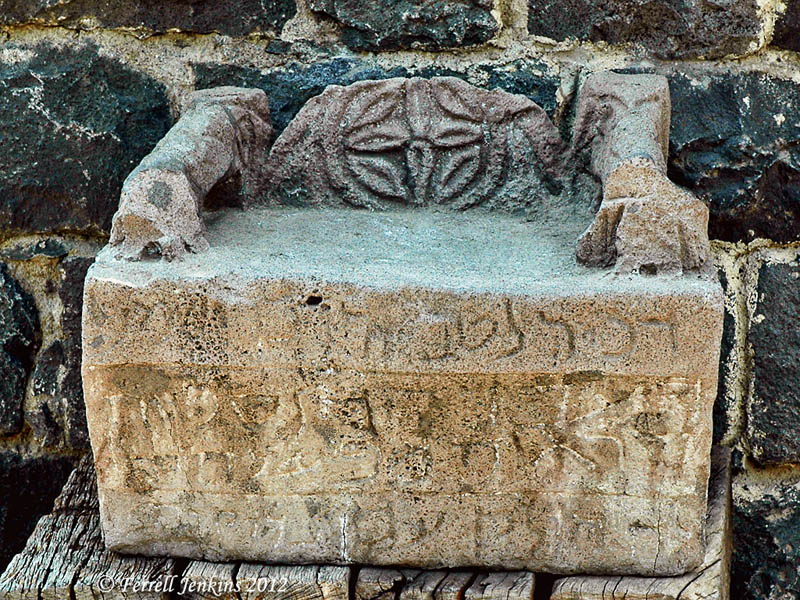
The photo below is of a replica of the Chair (or Seat) of Moses. The original is displayed in the Israel Museum, Jerusalem.

Chorazin Synagogue Chair. Photo by Ferrell Jenkins.

Replica of Chorazin Synagogue Chair. Photo by Ferrell Jenkins.

It may be that Jesus had this type of seat in mind in Matthew 23:2.

“The scribes and the Pharisees sit on Moses’ seat,  so do and observe whatever they tell you, but not the works they do. For they preach, but do not practice.  (Matthew 23:2-3 ESV)

A parallel might be that we should listen to those who teach the Bible from the pulpit, but not follow their example when they do not live according to the Bible.

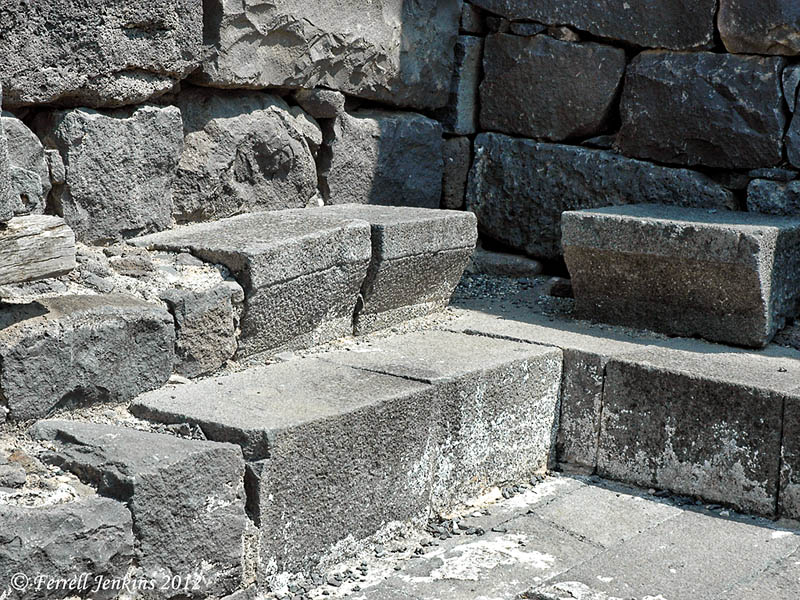
The seating running around the inside walls of the building is typical of what we know from several synagogues.

Chorazin Synagogue Seating - Photo by Ferrell Jenkins.

Chorazin Synagogue Seating. Photo by Ferrell Jenkins.

James uses the Greek word sunagogue to describe the meeting place of early Christians. It is most commonly translated assembly.

My brothers, show no partiality as you hold the faith in our Lord Jesus Christ, the Lord of glory.  For if a man wearing a gold ring and fine clothing comes into your assembly, and a poor man in shabby clothing also comes in,  and if you pay attention to the one who wears the fine clothing and say, “You sit here in a good place,” while you say to the poor man, “You stand over there,” or, “Sit down at my feet,”  have you not then made distinctions among yourselves and become judges with evil thoughts?  (James 2:1-4 ESV)

Whether our meeting place is elaborate or humble, we should not show partiality.

Jesus and the Moneychangers

We noted in a previous post that there are two accounts of Jesus cleansing the temple. By this we mean the temple precinct (the hieron), not the sanctuary where only priests were allowed (the naos). For the first account, early in his ministry, see John 2:13-25. The second account, toward the close of his ministry, is recorded in Matthew 21:12-13; Mark 11:15-18; and Luke 19:45-48.

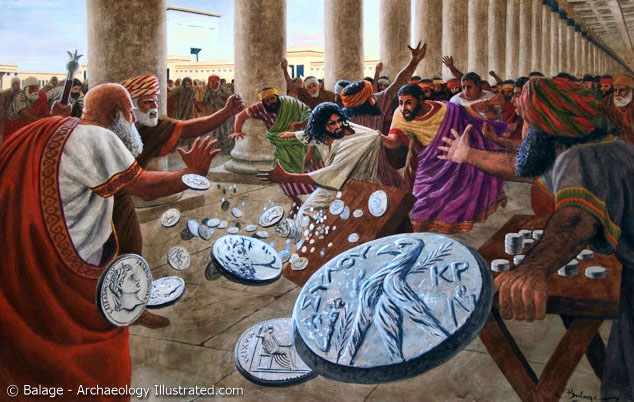
Artist Balage Balogh illustrates the scene of Jesus and the Money Changers. See more of his work at Archaeology Illustrated here.

Jesus and the Money Changers. Balage Balogh, Archaeology Illustrated.

Jesus and the Money Changers. Balage Balogh, ArchaeologyIllustrated.com.

The biblical account also mentions the animals and birds that were for sale to those coming to Jerusalem to worship (John 2:16; Matthew 21:12).

Money changers. (English versions use moneychagers, money-changers, and money changers.) The Jews normally would not bring the foreign money as an offering to the temple. The money had to be changed into the half-shekel of ancient Israel. This would necessitate money changers. Those who have traveled to foreign countries understand that money changers are common and necessary. Alfred Edersheim, who wrote a book on The Temple: Its Ministry and Services, pointed out that the total sum derived annually from the Temple tribute was large. The money changers were simply in the wrong place.

It is generally held that the coin used by the Jews for the temple tax was the Tyre shekel, which after 19 B.C. was most likely minted in Jerusalem (cf. Hendin, Guide to Biblical Coins, 175).

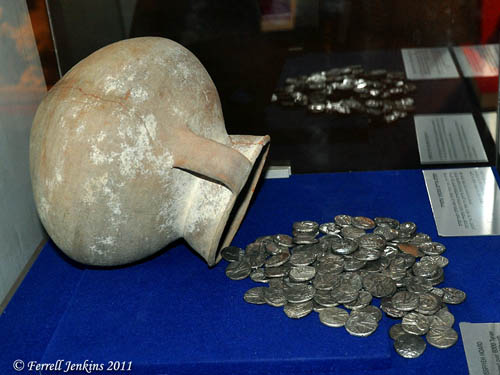
A hoard of coins including Tyrian Shekels, half shekels, and denarii bearing the image of  Roman Emperor Augustus (30 B.C.– A.D. 14) was found a few years ago at Ussifiyeh (Isfiya), a Druze village on Mount Carmel.

Ussifiyeh hoard of coins including Tyrian Shekels. Eretz Israel Museum.

Ussifiyeh hoard of coins including Tyrian Shekels. Photo by Ferrell Jenkins.

The information sign in the Eretz Israel Museum in Tel Aviv says,

The hoard probably represents a delivery of Temple tax intercepted and hidden away due to the events of the Jewish War which broke out in 66 C.E.

Click on the photo for an image large enough to use in classes and sermons.

John baptized in the river Jordan

John the Baptist proclaimed the coming Messiah in the Wilderness of Judea. The Gospel accounts point out that many people from Jerusalem and all Judea and the region about the Jordan came to be baptized. These were Jews who were being called to repent and confess their sins.

Then Jerusalem and all Judea and all the region about the Jordan were going out to him,  and they were baptized by him in the river Jordan, confessing their sins. (Matthew 3:5-6 ESV)

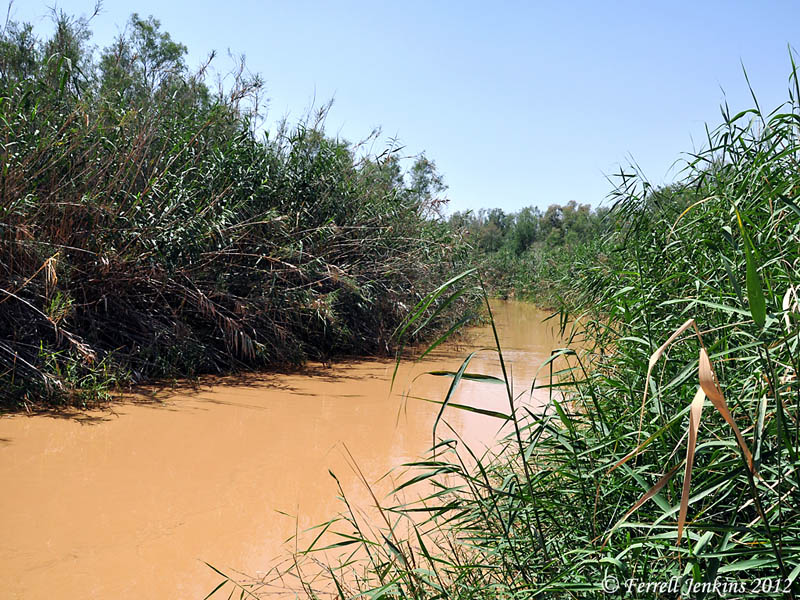
The photo shows a view of the River Jordan at the traditional site where John was baptizing. This photo was made in the spring of the year when the river shows the flow of mud as a result of the spring rains.

Jordan River (view south) at traditional site where John baptized. Photo: Ferrell Jenkins.

Jordan River (view south) where John baptized. Photo by Ferrell Jenkins.

Jesus was baptized by John, not because he was a sinner, but because it was part of God’s plan for him “to fulfill all righteousness.”

Then Jesus came from Galilee to the Jordan to John, to be baptized by him. John would have prevented him, saying, “I need to be baptized by you, and do you come to me?” But Jesus answered him, “Let it be so now, for thus it is fitting for us to fulfill all righteousness.” Then he consented. And when Jesus was baptized, immediately he went up from the water, and behold, the heavens were opened to him, and he saw the Spirit of God descending like a dove and coming to rest on him; and behold, a voice from heaven said, “This is my beloved Son, with whom I am well pleased.” (Matthew 3:13-17 ESV)

John was a voice in the wilderness

There may be some question about the location of the wilderness mentioned in Luke 3:2. The term wilderness (eremos) is described by BDAG as “an uninhabited region or locality, desert, grassland, wilderness (in contrast to cultivated and inhabited country).” The same term is translated deserts in Luke 1:80, where it seems to refer to an isolated area of Judah.

When John begins his ministry, it is clear that he was working in the wilderness between Jerusalem and the Jordan River/Dead Sea.

And he went into all the region around the Jordan, proclaiming a baptism of repentance for the forgiveness of sins.  As it is written in the book of the words of Isaiah the prophet, “The voice of one crying in the wilderness: ‘Prepare the way of the Lord, make his paths straight. (Luke 3:3-4 ESV)

Matthew’s account names the area of John’s preaching as “the wilderness of Judea” (Matthew 3:1).

This stretch of wilderness is well known as a region of rugged and desolate badlands. Our first photo shows a portion of the wilderness in bright sunlight on the way from Jerusalem to Jericho. The view is toward the west. Peter Walker describes the Judean Desert:

It is a place of austere beauty and an almost deafening silence; a place where human beings are acutely conscious of their frailty and utter dependence on water for brute survival. And yet in biblical times it was also a place where people went to find solitude and space, to hear the voice of God addressing them above the cacophony of other competing demands and voices. John the Baptist had begun his ministry here, ‘a voice of one calling in the desert’ (Isaiah 40:3).… (In the Steps of Jesus, Zondervan: 52)

Wilderness of Judea on way from Jerusalem to Jericho. Photo by Ferrell Jenkins.

Wilderness of Judea on way from Jerusalem to Jericho. Photo by Ferrell Jenkins.

One of the fascinating things about the wilderness is the constant change of the view, especially as clouds move over it from West to East

Wilderness of Judea. View toward east with rain clouds on mountain range. Photo by Ferrell Jenkins.

Wilderness of Judea. View west with clouds on the mountain range. Photo: F. Jenkins.

The road from Jerusalem to Jericho and the Jordan River was used even by pilgrims coming from Galilee for the various feast days in Jerusalem. Luke’s parable of the good Samaritan speaks of a man “going down from Jerusalem to Jericho” (Luke 10:30). Luke also records that Jesus traveled this way in the opposite direction (Luke 19). John records that Jesus traveled this way from Bethany beyond the Jordan to the Bethany near Jerusalem (John 11).

Jesus and the funeral procession at Nain

The town of Nain is mentioned only once in the New Testament.

Soon afterward Jesus went to a town called Nain, and his disciples and a large crowd went with him. (Luke 7:11 NET)

In the full account, Luke (7:11-17) reports that as Jesus approached the town gate a funeral procession was in progress. When Jesus saw the widow He had compassion and told her to stop weeping. Luke, the physician (Colossians 4:14), reports that Jesus touched the bier and said, “Young man, I say to you, get up!” Then, as a simple matter of fact, Luke says,

So the dead man sat up and began to speak, and Jesus gave him back to his mother. (verse 15)

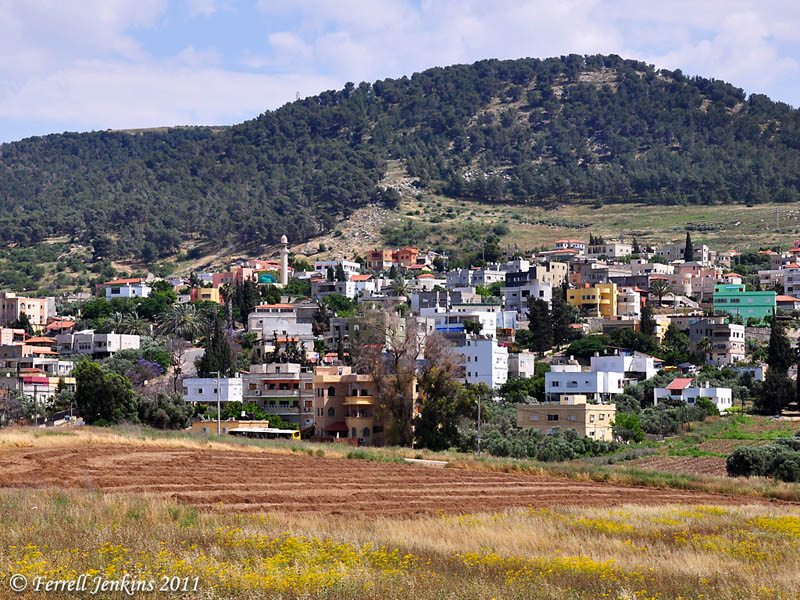
Nain is identified with the Arab village of Nein on the north slope of the Hill of Moreh. Nein is said to mean pleasant. Nain was a city of Issachar in Old Testament times. Here is a photo I made of the little Arab village last May.

The Village of Nain on the north slope of the Hill of Moreh. Photo by Ferrell Jenkins.

The Village of Nein on the north slope of the Hill of Moreh. Photo by Ferrell Jenkins.

Ralph Earle describes the pleasant location of Nain.

The town of Jesus’ day may have stood higher on the hill than the present village. It probably was named for the pleasant view that the site affords across the plain of Esdraelon. To the west one can see Mt. Carmel, and to the north the hills behind Nazareth stand out, about 9½ km [6 mi] away. To the northeast one can look past nearby Tabor (3 km [2 mi] away) to snowcapped Mt. Hermon in the distance. Southward lies Mt. Gilboa. (The International Standard Bible Encyclopedia, Revised, 3:480)

Our new header, which we will use for a while, is a 3-image panorama of Nain and the north side of the Hill of Moreh.

Discovery of rare Second Temple inscription announced

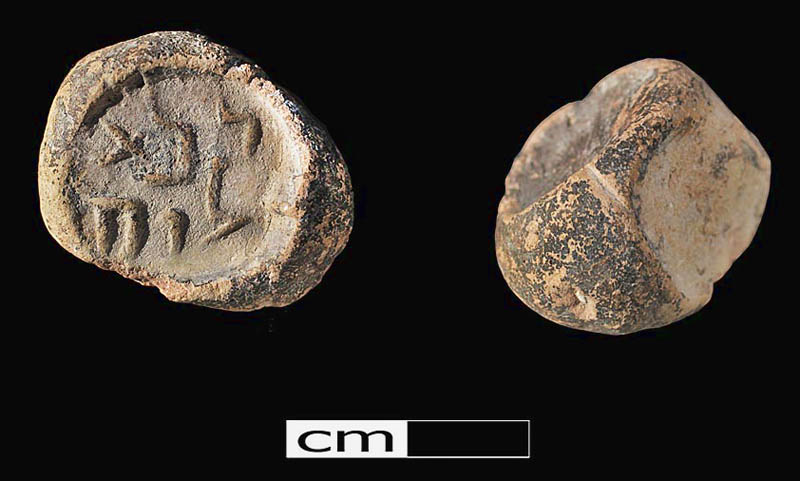
Announcement was made by the Israel Antiquities Authority in Jerusalem today of the recent discovery of an inscribed “seal” bearing a shortened version of the name of God (Yahweh).

The small fired clay object was discovered from the soil collected during the recent excavations at the southwest corner of the temple mount enclosure which we mentioned here about a month ago.

"Pure for G-d" Inscription Seal. IAA photo by Vladimir Naykhin.

"Pure for G-d" Inscription Seal. IAA photo by Vladimir Naykhin.

A portion of the press release by the IAA reads,

Layers of soil covering the foundations of the Western Wall, c. 15 meters north of the southwestern corner of the Temple Mount, were excavated beneath Robinson’s Arch in archaeological excavations of the Israel Antiquities Authority in the Jerusalem Archaeological Garden. On top of these layers, dating to the first century CE (the late Second Temple period), was paved the Herodian street which was the main road of Jerusalem at that time. From the very start of the excavations in this area the archaeologists decided that all of the soil removed from there would be meticulously sifted (including wet-sifting and thorough sorting of the material remnants left in the sieve). This scientific measure is being done in cooperation with thousands of pupils in the Tzurim Valley National Park, and is underwritten by the ʽIr David Association. It was during the sieving [sifting] process that a tiny object of fired clay, the size of a button (c. 2 centimeter in diameter [about 3/4 of an inch]) was discovered.

The Aramaic inscription, consisting of two lines, has the word for pure, a preposition and a shortened form of the word for G-d. Jews do not write the name of God. Many of our English versions of the Bible use the word LORD for the translation of the Tetragrammaton YHWH. The short form on this object has only YH.

The excavators, Elie Shukron and Ronny Reich, explain,

“The meaning of the inscription is “Pure for G-d”. It seems that the inscribed object was used to mark products or objects that were brought to the Temple, and it was imperative they be ritually pure. This stamped impression is probably the kind referred to in the Mishnah (Tractate Shekalim 5: 1-5) as a “חותם” (seal). To the best of our knowledge, this is the first time that such an object or anything similar to it was discovered in an archaeological excavation and it constitutes direct archaeological evidence of the activity on the Temple Mount and the workings of the Temple during the Second Temple period”.

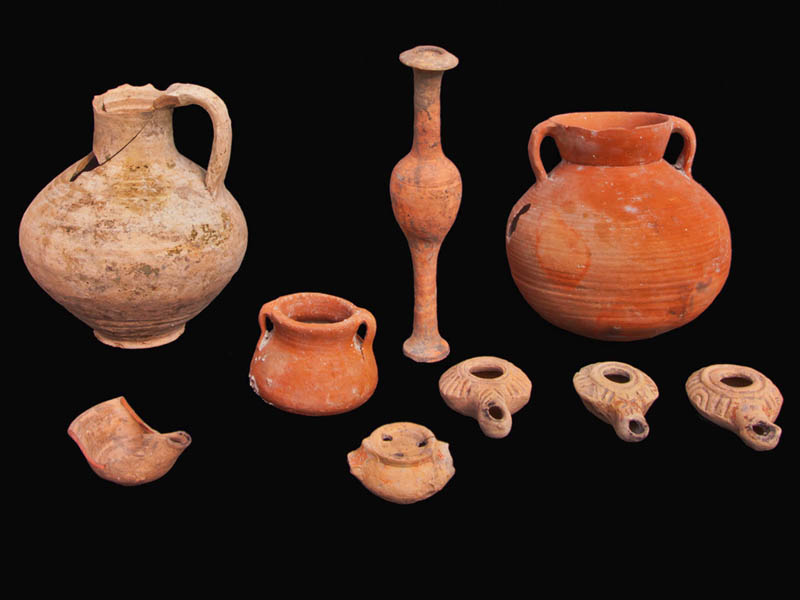
Other artifacts dating to the Second Temple period included some from the Hasmonean Period. In the photo below you will see “oil lamps, ceramic cooking pots and a fusiform juglet [the object in the top middle] that may have contained oils and perfume.” Coins minted in the days of Alexander Jannaeus (102-76 B.C.) and John Hyrcannus (135-104 B.C.) were also discovered.

The complete IAA Press Release may be read here.

Second Temple (Hasmonean Period) vessels. IAA photo by Vladimir Naykhin.

Second Temple (Hasmonean Period) vessels. IAA photo by Vladimir Naykhin.

Just a suggestion. Perhaps a seal such as the one mentioned above would have been used in the case mentioned by Jesus in the Sermon on the Mount.

So if you are offering your gift at the altar and there remember that your brother has something against you, leave your gift there before the altar and go. First be reconciled to your brother, and then come and offer your gift.  (Matthew 5:23-24 ESV)

HT: Joseph Lauer

Jesus visited Jerusalem during Hanukkah

The Gospel of John records more visits to Jerusalem by Jesus than any other of the Gospels. John is the only one to record the visit during the Feast of Dedication.

At that time the Feast of Dedication took place at Jerusalem. It was winter,  and Jesus was walking in the temple, in the colonnade of Solomon. (John 10:22-23 ESV)

BDAG translates the Greek term egkainia as “festival of rededication.” The feast is also known as Hanukkah and the Feast of Lights.

What is he Feast of Dedication? This feast, observed on the 25th of Kislev (roughly our December), had its origin in the period between the testaments. The desecration of the temple by the Seleucid ruler Antiochus Epiphanes took place in 168 B.C. The climax of the Maccabean revolt was the removal of all evidences of pagan worship from the temple. An eight day feast of dedication was observed in 165 B.C., and continued to be observed annually by the Jews.

At Modin, a village north-west of Jerusalem, on the way from Jerusalem to Lod, the Syrians tried to force an old priest by the name of Mattathias to offer a pagan sacrifice. The priest refused but another Jew volunteered to offer the sacrifice. Mattathias killed his fellow Jew and the Syrian officer. As word spread, Mattathias became a national hero. He was of the family of Hasmon (or Asmoneus). Thus began the Hasmoneans.

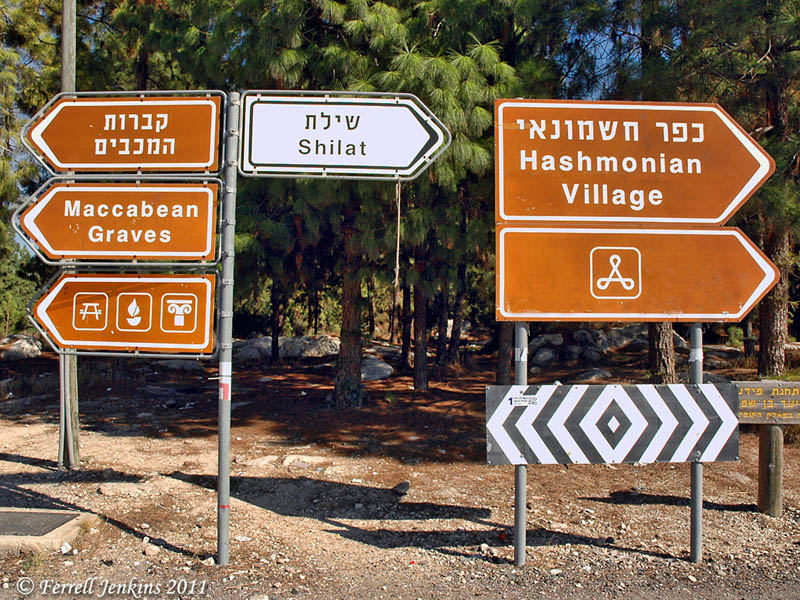
The discovery of a burial cave at Modin thought to have been used by the Maccabees and/or their descendants was reported in November, 1995. There are Israeli scholars who argue that this is not the true grave of the Maccabees. A recent article in Haaretz says,

Amit Re’em, an archaeologist of the Israel Antiquities Authority says all the evidence points to the fact that these graves are of Christians and pagans and that this burial site actually belongs to an ancient monastery.

Read the Haaretz article here.

Near Modin, signs point to the Maccabean Graves. Photo by Ferrell Jenkins.

Near Modin, signs point to the Maccabean Graves. Photo by Ferrell Jenkins.

Even though the Feast of Dedication was not a feast authorized by the Mosaic Law, it became part of the Jewish heritage, and Jesus came to Jerusalem at that time — at least once.

Jesus cleansed the Temple on two distinct occasions. The first time is recorded in John 2:14-22. The second account is recorded in Matthew 21:12-13; Mark 11:15-18; and Luke 19:45-48.