
Tag Archives: Israel

Visualizing Isaiah 9: the Philistines on the west

Isaiah 9 contains several geographical references. I decided to concentrate on the reference to the Philistines in verse 12. Notice that the text mentions the Syrians (Arameans) on the east, literally northeast of Israel and Judah, and the Philistines on the west (literally the southwest).

“The Syrians on the east and the Philistines on the west devour Israel with open mouth. For all this his anger has not turned away, and his hand is stretched out still.” (Isaiah 9:12 ESV)

Both powers were perennial enemies of Israel. Both would take part in attacks on Israel. The Philistines also are mentioned in 2:6 and 11:14.

It is commonly understoos that the Philistines of the Old Testament were the Sea People. The five major cities of the Philistines were Ashdod, Gaza, Ashkelon, Gath, and Ekron (1 Samuel 6:17).

A row of signs at the entry to Tel Ashkelon picture some of the peoples who lived there. This sign represents the Philistines. Photo by Ferrell Jenkins.

A row of signs at the entry to Tel Ashkelon picture some of the people who lived there. This sign represents the Philistines. Photo by Ferrell Jenkins.

The temple of Medinet Habu is located near the Colossi of Memnon at Thebes (Luxor), Egypt. The temple was built during the reign of Rameses III (reigned 1186–1155 B.C.). The structures at the site were built by the Pharaoh to serve as an administrative complex and funerary temple. The most interesting aspects of the temple to me are the reliefs of the Sea Peoples that the king claims to have subjugated. Notice that some of these men are bound.
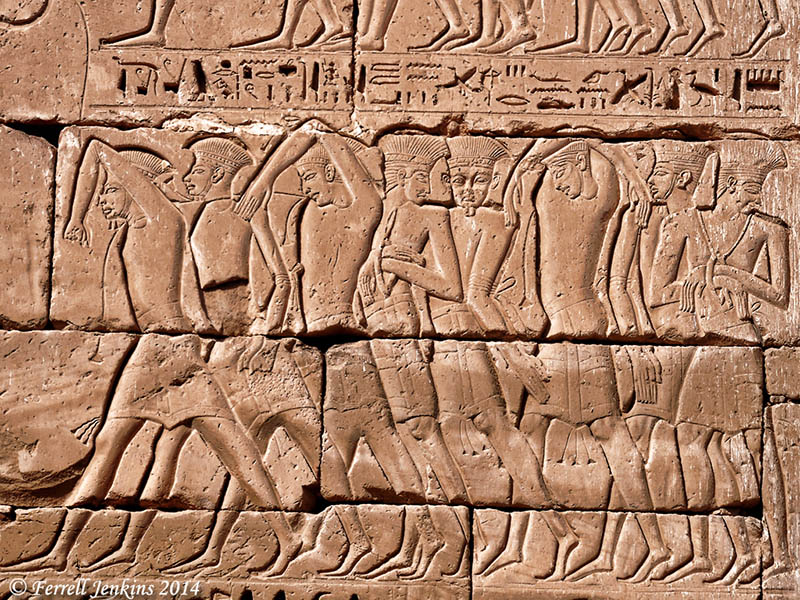
This is a portion of a wall at Medinet Habu showing the subjugation of the Sea People by Ramses III. Photo by Ferrell Jenkins.

A portion of a wall at Medinet Habu shows the subjugation of the Sea People by Ramses III. Notice the distinctive feathered hats and animal skin skirts. Photo by Ferrell Jenkins.

These peoples might seem more powerful than Israel at the moment, but the LORD will punish them. Both Damascus and the Philistines fell to the Assyrians within a few years.

The LORD continued to remind Israel and Judah that He was willing to save them from the coming oppression:

For all this his anger has not turned away, and his hand is stretched out still. (Isaiah 9:21 ESV)
Earthquake Felt in Israel, Syria and Lebanon

The Jerusalem Post reports that an earthquake was felt in Israel last Friday, Feb. 15. Read the full story here.

The earth shook in many parts of Israel at 12:37 p.m. Friday. The quake was felt mainly in coastline cities, including Haifa, Tel Aviv and Nahariya.
The quake, Israel Radio reported, was also felt in Syria and Lebanon. A faded echo of the quake that hit the coast was also felt at the editorial offices of The Jerusalem Post in Jerusalem.
….

The European-Mediterranean Seismological Center said on its Web site that the quake Friday was 5.3 on the Richter scale and that its epicenter was in Lebanon.

The region is long overdue for an earthquake of epic and potentially catastrophic proportions, scientists say.

The Great Rift runs all the way from northern Syria through Lebanon, Israel, the Arabah, and into eastern Africa. In Israel the area is called the Jordan Valley or the Dead Sea Rift, It is not surprising that earthquakes are mentioned frequently in the Bible. The prophet Amos dates his visions to “two years before the earthquake” (Amos 1:1). The earthquake he makes reference to must have been so memorable that everyone would know what he was talking about. Zechariah (14:5) also calls attention to this earthquake in the days of Uzziah king of Judah.

Jesus, in predicting the fall of Jerusalem to the Romans, said, “and in various places there will be famines and earthquakes” (Matthew 24:7; see Luke 21:11).

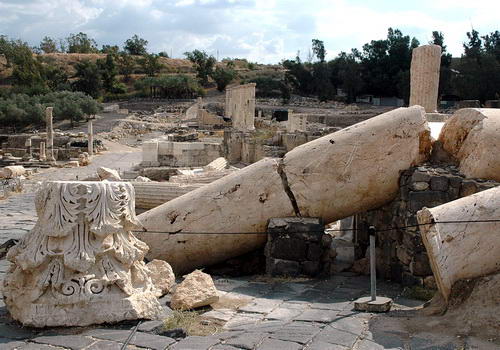
We have a wonderful example of the power of an earthquake in the Jordan Valley at the site of Bethshan [Bet-she’an, Beth-shean], about 25 miles south of the Sea of Galilee. The city was destroyed by an earthquake in A.D. 749. This photo shows the evidence brought to light during recently archaeological excavations in the city.

Earthquake Damage at Bethshan in A.D. 749. Photo by Ferrell Jenkins.

January 3rd in (my) History

I am sure that many significant things have happened on January 3rd, but the one most important to me was my birth on this day. One day I was looking for some photos of the old cotton mills from Huntsville, Alabama, and ran across a site that also had a vintage post card of the City Hospital. This is the way I remember the hospital when I was a kid.

Huntsville, AL, city hospital on an old postcard.

My parents lived in the New Hope area when I was born. About three years later we moved to Harvest, a rural community with a population of about 200. I attended a four-room school for the first 8 years of schooling. There were 2 grades in each room with one teacher. When I was about 10 years of age I was back in the hospital overnight to have a tonsillectomy.

Little could I have imagined in those formative years that I would be able to travel around the world (1995), and to many diverse and exotic places. I don’t even remember when I first learned about China or Egypt or Russia. There was no State of Israel back then, only a Zionist dream. My first remembrance of hearing about Japan was on December 7, 1941, the day of the infamous attack on Pearl Harbor.

I wish my Mother, now 94, could still remember this day in our history.

Good preachers could learn from a trip to Israel

Todd Bolen, of Bible Places fame, spent about 10 years teaching in Israel. In a recent blog at Todd’s Thoughts, he made this comment:

“…even really good preachers could learn something from a trip to Israel.”

How true! Occasionally I have a preacher tell me that he plans to retire in a year or two and hopes to travel with me to the Bible Lands. My thought is that a visit to the Bible Lands is a tool; not a crown!

The only thing I could add to Todd’s comment, and I think he would agree, “not only Israel, but Jordan, Egypt, Turkey, Greece, and other parts of the Bible world.”