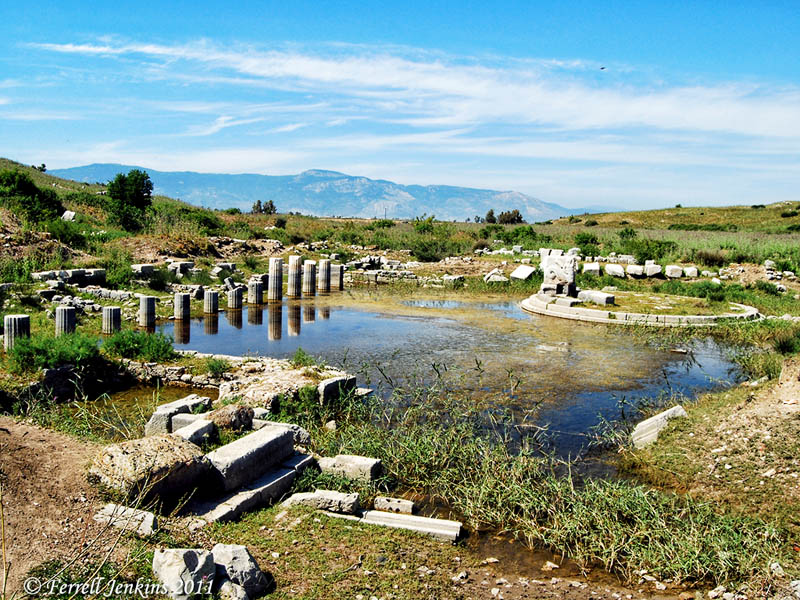
Tag Archives: Apostle Paul

Docking again at Perga

A few days ago we had some discussion here about whether Paul and his companions docked at Atttalia or Perga after sailing from Paphos, Cyprus.

Now Paul and his companions set sail from Paphos and came to Perga in Pamphylia. And John left them and returned to Jerusalem,  but they went on from Perga and came to Antioch in Pisidia. (Act 13:13-14a ESV)

Darryl said that he had been unable to track down the oft-cited reference in Strabo Geography. I located the quotation using Logos 4. The modern names are included in brackets.

[2] Next is the river Cestrus [Ak-su]; on sailing up its stream 60 stadia we find the city Perge, [Murtana] and near it upon an elevated place, the temple of the Pergæan Artemis, where a general festival is celebrated every year.

Nymphaeums (fountains) were important in Roman cities. The fountain at Perga flowed into a channel running the length of the main street.
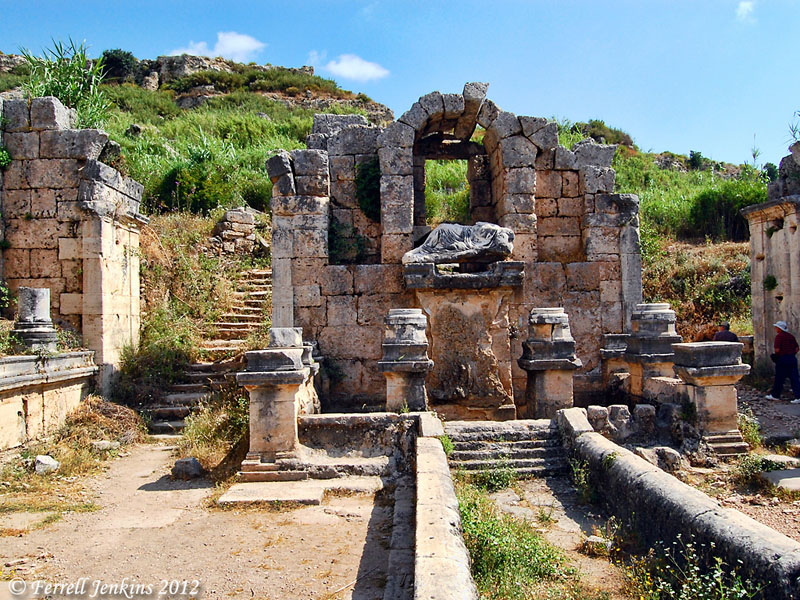
The Nymphaeum (Fountain) at Perga. Water flowed from the fountain. Photo by Ferrell Jenkins.

The Nymphaeum (Fountain) at Perga. Water flowed from the fountain into a channel in the middle of the main street. Photo by Ferrell Jenkins.

This close-up view shows the river god Cestrus. Water flowed under the image into the channel. Other cities had a similar image with the water flowing from a cornucopia held by the river god. At Ephesus it was the god Cayster.

The Nymphaeum (Fountain) at Perga, showing the river god Cestrus. Photo by Ferrell Jenkins.

The Nymphaeum at Perga, showing the river god Cestrus. Photo by Ferrell Jenkins.

Dr. Combs recommended the article by Douglas A. Campbell (“Paul in Pamphylia (Acts 13.13-14a; 14.24b-26): A Critical Note”) in New Testament Studies (2000): 595-602. This afternoon I was able to get access to the article. The map is especially helpful.

Campbell says the 175 mile trip from Paphos to Perga, with favorable winds, would have taken between 25 and 50 hours, but with difficult winds it could have taken longer. It would be more common for ships transporting goods from Cyprus to Perga and other cities in the region to have used the River Cestrus. On the return from the first journey, when Paul was headed east back to (Seleucia, then) Antioch (Acts 14:25-26), it would have been best to use Attalia as the port (as Tim Brinley also pointed out in his comment).

Some other sources explaining that Perga used the river Cestrus as a port include the following:

  • E. A. Judge. Perga. The International Standard Bible Encyclopedia, Revised (3:767-768).
  • E. M. Blaiklock. Perga. New Bible Dictionary (3rd ed.): 901.
  • A. E. Hillard. Perga. (Hastings) Dictionary of the Bible: 700.

An inland city of Pamphylia about 12 miles from Attalia on the coast, but possessing a river harbour of its own on the Cestrus 5 miles away. Its walls date from the 3rd century B.C.

From Perga Paul would have taken the Via Sebaste to Pisidian Antioch. When he returned to Perga, using the same Roman road, he would have taken the Claudian extension of the Via Sebaste which ran southwest for 12 miles to Attalia.

Campbell, a British scholar, says,

In my judgement the author of Acts at these two junctures is, quite simply, spot on.

The Mausoleum at Halicarnassus

Why would we want to visit Bodrum on the Aegean coast of Turkey? It is located in the area of the Roman province of Caria, and is built over the site of ancient Halicarnassus. It is where Mausolus built a tomb for himself. From this structure we get our word mausoleum.

Only a small city block preserves the remains of the famous Mausoleum. Parking nearby is almost an impossibility, but one of the shopkeepers allowed us to block the entry to his shop for a few minutes.

Halicarnassus. Site of the tomb of King Mausolos. Photo by Ferrell Jenkins.

Halicarnassus. Site of the tomb of King Mausolos. Photo by Ferrell Jenkins.

The small brochure available at the site gives this information about the Mausoleum.

It is one of the Seven Wonders of the Ancient World. Its construction was initiated by Mausolus, a member of the Hekatomnid dynasty appointed by Persians as the Satrap of Caria, before his death, and continued by his wife and sister Artemisia after his death. Mausolus, the then most important administrator, probably decided to build such an important structure to symbolize his eternity and greatness. Its construction was started just before Mausolus’ death, i.e. just before 353 B.C.

Along with a few architectural fragments at the site, there is a nice model suggesting how the Mausoleum looked. According to the brochure, the tomb may have been as high as a 20-story apartment building.

Model of the Tomb of Mausolos at Halicarnassus. Photo by Ferrell Jenkins.

Model of the Tomb of Mausolos at Halicarnassus. Photo by Ferrell Jenkins.

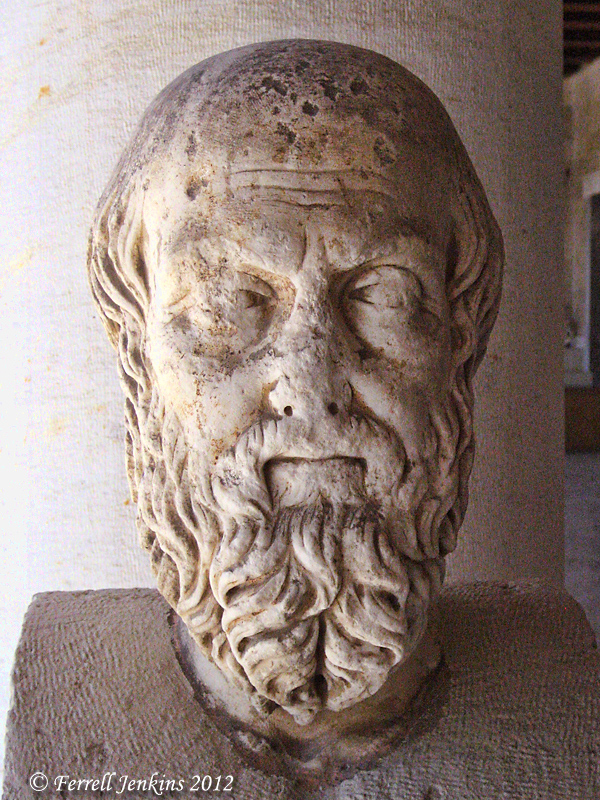
Herodotus Bust displayed in the Stoa of Attalus, Athens Agora

Herodotus Bust displayed in the Stoa of Attalus, Athens Agora. Photo: F. Jenkins.

Is it possible that Paul may have seen this structure when he sailed past Cos (Acts 21:1)? Ferries run between Bodrum (Turkey) and Cos (Greece) today.

Halicarnassus is listed among the towns that were informed by the Romans of their support of the Jews (1 Maccabees 15:23).

The Greek historian Herodotus claimed Halicarnassus as his home.

At least one lesson we learn at Halicarnassus is that monuments built to oneself do not endure for long. Think of Absalom.

Now Absalom in his lifetime had taken and set up for himself the pillar that is in the King’s Valley, for he said, “I have no son to keep my name in remembrance.” He called the pillar after his own name, and it is called Absalom’s monument to this day. (2 Samuel 18:18 ESV)

Did Paul’s ship dock at Perga or Attalia?

My friend and former student Darryl Smelser left a good comment regarding Perga for a post here. I thought I would elevate it to an entire post.

You point out that “Paul, Barnabas, and John Mark made their way from Paphos on Cyprus to Perga in Pamphylia,” which of course is correct. But as Perga is a bit inland from the sea, and Attalia was/is a port, I have pretty much assumed that as they traveled from Cyprus, the three men arrived *first at Attalia* and then went to Perga, and so toward Galatia. Why would not Luke have mentioned Attalia? I suppose the omission is due to the fact that in this part of the journey neither Attalia nor Perga were important to be mentioned, except for the fact that it was in Perga that John Mark turned back; thus it wins a mention. Does that seem to be sound reasoning to you? Would any ship delivering goods to Perga have ported at Attalia, or was there a closer port?

I think we can give no absolute answer to this question. Here is what I know about it.

Look at a good modern atlas of Turkey (Köy Köy Türkiye Yol Atlasi), and you will see the Aksu Cay (the ancient Cestrus River) about 3 miles east of Perga. Attalia (modern Antalya) is farther to the west.

Mark Wilson says,

Strabo (14.6.2) states that the Cestrus was navigable at this time and a road apparently linked the river with Perga. The city was 6 mi/10 km from the Mediterranean and linked to the coast via a road to its port at Magydus (Lara). (Biblical Turkey, 99).

Wilson continues in a sentence that seems to have a typo,

Perga was the port of entry Mark in Asia Minor for Paul, Barnabas, and John on their first journey (Acts 13:13). (100).

My first suggestion is that the word Mark somehow got moved from after John, to the line above. If so, then the sentence should be read as follows:

Perga was the port of entry in Asia Minor for Paul, Barnabas, and John Mark on their first journey (Acts 13:13).

Fant and Reddish say,

In ancient times Perga apparently had a port on the river, which was navigable, thus allowing the city to benefit commercially from the river. (Biblical Sites in Greece and Turkey, 265).

The Dictionary of the Apostolic Church (J. Hastings) recently became available through Logos community pricing. James Strahan says,

Paul and Barnabas were twice at Perga in their first missionary tour. In their outward journey they landed at the river-harbour and went up to the city (Ac 13:13).

The Roman Gate at Perga in Pamphylia. Photo by Ferrell Jenkins.

The Roman Gate at Perga in Pamphylia. Photo by Ferrell Jenkins.

Another Milestone — One Million Hits

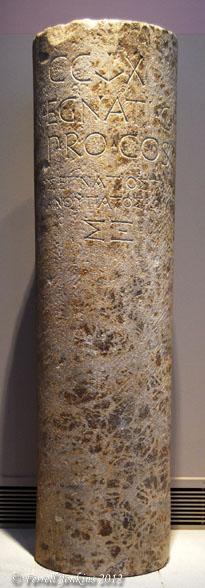
Milestone from the Via Egnatian. Thessalonica Museum. Photo by Ferrell Jenkins.

Milestone from the Via Egnatian displayed in the Thessaloniki Museum. Photo by Ferrell Jenkins.

A few minutes ago the counter on this blog indicated that we have reached one million hits since beginning the blog about five years ago.

This is not much compared to many secular web sites, or even some biblioblogs, but I am pleased with the results over these years.

Ferrell’s Travel Blog was begun to keep friends and family of our tour members informed about the progress of a tour in 2007. Had I realized it was to become a regular part of my life, averaging more than 1100 hits a day, I would have named it differently. But I didn’t, and here we are.

Thanks for following the blog. I am especially pleased when Bible class teachers write to tell me they are using the material in their Bible classes.

I have enjoyed the contact with some well-informed people who have taken time to communicate with me regarding the subjects I write about. Thanks to all who have taken the time to leave a comment on the blog, in person, by Facebook, or by Email.

We celebrated becoming half a millionaire November 21, 2010, here.

Some days I think of discontinuing the blog; other days I don’t.

The photo of the milestone from the Via Egnatian, a Roman road used by the Apostle Paul, seems appropriate today.

The Antikythera Shipwreck and “Danger at sea”

The Antikythera Shipwreck is a special exhibition at the Athens (Greece) National Museum which is scheduled to run from April 2012 to April 2013.

The shipwreck off the eastern coast of Antikythera is dated to 60-50 BC, a period during which maritime trade and transportation of works of Greek art from the Eastern Mediterranean to Italy flourished. Its cargo dates from the 4th to the 1st century BC. The ship was a freighter of about 300 tons capacity and was sailings towards Italy.

We had visited Thera (aka Santorini) during our Aegean cruise. Antikythera (“opposite Kythera”) is a Greek island between Crete and the Peloponnese (where Corinth is located).

The statue below is made of Parian marble. Scholars in the field suggest that this is possibly Achilles. Being on the bottom of the Aegean Sea for centuries shows its effects on the statue.

Possibly Achilles. The Antikythera Shipwreck. Athens National Museum. Photo by Ferrell Jenkins.

Possibly Achilles in Parian Marble. The Antikythera Shipwreck. Athens National Museum. Photo by Ferrell Jenkins.

Numerous bronze pieces are displayed. The bust below is part of a portrait statue known as “The Antikythera Philosopher.” The head, hands, feet, and pieces of the himation were recovered and are displayed. This piece of art is said to date to about 230 B.C.

The Antikythera Philosopher. Athens National Museum. Photo by Ferrell Jenkins.

The Antikythera Philosopher. Athens National Museum. Photo by Ferrell Jenkins.

We typically think of ships from the Roman period, and earlier, staying near the shore. This was certainly true of many of the sea journeys of the Apostle Paul (Acts 20:5, 13-16 27:5-7).

Greek archaeologists announce here the discovery of two Roman-era shipwrecks in water nearly a mile deep. Sailing to Italy required leaving the safety of the nearby shore for deep waters. Such was true of Paul’s journey to Rome after leaving Crete (Acts 27).

Paul spoke of the dangers at sea in his second letter to the Corinthians (11:24-29) about A.D. 55.

  • Three times I was shipwrecked.
  • A night and a day I was adrift at sea.
  • He mentioned “Danger at sea.”

The Malta shipwreck is the only one recorded in Acts, and it occurred after the writing of 2 Corinthians. Hughes mentions at least nine voyages between Acts 9 and 18. Paul says three of these ended in shipwreck. Hughes says there were at least another nine voyages between the writing of 2 Corinthians and the Malta shipwreck (The Second Epistle to the Corinthians, NICNT, 410-411).

At least some of the ships used by Paul seem to have been grain ships (Acts 27:38), but there may have been other cargo on some of them.

If you visit Athens between now and April 2013, be sure to take some time for The Antikythera Shipwreck.

Myra in Lycia, and other places

Myra was a town of Lycia about 85 miles from Antalya, Turkey (biblical Attalia, Acts 14:25). The town is located a few miles away from the Mediterranean, but has a port at nearby Andriake. When Paul was being escorted by a Roman centurion from Caesarea Maritima to Rome, the ship sailed along the coast of Cilicia and Pamphylia, and landed at Myra in Lycia (Acts 27:5). There they found an Alexandrian ship sailing for Italy.

Whether Paul was close enough to see any of Myra we do not know. There are several interesting things that could have been seen. My only previous visit to Myra was in 1987. I mention this to say that it was before the days of digital photos. One of the reasons to come back was to make digital photos.

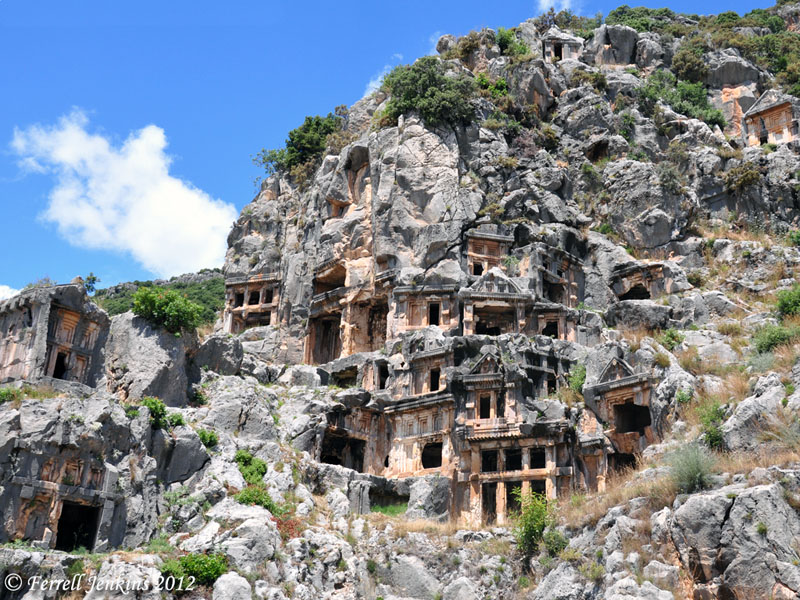
Here is a photo of the house-type tombs in the rock cliffs at Myra dating from the 4th century B.C.

Fourth century rock cut tombs at Myra, Turkey. Photo by Ferrell Jenkins.

Fourth century rock cut tombs at Myra, Turkey. Photo by Ferrell Jenkins.

In the past two days we have also visited Patara, Bodrum (the Mausoleum of King Mausolus of Caria), and Xanatos. In addition, we have learned much more about the travel conditions on sea and land during our travels.

Last evening we were unable to access the Internet, but tonight we have a nice signal at our hotel near Patara. Tomorrow will be a traveling day as we move from the Mediterranean coast to the Black Sea coast of Turkey.

From Cyprus to Pamphylia

Today we took a flight from Ercan Airport in the Turkish Republic of Cyprus to Turkey. Flying from Greece to Cyprus it was necessary to fly to Larnaca on the southern coast. Flights from Larnaca do not go to Turkey, and flights from Ercan do not go to Greece. Let’s put that aside for now.

The flight from Cyprus to Antalya (biblical Attalia) took about 45 minutes. I thought some about how Paul, Barnabas, and John Mark made their way from Paphos on Cyprus to Perga in Pamphylia (a few miles from the Antalya airport). The distance in a straight line is 185 miles. Here is Luke’s account of the journey.

Now Paul and his companions set sail from Paphos and came to Perga in Pamphylia. And John left them and returned to Jerusalem,  but they went on from Perga and came to Antioch in Pisidia.  (Act 13:13-14a ESV)

There are impressive Hellenistic and Roman ruins at Perga. Most of the Roman structures date to the second century A.D. This is where John Mark turned back from the work (Acts 13:13-14; 15:37-39). The text indicates that Perga was only a beginning point for work further north. On his return from the first journey, Paul spent some time preaching here (Acts 14:25).

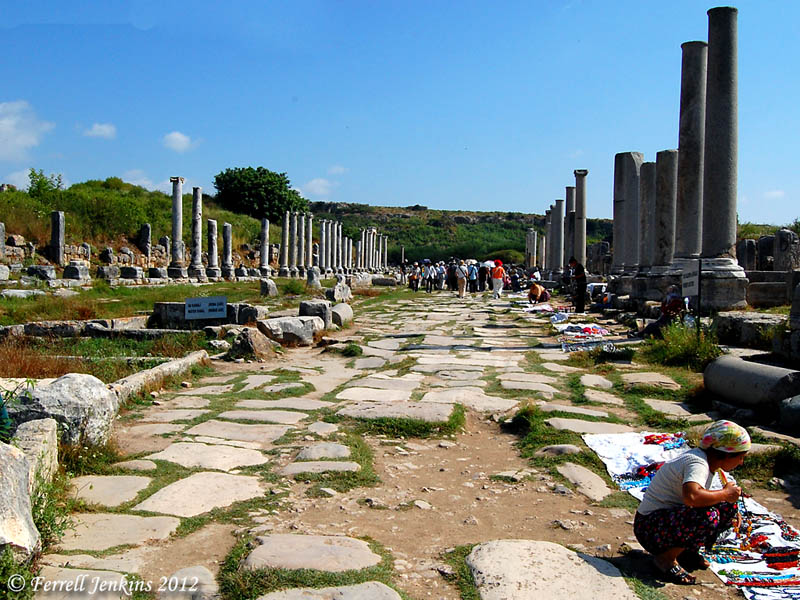
Our plans do not include revisiting sites that we have recently visited, but here is a photo of the North-South street in the Agora of Perga. The view is toward the fountain at the head of the street. A local vendor spreads out her jewelry on the ancient street.

Perga in Pamphylia. N-S street in the Agora with a view toward the fountain. Photo by Ferrell Jenkins.

N-S street in the Perga agora with view toward the fountain. Photo by Ferrell Jenkins.

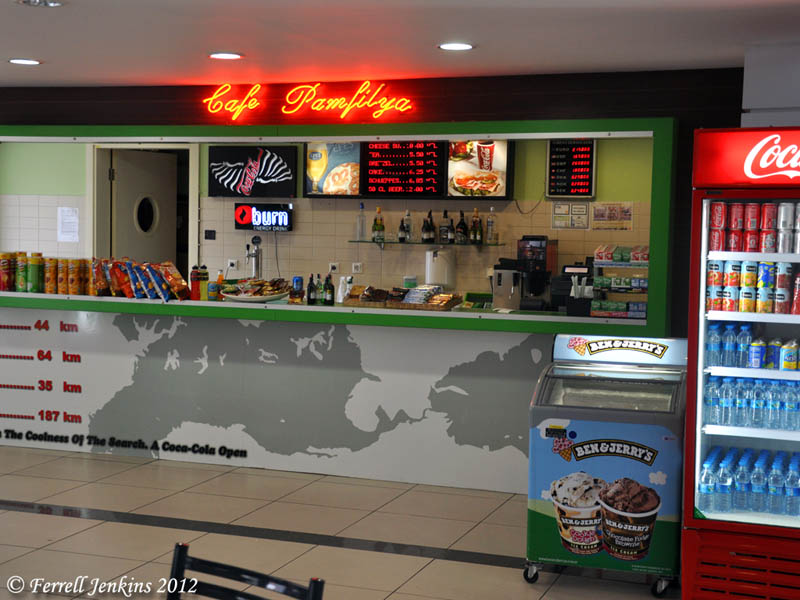
When we arrived at the Antalya International Airport I soon realized that we had come to the right place. The snack stand was named Cafe Pampilya. How appropriate.

Cafe Pamfilya in the Antalya International Airport. Photo by Ferrell Jenkins.

Cafe Pamfilya in the Antalya International Airport. Photo by Ferrell Jenkins.

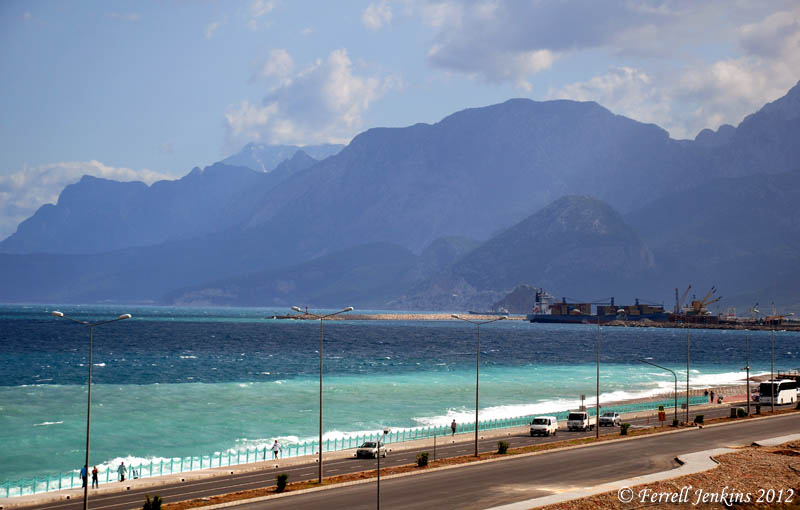
Tonight we are staying on the Mediterranean Sea on the west side of Antalya (Acts 14:25). Antalya is the modern name for Attalia which served as the port of entry from Egypt and Syria to the interior of Asia. From here Paul sailed back to Antioch (Acts 14:25).

We have a nice view of the Lycian Mountains from our hotel balcony. Tomorrow we plan to drive along the coast to Myra (Acts 27:5) and other points west.

Lycian Mountains west of Antalya, Turkey. Photo by Ferrell Jenkins.

Lycian Mountains west of Antalya, Turkey. Photo by Ferrell Jenkins.

Two week ago when I was in Turkey with the group, it was about 5-7 degrees warmer than usual. Today it has rained and the wind is cool.

A post I wrote about Perga and Attalia in 2007, in the early days of this blog, may be read here.

Salamis was the first stop for Barnabas and Saul

Barnabas and Saul were sent out by the Holy Spirit from Antioch. Their first stop after leaving the port of Seleucia was Salamis on the eastern coast of Cyprus. Here is Luke’s account.

When they arrived at Salamis, they proclaimed the word of God in the synagogues of the Jews. And they had John to assist them. (Act 13:5 ESV)

It is interesting to note that there are no accounts of conversions at Salamis. The city had a large Jewish population during the Roman period.

Why go to Cyprus? These facts might provide some suggestions.

  • Well, it was east of Antioch, and a first step toward going to the Gentiles.
  • It was also the home of Barnabas (Acts 4:36).
  • After the stoning of Stephen some had traveled to Cyprus preaching to the Jews (Acts 11:19).
  • Some men of Cyprus had come to Antioch preaching to the Hellenists (Greeks) (Acts 11:20).

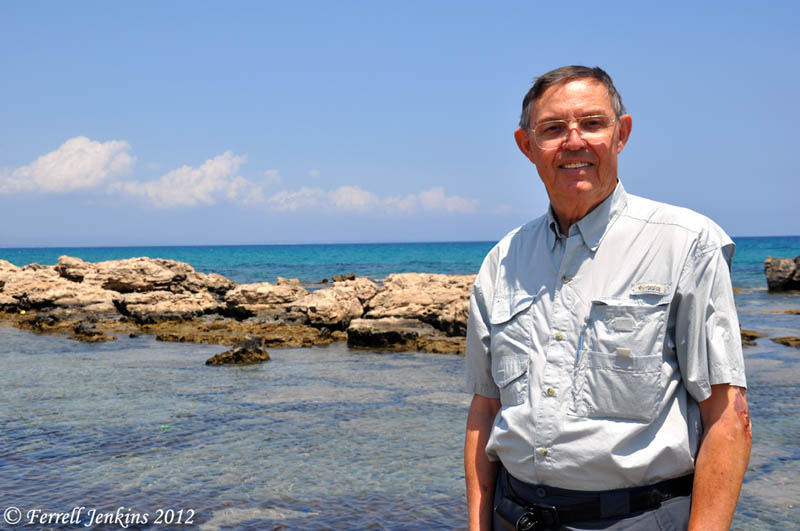
Salamis is now located in the the Turkish Republic of Northern Cyprus, or as the folks in the south say, “the occupied territory.” This photo shows some of the foundation stones of the harbor where Barnabas, Saul, and John Mark landed. Breakwaters extend for some distance into the sea.

Ferrell Jenkins at the ancient port of Salamis.

Ferrell Jenkins at the ancient port of Salamis. Photo by Leon Mauldin.

We visited the gymnasium. Not to workout. Our workout came from walking over the large site. This gym was build in the time of the Roman Emperor Augustus.

Salamis Roman gymnasium built in the time of Roman Emperor Augustus. Photo by Ferrell Jenkins.

Salamis Roman gymnasium built in the time of Roman Emperor Augustus. Photo by Ferrell Jenkins.

When I see one of these gymnasiums or palestras (exercise areas) I am reminded of what Paul wrote to Timothy:

for while bodily training is of some value, godliness is of value in every way, as it holds promise for the present life and also for the life to come. (1 Timothy 4:8 ESV)

A short distance from Salamis is the Church of St. Barnabas. The church is now a museum of icons. Many traditions have grown up in Cyprus about Barnabas.

In the afternoon we returned to Nicosia and made a stop at the Cyprus (Archaeology) Museum. They have a nice collection of artifacts, including some of the statues from Salamis, but photos are not allowed. Museum’s often do not allow photographs in hope of selling more books in the gift shop. Allowing photos provides an opportunity for teachers and others to talk about their visit with others. It actually encourages others to visit the museum. Too bad they don’t agree with me.

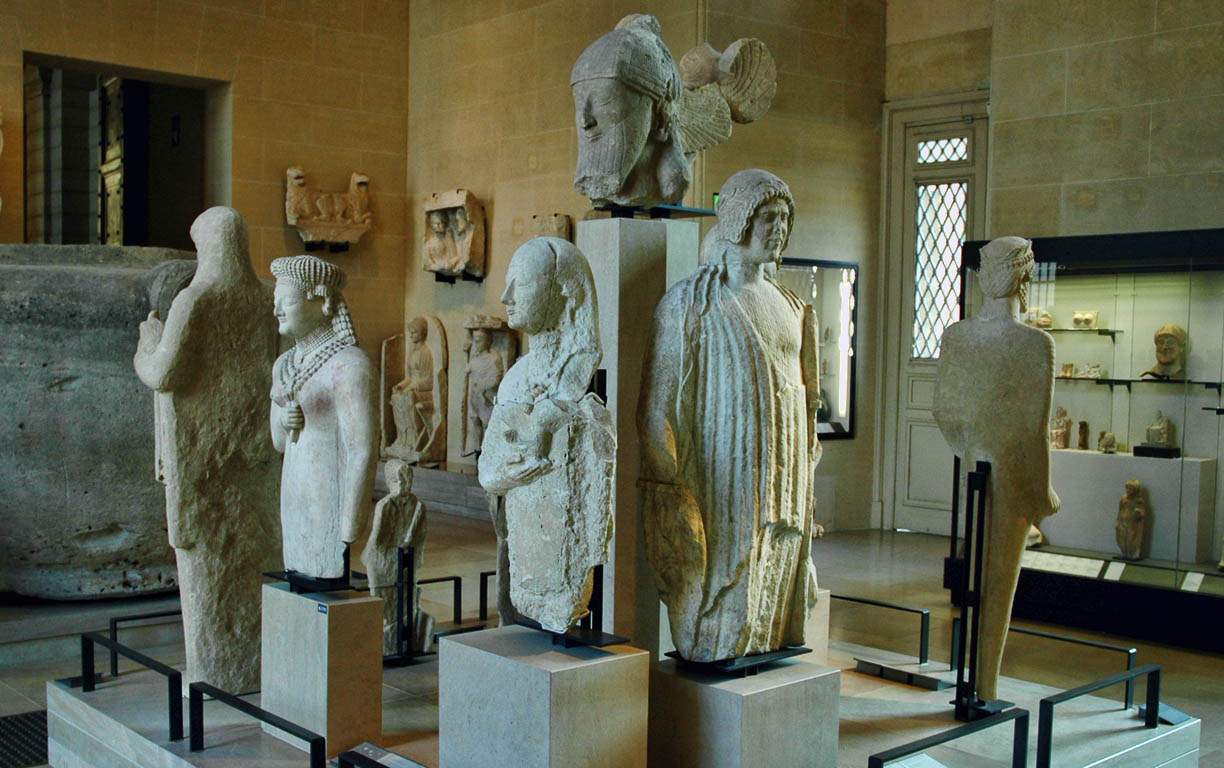
This photo is a collection of statues from Cyprus in the Louvre.

Cyprus collection from the fifth century B.C. in the Louvre. Photo by Ferrell Jenkins.

Cyprus collection from the fifth century B.C. displayed in the Louvre, Paris. Photo by Ferrell Jenkins.

It was a good day.

Saul came to be known as Paul at Paphos, Cyprus

On the first missionary journey, Barnabas, Saul, and John Mark, traveled through Cyprus from Salamis to Paphos on the southwestern coast of Cyprus. The following events involving these men took place there (Acts 13:6-13)

  • They found a Jewish magician, a false prophet, named Bar-Jesus, meaning Elymas. He tried to turn Sergius Paulus away from listening to Saul and Barnabas.
  • Paul resisted the efforts of Elymas to turn aside Sergius Paulus from the faith. Elymas was blinded.
  • Sergius Paulus, an intelligent man who served as proconsul, believed the Word.
  • Saul also came to be known as Paul. This is the name he would use throughout his ministry to the Gentiles.
  • From this time on, Paul became the lead man in the work that was being done.
  • Paul and his companions set sail for Perga in Pamphylia.

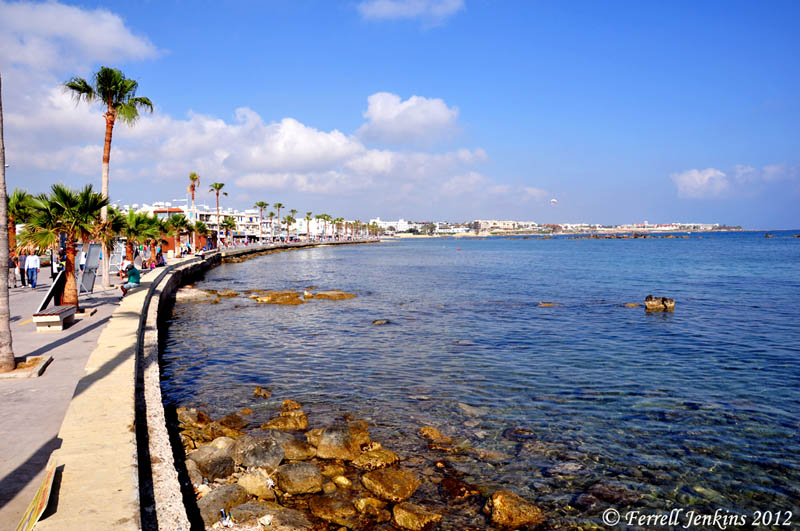
Tuesday afternoon and evening, and Wednesday morning, I visited Paphos. The harbor used by Paul and Barnabas is today a harbor used for pleasure boats and fishing boats. Tuesday afternoon the town was filled with tourists. I though a lot about the events we have listed above.

The harbor at Paphos. Photo by Ferrell Jenkins.

The harbor at Paphos. Photo by Ferrell Jenkins.

The archaeological park is large, but only a small portion of it has been excavated by archaeologists.

The most impressive items at the site are the numerous houses with elaborate mosaics. These houses began to be built in the 2nd century A.D. and continued in use until the 7th century.

Paphos was an important city during the Hellenistic period., and into the Roman period. The few structures dating to the time of Paul (or earlier) include the Asklepion, the odeion, and the Roman agora which still needs to be excavated.

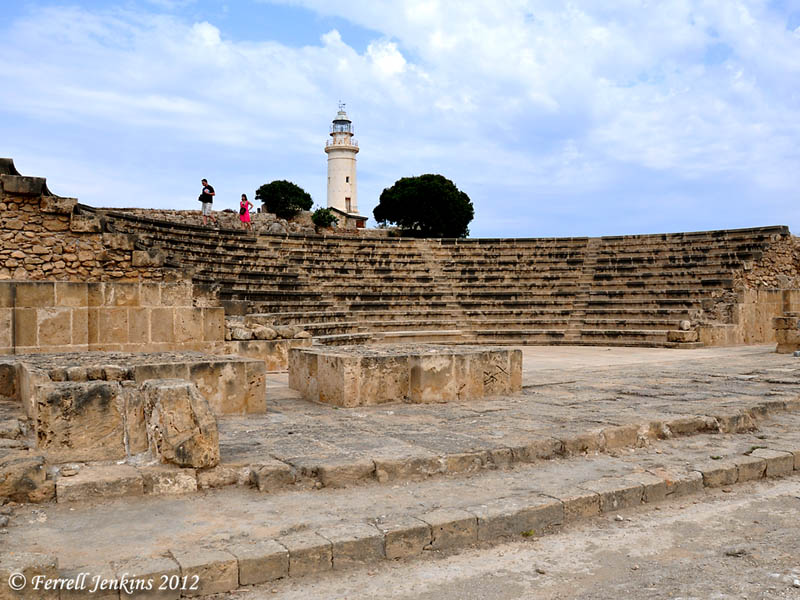
The photo below shows the odeion. The lighthouse of Paphos in the background is of recent origin, but is built upon Roman foundations.

The Odeion at Paphos. Photo by Ferrell Jenkins.

The Odeion at Paphos. Photo by Ferrell Jenkins.

My friend, Leon, was able to join me by this afternoon. Tonight we are in Nicosia, Cyprus.

Paul stopped at Miletus

This morning our group visited Ephesus, the site of the Temple of Aretmis, and the Ephesus Museum. In the book of Revelation, Ephesus is the first of the cities mentioned (Revelation 1:11; 2:1-7), but for our tour it was the seventh. Ephesus was also the location of much work by the Apostle Paul (Acts 19).

In the afternoon we drove south to the ruins of the city of Miletus.  Miletus is mentioned only two places in the New Testament. The first is on Paul’s return from the third journey about A.D. 57 (Acts 20:15, 17). The other time is when Paul tells Timothy, in his last letter, that he had left Trophimus “sick at Miletus” (2 Timothy 4:20). This indicates that Paul stopped at Miletus on the voyage to Rome, but no activity is recorded.

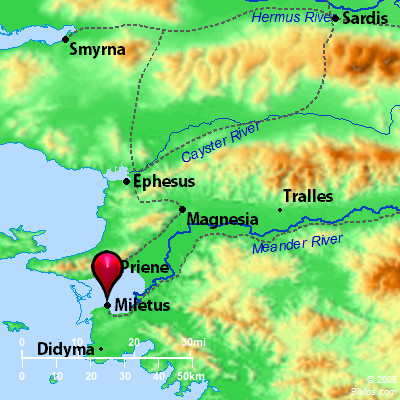
From Miletus, on the first visit, Paul sent for the elders of the church at Ephesus. In those days it would be a lengthy journey for a messenger to go from Miletus to Ephesus. The distance by land would have been about 63 miles. If the couriers went across the Gulf of Latmos (Latmus) the distance would be about 38 miles. The map below shows the location of Miletus on the south of the Gulf of Latmos. Over the centuries the harbor, fed by the Meander River (see our masthead), silted up. Today Miletus is landlocked about five miles away from the Aegean Sea.

Think about how long it took the courier to go from Miletus to Ephesus, locate the elders, and for them to make their way to Miletus.

Map showing Miletus and Ephesus. BibleAtlas.org.

Map showing Miletus and Ephesus. Map courtesy BibleAtlas.org.

Paul’s speech to the Ephesian elders is recorded in Acts 20:18-38. The photo below shows the ruins of the large Harbor Monument which was built originally in 63 B.C. This monument was at the end of the Lions’ Harbor, one of four harbors at Miletus.

Ruins of the large harbor at Miletus. Photo by Ferrell Jenkins.

Ruins of the large harbor at Miletus. Photo by Ferrell Jenkins.

At this harbor, or somewhere very near, Paul’s ship docked. After his meeting with the elders from Ephesus, they accompanied him to the ship for his departure to Jerusalem.

When he had said these things, he knelt down and prayed with them all. And they began to weep aloud and embraced Paul, and repeatedly kissed him,  grieving especially over the word which he had spoken, that they would not see his face again. And they were accompanying him to the ship.  (Acts 20:36-38 NAU)

Tomorrow we begin the Aegean cruise portion of the tour. In the afternoon we will visit Patmos. The next day we will be at Rhodes, and the following day at Crete and Santorini.

It may be difficult or impossible for me to blog during the cruise. Using the Internet on the ship would cost a fortune, and the time at port will be used for excursions.  Please check each day to see if we are able to post info.