Tag Archives: Apostle Paul

Identifying Lystra

Biblical sites are identified several ways. A few sites have been known for millennial. For example, Jerusalem (earlier Jebus, 1 Chronicles 11:4-5; and Salem, Genesis 14:18), Damascus, Athens, and Rome.

Some scholars have identified sites on linguistic grounds. For example, Edward Robinson identified biblical Bethel with Beitin in 1938. This proposal had been generally accepted until David Livingston suggested, in the last few decades, that Bethel should be identified with el- Bireh. Some names have remained virtually unchanged. Modern Anata is thought to be biblical Anathoth (Jeremiah 1:1). I note that the Syrian town of Ribleh is identified with biblical Riblah (2 Kings 25:6). After all these centuries only one letter is different.

Other sites are identified on the basis of inscriptions. Such is true of Gezer, Thyatira, and Lystra. This brings me to my topic today.

The identification of Lystra was made by J. R. S. Sterrett in 1855 on the basis of a Latin inscription found at the site. The inscription is now displayed at the archaeological museum in Konya (biblical Iconium).
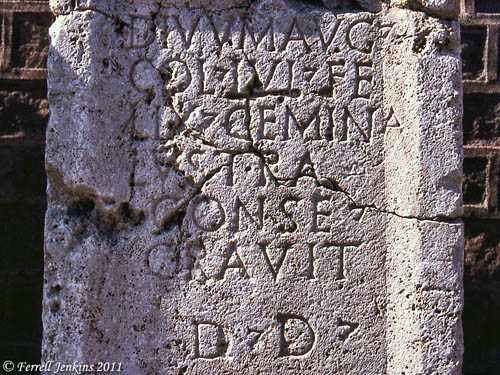
Inscription with the name Lystra. Photo by Ferrell Jenkins.

Inscription with the name Lystra. Photo by Ferrell Jenkins.

The inscription includes the full Roman name Colonia Iulia Felix Gemina Lustra. See Mark Wilson, Biblical Turkey, 173. We called attention to this inscription, with a photo of the entire stone as it is displayed at Konya more than four years ago, during the first month of this blog, here.

The brethren of Lystra and Iconium spoke well of young Timothy at the time Paul chose him to join his preaching party.

Paul came also to Derbe and to Lystra. And a disciple was there, named Timothy, the son of a Jewish woman who was a believer, but his father was a Greek,  and he was well spoken of by the brethren who were in Lystra and Iconium. (Acts 16:1-2 NAU)

I have failed to say recently that archaeological mounds (tells) in Turkey are identified by the Turkish word höyük (pronounced who-youk).
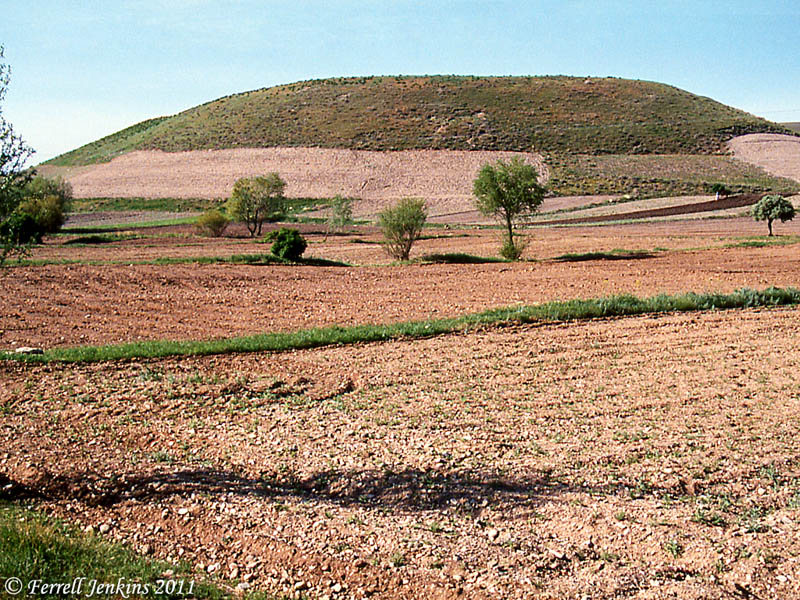
Illustrations from Lystra

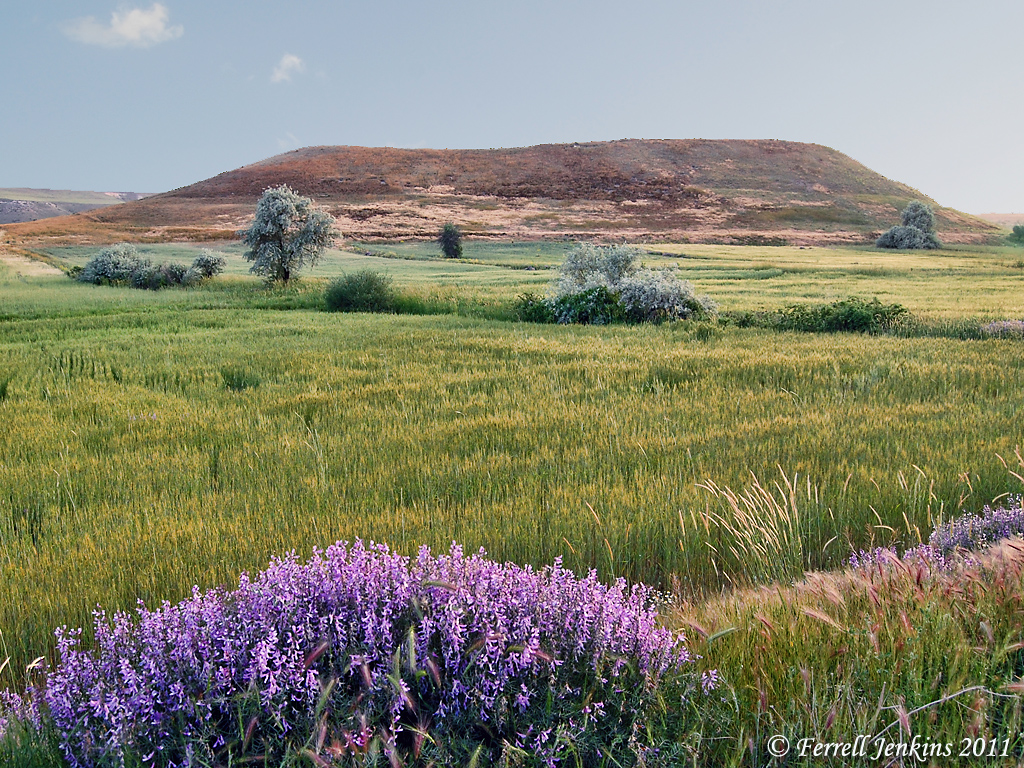
Looking through some slides, I found a nice photo of Lystra. In this photo from 1987 you will see that farmers have plowed the slopping side of the tell as far as practical. Often we see crops growing on the top of a tell, especially one that has not been excavated.

Lystra. 1987 Photo by Ferrell Jenkins.

Lystra. 1987 Photo by Ferrell Jenkins.

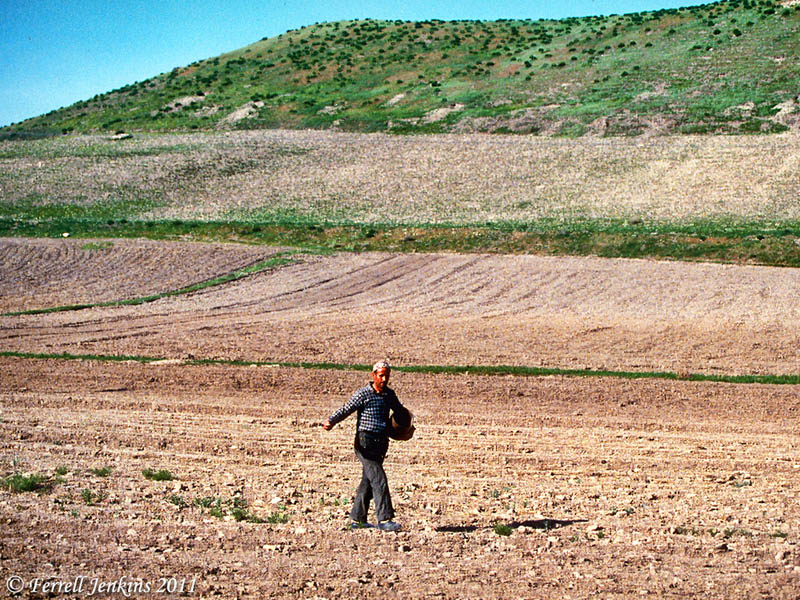
From another year, likely in the 80s, the sower is broadcasting seed. This is a practice that I saw frequently while growing up in the rural South. We rarely see this practice in the modern days of mechanization either in the USA or in the Bible World.

Sower at Lystra. Photo by Ferrell Jenkins.

Sower scattering seed at Lystra. Photo by Ferrell Jenkins.

The practice of the sower scattering seed is mentioned several times in the Bible. Notice Isaiah 55:10-11.

For as the rain and the snow come down from heaven, And do not return there without watering the earth And making it bear and sprout, And furnishing seed to the sower and bread to the eater;  So will My word be which goes forth from My mouth; It will not return to Me empty, Without accomplishing what I desire, And without succeeding in the matter for which I sent it.  (Isaiah 55:10-11 NAU)

Notice Paul’s use of the Isaiah text in 2 Corinthians 9:10.

We think also of the parables of Jesus.

3 And He spoke many things to them in parables, saying, “Behold, the sower went out to sow;  4 and as he sowed, some seeds fell beside the road, and the birds came and ate them up.  5 “Others fell on the rocky places, where they did not have much soil; and immediately they sprang up, because they had no depth of soil.  6 “But when the sun had risen, they were scorched; and because they had no root, they withered away. 7 “Others fell among the thorns, and the thorns came up and choked them out. 8 “And others fell on the good soil and yielded a crop, some a hundredfold, some sixty, and some thirty.  9 “He who has ears, let him hear.” (Matthew 13:3-9 NAU)

Lystra — the home of Timothy

The mound of Lystra, now called Zordula, is located about 18 miles south of Konya (biblical Iconium), Turkey, near the village of Hatunsaray.

Lystra was visited by Paul and Barnabas on the First Missionary or Preaching Journey (Acts 14). Lystra and Derbe were towns of Lycaonia (Acts 14:6). The locals spoke the Lycaonian language. They called Barnabas, Zeus, and Paul, Hermes (14:12). Inscriptions have been found that identify these particular gods with Lycaonia.

This was the home of young Timothy,  “the son of a Jewish woman who was a believer, but his father was a Greek” (Acts 16:1). Timothy accepted the invitation of Paul to join him on the second journey. Two of Paul’s epistles were written to Timothy.

The mound of Lystra, 18 miles south of modern Konya. Photo by Ferrell Jenkins.

The mound of Lystra, 18 miles south of modern Konya. Photo by Ferrell Jenkins.

After Paul healed a lame man, the residents of Lystra wanted to worship Paul and Barnabas as gods. Paul preached one of two sermons to Gentiles recorded in the Book of Acts (Acts 14 at Lystra; Acts 17 at Athens). The Jews of Pisidian Antioch who rejected the gospel message followed Paul to Lystra and persuaded the people against Paul. Paul was stoned, presumed dead, and dragged outside the city (Acts 14:19).

In the second letter to Timothy, Paul says that Timothy knows about the persecution he endured at Lystra.

10 You, however, have followed my teaching, my conduct, my aim in life, my faith, my patience, my love, my steadfastness, 11 my persecutions and sufferings that happened to me at Antioch, at Iconium, and at Lystra–which persecutions I endured; yet from them all the Lord rescued me. 12 Indeed, all who desire to live a godly life in Christ Jesus will be persecuted, 13 while evil people and impostors will go on from bad to worse, deceiving and being deceived. 14 But as for you, continue in what you have learned and have firmly believed, knowing from whom you learned it 15 and how from childhood you have been acquainted with the sacred writings, which are able to make you wise for salvation through faith in Christ Jesus. 16 All Scripture is breathed out by God and profitable for teaching, for reproof, for correction, and for training in righteousness, 17 that the man of God may be complete, equipped for every good work. (2 Timothy 3:10-17 ESV)

Here is a brief summary of the events at Lystra during the visit of Paul and Barnabas (Acts 14:6-20).

  • Healing of a lame man.
  • Priest of Zeus and the crowd wanted to offer sacrifice to Barnabas and Paul.
  • Sermon on the witness of God in nature.
  • Paul was stoned and dragged outside the city for dead.

In previous posts we have discussed the significance of Lystra in the work of Sir William Ramsay here and here.

Pisidian Antioch was the site of an important announcement

One of the important cities visited by Paul and Barnabas on the first preaching journey was Pisidian Antioch.

Moving from Perga, they arrived at Pisidian Antioch, and on the Sabbath day they went into the synagogue and sat down. After the reading from the law and the prophets, the leaders of the synagogue sent them a message, saying, “Brothers, if you have any message of exhortation for the people, speak it.” (Acts 13:14-15 NET)

Don’t confuse this Antioch in Pisidia, about 100 miles north of Perga, with Antioch in Syria where Barnabas and Saul began their journey (Acts 13:1-4).

Pisidian Antioch had been founded about 350 B.C. by either Seleucus Nicator or his son Antiochus I in ancient Phrygia, near Pisidia. About two thousand Jewish families were brought to Phrygia from Babylon about 200 B.C. (Josephus Ant. xii.3.4). This explains the presence of Jews and the synagogue.

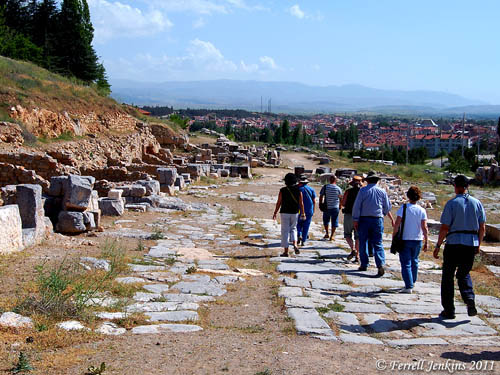
Our photo shows one of the Roman streets at Antioch. The modern Turkish town of Yalvac can be seen in the distance.

Roman Street in Pisidian Antioch. Photo by Ferrell Jenkins.

Roman Street in Pisidian Antioch. Photo by Ferrell Jenkins.

Acts 13 should be remembered as the chapter in which Luke records Paul’s sermon on the history of Israel to both Jews and God fearing Gentiles. The sermon recounted here is similar to the sermon Paul heard from the martyr Stephen (Acts 7).

The events at Pisidian Antioch are significant because it is here that we have many Jews and devout god-fearing proselytes accepting the message of Paul and Barnabas (Acts 13:43). When the Jews began contradicting the gospel we hear the announcement of a more concentrated effort to reach the Gentiles with the Gospel.

Both Paul and Barnabas replied courageously, “It was necessary to speak the word of God to you first. Since you reject it and do not consider yourselves worthy of eternal life, we are turning to the Gentiles. For this is what the Lord has commanded us: ‘I have appointed you to be a light for the Gentiles, to bring salvation to the ends of the earth.'” When the Gentiles heard this, they began to rejoice and praise the word of the Lord, and all who had been appointed for eternal life believed. So the word of the Lord was spreading through the entire region. (Acts 13:46-49 NET)

Keep your lamps burning

Light is necessary for life and growth. We are introduced to light in the biblical account of creation.

And God said, “Let there be light,” and there was light.  And God saw that the light was good. And God separated the light from the darkness.  God called the light Day, and the darkness he called Night. And there was evening and there was morning, the first day.  (Genesis 1:3-5 ESV)

Of Jesus, the Gospel of John says, “In him was life, and the life was the light of men” (John 1:4 ESV).

David spoke of meditating on God during the watches of the night (Psalm 63:6). He watched his sheep by night, but most work was not done in the night prior to the introduction of electric power. We used one Aladdin lamp and a few kerosene lamps in our home in the rural South until I was about 8 or 10 years old. Then we began to use a single electric bulb in a room when we needed to be in the room.

Jesus said,

We must work the works of of him who sent me while it is day; night is coming, when no one can work.  As long as I am in the world, I am the light of the world” (John 9:4-5 ESV).

Herodian period lamp burning. Photo by Ferrell Jenkins.

Herodian period lamp from the time of Jesus. Photo by Ferrell Jenkins.

The photo above is one of the Herodian period lamps I have purchased in the Bible lands over the past 44 years. Two or three times I have used some olive oil (or Wesson oil, or a small piece of a candle) to show how much light the lamp gives.

In the parable of the watchful slaves Jesus said,

“Stay dressed for action and keep your lamps burning,  and be like men who are waiting for their master to come home from the wedding feast, so that they may open the door to him at once when he comes and knocks. (Luke 12:35-36 ESV)

The Apostle Paul commanded the saints at Philippi to shine as lights in the world.

Do all things without grumbling or questioning,  that you may be blameless and innocent, children of God without blemish in the midst of a crooked and twisted generation, among whom you shine as lights in the world, (Philippians 2:14-15 ESV)

Monday Meandering — October 10

More about Paul’s Shipwreck on Malta. Gordon Franz reviews Robert Cornuke’s recent video on the claimed evidence for the shipwreck.  The review is available at the Associates for Biblical Research site here, or Gordon’s Life and Land blog here.

Gordon also exposes the photos purporting to show giant human skeletons from Greece here.

Shiloh. Leon Mauldin wrote about our recent visit to Shiloh here, here, here. The tabernacle was located at Shiloh for many years after ancient Israel came into the promised land. See Joshus 18; 1 Samuel 1-4, et al.

Recent excavations at the base of Tel Shiloh. Photo by Ferrell Jenkins.

Recent excavations at the base of Tel Shiloh. Photo by Ferrell Jenkins.

Jezreel Excavation. A well-trained team of archaeologists, headed by Norma Franklin and Jennie Ebeling, announces renewal of excavations at Jezreel. Details here.

The new website describes the importance of the location of Jezreel.

We are returning to Jezreel because it is an amazing site with a long history that reflects the rich cultural heritage of the area

Perched on the foothills of the Gilboa mountain range it commands an unparelled view over the valley below. The famous sentry site of Megiddo, Biblical Armageddon, lies 15 kms to the west and to the east the renowned city of Bet Shean (Scythopolis).

Reliability of the New Testament Manuscripts. Barry Creamer comments on the “debate between Bart Ehrman and Daniel Wallace on whether the text of the New Testament is trustworthy. Both are world class scholars in textual criticism.” Some interesting comments on the different approach taken by the two textual critics to the problem of no original manuscripts. Read here.

HT:  Bible Place Blog; Bible X.

Mount Hermon from the Damascus Road

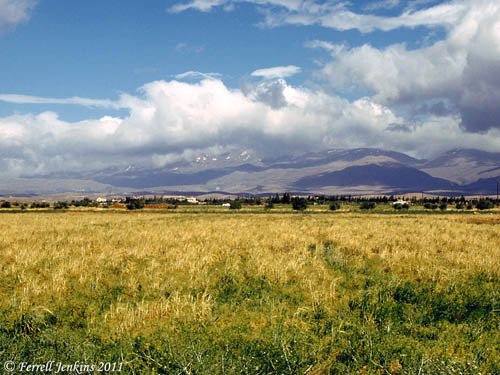
Mount Hermon is the southern end of the Anti-Lebanon mountain range. The mountain is about 20 miles long and has three peaks. At 9,232 feet above sea level it is the highest mountain of Canaan, or Roman Syria, named in the Bible. The mountain now is shared by the countries of Lebanon, Syria, and Israel. The photo below shows mount Hermon from the east, a few miles south of Damascus toward Quneitra. This is roughly the route of the famous Damascus Road taken by Paul as he went from Jerusalem to Damascus. This photo was made the middle of May, 2002. There was more snow on the west side of the mountain in Lebanon than you see here.

View of Mount Hermon from the East. Photo by Ferrell Jenkins 2002.

View of Mount Hermon from the East. Photo by Ferrell Jenkins 2002.

The first biblical reference to Mount Hermon is found in Moses’ account of the Israelite conquest of transjordan (Deuteronomy 3:8). He says that Israel took the land from the hand of two Amorite kings “from the valley of Arnon to Mount Hermon.” The Sidonians, of ancient Phoenicia, called the mountain Sirion, and the Amorites called it Senir (Deuteronomy 3:9). The half-tribe of Manasseh lived in the area of Bashan which is south of Mount Hermon (1 Chronicles 5:23). The Mountain of Bashan is probably a reference to Mount Hermon (Psalm 68:15). Hermon is mentioned in four references in the poetic books of the Old Testament (Psalm 42:6; 89:12; 133:3; Song of Solomon 4:8).

The heavens are yours; the earth also is yours; the world and all that is in it, you have founded them. The north and the south, you have created them; Tabor and Hermon joyously praise your name. (Psalm 89:11-12 ESV)

This post is a slightly revised post from 2009, but the photo is a new one digitized from a slide made in 2002.

The plain of Acco: Acco, Aczib, Ladder of Tyre

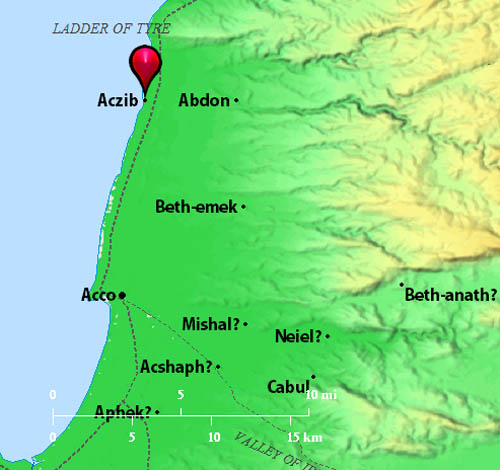
The coastal cities of Acco and Aczib (Achzib) were allotted to the tribe of Asher in the days of Joshua (Joshua 19:24-31). According to this text the territory reached from (Mount) Carmel on the south to Great Sidon on the north. Israel was not able to control all of the territory

Geographers describe the coastal portion of Asher as the plain of Acco.

Asher did not drive out the inhabitants of Acco, or the inhabitants of Sidon, or of Ahlab, or of Achzib, or of Helbah, or of Aphik, or of Rehob. (Judges 1:31 NAU)

The map below, intended to show the location of Aczib, shows the coastal area from Mount Carmel (where Haifa is located) to the Ladder of Tyre. The Ladder of Tyre is a natural formation that has served as a border between Israel and Lebanon during many historical periods. Within this territory you see Acco and Aczib.

Aczib, plain of Acco in Asher. BibleMapper.org.

Map showing Plain of Acco in tribe of Asher. BibleMapper.org.

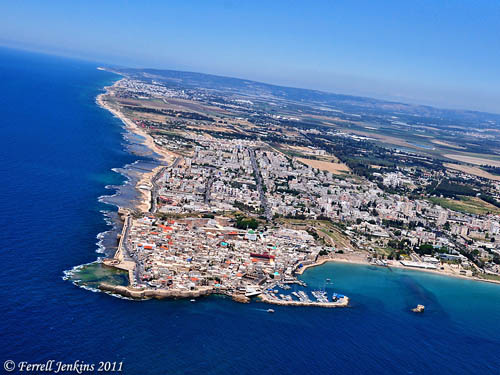
In the aerial photo below you will see the view north from Acco, including the Crusader city, to the ladder of Tyre. The total distance is about 20 miles.

Aerial view north from Acco to the Ladder of Tyre. Photo by Ferrell Jenkins.

Aerial view north from Acco to the Ladder of Tyre. Photo by Ferrell Jenkins.

In New Testament times the city of Acco was know as Ptolemais. The only biblical reference to the city is in the account of Paul’s return from his third journey. From Tyre to Ptolemais is a distance of about 45 miles. Paul and his companions stayed stayed seven days at Tyre, but only one day at Ptolemais.

When we had finished the voyage from Tyre, we arrived at Ptolemais, and after greeting the brethren, we stayed with them for a day. On the next day we left and came to Caesarea, and entering the house of Philip the evangelist, who was one of the seven, we stayed with him. (Acts 21:7-8 NAU)

In a subsequent post we plan to show you the Plain of Acco between Mount Carmel (Haifa) and Acco.

Friday’s findings

Looking for Joshua’s Ai. Gary Byers, administrative director of the Khirbet el-Maqatir excavation, has already posted info on six days of the dig. Because I assume this series will continue, I suggest you begin with Day One here. The expedition has posted photos on Facebook here. This will give prospective diggers some idea what goes on during a dig. Information about the purpose of the dig, a project of the Associates for Biblical Research, is posted here. Dr. Bryant Wood, and others associated with this dig, are looking for an alternative site for Ai.

Hidden Pyramids. Dr. Zahi Hawass has called in question the BBC program about the work of Dr. Sarah Parcak using satellite imagery to discover 17 new pyramids and other structures.

Although satellite imaging is useful for discovering new sites and monuments, interpretation of the images is not straightforward. No one can say with certainty that the features displayed under the sand are actually pyramids. Such anomalies could be houses, tombs, temples, pyramids, buried cities or even geological features. The only way we can definitely identify what is there is by excavating it – by investigating it physically. This was not made clear in the article.

Read the complete article here. See our earlier report here.

Corinth Matters. David Pettegrew, assistant Professor of History at Messiah College near Harrisburg, PA., has started a blog called Corinth Matters. Pettegrew completed a dissertation on Corinth on the Isthmus. The new blog deals with the ancient city of Corinth, the Isthmus, the Diolkos, and other things Corinthian. You will find readings lists, links to conferences, info on excavations, maps and images relating to Corinth and the Corinthian correspondence.

Dr. Pettegrew currently is traveling in Albania, the location of ancient Illyricum, visiting Corinthian colonies from the pre-Christian period. Paul made reference to preaching as far as Illyricum.

by the power of miraculous signs and wonders, and by the power of God’s Spirit. As a result, I have fully proclaimed the good news about the Messiah from Jerusalem all the way around to Illyricum. (Romans 15:19 CSB)

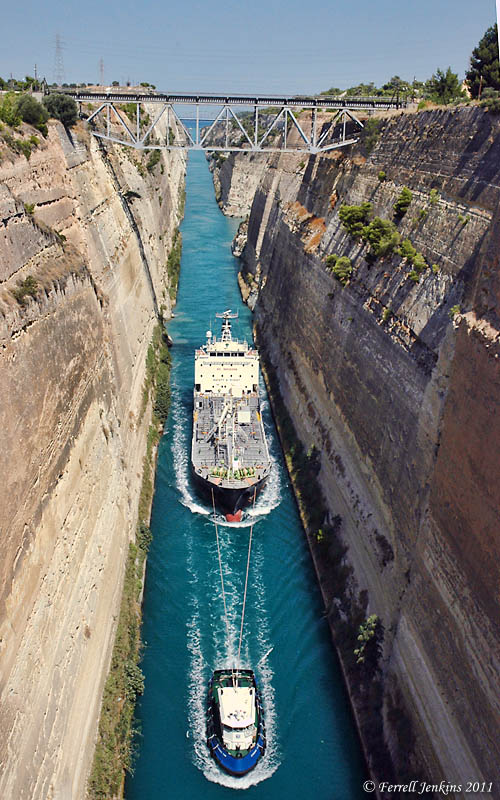
Corinth Canal - Photo by Ferrell Jenkins.

A ship is towed through the Corinth Canal. View west toward the Gulf of Corinth. Photo by Ferrell Jenkins.

Having taught the Corinthian correspondence for several year, I find this blog especially interesting.

Walking on Roman roads

Gordan Franz, Life and Land Seminars, recently led the 2011 Talbot Bible Lands study tour of Turkey and Greece. He writes about the Roman roads used by Paul in his journeys. See here.

Photos are included of the following roads, portions of which still exist.

  • The Via Taurus, “a beautifully preserved road between Tarsus and the Cilician Gates” (Acts 15:36).
  • The Via Sebaste (“Emperor’s Road”) connecting Iconium and Pisidian Antioch (Acts 13:51; 14:21-23).
  • The Roman Road west of Assos (Acts 20:22-23).
  • The Roman Road inside the city of Alexandria Troas leading to the harbor (Acts 16:8-11).
  • The Via Egnatia which connected Neapolis and Philippi (Acts 16:11-12; 20:6).
  • The Appian Way (Acts 28:14-16).

The link to photos made by one of the tour members is given at the bottom of the article. At this moment you will need to copy the link and paste it into your browser. There is an extra http// in the embedded code.

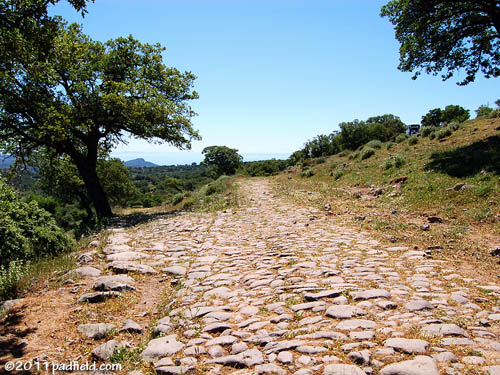
The photo below is one provided by friend David Padfield of the Roman road near Assos.

Roman Road near Assos. Photo by David Padfield.

Roman Road near Assos. Photo by David Padfield.

I have been on journeys many times, in dangers from rivers, in dangers from robbers, in dangers from my own countrymen, in dangers from Gentiles, in dangers in the city, in dangers in the wilderness, in dangers at sea, in dangers from false brothers… (2 Corinthians 11:26 NET)