Dr. James Turner Barclay remembered in the Cathedral of St. George, Jerusalem

A little more than two years ago I wrote two posts about the discovery of Solomon’s Quarries (also called Zedekiah’s Cave) here and here. I will reproduce only a few comments from those articles in hope that you will check them and the many photos I have included there.
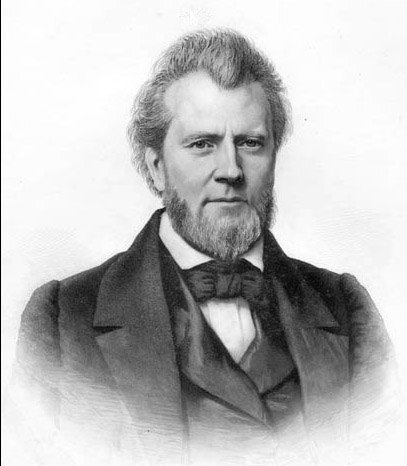
Portrait of Dr. James Turner Barclay from about 1848.

Portrait of Dr. James Turner Barclay engraved by John Sartain. This image may also be found on the Scottsville Museum (Virginia) web page here. The photo is from Barclay’s book, The City of the Great King (1858).

Dr. James Turner Barclay was sent to Jerusalem by the American Christian Missionary Society in 1851 as a medical and evangelistic missionary. During his first trip he stayed until 1854 and returned for a second stint from 1858 to 1861. Barclay was active in medical work, treating more than 2,000 cases of malaria during his first year in the city.

Barclay is known not only for the aforementioned discovery but for the discovery of an ancient gate in the Western Wall now known as Barclay’s Gate. I gathered all of my sources to write about that when I wrote the previous articles, but eventually had to put the books away to make room for something else. Perhaps someday.

While admitting mistakes that Barclay made in those early days, Dr. Jack P. Lewis says,

The significant steps that Barclay took toward the scientific study of Jerusalem will keep his contribution to scholarship from being forgotten. (Biblical Archaeologist, 1988).

A few decades ago a church in Atlanta, Georgia, provided two stained glass windows for the Cathedral of St. George to honor and maintain the memory of Dr. Barclay. The Cathedral is the seat of the Episcopal Church bishop of Jerusalem. Our first picture shows the courtyard and entrance along Nablus (formerly Damascus) Road. It is near the famous American Colony Hotel and other well-known tourist hotels (e.g., the Grand Court Hotel where many of my groups have stayed).
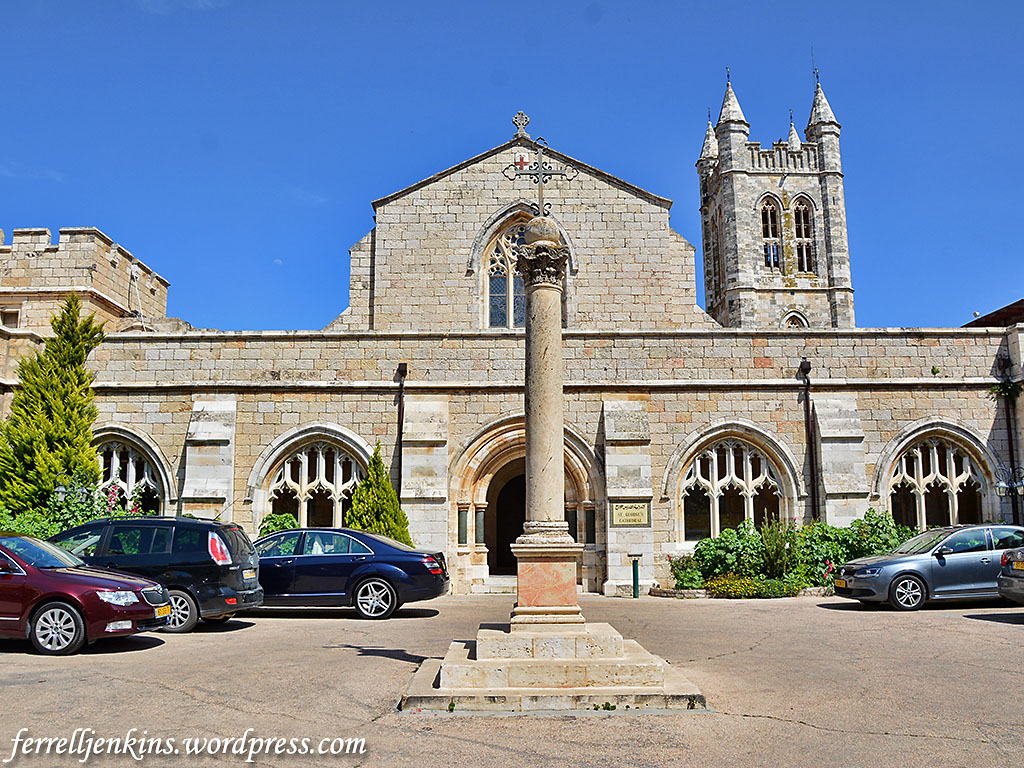
The courtyard and entrance to St. George Cathedral in east Jerusalem. Photo by Ferrell Jenkins.

The courtyard and entrance to St. George Cathedral in east Jerusalem. Photo by Ferrell Jenkins.

Our next photo shows the interior of the building. The stained class windows, not visible in this photo are on the left and near the front of the building. The building seems to be open for visits at most times.
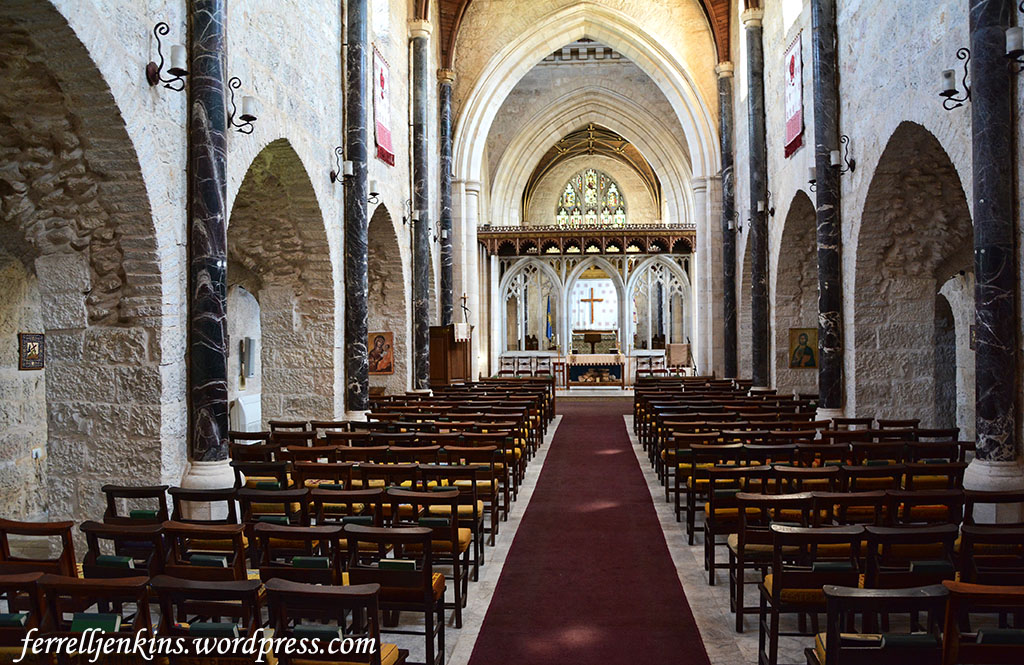
The interior of the St. George Cathedral. The stained glass windows are on the left side. Photo by Ferrell Jenkins.

The interior of the St. George Cathedral. The stained glass windows are on the left side. Photo by Ferrell Jenkins.

There are two other windows depicting the naming of John the Baptist and the preaching by John of “a baptism of repentance.” The ones we show below are the ones honoring Dr. Barclay. The window on the left bears the title “Jesus was baptized by John in the Jordan” and the one on the right has “John heard in prison about the deeds of Jesus” as a title. John is holding a manuscript with a portion of the text of Matthew 11:4-6.

And Jesus answered them, “Go and tell John what you hear and see: 5 the blind receive their sight and the lame walk, lepers are cleansed and the deaf hear, and the dead are raised up, and the poor have good news preached to them. 6 And blessed is the one who is not offended by me.” (Matthew 11:4-6 ESV)
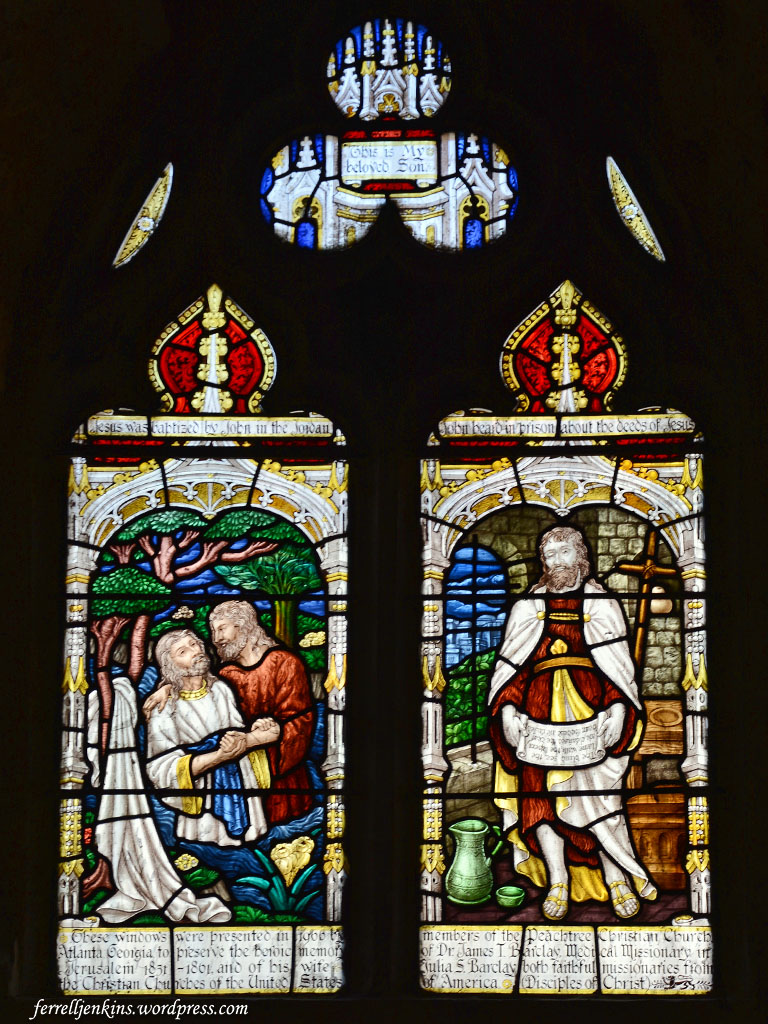
The windows honoring Dr. Barclay. Photo by Ferrell Jenkins.

The windows honoring Dr. Barclay. Photo by Ferrell Jenkins.

The dedication reads across both windows:

These windows were presented in 1966 by members of the Peachtree Christian Church, Atlanta, Georgia, to preserve the heroic memory of Dr. James T. Barclay, Medical Missionary in Jerusalem 1851–1861, and of his wife Julia S. Barclay, both faithful missionaries from the Christian Churches of the United States of America. (Disciples of Christ).

I have made mention of the Restoration Movement, sometimes called the Stone-Campbell Movement, at other times. Just as a matter of record, my life’s work has been among more conservative Churches of Christ, rather than among Christian Churches or Disciples of Christ. The introduction of the American Christian Missionary Society was one of the things that precipitated the division.

It is good to see the work of men like Barclay honored by whomever wishes to do so.

As a courtesy to those who would like to use these photos in teaching, you may click on them for an image suitable for PowerPoint presentations.

New books from Carta Jerusalem – # 2

The Twice Told Tale parallel study of Samuel, Kings, Chronicles, and more.

The Twice Told Tale parallel study of Samuel, Kings, Chronicles, and more.

The Twice-Told Tale. This hardback book of 284 (6½” x 9½”) pages is written by Abba Bendavid, with an introduction by Mordechai Cogan. ($64). Cogan says,

It is well-known that readers of the Bible generally skip over the Book of Chronicles [1-2 Chronicles], the last book of the Hebrew Bible [chronologically]. All too often Chronicles is seen as merely a recap and summary of the historical books that preceded it….

This book includes an index to biblical citations. It will be extremely helpful to those studying Samuel, Kings, and Chronicles.

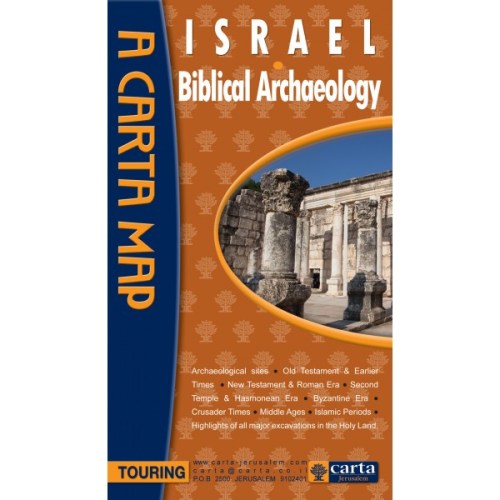
Israel Biblical Archaeology touring map.

Israel Biblical Archaeology touring map.

Israel Biblical Archaeology (A Carta Touring Map) $14.95. Carta Jerusalem describes this folding map:

 The first major comprehensive map of  archaeological sites in the Holy Land, together with over a dozen annotated historical vignette maps of major sites and events throughout the land that provide an insightful overview of all archaeological sites related to the Bible and later historical periods.

This 24 × 35½ in. map folds to 5¼×9¼ in. For those interested in locating archaeological sites this can be a very helpful resource. On the back side of the map there are numerous smaller maps and diagrams helpful in study and travel. My preference would be to have this material in spiral bound atlas format, but I expect to use the map in planning and during my next personal study trip.

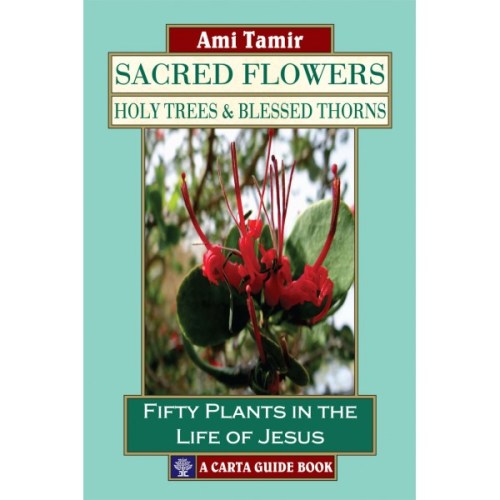
Sacred Flowers, Holy Trees & Blessed Thorns by Ami Tamir is a new book published this year. The Introduction explains,

This book tells the stories of fifty plants connected to Christian tradition which can be found, in season, by the Christian pilgrim visiting the land of Israel. Illustrations that enable the pilgrim to identify the less-recognizable plants are included, and encourage the study of the rich botanical variety he/she will find on footpaths between pilgrimage sites, churches and archaeological remains.

“The encounter with the plants brings to life the wondrous tales of the Holy Family: here they acquire a deeper religious significance. That is the magic secret: to touch the matter, the rocks, the clumps of earth, and the flowers growing on them.” (From the Introduction)

Sacred Flowers Holy Trees & Blessed Thorns.

Sacred Flowers, Holy Trees & Blessed Thorns.

My personal interests are not as much attuned to the traditions and legends that have grown up around certain plants, but more to the various plants and thorns mentioned in the Bible. Nonetheless, this is a beautiful little book and one that many visitors to Israel will find helpful.

This 8″ x 5½” paperback book of 176 pages belongs to the Carta Guide Book series. It is lavishly illustrated and sells for $25.00.

Check the Carta online catalog to learn more about each book. The books also are available from Hendrickson, Amazon, and some other publishers. The books mentioned here were sent to me by Carta Jerusalem, but the comments are my own opinion.

Jesus used the camel in His illustrations

Camels are first mentioned in the Bible in the time of Abraham (Genesis 12:16), and they are prominently mentioned in other Old Testament stories such as the account of  Genesis 24. John the Baptist is noted for wearing a garment made of camel’s hair (Matthew 3:4).

A mother camel and her young calf in Palestine (or West Bank). Photo by Ferrell Jenkins.

A mother camel and her young calf in Palestine (or West Bank). Photo by Ferrell Jenkins.

Jesus used the camel to illustrate His teaching. He said,

Again I tell you, it is easier for a camel to go through the eye of a needle than for a rich person to enter the kingdom of God.” (Matthew 19:24 ESV)

and, to the Scribes and Pharisees He said,

You blind guides, straining out a gnat and swallowing a camel! (Matthew 23:24 ESV)

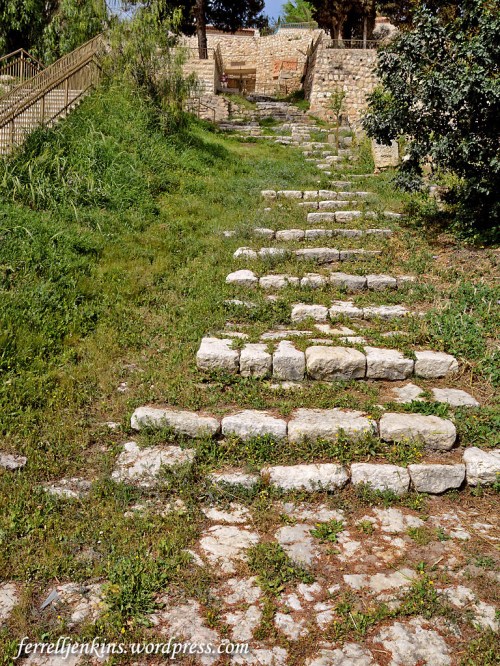
Did Jesus use these steps?

Jesus observed the Passover of the Jews somewhere in the upper city of Jerusalem, the present Mount Zion. Scholarly consensus locates the house of Caiaphas at a site near the Cenacle on Mount Zion. Another site, further down the slope toward the Pool of Siloam, is held by some as the house of Caiphas. It is  called St. Peter in Gallicantu (cock-crow). According to this tradition, it is the place where Jesus was taken after His arrest (Matthew 26:57). If correct, this would be the site of Peter’s denial of the Lord.

The late W. Harold Mare says,

Whatever interpretation is accepted, one is impressed with the ancient stone stairs that run from the vicinity of the Cenacle down past the Church of St. Peter in Gallicantu to the Pool of Siloam, stairs that are thought to be from the Jewish period. It could be that these were the very stairs used by Jesus as he went down from the Last Supper to the Kidron Valley and on to Gethsemane (John 18:1). (The Archaeology of the Jerusalem Area. Baker, 1987)

My understanding is that Jesus would have observed the Passover and instituted the Lord’s Supper in the Upper City. He then went with His disciples to Gethsemane. From there He was taken to the House of Caiaphas. Jesus may have taken these steps in both directions. Here is a photo of those stone stairs that I made last year.

First century steps leading to the Upper City. Photo by Ferrell Jenkins.

First century steps leading to the Upper City. Photo by Ferrell Jenkins.

New books from Carta Jerusalem

Carta Jerusalem, publisher of some wonderful resources about the Bible, Biblical History, and the Bible Land, recently sent me several new books. I will make brief mention of these books in hope that you will check the Carta online catalog to learn more. The books also are available from Amazon and some other publishers.

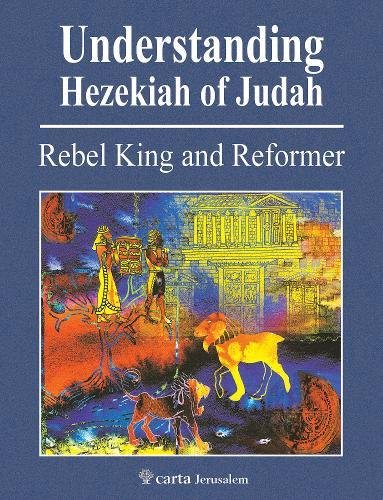
Understanding Hezekiah of Judah (Rebel King and Reformer) by Mordechai Cogan. This full-color paperback is 9″ x 11¾”, 40 pages. The book is based on the Bible and extra-biblical sources including archaeological discoveries. $14.95.

Carta Jerusalem's new Understanding Hezekiah of Judah.

Carta Jerusalem’s new Understanding Hezekiah of Judah.

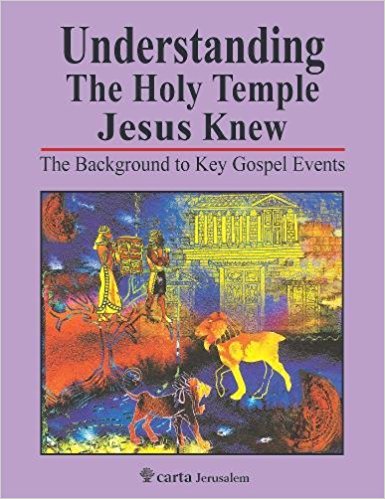
Understanding the Holy Temple Jesus Knew (The Background to Key Gospel Events) by Leen and Kathleen Ritmeyer. This full-color paperback is 9″ x 11¾”, 48 pages. $14.95. We have frequently mentioned the superb work of the Ritmeyer’s on the temple that Jesus knew.

Leen and Kathleen Ritmeyer's Understanding the Holy Temple Jesus Knew.

Leen and Kathleen Ritmeyer’s Understanding the Holy Temple Jesus Knew.

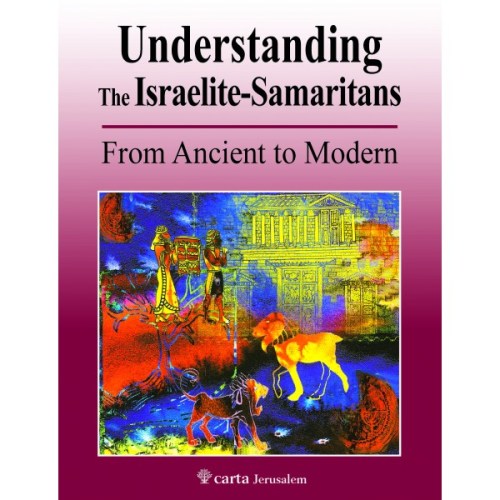
Understanding the Israelite-Samaritans (From Ancient to Modern) by BenyamimTsedaka. This full-color paperback is 9″ x 11¾”, 40 pages. The author is an Elder of the Samaritan community living in Israel. Having visited the Samaritan community on Mount Gerizim, I found this work to be extremely interesting. $14.95.

Understanding the Israelite-Samaritans by Carta Jerusalem.

Understanding the Israelite-Samaritans by Carta Jerusalem.

The Carta books mentioned above are lavishly illustrated with photos, drawings, and maps.

In a future post or two I will mention a few more of the new books supplied by Carta Jerusalem.

The women of Mount Samaria are like the cows of Bashan

Amos of Tekoa is recognized as a straight forward, no-nonsense, prophet (Amos 1:1). He called the women of the northern kingdom of Israel cows. Nothing politically correct about that.

Listen to this message, you cows of Bashan who live on Mount Samaria! You oppress the poor; you crush the needy. You say to your husbands, “Bring us more to drink!” (Amos 4:1 NET)

The sn (study note) in the NET Bible is worth reading.

The expression cows of Bashan is used by the prophet to address the wealthy women of Samaria, who demand that their husbands satisfy their cravings. The derogatory language perhaps suggests that they, like the livestock of Bashan, were well fed, ironically in preparation for the coming slaughter. This phrase is sometimes cited to critique the book’s view of women.

Bashan is in the area we now call the Golan Heights. It is located to the east of the Sea of Galilee and northward. Golan in Bashan was one of the cities of refuge located in the territory of eastern Manasseh (Joshua 20:8). The region was noted as good pasture land.

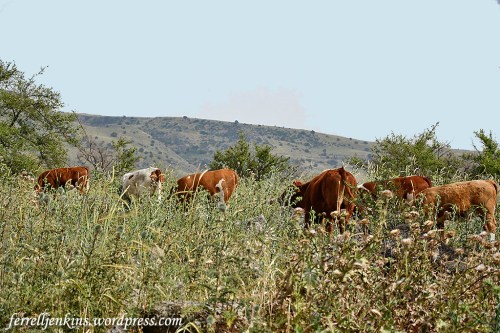
In the modern state of Israel we notice an attempt to grow crops known from biblical times in the same area where they were grown then. And the same is true of cattle. Here is a photo I made earlier this year of some of the cows grazing in ancient Bashan (modern Golan Heights).

Cows grazing in the Golan Heights, the area known as Bashan in Old Testament times. Photo by Ferrell Jenkins.

Cows grazing in the Golan Heights, the area known as Bashan in Old Testament times. Photo by Ferrell Jenkins.

The solar eclipse of June 15, 763 B.C.

I watched the solar eclipse on TV. Now you might enjoy going to the link I mention below.

Carl Rasmussen has posted an interesting article on his HolyLandPhotos’Blog here about “A Solar Eclipse and Old Testament Chronology.” He says,

But did you know that the solar eclipse of June 15, 763 B.C. holds the key to the chronology of the Old Testament (Hebrew Bible)?

He continues to explain how we are able to know the date for certain Old Testament kings and events. We are all dependent on the work of scholars such as the late Edwin R. Thiele (1895-1986) and his The Mysterious Numbers of the Hebrew Kings.

How are we to convert the relative dates given in the Bible (e.g., “in the fourth year of…”) to absolute dates (e.g., 966 B.C.)?

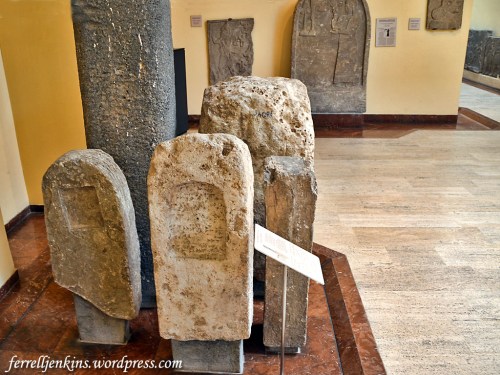
The Assyrians kept records of their kings and various officials on these stone documents called limmus, but in one of them they recorded the eclipse of the sun that occurred June 15, 763 B.C. according to astronomical computation.

Limmu stelae from Asshur. Museum of the Ancient Orient, Istanbul, Turkey. Photo by Ferrell Jenkins.

Limmu stelae from Asshur. Museum of the Ancient Orient, Istanbul, Turkey. Photo by Ferrell Jenkins.

I confess to having made the above photo of the limmu stelae from Asshur, displayed in the Museum of the Ancient Orient in Istanbul, Turkey, but failing to photograph the identifying sign.

Carl’s post and photo was enlightening to me. He explains about the limmu stelae and how Thiele used this material to develop a widely accepted Biblical Chronology. I urge you to read his article, and perhaps Thiele’s book. The book is available from Amazon and other sources.

The water system at Megiddo

Ancient people built their villages and towns near water sources. If there was not a spring at the base of the hill where they settled they would need to dig a well, a shaft, or a tunnel to reach the water source.

Many visitors to Israel have made their way through the water system at Megiddo. Professor David Ussishkin, who is able to include Megiddo among his numerous excavations, says,

As mentioned before, there were two springs at Megiddo. The nearer one was located on the western side, at the bottom of the mound. There were two obvious difficulties in the use of the water by the inhabitants of the city. First, in order to obtain water for daily use, the inhabitants – and these were most probably the ladies – had to descend the steep slope down to the spring and then carry the water in jars back to their homes which were situated on the summit of the mound. Second, in time of siege, the spring remained outside the city-walls, and thus inhabitants could not reach it while the besieging army had easy access to the water. These difficulties were overcome by constructing a huge water system (Figs. 2.5; 2.22; 2.27). A vertical shaft was cut in the rock from the surface of the mound. Starting from the bottom of the shaft, a horizontal tunnel was cut in the rock till it reaches the spring. At the same time the approach to the spring from outside was blocked and hidden from view. The way to the spring now became easier and safer: one had to descend by rock-cut steps down the vertical shaft, and then walk through the horizontal tunnel to the spring.

In a later stage, the bottom of the horizontal tunnel was lowered, so that the water flowed by gravitation from the spring to the bottom of the vertical shaft. From here, the water could be raised with the aid of pulleys to the surface of the mound, saving a lot of work and energy.

Naturally, as time passed and the settlement was abandoned, the water system was filled with debris. The Chicago expedition [1933-1939] made a huge effort excavating and cleaning up the water system, restoring the steps in the vertical shaft, and preparing the place for visitors. The water system is now one of the major attractions for visitors to Megiddo.
Source: Ussishkin, David. On Biblical Jerusalem, Megiddo, Jezreel and Lachish. Hong Kong: Divinity School of Chung Chi College, Chinese University of Hong Kong. 2011: 66-67.

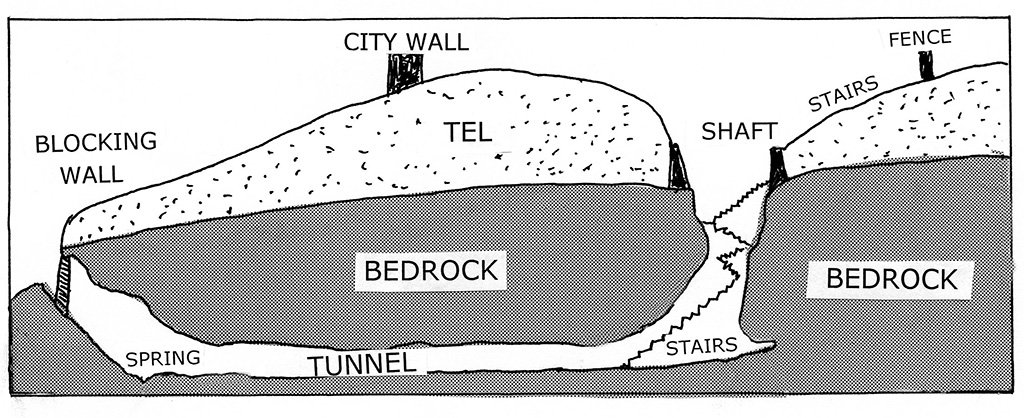
The sign at the entrance to the water system was in poor condition when I made my photo. I have made a drawing based on that sign showing the various elements of the system.

The Megiddo water system. Based on the sign at the site.

The Megiddo water system. Based on the sign at the site.

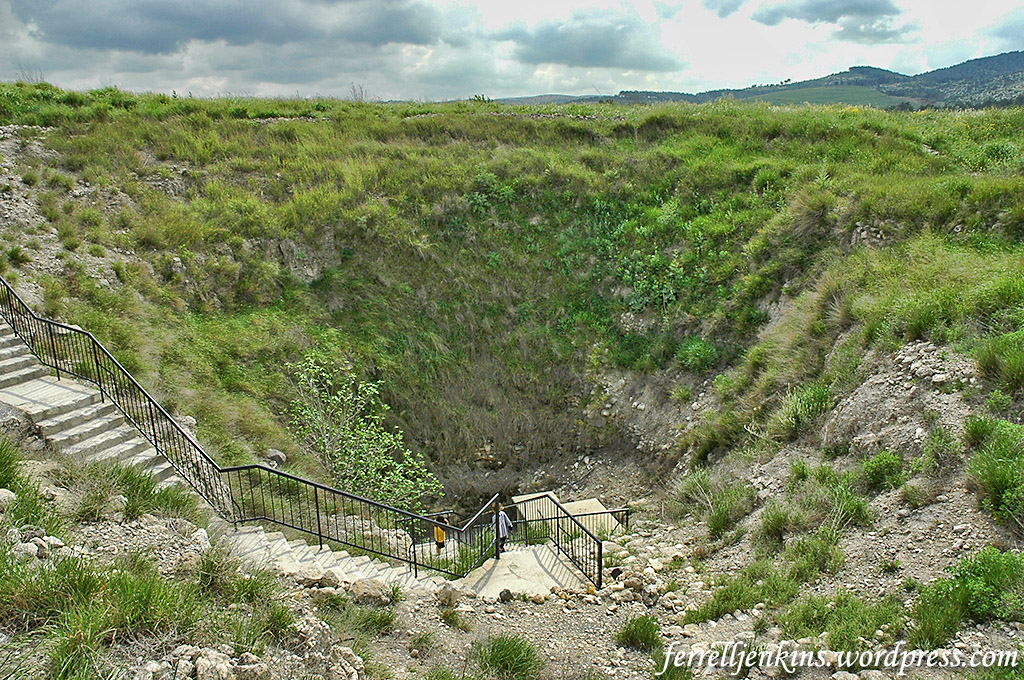
Our photos will take you through the water system step by step. The first photo shows a view of the entrance to the system from the top of the tel.

The shaft of the Megiddo water system from the top of the tel. Photo by Ferrell Jenkins.

The shaft of the Megiddo water system from the top of the tel. Photo by Ferrell Jenkins.

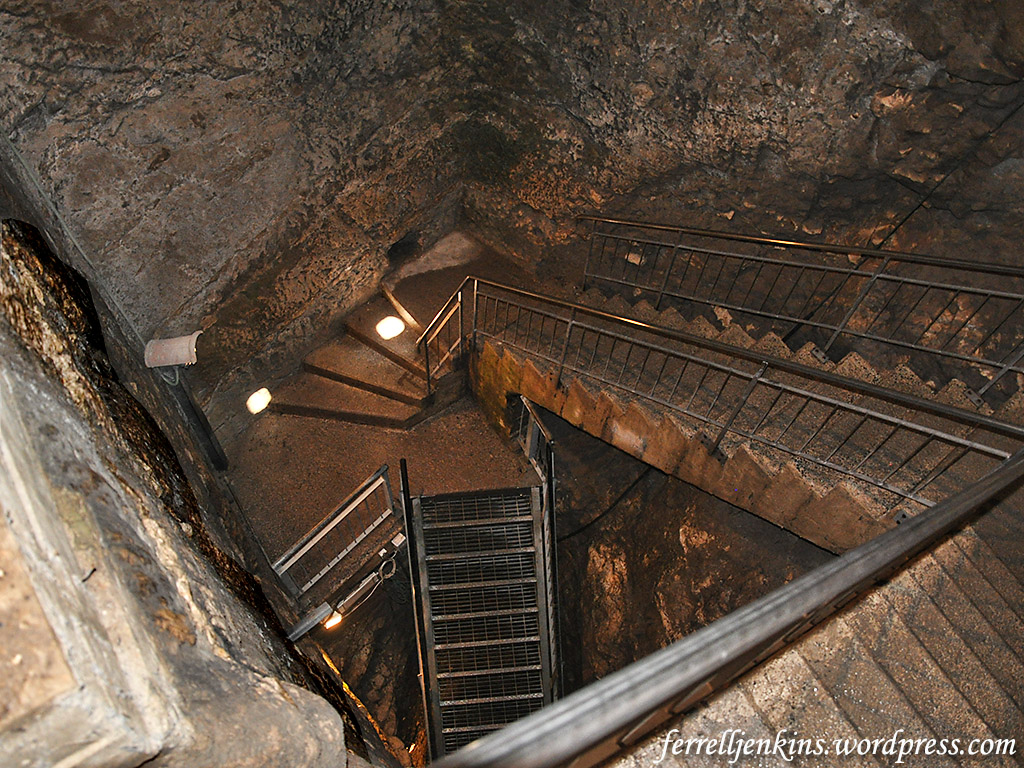
I see a variety of figures regarding the depth of the shaft and the length of the tunnel. The brochure distributed by the Israel Nature and Parks Authority says the shaft is 36-meters-deep [119 feet]. (Download the brochure here.) There are more than 180 steps down to the tunnel.

The same brochure says,

The tunnel was cut on an incline so the water would flow to the bottom of the shaft and the inhabitants could draw water while standing at the top. The outer entrance to the spring was sealed with a massive stone wall, concealed with earth so that an enemy besieging the city would not discover its location.

Steps going down to the level of the tunnel. Photo by Ferrell Jenkins.

Steps going down to the level of the tunnel. Photo by Ferrell Jenkins.

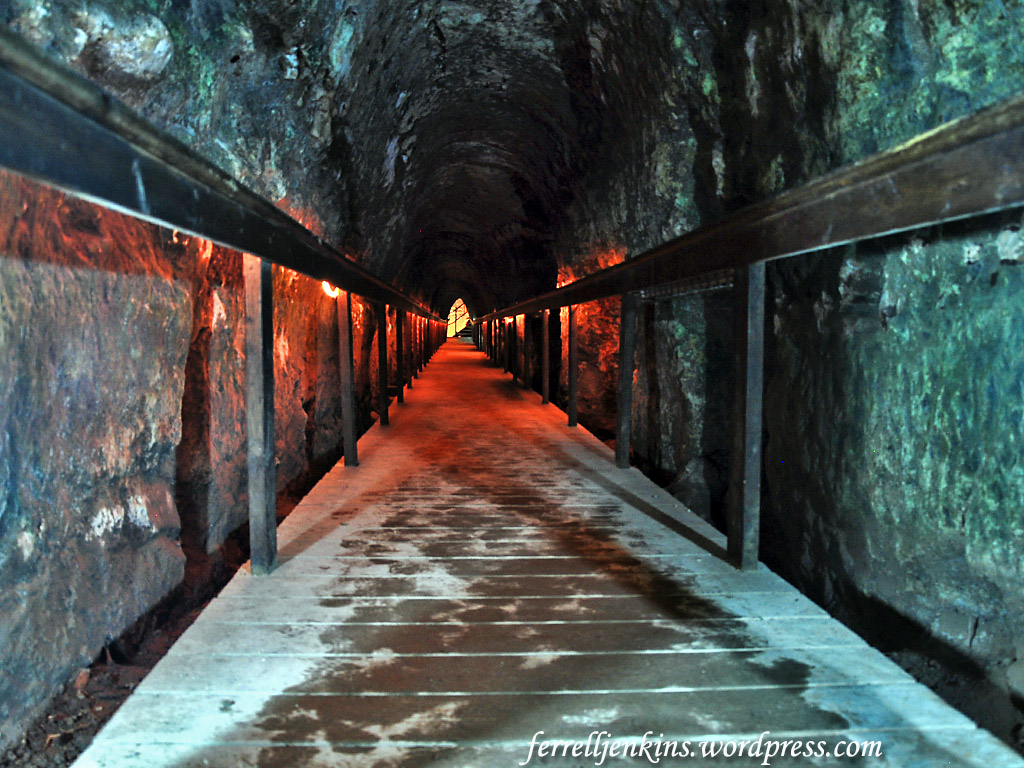
The water flowed from the spring on the western side of the tel through a 70-meter-long [230 feet] tunnel. I have never seen the water in the tunnel, but I recall a few times when tours were not allowed to go through the tunnel due to high water.

The tunnel at Megiddo with a modern walk for ease of traversing the length. Photo by Ferrell Jenkins.

The tunnel at Megiddo with a modern walk for ease of traversing the length. Photo by Ferrell Jenkins.

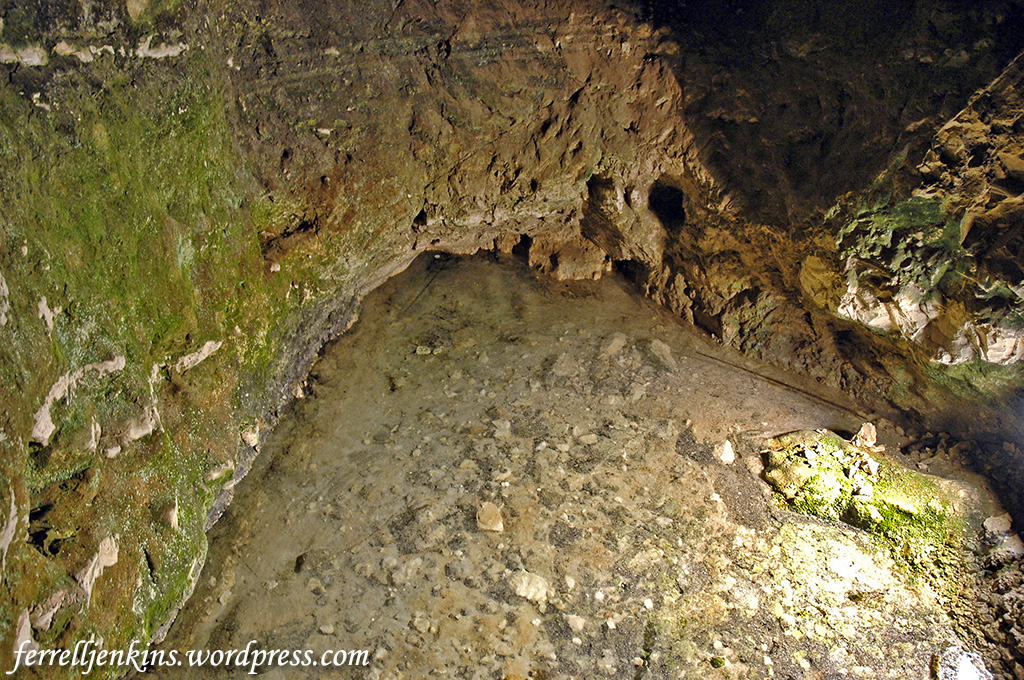
Only a small amount of water was seen at the spring in this 2006 photo.

The spring at it was on April 02, 2006. Photo by Ferrell Jenkins.

The spring at it was on April 02, 2006. Photo by Ferrell Jenkins.

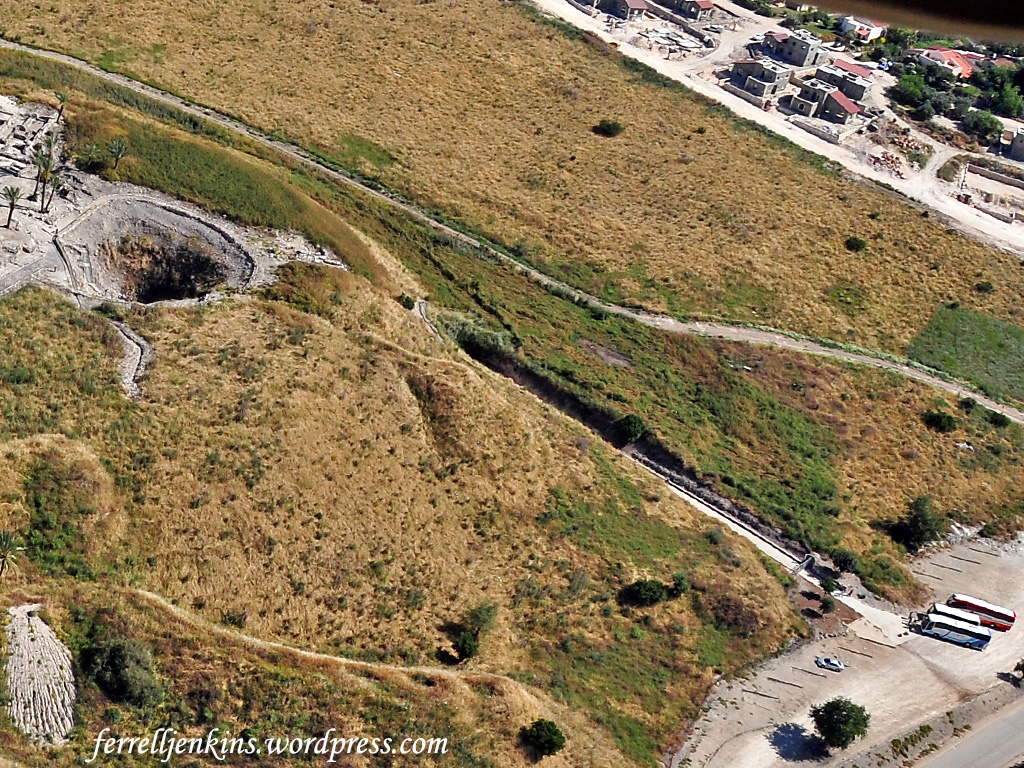
The aerial photo below shows the portion of the tel where the water system is located. You can see the opening of the shaft, and you can see there the tour buses are parked awaiting the tourists who have visited the tel and walked through the tunnel. A modern cut has been made to the modern steps leading to the spring.

Aerial view of the Megiddo water system. Photo by Ferrell Jenkins.

Aerial view of the Megiddo water system. Photo by Ferrell Jenkins.

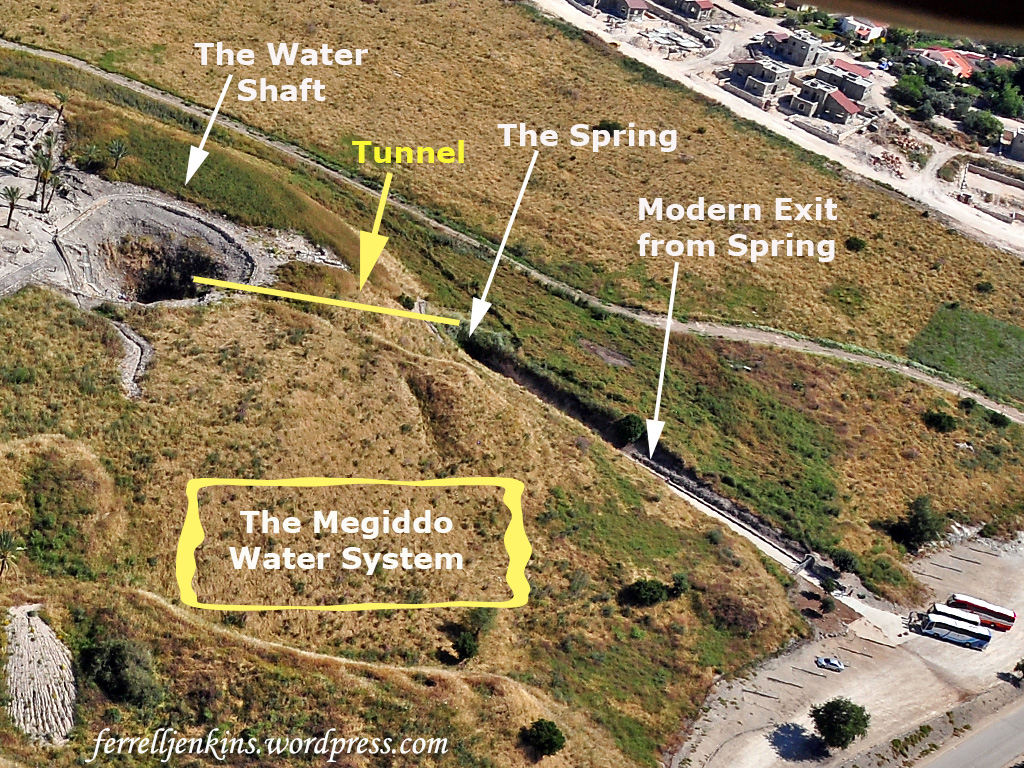
Our next image is the same photo annotated to show the various parts of the system. Compare this with the drawing above.

Annotated aerial photo showing elements of the water system. Photo by Ferrell Jenkins.

Annotated aerial photo showing elements of the water system. Photo by Ferrell Jenkins.

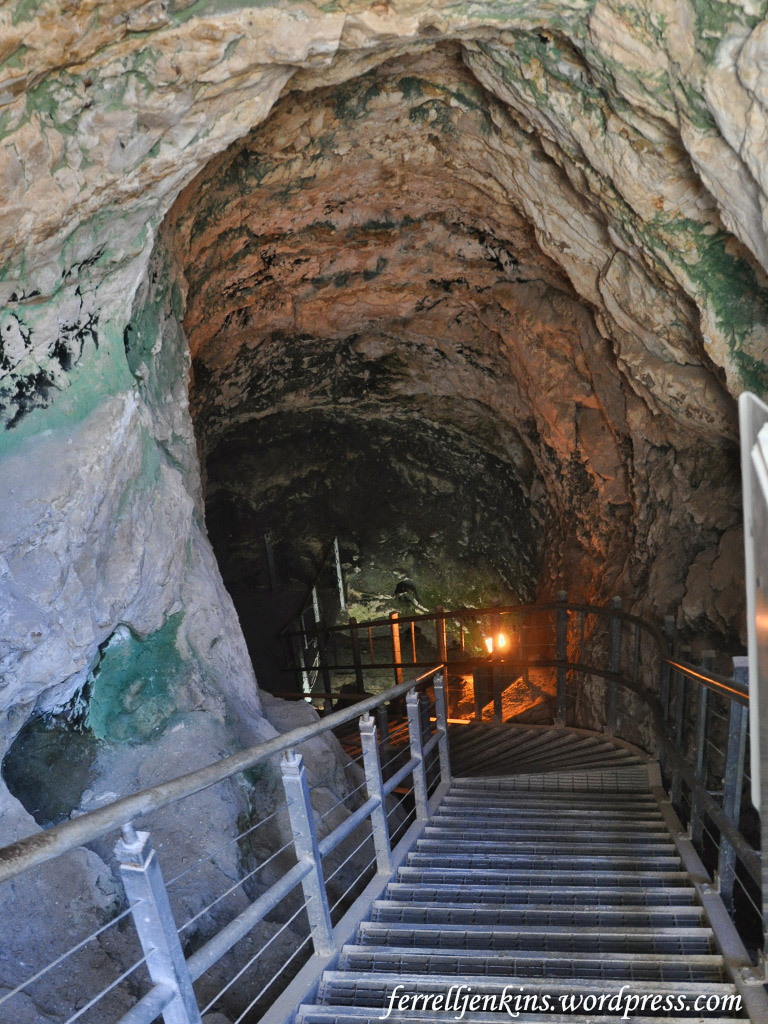
The next photo was made near the top of the steps that lead from the spring to the exit.

After exiting the tunnel, this is the view down the steps to the spring. Photo by Ferrell Jenkins.

After exiting the tunnel, this is the view down the steps to the spring. Photo by Ferrell Jenkins.

During the early days of my visits I prepared a book about places we visited throughout the Bible Lands. In 1976 the book was published under the title The Book and the Land. In it I stated the understanding at the time that the water system dated to the 12th century B.C. (p. 63)

In the most recent tour guide (2016) I said,

A water system and tunnel which brought water from a spring outside the city is now thought to belong to the time of Ahab.

Chris McKinny gives the dates of Ahab’s reign as 874-863 B.C. in The Regnal Chronology of the Kings of Judah and Israel.

Not all of the smart people live in the 21st century A.D.

Now Available: Photo Companion to the Bible

If you received the Bible Places Newsletter today you already know about the Photo Companion to the Bible: The Gospels. For those who may not be subscribed to the Newsletter I wish to direct you to information about this new, highly significant resource.

This PowerPoint-based resource provides illustrations for almost every verse of the text. The advertisement describes the Photo Companion to the Bible this way:

More than 10,000 images illustrating Matthew, Mark, Luke, and John with modern and historic photographs of ancient sites, museum artifacts, and cultural scenes.

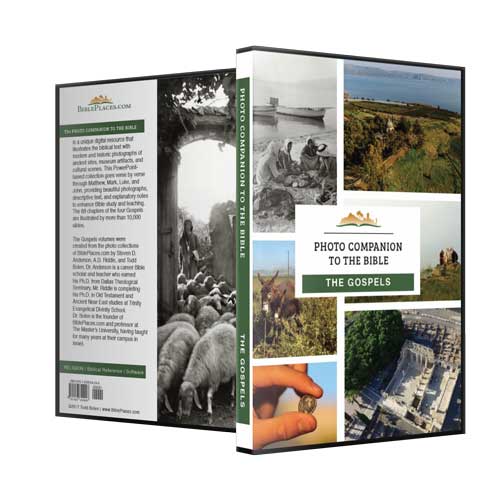
Cover of the Photo Companion to the Bible: The Gospels.

Cover of the Photo Companion to the Bible: The Gospels.

You may already own the Pictorial Library of Bible Lands and the Historic Views of the Holy Land. This new resource has photos, including many new ones, organized by chapter and verse for each of the four gospels. In fact, each chapter is illustrated by 40 to 230 photographs. The entire set contains more than 10,000 images.

When I looked through Matthew 4 I was impressed with the large number of illustrations. This means the teacher or preacher will be able to use these PowerPoint images to enhance his or her presentation. The audience will see and understand things about the text that they have never quite understood before.

There is a brief YouTube video illustrating what the Photo Companion to the Bible is and how it works. There are two chapters available for free download.

BiblePlaces.com is offering a deep discount price from now through August 21. I urge you to take advantage of it.

This new resource has been created by a team of professors and scholars under the direction of Dr. Todd Bolen who lived and taught in Israel for a decade or more and has traveled extensively in the Bible Lands. He is now a professor at Master’s University in California.

I have heard very few sermons or classes that could not have been greatly improved by the proper use of these illustrations of Bible lands and customs.

During my years of teaching and preaching I often paid for my own resources, but the positive response from the audience made it worthwhile. I hope to learn that many of you will be ordering this set.

All the information you need to place an order may be found here.

To subscribe to the BiblePlaces Newsletter see here.

To see a copy of the August 14, 2017 BiblePlaces Newsletter click here.

The significance of Megiddo and the Jezreel Valley

From Tel Megiddo one has a good view of the Jezreel Valley. Our panorama is composed of three photos made from the same spot at Megiddo. The Jezreel Valley lies before us to the north (and slightly east). Nazareth is located in the mountains of lower Galilee. The valley continues east between the Hill of Moreh and Mount Gilboa to Beth-Shean, the Jordan Valley, and the mountains of Gilead. The valley was known by the Greek name Esdraelon in New Testament times.

It was almost inevitable that those traveling from Babylon, Assyria, the territory of the Hittites, or Syria to Egypt, would travel through the Valley of Jezreel. The site of Jezreel is between the Hill of Moreh and Mt. Gilboa. (More about this at another time.)

Panorama of Jezreel Valley from Megiddo. Photo by Ferrell Jenkins.

Panorama of Jezreel Valley from Megiddo. Photo by Ferrell Jenkins.

For teaching purposes you may wish to use this annotated panoramic photograph. Click on the photos for the larger size suitable for Powerpoint.

Annotated panorama of Jezreel Valley from Megiddo. Photo by Ferrell Jenkins.

Annotated panorama of Jezreel Valley from Megiddo. Photo by Ferrell Jenkins.

The vicinity of the Valley of Megiddo (Jezreel/Esdraelon) was the scene of many significant historical battles. In The Battles of Armageddon Eric H. Cline lists 35 battles fought or still to come in the Jezreel Valley. Many of these battles have to do with the Romans versus the Jewish Resistance, the Muslims and the Crusaders, and a few 19th century battles. I am listing some of the more significant battles affecting Biblical history.

  • Thutmose III of Egypt fought Syrian forces – 1468 B.C.
  • Joshua defeated the King of Megiddo – Joshua 12:21.
  • Deborah and Barak defeated the Kings of Canaan – Judges 5:19.
  • Gideon defeated the Midianites – Judges 7.
  • Saul was defeated by the Philistines – 1 Samuel 28-31.
  • Ahaziah, king of Judah, died there – 2 Kings 9:27.
  • King Josiah was slain in a battle against Pharaoh Neco of Egypt – 2 Kings 23:29-30; 2 Chronicles 35:20-27.

Megiddo, the tell overlooking the valley, became typical of national grief and a symbol of decisive battles, similar to modern Waterloo, the Alamo, or Pearl Harbor. No wonder it provides the symbolism for the decisive battle in Revelation 16.  John’s Greek Har-Magedon becomes the English Armageddon.

The NAU transliterates harmagedon as Har-Magedon. Other English versions use something similar to the ESV.

And they gathered them together to the place which in Hebrew is called Har-Magedon. (Revelation 16:16 NAU)

And they assembled them at the place that in Hebrew is called Armageddon. (Revelation 16:16 ESV)

This valley has been significant even in modern times. Here are just a few of those battles laying the foundation for the modern State of Israel.

  • Napoleon advanced against the Turks in 1799.
  • General Allenby and the British defeated the German-Turkish coalition in 1918.
  • British officer Orde Wingate trained Jewish defense forces in this valley in the 1930s. Later leaders of the War of Independence (1948-1949), including Moshe Dayan and Yigal Alon, were trained by Wingate.

General Allenby read the historical survey about the importance of the valley in G. A. Smith’s Historical Geography prior to his battle against the German-Turkish coalition in 1918. In the later editions of his book Smith included that battle.

In a future post, perhaps later this week, I plan to discuss the water system at Megiddo.