Category Archives: Travel

Paul in the midst of the Areopagus in Athens

When Paul arrived in Athens, the intellectual capital of his day, he had some time alone in the city to view its monuments.

So Paul, standing in the midst of the Areopagus, said: “Men of Athens, I perceive that in every way you are very religious. For as I passed along and observed the objects of your worship, I found also an altar with this inscription, ‘To the unknown god.’ What therefore you worship as unknown, this I proclaim to you. (Acts 17:22-23 ESV)

Luke tells us that Paul stood in the midst of the Areopagus which was the most venerable of Athenian institutions (Bruce, Paul: Apostle of the Heart Set Free, 238). It derived its name from the original meeting place on the Areopagus, the hill of Mars (Ares), west of the Acropolis. Tenney says,

Whether the `areopagus’ of Acts 17 referred to the hill or to the court which in Paul’s day met in one of the colonades near the Agora cannot be determined exactly (Tenney, New Testament Times, 265).

In Roman times the court held most of its meetings in the Royal Portico (stoa basileios) in the agora, but we don’t know whether Paul addressed the court in the Royal Portico or on the Areopagus (Bruce 238).

Blaiklock says,

the Court of the Areopagus seems to have exercised some supervision over itinerant preachers, and the invitation to Paul was by way of being a courteous command (Cities of the New Testament, 52).

The first recorded convert in Athens was Dionysius the Areopagite (a member of the court) (17:34). Tradition has it that Dionysius became bishop of Athens and suffered martyrdom during the persecutions of Domitian. He is today venerated as the patron saint of Athens by the Eastern Greek Orthodox Church.

Our photo shows the traditional Areopagus at the base of the Acropolis. From the top of the hill there is a wonderful view of the buildings of the Acropolis and of the agora where Paul may have spoken.
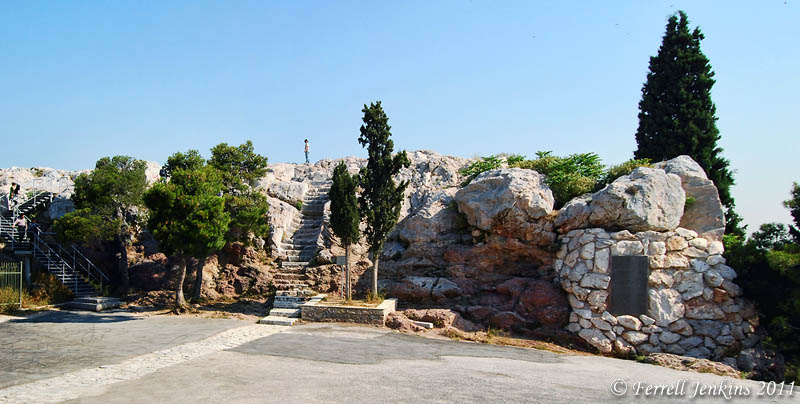
The traditional Areopagus at the base of the Acropolis in Athens. Photo by Ferrell Jenkins.

Traditional Areopagus at the base of the Acropolis in Athens. Photo by Ferrell Jenkins.

On the right side of the photo you will see a bronze plaque in the rocks with Paul’s speech in Greek.

Plan to sacrifice to Paul and Barnabas at Lystra

It is often been pointed out that the common designation of The Acts of the Apostles is a bit of an overstatement. Primarily the book of Acts is the story of some of the acts of the apostles Peter and Paul. Luke seems to be telling us that Paul is every bit as genuine an apostle as Peter. Peter can heal a man lame from his mother’s womb (Acts 3:2). So can Paul (Acts 14:8-10).

When the Lystrans saw the healing of the lame man they began to call Barnabas, Zeus, and Paul, Hermes. Luke’s account says that the priest of Zeus prepared to offer sacrifices with the crowds.

13 The priest of Zeus, whose temple was just outside the city, brought oxen and garlands to the gates, and wanted to offer sacrifice with the crowds. 14 But when the apostles Barnabas and Paul heard of it, they tore their robes and rushed out into the crowd, crying out (Acts 14:13-14 NAU)

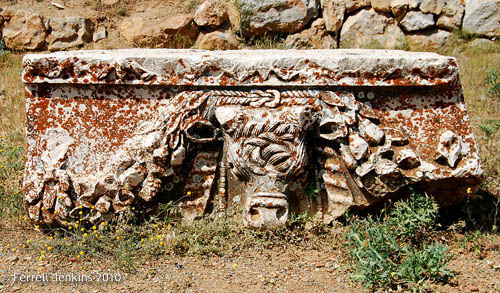
The photo below provides a good illustration of what happened at Lystra. It is an architectural relief fragment showing preparation for a sacrifice. The large marble fragment belongs to the early part of the second century. It comes from Rome, but is now displayed in the Louvre.

The bull is being brought for sacrifice. It is thought that this represents only part of the original scene. A panel to the right should show the priest and the altar. Perhaps the laurel wreaths worn by the two characters on the left indicates the departure or return of the Roman emperor.

Roman architectural relief shows preparation for sacrifice. Louvre. Photo by Ferrell Jenkins.

Roman relief shows preparation for sacrifice. Louvre. Photo by Ferrell Jenkins.

The motif on this altar is common in the Greco-Roman world. The photo below shows a similar bull’s head on what appears to be part of an architectural frieze in the Augustan Imperial Sanctuary at Pisidian Antioch.

Frieze from the Augustan Imperial sanctuary at Pisidian Antioch. Photo by F. Jenkins.

Frieze from the Augustan Imperial sanctuary at Pisidian Antioch. Photo by F. Jenkins.

Lystra — Barnabas is Zeus and Paul is Hermes

G. Walter Hansen comments on the religious life of Galatia and the importance of Zeus and Hermes to the people who lived there.

Zeus was the most widely worshipped god in Galatia; temples to Zeus were ubiquitous. Zeus was often linked with other gods. In the territory of Lystra there are carvings and inscriptions which show Zeus accompanied by Hermes. An inscription found near Lake Sugla is a dedication to Zeus of a sundial and a statue of Hermes. The names of the dedicators are Lycaonian. A stone altar near Lystra is dedicated to “the Hearer of Prayer [presumably Zeus] and Hermes.” A relief near Lystra depicts Hermes with the eagle of Zeus. In Lystra a stone carving shows Hermes with two other gods, G and Zeus. (Gill and Gempf, The Book of Acts in its First Century Setting, Vol. 2: Graeco-Roman Setting, 393)

This evidence, says Hansen, provides the setting for the events of Paul and Barnabas at Lystra. Luke describes the reaction of the Lystrans when they saw Paul heal a lame man.

When the crowds saw what Paul had done, they raised their voice, saying in the Lycaonian language, “The gods have become like men and have come down to us.”  And they began calling Barnabas, Zeus, and Paul, Hermes, because he was the chief speaker.  The priest of Zeus, whose temple was just outside the city, brought oxen and garlands to the gates, and wanted to offer sacrifice with the crowds.  (Acts 14:11-13 NAU)

Bruce reminds us that “Zeus was the chief god in the Greek pantheon; Hermes, the son of Zeus by Maia, was the herald of the gods” (The Book of the Acts, NICNT, 292).

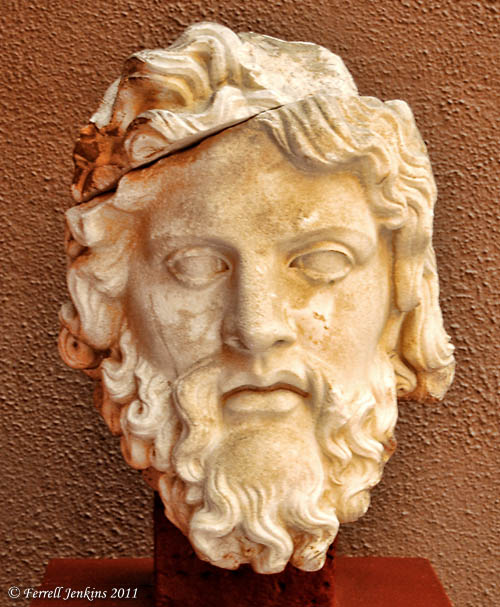
Our photo of Zeus is of a bust displayed in the archaeological museum at Ephesus.

Bust of Zeus in the Ephesus Museum. Photo by Ferrell Jenkins.

Bust of Zeus in the Ephesus Museum. Photo by Ferrell Jenkins.

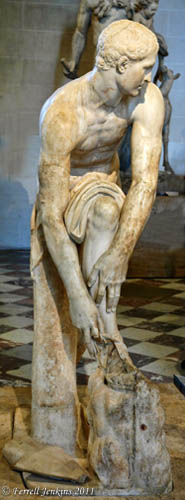
Paul was called Hermes because he was the chief speaker. Hermes was the messenger of the gods. How appropriate that our word hermeneutics, coming from the name Hermes, is used to describe the important work of interpreting the Scriptures. I have heard some speakers make fun of the word and then proceed to say that a certain phrase in the Scripture means … ! The photo below shows Hermes tying on his sandal in preparation for delivering a message. Some may recognize Hermes as the Latin Mercury, who is used as the symbol for the floral industry.

Hermes Putting on Sandal. Louvre. Photo by Ferrell Jenkins.

Hermes Putting on Sandal. Displayed in the Louvre. Photo by Ferrell Jenkins.

The King James Version used the Latin terms Jupiter and Mercurius in Acts 14:12. Bruce says this is “due to an old and foolish fashion of replacing Greek proper names by their Latin equivalents in English translations from the Greek.”

Identifying Lystra

Biblical sites are identified several ways. A few sites have been known for millennial. For example, Jerusalem (earlier Jebus, 1 Chronicles 11:4-5; and Salem, Genesis 14:18), Damascus, Athens, and Rome.

Some scholars have identified sites on linguistic grounds. For example, Edward Robinson identified biblical Bethel with Beitin in 1938. This proposal had been generally accepted until David Livingston suggested, in the last few decades, that Bethel should be identified with el- Bireh. Some names have remained virtually unchanged. Modern Anata is thought to be biblical Anathoth (Jeremiah 1:1). I note that the Syrian town of Ribleh is identified with biblical Riblah (2 Kings 25:6). After all these centuries only one letter is different.

Other sites are identified on the basis of inscriptions. Such is true of Gezer, Thyatira, and Lystra. This brings me to my topic today.

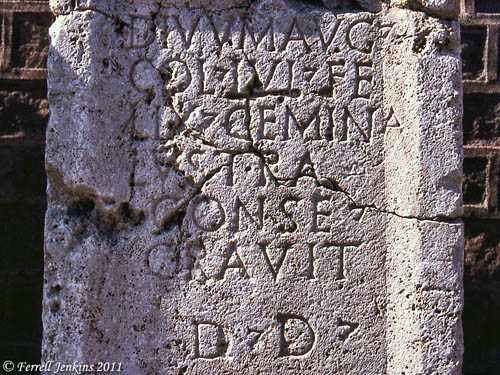
The identification of Lystra was made by J. R. S. Sterrett in 1855 on the basis of a Latin inscription found at the site. The inscription is now displayed at the archaeological museum in Konya (biblical Iconium).

Inscription with the name Lystra. Photo by Ferrell Jenkins.

Inscription with the name Lystra. Photo by Ferrell Jenkins.

The inscription includes the full Roman name Colonia Iulia Felix Gemina Lustra. See Mark Wilson, Biblical Turkey, 173. We called attention to this inscription, with a photo of the entire stone as it is displayed at Konya more than four years ago, during the first month of this blog, here.

The brethren of Lystra and Iconium spoke well of young Timothy at the time Paul chose him to join his preaching party.

Paul came also to Derbe and to Lystra. And a disciple was there, named Timothy, the son of a Jewish woman who was a believer, but his father was a Greek,  and he was well spoken of by the brethren who were in Lystra and Iconium. (Acts 16:1-2 NAU)

I have failed to say recently that archaeological mounds (tells) in Turkey are identified by the Turkish word höyük (pronounced who-youk).

Illustrations from Lystra

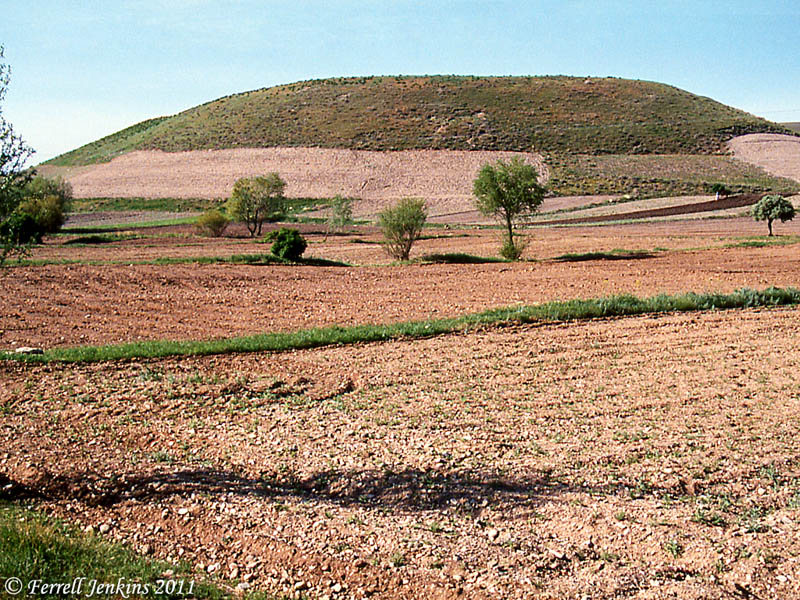
Looking through some slides, I found a nice photo of Lystra. In this photo from 1987 you will see that farmers have plowed the slopping side of the tell as far as practical. Often we see crops growing on the top of a tell, especially one that has not been excavated.

Lystra. 1987 Photo by Ferrell Jenkins.

Lystra. 1987 Photo by Ferrell Jenkins.

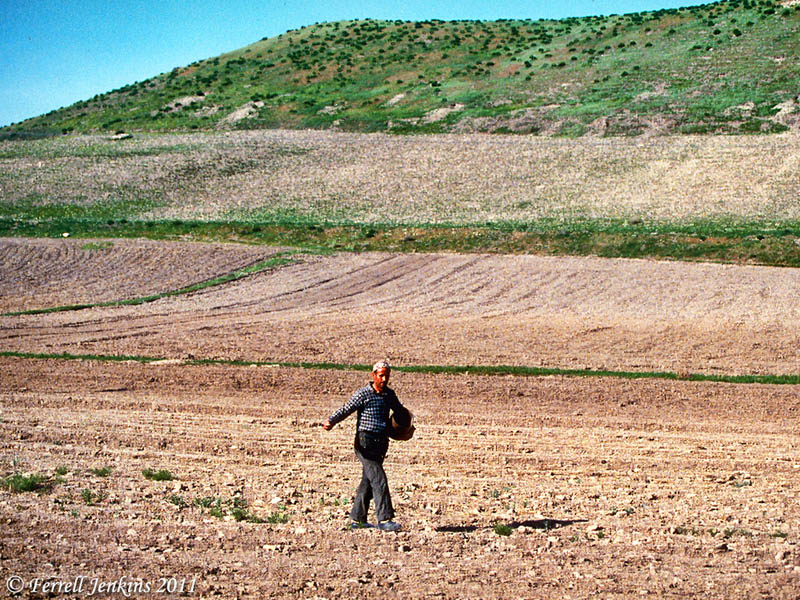
From another year, likely in the 80s, the sower is broadcasting seed. This is a practice that I saw frequently while growing up in the rural South. We rarely see this practice in the modern days of mechanization either in the USA or in the Bible World.

Sower at Lystra. Photo by Ferrell Jenkins.

Sower scattering seed at Lystra. Photo by Ferrell Jenkins.

The practice of the sower scattering seed is mentioned several times in the Bible. Notice Isaiah 55:10-11.

For as the rain and the snow come down from heaven, And do not return there without watering the earth And making it bear and sprout, And furnishing seed to the sower and bread to the eater;  So will My word be which goes forth from My mouth; It will not return to Me empty, Without accomplishing what I desire, And without succeeding in the matter for which I sent it.  (Isaiah 55:10-11 NAU)

Notice Paul’s use of the Isaiah text in 2 Corinthians 9:10.

We think also of the parables of Jesus.

3 And He spoke many things to them in parables, saying, “Behold, the sower went out to sow;  4 and as he sowed, some seeds fell beside the road, and the birds came and ate them up.  5 “Others fell on the rocky places, where they did not have much soil; and immediately they sprang up, because they had no depth of soil.  6 “But when the sun had risen, they were scorched; and because they had no root, they withered away. 7 “Others fell among the thorns, and the thorns came up and choked them out. 8 “And others fell on the good soil and yielded a crop, some a hundredfold, some sixty, and some thirty.  9 “He who has ears, let him hear.” (Matthew 13:3-9 NAU)

Lystra — the home of Timothy

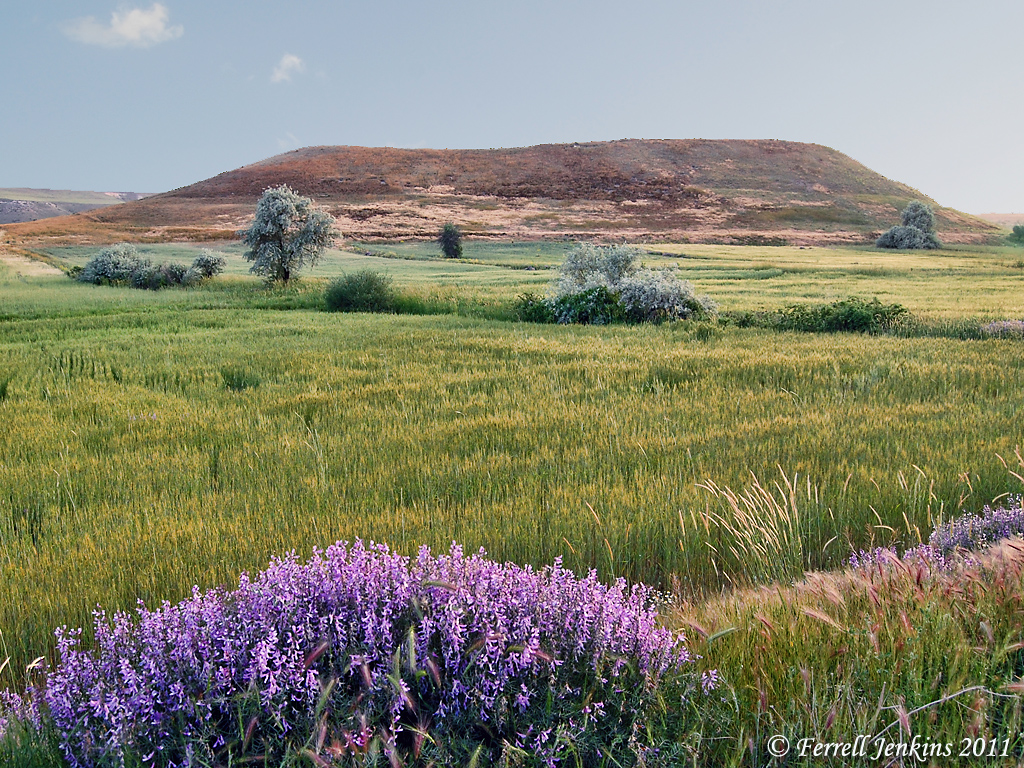
The mound of Lystra, now called Zordula, is located about 18 miles south of Konya (biblical Iconium), Turkey, near the village of Hatunsaray.

Lystra was visited by Paul and Barnabas on the First Missionary or Preaching Journey (Acts 14). Lystra and Derbe were towns of Lycaonia (Acts 14:6). The locals spoke the Lycaonian language. They called Barnabas, Zeus, and Paul, Hermes (14:12). Inscriptions have been found that identify these particular gods with Lycaonia.

This was the home of young Timothy,  “the son of a Jewish woman who was a believer, but his father was a Greek” (Acts 16:1). Timothy accepted the invitation of Paul to join him on the second journey. Two of Paul’s epistles were written to Timothy.

The mound of Lystra, 18 miles south of modern Konya. Photo by Ferrell Jenkins.

The mound of Lystra, 18 miles south of modern Konya. Photo by Ferrell Jenkins.

After Paul healed a lame man, the residents of Lystra wanted to worship Paul and Barnabas as gods. Paul preached one of two sermons to Gentiles recorded in the Book of Acts (Acts 14 at Lystra; Acts 17 at Athens). The Jews of Pisidian Antioch who rejected the gospel message followed Paul to Lystra and persuaded the people against Paul. Paul was stoned, presumed dead, and dragged outside the city (Acts 14:19).

In the second letter to Timothy, Paul says that Timothy knows about the persecution he endured at Lystra.

10 You, however, have followed my teaching, my conduct, my aim in life, my faith, my patience, my love, my steadfastness, 11 my persecutions and sufferings that happened to me at Antioch, at Iconium, and at Lystra–which persecutions I endured; yet from them all the Lord rescued me. 12 Indeed, all who desire to live a godly life in Christ Jesus will be persecuted, 13 while evil people and impostors will go on from bad to worse, deceiving and being deceived. 14 But as for you, continue in what you have learned and have firmly believed, knowing from whom you learned it 15 and how from childhood you have been acquainted with the sacred writings, which are able to make you wise for salvation through faith in Christ Jesus. 16 All Scripture is breathed out by God and profitable for teaching, for reproof, for correction, and for training in righteousness, 17 that the man of God may be complete, equipped for every good work. (2 Timothy 3:10-17 ESV)

Here is a brief summary of the events at Lystra during the visit of Paul and Barnabas (Acts 14:6-20).

  • Healing of a lame man.
  • Priest of Zeus and the crowd wanted to offer sacrifice to Barnabas and Paul.
  • Sermon on the witness of God in nature.
  • Paul was stoned and dragged outside the city for dead.

In previous posts we have discussed the significance of Lystra in the work of Sir William Ramsay here and here.

New insights into the clothing of the Qumran inhabitants

The recent edition of Dead Sea Discoveries has an article by Orit Shamir and Naama Sukenik on “Qumran Textiles and the Garments of Qumran’s Inhabitants.” The article costs $35 from Brill. To order click here. Here is the abstract.

Among the Qumran textiles that were kept at the Rockefeller Museum was a group of textiles that were unusual for Qumran. Most of them were made of wool, and some were dyed or decorated. Their marking QCC—Qumran Christmas Cave indicates their origin. In 2007 the cave was investigated by Porat, Eshel, and Frumkin. The cave is located in the bottom section of Kidron valley and doesn’t belong to Qumran caves. It can now be determined that all of the textiles from Qumran are made solely of linen. They were free of any colored decoration, except for scroll wrappers that decorated in blue. This, and the simplicity and whiteness of the textiles from Qumran, is compatible with the literary sources. It appears that the people of Qumran wished to differentiate themselves from the rest of the population also on the basis of their style of garments.

A popular article based on the technical paper appears in LiveScience here. Some speculation about the writers of the scrolls is based on the cloths found with the scrolls. Look also for an Image Album of 8 captioned photos including the textiles from Qumran and the Christmas Cave.

Most of the cloth wrappings found at Qumran were white and made of linen. The wrappings found at Christmas Cave were colorful and made of wool. The Mosaic law was clear about the clothing to be worn by the Israelites.

Do not wear clothes made of both wool and linen. (Deuteronomy 22:11 CSB)

Jodi Magness cites the War Scroll to illustrate that the “Qumran sectarian clothing must be made entirely of linen” (Stone and Dung, Oil and Spit, 116).

Most Bible students probably think of the Kidron valley running north to south between Jerusalem and the Mount of Olives. That is correct, except that the brook joins with the Hinnom valley and continues east to the Dead Sea.

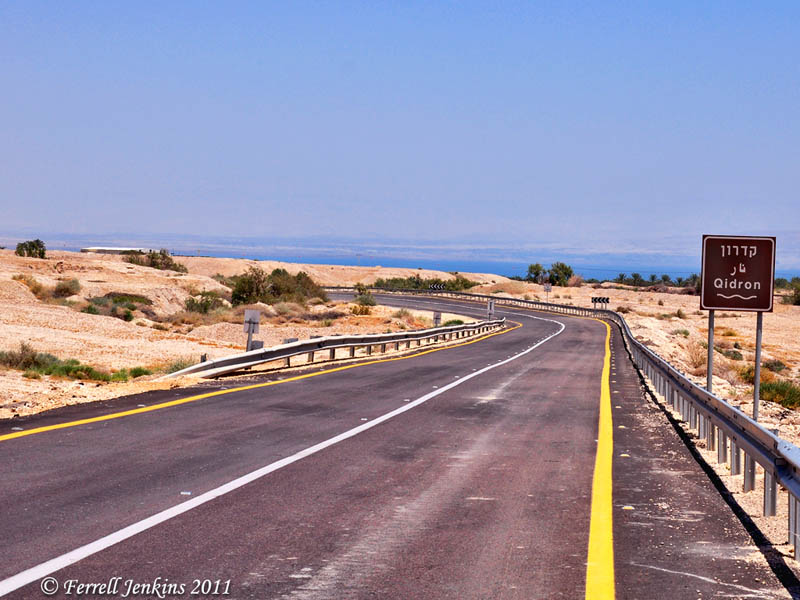
The photo below was made about 4.25 miles south of Qumran along the Dead Sea Road (Hwy. 90) as it crosses the brook Kidron (Qidron). The Christmas Cave mentioned in the article is to the west (left) of the highway as the brook comes down from Jerusalem. (Click on the photo for a larger image.)

Location of the Brook Kidron on Dead Sea Road (view north). Photo by Ferrell Jenkins.

Crossing Brook Kidron on Dead Sea Road (view northeast). Photo by Ferrell Jenkins.

When David fled from Jerusalem at the time of Absalom’s rebellion, he crossed the Kidron “toward the way of the wilderness.”

Everyone in the countryside was weeping loudly while all the people were marching past. As the king was crossing the Kidron Valley, all the people were marching past on the road that leads to the desert. (2 Samuel 15:23 CSB)

HT: Joseph I. Lauer

Pisidian Antioch was the site of an important announcement

One of the important cities visited by Paul and Barnabas on the first preaching journey was Pisidian Antioch.

Moving from Perga, they arrived at Pisidian Antioch, and on the Sabbath day they went into the synagogue and sat down. After the reading from the law and the prophets, the leaders of the synagogue sent them a message, saying, “Brothers, if you have any message of exhortation for the people, speak it.” (Acts 13:14-15 NET)

Don’t confuse this Antioch in Pisidia, about 100 miles north of Perga, with Antioch in Syria where Barnabas and Saul began their journey (Acts 13:1-4).

Pisidian Antioch had been founded about 350 B.C. by either Seleucus Nicator or his son Antiochus I in ancient Phrygia, near Pisidia. About two thousand Jewish families were brought to Phrygia from Babylon about 200 B.C. (Josephus Ant. xii.3.4). This explains the presence of Jews and the synagogue.

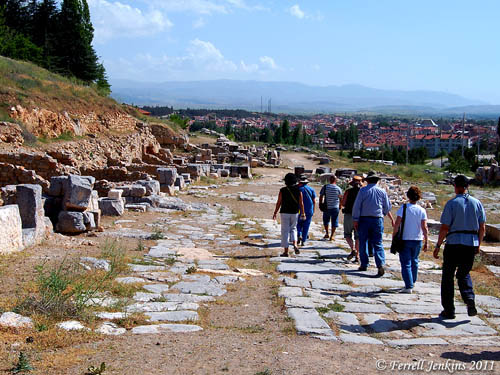
Our photo shows one of the Roman streets at Antioch. The modern Turkish town of Yalvac can be seen in the distance.

Roman Street in Pisidian Antioch. Photo by Ferrell Jenkins.

Roman Street in Pisidian Antioch. Photo by Ferrell Jenkins.

Acts 13 should be remembered as the chapter in which Luke records Paul’s sermon on the history of Israel to both Jews and God fearing Gentiles. The sermon recounted here is similar to the sermon Paul heard from the martyr Stephen (Acts 7).

The events at Pisidian Antioch are significant because it is here that we have many Jews and devout god-fearing proselytes accepting the message of Paul and Barnabas (Acts 13:43). When the Jews began contradicting the gospel we hear the announcement of a more concentrated effort to reach the Gentiles with the Gospel.

Both Paul and Barnabas replied courageously, “It was necessary to speak the word of God to you first. Since you reject it and do not consider yourselves worthy of eternal life, we are turning to the Gentiles. For this is what the Lord has commanded us: ‘I have appointed you to be a light for the Gentiles, to bring salvation to the ends of the earth.'” When the Gentiles heard this, they began to rejoice and praise the word of the Lord, and all who had been appointed for eternal life believed. So the word of the Lord was spreading through the entire region. (Acts 13:46-49 NET)

Approaching Gennesaret

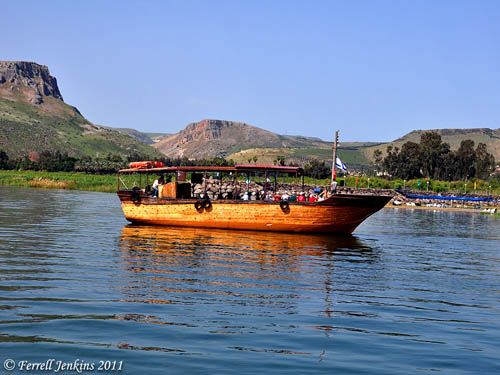
The Sea of Galilee is called the “lake of Gennesaret” (Luke 5:1), and the “Sea of Tiberias” (John 6:1; 21:1). This indicates that both Tiberias, where Herod Antipas had built his capital in the mid-20s of the first century, and Gennesaret were significant places. When one traveled from Nazareth, Cana, or others places west of the Sea of Galilee, he would pass by Mount Arbel into the plain or land of Gennesaret.

This photo, taken on an unusually clear day, shows a small ship about to anchor at Nof Ginosaur (= Gennesaret). To the west we see Mount Arbel and the pass below allowing travel and commerce between lower Galilee and the towns around the Sea of Galilee.

Boat approaches the land of Genessaret. Photo by Ferrell Jenkins.

Boat approaching the land of Gennesaret. Photo by Ferrell Jenkins.

The photo nicely illustrates the text of Mark 6.

When they had crossed over they came to land at Gennesaret, and moored to the shore. When they got out of the boat, immediately the people recognized Him, and ran about that whole country and began to carry here and there on their pallets those who were sick, to the place they heard He was. Wherever He entered villages, or cities, or countryside, they were laying the sick in the market places, and imploring Him that they might just touch the fringe of His cloak; and as many as touched it were being cured. (Mark 6:53-56 NAU. cf. Matthew 14:34-36)

The first disciples of Jesus were called by the lake of Gennesaret (Luke 5:1).

The Patriarchs lived in the Negev

English Bibles translate the Hebrew word negev in a variety of ways.

  • South — KJV; NKJV
  • “the South [country]” is the Translator’s Note in the NET Bible. A study note says, “Negev is the name for the southern desert region in the land of Canaan.”
  • Negeb — ESV
  • Negev — most modern English versions.
  • eremos — the word for desert or wilderness is used in the LXX. This word does not describe the Negev precisely enough.

I am away from home and most of my resources, but I recall hearing the late Anson Rainey describe the Negev like the figure 8. Turn the 8 horizontal with Beersheba in the center. The area is one that is often subject to drought and famine.

The Patriarchs, Abraham, Isaac, and Jacob spent much time in the Negev (Genesis 12:9; 13:1,3; 20:1; 24:62).

The Israelite spies were sent by Moses from the Sinai to investigate Canaan. The text makes it clear that they had to go through the Negev to get to the hill country and Hebron. Hebron is only about 25 miles north of Beersheba. Once we head south from Hebron we begin to notice a change from the hill country to a more dry clime.

When Moses sent them to investigate the land of Canaan, he told them, “Go up through the Negev, and then go up into the hill country (Numbers 13:17 NET)

When they went up through the Negev, they came to Hebron… (Numbers 13:22 NET)

The Canaanite king of Arad lived in the Negev (Numbers 21:1). Arad is located east of Beersheba as the land slopes down to the Dead Sea.

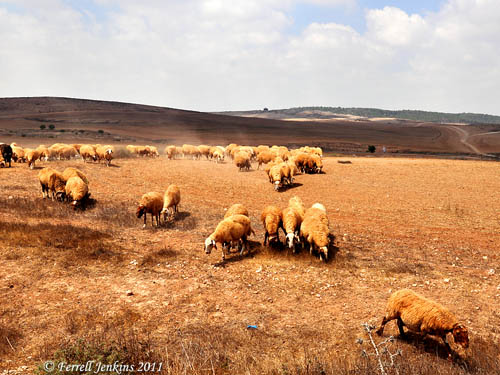
Our photo today was made a few miles north of Beersheba. I think it illustrates the typical dryness of the region.

Sheep in the Negev. Photo by Ferrell Jenkins.

Sheep in the Negev. Photo by Ferrell Jenkins.