Category Archives: Travel

Previous posts relating to the birth of Jesus and Christmas

Thanks for the good response to our posts on frankincense and myrrh. Over the past 4+ years I have written several posts about Christmas, the birth of Jesus, and Bethlehem, in hope that they would be beneficial to Bible students and teachers.

Here are links to some of the more significant articles, usually with photos.

If you have more interest in learning about the origin of the celebration of the birth of Christ, take a look here. A more detailed study of the historical aspects of the celebration is available in PDF here.

For the next couple of days I plan to spent some (read, total) time with my grandson. I trust you will enjoy quality time with your family and friends.

I see that Leon Mauldin has a post about the manger at Leon’s Message Board here, and another about the traditional site of Jesus’ birth in Bethlehem here.

Todd Bolen has a list of his Christmas-Related Posts at Bible Places Blog here.

Some things you may not hear about Myrrh in a sermon

Myrrh is described in Fauna and Flora of the Bible, a publication of the United Bible Societies, as follows:

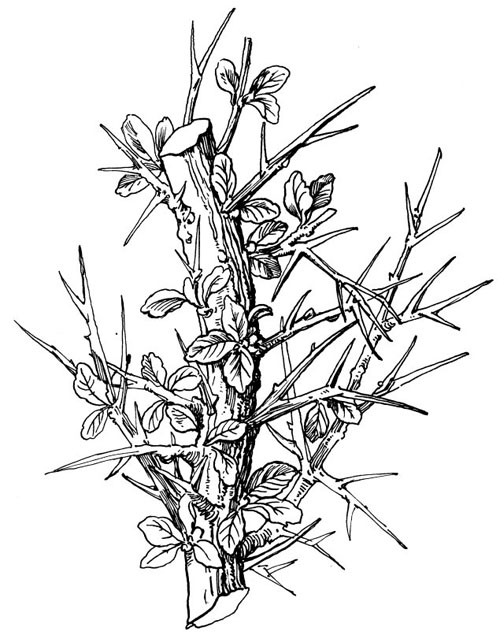
Myrrh is a dark-red gum with a strong aroma and a bitter taste. It exudes from a bush or tree belonging to a family of the burseraceæ which grows in Arabia, Abyssinia and on the Somali coast of East Africa. It is not native to Palestine. This tree or bush has a great number of knotted branches. The gum exudes from the branch as a thick light-coloured paste which, when exposed to the atomsphere, soon hardens and takes on a brownish colour. The finest myrrh was the resin secreted of itself (rather than by artificial incision) through the bark… (147)

When the secretion is collected directly from the bark it can be used as an ingredient in ointments.

When Ismaelites (Midianites) came from Gilead into the Dothan valley on their way to Egypt, Joseph’s brothers sold him to them (Genesis 37:27, 36). The Bible describes the caravan and the goods the Midianites were transporting.

a caravan of Ishmaelites was coming from Gilead, with their camels bearing aromatic gum and balm and myrrh, on their way to bring them down to Egypt. (Genesis 37:25 NAU)

In previous posts we have written about the Incense Route which was used by the Nabateans. This event was much earlier, and we see the caravan coming from the east (Gilead). The famous King’s highway ran through Gilead.

Myrrh is listed as a product of the land of Canaan when Jacob prepares his gift basket to be taken to Joseph (Genesis 43:11). This differs from what we normally read about myrrh. I do not know the solution to the problem at the moment. Perhaps it had been purchased from traveling merchants and was included with local products in the gift basket.

Myrrh could be in a liquid form. The ointment used in the anointing of priests had myrrh in it (Exodus 30:23). Oil of myrrh was in the cosmetics used by Esther (Esther 2:12). See also Song of Solomon 5:5.

The young man is advised to avoid the prostitute. He is told that she will entice him by saying,

I have sprinkled my bed
With myrrh, aloes and cinnamon. (Proverbs 7:17 NAU)

The young lady in the Song of Solomon thinks of her lover as a pouch or sachet of myrrh that lies all night between her breasts (1:13). She thinks of his lips as dripping with liquid myrrh (5:13).

The young man dreams of the time when he can approach her, and perhaps thinks of her breasts as the mountain of myrrh and the hill of frankincense.

Until the day breathes and the shadows flee, I will go away to the mountain of myrrh and the hill of frankincense. (Song of Solomon 4:6 ESV)
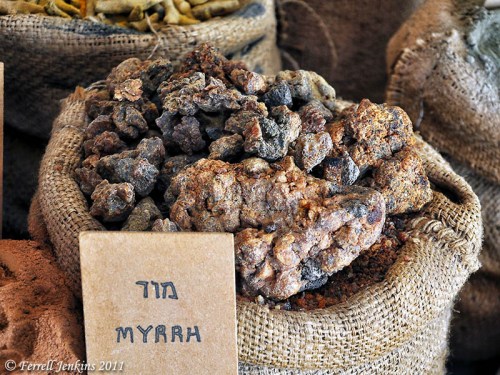
Myrrh displayed at Avdat, a stop on the Incense Route. Photo by Ferrell Jenkins.

Myrrh displayed at Avdat, a stop on the Incense Route. Photo by Ferrell Jenkins.

The wine offered to Jesus on the cross was mixed with myrrh (Mark 15:23).

Nicodemus brought about 75 pounds (= 100 Roman pounds) of myrrh and aloe for the burial of Jesus (John 19:39). We may conclude from this that Nicodemus, like Joseph of Arimathea (Matthew 27:57 NAU), was a wealthy man.

Myrrh branch. From 1000 Bible Images (Logos digital edition).

Myrrh branch. From 1000 Bible Images (Logos digital edition).

The wise men brought rare and expensive gifts to Jesus (Matthew 2:11). I trust that this brief discussion over the past three days has enhanced your understanding and appreciation of those gifts. What have we to give Him?

J. P. Van de Giessen has an article on Myrrh here, and a photo of the tree here.

Frankincense comes from a tree

In the previous post we looked at a few Biblical references that mention both frankincense and myrrh. We called attention to the Incense Route which ran from Arabia through Petra (now in Jordan) and Avdat in the Negev. In New Testament times this route was controlled by the Nabateans.

Frankincense is described in the Fauna and Flora of the Bible:

Frankincense is a balsamic gum exuding from the wood of different species of shrubs and trees belonging to the genus Boswellia. The bark is incised, and the finest quality of resin is obtained if this is done not too early in the year. The different species of Boswellia are native to India, the Somali coast and Arabia; the Midianites imported frankincense from Ephah and Sheba, Is 60:6; Jer. 6:20. Whether the Boswellia was grown in Palestine is rather doubtful. (121-122)

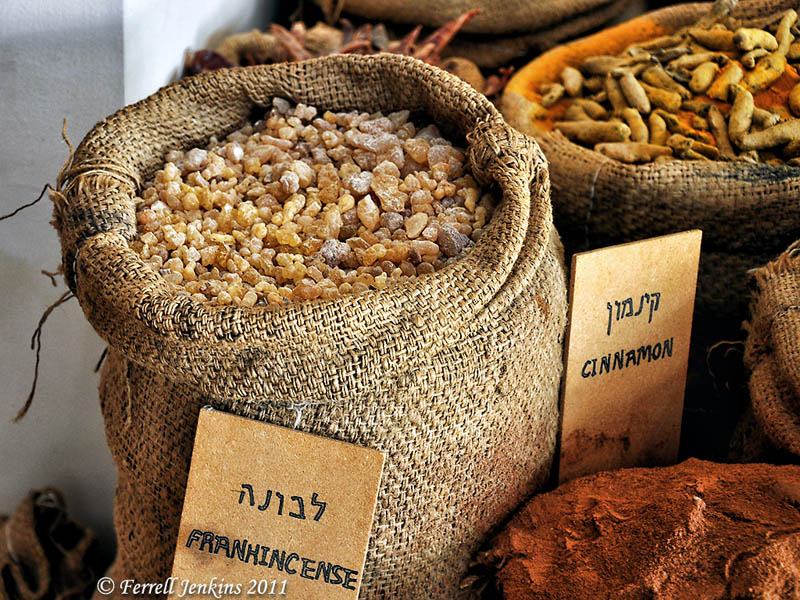
Frankincense is displayed at Avdat, stop number 62 on the famous Incense Route. Click on the photo for a larger image.

Frankincense at Avdat on the Incense Route. Photo by Ferrell Jenkins.

Frankincense at Avdat on the Incense Route. Photo by Ferrell Jenkins.

The Bible indicates several uses for frankincense.

  • Used in the incense associated with the anointing of the priests (Exodus 30:32).
  • Placed on a grain offering (Leviticus 2:1-2).
  • Placed on the bread for the tabernacle (Leviticus 24:7).

Levites were appointed to take care of the frankincense used in the temple (1 Chronicles 9:29). Eliashib the priest hid Tobiah in a large room where frankincense and other sacrificial items were stored (Nehemiah 13:5, 9).

Gold is mentioned with frankincense in Isaiah 60:6 and Matthew 2:11. Both are mentioned among the goods the merchants could no longer sell because of the fall of Babylon (Revelation 118:11-13).

The illustration showing the frankincense tree comes from 1000 Bible Images (Logos digital edition).

Frankincense Tree. 1000 Bible Images.

Frankincense Tree. 1000 Bible Images.

Our current header photo was made at Avdat, and indicates the importance of the city as an important stop on the Incense Route.

Frankincense and Myrrh

Frankincense and myrrh are mentioned together in the Song of Solomon and in the account of the visit of the magi from the east to see Jesus. Several significant things can be learned from these Biblical verses.

Look first at Song of Solomon 3:6.

“What is this coming up from the wilderness Like columns of smoke, Perfumed with myrrh and frankincense, With all scented powders of the merchant? (Song of Solomon 3:6 NAU)

  • Myrrh and frankincense are associated with the wilderness (desert; Hebrew, midbar).
  • Perhaps incense used in sacrifice or offering, “like columns of smoke.”
  • Associated with perfume and scented or fragrant powders.
  • Something traveling merchants would bring from the wilderness.

Song of Solomon 4:13-14 provides more insights.

“Your shoots are an orchard of pomegranates With choice fruits, henna with nard plants,  Nard and saffron, calamus and cinnamon, With all the trees of frankincense, Myrrh and aloes, along with all the finest spices. (Song of Solomon 4:13-14 NAU)

  • Associated with trees, and classified with spices.

The reference in the New Testament is in the account of the birth of Jesus (Matthew 2:1-11).

  • Frankincense and myrrh are in the category with gold, and offered as gifts to one who is considered a king and is being worshiped.
  • The magi have come from east of Jerusalem and Bethlehem.
  • Gold, frankincense, and myrrh are considered treasures.

All of these tips harmonize with what is known about frankincense and myrrh. The plants or trees from which these come are known to grow in the desert regions. They are not native to Biblical Israel. Traveling merchants from Arabia traveled long distances across the desert, making stops at Petra, Avdat, and other places on their way to Gaza and other Mediterranean ports where the products could be shipped throughout the Mediterranean world.

The photo below was made at Avdat, a Nabatean site in the Negev. The city was especially significant in the first century B.C. and the first century A.D. Avdat was stop number 62 on the famous Incense Route. It is now part of Israel’s National Park system, and a World Heritage Site. A display at the ticket office and shop explains about the Incense Route and shows some of the goods that were transported across the desert. This photo shows little packets of frankincense and myrrh that may be bought as souvenirs of your visit. Gold is still costly, but the market for frankincense and myrrh has fallen drastically since Bible times. The price in New Israeli Shekels is less than $4.

Frankincense and myrrh on the Incense Route at Avdat. Photo by Ferrell Jenkins.

Frankincense and myrrh on the Incense Route at Avdat. Photo by Ferrell Jenkins.

More to follow, hopefully.

Paul quotes hometown poet in Athens speech

As Paul taught the Areopagus about the God that could be known, he cited two Greek poets who had indicated belief in a supreme being.

for in Him we live and move and exist, as even some of your own poets have said, ‘For we also are His children.’  “Being then the children of God, we ought not to think that the Divine Nature is like gold or silver or stone, an image formed by the art and thought of man.  (Acts 17:28-29 NAU)

The first quotation is attributed to the Cretan poet Epimenides. The second quotation is attributed to Aratus of Cilicia, which was also Paul’s home (Acts 21:39). These poets certainly did not have in mind the same God that Paul was preaching, but they acknowledged that there was a supreme power back of the universe.

The photo below shows a bust of Aratus displayed in the British Museum.

The Cilician poet Aratus. British Museum. Photo by Ferrell Jenkins.

Cilician poet Aratus. British Museum. Photo: Ferrell Jenkins.

If Paul needed a weather report in Athens

The Roman Forum is located north of the Acropolis in Athens. If you are walking in the ancient Agora you could wander into the Roman Forum without realizing the difference. The Tower of the Winds in the Roman Forum might have been seen by the Apostle Paul during his stay in Athens (Acts 17:15-34).

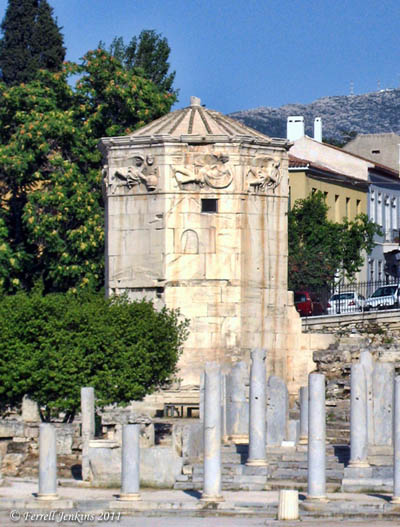
The Tower of the Winds was built about 40 B.C. by Andronicus to serve as a sundial, water-clock, and weather-vane. Fant and Reddish describe the structure this way:

… the Tower of the Winds on the east side of the forum, named for the reliefs of the Eight Winds on the frieze about the top of the tower. Originally the tower was a complete ancient weather station, designed by a famous Macedonian astronomer, Andronikos of Kyrrhos. Sundials were mounted on the exterior sides of the building, a water clock operated inside the tower, and the bronze weather vane on top indicated the wind direction over the applicable image of one of the Eight Winds. (A Guide to Biblical Sites in Greece and Turkey, 32)

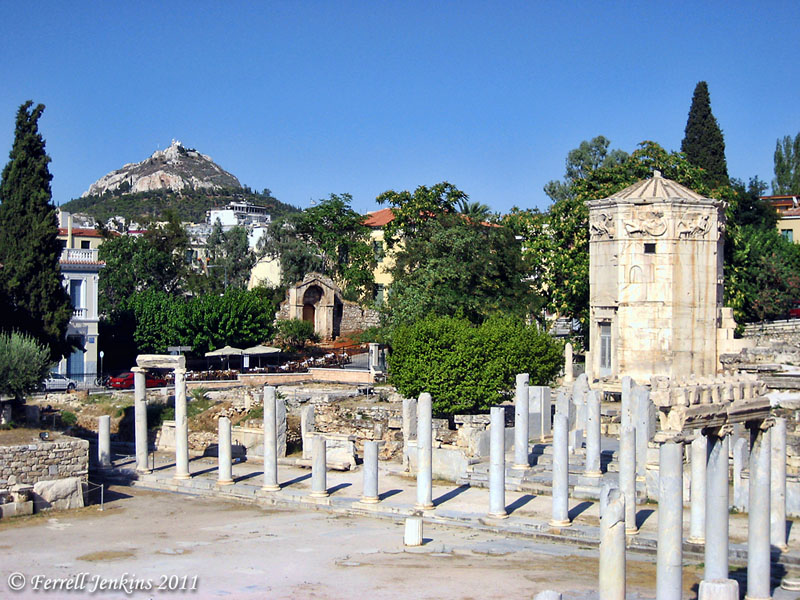
In the photo below you will see the Tower of the Winds on the right in the Roman Forum. The hill in the distance is known as Mount Lycabetus. It is the highest point in the city of Athens.

Tower of the Wind. Mount Lycabetus in distance. Photo by Ferrell Jenkins.

Tower of the Wind in Roman Forum. Mt. Lycabetus in distance. Photo by Ferrell Jenkins.

Here is a larger image of the Tower of the Winds.

Tower of the Winds in the Roman Forum of Athens. Photo by Ferrell Jenkins.

Tower of the Winds in the Roman Forum. Photo by Ferrell Jenkins.

Athens — the Agora and the Areopagus

A few days ago we discussed Paul’s appearance in the midst of the Areopagus here. We noted that several classical and New Testament scholars indicate that the Areopagus (the court) of Athens originally met on the hill commonly called Mar’s Hill or the Areopagus, but that the court later met in the agora.

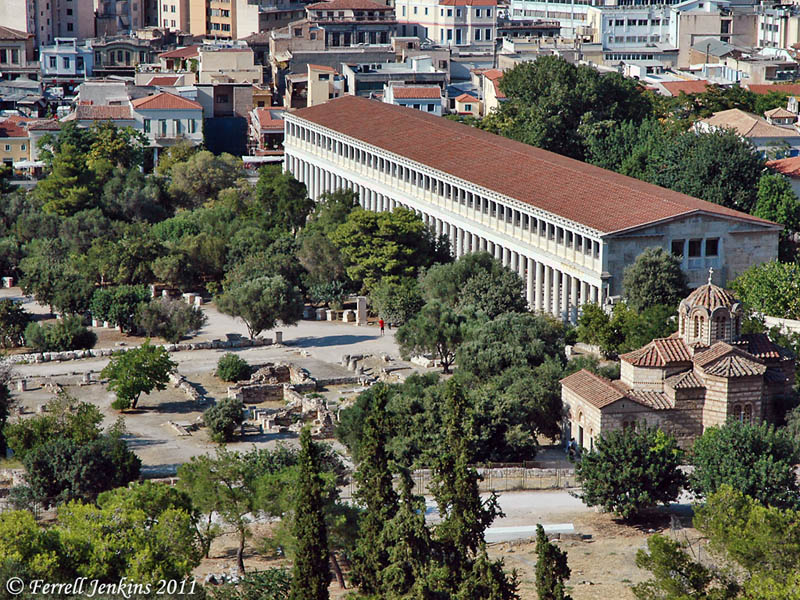
Our photo below was made from atop the Areopagus. It shows a small part of the ancient agora and the Stoa of Attalus in the center of the city of Athens.

View from Mars Hill (Areopagus) of the agora and the Stoa of Attalus in Athens. Photo by Ferrell Jenkins.

View showing a portion of the agora and the Stoa of Attalus. Photo by Ferrell Jenkins.

The Stoa of Attalus was built by King Attalos II of Pergamum (159-138 B.C.). It has been reconstructed and now serves as the Agora Museum.

In Roman times the court held most of its meetings in the Royal Portico (stoa basileios) in the agora, but we still don’t know whether Paul addressed the court in the Royal Portico or on the Areopagus (Bruce, Paul: Apostle of the Heart Set Free, 238).

Remember Pearl Harbor

President Franklin D. Roosevelt described December 7, 1941 as “a day that will live in infamy.” That was the day of the Japanese attack on Pearl Harbor. We were in the kitchen/dining room of our four room house when I first recall the words “Pearl Harbor.” I was sitting at the table when my father said that he had heard on the radio about the bombing of Pearl Harbor.

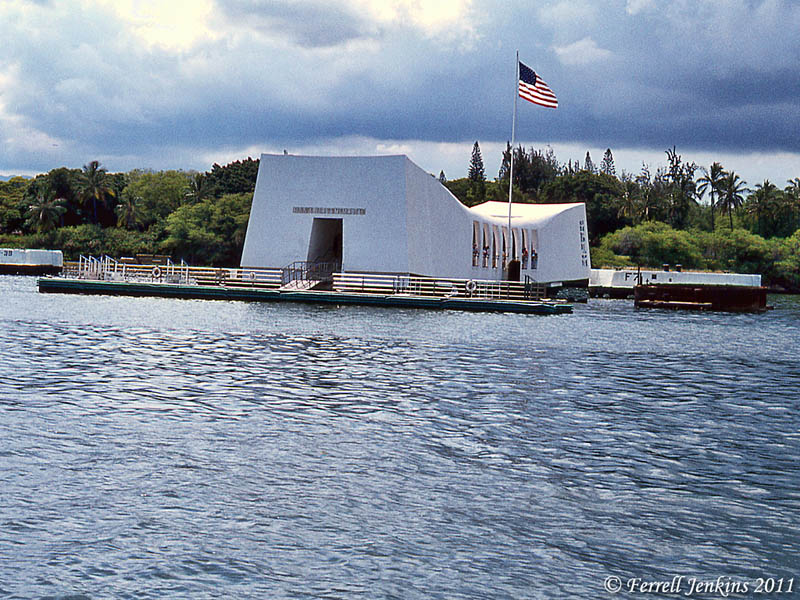
I have been in Hawaii several times, but visited the memorial on Pearl Harbor once. This is a photo I made of the USS Arizona Memorial in 1982. The structure straddles the ship that serves as the tomb of 1,177 Americans. The total killed exceeded 2,400.

USS Arizona Memorial at Pearl Harbor. 1982 Photo by Ferrell Jenkins.

USS Arizona Memorial at Pearl Harbor. 1982 Photo by Ferrell Jenkins.

One of my friends in college was from Hawaii. He and his brother watched the attack on Pearl Harbor from near their home. I’ve heard him tell the story several times. He said they thought the maneuvers were especially good that day. It was only when they arrived home that they found their mother crying, fearful that the older boys would have to go to war.

It is appropriate that we “Remember Pearl Harbor” today. If you go to Hawaii, please visit Pearl Harbor and leave with the determination to pursue peace.

Turn away from evil and do good; seek peace and pursue it. (Psalm 34:14 ESV’ cf. 1 Peter 3:11)

So then let us pursue what makes for peace and for mutual upbuilding. (Romans 14:19 ESV)

Strive for peace with everyone, and for the holiness without which no one will see the Lord. (Hebrews 12:14 ESV)

The Parthenon — in Athens, Greece, and in Athens of the South

The Parthenon in Athens, Greece, is one of the most famous architectural landmarks on earth. The building was erected on the Acropolis in the fifth century B.C. According to Fant and Reddish, “the cult statue of Athena stood in the east cella, surrounded by a colonnade of twenty-three columns and an entrance portico with six columns.”

Completed in 438 B.C.E. the statue of Athena was designed and constructed by Phidias himself. On its base it stood nearly 40 feet tall, supported by a massive post. The face and hands were of ivory. According to Thucydides, more than 40 talents of gold (approximately 250 lbs.) were used to plate the remainder of the enormous statue. These plates were removable so that the weight of the gold could be checked periodically. The goddess stood upon a large platform upon which the Pandora myth was depicted. Her left hand rested upon her shield, her spear leaned against her left shoulder, and in her right hand she held a small image of Nike. The statue eventually was carried off to Constantinople and destroyed there in 1203 C.E. (Fant and Reddish, A Guide to Biblical Sites in Greece and Turkey, Oxford, 30-31)

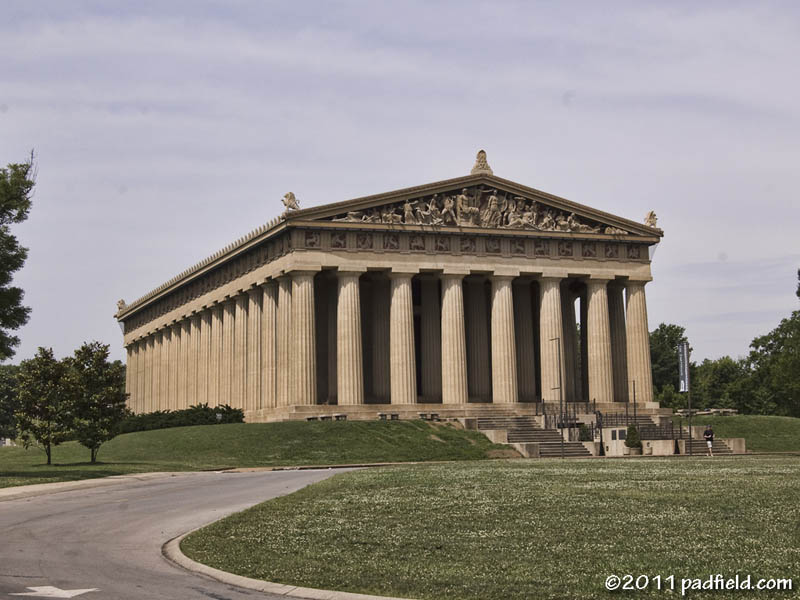
Nashville, Tennessee, had nicknamed itself the Athens of the South by the mid 19th century. In 1897 a replica of the Greek Parthenon was built in Nashville’s Centennial Park. After yesterday’s post about the original Parthenon, my friend Ken Green, who lives in Nashville, wrote that he was sure I had seen the Parthenon, but wondered if I had seen the 42-foot statue of Athena which was unveiled to the public in 1990. In earlier years I have lived in Alabama and Kentucky, with frequent trips through Nashville, but I have not seen the Athena statue. Fortunately, my friend David Padfield visited Nashville last year and made some nice photos (as usual). He has graciously allowed me to share a couple of these photos with our readers.

The first photo shows the exterior of the Nashville Parthenon.

The Parthenon in Nashville, Tennessee. Photo by David Padfield.

The Parthenon in Nashville, Tennessee. Photo by David Padfield.

The next photo shows the statue of Athena as it is displayed in the Parthenon.

Athena in the Parthenon in Nashville, Tennessee. Photo by David Padfield.

Athena in the Parthenon in Nashville, Tennessee. Photo by David Padfield.

Think of the glory of the original Parthenon and the statue of Athena on the Acropolis in Athens. Paul certainly saw the building and may have seen the statue of Athena that was then inside the building.

Now while Paul was waiting for them at Athens, his spirit was being provoked within him as he was observing the city full of idols. (Acts 17:16 NAU)

“Being then the children of God, we ought not to think that the Divine Nature is like gold or silver or stone, an image formed by the art and thought of man. (Acts 17:29 NAU)

You may read more about the Nashville Parthenon at the official city website here.

Athens — a “city full of idols”

While the Apostle Paul waited for his companions to come from Macedonia his spirit was provoked or upset because he observed “the city full of idols” (Acts 17:16).

There were many idols in Athens, but none more impressive than those on the Acropolis. The word acropolis means the “high point of the city.” The name was applied to any fortified strong hold or citadel overlooking a populated area. It served as a place of refuge and defense. The Acropolis is 512 ft. high.

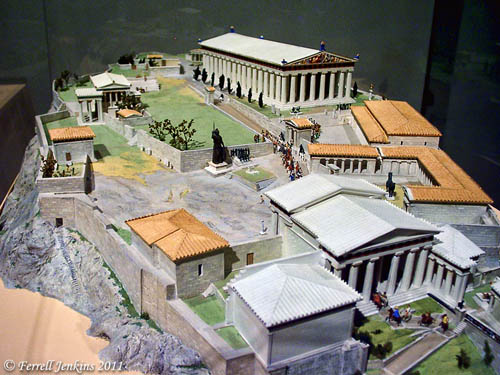
The Royal Ontario Museum in Toronto has a nice exhibit of Greek artifacts and a helpful model of the Acropolis with its magnificent buildings. Click on the photo for an image suitable for use in teaching.

Athens - Acropolis - ROM, Toronto.

Model of the Acropolis at Royal Ontario Museum. Photo by Ferrell Jenkins.

Here is a list of significant monuments Paul might have visited:

  1. The Parthenon where the goddess Athena was worshiped was built between 447 and 438 B.C.
  2. Temple of Athena Nike (Wingless Victory, 5th cent. B.C.).
  3. The Erechtheion with its porch of Caryatids was built between 421 and 406 B.C. An olive tree beside the building commemorates the first olive tree planted by Athena.
  4. Temple of Rome and Augustus.

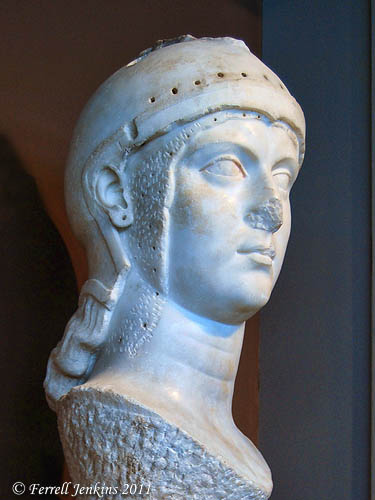
Temples were built to Athena all over the Roman Empire. This photo of a bust of Athena was made in the Archaeology Museum of Thessalonica (Thessaloniki, Greece).

Athena. Archaeology Museum of Thesaloniki, Greece. Photo by Ferrell Jenkins.

Athena. Archaeology Museum of Thesaloniki. Photo by Ferrell Jenkins.

Paul described gods and goddesses like Athena as having been formed by man.

Being then the children of God, we ought not to think that the Divine Nature is like gold or silver or stone, an image formed by the art and thought of man. (Acts 17:29 NAU)

As Paul writes to the Corinthians, he says,

For even if there are so-called gods whether in heaven or on earth, as indeed there are many gods and many lords,  yet for us there is but one God, the Father, from whom are all things and we exist for Him; and one Lord, Jesus Christ, by whom are all things, and we exist through Him. However not all men have this knowledge;  (1 Corinthians 8:5-7a NAU)