Category Archives: Travel

The Exploration in Antiquity Center

The Explorations in Antiquity Center at LaGrange, Georgia, is the brainchild of Dr. James Fleming. Fleming has lived and worked in Israel since 1973. Numerous tour groups have visited his Biblical Resources center there. I first met Jim many years ago in the home of Richard Cleave in Jerusalem. Cleave is the author/photographer/publisher of The Holy Land Satellite Atlas and other photographic and geographic materials. In that meeting I saw that the three of us shared a common passion in wanting to use what we had learned about the Bible lands in teaching others.

The Explorations in Antiquity Center web page says,

Dr. Fleming established Biblical Resources in 1975, for the purpose of producing educational materials and aids for teaching the historical, geographical, and archaeological background of the Bible.

It was wonderful to have these resources together at one place in Israel, but it is beneficial to many more to have the resources available in the Southeastern United States.

David Padfield recently visited the Center in LaGrange. At my request he has written a brief review for Ferrell’s Travel Blog. We plan to run the review with photographs during the next few days.

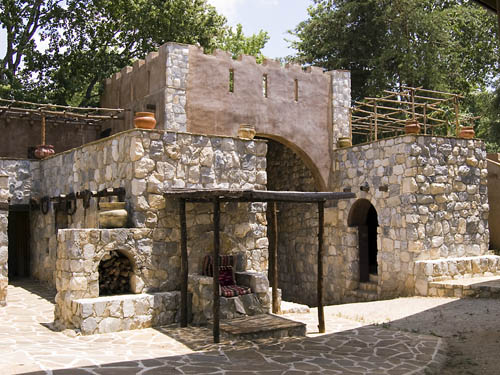
The city gate at Exploration in Antiquities Center. Photo by David Padfield.

The city gate at Exploration in Antiquities Center. Photo by David Padfield.

You may access the Center’s web site here.

David Padfield is well known for his helpful web site, Padfield.com.

The Garrard temple model

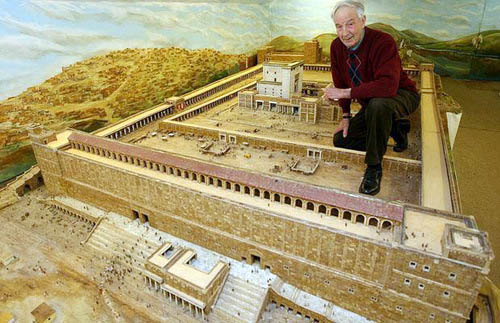
A few months ago the world discovered Alec Garrard’s model of Herod’s Temple. I was traveling a lot then, and many of the blogs covered the news, so I let it go. I suppose I received 10 or 12 emails from readers informing me about the articles. Well, finally, here it is for those who missed it.

Garrard is a 78 year old retired property developer from Norfolk in the East of England who has spent 33,000 hours researching and building a model of Herod’s Temple. It is fascinating that one person spends so much time on a project. The Daily Mail reporter comments on this.

And while he sees it as a form of relaxation, he says his wife thinks he is mad. ‘She wishes she’d married a normal person,’ he said.

Garrard and his Temple Model. Photo: Geoff Robinson Photography.

Garrard and his Temple Model. Photo: Geoff Robinson Photography.

The article in the Daily Mail is here. The Telegraph article is here.

The Telegraph has added an album of nice photos here.

Walter Bingham of Israel National News has a report about the model, including an interview with Garrard, here.

HT: Reminder – Joseph I. Lauer.

Update: I see that Leen Ritmeyer has a set of PowerPoint slides based on Garrard’s model. Full details here.

I take every step with them

A couple of my friends, Royce and Luke Chandler, are in Israel to participate in the archaeological dig at Khirbet Qeiyafa. The site, overlooking the Valley of Elah, is also called the Elah Fortress. They are spending a few days traveling in Israel prior to joining the dig.

Luke is posting some of his photos and a bit of information about the places on his A Bible, History & Travel Blog. Today he has a great photo of the Jezreel Valley from the Spring of Harod to the Hill of Moreh (Judges 7). Take a look.

Where were you 40 years ago?

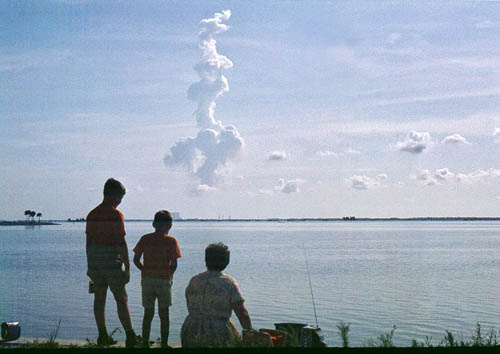
Even if we did not remember the exact day, all of us have heard that today is the 40th anniversary of the Apollo 11 mission to the moon. Our family had moved to Florida the previous December. School was not in session. What a great opportunity to take the boys to Cape Canaveral to see the “moon shot.”

Still in awe after the launch of Apollo 11. Photo by Ferrell Jenkins.

Still in awe after the launch of Apollo 11. Photo by Ferrell Jenkins.

You may notice what appears to be a scratch on the slide running from the ground up into the water. That is the antenna to an little battery-operated TV. Afterwards we had a great picnic lunch mom had prepared.

The Land of Rameses

Note: Over the past nine years I have contributed nearly 100 articles on Bible places to a magazine published by some of my friends. Normally I do not repeat the material here for several years.  The typesetter made a mistake in the July, 2009, issue of Biblical Insights using the title from the previous issue. Because of this I decided to run the article here with the correct title.

-o-o-o-o-o-o-

For many years scholars identified Rameses with Tanis (San el Hagar). Tanis is often identified with the Zoan which was built seven years after Hebron (Numbers 13:22). As a result of recent excavations in the eastern Nile Delta by Austrian archaeologists under the direction of Manfred Bietak, Rameses is now identified with Tell el-Daba. Tell el-Daba is situated on the eastern side of the ancient Pelusiac branch of the Nile River in the biblical land of Goshen (Gen. 45:10) which is also called the land of Rameses (Genesis 47:11). Rameses was the starting point of the exodus (Ex. 12:37; Num. 33:3,5).

Scholars posit four main proposals for the date of the exodus. (1) Before 2000 B.C. (Anati); (2) 1477 B.C. (Goedicke); (3) about 1450 B.C. (Bimson); (4) 1280 B.C. (popular view). If we believe that 1 Kings 6:1 should be taken seriously, as I do, the date of the exodus would have been about 1446 B.C. Conservative scholars disagree over whether there was a long bondage (430 years), or a short bondage (215 years).

The history of this area should be divided into three periods: pre-Hyksos, Hyksos, and post-Hyksos. The Hyksos were foreign (Canaanite or Asiatic) rulers who lived in the eastern Nile Delta and eventually ruled northern Egypt for some 108 years (c. 1663-1555 B.C.; 15th dynasty). In the pre-Hyksos period the town was known as Rowaty (“the door of the two roads”). During the 15th Dynasty the name was changed to Avaris. The Hyksos made their capital there and retained the name. When the Egyptians ran the Hyksos out of Egypt the name was likely changed to Peru-nefer (“happy journey”). Pharaoh Rameses built a new city at the same location and named it Rameses.

During their stay in the land of Egypt the Israelites built the storage cities of Pithom and Rameses (Exodus 1:11). Pharaoh Rameses II ruled Egypt about 1304 to 1227 B.C. How could the Israelites have built the city of Rameses prior to 1446 B.C. if Pharaoh Rameses was not the ruler of Egypt until nearly 200 years later? Some have suggested that the name Rameses was given to the city by the Hyksos in the 17th century B.C. Perhaps the city was named for a private individual by that name. The most common explanation is that Rameses is the modernization of an obsolete place name. We might say that Caesar crossed the English Channel though it was not known by that name at the time. We say St. Nicholas of Myra was a Turkish bishop, but Turkey did not exist at the time.

Earlier this year I spent two days in the land of Goshen. My guide gained access to a field in the Tell el-Daba area where we saw remnants of a colossal statue of Pharaoh Rameses II estimated to have been more than 30 feet high. The royal precinct of the city at the time of Moses has also been uncovered at Ezbet Helmi on the bank of the Pelusiac branch of the Nile.
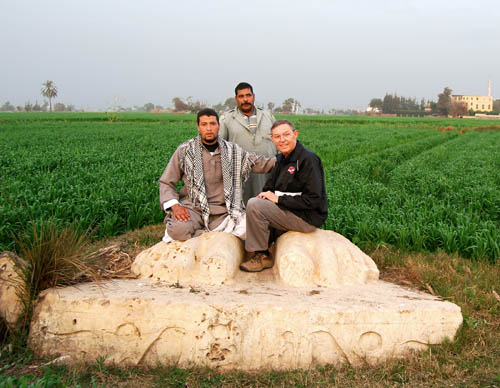
Remnant of a colossal statue of Rameses II at Tell el-Daba in the land of Goshen.

Remnant of a colossal statue of Rameses II at Tell el-Daba in the land of Goshen.

It is incorrect to say that there was no Egyptian building in the delta during the time of Rameses II. The storage city constructed by the Israelites was not known as Rameses when they built it, but by one of the earlier names.

Mount Hermon

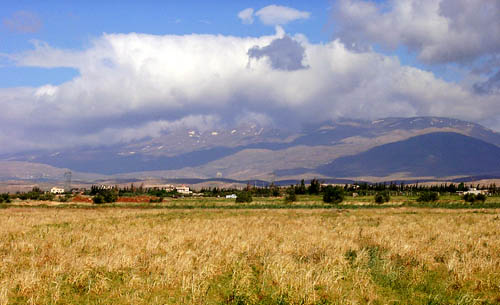
Mount Hermon is the southern end of the Anti-Lebanon mountain range. The mountain is about 20 miles long and has three peaks. At 9,232 feet above sea level it is the highest mountain of Canaan, or Roman Syria, named in the Bible. The mountain now is shared by the countries of Lebanon, Syria, and Israel. The photo below shows mount Hermon from the east, a few miles south of Damascus toward Quneitra. This photo was made the middle of May, 2002. There was more snow on the west side of the mountain in Lebanon than you see here.

View of Mount Hermon from the East. Photo by Ferrell Jenkins 2002.

View of Mount Hermon from the East. Photo by Ferrell Jenkins 2002.

The first biblical reference to Mount Hermon is found in Moses’ account of the Israelite conquest of transjordan (Deuteronomy 3:8). He says that Israel took the land from the hand of two Amorite kings “from the valley of Arnon to Mount Hermon.” The Sidonians, of ancient Phoenicia, called the mountain Sirion, and the Amorites called it Senir (Deuteronomy 3:9). The half-tribe of Manasseh lived in the area of Bashan which is south of Mount Hermon (1 Chronicles 5:23). The Mountain of Bashan is probably a reference to Mount Hermon (Psalm 68:15). Hermon is mentioned in four references in the poetic books of the Old Testament (Psalm 42:6; 89:12; 133:3; Song of Solomon 4:8).

The heavens are yours; the earth also is yours; the world and all that is in it, you have founded them. The north and the south, you have created them; Tabor and Hermon joyously praise your name. (Psalm 89:11-12 ESV)

Flag faux pas

We have been flying our flag since a few days before Memorial Day.

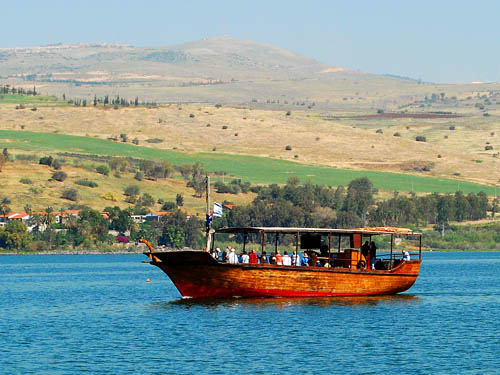
When traveling outside the United States it is fairly common to see the flag of the USA displayed in front of hotels that cater to citizens of the USA. Dozens of boats carry tourists across the Sea of Galilee from one port to another. This is an important part of our tours to give the travelers some sense of the elevation of the sea, and of the quietness of its water.

Tourist boat on Sea of Galilee. View to East. Photo by Ferrell Jenkins.

Tourist boat on Sea of Galilee. View to East. Photo by Ferrell Jenkins.

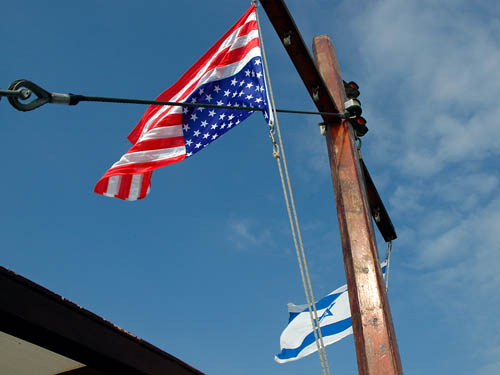
It is fairly typical of these boats to hoist a flag of the country from which its passengers come. In 2006 the boat we were on had inadvertently hoisted the USA flag upside down. The rules of etiquette for the display of the flag say that the flag should be flown upside down only as a distress signal. Fortunately we did not have a storm like the one mentioned in the gospels. Such storms still occur when the strong winds come down upon the sea from the surrounding mountains. In that case I suppose a distress signal might have been helpful.

But as they were sailing along He fell asleep; and a fierce gale of wind descended on the lake, and they began to be swamped and to be in danger. They came to Jesus and woke Him up, saying, “Master, Master, we are perishing!” And He got up and rebuked the wind and the surging waves, and they stopped, and it became calm. (Luke 8:23-24 NAU)

United States flag upside down on Israeli boat. Photo by Ferrell Jenkins.

United States flag upside down on Israeli boat. Photo by Ferrell Jenkins.

Happy fourth of July to my USA friends. Fly your flag proudly, but don’t turn it upside down!

The Hasankef Dam on the Tigris River halted

The Biblical Archaeology Review Daily News for June 26, 2009, reports a halt in the building of the dam on the Tigris River in southeastern Turkey. BAR calls attention to an report by the BBC about the halting of the project. Note this portion of the report:

Insurers have suspended their support for a controversial dam project in southeastern Turkey amid concern about its environmental and cultural impact.Export credit insurers in Austria, Germany and Switzerland said on Tuesday they had told suppliers to suspend work on the Ilisu dam on the Tigris river.

They are giving Ankara 180 days to meet standards set by the World Bank. The ancient Hasankeyf fortress is in the area that would be flooded and more than 50,000 people would have to move.

The hydroelectric project near Turkey’s borders with Syria and Iraq is part of a scheme to develop the mainly Kurdish region, which has suffered for decades from poverty, neglect and conflict.

Environmentalists say the dam would destroy archaeological treasures, including Roman remains. The dam consortium plans to create a culture park on the edge of the reservoir and transfer key monuments from Hasankeyf there.

The full (brief) report may be read here. See information about the history of the site here.

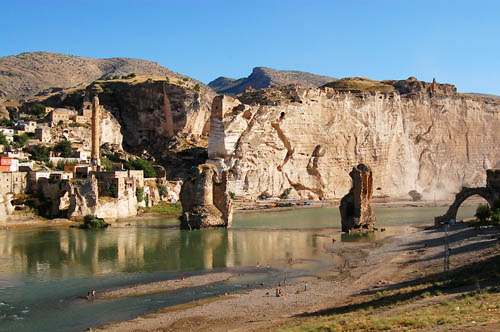
I had the opportunity to visit this area in June, 2007. This is one of the most fascinating places I have visited. The site of ancient Nineveh is less than 125 miles south of Hasankef on the Tigris.

Tigris River at Hasankief. Ruins of Roman bridge. Photo by Ferrell Jenkins.

Tigris River at Hasankef. Note ruins of Roman bridge. Photo by Ferrell Jenkins.

The Tigris River formed the eastern border of Mesopotamia, the land between the rivers (Tigris and Euphrates). It is mentioned by name only twice in the Bible.

  • The Tigris was the third of the rivers flowing from the Garden of Eden. It is said to be east of Assyria (Genesis 2:14). Was this in the north near the source of the river in the mountains of Ararat? Or was it in the south near the Persian Gulf? I don’t know.
  • The prophet Daniel was by the bank of the great river, the Tigris (Daniel 10:4). This would have been further south in present Iraq.

The Sea of Galilee

A boat ride on the Sea of Galilee is one of the highlights of a trip to Israel for most Christian tourists. They enjoy seeing the lake and recognizing the places they have read about so much in their Bible study: Tiberias, Magdala, the Mount of Beatitudes, Capernaum. They reflect on the accounts of Jesus walking on the water and stilling the tempest, etc.

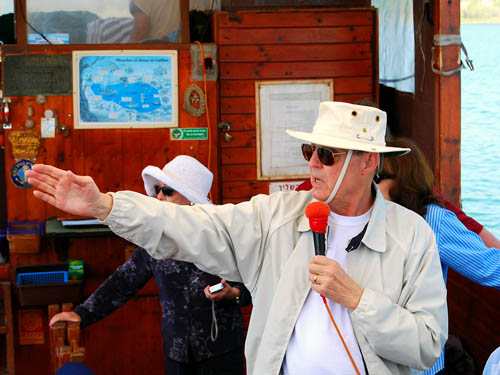
My wife had someone shooting photos while I was pointing out sites of interest along the shores of Galilee. I think I was pointing out the possible location of the account of the swine rushing down the steep bank into the sea (Matthew 8:28 – 9:1).

Ferrell Jenkins pointing out sites of interest on the shore of Galilee.

Ferrell Jenkins pointing out sites of interest along the shore of Galilee.

Luke calls the Sea of Galilee a lake (Luke 5:1-2; 8:22-23,33).

Now Jesus was standing by the Lake of Gennesaret, and the crowd was pressing around him to hear the word of God. (Luke 5:1 NET)

Did Paul visit Samos?

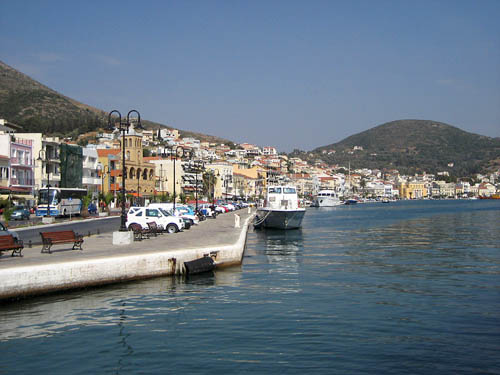
Samos is a mountainous island in the SE part of the Aegean Sea off the coast of Asia Minor. It is 27 miles long (E-W) and about 14 miles wide. The island is separated from the mainland by a strait of one mile.

The port of Samos on the island of Samos. Photo by Ferrell Jenkins.

Paul and his companions stopped at, or passed near, Samos on the return from his third journey.

Sailing from there [Mitylene], we arrived the following day opposite Chios; and the next day we crossed over to Samos; and the day following we came to Miletus. (Act 20:15 NAU)

English versions do not make it clear whether Paul stopped at Samos or came within sight of the island. These comments by Floyd Filson might be helpful.

Paul’s ship…either ‘touched at’ and anchored overnight at Samos (so RSV, though this is an unusual meaning for parebalomen) or ‘came near’ to Samos and passed by it on the E or the W to anchor for the night at Trogyllium. (Interpreter’s Dictionary of the Bible. IV:197)

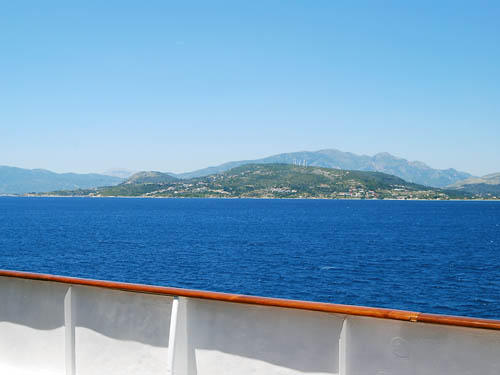
Here is a view of the eastern end of Samos as a ship passes through the most narrow part of the strait between the island and the Turkish mainland.

View of Samos from a ship in the strait between island and mainland. Photo by F. Jenkins.
Samos from a ship in the strait between island & mainland. Photo: F. Jenkins.

Paul may not have visited Samos, but it is clear that he came very close.