Category Archives: Travel

Jabbok River valley inhabited and irrigated for millennia

A recent report by Dutch researchers calls attention to the relation of the irrigation, especially that in the Zerqa River triangle of Jordan, to population and the nature of the communities.

You can make major discoveries by walking across a field and picking up every loose item you find. Dutch researcher Eva Kaptijn succeeded in discovering – based on 100,000 finds – that the Zerqa Valley in Jordan had been successively inhabited and irrigated for more than 13,000 years. But it was not just communities that built irrigation systems: the irrigation systems also built communities.

Archaeologist Eva Kaptijn has given up digging in favour of gathering. With her colleagues, she has been applying an intensive field exploration technique: 15 metres apart, the researchers would walk forward for 50 metres. On the outward leg, they’d pick up all the earthenware and, on the way back, all of the other material. This resulted in more than 100,000 finds, varying from about 13,000 years to just a few decades old. Based on further research on the finds and where they were located, Kaptijn succeeded in working out the extent of habitation in the Zerqa Valley in Jordan over the past millennia.

Read the longer report here.

The Zerqa River is known as the Jabbok in the Bible. It is probably best known as the place where Jacob met with Esau as he returned from Paddan Aram, and where his name was changed to Israel (Genesis 32).

The same night he arose and took his two wives, his two female servants, and his eleven children, and crossed the ford of the Jabbok. (Genesis 32:22 ESV)

Jordan utilizes the water of the Jabbok (Zerqa) for irrigatation, especially in the Jordan Valley. This photo which I made last year shows the Jabbok a few miles from the Jordan Valley. The mountains are in the Biblical land of Gilead. Before the river reaches this point much of the water has been caught in reservoirs for use by the Jordanians.
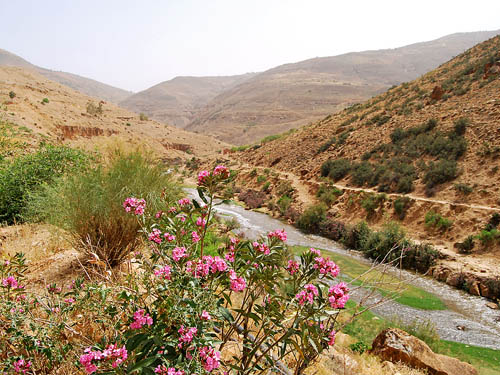
The Jabbok (Zerqa) River near the Jordan Valley. Photo by Ferrell Jenkins.

The Jabbok (Zerqa) River near the Jordan Valley. Photo by Ferrell Jenkins.

HT: Biblical Paths.
Ephesus: “Turkey’s ancient splendour”

A recent article in stuff.co.nz calls Ephesus “Turkey’s ancient splendour.” Here a few excerpts from the article by Brenda Webb of the Marlborough Express.

The ruins of Ephesus on Turkey’s west coast are among the best preserved and most impressive in the Mediterranean.

Imagine 250,000 people living in an area roughly the size of Picton township [a New Zealand town of about 3000 population].

Throw in an amphitheatre that seats 25,000 people, a massive three-story library, several temples, an agora (market place), a brothel, Roman baths complex, a gymnasium and various basilicas, temples and fountains.

This gives some idea of the size and complexity of the amazing ancient city of Ephesus, one of the 12 cities of the Ionian League and a once thriving Mediterranean port where skillful artisans and rich merchants gathered.

Today it’s a frantically busy historical site, so it’s best to visit early morning or late afternoon and avoid peak holiday season of July and August.

Half an hour inland from the Turkish coastal city of Kusadasi, Ephesus retains much of its former grandeur thanks to sensitive excavation and preservation that began around 100 years ago and continues today, with only 20 per cent of the site uncovered.

It certainly is a work in progress – the day we visited a huge crane was removing rubble from yet another new excavation site beside the magnificent amphitheatre that took 60 years to build.

In was here that gladiatorial combats were said to be held during Roman times as well as less brutal concerts and theatrical performances.

The acoustics in the amphitheatre are fantastic. We watched and listened in awe as an Italian tourist recited poetry on the stage, his words clearly reaching us some distance away.

Ephesus was first inhabited as long ago as 6000 BC but reached its peak in Roman times and most of the remains you see today date from then.

Despite its age and years of plundering, Ephesus remains surprisingly intact, especially its marble streets, the much photographed library and massive amphitheatre.

Some of the best-preserved artefacts, statues and tools have been taken to the nearby Ephesus Museum in Selcuk but some amazing structures remain and it is its completeness that gives it the edge over other historical sites in the Mediterranean.

Read the rest of the article here.

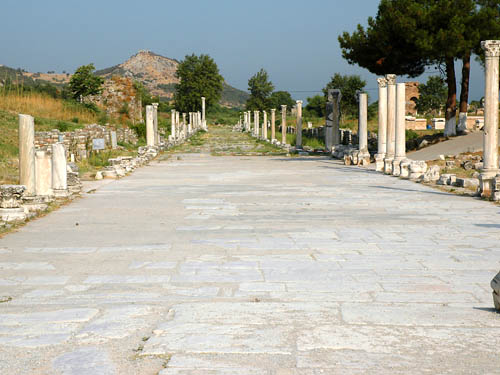
The Arcadian Way - Ephesus

The Arcadian Way runs from the Theater (to our back) and the harbor (now silted up). Photo by Ferrell Jenkins.

Luke describes some of the work of Paul at Ephesus in these words:

And he entered the synagogue and continued speaking out boldly for three months, reasoning and persuading them about the kingdom of God. But when some were becoming hardened and disobedient, speaking evil of the Way before the people, he withdrew from them and took away the disciples, reasoning daily in the school of Tyrannus. This took place for two years, so that all who lived in Asia heard the word of the Lord, both Jews and Greeks. (Acts 19:8-10 NAU)

For the full account of Paul’s work in Ephesus read Acts 18-20.

HT: Biblical Paths.

Fisherman in Egypt

A fisherman brings in a large catch of fish in a lake on the outskirts of Alexandria, Egypt.

Fisherman Near Alexandria, Egypt. Photo by Ferrell Jenkins.

Fisherman Near Alexandria, Egypt. Photo by Ferrell Jenkins.

The wise writer of Ecclesiastes likened the unfortunate things that happen in life to fish being caught in a net.

Surely, no one knows his appointed time! Like fish that are caught in a deadly net, and like birds that are caught in a snare– just like them, all people are ensnared at an unfortunate time that falls upon them suddenly. (Ecclesiastes 9:12 NET)

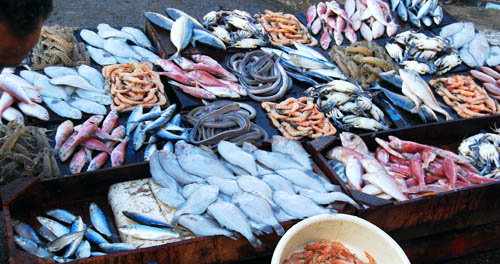
This photo was made in the street fish market along the pier in Alexandria.

The Fish Market at Alexandria, Egypt. Photo by Ferrell Jenkins.

The Fish Market at Alexandria, Egypt. Photo by Ferrell Jenkins.

The prophet Isaiah (about 725 B.C.) spoke of a time that was coming upon Egypt in these words.

The fishermen will mourn and lament, all those who cast a fishhook into the river, and those who spread out a net on the water’s surface will grieve. (Isaiah 19:8 NET)

The Ark at Kiriath-jearim

The first reference to Kiriath-jearim is in Joshua 9:17 where it is listed as one of the cities of the Hivites along with Gibeon, Chephirah, and Beeroth. These cities were located on the western side of the Judean hill country.

The name, Kiriath-jearim, means “city of forests” or wood, and is identified with Deir el-Azar. The Arab village at the site today is called Abu Ghosh and can be seen about nine miles west of Jerusalem to the right of the main highway to Tel Aviv. Several other names are given for the place. It is called Kiriath-baal (Joshua 15:60; 18:14), Baalah (Joshua 15:9), possibly Baalath (1 Kings 9:18), and Baale-judah (2 Samuel 6:2). Perhaps the simplest and correct explanation is that the Israelites changed the name from a place that honored Baal to a geographical one, the city of forests.

When the Danites moved from their allotted territory to the north they camped a little to the west of Kiriath-jearim at a place they called Mahaneh-dan (Camp of Dan; Judges 18:11-12).

Kiriath-jearim’s highest honor is in the association with the ark of the covenant. The Israelites took the ark from the tabernacle at Shiloh to the battle field at Ebenezer when they were fighting with the Philistines (1 Samuel 4). The ark was captured by the Philistines and taken to Ashdod, then to Gath, and finally to Ekron before they decided to get rid of it. The ark was returned to Beth-shemesh (1 Samuel 4-6).

The men of Beth-shemesh sent messengers to the residents of Kiriath-jearim asking them to come and take the ark to their town. The ark was brought into the house of Abinadad on the hill. His son, Eleazar, was consecrated by the men of the city to keep the ark of the LORD. The ark remained there for many years until David had it brought to Jerusalem (1 Samuel 6:21-7:2; 2 Samuel 6).

A prophet named Uriah, a contemporary with Jeremiah, lived at Kiriath-jearim. He preached a message similar to that of Jeremiah regarding Jerusalem in the days of the Babylonian threat. When he was threatened by King Jehoiakim he fled to Egypt, but was captured and brought back to Jerusalem and put to death (Jeremiah 26:20-24).

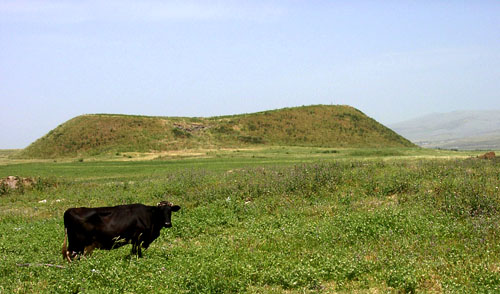
The ark of the covenant was here at Kiriath-jearim before David took it to Jerusalem. Photo by Ferrell Jenkins.

The ark of the covenant was here at Kiriath-jearim before David took it to Jerusalem. Photo by Ferrell Jenkins.

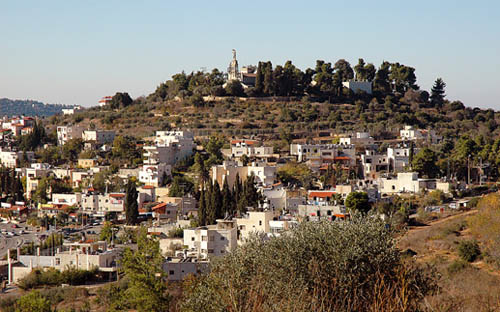
Our photograph shows the hill of Kiriath-jearim. Our Lady of the Ark of the Covenant Church was built in 1911 on the ruins of a fifth century Byzantine church.

This article was published in Biblical Insights, June, 2007.

The fall of the Berlin Wall

Twenty years ago today the Berlin wall began to come down. The wall had been a vivid symbol of the Iron Curtain and of the Cold War.

The phrase Iron Curtain came into common use after the speech by Winston Churchill at Westminster College, Fulton College, March 5, 1946.

From Stettin in the Baltic to Trieste in the Adriatic an iron curtain has descended across the Continent. Behind that line lie all the capitals of the ancient states of Central and Eastern Europe. Warsaw, Berlin, Prague, Vienna, Budapest, Belgrade, Bucharest and Sofia, all these famous cities and the populations around them lie in what I must call the Soviet sphere, and all are subject in one form or another, not only to Soviet influence but to a very high and, in some cases, increasing measure of control from Moscow.

My first visit to Berlin was March 25, 1978. I took a group there to be able to visit the fabulous Pergamum Museum. In my tour brochure I had included this statement from one of Arthur Frommer’s books. He says that the entire trip to East Berlin “is worthwhile just to see the Pergamon Altar…not even in Greece itself does one get a more solid idea of the glory of Greek civilization.”

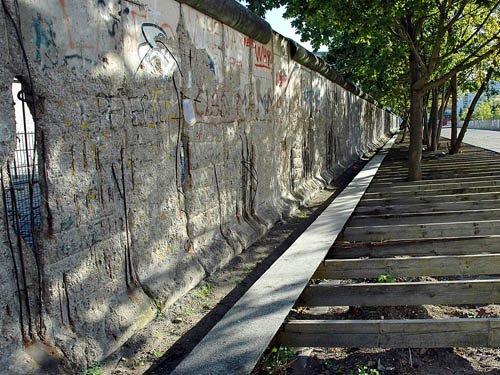
I went back to Berlin several times prior to the fall of the Wall, and I have been back several times since then. This photo shows a small portion of the Wall that remains as a reminder of the previous division.

A remnant of the Berlin Wall. Photo by Ferrell Jenkins.

A remnant of the Berlin Wall. Photo by Ferrell Jenkins.

Sunset at Hierapolis

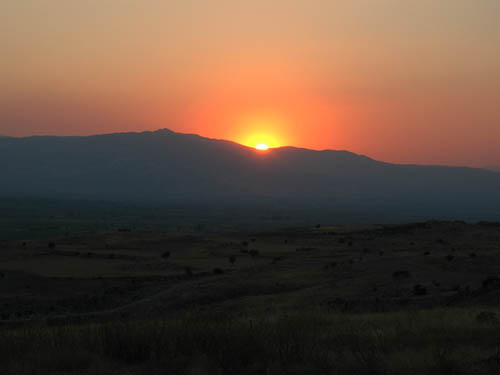
This is a sunset view I made at Pamukkale (biblical Hierapolis; Colossians 4:13). Hierapolis is famous for hot mineral springs and terraced travertine formations. It is now a World Heritage site.

For I bear him witness that he [Epaphras] has worked hard for you and for those in Laodicea and in Hierapolis. (Colossians 4:13 ESV)

Sunset at Hierapolis in the Lycus River Valley. Photo by Ferrell Jenkins.

Sunset at Hierapolis in the Lycus River Valley. Photo by Ferrell Jenkins.

German Archaeologist: Beneath every footstep in Syria is an ancient civilization

The Global Arab Network reports on a statement made by German archaeologist Markus Gschwind, head of the Syrian-German Archaeology Expedition, here. The report says,

Syria, the land of civilizations and history, is rife with ancient monuments that tell the stories of the many peoples and civilizations that lived in it, whose stories endured in the face of time to tell humanity about their greatness.

“Beneath every footstep in Syria is an ancient civilization,” says Archaeologist Markus Gschwind, head of the Syrian-German Archaeology Expedition working at al-Rafina in Hama. He notes that this saying is repeated around Germany, as most Germans consider Syria the most historically deep-rooted country in the Mediterranean.

In a statement to SANA, Gschwind said that he has been living and excavating in Syria for six years, each day discovering many secrets from the history of mankind.

Gschwind is working at the ancient city of al-Rafina in Hama. Hama is at the site of Biblical Hamath  (2 Kings 14:25; 2 Chronicles 8:4).

My limited visits to Syria have convinced me that the statement by Gschwind is correct. Of course, the same could be said of Israel, Jordan, Turkey, Iraq, et al.

The Assyrian Empire ruled the ancient near east from the battle of Qarqar (853 B.C.) till the battle of Carchemish (605 B.C.) when they were defeated by the Babylonians. Nineveh had fallen seven years earlier. This was the time of the Divided Kingdom period in Israelite history, and Assyria had contact with a numerous biblical kings. Ahab, for example, fought against the Assyrians at Qarqar. Qarqar is north of Hammath. Both are on the Orontes River.

Qarqar on the Orontes. Photo by Ferrell Jenkins.The tell of Qarqar in northern Syria. Photo by Ferrell Jenkins.

HT: Biblical Paths

Move evidence of Babylonian-Egyptian contacts

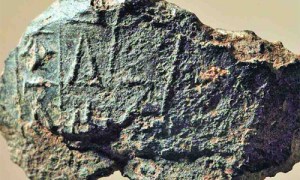
Austrian Times reports here on the discovery of a Babylonian seal impression at Tell el-Dab’a in Egypt.

Austrian archaeologists have found a Babylonian seal in Egypt that confirms contact between the Babylonians and the Hyksos during the second millennium B.C.

Irene Forstner-Müller, the head of the Austrian Archaeological Institute’s (ÖAI) branch office in Cairo, said today (Thurs) the find had occurred at the site of the ancient town of Avaris near what is today the city of Tell el-Dab’a in the eastern Nile delta.

The Hyksos conquered Egypt and reigned there from 1640 to 1530 B.C.

She said a recently-discovered cuneiform tablet had led archaeologists to suspect there had been contact between the Babylonians and the Hyksos.

Forstner-Müller added that Manfred Bietak had begun archaeological research on the period of Hyksos dominance at the remains of a Hyksos palace at Avaris in 1966.

Babylonian seal impression.

Babylonian seal impression.

Earlier in the year we reported on the discovery of a Babylonian tablet at Tell el-Dab’a here.

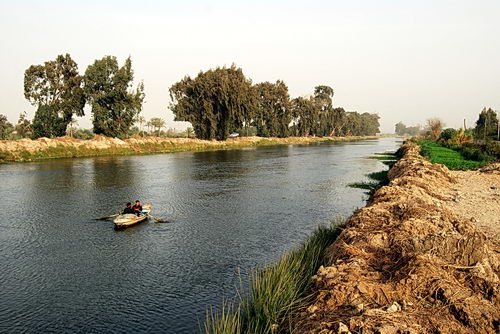
The report  says the Austrian plan to build a museum in the area. A more complete report in Die Presse says they also have plans to restore the river. The Pelusiac branch of the Nile once flowed by this ancient site. Below is a photo of the canal which often follows the course of the Pelusiac.

A canal where the Pelusiac branch of the Nile once flowed. Photo by F. Jenkins.Canal along the Pelusiac Branch of the Nile near Tell el-Dab’a. Photo by FJ.

Tell el-Dab’a is in the eastern Nile Delta. In Biblical times it was known as the Land of Goshen, and served as the home of the Israelites.

“Hurry and go up to my father, and say to him, ‘Thus says your son Joseph, “God has made me lord of all Egypt; come down to me, do not delay. “You shall live in the land of Goshen, and you shall be near me, you and your children and your children’s children and your flocks and your herds and all that you have. “There I will also provide for you, for there are still five years of famine to come, and you and your household and all that you have would be impoverished.” (Genesis 45:9-11 NAU)

These new findings might shed some light on the plausibility of Achan finding a garment from Shinar (Babylon) at Jericho (Joshua 7).

HT: Biblical Paths

What is in the basement of the Cairo Museum?

Tourists who visit the Egyptian Museum in Cairo are overwhelmed at the large collection of Egyptian artifacts. In fact, most folks just see a few of the displayed items. Have you ever thought about the basement. Take a look at this video featuring Dr. Zahi Hawass, the flamboyant director of antiquities in Egypt.


Now, if they would only allow the taking of photos in the galleries!
HT: Biblical Paths

Something lite for October 31

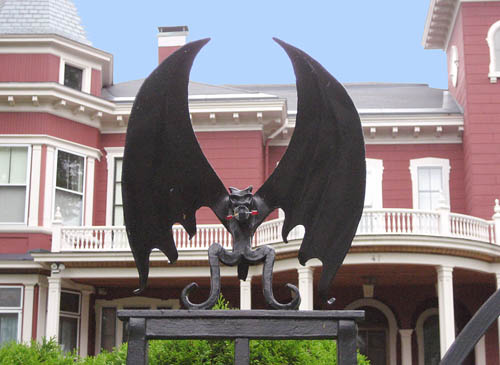
This is a photo I made in front of Stephen King’s house in Bangor, Maine.
Stephen King House in Bangor, Maine.