Category Archives: Travel

Kinneret Regional Project uncovers synagogue

Several weeks ago I added a link to the Kinneret Regional Project on the Bible Places page of the Biblical Studies Info Page. My intention was to write about the project and show a photo of Tel Kinneret (Kinrot; Arabic Tell el-‘Oreme) on the northwestern shore of the Sea of Galilee.

Now word comes of the discovery of a fourth century synagogue at Horvat Kur, about a mile northwest of Tel Kinneret. The press release here says that the discovery “adds new evidence [along with the synagogues at Capernaum, Chorazin, Kh. Hammam, and Magdala] for a very tight net of synagogues in a relatively small area on the Northwestern shores of the Lake of Galilee.”

Todd Bolen created a map using Google Earth to identify Horvat Kur, Tel Chinnereth (Kinneret), Tabgha, Mount of Beatitudes, Cove of the Sower, and Capernaum. This great resource for studying the ministry of Christ may be accessed at the Bible Places Blog.

Earlier I mentioned that the day in early May when my group took a boat ride on the Sea of Galilee was a great one for making photos. I caught this wonderful view of Tel Kinneret from the boat. The buildings on the shore below the tel belong to Pilgerhaus Tabgha, a guesthouse operated by the German Association of the Holy Land.
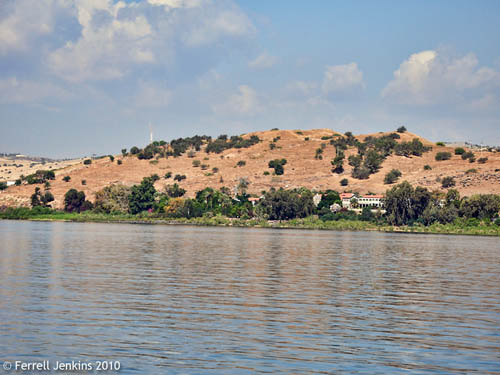
Tel Kinerot from the Sea of Galilee. Photo by Ferrell Jenkins.

Tel Kinneret from the Sea of Galilee. Photo by Ferrell Jenkins.

From the Kinneret Regional Project site you may download several good resources. The 2004 report by Pakkala, et al., begins with this description of Tel Kinneret.

The site boasts remains from the Chalcolithic to the Ottoman period. In its heyday in the Early Iron Age, i.e. the 11th/early 10th century BCE, Kinneret developed into a regional center, controlling the surrounding region and becoming one of the most important urban sites of the country.

The body of water that we commonly call the Sea of Galilee is known as the Sea of Chinnereth in the Old Testament (Numbers 34:11; Joshua 13:27). Chinnereth is listed as one of the fortified cities of the tribe of Naphtali in Joshua 19:35.

I think most tourists to Galilee overlook Tel Kinneret. They are excited about having seen the Roman boat at Nof Ginosaur, and the guide is beginning to tell them about Taghba, Capernaum, or the Mount of Beatitudes. Or it may be because the site is obscured from the highway by the electric power station below it.

HT: Joseph I. Lauer
Headed for the Elah Fortress

Luke Chandler is traveling in Israel in advance of participation in the Khirbet Qeiyafa (the Elah Fortress) Excavation. He is posting some comments and photos of the places he is visiting. Take a look at Luke Chandler’s Blog.

Go Southeast, Old Man!

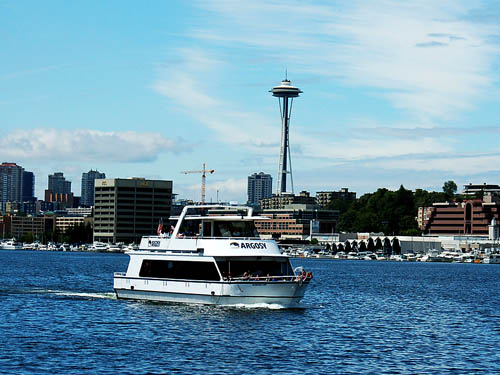
The mountains and lakes of the Northwest are a pleasure to behold. A friend took me for a cruise on Lake Washington where he pointed out the houses of the rich and famous of the business, sports, and entertainment world.

Seattle. Photo by Ferrell Jenkins.

Seattle. Photo by Ferrell Jenkins.

I enjoyed speaking to appreciative audiences at the Kirkland Church of Christ Sunday and Monday evenings. The illustrated lessons included discussions of Bible history, archaeology, and the Bible world. Quite a few friends from the past were present.

Thanks to those of you who check the blog regularly. Hopefully by the first of the week I can get back to posting some photos of the Bible world.

Moving on to the Northwest

Stop blogging? Not yet. We just had an extremely busy week in San Jose. Now I am on my way to the Seattle area where I will be speaking for a couple of days.

Excavation begins today at Tel Rehov

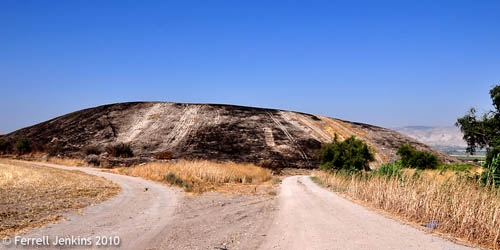
Tel Rehov is located in the Jordan Valley a few miles south of Beth-Shean. The excavation web site describes the tell as one of the largest in the Holy Land. Previous excavations since 1997 reveal that the site was occupied during the Late Bronze Age and Iron Age I. The site is not named in the Bible. The suggestion has been made that it may have remained one of the cities not conquered by the Israelites — like the ones mentioned here:

Yet the people of Manasseh could not take possession of those cities, but the Canaanites persisted in dwelling in that land. Now when the people of Israel grew strong, they put the Canaanites to forced labor, but did not utterly drive them out. (Joshua 17:12-13 ESV)

Rehov is mentioned in Egyptian writings from the time of Pharaoh Shishak, the ruler who invaded Israel during the reign of King Rehoboam about 925 B.C. (1 Kings 14:25).

Last month, while traveling in Israel, I saw that the tell had already been burned off. This is frequently done prior to a dig to help clear it of excess growth. There is always a lot of clean up work that goes on the first few days of a dig.

Tel Rehov. Photo by Ferrell Jenkins.

Tel Rehov with the Jordan Valley in the distance. Photo by Ferrell Jenkins.

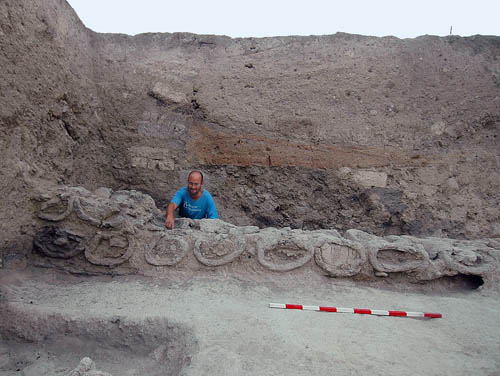
The most exciting discovery that has come from the excavation of Tel Rehov is “the industrial apiary — the only ancient beehives ever discovered in archaeological excavations.”

Tel Rehov. Beehives excavated in 2007.

Beehives Discovered at Tel Rehov in 2007. Archaeologist Amichai Mazar. Photo: Copyright - The Beth-Valley Archaeological Project, Hebrew University of Jerusalem

Read more about the excavation, and hopefully keep up with the current dig, at the web site of the Beth-Shean Valley Archaeological Project here.

Walking through the sewers of first century Jerusalem

The Israel Antiquities Authority announced September 10, 2007 the discovery of a channel that is thought to run from the Temple Mount to the Pool of Siloam, or further.

In excavations the Israel Antiquities Authority is conducting in the City of David in order to expose the main road of Jerusalem from the time of the Second Temple period, the city’s main drainage channel was discovered. According to the writings of Josephus Flavius, the residents of the city fled to this channel at the time of the revolt in order to hide from the Romans.

In excavations the Israel Antiquities Authority is jointly carrying out with the Elad Association in the Walls around Jerusalem National Park, approximately 70 meters of Jerusalem’s main drainage channel from the time of the Second Temple period have been exposed so far. The channel is located along the route from the Temple Mount to the Shiloah Pool. The channel, which passes beneath the main road of the city and apparently continues to Nahal Kidron on its way to the Dead Sea, drained the rainfall of ancient Jerusalem; the Jewish quarter, the western region of the City of David and the Temple Mount.

The complete report may be read here.

Old news, you say. Here is what is new. My group had the opportunity May 7, 2010, to walk through the channel. Twice before I had walked along a portion of the steps leading uphill from the Pool of Siloam, but this was my first time to walk in through the channel (sewer). It was the first time my local guide had walked through the channel.

Ronnie Reich and Eli Shukron, the excavators, are quoted as saying,

“There is evidence in the writings of Josephus Flavius, the historian who described the revolt, the conquest and the destruction of Jerusalem, that numerous people took shelter in the channel and even lived in it for a period until they succeeded to flee the city through its southern end.”

In some of the media reports this comment includes a reference to The Jewish War. I admit to not being a great Josephus scholar, but I have been unable to locate a specific reference like this in Josephus. He does speak of the citizens of Jerusalem hiding in subterranean caverns of the temple (under the platform, I assume) (5:102), and he mentions secret passages (JW 5:497). If a reader has located the reference to the channel I would be pleased to have it. This does sound like a reasonable suggestion.

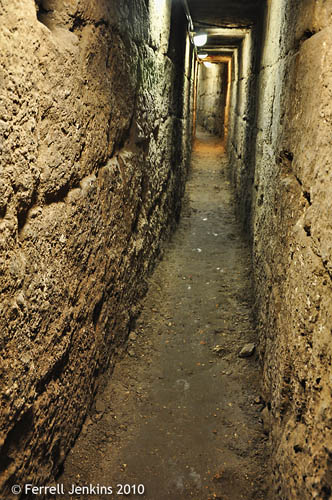
This first photo was made closer to the Pool of Siloam.

Roman Period Sewer in Jerusalem. Photo by Ferrell Jenkins.

Roman Period Sewer in Jerusalem. Photo: F. Jenkins.

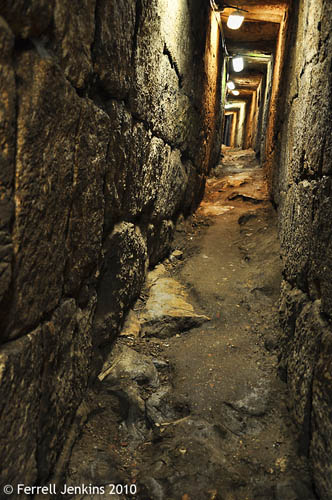
The next one is closer to the northern end of the current excavation. I would say this is a about half way from the Pool to the Temple Mount. At this point the  channel begins to have the smell of a sewer.

Roman Period Sewer in Jerusalem. Photo by Ferrell Jenkins.

Roman Period Sewer in Jerusalem. Photo: F. Jenkins.

The current channel exits on the west side of the street.

This photo was made as I walked up toward the Temple Mount. You can see the southern wall of the Temple Mount. The building on the right, past the flags, is the entrance to the City of David operated by the Ir David Foundation.

View north toward Temple Mount. Photo by Ferrell Jenkins.

View north toward Temple Mount. Photo by Ferrell Jenkins.

The next photo shows the view to the south toward the Pool of Siloam, and eventually the point at which the Tyropean, Hinnom, and Kidron valleys come together.

View south toward Pool of Siloam. Photo by Ferrell Jenkins.

View south toward Pool of Siloam. Photo by Ferrell Jenkins.

Update: Be sure to read the comment by Tom Powers in which he mentions other possible references from Josephus. You may also find Tom’s articles helpful. See his israelpalestineguide.wordpress.com blog here.

How? When we were looking at the mural showing a reconstruction of the Pool of Siloam, our guide (Elie) started to go back the way we entered. An elderly gentlemen who was selling booklets said we could now go through the channel. Fortunately he was correct!

3,500 year old discovery at Tell Kassis (Qassis)

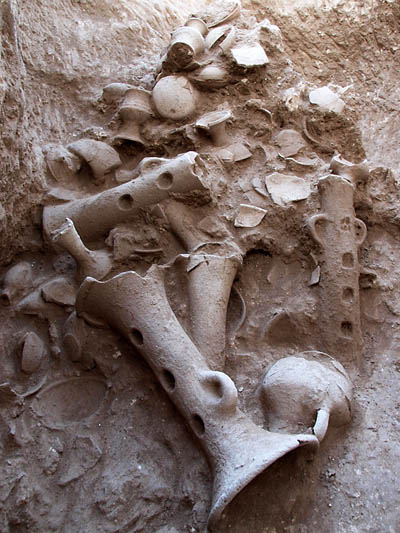
The Israel Antiquities Authority reports here today on the discovery of more than 100 ancient cultic vessels in a natural hollow in the bedrock next to the Tishbi (Yokneam) junction

In an excavation the Israel Antiquities Authority is conducting along the route of the northern gas pipeline planned by the Israel Natural Gas Lines Company

A natural hollow in the bedrock that was exposed in archaeological excavations by the Israel Antiquities Authority prior to the installation of the northern gas pipeline by the Israel Natural Gas Lines Company, at the foot of Tel Qashish (Tell el Qassis [or Tell Kassis]), did not cease to provide ancient surprises. For two weeks archaeologists of the Israel Antiquities Authority excavated the contents of the rock-hollow and removed from it more than 100 intact cultic vessels and other extraordinary items that are c. 3,500 years old. Again and again, every time the excavators thought they reached the bottom of the cavity a new and fascinating layer of complete vessels was discovered beneath the one that was previously dismantled.

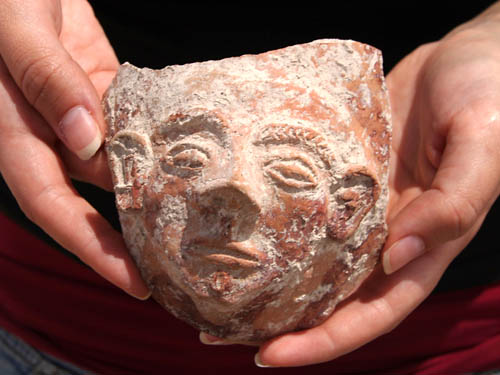
In the past the ancients would descend into the rock-hollow by way of two broad, hewn steps. Inside the cavity whole vessels were found piled one atop the other and other vessels were broken by those that had been placed upon them. Among the finds that were recovered: a cultic vessel that was used for burning incense, a sculpted face of a woman that was part of a cultic cup used in dedicating a libation to a god, goblets and bowls with high bases and tableware that was intended for eating and drinking. Other vessels that were found had been brought from Mycenae in Greece, including a storage vessel for precious oils – evidence of the ancient trade relations that existed with Greece.

According to archaeologists Uzi Ad and Dr. Edwin van den Brink, the excavation directors on behalf of the Israel Antiquities Authority, this is an extremely rare discovery. Until now no such pits as these have been found from 3,500 years ago. It is also extraordinary to find scores of vessels that are in such a good state of preservation. In most excavations fragments of pottery vessels are found, whereas here the vessels were removed from the rock-hollow intact. Each object was removed with the greatest of care, was drawn and documented and revealed beneath it a wealth of other finds. The vessels are numbered and their precise location in the heap is recorded for future research. According to the archaeologists, it is obvious that considerable time and thought were invested in the placement of the vessels in the rock-hollow, as evidence by the different kinds of vessels that were buried separately.

Archaeologists van den Brink and Ad have various theories regarding the purpose of the rock-hollow. “In this period, before the Bible, the children of Israel were still in Egypt or the desert, and it would appear that the vessels were used in a pagan cult that worshiped idols. During this period it was customary that each city had a temple of its own where special cultic vessels were used”.

At the end of the Late Bronze Age (the Canaanite period) the region was vanquished, including Tel Qashish, which was destroyed by a fierce conflagration, along with nearby Tel Yoqneʽam.  Therefore, one of the theories is that the vessels were buried in order to protect them from the impending destruction.

Another possibility is that the cultic vessels that were employed in the rituals practiced in the temple were buried after they were no longer used. Since these artifacts were part of the ritual ceremonies a special place was allocated for them and unlike other vessels they were not discarded in the garbage.

Cultic Verssels at Tell Kassis. Photo: Assaf Peretz, IAA.

Cultic Verssels at Tell Kassis. Photo: Assaf Peretz, IAA.

The next photo shows a cultic cup with the face of a woman.

Cultic Cup discovered at Tell Kishbi. Photo: Assaf Peretz, IAA.

Cultic Cup discovered at Tell Kassis. Photo: Assaf Peretz, IAA.

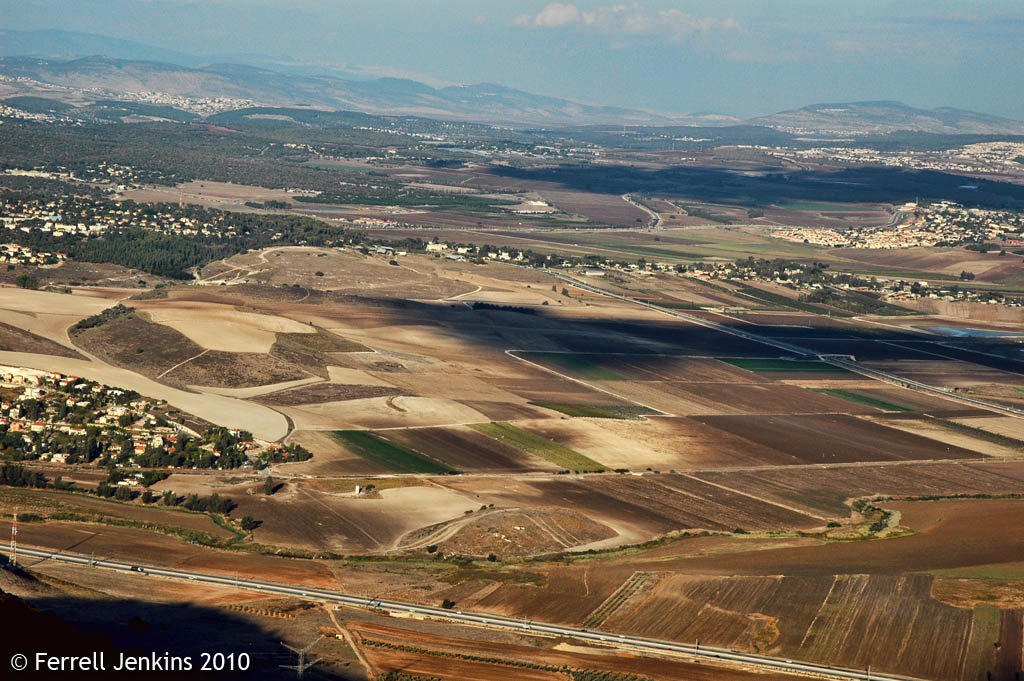
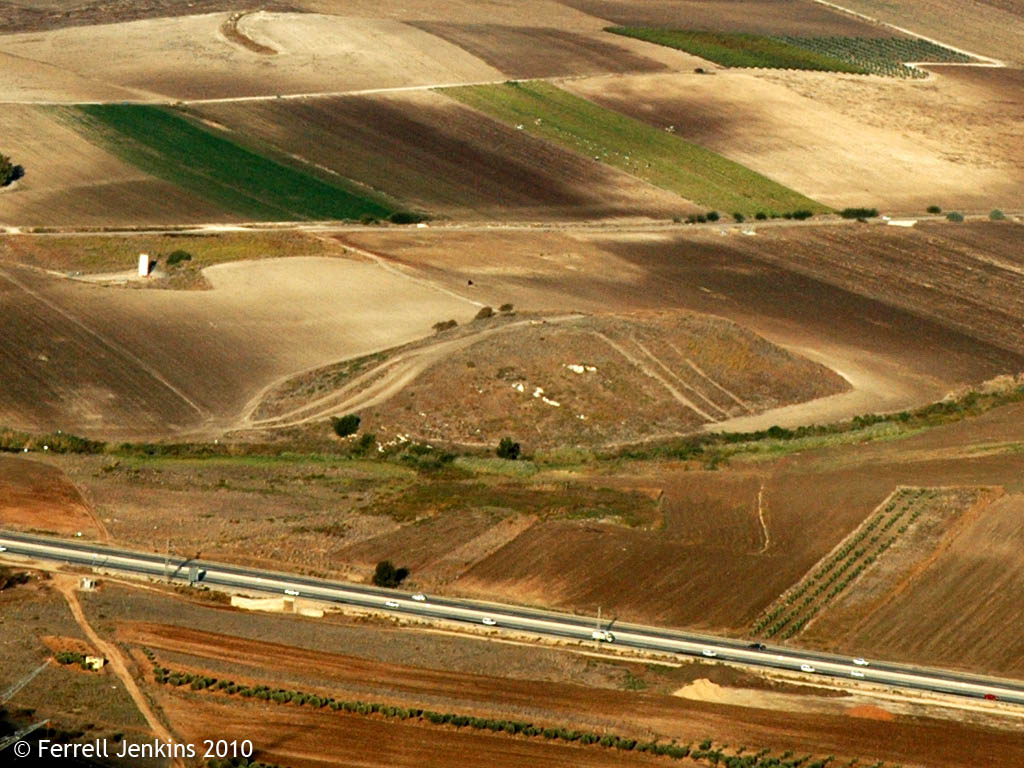
Those who have visited the site of Murakah on Mount Carmel have seen this tell and the Kishon River in the Jezreel Valley. The photo below shows the eastern end of the Jezreel Valley. The tell is in the center of the photo at the bottom. You can make out the line of the Kishon River below the tell. The dark areas in the photo are shadows of passing clouds. Click for a larger image.

Tell Kassis and the Kishon in the Jezreel Valley. Photo by Ferrell Jenkins.

Tell Kassis and the Kishon in the Jezreel Valley. Photo by Ferrell Jenkins.

This photo is a cropped portion of the previous photo. The tell is clearly visible.

Tell Kassis and the Kishon River from Mount Carmel. Photo by Ferrell Jenkins.

Tell Kassis and the Kishon River from Mount Carmel. Photo by Ferrell Jenkins.

Tell Kassis (or Tell el-Qasis) is thought by some scholars to be the Biblical Helkath. Helkath was a town belonging to the tribe of Asher (Joshua 19:25), and one of the Levitical cities (Joshua 21:31). This area is also associated with the battle of Deborah and Barak against the Canaanites (Judges 4-5). After the contest on Mount Carmel, Elijah had the prophets of Baal killed at the Brook Kishon.

And Elijah said to them, “Seize the prophets of Baal; let not one of them escape.” And they seized them. And Elijah brought them down to the brook Kishon and slaughtered them there. (1 Kings 18:40 ESV)

Rotem, the young lady who is webmaster for Bible Walks, lives only a few kilometers from the site. She has included many great photos of the mound and of the recent emergency excavations here.

HT: Joseph I. Lauer

The first cataract of the Nile

Aswan is the location of the first cataract of the Nile River. This made it an ideal location for the Aswan Dam which was built between 1898 and 1902. This created a small lake south of the dam, but it was nothing to compare with Lake Nasser which has been formed as a result of the building of the new high dam at Aswan between 1960 and 1971.

The new high dam was constructed at a time when the Soviet Union was providing technical, economic and military support to Egypt. I remember staying in a hotel in Egypt in 1973 filled with Soviet tourists. In the years following we saw none of them. Lake Nasser stretches south for more than 300 miles. Many of the Nubians who lived in this area were resettled by the Egyptian government.

Our photo was made below the new high dam from a Nubian settlement. Click on the photo for a larger image.

The first cataract of the Nile at Aswan. Photo by Ferrell Jenkins.

The first cataract of the Nile at Aswan. Photo by Ferrell Jenkins.

Some scholars identify the Arabic name Aswan with the Syene of Ezekiel 29:10 and 30:6. It may be identified with the Sinim of Isaiah 49:12.

I am against you and your waterways. I will turn the land of Egypt into an utter desolate ruin from Migdol to Syene, as far as the border with Ethiopia. (Ezekiel 29:10 NET)

The Hebrew word translated Ethiopia (or Cush) in some English versions is Kush (Cush).

Look, they come from far away! Look, some come from the north and west, and others from the land of Sinim! (Isaiah 49:12 NET)

The Text Critical note in the NET Bible explains,

The MT reads “Sinim” here; the Dead Sea Scrolls read “Syene,” a location in Egypt associated with modern Aswan. A number of recent translations adopt this reading: “Syene” (NAB, NRSV); “Aswan” (NIV); “Egypt” (NLT).

Goshen and the Great Bitter Lake

The land of Goshen is fascinating because it is much different from the Egypt that so many of us studied in elementary school. Instead of sand, river, and pyramids, Goshen is a flat agricultural region in the eastern Nile Delta.

Perhaps Goshen is most fascinating as the long-time home of the sons of Israel. Joseph told his brothers,

You shall dwell in the land of Goshen, and you shall be near me, you and your children and your children’s children, and your flocks, your herds, and all that you have. (Genesis 45:10 ESV)

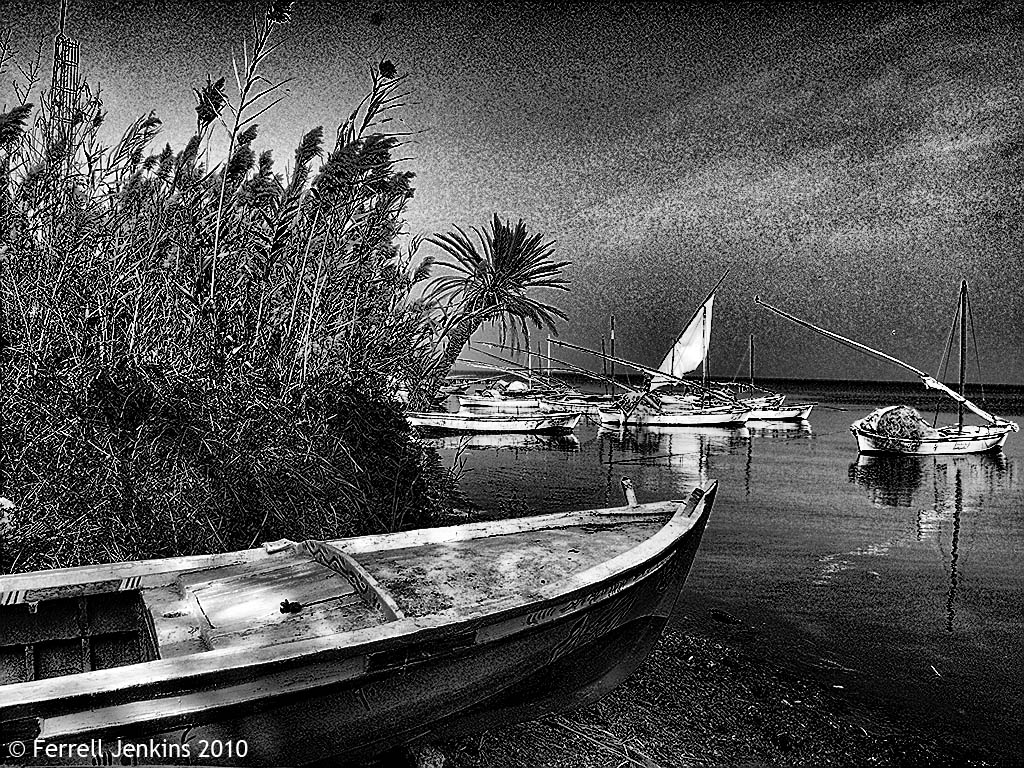
The photo below  shows reeds (bulrushes) growing on the banks of the Great Bitter Lake. This is the largest of a chain of lakes through which the Suez Canal runs. I have used a Photoshop plug-in called Topaz Adjust to turn this photo into a sketch that more resembles a photo made at night. If you think it might be useful in a lesson, you may click on the photo for a larger image.

Reeds (bulrushes) growing in the Great Bitter Lake. Photo by F. Jenkins.

Sketch of Reeds (bulrushes) growing in the Great Bitter Lake. Photo by F. Jenkins.

There are several good suggestions for the place of the exodus recorded in Exodus 14. This vicinity may be the sea described in Exodus 14:9.

Then the Egyptians chased after them with all the horses and chariots of Pharaoh, his horsemen and his army, and they overtook them camping by the sea, beside Pi-hahiroth, in front of Baal-zephon.

Other scholars suggest a location associated with Lake Timsa which is a few miles to the north.

Sadat of Egypt died in the pursuit of peace

My schedule is full, but I ran across this photo that I thought I would share. Anwar El Sadat was the third president of Egypt in modern times. He served from 1970 until his assassination October 6, 1981. Sadat made peace with Israel on March 26, 1979.

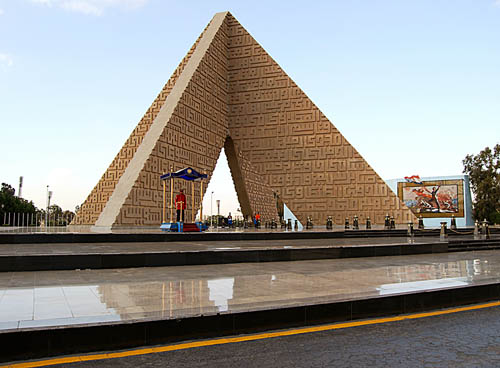
This photo shows the beautiful monument to Sadat that stands across the street from the viewing stands where he was assassinated.

Sadat Monument in Cairo. Photo by Ferrell Jenkins.

Sadat Monument in Cairo. Photo by Ferrell Jenkins.