Category Archives: Travel

The flea river: Nahr Bareighit or Nahal Iyon

The least known of the sources of the Jordan River is the Nahr Bareighit (flea river) or Nahal Iyon (the name used in Israel). Like the Senir (Hasbani), this river begins in the Beka Valley of Lebanon. It is often overlooked when the sources of the Jordan are named.

Nelson Glueck, The River Jordan, describes the Nahr Bareighit.

The westernmost source of the Jordan is the small mountain stream, Nahr Bareighit. Through a rude gorge, it tumbles down southward from the hilly meadowland of Merj ‘Ayun, which retains in clear part its ancient Biblical name of Ijon (1 Kings 15:20), to add its waters to the formation of the fateful [Jordan] river. The Nahr Bareighit joins the Nahr Hasbani about three quarters of a mile above the point where the Hasbani joins the junction of the Leddan and Banias streams. These last two alone were anciently considered as the sole sources of the Jordan. All found help to form it, and lose their identity in it, as the Jordan starts it flow under its own name.

“Roll, Jordan, roll;
I want to go to heaven when I die
To hear sweet Jordan roll.”

Deni Baly, The Geography of the Bible, devotes a single sentence to this little stream.

The basin of Marj ‘Ayoun to the west is drained by the smaller Bareighit, which leaps over the threshold in a series of charming waterfalls near Metullah and postpones its junction with the Jordan until just before the Huleh marshes. (193)

The photo below shows the Iyon Mill Falls. It is one of the beautiful photos of several falls on the river from the Pictorial Library of Bible Lands. Check BiblePlaces.com to purchase the complete set or the DVD of Galilee and the North.
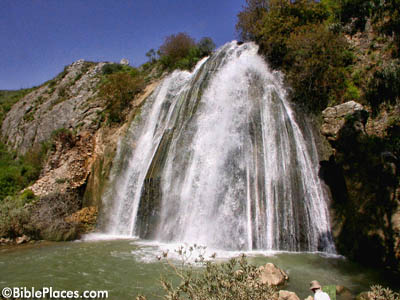
Nahal Iyon Mill Falls. Photo: BiblePlaces.com.

Nahal Iyon Mill Falls. Photo courtesy of BiblePlaces.com.
The Senir, a source of the Jordan River

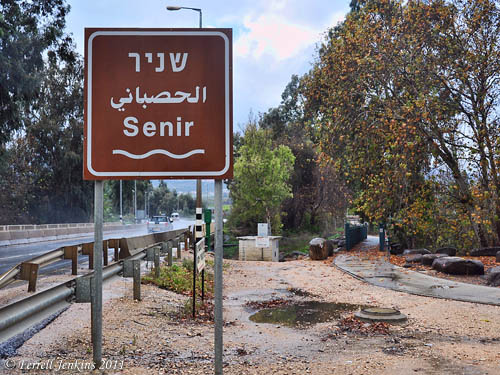
The longest source of the Jordan is the 24-mile-long Nahr Hasbani which begins in the Beka Valley of Lebanon and flows south to join the Jordan. Israel has replaced many of the Arabic names that were commonly used in earlier decades with Hebrew names. The Old Testament says that the Sidonians “call Hermon Sirion, and the Amorites call it Senir” (Deuteronomy 3:9). The river is now designated Senir in Israel.

At the Senir (Hasbani) on Israel Highway 99. Photo by Ferrell Jenkins.

At the Senir (Hasbani) on Israel Highway 99. Photo by Ferrell Jenkins.

Other passages identifying Mount Hermon as Senir are 1 Chronicles 5:23, Song of Solomon 4:8, and Ezekiel 27:5. Nelson Glueck, The River Jordan, calls attention to Psalm 42:6, translating it this way:

O my God, my soul is cast down within me: Therefore am I mindful of thee from the land of the Jordan, and the Hermons” (Psalm 42:6)

The plural of the Hebrew word chermonim is bought out in the English translations by phrases like “peaks of Hermon” or “heights of Hermon.”

Israel Highway 99 runs north east from Kiryat Shmona to the Golan Heights past Tel Dan and Banias (Caesarea Philippi) and two other sources of the Jordan (the River Dan and the River Banias). Because this river begins in the vicinity near Mount Hermon, it is called the Senir.

The photo below is the view north from Highway 99.

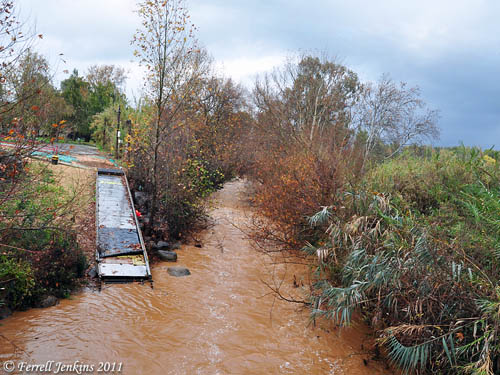
The Senir River (Hasbani) view north from HWY 99.

The Senir River (Hasbani) view north from HWY 99. Photo by Ferrell Jenkins.

I think the slide on the west side of the river is used to launch kayaks into the river.

Location of the Red Sea crossing and Mount Sinai

Others, in addition to the late Ron Wyatt, advocate the Red Sea Crossing at the Gulf of Aqaba/Eilat. Those who take this view also place Mount Sinai in Saudi Arabia.

If you have not taken a look at Life and Land by Gordon Franz, I suggest you do so. Gordon is a careful scholar. His material is always well researched and documented. One category that caught my attention at Life and Land is called Cracked Pot Archaeology. Here is how he describes this category.

The Cracked Pot Archaeology category contains articles about popular, contemporary archaeological theories and ideas that, like cracked pots, hold no water! These articles are a review, scholarly analysis and critiques of theories and ideas that have been presented on the Internet or popular books, movies, DVD’s and videos.

Over the past few years Gordon has written a number of articles about the claims of the late Ron Wyatt and Robert Cornuke. Cornuke claims to have found an anchor from Paul’s shipwreck on Malta. He also claims to have photographed an inscription with the name Yahweh (LORD/Jehovah) on it. The inscription was found near Jebel al-Lawz, in Saudi Arabia, which, according to Cornuke, Wyatt, and several others, is the real Mount Sinai.

Read the response by Franz here. The final sentence by Franz sums it up:

The assertion that Mount Sinai is at Jebel al-Lawz in Saudi Arabia still lacks credible and verifiable historical, geographical, archaeological, or biblical evidence.

You will find links to three articles dealing with the claim that Jebel al-Lawz in Saudi Arabia is Mount Sinai. Another, more technical article by Franz, is entitled “Mount Sinai is not Jebel al-Lawz in Saudi Arabia.” It is available at the ABR web site here.

Franz claims that the article,

will conclusively demonstrated that there is no credible historical, geographical, archaeological or Biblical evidence to support the thesis that Mt. Sinai is at Jebel al-Lawz in Saudi Arabia.

Later on, over a period of weeks (months?), as time permits, I hope to deal with specific questions about the biblical places mentioned in the account of the exodus.

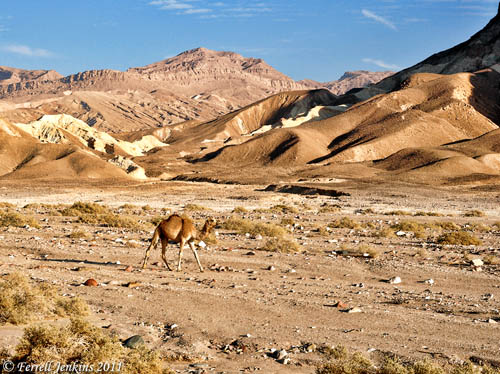
The terrain in the Sinai peninsula is varied. The photo below shows one scene. This photo was made January 25, 2011, the day the Revolution began in Egypt.

A scene in the Sinai Peninsula. Photo by Ferrell Jenkins.

A scene in the Sinai Peninsula. Photo by Ferrell Jenkins.

Camels in biblical times

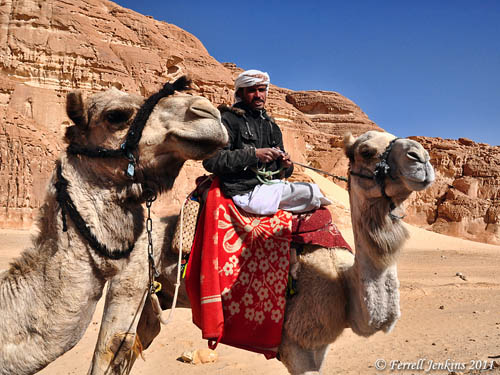
Camels are mentioned in the Bible from the days of Abraham (Genesis 12:16) to New Testament times (Mark 1:6). Recently while traveling in the eastern Sinai peninsula near the Gulf of Aqaba (Eilat) we saw a large number of camels with their riders.

Camels in the Eastern Sinai Peninsula. Photo by Ferrell Jenkins.

Camels in the Eastern Sinai Peninsula. Photo by Ferrell Jenkins.

When the Queen of Sheba visited Jerusalem to quiz Solomon she brought with her a large retinue, with camels carrying valuable gifts for Solomon.

Now when the queen of Sheba heard of the fame of Solomon, she came to Jerusalem to test Solomon with difficult questions. She had a very large retinue, with camels carrying spices and a large amount of gold and precious stones; and when she came to Solomon, she spoke with him about all that was on her heart. Solomon answered all her questions; nothing was hidden from Solomon which he did not explain to her. (2 Chronicles 9:1-2 NAU)

Mahanaim — where Jacob wrestled with an angel

The name Mahanaim is found 13 times in the Old Testament. The site is where Jacob and Laban met and made a covenant. Mahanaim seems to mean “two camps” (Genesis 32:2). This is where Jacob’s name was changed to Israel after he wrestled with a man (angel, Hosea 12:4). When morning came Israel crossed over Penuel (Genesis 32:31).

Two large tells face each other and the Jabbok River flows in an S-curve between them. The tells are now named Tall adh-Dhahab East and Tall adh-Dhahab West. These tells are located a few miles east of the Plains of the Jordan and Tell Deir Allah (likely the site of biblical Succoth). Some scholars identify Dhahab West as Mahanaim and Dhahab East as Penuel. Other scholars reverse the identifications.

When Transjordan was divided among the tribes, Mahanaim was located in the territory of Gad on the boundary with East Manasseh (Joshua 13:26, 30). It was one of the cities allotted to the Levites (Joshua 21:38; 1 Chronicles 6:80).

After the death of Saul, Abner made Ishbosheth, the son of Saul, king over all Israel from Mahanaim (2 Samuel 2:8, 12, 29).

When David fled from his rebellious son Absalom he fled across the Jordan to Mahanaim (2 Samuel 17:24, 27; cf. 2 Kings 2:8). Absalom met his death in a nearby forest.

A Gileadite by the name of Barzillai took care of King David while he stayed at Mahanaim (2 Samuel 19:32). The city became one of Solomon’s administrative centers (1 Kings 4:14).

Song 6:13 describes gazing upon the Shulammite girl to be like looking on “the dance of the two camps” or “dance of two companies” (CSB, JPS, NAU, NKJ). Other translations use the expression “the dance of Mahanaim” (ASV, NIV, NJPS, TNIV) or “dance of the Mahanaim” (NET).

Recent excavations at Dhahab West, conducted by a German team, have revealed what they believe to be part of a monumental building of Herod the Great. They think this was the Hellenistic and Roman site described by Josephus as Amathus.

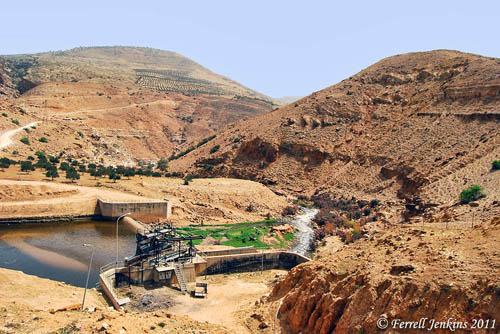
Tall adh-Dhahab East (left) and Tall adh-Dhahab West (right). Photo by Ferrell Jenkins.

Tall adh-Dhahab East (left) and Tall adh-Dhahab West (right). These are thought to be the sites of Mahanaim and Penuel. Photo by Ferrell Jenkins.

Our photo shows both tells. (Tall adh-Dhahab East is on the left. Tall adh-Dhahab West is on the right.) There is a pumping station on the Jabbok to provide agricultural irrigation. The Jabbok continues in the valley separating the two hills and tells.

Click on the photo for an image suitable for use in teaching presentations.

Bauckham on the Gospels as Histories

Last Wednesday I went to the Reformed Theological Seminary near Orlando to hear a lecture by Prof. Richard Bauckham. Bauckham was the speaker for the annual Kistemaker Academic Lecture Series. His general topic was The Gospels as Histories: What sort of history are they? I suspect that he was reading chapters that will eventually be published in a new book.

I found Bauckham, Professor Emeritus at St. Andrews University, difficult to understand during the lecture because of the his accent, but I was able to keep up with the general thread of his argument.

If you would like a little taste of Bauckham’s argument about Jesus and the Eyewitnesses I suggest you watch this short video by StJohnsNottingham (other interesting videos also available).

I was delighted to pick up a copy of Jesus and the Eyewitnesses: The Gospels as Eyewitness Testimony at the bookstore and have it autographed by Prof. Bauckham.

Richard Bauckham signs a book. Photo by Ferrell Jenkins.

Richard Bauckham autographs a book. Photo by Ferrell Jenkins.

Order Jesus and the Eyewitnesses from Amazon.
Jesus and the Eyewitnesses: The Gospels As Eyewitness Testimony

Bauckham’s material speaks clearly to the common misconception that the “Church” compiled the Gospels decades, even centuries, after Jesus lived.

Discovery’s last trip

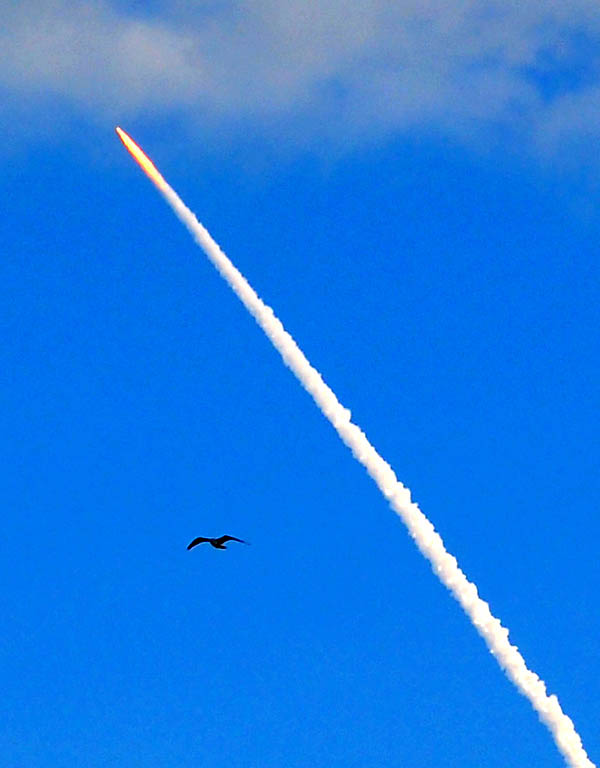
It is not like being at Kennedy Space Center, but we had a nice view of the first few seconds of Discovery’s last trip. We have been at Daytona Beach for the past two days. I think this is about 45 to 50 miles north of the Kennedy Space Center.

Discovery's last trip. Photo by Ferrell Jenkins. Feb. 24, 2011.

Discovery's last trip. Photo by Ferrell Jenkins. Feb. 24, 2011.

We took our two sons to see the Apollo 11 blast-off almost 42 years ago. See photo here.

Trust each of you have your sights set on something higher.

Set your minds on things that are above, not on things that are on earth. (Colossians 3:2 ESV)

Mark Wilson’s book on Biblical Turkey

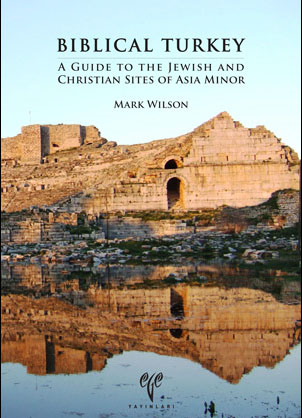
Mark Wilson’s book on Biblical Turkey: A Guide to the Jewish and Christian Sites of Asia Minor is now available through Amazon. Use this Amazon link to order.
Biblical Turkey: A Guide to Jewish and Christian Sites of Asia Minor

A little over two months ago I started a post about Wilson’s book, intending to write a brief review. I see now that A. D. Riddle has written a review over at the Bible Places Blog. I direct our readers to that post for more info about the book.

Since 2003 we have had A Guide to Biblical Studies in Greece and Turkey by Fant and Reddish. Now we have a book by Mark Wilson that is superior in several ways. Wilson includes sites not mentioned by Fant and Reddish, and his book contains an abundance of color photos. Every person who plans a trip to Turkey to visit Biblical sites should study both books.

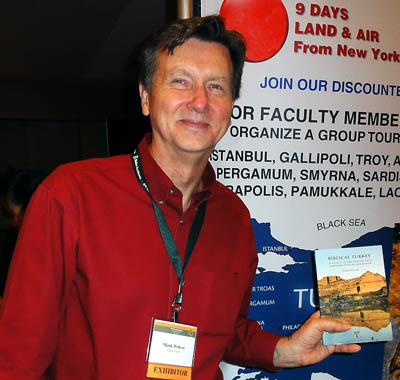
Dr. Wilson proudly displayed his book at the SBL meeting in Atlanta last November. Mark loves Turkey and its biblical sites. For several years he has spent at least half his time studying and exploring in Turkey. If you wish to know about the biblical sites of Turkey, you will enjoy this book.

Mark Wilson shows his new book at SBL in Atlanta. Photo by Ferrell Jenkins.

Mark Wilson shows his book at SBL in Atlanta. Photo by F. Jenkins.

Dr. Wilson spoke to one of my groups in Izmir in 2008. See here.

The donkey: beast of burden

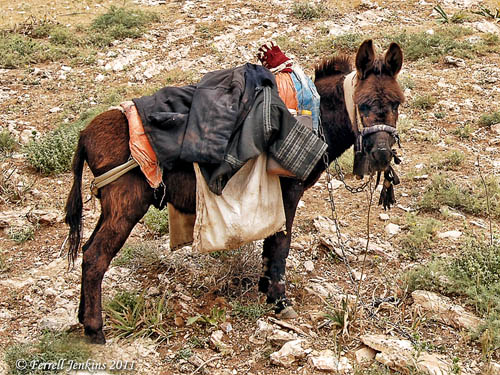
Donkeys are mentioned throughout the Bible beginning in Genesis 16:12. This photo shows the donkey belonging to a shepherd in the area of Gilead in Transjordan.

A donkey in Gilead (Transjordan). Photo by Ferrell Jenkins.

A donkey in Gilead (Transjordan). Photo by Ferrell Jenkins.

Abraham took a donkey when he went to the land of Moriah to offer Isaac.

So Abraham rose early in the morning and saddled his donkey, and took two of his young men with him and Isaac his son; and he split wood for the burnt offering, and arose and went to the place of which God had told him. (Genesis 22:3 NAU)

Jesse loaded a donkey with food supplies to send to Saul when the Israelites fought against the Philistines in the Valley of Elah.

Jesse took a donkey loaded with bread and a jug of wine and a young goat, and sent them to Saul by David his son. (1 Samuel 16:20 NAU)

Walking on Roman roads

Gordan Franz, Life and Land Seminars, recently led the 2011 Talbot Bible Lands study tour of Turkey and Greece. He writes about the Roman roads used by Paul in his journeys. See here.

Photos are included of the following roads, portions of which still exist.

  • The Via Taurus, “a beautifully preserved road between Tarsus and the Cilician Gates” (Acts 15:36).
  • The Via Sebaste (“Emperor’s Road”) connecting Iconium and Pisidian Antioch (Acts 13:51; 14:21-23).
  • The Roman Road west of Assos (Acts 20:22-23).
  • The Roman Road inside the city of Alexandria Troas leading to the harbor (Acts 16:8-11).
  • The Via Egnatia which connected Neapolis and Philippi (Acts 16:11-12; 20:6).
  • The Appian Way (Acts 28:14-16).

The link to photos made by one of the tour members is given at the bottom of the article. At this moment you will need to copy the link and paste it into your browser. There is an extra http// in the embedded code.

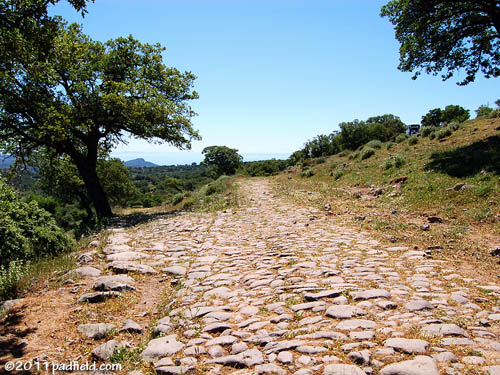
The photo below is one provided by friend David Padfield of the Roman road near Assos.

Roman Road near Assos. Photo by David Padfield.

Roman Road near Assos. Photo by David Padfield.

I have been on journeys many times, in dangers from rivers, in dangers from robbers, in dangers from my own countrymen, in dangers from Gentiles, in dangers in the city, in dangers in the wilderness, in dangers at sea, in dangers from false brothers… (2 Corinthians 11:26 NET)