Category Archives: Travel

Shepherd with sheep and goats at Socoh

Today we visited sites in the Shephelah (lowlands, foothills, Deuteronomy 1:7). We discussed the importance of the Sorek Valley, Beth Shemesh, Timnah, Eshtaol, Zorah. Think of Samson. We noted the important sites associated with the Valley of Elah: Azekah, Khirbet Queiyafa (the Elah Fortress), and Socoh. Think of David and Goliath.

At Socoh (1 Samuel 17:1) we had one of those nice moments on tour when something unexpected comes along. We saw two shepherds bringing their sheep and goats to water. The photo below is one of several that I made.
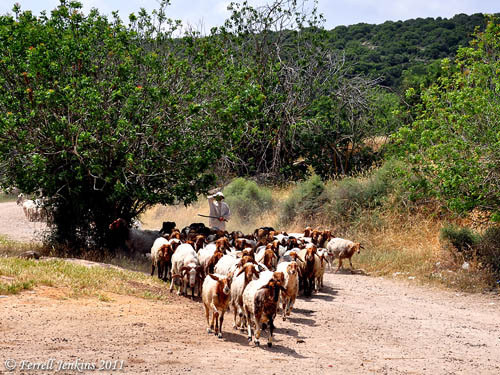
Shepherd with sheep and goats at Soccoh. Photo by Ferrell Jenkins.

Shepherd with sheep and goats at Socoh. Photo by Ferrell Jenkins.

I am reminded of the teaching of Jesus about the importance of the shepherd.

When he saw the crowds, he had compassion on them because they were bewildered and helpless, like sheep without a shepherd. Then he said to his disciples, “The harvest is plentiful, but the workers are few. Therefore ask the Lord of the harvest to send out workers into his harvest.” (Matthew 9:36-1 NET)

We also made stops at Lachish and Gath before dinner along the Mediterranean Sea at Joppa, and then heading for the airport.

Our group is scheduled to depart for the USA shortly after midnight. Six tour members are staying over for varying length to pursue additional visits throughout the area.

Thank you for following the blog these past two weeks. I have written less than usual due to the demands of the tour, and this will continue for another week as I spend time in additional study here. Stay with me.
Prayers disturbed by a snake in the wall

Our group went to the Western Wall this afternoon. The Western Wall, sometimes called the Wailing Wall by non-Jews, is part of the enclosure built by Herod the Great around the temple precinct in Jerusalem. The temple and everything else on the top of the platform was destroyed by the Romans in A.D. 70.

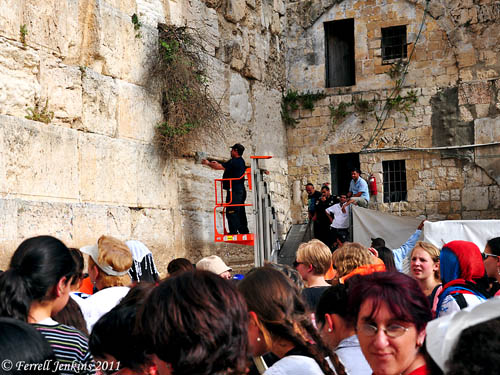
The Western Wall is now a place for prayer. Men have a large portion of it for their use. To the south there is a small area for women. I entered the enclosure north of the men’s section to get a photo of Wilson’s Arch. When I came out I noticed a workman on the lift trying to get something out of the wall with a long stick. At first I thought he was removing some of the paper prayers that had been left in the wall by worshipers. I learned from one of our ladies who was there that a snake had been seen by the ladies.

Of more interest to me was that the snake was somewhere around the lintel of Barclay’s Gate.

Women watch at the Western Wall while workmen remove snake from the wall. Photo by Ferrell Jenkins.

Women watch at the Western Wall while workmen remove snake from the wall. Photo by Ferrell Jenkins.

It is not often that one see’s men on the women’s side of the Western Wall plaza. Well, I never have before.

A number of biblical references come to mind. The prophet Amos says,

18 Alas, you who are longing for the day of the LORD, For what purpose will the day of the LORD be to you? It will be darkness and not light;
19 As when a man flees from a lion And a bear meets him, Or goes home, leans his hand against the wall And a snake bites him.
20 Will not the day of the LORD be darkness instead of light, Even gloom with no brightness in it?  (Amos 5:18-20 NAU)

I imagine the same thing would happen to a woman as well as to a man.

We recall the serpent of the Garden of Eden (Genesis 3). Paul used that event as an illustration.

 But I am afraid that, as the serpent deceived Eve by his craftiness, your minds will be led astray from the simplicity and purity of devotion to Christ. (2 Corinthians 11:3 NAU)

Earlier today we visited the Herodian Family tomb, the Second Temple Model, Shrine of the Book, and the archaeological section of the Israel Museum. I had visited the renovated Museum in January and was ready to take the group to some of the more significant biblically related artifacts. For the earlier discussion of some of these things see here (Old Testament) and here (New Testament).

In the afternoon we entered the Old City and visited the Jewish Quarter and the Western Wall.

We look forward to completing our planned visit of the Old City tomorrow. Lots of walking in the Old City.

Everyone in the group is doing well and seems to be enjoying the experience. We have about a dozen who have been here at least once before. They are seeing new things every day and enjoying a revisit to things they saw on a previous tour.

The baptism site in Israel

We had a surprise for the tour group today.

Arrangements had been made through our tour operator to visit the traditional site where John the Baptist worked, and where Jesus was baptized in the Jordan River.  This site, called Qasr al-Yahud, has been closed since 1967 except for the use of the Greek Orthodox Church on special occasions such as Epiphany. The area from the main highway to the site is still military. We had to get special permission and arrive at an appointed time in order to enter.

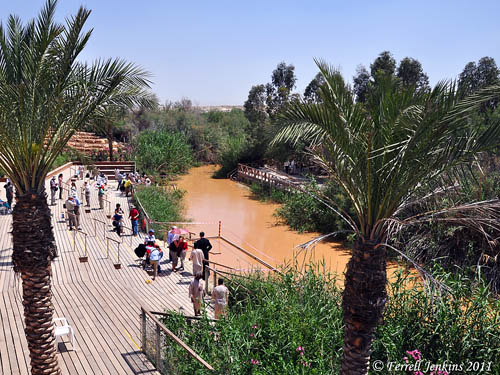
The photo shows a portion of the  yet incomplete new site, the Jordan River, and the access point across the river in Jordan. The Jordanian site claims to be Bethany beyond the Jordan.

25 They asked him, and said to him, “Why then are you baptizing, if you are not the Christ, nor Elijah, nor the Prophet?”
26 John answered them saying, “I baptize in water, but among you stands One whom you do not know.
27 “It is He who comes after me, the thong of whose sandal I am not worthy to untie.”
28 These things took place in Bethany beyond the Jordan, where John was baptizing.
29 The next day he saw Jesus coming to him and said, “Behold, the Lamb of God who takes away the sin of the world!
30 “This is He on behalf of whom I said, ‘After me comes a Man who has a higher rank than I, for He existed before me.’
31 “I did not recognize Him, but so that He might be manifested to Israel, I came baptizing in water.”
32 John testified saying, “I have seen the Spirit descending as a dove out of heaven, and He remained upon Him.
33 “I did not recognize Him, but He who sent me to baptize in water said to me, ‘He upon whom you see the Spirit descending and remaining upon Him, this is the One who baptizes in the Holy Spirit.’
34 “I myself have seen, and have testified that this is the Son of God.” (John 1:25-34 NAU)

Traditional Baptism Site on the Jordan River. Photo by Ferrell Jenkins.

Traditional Baptism Site on the Jordan River. Photo by Ferrell Jenkins.

This location is also the in the area where ancient Israel crossed from the Plains of Moab into the promised land.

The new site will be nice once it is completed and the road is upgraded.

We also visited Wadi Qelt, Qumran, the Dead Sea, and Masada today.

The group photo in Jerusalem

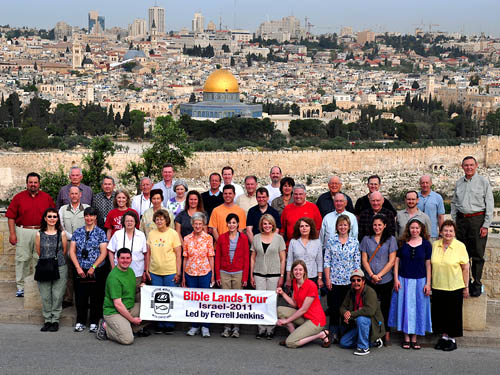
Our group had a wonderful day for the traditional photo from the Mount of Olives with Jerusalem as a backdrop.

Bible Land Tour of Israel Group Led by Ferrell Jenkins.

Bible Land Tour of Israel Group Led by Ferrell Jenkins.

If you know some of the folks in the group you might like to look at a larger image here.

Post Number 1,000

This, incidentally, is post number 1,000 for this blog. I have never tried to emphasize an abundance of posts, but to concentrate on posts of some quality. And, I have tried to stay close to the general purpose that we set forth at the beginning. We concentrate on places and significant events in the Bible World.

Thanks for following our journeys.

A personal note about other traveling bloggers

In recent years it is common for tour members to begin a blog and post their impressions and photos during the tour. I must say that this isn’t always easy. First there is the problem of connecting to the Internet. I have an unlocked air card that has worked with a local data SIM card. This time I am having trouble with it. The rates for the use of the Internet at the Tiberias hotel was $23 a day. Highway robbery! The hotel here in Jerusalem charges $15 a day. Local street robbery!  Then there is the problem of time. I have seen bloggers up until late hours just getting online, preparing photos and writing readable info for friends back home.

The bloggers also lug around expensive computer and photographic equipment in order to accomplish the self-appointed task.

I thought that some of our readers might like to take a look at how these bloggers are handling the matter. A couple of them are using WordPress, and one is using Blogger.

Nick and Erin Smith are blogging at Oh, the Places We Go here. Nick and Erin are a young married couple making their first foreign trip.

Stephen Cook is blogging under the title From Athens to Israel here. Stephen is from Athens, Alabama. Stephen has done some foreign travel before.

All three of these folks are on their first tour of the Bible Lands. Their perspective will reveal the approach of a first time traveler to the area. They are looking forward to using their new knowledge and photos in Bible teaching. And they all come from North Alabama, an area hit by the recent tornadoes that devastated some areas of the South last Wednesday. Fortunately their property was untouched.

Larry Haverstock is blogging under his own name here. This is Larry’s second tour in as many years. He knows exactly why he is here this year. He wishes to gain a deeper understanding of the land and its relation to the Word. He is an experienced minister who already understands exactly how he will use what he is learning.

Former Travelers Back Home Braving the Storms

Olen and Jane Britnell, also from North Alabama, have traveled with us on a number of tours. Jane blogs when she travels. She is not on this tour, but she is blogging again. This time it is about the devastating storms that hit all around them a few days ago. You might enjoy reading this first hand report. She also includes info on Shirley — another personal friend who lost her house in the storm. Shirley has traveled with us on numerous tours, and  is a faithful follower of this blog. The blog, wesurvivedthestorms, is here.

Living springs of water

Today we traveled north from Tiberias on the Sea of Galilee to Hazor. About the time our bus stopped the rain began. We waited a while, but left the bus as soon as the rain let up. This gave an opportunity to visit the gate, the Canaanite palace, and a few other areas before the rain started again. Finally we left and went on to Dan. There we were able to visit the site with only sprinkles.

By this time of the year I had come to expect that major rains (the latter rains, Joel 2:23) would be over, but still delighted to see the rains coming to a land that has suffered drought for a few years.

From Dan we continued to Banias, the site of New Testament Caesarea Philippi. This is the area where Peter confessed Jesus to be the Christ, the Son of the Living God, and where Jesus made the promise to build His church.

Now when Jesus came into the district of Caesarea Philippi, He was asking His disciples, “Who do people say that the Son of Man is?” And they said, “Some say John the Baptist; and others, Elijah; but still others, Jeremiah, or one of the prophets.”  He said to them, “But who do you say that I am?”  Simon Peter answered, “You are the Christ, the Son of the living God.” And Jesus said to him, “Blessed are you, Simon Barjona, because flesh and blood did not reveal this to you, but My Father who is in heaven.  “I also say to you that you are Peter, and upon this rock I will build My church; and the gates of Hades will not overpower it.  “I will give you the keys of the kingdom of heaven; and whatever you bind on earth shall have been bound in heaven, and whatever you loose on earth shall have been loosed in heaven.”  Then He warned the disciples that they should tell no one that He was the Christ. (Matthew 16:13-20 NAU)

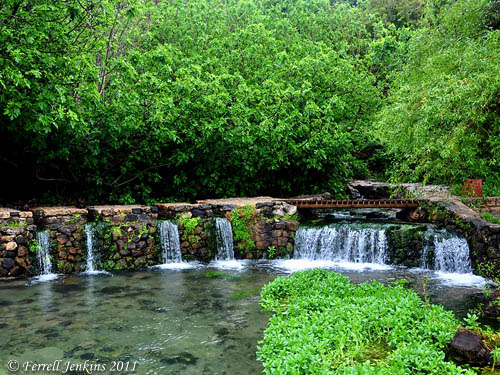
It was still raining some, but I was much impressed with the force of the water today. I have been here on probably every tour since the site has been under Israeli control. I don’t recall ever seeing so much water surging from the earth. This is a good sign, I think.

Here is a photo made looking north toward the source of the River Banias, the easternmost source of the Jordan River.

Looking to the source of the Banias River. Photo by Ferrell Jenkins.

Looking to the source of the Banias River. Photo by Ferrell Jenkins.

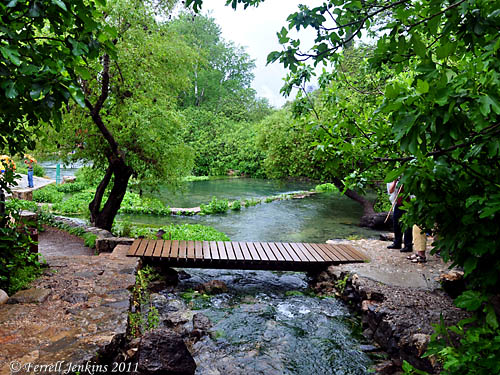
The photo below shows the same area from the north. Here we are immediately above the outlet of the powerful springs.

River Banias, a source of the Jordan, from the North. Photo by Ferrell Jenkins.

River Banias, a source of the Jordan, from the North. Photo by Ferrell Jenkins.

We got only an occasional glimpse of Mount Hermon to see the patches of snow on it.

A beautiful day in Galilee and at Megiddo

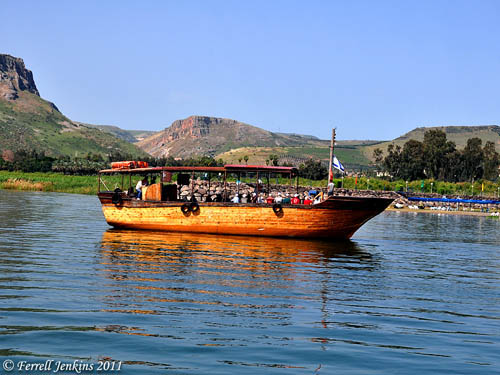
This morning we took our group on the usual boat ride across the Sea of Galilee. We left Tiberias and sailed to near the Cove of the Sower and then turn west to Nof Ginosaur on the western coast of the Sea. Ginosaur is the English Gennesaret.

Boat approaches the region of Genesaret. Photo by Ferrell Jenkins.

Boat approaches the region of Genesaret. Photo by Ferrell Jenkins.

After they had crossed over, they came to land at Gennesaret and anchored there.  As they got out of the boat, people immediately recognized Jesus.  They ran through that whole region and began to bring the sick on mats to wherever he was rumored to be. And wherever he would go– into villages, towns, or countryside– they would place the sick in the marketplaces, and would ask him if they could just touch the edge of his cloak, and all who touched it re healed.  (Mark 6:53-56 NET)

I noticed to significant things about the Sea of Galilee today.

  1. It appeared to be higher than the three or four previous times I saw it.
  2. Fishing boats were missing when I looked from my room to the Sea this morning. We have come to expect many fishing boats plying the quiet waters, but this has changed since the fishing ban was put into effect.

Indeed, the Sea level is higher. We reported December 11, 2009, that the level was 703,12 feet below Mediterranean sea level. In October , 2010, the level had risen to 701.71 feet below sea level.

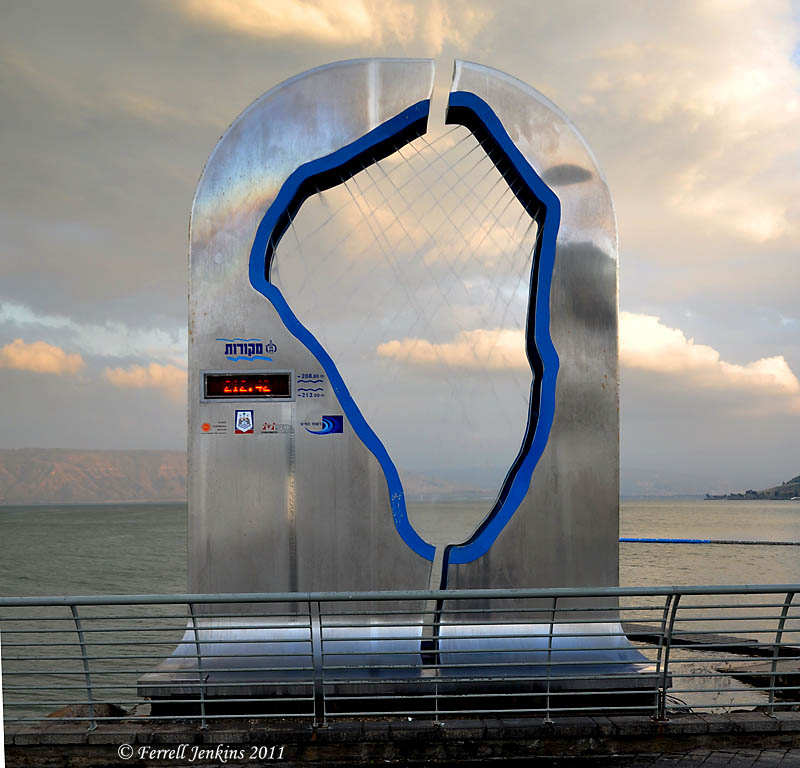
Sea of Galilee guage, April 29, 2011. Photo by Ferrell Jenkins.

Sea of Galilee gauge, April 29, 2011 shows -212.42. Photo by Ferrell Jenkins.

After we returned to the hotel at Tiberias, I walked down to the pier to see the current measurement. The Sea was 212.42 meters below sea level (= 696.916 feet). The rise of the water is significant. The all time low is about 704 feet below sea level. The maximum former level is about 686 feet below sea level. Look carefully and you will see jets of water streaming through the Sea gauge.

Yesterday we stopped at Megiddo to look at the model of the city, but due to the rain we decided not to visit the tel. This afternoon we returned. The view of the Jezreel Valley was good.

And, there was more…

The missing luggage for our two wayward tour members was at the hotel when we returned.

We have several tour members from Alabama, Georgia, and Tennessee. Various ones were getting more reports of severe damage in their area back home, but none reported personal injury. For this we are thankful. The prayers of all spiritual persons is appreciated.

Difficult to make Internet connection tonight

Everyone in our group is well, and our two delayed tour members arrived early this morning. I am having difficulty with my air card this evening in Tiberias. We had some light rain off and on today. Tonight we are in Tiberias.

Regret to hear about the terrible devastation and loss in the southern USA, including some we know personally.

Jonah sailed from Joppa

Our group arrived in Israel today except for two persons who were delayed due to a bad weather connection in Detroit. Just learned a few minutes ago that they are on their way via Paris.

We had time to visit Joppa (Yafo) before proceeding to Netanya, along the Mediterranean coast, for overnight.

Joppa is located in the Plain of Sharon and served as the seaport for Jerusalem which is about 35 miles away. The city is now called Jaffa, or Yafo. Joppa was a walled town as early as the reign of Pharaoh Thutmose III (1490-1435 B.C.) who mentions Joppa in his town lists.

Here are a few of the biblical highlights for Joppa.

  • Joppa was assigned to the tribe of Dan, but was not controlled by the Israelites till the time of David (Joshua 19:46).
  • Hiram of Tyre floated cedar from Lebanon to Joppa for Solomon’s Temple (2 Chronicles 2:16).
  • Jonah sought a ship for Tarshish at Joppa to avoid going to Nineveh (Jonah 1:3).
  • Cedars from Lebanon again were floated to Joppa for the rebuilding of the temple (520-516 B.C.; Ezra 3:7). The port of the city is behind St. Peter’s Church.
  • Tabitha (Dorcas) lived in Joppa. When she died the disciples sent for Peter who was a Lydda. He came to Joppa and raised Dorcas (Acts 9:36-42). (Acts 10:6).
  • Peter stayed many days in Joppa with Simon the tanner (Acts 9:43). His house was by the sea (Acts 10:6). A house near the port is shown as the house of Simon, but there is no way to know this with certainty.
  • Peter received the housetop vision and learned that he was to go to Caesarea to preach the gospel to the Gentiles at the house of the Roman centurion Cornelius (Acts 10:23).

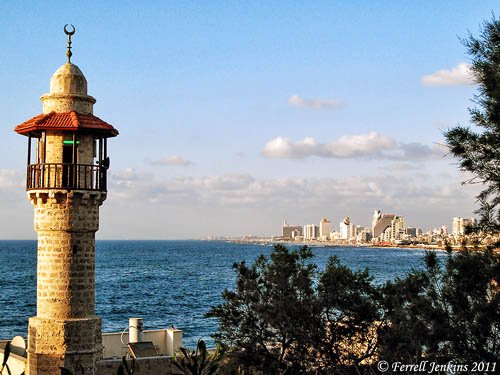
The photo below shows the view of modern Tel Aviv from Joppa. The minaret in the foreground dates to the Turkish period.

View of modern Tel Aviv from Joppa. Photg by Ferrell Jenkins.

View of modern Tel Aviv from Joppa. Photo by Ferrell Jenkins.

Peter: “God raised him on the third day”

In the first gospel sermon preached to Gentiles at the house of Cornelius, Peter said,

39 And we are witnesses of all that he did both in the country of the Jews and in Jerusalem. They put him to death by hanging him on a tree,
40 but God raised him on the third day and made him to appear,
41 not to all the people but to us who had been chosen by God as witnesses, who ate and drank with him after he rose from the dead.
42 And he commanded us to preach to the people and to testify that he is the one appointed by God to be judge of the living and the dead.
43 To him all the prophets bear witness that everyone who believes in him receives forgiveness of sins through his name.” (Acts 10:39-43 ESV)

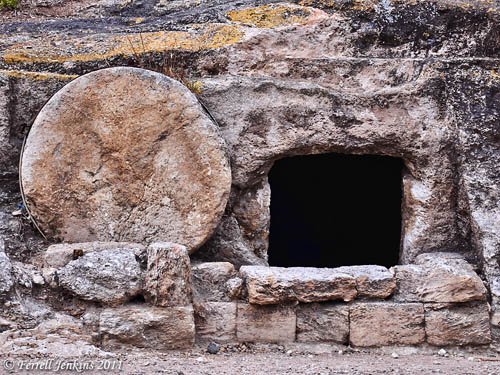
Last year we wrote about The Empty Tomb here, and used a photo of a tomb with a rolling stone. Our photo today is of the same tomb, but it is a different photo which we thought might be useful to those teaching on the resurrection of Christ. This tomb was uncovered during road work at the foot of Mount Carmel near the Jezreel Valley.

Tomb with rolling stone near Jezreel Valley in Israel. Photo by Ferrell Jenkins.

Roman period tomb with a rolling stone. Photo by Ferrell Jenkins.

A larger image, suitable for use in teaching presentations, is available by clicking on the photo above.