Category Archives: Old Testament

Honoring Dr. Jack P. Lewis

Dr. Jack P. Lewis was honored March 6 at a dinner hosted by Faulkner University, Montgomery, Alabama, during their annual Bible lectureship. I was pleased that I could attend the lectures one day and be present for the dinner honoring Dr. Lewis.

Lewis is Professor Emeritus at the Harding Graduate School of Religion in Memphis. Among several good teachers that I had, Lewis was unique. He holds two earned doctorates, a Ph.D. in New Testament from Harvard, and a Ph.D. in Old Testament from Hebrew Union. He was the most demanding teacher I had, and one of a few from whom I learned the most.

After the high school years at Athens Bible School, and four years of Bible at Florida Christian College (now Florida College), with teachers such as Homer Hailey, I had a good general knowledge of the Bible. I think I had about 60 hours of Bible at FCC. The graduate work was not too difficult, it was just on a higher level.

It was part of the graduate program generally, but Lewis taught the importance of using primary sources where possible and the importance of thorough preparation. He entered the class room, called the roll, and began lecturing. As a student I made notes the best I could, then spent hours after each class verifying the names, dates, and facts presented. Different from the students I had in college, we would never imagine asking “How do you spell that?” He taught us the importance of using up-to-date sources in our research.

Jack Lewis was my first teacher who had spent a considerable amount of time studying the land of the Bible. He had worked in the archaeological excavation at Arad, and had spent a year as a fellow at the American Schools of Oriental Research in Jerusalem (now the Albright Institute).

In one of the classes with Dr. Lewis I did a paper on “Authentic First Century Remains in Palestine.” Soon afterward I began to prepare for my own visit to the Bible lands. I might have gone anyway, but I must credit Dr. Lewis, and his unique insight into the land of the Bible, for spurring my interest in traveling to this part of the world. The other day, as we visited, he said something like this: “There is nothing as valuable as seeing the places you study about.” So, now you know one of the major motivations in my travels to Bible lands over all these years since the first trip in 1967. I still learn on every trip, and in the preparation for the trip.

Dr. Lewis is a prolific writer. His many books included The History of the English Bible from the KJV to the NIV, The Interpretation of Noah and the Flood in Jewish and Christian Literature, Historical Backgrounds to Bible People, a two volume commentary on the Gospel of Matthew. There are also books on the prophets and other areas of biblical studies.

Several Faulkner faculty members spoke of what Lewis had meant to them. These included Dr. Cecil May, Jr., Dr. Carl Cheatham, and Dr. Ed Hicks. Dr. Jim Howard, from Memphis, was also on the program. Carl and Jim were at HGSR when I was there. Cecil and I spoke on the same topic at both the Nashville and Dallas meetings of institutional and non-institutional brethren a few years back. It was a pleasure to see them.

In the afternoon, Dr. Lewis had presented a lecture on “The Battle for the Integrity of the Bible.” In his typical rapid-fire manner, he surveyed the battles that have been won in demonstrating the integrity of the Bible. It was just a survey, but he seemed as sharp as in those classes on The History of the English Bible and on Archaeology and the Bible from which I profited so much.

Today Dr. Jack Pearl Lewis is 89 years old. Happy birthday, Dr. Lewis.
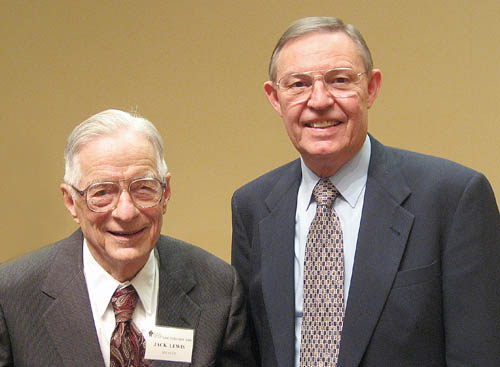
Dr. Jack P. Lewis and Ferrell Jenkins. Photo by Leon Mauldin.

This photo was made March 6 after the lecture on “The Battle for the Integrity of the Bible.”
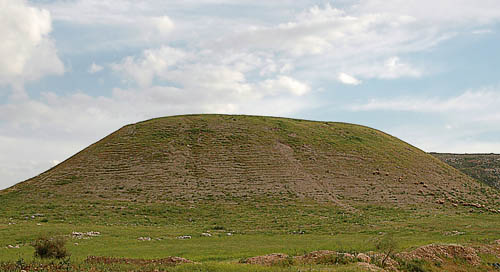
The Home of Elisha

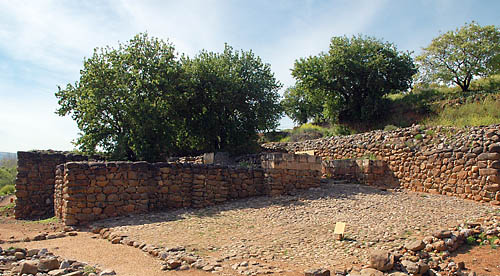
Abel Meholah (or Abel-meholah), NAS, ESV is a tell in the Jordan Valley, about 10 miles south of Beth-shean. It is mentioned only three times in the Bible. The Midianites, who were fleeing from Gideon’s army of 300, fled as far as the border of Abel Meholah (Judges 7:22).

Solomon (reigned 970-931 B.C.) set up administrative officers over Israel. Baana, the son of Ahilud, was over the fifth district that included Abel Meholah.

Baana the son of Ahilud, in Taanach, Megiddo, and all Beth-shean that is beside Zarethan below Jezreel, and from Beth-shean to Abel-meholah, as far as the other side of Jokmeam (1 Kings 4:12, ESV).

Many of us likely would find Abel Meholah of interest as the home of Elisha the prophet. When Elijah met the LORD at Horeb, the mountain of God, he was told to do three things: (1) Anoint Hazael king over Aram [Syria]; (2) Anoint Jehu king over Israel; (3) Anoint Elisha from Abel Meholah to take his place as prophet. This took place around the middle of the 9th century B.C. See 1 Kings 19:11-16.

Elijah and Elisha were two of the more important oral prophets of Israel. Elijah was among the settlers of Gilead, on the east side of the Jordan (1 Kings 17:1).

The identification of Abel Meholah is uncertain. Two sites east of the Jordan River have been suggested. The biblical statements seem to favor a site on the west side of the Jordan. Four sites have been suggested. Check the Anchor Bible Dictionary for details and a bibliography. Our photo is of Tell Abu Sus. Future excavations may help settle this question. This is a beautiful example of a tell. Who knows what might be buried within it?

Abel Meholah in the Jordan Valley. Possible home of the prophet Elisha. Photo by Ferrell Jenkins.

The Tell es-Safi/Gath Archaeological Project

Prof. Aren Maeir, director of the Tell es-Safi/Gath Archaeological Project, asked permission to post my 1969 photo of the tell which we posted here. I was honored to do so. He has given us some directional info that I overlooked. He says that it is “of the northeastern portion” of the tell. He comments on the changes that have taken place since 1969.

Not only is the foto very nice, it is very interesting, since there are quite a few changes that can be seen on the tell since then. In particular, the intense 4X4 vehicle activity has taken a toll on the site, and a current view shows various parts that have been eroded away.

Maeir’s post includes a recent photo showing the northeastern part of the tell from another angle. Take a look here.

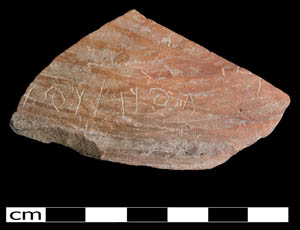
Back in 2005, I think, a pottery shard, inscribed with the Semitic letters AWLT and WLT, was found. Maeir says,

BOTH names that appear on the sherd (AWLT and WLT…) are etymologically very close to Goliath. All are quite similar to Indo-European, names such as Lydian Wylattes/Aylattes, which in the past have been etymologically compared to Goliath (way before this find).

I can’t resist posting a tiny photo here.

Goliath Inscription on Pottery from Tell es-Safi/Gath.

There is a wonderful high resolution photo of the shard online with other information. Read here.

The excavation at Tell es-Safi/Gath this year will be July 6-August 1. Click here for some information about the dig if you have interest. This site, near the valley of Elah, provides a wonderful background for the conflict between the Philistines and the Israelites, between David and Goliath.

Then a champion came out from the armies of the Philistines named Goliath, from Gath, whose height was six cubits and a span. (1 Samuel 17:4)

Eighth Century B.C. Seal Found in the City of David

The Israel Antiquities Authority reports on the discovery of another seal from the area of the City of David. Read the full account here.

Finds recovered from the excavations in the City of David reveal an interesting development in the ancient world: whereas during the 9th century BCE letters and goods were dispatched on behalf of their senders without names, by the 8th century BCE the clerks and merchants had already begun to add their names to the seals.

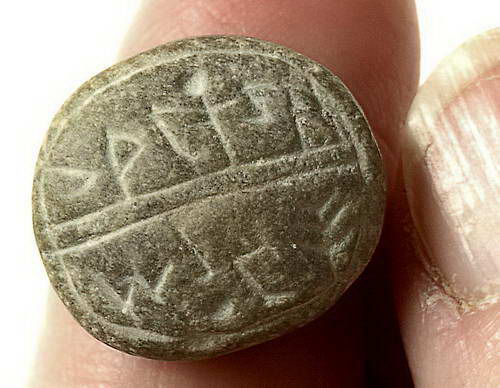
In an excavation the Israel Antiquities Authority is conducting together with the Nature and Parks Authority and the Elad Association, a complete seal bearing an ancient Hebrew inscription with the name of its owner – Raphaihu (ben) Shalem – as well as parts of other seals with writing on it were found.

Here is a nice photo of the seal, courtesy of IAA.

Rephaihu (ben) Shalem seal discovered in the City of David. Courtesy of IAA.

Seals were commonly used during Old Testament times. Jeremiah speaks of sealing and signing a deed (Jeremiah 32:10). Jezebel sealed letters with Ahab’s seal (1 Kings 21:8). Numerous seals bearing the names of biblical characters have been found over the years. It is suggested that this seal belonged to a clerk or merchant of some importance in the 8th century B.C.

Professor Ronny Reich and Eli Shukron are the excavators of the project where this find was made.

HT: BiblePlaces Blog; PaleoJudaica.

Rivers in the Desert

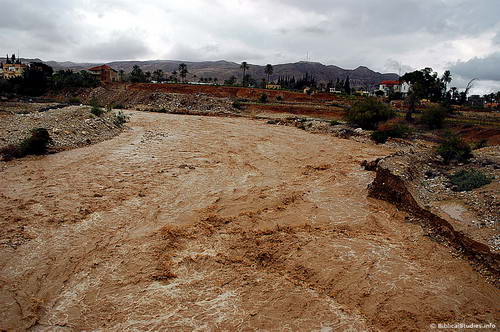
Todd Bolen, over at BiblePlaces Blog, calls attention to an article in the Jerusalem Post about an American tourist who was killed in a Flash Flood at En Gedi. He calls attention, in one of the links, to some photos I made April 2, 2006 of a flash flood in the Wilderness of Judea. Afterwards I wrote an article about it for Biblical Insights. Read Todd’s blog and then read my article below. Todd also includes a beautiful photo of Nahal David at a more tranquil time.

————————————

Rivers in the Desert is the title of Nelson Glueck’s 1959 history of the Negev. These rivers also may be seen in the Judean wilderness and in the Sinai. Thomas Levy followed up on some of Glueck’s research in a Biblical Archaeology Review article in 1990.

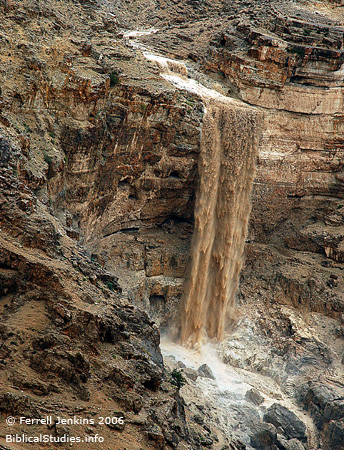
Wilderness of Judea Waterfall - April 2, 2006. Photo by Ferrell Jenkins.

If one travels in the desert during the summer months he will see a dry, desolate bad land with only an isolated tamarisk tree or shrub where the last water of the winter rain flowed. In the winter it can be different. Israel has two dominant seasons: winter and summer. The summer is dry and the winter is wet. The early rains begin about mid-October and continue till the late rains of early April. See Deuteronomy 11:14 and Joel 2:23.

he wilderness of Judea receives very little rain, but the area is affected by the rains that fall in the central mountain range (Jerusalem and the Mount of Olives; Bethlehem; Hebron). We sometimes describe the road that runs along that range as the water parting route. The rain that falls must seek its lowest level. From an elevation of about 2500 feet above sea level the water flows east through the wadis to an elevation of more than 1300 feet below sea level at the Dead Sea.

Levy reminds us that “Nahal, incidentally, is Hebrew for a dry river bed or valley that flows at most a few times a year. In Arabic, the word is wadi. The two words are used interchangeably in Israel today.” The wadi is similar to the arroyo of the American southwest.

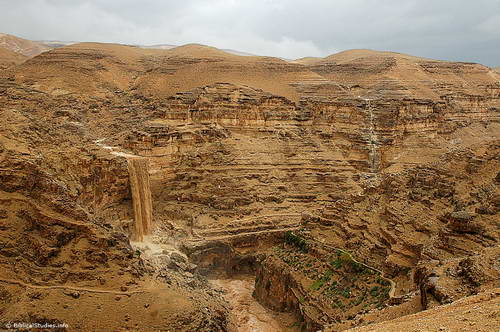
Wilderness of Judea Waterfall - April 2, 2006. Photo by Ferrell Jenkins.

Several members of my group told me of being awakened during the morning of April 2 by the severe storms in Jerusalem. At breakfast I explained to the group that this would be no problem for our planned sightseeing; we would just go to the Dead Sea and Masada. Eli, our guide, told the group that when we came out of the new tunnel that now cuts through the mountain between Mount Scopus and the Mount of Olives, it would probably be dry. In fact it was still raining on us almost all the way to the Jordan Valley.

Our driver decided to pull off the highway onto the old road that overlooks the Wadi Kelt (Qilt) on the way down to Jericho. On the south side of the wadi there is an overlook allowing a view of the Monastery of Saint George of Koziba. There we saw one of the most fascinating sights that can be imagined. It rained an astounding 4.41 inches in Jerusalem. This is about three times what the city normally gets for the entire month of April.

In this normal desert land there was a tremendous waterfall pouring down the side of the cliff into the wadi. Our guide said, and another experienced guide is reported to have told his group, that he had never seen it like this. That evening Todd Bolen and his wife were my guests for dinner at the hotel. Todd has lived and taught in Israel for the past ten years. He has provided us with excellent photos in his Pictorial Archive of Bible Lands (see bibleplaces.com). He was excited about the photos I had taken that day and included three of them on his blog. He was headed for Galilee the next day. He reported seeing hail at En Gev on the Sea of Galilee. The Jerusalem Post ran a photo of the flooded road at the Megiddo junction, and reported that five people had died as a result of the heavy rains.

Not only could we not get to Masada that day, but we could not go to Qumran on the shores of the Dead Sea. A couple of days later when we visited these sites we saw the damage to the road in multiple places where the wadis descended to the Dead Sea. Debris could be seen in the Dead Sea.

Wadi Qelt (Kelt) in the Wilderness of Judea. Photo by Ferrell Jenkins.

In forty years of travel in the Bible Lands, this was one of my most exciting days for photography. I am delighted to share it with you.

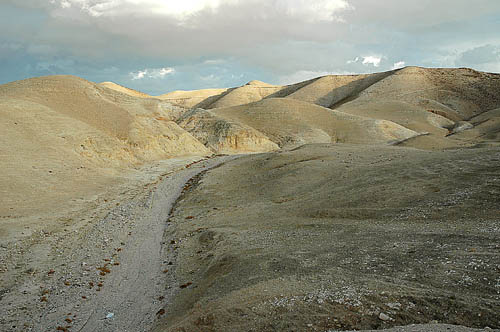
The photo below is of a typical dry wadi in the Wilderness of Judea.

A dry wadi in the Wilderness of Judea. Photo by Ferrell Jenkins.

Earthquake Felt in Israel, Syria and Lebanon

The Jerusalem Post reports that an earthquake was felt in Israel last Friday, Feb. 15. Read the full story here.

The earth shook in many parts of Israel at 12:37 p.m. Friday. The quake was felt mainly in coastline cities, including Haifa, Tel Aviv and Nahariya.
The quake, Israel Radio reported, was also felt in Syria and Lebanon. A faded echo of the quake that hit the coast was also felt at the editorial offices of The Jerusalem Post in Jerusalem.
….

The European-Mediterranean Seismological Center said on its Web site that the quake Friday was 5.3 on the Richter scale and that its epicenter was in Lebanon.

The region is long overdue for an earthquake of epic and potentially catastrophic proportions, scientists say.

The Great Rift runs all the way from northern Syria through Lebanon, Israel, the Arabah, and into eastern Africa. In Israel the area is called the Jordan Valley or the Dead Sea Rift, It is not surprising that earthquakes are mentioned frequently in the Bible. The prophet Amos dates his visions to “two years before the earthquake” (Amos 1:1). The earthquake he makes reference to must have been so memorable that everyone would know what he was talking about. Zechariah (14:5) also calls attention to this earthquake in the days of Uzziah king of Judah.

Jesus, in predicting the fall of Jerusalem to the Romans, said, “and in various places there will be famines and earthquakes” (Matthew 24:7; see Luke 21:11).

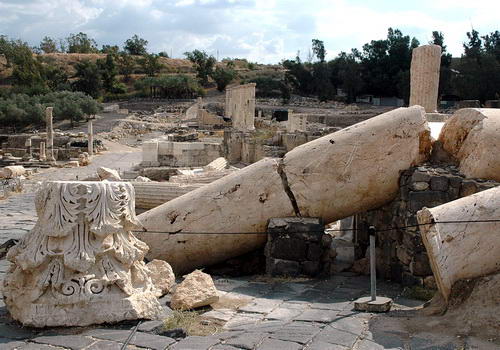
We have a wonderful example of the power of an earthquake in the Jordan Valley at the site of Bethshan [Bet-she’an, Beth-shean], about 25 miles south of the Sea of Galilee. The city was destroyed by an earthquake in A.D. 749. This photo shows the evidence brought to light during recently archaeological excavations in the city.

Earthquake Damage at Bethshan in A.D. 749. Photo by Ferrell Jenkins.

The Death of Aaron on Mount Hor

When Aaron, Israel’s first High Priest, died his son Eleazar became the High Priest. The book of Numbers says that Aaron died on the mountain top of Mount Hor.

“Take Aaron and his son Eleazar and bring them up to Mount Hor; and strip Aaron of his garments and put them on his son Eleazar. So Aaron will be gathered to his people, and will die there.” So Moses did just as the LORD had commanded, and they went up to Mount Hor in the sight of all the congregation. After Moses had stripped Aaron of his garments and put them on his son Eleazar, Aaron died there on the mountain top. Then Moses and Eleazar came down from the mountain. When all the congregation saw that Aaron had died, all the house of Israel wept for Aaron thirty days.” (Numbers 20:25-29, NASB).

Deuteronomy records that Aaron died at Moserah (10:6), but it also records that he died on Mount Hor (32:50). We need not think of this as a discrepancy.

The best solution that can be posed to this problem so far is that Moserah is probably a larger area that included Mount Hor. Thus it would be quite correct to declare that Aaron’s death was either on Mount Hor (Num 20:22–29; 33:38–39; Deut 32:50) or Moserah (Deut 10:6). (Hard Sayings of the Bible, 166).

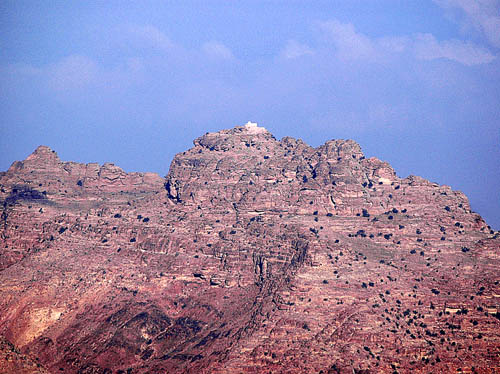
Mount Hor is identified traditionally with Jebel Nebi Harun in the territory of ancient Edom near Petra. From the area of the hotels above Petra one can see the white Moslem shrine marking the tomb of Aaron on the top of Mount Hor. This photo shows the monument in the distance. The mountains reflect the typical color of the area around Petra.

Mount Hor near Petra in Jordan. Photo by Ferrell Jenkins.

Mazar now reads seal as Shlomit

We mentioned here that a seal found in the “City of David Excavation” in Jerusalem had been read by Prof. Eilat Mazar as Temech. In a comment on that page we noted that she had now changed her mind about the reading.

Today, the Jerusalem Post carried an article about this.

Mazar had originally read the name on the seal as “Temech,” and suggested that it belonged to the family of that name mentioned in the Book of Nehemiah.

But after the find was first reported in The Jerusalem Post, various epigraphers around the world said Mazar had erred by reading the inscription on the seal straight on (from right to left) rather than backwards (from left to right), as a result of the fact that a seal creates a mirror image when used to inscribe a piece of clay.

Several other scholars said the reading should be Shlomit.

Mazar said Monday that she accepted the reading of “Shlomit” on the ancient seal, and added that she appreciated the scholarly research on the issue.

“We are involved in research, not in proving our own opinions,” Mazar said.

Shlomit is the name of a woman mentioned in 1 Chronicles 3:19. Several English versions I checked use the spelling Shelomith. Whether the seal has anything to do with the persons named in the biblical text is unknown.

“From Dan to Beersheba”

The tribe of Dan was assigned territory along the Mediterranean Sea where Joppa and the modern city of Tel Aviv now stand (Joshua 19:40-48). Because the Philistines lived in this territory the Danites found it necessary to move to a new location. A portion of the tribe moved north to the city of Laish at the foot of Mount Hermon and renamed it Dan (Judges 18). This northern city became the northern boundary of Israelite occupation and prompted the expression “from Dan to Beersheba” (Judges 20:1; 1 Kings 4:25).

An Aramaic inscription was found by Professor Avraham Biran at Dan July 21, 1993. The inscription mentions the king of Israel, the “the house of David,” and the Aramean (Syrian) god of storms and warfare, Hadad. The “house of David” is a reference to the southern kingdom of Judah. Two additional pieces of the inscription were found in June, 1994.

This photo show the partially reconstructed Iron Age (Israelite) gate at Dan.

The Iron Age City Gate at Dan. Photo by Ferrell Jenkins.

Does this seal bear the name of a Bible character?

We now have dozens of seals bearing the names of characters mentioned in the Bible, but every new one is interesting. The Jerusalem Post, January 16, 2008, reports the discovery of a seal that it says bears the name of a family of temple servants who were exiled to Babylon in 586 B.C., and then returned to Jerusalem after the exile. The discovery was made by Dr. Eilat Mazar at the City of David Excavation.

The Jerusalem Post:

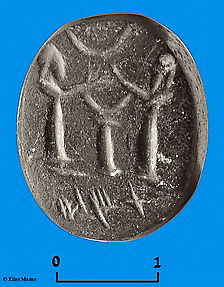
The seal, which was bought in Babylon and dates to 538-445 BCE, portrays a common and popular cultic scene, Mazar said.
The 2.1 x 1.8-cm. elliptical seal is engraved with two bearded priests standing on either side of an incense altar with their hands raised forward in a position of worship.
A crescent moon, the symbol of the chief Babylonian god Sin, appears on the top of the altar.
Under this scene are three Hebrew letters spelling Temech, Mazar said.
The Bible refers to the Temech family: “These are the children of the province, that went up out of the captivity, of those that had been carried away, whom Nebuchadnezzar the king of Babylon had carried away, and came again to Jerusalem and to Judah, every one unto his city.” [Nehemiah 7:6]… “The Nethinim [7:46]”… The children of Temech.” [7:55].
. . .
“The seal of the Temech family gives us a direct connection between archeology and the biblical sources and serves as actual evidence of a family mentioned in the Bible,” she said. “One cannot help being astonished by the credibility of the biblical source as seen by the archaeological find.”

The full article is here.

Seal Discovered by Dr. Eilat Mazar in City of David Excavation.

According to the article, Dr. Mazar reads the inscription as Temech. In many English versions this name is translated as Temah. The Nethinim are mentioned in Nehemiah 7:24 rather than 7:46. See also Ezra 2:53. Other scholars were quick to point out that Mazar had read the inscription left to right, but that seals are normally in the reverse order so that when they are impressed in clay the name reads right to left. Thus the suggestion has been made that the name should be Shelomith. Others have pointed out that there was a Shelomith among the returnees from Babylon (Ezra 8:10).

A warning is in order. There is no way to connect a name on a seal, without additional information such as a title, to a specific person in the Bible. The best one can say is that the name was common to the time of a given event or book. And we are never quite sure if the reporter with a deadline to meet got the comment correct, or placed it in the correct context. In other words, we must await additional, more detailed information. A context for the dating of the seal to a particular year, or span of years, must be provided.

Be patient and wait at least another week (month, year, decade) before using this in your sermon!

Many scholars are critical of Dr. Eilat Mazar and her work in the City of David Excavation. They paint her as a person with an agenda to prove the Bible true, and that she stretches the evidence to fit the theory. If this is true, it is not good. On the other hand, I suspect it is the lack of belief in the veracity of the Bible that prompts some to criticize her every shovel of dirt.

In 2005 Mazar announced the discovery of a clay bulla (the impression of a seal) bearing the inscription, “Yehukal son of Shelemyahu son of Shobi.” The suggestion has been made, and seems legitimate, that this is the name of the “Jehucal the son of Shelemiah” mentioned in Jeremiah 37:3. This bulla is added to several others, published much earlier, of persons named in the book of Jeremiah.

Archaeology has been a wonderful tool for the Bible expositor, but we must be careful not to expect too much from it.

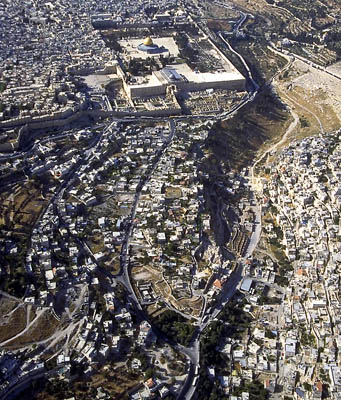
The aerial photo below, which I commissioned a fews years back, shows the area of the Temple Mount to the north (top of photo) and the City of David to the south (bottom of photo).

Aerial View of Jerusalem - Temple Mount and City of David. Photo belongs to Ferrell Jenkins.

HT: Paleojudaica; Todd Bolen; Chris Heard