Category Archives: Old Testament

German Archaeologist: Beneath every footstep in Syria is an ancient civilization

The Global Arab Network reports on a statement made by German archaeologist Markus Gschwind, head of the Syrian-German Archaeology Expedition, here. The report says,

Syria, the land of civilizations and history, is rife with ancient monuments that tell the stories of the many peoples and civilizations that lived in it, whose stories endured in the face of time to tell humanity about their greatness.

“Beneath every footstep in Syria is an ancient civilization,” says Archaeologist Markus Gschwind, head of the Syrian-German Archaeology Expedition working at al-Rafina in Hama. He notes that this saying is repeated around Germany, as most Germans consider Syria the most historically deep-rooted country in the Mediterranean.

In a statement to SANA, Gschwind said that he has been living and excavating in Syria for six years, each day discovering many secrets from the history of mankind.

Gschwind is working at the ancient city of al-Rafina in Hama. Hama is at the site of Biblical Hamath  (2 Kings 14:25; 2 Chronicles 8:4).

My limited visits to Syria have convinced me that the statement by Gschwind is correct. Of course, the same could be said of Israel, Jordan, Turkey, Iraq, et al.

The Assyrian Empire ruled the ancient near east from the battle of Qarqar (853 B.C.) till the battle of Carchemish (605 B.C.) when they were defeated by the Babylonians. Nineveh had fallen seven years earlier. This was the time of the Divided Kingdom period in Israelite history, and Assyria had contact with a numerous biblical kings. Ahab, for example, fought against the Assyrians at Qarqar. Qarqar is north of Hammath. Both are on the Orontes River.
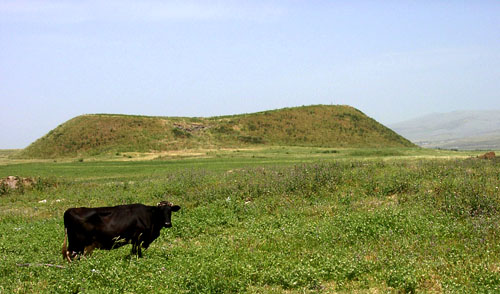
Qarqar on the Orontes. Photo by Ferrell Jenkins.The tell of Qarqar in northern Syria. Photo by Ferrell Jenkins.

HT: Biblical Paths
Move evidence of Babylonian-Egyptian contacts

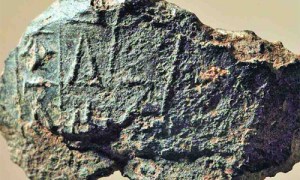
Austrian Times reports here on the discovery of a Babylonian seal impression at Tell el-Dab’a in Egypt.

Austrian archaeologists have found a Babylonian seal in Egypt that confirms contact between the Babylonians and the Hyksos during the second millennium B.C.

Irene Forstner-Müller, the head of the Austrian Archaeological Institute’s (ÖAI) branch office in Cairo, said today (Thurs) the find had occurred at the site of the ancient town of Avaris near what is today the city of Tell el-Dab’a in the eastern Nile delta.

The Hyksos conquered Egypt and reigned there from 1640 to 1530 B.C.

She said a recently-discovered cuneiform tablet had led archaeologists to suspect there had been contact between the Babylonians and the Hyksos.

Forstner-Müller added that Manfred Bietak had begun archaeological research on the period of Hyksos dominance at the remains of a Hyksos palace at Avaris in 1966.

Babylonian seal impression.

Babylonian seal impression.

Earlier in the year we reported on the discovery of a Babylonian tablet at Tell el-Dab’a here.

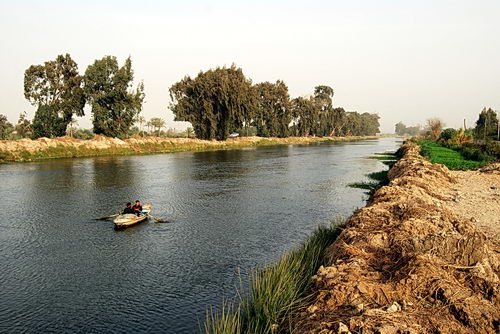
The report  says the Austrian plan to build a museum in the area. A more complete report in Die Presse says they also have plans to restore the river. The Pelusiac branch of the Nile once flowed by this ancient site. Below is a photo of the canal which often follows the course of the Pelusiac.

A canal where the Pelusiac branch of the Nile once flowed. Photo by F. Jenkins.Canal along the Pelusiac Branch of the Nile near Tell el-Dab’a. Photo by FJ.

Tell el-Dab’a is in the eastern Nile Delta. In Biblical times it was known as the Land of Goshen, and served as the home of the Israelites.

“Hurry and go up to my father, and say to him, ‘Thus says your son Joseph, “God has made me lord of all Egypt; come down to me, do not delay. “You shall live in the land of Goshen, and you shall be near me, you and your children and your children’s children and your flocks and your herds and all that you have. “There I will also provide for you, for there are still five years of famine to come, and you and your household and all that you have would be impoverished.” (Genesis 45:9-11 NAU)

These new findings might shed some light on the plausibility of Achan finding a garment from Shinar (Babylon) at Jericho (Joshua 7).

HT: Biblical Paths

Looking for Libnah

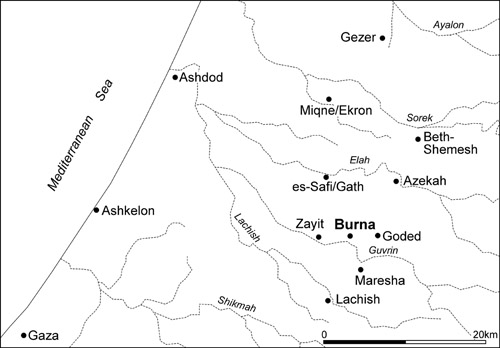
A new blog, called The Tel Burna Excavation Project, has been launched to report on the preliminary survey of Tel Burna. The tel is located in the Shephelah of Israel among such sites as es-Safi/Gath, Zayit, Goded, Mareshah, Azekah and Lachish.

The Shephelah. Map: Tel Burna Excavation Project.

The Shephelah. Map: Tel Burna Excavation Project.

In the case of Tel Burna, with no excavation material available, the problem is even more difficult. despite this, several scholars have suggested identifying the site with Biblical Libnah (although one should note that nearby Tel Zayit is a very likely candidate as well – as Ron Tappy, the excavator there, has recently published).

Libnah was a Canaanite town that was conquered by Joshua who allotted it to the tribe of Judah (Joshua 10:29-30; 15:42). The city was chosen as one of the Levitical cities (Joshua 21:13), which points to its role as a border site. According to 2 Kings 8:22 (and 2 Chronicles 21:10), the city of Libnah was involved in the rebellion against Jehoram the king of Judah (in 9th century BCE) and later, a woman from Libnah married King Josiah in the 7th century BCE (Kings 23:31-32;2 Kings 24:17-18; Jeremiah 22:11).

In any case, even if the site is not Libnah, it is clear for the survey results (which will be mentioned in an upcoming post) that the site was a very important site in the Iron Age, along the border between Judah and the Philistines.

HT: Luke Chandler’s Blog; Aren Maeir.

Al Aqsa Mosque in Jerusalem

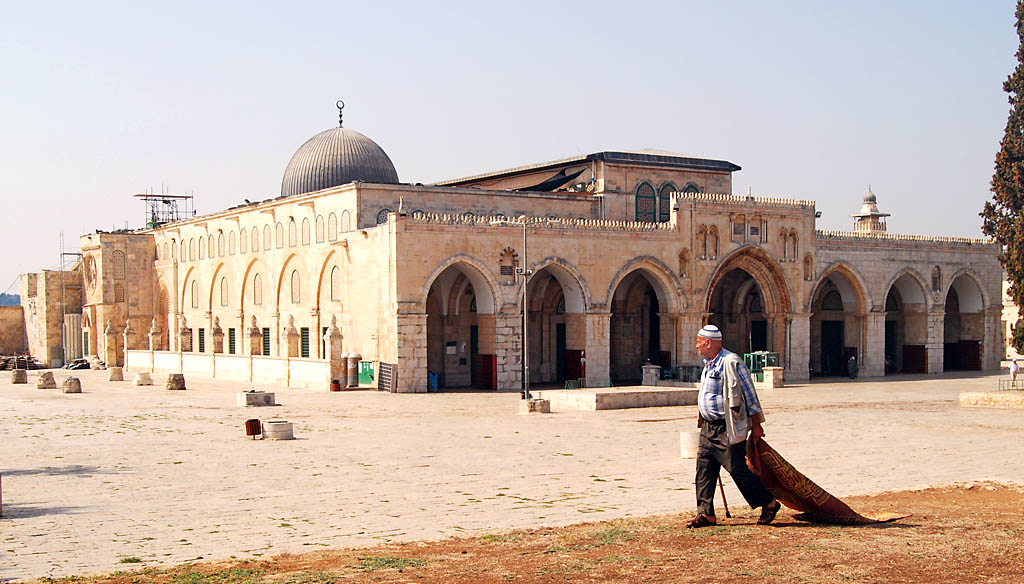
The Al-Aqsa (or Al-Aksa) Mosque is one of the two important buildings erected by Moslems on the platform built by Herod the Great. A Brief Guide to the Dome of the Rock and Al-Haram Al-Sharif, published in 1965, says the Al-Aksa Mosque was built in A.D. 693 or A.D. 705. The other significant building on the platform is called The Dome of the Rock or the Mosque of Omar. It is built over the rock where, according to tradition, Abraham offered Isaac (Genesis 22), and where the Temple of Solomon once stood (1 Kings 6).

Al-aksa Mosque. View toward south west. Photo by Ferrell Jenkins.

This building has often been in the news. In 1951 King Abdullah of Jordan was assassinated in the Mosque. In 1969 an Australian tourist set fire to the building. Just a couple of days ago we saw news reports of disturbances in the Mosque. The Guardian of London headline reports,

Palestinians clash with Israeli troops at al-Aqsa mosque in Jerusalem. Demonstrations at holy shrine erupt into violence as youths fight battles with riot police.

Thebes in Bible Prophecy

Luxor was known as Thebes in Old Testament times. Both Jeremiah and Ezekiel prophesied the Lord’s judgment of the city. Jeremiah says,

“The LORD of hosts, the God of Israel, says, ‘Behold, I am going to punish Amon of Thebes, and Pharaoh, and Egypt along with her gods and her kings, even Pharaoh and those who trust in him’” (Jeremiah 46:25; see also Ezekiel 30:14-16)

A visit to the ruined and unoccupied temples of Karnak and Luxor, where Amon (or Amun) was worshiped as a great god, illustrates the fulfillment of this prophecy. Shortly after the time of Jeremiah (c. 586 BC), Egypt and Thebes began to decline as a world power.

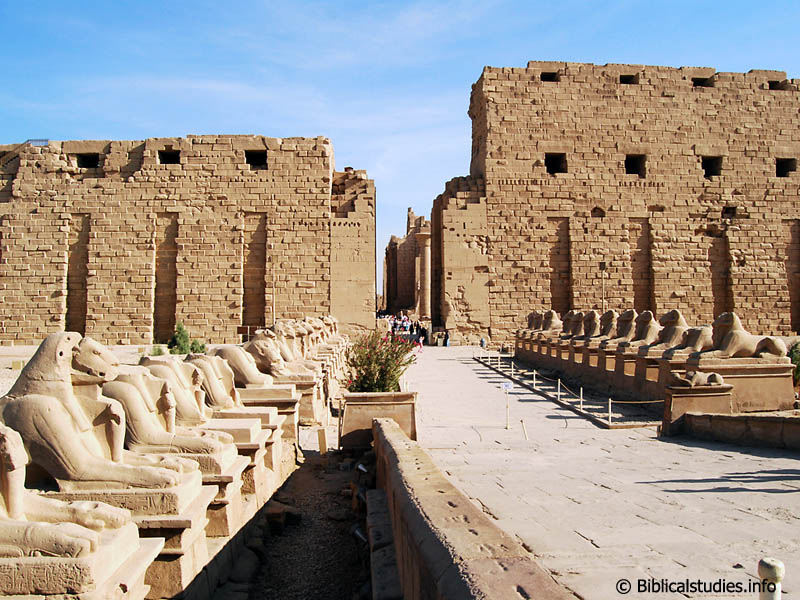
This photo of the avenue of the ram-headed sphinxes leads to the first pylon of the great temple of the god Amon (or Amun). The first pylon was the last part of the temple constructed (about 700 BC) and remains unfinished. This photo is large enough to be used in teaching presentations. Click on the photo for a larger image. I hope you will enjoy using it.

The avenue of ram-headed sphinxes and the first pylon at Karnak. Photo by Ferrell Jenkins.

The avenue of ram-headed sphinxes and the first pylon of the great temple of Amun at Karnak. Photo by Ferrell Jenkins.

In 663 BC the Assyrian king Ashurbanipal had already conquered Thebes (Hebrew, No Amon). The prophet Nahum, in prophesying the fall of Nineveh, calls attention to this event (3:8ff.).

How big is the Canon? Depends on who you ask.

Bible Study Magazine has made available a chart comparing various canons of Scripture. Those included are the SamWhat's in Your Bible? Find out at BibleStudyMagazine.comaritan Bible, Hebrew Bible, Greek Orthodox, Roman Catholic, Syriac, Ethiopian, and Protestant. By clicking on the small chart you will be taken to the complete large chart in Bible Study Magazine.

Nabataean site in the Negev vandalized

Ynet News reports that Avdat, a Nabataean site in the Negev, has been severely damaged by vandals. In August, 2008, I had Avdat on my list of places to visit. We made it to the site, but it was within 30 minutes of closing time and the guard would not allow us to go to the top. I regret that we missed seeing everything — even more now.

The Nabataean site of Avdat in the Negev. Photo by Ferrell Jenkins.

The Nabataean site of Avdat in the Negev. Photo by Ferrell Jenkins.

Raviv Shapira, director of the southern district of the Israel Nature and Parks Authority told Ynet that the sight of the destruction was awful: “We came in the morning and found the place in shambles,” described Shapira, “They broke the staircase, destroyed the walls, and painted on them. The worst is that the two most ancient churches in Israel were destroyed, and 13-foot columns were shattered with hammers along with artifacts and the authentic marble alter, which is the most important (artefact) in the city.”

The Nabataeans founded Avdat around the 3rd century BC, along the “Perfume Road” which stretched between the Jordanian city of Petra and Gaza. The place was named after the Nabataean king, Avdat, who was also buried at the site. According to Shapira, Avdat was the most important historic city on the “Perfume Road” after Petra between the 1st century BC and the 7th century AD, and was inhabited by Nabataeans, Romans and Byzantines.

We typically refer to the “Perfume Road” as the “Spice Road.” Read the full story here (including a video).

HT: Joseph I. Lauer

Wasting time with technology

Donovan Palmer calls attention to this video by Phil Gons. It is well worth the time you waste watching it!

A little sleep, a little slumber, a little folding of the hands to rest, and poverty will come upon you like a robber, and want like an armed man. (Proverbs 24:33-34 ESV)

Todd Bolen announces the Jerusalem CD

Todd Bolen has announced the publication of Jerusalem: Volume 2 of The American Colony and Eric Matson Collection. We mentioned this marvelous set of photographs earlier here. For more information on the current CD on Jerusalem click here

A beautiful but hazy day in the Bernese Oberland

Today we visited the Bernese Oberland in Switzerland. It was a beautiful sunny day by about 10 a.m., but the distant mountains remained hazy almost all day. We went to Trummelbach Falls. Using an elevator and steps one is able to go inside the mountain to see the falls.  I think everyone in our group saw at least part of the falls, and several went all the way to the top.

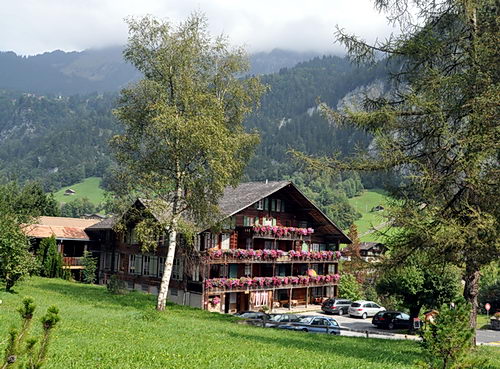
Here is a photo I made of one of the colorful buildings. It is typical here for houses and other buildings to display beautiful flowers under their window”I am my beloved’s and my beloved is mine, He who pastures his flock among the lilies.”s. This provide color for those passing buy as well as for those in the house. This reminds me of the Shunamite (Shulamite) girl’s description of her beloved.

“I am my beloved’s and my beloved is mine, He who pastures his flock among the lilies.” (Song of Solomon 6:3)

A little color adds a lot to life even when one has to deal with difficult earthly problems.

A beautiful house at Lauterbrunen. Photo by Ferrell Jenkins.

A beautiful hotel at Lauterbrunnen. Photo by Ferrell Jenkins.

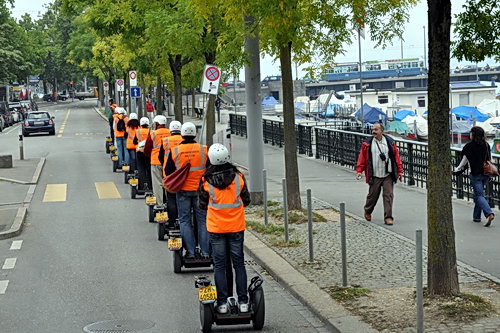
Both in Lucerne and in Interlaken we saw some small tour groups traveling on Segways. This service is offered in the City of David in Jerusalem (click here), but it is the first time I have seen it in action. I think each participtant can hear the leader speaking through the earphones in the helmet.

Segway tour in Lucerne, Switzerland. Photo by Ferrell Jenkins.

Segway tour in Lucerne, Switzerland. Photo by Ferrell Jenkins.

If you know some of the people in our group and wish to read more about the individuals, take a look at Journey’s With Jane.