Category Archives: Old Testament

BU archaeologist discovers evidence of ancient Egyptian shipping

BU Today has an update here on the work of Professor Kathryn Bard in Egypt. This new article reports on a discovery first made by Bard five years ago. A video of some of the artifacts soon to go on display in the Egyptian Museum is included.

The team discovered seven caves at Wadi Gawasis containing relics dating back 4,000 years. The first pieces ever recovered from Egyptian seagoing vessels, they offer a tantalizing glimpse into an elaborate network of Red Sea trade.

Best known for its exports of gold, incense, ebony, elephant ivory, and exotic animals, the exact location of the port city Punt remains a mystery; Bard believes it was in present-day eastern Sudan. Inscriptions discovered more than a century ago indicate that Egyptian pharaohs mounted naval expeditions to Punt as far back as the Old Kingdom (2686 –2125 B.C.), and Bard’s findings give credibility to the legend in the form of stelae, limestone slabs installed in niches outside of the second cave.
King Solomon of Israel sought to make use of the Red Sea for shipping, but his plan does not appear to have been successful.

King Solomon also built a fleet of ships in Ezion-geber, which is near Eloth on the shore of the Red Sea, in the land of Edom. And Hiram sent his servants with the fleet, sailors who knew the sea, along with the servants of Solomon. They went to Ophir and took four hundred and twenty talents of gold from there, and brought it to King Solomon. (1 Kings 9:26-28 NAU)

Here is a photo I made at Eilat in the Red Sea (Gulf of Eilat/Aqaba).

Fish and coral in the Red Sea at Eilat. Photo by Ferrell Jenkins.

Fish and coral in the Red Sea at Eilat. Photo by Ferrell Jenkins.

HT: Joseph Lauer
Thanksgiving Day – 2009

Oh give thanks to the LORD, for he is good, for his steadfast love endures forever! (Psalm 107:1 ESV)

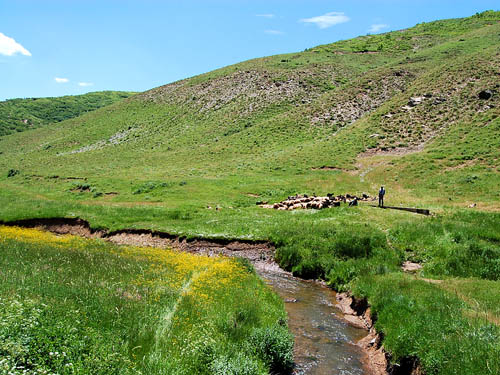
Shepherd with sheep in the Land of Ararat. Photo by Ferrell Jenkins.

Shepherd with sheep in the Land of Ararat. Photo by Ferrell Jenkins.

Jabbok River valley inhabited and irrigated for millennia

A recent report by Dutch researchers calls attention to the relation of the irrigation, especially that in the Zerqa River triangle of Jordan, to population and the nature of the communities.

You can make major discoveries by walking across a field and picking up every loose item you find. Dutch researcher Eva Kaptijn succeeded in discovering – based on 100,000 finds – that the Zerqa Valley in Jordan had been successively inhabited and irrigated for more than 13,000 years. But it was not just communities that built irrigation systems: the irrigation systems also built communities.

Archaeologist Eva Kaptijn has given up digging in favour of gathering. With her colleagues, she has been applying an intensive field exploration technique: 15 metres apart, the researchers would walk forward for 50 metres. On the outward leg, they’d pick up all the earthenware and, on the way back, all of the other material. This resulted in more than 100,000 finds, varying from about 13,000 years to just a few decades old. Based on further research on the finds and where they were located, Kaptijn succeeded in working out the extent of habitation in the Zerqa Valley in Jordan over the past millennia.

Read the longer report here.

The Zerqa River is known as the Jabbok in the Bible. It is probably best known as the place where Jacob met with Esau as he returned from Paddan Aram, and where his name was changed to Israel (Genesis 32).

The same night he arose and took his two wives, his two female servants, and his eleven children, and crossed the ford of the Jabbok. (Genesis 32:22 ESV)

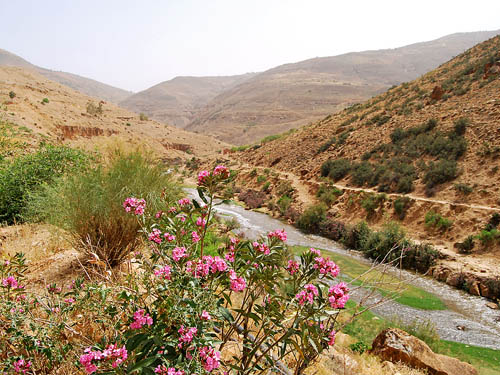
Jordan utilizes the water of the Jabbok (Zerqa) for irrigatation, especially in the Jordan Valley. This photo which I made last year shows the Jabbok a few miles from the Jordan Valley. The mountains are in the Biblical land of Gilead. Before the river reaches this point much of the water has been caught in reservoirs for use by the Jordanians.

The Jabbok (Zerqa) River near the Jordan Valley. Photo by Ferrell Jenkins.

The Jabbok (Zerqa) River near the Jordan Valley. Photo by Ferrell Jenkins.

HT: Biblical Paths.

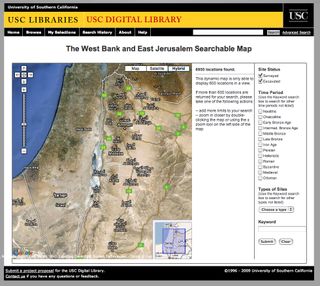
Unique Archaeology Map of the West Bank and East Jerusalem

Suzanne Muchnic, of the Los Angeles Times, reports on a new online map that will be of interest to students of the archaeology of Palestine. Here is a portion of that report.

A searchable map detailing 40 years of Israeli archaeological work in the West Bank and East Jerusalem, developed for the USC Digital Library, has won the 2009 Open Archaeology Prize from the American Schools of Oriental Research.

Project leaders Lynn Swartz Dodd of USC and Rafi Greenberg of Tel Aviv University are expected to accept the award on behalf of an international team composed of Americans, Israelis and Palestinians.

The West Bank and East Jerusalem Digital Map

The digital map apparently won the approval of jurors because it offers a body of information previously unavailable to the public about sites surveyed or excavated since 1967, when Israel occupied the West Bank and East Jerusalem.

USC’s website is part of an effort to establish a framework for the disposition of the region’s cultural heritage in the event of a peace agreement between Israel and Palestine. Interactive satellite maps on the website show about 7,000 archaeological locales, including Shiloh, where the original tabernacle of the Hebrews is thought to have been located, and the Qumran caves, where the Dead Sea scrolls were found.

The public can access the West Bank and East Jerusalem Archaeology Database at http://digitallibrary.usc.edu/wbarc. Users must have Google Earth to get full use of the information.

Read the complete article in The Los Angeles Times. A UCLS news release may be read here.

This is a remarkable map. It includes only sites in the West Bank and East Jerusalem that have been surveyed or excavated. A search may be made by archaeological period, or by type: burial, cave, cistern, winepress, synagogue, mikveh, tell, etc.

I have added a link to this map on the Biblical Studies Info Page under Scholarly/Archaeology.

This video features Lynn Swartz Dodd and Ran Boytner discussing the importance of this project.

Earlier we reported here on the interactive map of the Dead Sea by A.D. Riddle and David Parker showing the history of change. We look forward to more material of this sort in the years to come as scholars make their information available to the wider public.

HT: Joseph Lauer.

Missing the professional meetings in New Orleans

Normally I would have been in attendance at some of the annual professional meetings being held this year in New Orleans. I have another extended trip planned in December and thought it best not to try to afford to attend the professional meetings. I am speaking of the ETS, NEAS, SBL, and the ASOR meetings.

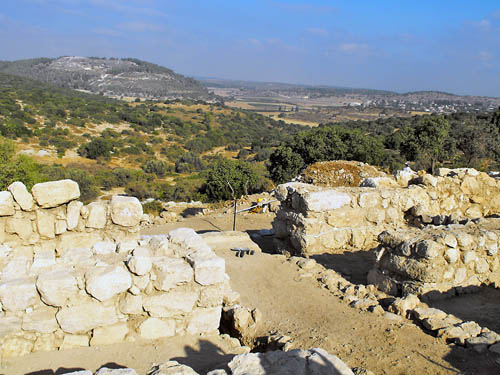
There will be a lot of good reports coming from these meetings in some of the other blogs. Earlier in the year we reported on our friend Luke Chandler who was working in the excavation at Khirbet Queifaya, a site that overlooks the Valley of Elah, and possible associated with the account of David and Goliath in 1 Samuel 17. Luke has been attending the ASOR (American Schools of Oriental Research) meetings. We are not surprised that he reports first on the sessions devoted to Khirbet Queifaya. He provides a summary of the sessions here. Thanks, Luke.

View from Khirbet Queifaya toward Azekah. Photo by Luke Chandler.

View from Khirbet Queifaya toward Azekah. Photo by Luke Chandler.

Earthquakes still a problem in the Middle East

The Israel Antiquities Authority and the National Commission for UNESCO say that “Heritage sites in Israel are in danger of being destroyed in the event of natural disasters.” The meeting of international experts took place in the Crusader fortress at Akko.

Jerusalem, Masada, Caesarea … are they here to stay? The Israel Antiquities Authority and the Israel National Commission for UNESCO (the United Nations Education, Scientific and Cultural Organization) have warned today (Wednesday) that the heritage sites in Israel are at risk of destruction in the event of natural disasters and being vandalized by man.

Not only Israel, but Jordanian sites such as Petra are in danger of earthquake damage. Other sites in Israel, such as Ashkelon and Caesarea, are in danger of erosion and collapse. Then, there is always the problem of vandalism.

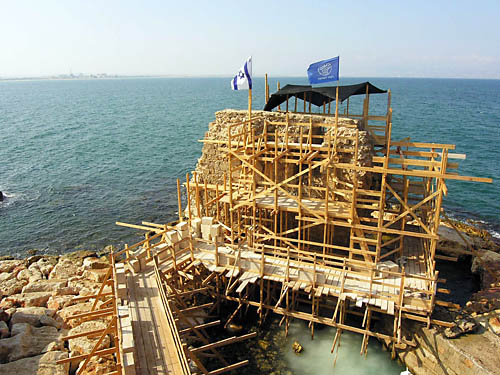
Repairing the wall of the Crusader Fortress at Akko. Photo: IAA.

Fortifying the wall of the Crusader Fortress at Akko. Photo: IAA.

The complete report may be read here. The report included this photo showing repair being made on the walls of Akko.

Akko (or Acre) is known in the many English versions of the Bible as Acco (Judges 1:31). In New Testament (Roman) times the city was call Ptolemais (Acts 21:7).

The Great Rift runs all the way from northern Syria through Lebanon, Israel, the Arabah, and into eastern Africa. In Israel the area is called the Jordan Valley or the Dead Sea Rift, It is not surprising that earthquakes are mentioned frequently in the Bible. The prophet Amos dates his visions to “two years before the earthquake” (Amos 1:1). The earthquake he makes reference to must have been so memorable that everyone would know what he was talking about. Zechariah (14:5) also calls attention to this earthquake in the days of Uzziah king of Judah.

Jesus, in predicting the fall of Jerusalem to the Romans, said, “and in various places there will be famines and earthquakes” (Matthew 24:7; see Luke 21:11).

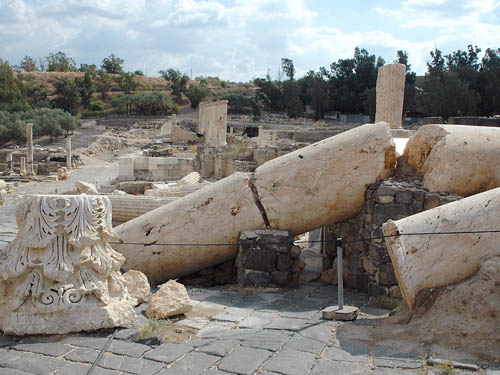
We have a wonderful example of the power of an earthquake in the Jordan Valley at the site of Bethshan [Bet-she’an, Beth-shean], about 25 miles south of the Sea of Galilee. The city was destroyed by an earthquake in A.D. 749. This photo shows the evidence brought to light during recent archaeological excavations in the city.

Earthquake damage at Beth-shean in the Jordan Valley. Photo by Ferrell Jenkins.

Earthquake damage at Beth-shean in the Jordan Valley. Photo by Ferrell Jenkins.

HT: Joseph I. Lauer

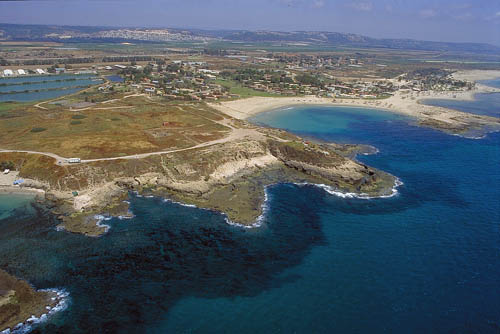
Another aerial view of Tel Dor

This view of Tel Dor and the Mediterranean coast was made in 2000 by the well-known photographer Zev Radovan. Look through almost any Bible Dictionary or other well illustrated book on Bible subjects and you will see some photos credited to Zev. Back in 2000, when I was still teaching at Florida College I approached Zev about making some photos for our use in teaching.

It took a couple of months before he had a good day to make these photos. Several times he sent Emails to let me know he was ready and had the helicopter reserved when the weather was good. I think this was made in May.

Aerial view of Tel Dor and the Mediterranean coast. Photo by Zev Radovan.

Aerial view of Tel Dor and the Mediterranean coast. Photo by Zev Radovan.

The photo we published here on November 16 was made looking north. This one is made looking south-east. Even though the tel is not shown as large in this photo, you will see that considerable archaeological work has been done in the past 9 years. You know that in those days photos were still being made in 35mm slide format.

An impressive location, indeed.

Take a look at Zev Radovan’s Bible Land Pictures Photo Archives here. Zev told me an interesting story back in 2000. He said that years earlier he could go out into the countryside and easily find a man plowing with a wooden plow pulled by a donkey. Now, in 2000, he said he would go out and find a man plowing, but with a cell phone on his belt. It has become difficult to find the biblical-type scenes as the country has become more mechanized.

An aerial view of Tel Dor

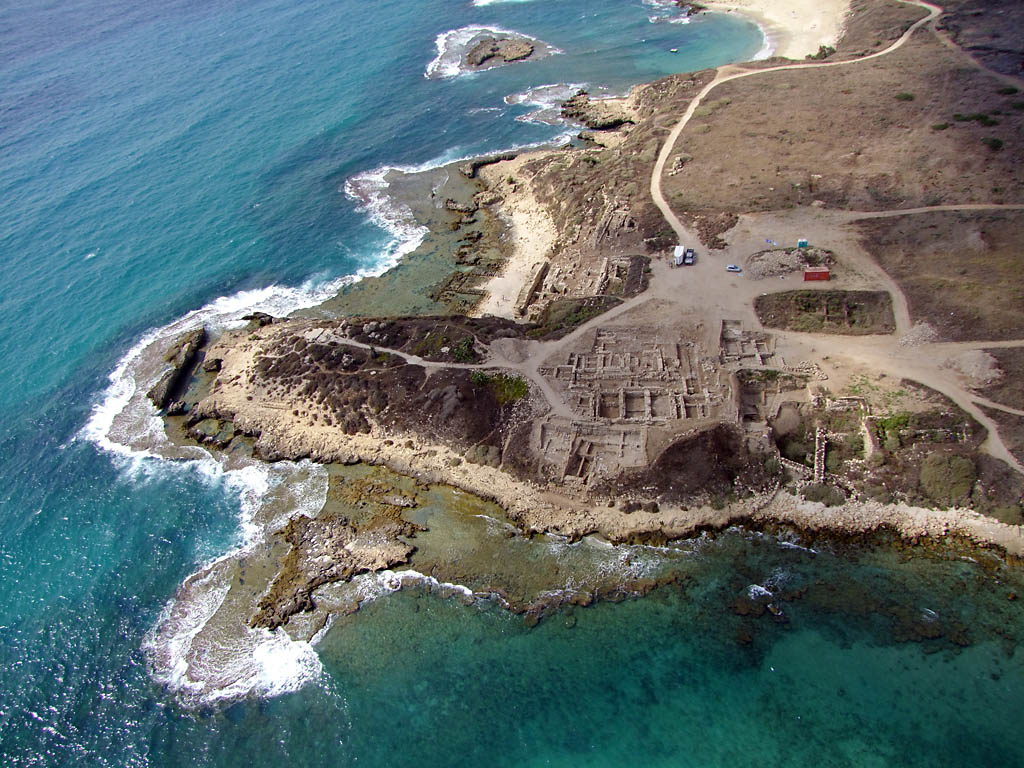
Earlier we wrote about the excavation at Tel Dor here. Dr. Ayelet Gilboa, chair of the Department of Archaeology at the University of Haifa, and the co-director of the Tel Dor Excavation Project, was kind enough to provide us with one of the wonderful aerial photos of Tel Dor.

Aerial view of Tel Dor looking northeast. Photo courtesy: Dr. Ayelet Gilboa.

Aerial view of Tel Dor looking northeast. Photo courtesy: Dr. Ayelet Gilboa.

Click on the image for a photo suitable for use in a PowerPoint presentation.

Dor has a long history extending from the Canaanite period around the 20th century B.C. It was also controlled by the Phoenicians, the Sea People, the Israelites, the Assyrians, the Babylonians, the Persians, the Greeks, and the Romans. Dor was abandoned in the third century A.D. (Biblical Archaeology Review, Nov./Dec. 2002).

Dor is mentioned only a few times in the Old Testament Scriptures.

  • When Jabin, king of Hazor, heard of the victories of Joshua and the Israelites he put together a confederacy of armies including the king of the “heights of Dor on the west” (Joshua 11:2).
  • Joshua conquered “the king of Dor in the heights of Dor” (Joshua 12:32).
  • Dor was allotted to the tribe of Manasseh (Joshua 17:11). The writer of Joshua quickly acknowledges that Manasseh could not take possession of these cities, “because the Canaanites persisted in living in that land” (Joshua 17:12; see Judges 1:27).
  • Solomon appointed his son-in-law Ben-abinadad over the height of Dor (1 Kings 4:11).
  • Ephraim’s territory extended to the border of Manasseh, including “Dor with its towns” (1 Chronicles 7:29).

For more information about the 2010 excavation season at Tel Dor check the official web site here.

Moussaieff called “The genuine article”

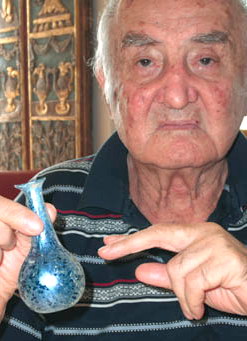
The Jerusalem Post Online Edition Magazine ran a feature article November 12 here about Shlomo Moussaieff here. Moussaieff, 86, is known for many things. He is a billionaire, but he is also a collector of archaeological artifacts, Torah scrolls, cuneiform inscriptions, and other significant items.

Shlomo Moussaieff

Shlomo Moussaieff

Moussaieff has received renewed attention in connection with the recent law suit accusing antiquities experts of forgery. Here are a few comments by Lauren Gelfond Feldinger, author of the magazine feature.

His stories, like his collections, are often considered controversial. In the antiquities world, he is especially renowned for often turning his nose up at the accepted logic that artifacts should be documented in situ by archeologists to make the most of their historical meaning. Moussaieff bah-humbugs traditional thinking, arguing, like his old friend Moshe Dayan, that so-called looters are also salvaging history by bringing it into the light and keeping it out of the dusty cellars of antiquities authorities.

In court I showed them how to know if the clay is genuine – I lick it. I know the taste. After so many years in the business, just looking, you also know. Everyone who is jealous says that I have some fakes. I spend a lot of money to double-check, and so far in four years of court cases they haven’t been able to prove any one of them is a fake. I have been collecting for 65 years and have 60,000 items in my collection. It is possible I have made a mistake, but if I have made a mistake, nobody can prove it. (Laughs.)

When asked why he snubs Israel’s antiquities laws, Moussaieff said,

These are ridiculous laws from the time of the Turks. The Antiquities Authority should be teaching and not torturing. They should ignite history. Instead, they find Arab shepherds and beat them and take what they have. What do they have, broken clay pieces? Bravo. All day they sit with a telescope to see who is going in the field to look for something, it’s ridiculous. For a 500-millimeter piece of parchment, they will put a man in jail.

If you build a building, you have to stop work, you have to pay for the excavation – not them. This is torture. The laws don’t make any sense. This is what they do with their budget? The law should allow more freedom, let anybody display anything in his house, and not make a coin collection worth $10 illegal. They have 600,000 coins in storage, what do they display? A few pieces.

I have artifacts from the time of Abraham. I have artifacts from the second our people were born. They call me a looter. They call me an antiquities thief. Nobody wanted to publish my things [that were not found in situ]. But the museums could only pray to have such a collection as I have. Now that they realize that how much I have and that it is not fake, they all love me, they all want my collections.

HT: Joseph I. Lauer

Fisherman in Egypt

A fisherman brings in a large catch of fish in a lake on the outskirts of Alexandria, Egypt.

Fisherman Near Alexandria, Egypt. Photo by Ferrell Jenkins.

Fisherman Near Alexandria, Egypt. Photo by Ferrell Jenkins.

The wise writer of Ecclesiastes likened the unfortunate things that happen in life to fish being caught in a net.

Surely, no one knows his appointed time! Like fish that are caught in a deadly net, and like birds that are caught in a snare– just like them, all people are ensnared at an unfortunate time that falls upon them suddenly. (Ecclesiastes 9:12 NET)

This photo was made in the street fish market along the pier in Alexandria.

The Fish Market at Alexandria, Egypt. Photo by Ferrell Jenkins.

The Fish Market at Alexandria, Egypt. Photo by Ferrell Jenkins.

The prophet Isaiah (about 725 B.C.) spoke of a time that was coming upon Egypt in these words.

The fishermen will mourn and lament, all those who cast a fishhook into the river, and those who spread out a net on the water’s surface will grieve. (Isaiah 19:8 NET)