Category Archives: Old Testament

Beth-shemesh from another vantage point

The weather changes every few days (or hours?) in Israel. One day may be hot and hazy, and another day may be cool and clear. The day our group went to the Sorek Valley and Beth-shemesh the sky was thick with haze. Two days later it was clear. Elizabeth and I went back to try to get a few photos to share with our group. We drove into the village (kibbutz) of Yishi to locate a good vantage point for the photo.

It’s true that there are a lot of rooftops in the foreground, but it still gives us a nice view of the mound.
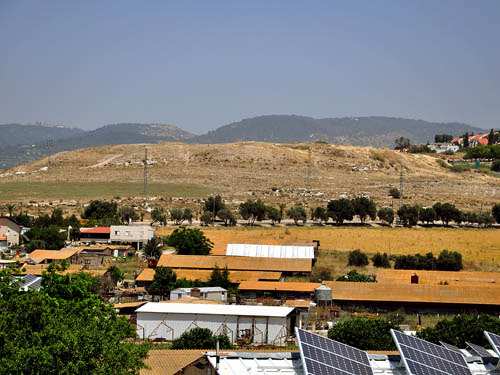
Beth-shemesh from the west. Photo by Ferrell Jenkins.

Beth-shemesh from the west. Photo by Ferrell Jenkins.

The Israelites took the ark of the covenant from the tabernacle at Shiloh to the battle field at Ebenezer when they were fighting with the Philistines (1 Samuel 4). The ark was captured by the Philistines and taken to Ashdod, then to Gath, and finally to Ekron before they decided to get rid of it. The ark was returned to Beth-shemesh (Beth Shemesh, Bethshemesh; 1 Samuel 4-6).

Now the people of Beth-shemesh were reaping their wheat harvest in the valley, and they raised their eyes and saw the ark and were glad to see it. The cart came into the field of Joshua the Beth-shemite and stood there where there was a large stone; and they split the wood of the cart and offered the cows as a burnt offering to the LORD. (1 Samuel 6:13-14 NAU)

There is a small grain field between the row of trees and the first buildings of the kibbutz. This makes it easy enough to visualize the biblical event.
Samson and the Sorek Valley

Samson is often described as a man of great physical strength, but one lacking in moral character. After outwitting the Gazites and taking away the door of the gate of the city he became involved with a Philistine woman named Delilah.

After this he loved a woman in the Valley of Sorek, whose name was Delilah. (Judges 16:4 ESV)

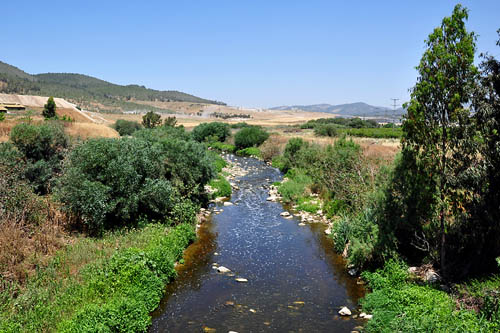
The Sorek River flows east from the mountains of Judea through the Sorek Valley, past Beth-shemesh and Timnah. Today the brook is polluted, as you may be able to detect in the photo. At this point, near Beth-shemesh, there is a terrible odor associated with the area around the river. I think it comes from the chicken or turkey farms in the valley.

No longer a nice place to take a date.

The Sorek River in the Sorek Valley near Beth-shemesh. Photo by Ferrell Jenkins.

Sorek River in the Sorek Valley near Beth-shemesh. Photo by Ferrell Jenkins.

Pentecost morning at Nebi Samwil

Last evening at sundown the Jews began to celebrate their modern interpretation of  Pentecost (Shavu’ot). Christians know this from the Old Testament scriptures as the feast of weeks (Leviticus 23:15; Deuteronomy 16:9).

The church had it beginning with the preaching of the gospel in its fullness on the first Pentecost after the resurrection of Christ (Acts 2).

When we noticed that the sky was clear with a few nice clouds, we decided to go to Nebi Samwil (Prophet Samuel), a site suggested as the location of Mizpah by some scholars. Others suggest Tell en-Nasbeh, a mound located at Al Bira in the West Bank. I will have to postpone commenting further due to the fact that my flight will soon be called.

Samuel, the last judge of Israel, called all of the people of Israel to Mizpah and judged them (1 Samuel 7:5-6). Samuel also anointed Saul to be the first king of Israel at Mizpah (1 Samuel 10:1). Mizpah became the headquarters of Gedaliah as governor of Judah after the Babylonian destruction of Jerusalem  (2 Kings 25:23).

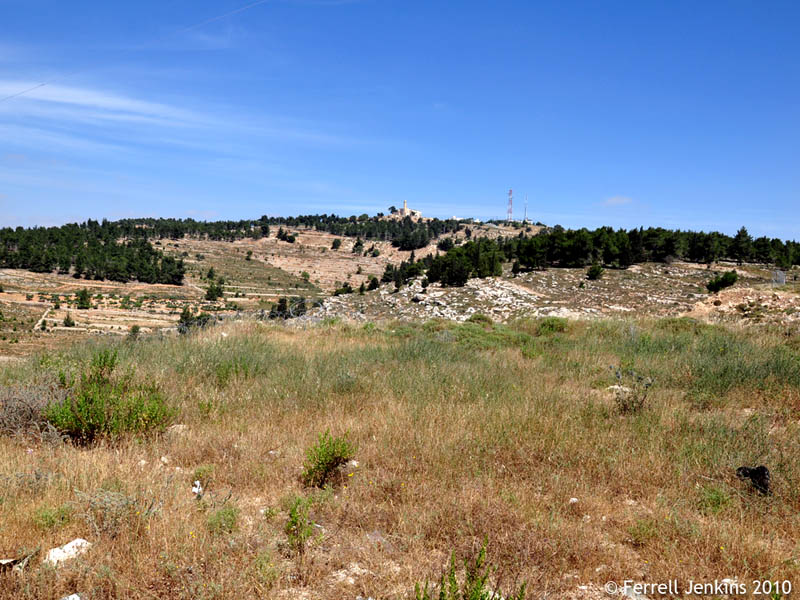
Back to Pentecost. Pentecost is celebrated in much the same way as a sabbath. I said all of that to say, there was very little traffic this morning as we made our way to Nebi Samwil. This distant photo shows how clear the view was on the southern side of the ridge where Nebi Samwil sits. The view on the north side of the territory of Benjamin was not quite as clear, but it was still nice.

Nebi Samwil on the Ridge. Photo by Ferrell Jenkins.

Nebi Samwil on the Ridge. Photo by Ferrell Jenkins

The lady in the photo below is my lovely wife of more than 55 years. She has been with me on numerous tours to Israel, but she has made two trips when it was just the two of us. I must say that she is not that much into tells. A day or two ago I took her to Tell Jerusalem Mall, and that made up for a lot. 🙂  We have had a great time these past 9 days since our group returned home.

Elizabeth at Nebi Samwil. Photo by Ferrell Jenkins.

Elizabeth at Nebi Samwil. Photo by Ferrell Jenkins.

Thanks for sharing this trip with us. Please continue to read the travel blog on a regular basis. If there is some particular photo you would like to see let me know by leaving a comment.

Models can be valuable teaching aids

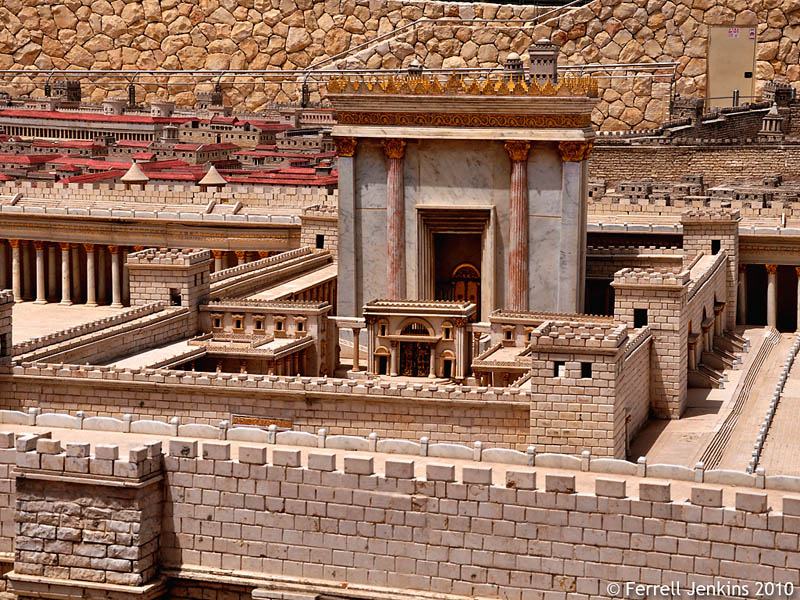
Model reconstructions can be helpful in teaching when the original is not available. Such is true of the temple of biblical times. Herod’s temple was a magnificent building, according to the disciples of Jesus.

And as he came out of the temple, one of his disciples said to him, “Look, Teacher, what wonderful stones and what wonderful buildings!” (Mark 13:1 ESV)

Jesus left the temple and was going away, when his disciples came to point out to him the buildings of the temple. (Matthew 24:1 ESV)

Using the hints from the New Testament, Josephus, and other Jewish sources, some scholars have made a model of the Second Temple (Herod’s Temple). For many years this model was located on the grounds of the Holyland Hotel, but recently has been moved to the grounds of the Israel Museum. Click for a larger image.

Second Temple Model at the Israel Museum. Photo by Ferrell Jenkins.

Second Temple Model at the Israel Museum. Photo by Ferrell Jenkins.

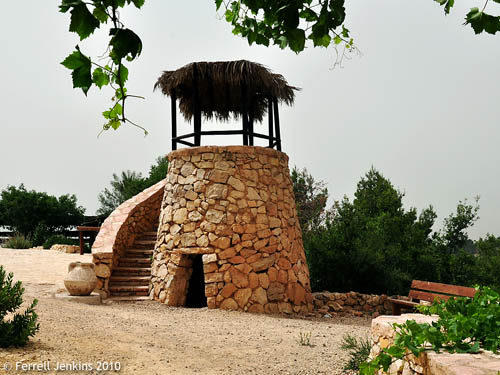
Watchtowers were used in vineyards (Isaiah 5:2; Luke 14:28; see here), and as lookout posts.

Then he who saw cried out: “Upon a watchtower I stand, O Lord, continually by day, and at my post I am stationed whole nights. (Isaiah 21:8 ESV)

The concept is used figuratively of the LORD’S care for His people.

for you have been my refuge, a strong tower against the enemy. (Psalm 61:3 ESV)

The name of the LORD is a strong tower; the righteous man runs into it and is safe. (Proverbs 18:10 ESV)

Yesterday afternoon we stopped by Yad Hashmona in the Judean Hills near Abu Ghosh (Kiriath-jearim) to visit the Biblical Village. Yad Hashmona operates a guest house and guiding center. Some readers will recognize it as the site of the campus of Master’s College IBEX program.

The Biblical Village provides a wonderful site for teaching, and photos of the reconstructions should be helpful too.

Watchtower, Biblical Garden, Yad Hashmona. Photo by Ferrell Jenkins.

Watchtower, Biblical Village, Yad Hashmona. Photo by Ferrell Jenkins.

Actually I wrote about this to provide Todd his regular fix of Israel while he is in exile in Texas. 🙂

Acco, Akko, Acre, Tell el Fukhar

Saterday afternoon we drove from Tiberias to Akko. On my previous tour I failed to get any photos of the ancient tel of Acco (also spelled Akko and Acre). The mound is known as Tell el Fukhar (hill of clay pottery) in Arabic.

Excavations by Prof. Moshe Dothan between 1973-1985 demonstrated that the site was first inhabited in the Early Bronze Age (about 3000 B.C.).

Tel Akko (Acco, Acre). Photo by Ferrell Jenkins.

Tel Akko (Acco, Acre). Photo by Ferrell Jenkins.

Acco is mentioned only once in the Bible. The city is within the territory originally allotted to the tribe of Asher, but the tribe was unable to conquer it.

Asher did not drive out the inhabitants of Acco, or the inhabitants of Sidon or of Ahlab or of Achzib or of Helbah or of Aphik or of Rehob, (Judges 1:31 ESV)

After about 100 B.C. the coastal city was known as Ptolemais (Acts 21:7). Paul spent one day with the brethren here on the return from his third journey.

The acacia tree

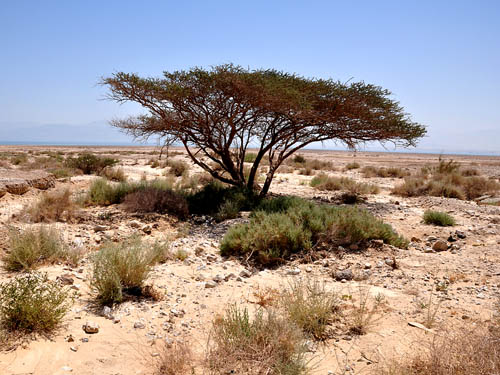
Today we drove along the entire length of the Dead Sea on the western shore. Even places like the terrain of the wilderness of Judea and the Dead Sea have a beauty all their own.

The acacia is one of the few trees seen along the shore of the Dead Sea and in the wilderness of Judea, and in the Sinai.

A lone acacia tree on the shore of the Dead Sea. Photo by Ferrell Jenkins.

A lone acacia tree on the shore of the Dead Sea. Photo by Ferrell Jenkins.

You doubtless recall that the tabernacle was constructed while Israel dwelt in the Sinai wilderness. Many of the pieces of furniture, including the ark of the covenant, were made of acacia wood.

Bezalel made the ark of acacia wood. Two cubits and a half was its length, a cubit and a half its breadth, and a cubit and a half its height. And he overlaid it with pure gold inside and outside, and made a molding of gold around it. (Exodus 37:1-2 ESV)

Tonight we are on the shore of the Sea of Galilee on the north side of Tiberias.

From Jerusalem to the Dead Sea

We got a late start this morning from Jerusalem. Our evening destination was the southern end of the Dead Sea (near Sodom) at En Boqeq. We took the long way to get here by traveling south around Bethlehem, then west to the Elah Valley, Bethshemesh, and Gath. Eventually we got on Highway 6, a wonderful toll road named in honor of the late Prime Minister Yitzhak Rabin. The road runs south ending a few miles north of Beersheba. From there we went down past Arad to the Dead Sea.

We saw numerous camels along the way. This is the region known in the Bible as the Negeb (Negev, South).

And Abram journeyed on, still going toward the Negeb. Now there was a famine in the land. So Abram went down to Egypt to sojourn there, for the famine was severe in the land. (Gen 12:9-10 ESV)

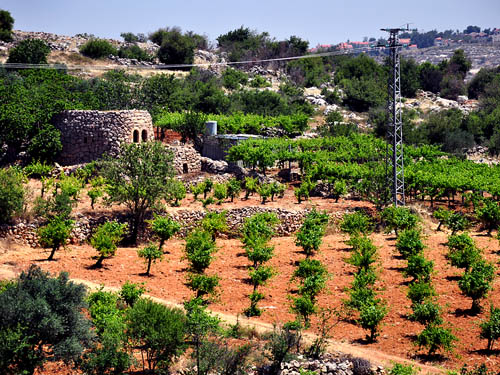
There are nice vineyards a few miles southwest of Bethlehem that remind me of Isaiah 5 and Matthew 21:33-46.

Let me sing for my beloved my love song concerning his vineyard: My beloved had a vineyard on a very fertile hill. He dug it and cleared it of stones, and planted it with choice vines; he built a watchtower in the midst of it, and hewed out a wine vat in it; and he looked for it to yield grapes, but it yielded wild grapes. And now, O inhabitants of Jerusalem and men of Judah, judge between me and my vineyard. (Isaiah 5:1-3 ESV)

Vineyard with a Watchtower SW of Bethlehem. Photo by Ferrell Jenkins.

Vineyard with a Watchtower SW of Bethlehem. Photo by Ferrell Jenkins.

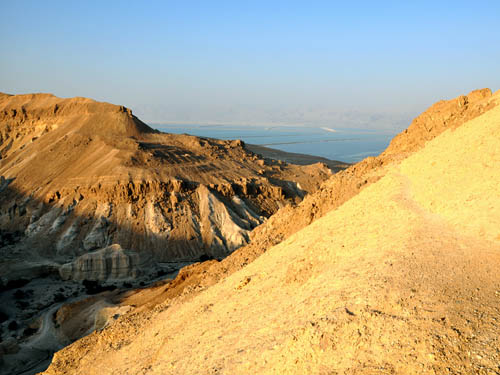
The sun was low as we approached the Dead Sea. This is the view from the Sodom-Arad Road. The rugged bad lands (the wilderness of Judea) begins a few miles north of Jericho and continues south until it finally blends with the Sinai peninsula.

The Dead Sea from the Sodom-Arad Road

The Dead Sea from the Sodom-Arad Road. Photo by Ferrell Jenkins.

Ketef Hinnom excavation

In order to reach the Ketef Hinnom excavation one must enter through the Menachem Begin Heritage Center. Jewish Ideas Daily reported May 6th about the neglect of the excavation.

Interestingly, the Heritage Center also hosts an actual biblical site: Ketef Hinnom, or the “Shoulder of Hinnom.” This is a chain of Jewish burial chambers that were carved out of the rock in the 7th century B.C.E.  In 1979, a dig conducted by the archaeologist Gabriel Barkay yielded one of the most significant finds in Israel’s history: tiny rolled-up silver scrolls on whose inner surface is inscribed the Priestly Blessing—”The Lord bless you and keep you . . .” (Numbers 6:24-26)—in ancient Hebrew. These are the oldest surviving texts of the Bible—older than the Dead Sea Scrolls by roughly a half-millennium. Barkay speculates that the scrolls were originally worn “as amulets to give their wearers protection against evil.”

Ketef Hinnom is thus one of the most important sites in the history of biblical archeology. Yet it suffers from serious neglect. The burial chambers lie hidden behind the Heritage Center’s courtyard; you won’t even find a sign pointing you in the right direction. More troublingly, the site is completely exposed to the elements, and in winter months some of the chambers are filled with standing rainwater. Trash is strewn between the graves; unattended foliage grows over the stone.

Read the article in its entirety here.

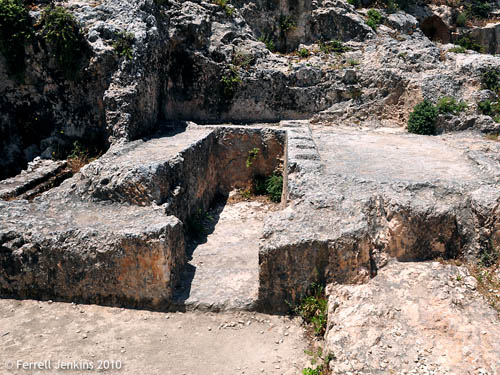
This morning I went to the Begin Heritage Center to visit the Ketef Hinnom excavation. It is true that no signs direct one to the site. In December, and again today, the receptionist pointed me in the right direction.

Ketef Hinnom Iron Age Tomb. Photo by Ferrell Jenkins.

Ketef Hinnom Iron Age Tomb. Photo by Ferrell Jenkins.

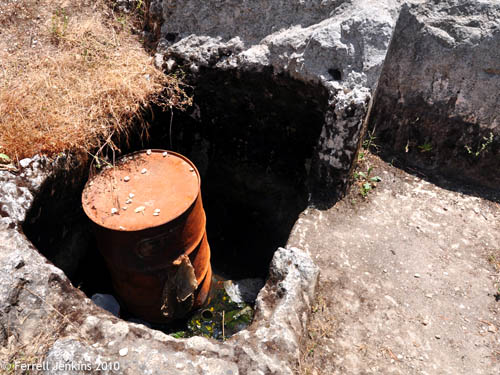
The site was somewhat as described by the Jewish Ideas Daily article.  This photo shows standing water, a rusty drum, and trash only feet from the area shown in the previous photo.

Trash in the Ketef Hinnom Excavation. May 11, 2010. Photo by F. Jenkins.

Trash in the Ketef Hinnom Excavation. May 11, 2010. Photo by F. Jenkins.

HT: PaleoJudaica

Our group heads for home

Our tour of Israel and Jordan came to an end this evening as the group went to the Ben Gurion International Airport for departure to the United States.

We visited a variety of sites today, but spent most of our time in the Shephelah (lowlands).  We are informed in 2 Chronicles about the activity of King Uzziah (792–740 B.C.) in the  Shephelah.

And he built towers in the wilderness and cut out many cisterns, for he had large herds, both in the Shephelah and in the plain, and he had farmers and vinedressers in the hills and in the fertile lands, for he loved the soil. (2 Chronicles 26:10 ESV)

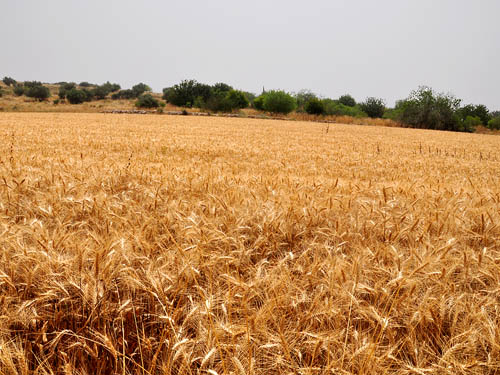
Wheat fields are in abundance in the Shephelah today.

A Wheat Field in the Shephelah. Photo by Ferrell Jenkins.

A Wheat Field in the Shephelah. Photo by Ferrell Jenkins.

Elizabeth and I said goodbye to our tour group and turned to Jerusalem. We plan to visit several more sites in Israel before returning home. By now the group should have begun their 13 hour flight home.

— ♦ —

Update: May 11. Last evening before going to bed I began tracking the flight of our friends returning home. When I checked it this morning I noticed that they have been routed north across Turkey, Eastern Europe, and north of Iceland. The flight continued across Greenland. Now they are headed south over Canada toward the Great Lakes area. The flight is delayed by 2 hours. This is because of the Iceland Volcano. A friend returning from Greece to the USA told me a similar story about his flight.

A beautiful backdrop for a photo

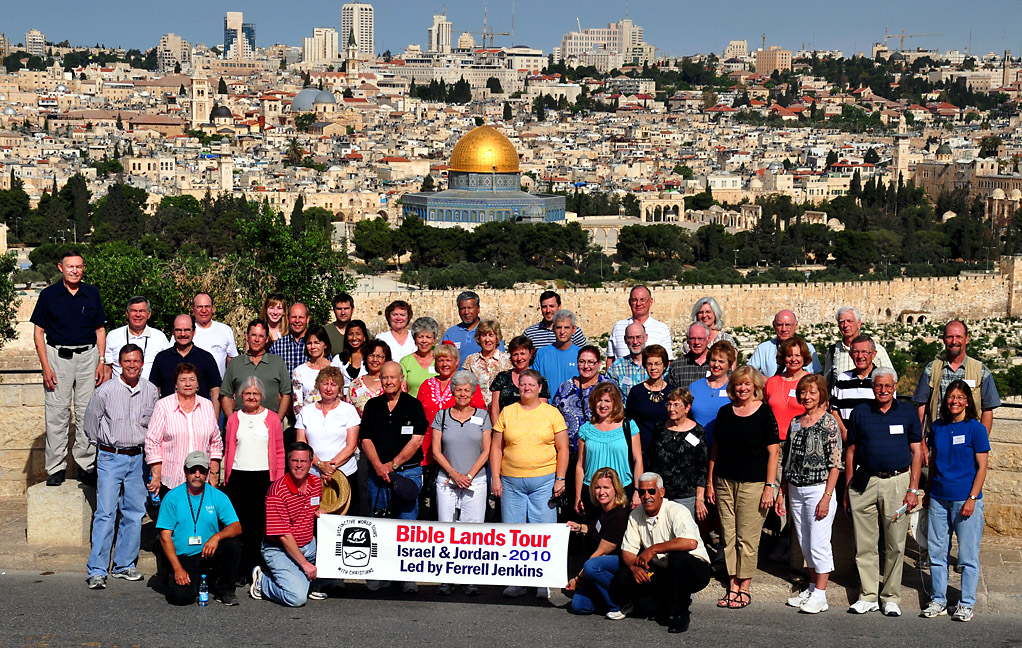
The city of Jerusalem provides a beautiful backdrop for a group photo. We almost always have a photo made of the group from the Mount of Olives with the city of Jerusalem in the background.

Bible Land Tour Group in Jerusalem - May 8, 2010.

Bible Land Tour Group in Jerusalem - May 8, 2010.

At this time of year there are no clouds to be seen, but the sky is clear. Click on the photo of our group of 46 travelers, plus our guide and driver, for a larger image. This will allow you to pick out any of the persons you may know. These folks are from numerous states ranging from the Northwest to Florida and Southern California to the Midwest.

We crossed out of Israel into the region controlled by the Palestinian Authority to visit Bethlehem. There we visited the Church of the Nativity and (one of) the Shepherd’s Fields. Tourists always enjoy shopping in Bethlehem. Specialties include olive wood carvings, mother of pearl, and jewelry. In the past I have enjoyed visiting a store operated by two brothers, but in the years of the Second Intifada they closed the store and moved to the USA where they had gained citizenship.

Today we visited a shop with some history — the Kando Store. One does not have to read very much about the early history of the Dead Sea Scrolls to encounter the name Kando. He was the shopkeeper who bought some of the original scrolls from the bedouin. In those years he operated a store directly across from the American Schools of Oriental Research (now the Albright Institute) in East Jerusalem (then in Jordan). I think it was 1969 (or 1970 or 1971) when Melvin Curry and I went to Kando’s antiquities shop and purchased about $1,000 worth of antiquities for Florida College. Those antiquities are now displayed in the Chatlos Library on the campus in Temple Terrace, FL.  They have been used in the Bible and Archaeology class many times. Today $1,000 would buy only about 4 good Herodian lamps, but we got a nice collection back then.

Kando was a Syrian Christian whose full name was Khalil Iskander Shahin. His name appears many times on the page describing the Dead Sea Scrolls in the Schøyen Collection. His family now operates the Kando Store in Bethlehem. All of the scrolls, and things pertaining to the scrolls, that came to the hands of Kando, have now been disposed of except for the original jar in which the Temple Scrolls was found.

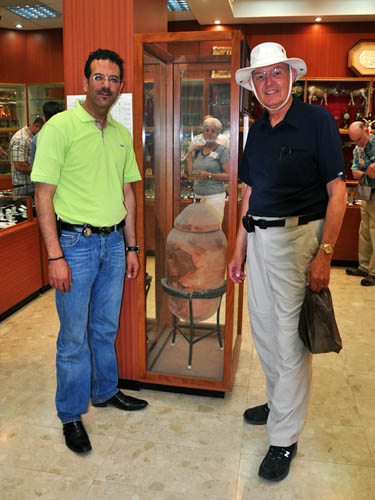
I was pleased to meet Shibly, the grandson of Kando, and have my photo made with him. You can see the original jar in the case between us.

Shibly, grandson of Kando, the Temple Scroll Jar, and Ferrell Jenkins.

Shibly, grandson of Kando, the Temple Scroll Jar, and Ferrell Jenkins.

It was 1956-57 when I began reading about the Dead Sea Scrolls. Being in the Kando Store today was an added excitement to any already great day of touring.