Category Archives: Old Testament

Prayers disturbed by a snake in the wall

Our group went to the Western Wall this afternoon. The Western Wall, sometimes called the Wailing Wall by non-Jews, is part of the enclosure built by Herod the Great around the temple precinct in Jerusalem. The temple and everything else on the top of the platform was destroyed by the Romans in A.D. 70.

The Western Wall is now a place for prayer. Men have a large portion of it for their use. To the south there is a small area for women. I entered the enclosure north of the men’s section to get a photo of Wilson’s Arch. When I came out I noticed a workman on the lift trying to get something out of the wall with a long stick. At first I thought he was removing some of the paper prayers that had been left in the wall by worshipers. I learned from one of our ladies who was there that a snake had been seen by the ladies.

Of more interest to me was that the snake was somewhere around the lintel of Barclay’s Gate.
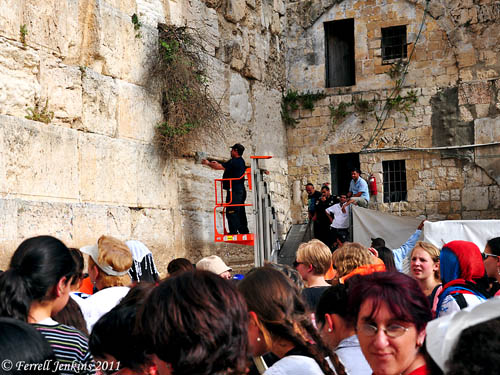
Women watch at the Western Wall while workmen remove snake from the wall. Photo by Ferrell Jenkins.

Women watch at the Western Wall while workmen remove snake from the wall. Photo by Ferrell Jenkins.

It is not often that one see’s men on the women’s side of the Western Wall plaza. Well, I never have before.

A number of biblical references come to mind. The prophet Amos says,

18 Alas, you who are longing for the day of the LORD, For what purpose will the day of the LORD be to you? It will be darkness and not light;
19 As when a man flees from a lion And a bear meets him, Or goes home, leans his hand against the wall And a snake bites him.
20 Will not the day of the LORD be darkness instead of light, Even gloom with no brightness in it?  (Amos 5:18-20 NAU)

I imagine the same thing would happen to a woman as well as to a man.

We recall the serpent of the Garden of Eden (Genesis 3). Paul used that event as an illustration.

 But I am afraid that, as the serpent deceived Eve by his craftiness, your minds will be led astray from the simplicity and purity of devotion to Christ. (2 Corinthians 11:3 NAU)

Earlier today we visited the Herodian Family tomb, the Second Temple Model, Shrine of the Book, and the archaeological section of the Israel Museum. I had visited the renovated Museum in January and was ready to take the group to some of the more significant biblically related artifacts. For the earlier discussion of some of these things see here (Old Testament) and here (New Testament).

In the afternoon we entered the Old City and visited the Jewish Quarter and the Western Wall.

We look forward to completing our planned visit of the Old City tomorrow. Lots of walking in the Old City.

Everyone in the group is doing well and seems to be enjoying the experience. We have about a dozen who have been here at least once before. They are seeing new things every day and enjoying a revisit to things they saw on a previous tour.
Jonah sailed from Joppa

Our group arrived in Israel today except for two persons who were delayed due to a bad weather connection in Detroit. Just learned a few minutes ago that they are on their way via Paris.

We had time to visit Joppa (Yafo) before proceeding to Netanya, along the Mediterranean coast, for overnight.

Joppa is located in the Plain of Sharon and served as the seaport for Jerusalem which is about 35 miles away. The city is now called Jaffa, or Yafo. Joppa was a walled town as early as the reign of Pharaoh Thutmose III (1490-1435 B.C.) who mentions Joppa in his town lists.

Here are a few of the biblical highlights for Joppa.

  • Joppa was assigned to the tribe of Dan, but was not controlled by the Israelites till the time of David (Joshua 19:46).
  • Hiram of Tyre floated cedar from Lebanon to Joppa for Solomon’s Temple (2 Chronicles 2:16).
  • Jonah sought a ship for Tarshish at Joppa to avoid going to Nineveh (Jonah 1:3).
  • Cedars from Lebanon again were floated to Joppa for the rebuilding of the temple (520-516 B.C.; Ezra 3:7). The port of the city is behind St. Peter’s Church.
  • Tabitha (Dorcas) lived in Joppa. When she died the disciples sent for Peter who was a Lydda. He came to Joppa and raised Dorcas (Acts 9:36-42). (Acts 10:6).
  • Peter stayed many days in Joppa with Simon the tanner (Acts 9:43). His house was by the sea (Acts 10:6). A house near the port is shown as the house of Simon, but there is no way to know this with certainty.
  • Peter received the housetop vision and learned that he was to go to Caesarea to preach the gospel to the Gentiles at the house of the Roman centurion Cornelius (Acts 10:23).

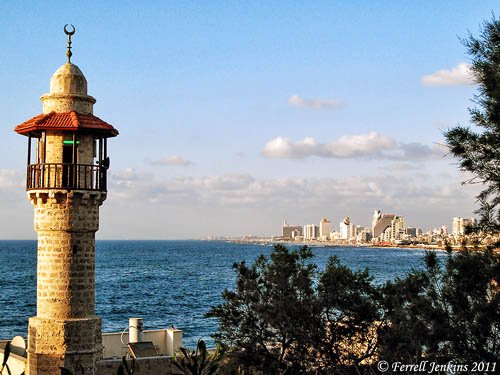
The photo below shows the view of modern Tel Aviv from Joppa. The minaret in the foreground dates to the Turkish period.

View of modern Tel Aviv from Joppa. Photg by Ferrell Jenkins.

View of modern Tel Aviv from Joppa. Photo by Ferrell Jenkins.

Carchemish after a century

The ancient site of Carchemish was identified by George Smith in 1876, and later excavated by the British Museum beginning in 1911. The various directors included Hogarth, Thompson, Wooley, and Lawrence. Many remains of Assyrian and Neo-Hittite periods were uncovered.

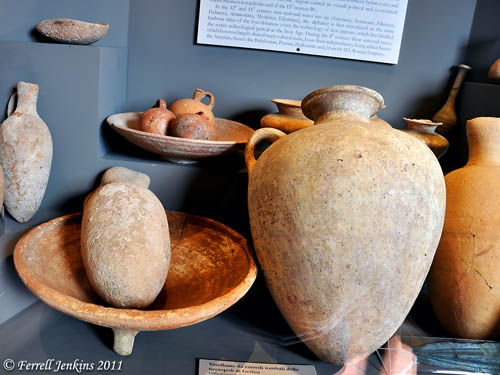
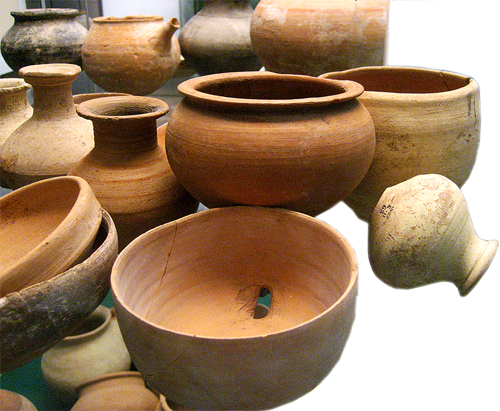
Surveys of the vicinity around Carchemish revealed tombs, pottery and weapons from the Middle Bronze Age. The photo shows one such collection displayed in the British Museum.

Pottery found near Carchemish between 1911-1914. Photo by Ferrell Jenkins.

Pottery found near Carchemish between 1911-1914. Photo by Ferrell Jenkins.

The sign that accompanies this display of pottery says,

During the course of the British Museum’s excavations at Carchemish in north Syria between 1911 and 1914, the field directors, Leonard Wooley and T. E. Lawrence, made regular visits to various sites in the vicinity. One such site was Amarneh and it was from here that Wooley acquired large numbers of objects which had been looted from the associated ancient cemetery. The majority of the finds, consisting of pottery vessels and metal weapons, date to the third and early second millennnium BC. Although it is impossible to reconstruct the early tomb groups, it is clear from Lawrence’s notes and sketches that they were large, collective chambers, lined and roofed over with stone slabs, each tomb containing several individuals and hundreds of pots.

The border between Syria and Turkey is now immediately south of Carchemish. The tell is now in Turkey.

New excavations at Carchemish

Carchemish is mentioned only a few times in the Bible, but it was one of the most significant cities in the ancient Bible world.

  • Isaiah made a reference to Carchemish (Isaiah 10:9). The city had been sacked by Sargon II in 717 B.C.
  • Pharaoh Necho of Egypt went up to Carchemish on the Euphrates to assist the Assyrians against the Babylonians in 609 B.C. (2 Chronicles 35:20; Jeremiah 46:2). King Josiah of Judah tried to stop him, but was killed.

One of the Babylonian Chronicles says that Nebuchadnezzar “crossed the river to go against the Egyptian army which lay in Carchemish.”

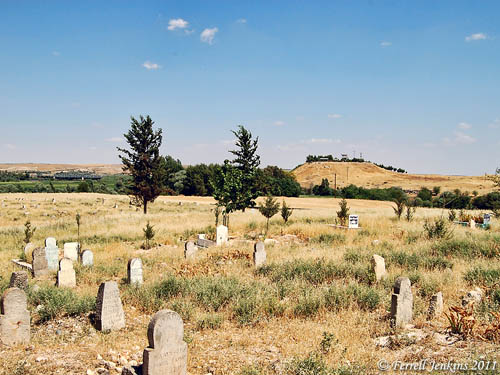
Our photo shows the tell in the distance. The tell is in Turkey today. In the far left of the photo you may see a bridge over the Euphrates River. The bridge crosses into Syria.

Cemetery at Carchemish, Tell in the distance. Photo by Ferrell Jenkins.

Cemetery at Carchemish, Tell in the distance. Photo by Ferrell Jenkins.

We are informed that a new excavation will begin at Carchemish this year. The area has been cleared of 1200 land mines. A few details, along with a photo of some of the land mines, may be viewed here.

HT: Bible Places Blog.

The pot may be calling the kettle black

KLY Website - Dutch society for Old Testament Studies.The Dutch society for Old Testament study (OTW), after ten years of planning and work, has put online a research project to “elucidate the names of utensils in biblical Hebrew making methodical use of partially new approaches.”

The new web site, KLY, is written in the Dutch language, but there is an introduction in English. Here is a portion of it:

The problem with identifying utensils in the Hebrew Bible is that their common everyday use made it superfluous to provide detailed descriptions of the vessels or implements in written form. Everyone knew from experience what was meant. As a result dictionaries of biblical Hebrew often have to content themselves with non-descript generalizations like “bowl”, “jar”, “pot”, “knife”. Mostly the shape and purpose of a given utensil can not be established on the basis of context alone because the number of occurrences is too low. Archaeology has brought to light large quantities of pottery and implements, but in many cases we do not know which word in ancient Hebrew was used for the object unearthed.

Meanwhile the possibilities for resolving such problems have increased dramatically. Not only archaeology, but also comparative linguistics, iconography, anthropology, improved understanding of the ancient versions of the Bible have enhanced our chances to come closer to the precise nature of the objects.

Some knowledge of Hebrew will be helpful, but English-only readers will be able to go to the KLY database, click on a Hebrew letter, and see the terms considered with the English usage. From there you can move to the dictionary entry on the term. The entries are in Hebrew and English. Distribution of each term in the Torah (Law), Nebiim (Nevi’im, prophets), and Ketubim (Writings) is given.

As a future project, an English Index could make this an extremely valuable  project for many more readers.

MB2 Pottery from Jericho. Vatican Museum. Photo by Ferrell Jenkins.

MB2 Pottery from Jericho. Vatican Museum. Photo by Ferrell Jenkins.

It would be possible for an energetic person to download all of the PDF entries and compile them into one document. This would make for easy searching.

If our Dutch friends and colleagues miss the English idiom used as a title for this blog, the definition is given here.

Idiom Meaning — Accusing a person of a misdemeanour whilst the accuser is guilty of the same thing.

I am using the title to suggest we may be using the wrong term for certain biblical pots and pans. The KLY Database of Utensils in the Hebrew Bible will help us not to make the mistake again.

Thanks for the help.

: J.P. van de Geissen, Aantekeningen bij de Bijbel

Cemetery on the Mount of Olives

The Washington Post reports here on US and Israeli efforts to end the desecration of Jewish graves on the Mount of Olives. Both religious and political considerations are mentioned.

It is amazing to view the Mount of Olives and see how much of the mountain is now covered with graves. This aerial view may help you to visualize the situation.The cemetery under discussion is shown in the lower right quarter of this photo.

Jerusalem - the Old City and the Mount of Olives. Photo by Ferrell Jenkins.

Jerusalem - the Old City and the Mount of Olives. Photo by Ferrell Jenkins.

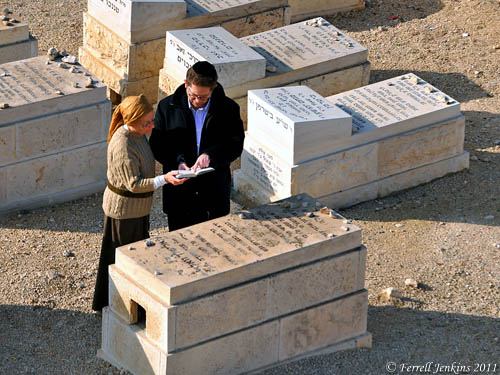
Sometimes when we look at the big picture we miss some important details. The next photo puts a human face and emotion on the situation.

Cemetery on the Mount of Olives. Photo by Ferrell Jenkins.

Cemetery on the Mount of Olives. Photo by Ferrell Jenkins.

At the time of Absalom’s rebellion, David crossed the Mount of Olives as he fled Jerusalem.

But David went up the ascent of the Mount of Olives, weeping as he went, barefoot and with his head covered. And all the people who were with him covered their heads, and they went up, weeping as they went. (2 Samuel 15:30 ESV)

HT: Paleojudaica.

Speaking in North Georgia

The Mountain View Church of Christ, Cumming, Georgia, has invited me to speak on Bible History and Archaeology at the North Georgia Bible Forum in Cumming, Georgia, March 20-25. Stop by if you happen to be in the area. Full details are available here.

Nahal Dan — strongest source of the Jordan

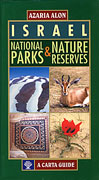
Israel National Parks and Nature Reserves, by Azaria Alon, is a must book for those who plan to visit more than the popular few of the parks and reserves in Israel.  It is published by Carta (Jerusalem), and distributed by Eisenbraun’s in the USA. Click on the link here to go directly to the description and order info.

Here is Alon’s description of the Nahal Dan (Nahr el-Leddan; River Dan):

Nahal Dan is situated in the heart of an area known as “the land of streams and rivers,” and indeed, in the Nahal and along its margins, water and vegetation are present in abundance. The Nahal has a single principal source but it is also fed by dozens of smaller springs. Walking in this environment one has the feeling of springs emerging everywhere. All this water has its origin from the winter snows on Mt. Hermon. The snow melts slowly, seeps into the sponge-like earth of the mountain, and emerges in the foothills. The water flows quietly from the springs, but it continues down an ever-increasing slope, turning into a torrent and generating standing waves and foam. When the stream emerges from the nature reserve, it splits into several rivulets which rejoin when it encounters Nahal Hermon to form the Jordan River.

Nahal Hermon is more commonly known as the Nahr Banias which begins at the site of Caesarea Philippi.

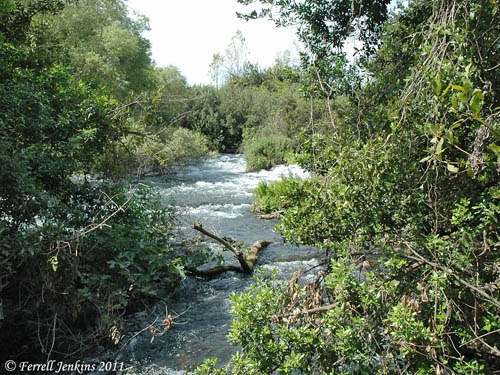
Here is a view of the Nahal Dan within the Tel Dan Nature Reserve.

Nahal Dan in the Tel Dan Nature Reserve. Photo by Ferrell Jenkins.

Nahal Dan in the Tel Dan Nature Reserve. Photo by Ferrell Jenkins.

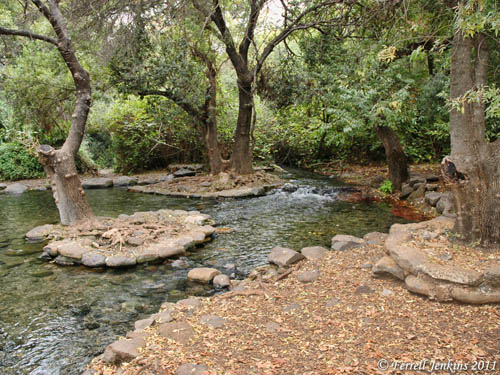
And here is one of the springs. This one is located immediately below the northwest corner of Tel Dan.

A spring in the Tel Dan Nature Reserve. Photo by Ferrell Jenkins.

A spring in the Tel Dan Nature Reserve. Photo by Ferrell Jenkins.

Dan is Israel’s northernmost city (Judges 18:29).

The flea river: Nahr Bareighit or Nahal Iyon

The least known of the sources of the Jordan River is the Nahr Bareighit (flea river) or Nahal Iyon (the name used in Israel). Like the Senir (Hasbani), this river begins in the Beka Valley of Lebanon. It is often overlooked when the sources of the Jordan are named.

Nelson Glueck, The River Jordan, describes the Nahr Bareighit.

The westernmost source of the Jordan is the small mountain stream, Nahr Bareighit. Through a rude gorge, it tumbles down southward from the hilly meadowland of Merj ‘Ayun, which retains in clear part its ancient Biblical name of Ijon (1 Kings 15:20), to add its waters to the formation of the fateful [Jordan] river. The Nahr Bareighit joins the Nahr Hasbani about three quarters of a mile above the point where the Hasbani joins the junction of the Leddan and Banias streams. These last two alone were anciently considered as the sole sources of the Jordan. All found help to form it, and lose their identity in it, as the Jordan starts it flow under its own name.

“Roll, Jordan, roll;
I want to go to heaven when I die
To hear sweet Jordan roll.”

Deni Baly, The Geography of the Bible, devotes a single sentence to this little stream.

The basin of Marj ‘Ayoun to the west is drained by the smaller Bareighit, which leaps over the threshold in a series of charming waterfalls near Metullah and postpones its junction with the Jordan until just before the Huleh marshes. (193)

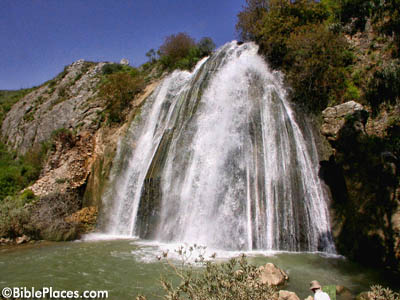
The photo below shows the Iyon Mill Falls. It is one of the beautiful photos of several falls on the river from the Pictorial Library of Bible Lands. Check BiblePlaces.com to purchase the complete set or the DVD of Galilee and the North.

Nahal Iyon Mill Falls. Photo: BiblePlaces.com.

Nahal Iyon Mill Falls. Photo courtesy of BiblePlaces.com.

The Senir, a source of the Jordan River

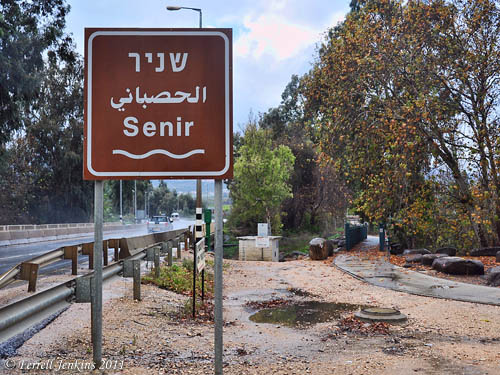
The longest source of the Jordan is the 24-mile-long Nahr Hasbani which begins in the Beka Valley of Lebanon and flows south to join the Jordan. Israel has replaced many of the Arabic names that were commonly used in earlier decades with Hebrew names. The Old Testament says that the Sidonians “call Hermon Sirion, and the Amorites call it Senir” (Deuteronomy 3:9). The river is now designated Senir in Israel.

At the Senir (Hasbani) on Israel Highway 99. Photo by Ferrell Jenkins.

At the Senir (Hasbani) on Israel Highway 99. Photo by Ferrell Jenkins.

Other passages identifying Mount Hermon as Senir are 1 Chronicles 5:23, Song of Solomon 4:8, and Ezekiel 27:5. Nelson Glueck, The River Jordan, calls attention to Psalm 42:6, translating it this way:

O my God, my soul is cast down within me: Therefore am I mindful of thee from the land of the Jordan, and the Hermons” (Psalm 42:6)

The plural of the Hebrew word chermonim is bought out in the English translations by phrases like “peaks of Hermon” or “heights of Hermon.”

Israel Highway 99 runs north east from Kiryat Shmona to the Golan Heights past Tel Dan and Banias (Caesarea Philippi) and two other sources of the Jordan (the River Dan and the River Banias). Because this river begins in the vicinity near Mount Hermon, it is called the Senir.

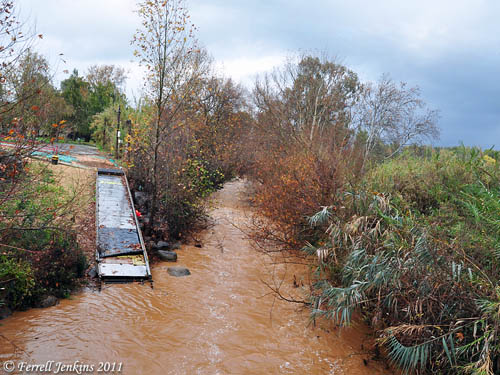
The photo below is the view north from Highway 99.

The Senir River (Hasbani) view north from HWY 99.

The Senir River (Hasbani) view north from HWY 99. Photo by Ferrell Jenkins.

I think the slide on the west side of the river is used to launch kayaks into the river.