Category Archives: Old Testament

Why were shepherds detestable to Egyptians?

A readers asks about Joseph’s instruction to his family when they moved to the land of Goshen in Egypt.

“When Pharaoh calls you and says, ‘What is your occupation?’ you shall say, ‘Your servants have been keepers of livestock from our youth even until now, both we and our fathers,’ that you may live in the land of Goshen; for every shepherd is loathsome to the Egyptians.”  (Genesis 46:33-34 NAU)

Why was every shepherd loathsome (an abomination, disgusting, abhorrent, detestable) to the Egyptians. Here are some suggestions.

G. J. Wenham says,

Shepherds are detestable to the Egyptians probably reflects a common distrust of nomadic peoples by urban dwellers (cf. attitudes to gypsies and ‘travellers’ in modern society). (The New Bible Commentary)

The IVP Bible Background Commentary says,

It is unlikely that native Egyptian herdsmen would be detested by other Egyptians. Joseph’s advice to his father is both a warning about Egyptian attitudes toward strangers and a piece of diplomacy in that they would claim independent status (they had their own herds to support them) and show they were not an ambitious group who wished to rise above their occupation as shepherds.

Derek Kidner likes the explanation of J. Vergote:

A more likely explanation is that of J. Vergote, that this is only the perennial antipathy of the town-dweller for the nomad or the gipsy [gypsy]. Joseph saw the importance of emphasizing this, to ensure that Pharaoh’s goodwill would be to the family’s real benefit, not to their detriment by drawing them into an alien way of life at the capital. ( Tyndale Old Testament Commentaries)

Howard Vos says,

The reason for Joseph’s concern was that Egyptians considered shepherds an abomination. Settlement in Goshen would separate them from the Egyptian cattlemen of the Nile Valley and thus reduce friction with Egyptians and preserve their distinctiveness as a people. (Genesis in Everyman’s Bible Commentary)

John T. Willis points out that the term livestock (or cattle; Hebrew, miqneh) is “a comprehensive term including cattle, sheep, goats, and the like” (Genesis in The Living Word Commentary on the Old Testament).

The biblical Land of Goshen, where Israel settled, is the eastern portion of the Nile Delta. This was the home of the Israelites for many years.

Joseph went and told Pharaoh, “My father and brothers, with their flocks and herds and everything they own, have come from the land of Canaan and are now in Goshen.” (Genesis 47:1 NAS)
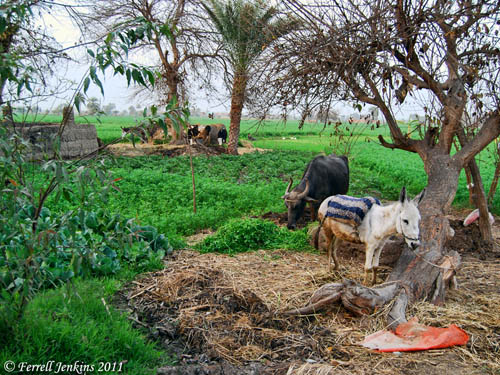
A typical scene in the Eastern Nile Delta. Photo Ferrell Jenkins.

A typical scene in the Eastern Nile Delta near Tel Daba. Photo Ferrell Jenkins.

To think of the stereotypical view of Egypt as a pyramid in the desert is to misunderstand the area where Israel settled.  Goshen is a flat, fertile, area, situated along the Pelusiac branch of the Nile River. That branch has now been replaced by a canal that runs generally along the same course. Cattle, including sheep, are common in the Eastern Nile Delta today. The canal in the photo below is one of the numerous smaller canals providing water to the farm land of the region.
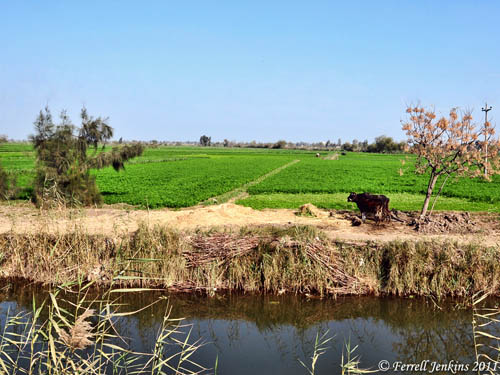
The land of Goshen near ancient Tanis. Photo by Ferrell Jenkins.

The land of Goshen between ancient Tanis and Tel Daba. Photo by Ferrell Jenkins.

I enjoy the vividness of The Five Books of Moses by Everett Fox. Fox translates Genesis 46:34 as follows:

Then say: Your servants have always been livestock men, from our youth until now, so we, so our fathers—
in order that you may settle in the region of Goshen.
For every shepherd of flocks is an abomination to the Egyptians.

This will give you something to consider. Hopefully it will be helpful. We have mentioned Goshen several times in this blog. Put the word goshen in the search box to locate them.
Abraham at Beersheba (Beer Sheba)

Bible students associate the town of Beersheba (Beer Sheba; Be’er Sheva) with the patriarch Abraham (Genesis 21-22).

  • The first reference to Beersheba is when Abraham sent Hagar and Ishmael to wander in the wilderness of Beersheba (21:14). This is the region known as the Negev.
  • Abraham dug a well and called the place Beersheba (21:30-31). Abraham and Abimelech, the king of Gerar, made a covenant. Abraham presented seven ewe lambs to Abimelech. The name Beersheba means “the well of the seven.”
  • Abraham planted a tamarisk tree at Beersheba and called upon the name of the LORD, the Everlasting God (21:33).

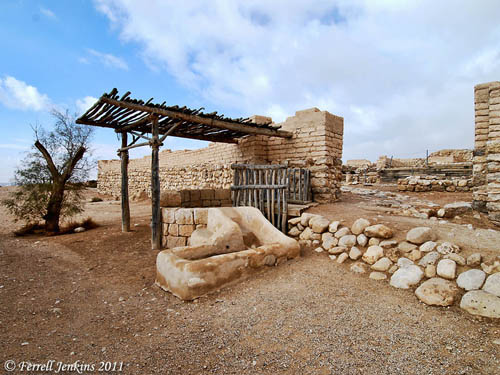
Archaeological excavations were conducted at Tel Beersheba by Tel Aviv University Institute of Archaeology under the direction of Yohanan Aharoni (1969-1973). The excavation indicated that there was no city at the site before the Iron Age. The outer gate of the reconstructed Iron Age city, an older well, and a tamarisk tree, in the photo below, serve as a reminder that Abraham lived in this general vicinity.This tamarisk tree has been cut back and is putting out fresh branches.

Abraham planted a tamarisk tree at Beersheba, and there he called on the name of the LORD, the Everlasting God. (Genesis 21:33 NAU)

The outer gate, well, and tamarisk tree at Tel Beersheba. Photo by Ferrell Jenkins.

The outer gate, well, and tamarisk tree at Tel Beersheba. Photo by Ferrell Jenkins.

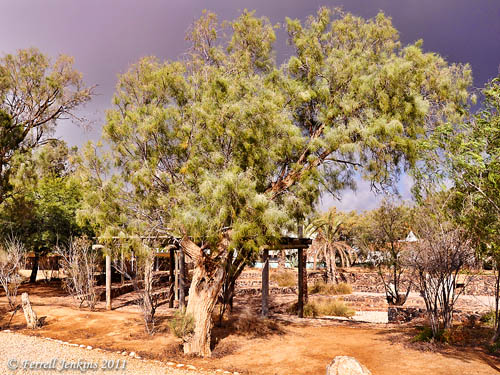
The Negev is suitable for the tamarisk tree. Here is a larger tamarisk at the entry to the site. This photo was made in the month of December. Heavy clouds are visible to the west.

Tamarisk trees at Tel Beersheba. Photo by Ferrell Jenkins.

Tamarisk trees at Tel Beersheba. Photo by Ferrell Jenkins.

Fauna and Flora of the Bible describes the tamarisk this way:

The Tamarisk is a small, fast-growing tree with durable wood, to be found abundantly in deserts, dunes and salt marshes.

Tamaris Aphylla is leafless and has green branches and a wide crown. It has small white flowers, and its fruit is a capsule with feathery seeds. (p. 182)

Photos suitable for use in teaching are available by clicking on the images above.

More on the Ophel City Walls site

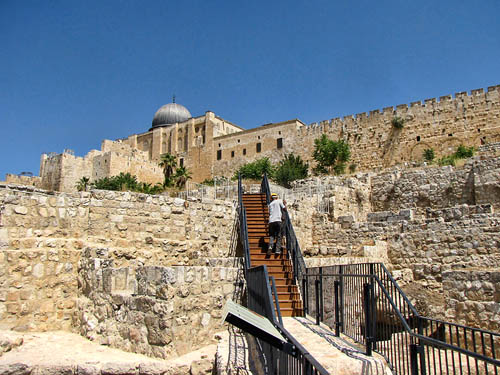
The Israel Antiquities Authority provided several good photos of the Ophel City Walls site. I thought this was an especially nice photo. The view from the site looks at the new steps leading to and from the excavation. The southern wall of the temple mount enclosure is visible in the distance.

Ophel city walls site. Photo: IAA

Ophel City Walls site. Photo: Israel Antiquities Authority.

Leen Ritmeyer provides insight into the excavation dating back to the mid-1970s when he supervised some of the excavations under the direction of Prof. Benjamin Mazar. Take a look here.

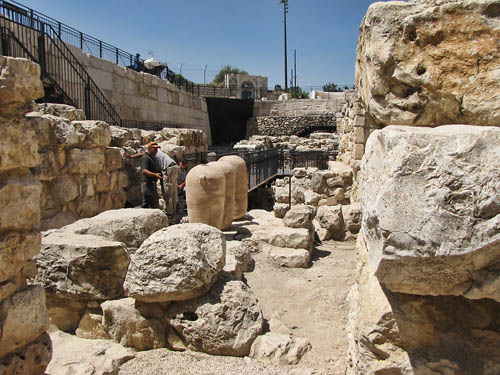
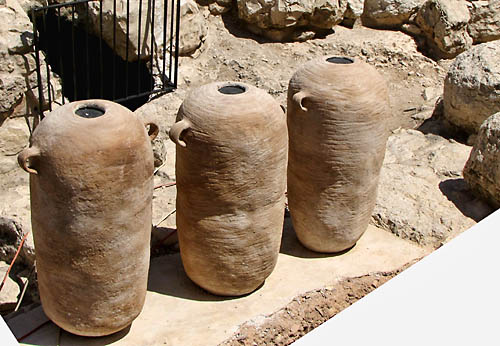
The next photo shows workmen putting the finishing touches on some of the stones. Three pithoi are visible. The view is toward the southwest.

Ophel City Wall site. Photo: Israel Antiquities Authority.

Ophel City Wall site. Photo: Israel Antiquities Authority.

Ophel City Walls site opened in Jerusalem

The Israel Antiquities Authority announced the opening today of what is being called the First Temple Period Ophel City Walls Site in the Walls Around Jerusalem National Park.

In a festive ceremony that was held Today – Tuesday, June 21, 2011, the Ophel City Wall site, a complex of buildings uncovered along the route of the fortifications from the First Temple period (tenth-sixth centuries BCE), and the display of the earliest written document ever uncovered in Jerusalem was inaugurated. The opening of the site, located in the Walls Around  Jerusalem National Park, and the exhibit in the Davidson Center are made possible through the generous donation by Daniel Mintz and Meredith Berkman.

Upon completion of the excavation and conservation work at the Ophel City Wall site, visitors will now be able to touch the stones and walls whose construction tells the history of Jerusalem throughout the ages.  It is now possible to walk comfortably through the built remains, in places that were previously closed to the public, to sense their splendor and learn about the history of the region by the signage and the different means of presentation and illustration.

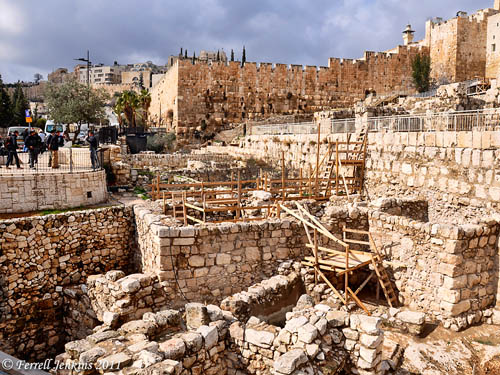
This photo shows construction work in the area a few months ago.

Ophel First Temple Site during construction of park. Photo by Ferrell Jenkins.

Ophel First Temple Site during construction of park. Photo by Ferrell Jenkins.

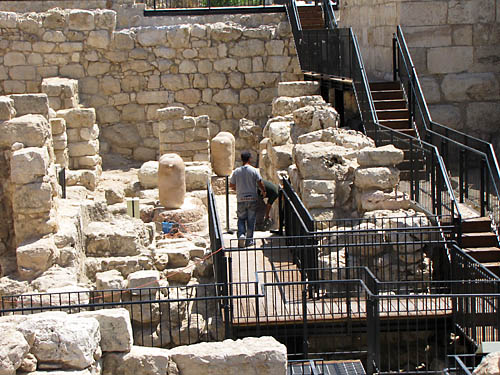
Here is a more recent view showing workmen putting final touches on the nice stairs and overviews for those who enter the site through the Davidson Center.

Ophel Site Park. IAA.

Ophel Site Park being prepared for opening. Photo: Israel Antiquities Authority.

The IAA news release continues,

The architecture at the site that was exposed includes an impressive building thought to be a gate house, a royal edifice, a section of a tower and the city wall itself. Dr. Mazar suggests identifying the buildings as part of the complex of fortifications that King Solomon constructed in Jerusalem: “…until he had made an end of building his own house, and the house of the Lord, and the wall of Jerusalem round about” (1 Kings 3:1). In addition to the fortifications of the First Temple period, sections of the Byzantine city wall and two of its towers were exposed. This wall was built at the initiative of the Byzantine empress Eudocia in the fifth century CE. In addition to the complex of fortifications, the excavation of two rooms from the Second Temple period (first century CE) was completed, which were preserved to a height of two stories.

The highlight of the excavations is the complete exposure of the gate house. The plan of this impressive building includes four rooms of identical size, arranged on both sides of a broad corridor paved with crushed limestone. The plan of the gate house is characteristic of the First Temple period (tenth-sixth centuries BCE) and is similar to contemporaneous gates that were revealed at Megiddo, Be‘er Sheva’ and Ashdod. The excavator, Eilat Mazar, suggests identifying the gate house here with the ‘water gate’ mentioned in the Bible: “…and the temple servants living on Ophel repaired to a point opposite the Water Gate on the east and the projecting tower” (Nehemiah 3:26). The ground floor of a large building that was destroyed in a fierce conflagration can be seen east of the gate. Mazar suggests that this structure was destroyed by the Babylonian conquest of the city in 586 BCE. Twelve very large, clay store jars (pithoi), which probably contained wine or oil, were discovered on the floor of the building. Engraved on the shoulder of one of these pithoi is the Hebrew inscription “לשר האו…”. The inscription indicates that this pithos belonged to one of the kingdom’s ministers, perhaps the overseer of the bakers.

This photo shows (replicas of?) some of the pithoi on display at the site.

Pithoi displayed at the Ophel Site. Photo: Israel Antiquities Authority.

Pithoi displayed at the Ophel Site. Photo: Israel Antiquities Authority.

A fragment of a clay tablet written in Akkadian cuneiform script was discovered in the recent re-excavation of the area by Dr. Mazar. The tablet is typical of those “used in antiquity throughout Mesopotamia for international correspondence.”

Analyses of the writing and the clay used to produce the tablet show that the document originated in the Jerusalem region. It seems that it is a copy of a letter that the king of Jerusalem at the time, Abdi-Heba, sent to the king of Egypt. It was customary that a copy of this correspondence would be kept in the archives of the city Salem, which was Jerusalem in that period. The fragment of the tablet constitutes credible evidence of the status of Jerusalem as an important royal city in Canaan, which was administered as a city-state under the auspices of the pharaonic Egypt kingdom.

We have posted info about the first temple period (suggested) gate and wall here, and about the clay tablet earlier here and here.

The site also may be viewed from Ma’aleh Ha-Shalom Street a short distance east of Dung Gate.

HT: Joseph Lauer

The Nimrud ivories

Ray Moseley writes an article for Al-Arabiya about the Nimrud Ivories in the British Museum. The exquisite ivories date to the time of the Assyrian empire.

The British Museum in London has recently saved for the nation a horde of the so-called Nimrud ivories—1,000 intact pieces, 5,000 fragments—after a public fund-raising campaign that netted £1.17 million. That was about a third of the value of the ivories, and another third of the collection was donated by the British Institute for the Study of Iraq. The remaining third is expected to be returned to Iraq.…

The first group of ivories, dating from the 9th and 8th centuries BC, was excavated by the archaeologist Austin Henry Layard in 1845 at Nimrud, just south of Mosul on the Tigris River. They came from the ruins of the palace of Shalmaneser III, who ruled from 859 to 824 B.C., and more came to light a few years later.

The complete article may be read here. Some readers will enjoy the connection with archaeologist Max Mallowan and his wife, crime-novelist Agatha Christie, who used a knitting needle and cold cream to clean some of the ivories.

“Oh what a beautiful spot it was,” the novelist wrote. “The Tigris just a mile away, and on the great mound of the Acropolis, big stone Assyrian heads poked out of the soil. In one place there was the enormous wing of a great genie.”

The earliest ivories belong to the reign of Ashurnasirpal, but the largest number came from Fort Shalmaneser, a palace/fort built by Shalmaneser III (858-824 B.C.). He is the Assyrian king who brags about defeating “Ahab the Israelite” at the battle of Qarqar in 853 B.C. (Monolith from Kurkh), and of taking tribute from the Israelite king Jehu (Black Obelisk). The writers of the Bible had no reason to include either of these facts in their writings.

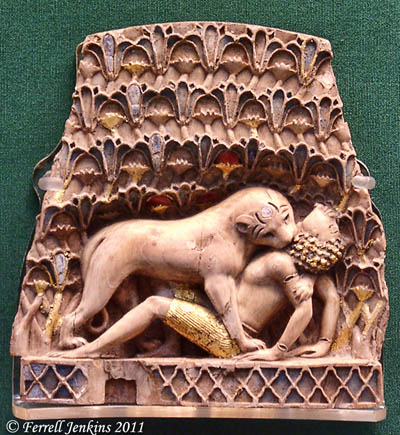
Our photo shows a relief in ivory of a lioness devouring a man with negroid features (a Nubian boy) in a thicket of stylized lotus and papyrus plants. This piece belongs to the Nimrud ivories displayed in the British Museum.

Assyrian Nimrud Ivory in British Museum. Photo by Ferrell Jenkins.

Assyrian Nimrud Ivory in British Museum. Photo by Ferrell Jenkins.

Moseley’s says the British Museum “recently put some of it’s collection on permanent display and intends to make other available for traveling exhibitions.”

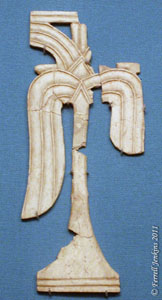
Samaria Ivory. British Museum. Photo: Ferrell Jenkins.

Samaria Ivory. British Museum. Photo: Ferrell Jenkins.

Bible writers spoke of Ahab’s ivory house at Samaria (1 Kings 22:39; Amos 3:15; 6:3-4). Both the British Museum and the Israel Museum display some of the ivories excavated at Samaria that follow the same general motif as those from Nimrud. The Israelites may have sent workers to learn from the Assyrians, Phoenicians, and Egyptians, or they may have hired foreign craftsmen to do their work, or imported the ivory pieces. The piece in the photo to the right is exhibited in the British Museum.

HT: Joseph Lauer

Friday’s findings

Looking for Joshua’s Ai. Gary Byers, administrative director of the Khirbet el-Maqatir excavation, has already posted info on six days of the dig. Because I assume this series will continue, I suggest you begin with Day One here. The expedition has posted photos on Facebook here. This will give prospective diggers some idea what goes on during a dig. Information about the purpose of the dig, a project of the Associates for Biblical Research, is posted here. Dr. Bryant Wood, and others associated with this dig, are looking for an alternative site for Ai.

Hidden Pyramids. Dr. Zahi Hawass has called in question the BBC program about the work of Dr. Sarah Parcak using satellite imagery to discover 17 new pyramids and other structures.

Although satellite imaging is useful for discovering new sites and monuments, interpretation of the images is not straightforward. No one can say with certainty that the features displayed under the sand are actually pyramids. Such anomalies could be houses, tombs, temples, pyramids, buried cities or even geological features. The only way we can definitely identify what is there is by excavating it – by investigating it physically. This was not made clear in the article.

Read the complete article here. See our earlier report here.

Corinth Matters. David Pettegrew, assistant Professor of History at Messiah College near Harrisburg, PA., has started a blog called Corinth Matters. Pettegrew completed a dissertation on Corinth on the Isthmus. The new blog deals with the ancient city of Corinth, the Isthmus, the Diolkos, and other things Corinthian. You will find readings lists, links to conferences, info on excavations, maps and images relating to Corinth and the Corinthian correspondence.

Dr. Pettegrew currently is traveling in Albania, the location of ancient Illyricum, visiting Corinthian colonies from the pre-Christian period. Paul made reference to preaching as far as Illyricum.

by the power of miraculous signs and wonders, and by the power of God’s Spirit. As a result, I have fully proclaimed the good news about the Messiah from Jerusalem all the way around to Illyricum. (Romans 15:19 CSB)

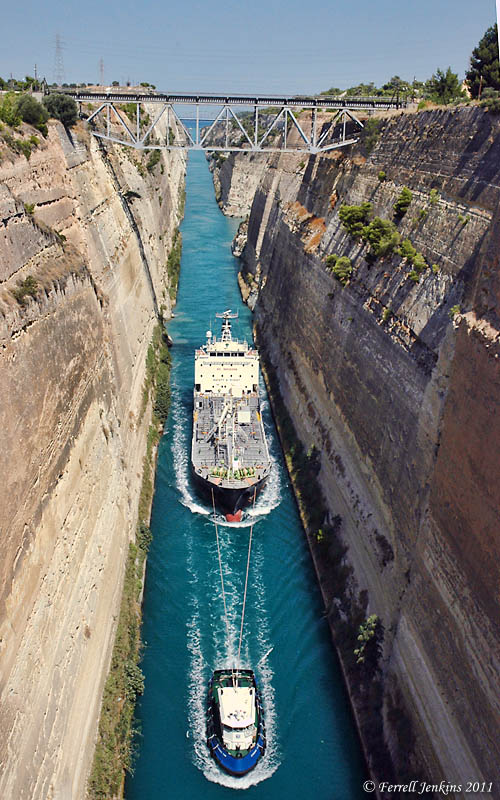
Corinth Canal - Photo by Ferrell Jenkins.

A ship is towed through the Corinth Canal. View west toward the Gulf of Corinth. Photo by Ferrell Jenkins.

Having taught the Corinthian correspondence for several year, I find this blog especially interesting.

The rocks of the wild goats (Ibex)

Wild goats (Hebrew ya’el) are mentioned in a few Old Testament passages (1 Samuel 24:2; Job 39:1; Psalm 104:18; Prov. 5:19). This animal is often identified with the Ibex.

The ibex, a type of wild goat, is still found in Southern Palestine, Sinai, Egypt and Arabia; it was known also in ancient times, as is evident from rock carvings. (Fauna and Flora of the Bible, 46).

The wild goats are associated with En Gedi on the shore of the Dead Sea.

Now when Saul returned from pursuing the Philistines, he was told, saying, “Behold, David is in the wilderness of Engedi.” Then Saul took three thousand chosen men from all Israel and went to seek David and his men in front of the Rocks of the Wild Goats. (1 Samuel 24:1-2 NAU)

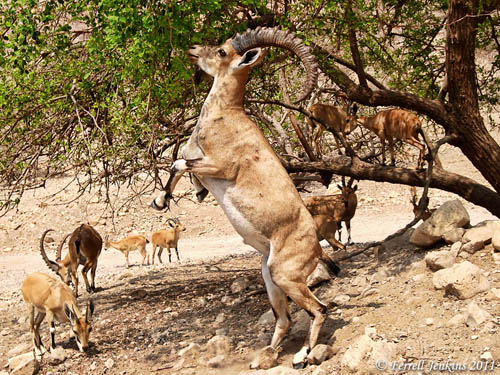
Our photo below was made at En Gedi.

Ibex at En Gedi. Photo by Ferrell Jenkins.

Ibex at En Gedi. Photo by Ferrell Jenkins.

The Psalmist says the high mountains are for the wild goats.

The high mountains are for the wild goats; The cliffs are a refuge for the shephanim. (Psalm 104:18 NAU)

SourceFlix has put together a nice video showing the Wild Goats (Ibex) at En Gedi.

The Crags of the Wild Goats from SourceFlix on Vimeo.

HT: Dr. Claude Mariottini

Update: Yesterday worked on this post, with the intention of completing it this morning. Early today I had to go to the airport to take a loved one. When I returned I continued working on the post and published it. Just now I decided to check some other blogs. To my surprise, I see that Todd Bolen has posted some fascinating videos of the Ibex fighting. Check it here.

What is that expression about great minds?

Apollonoia (Tel Arsuf) and the Plain of Sharon

Apollonia is not mentioned in the Bible, but the site is significant in understanding the land of the Bible. The coastal plain from Tel Aviv north to Haifa is known as the Plain of Sharon. The pasture lands of Sharon were allotted to the tribe of Gad (1 Chronicles 5:16). The plain seems to be mentioned in the account of the healing of Aeneas by Peter at Lydda (the area of modern Lod). Word spread quickly to the residents of Lydda and Sharon.

There he found a man named Aeneas, bedridden for eight years, who was paralyzed.  And Peter said to him, “Aeneas, Jesus Christ heals you; rise and make your bed.” And immediately he rose.  And all the residents of Lydda and Sharon saw him, and they turned to the Lord. (Acts 9:33-35 ESV)

The city at Tel Arsuf was established by the Phoenicians and dedicated to Reshef, the Canaanite god of fire. The Greeks equated Reshef with Apollo and called the city Apollonia (Alon, Israel National Parks & Nature Reserves, 286).

Apollonia was important to the Crusaders near the close of the 12th century and the decades to follow when the Crusaders “established part of their kingdom in the coastal area of the Holy Land, without Jerusalem” (Alon, 287). The fortress and walls from 1241 A.D. are now part of the National Park.

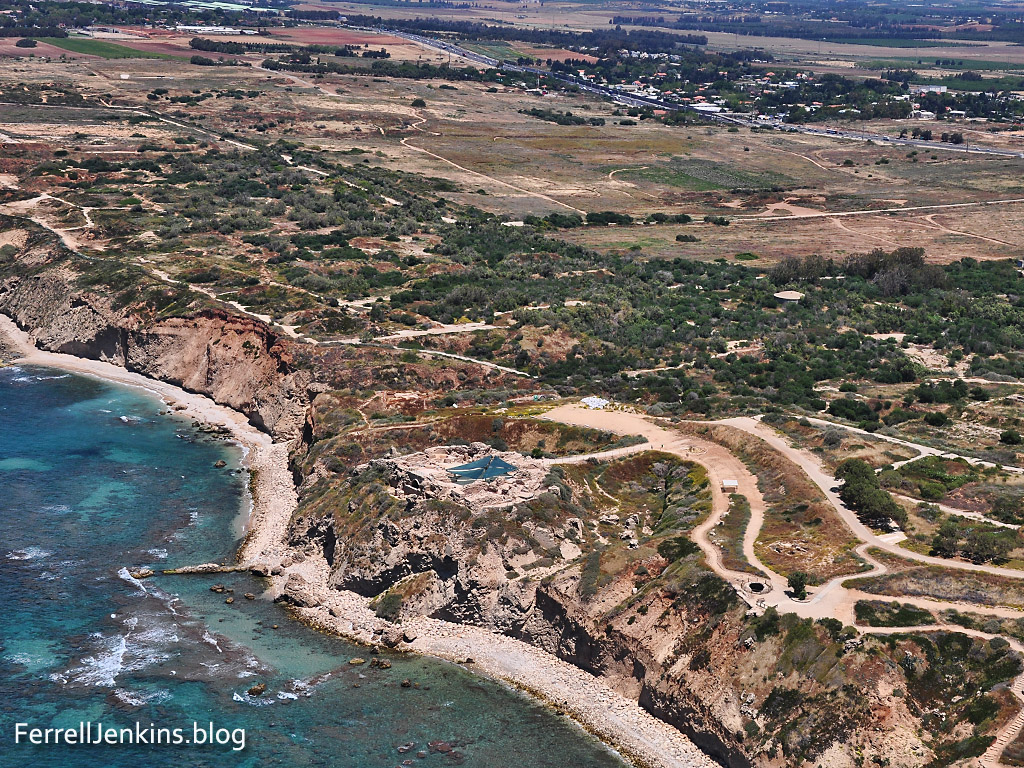
Our first photo shows the coastal plain of Sharon. Notice especially the kurkar ridge along the coast. Israel highway 2 may be seen a short distance inland. You will see Apollonia on the ridge overlooking the sea.

Aerial View of Apollonia and the Plain of Sharon. Photo by Ferrell Jenkins.

Aerial View of Apollonia and the Plain of Sharon. Photo by Ferrell Jenkins.

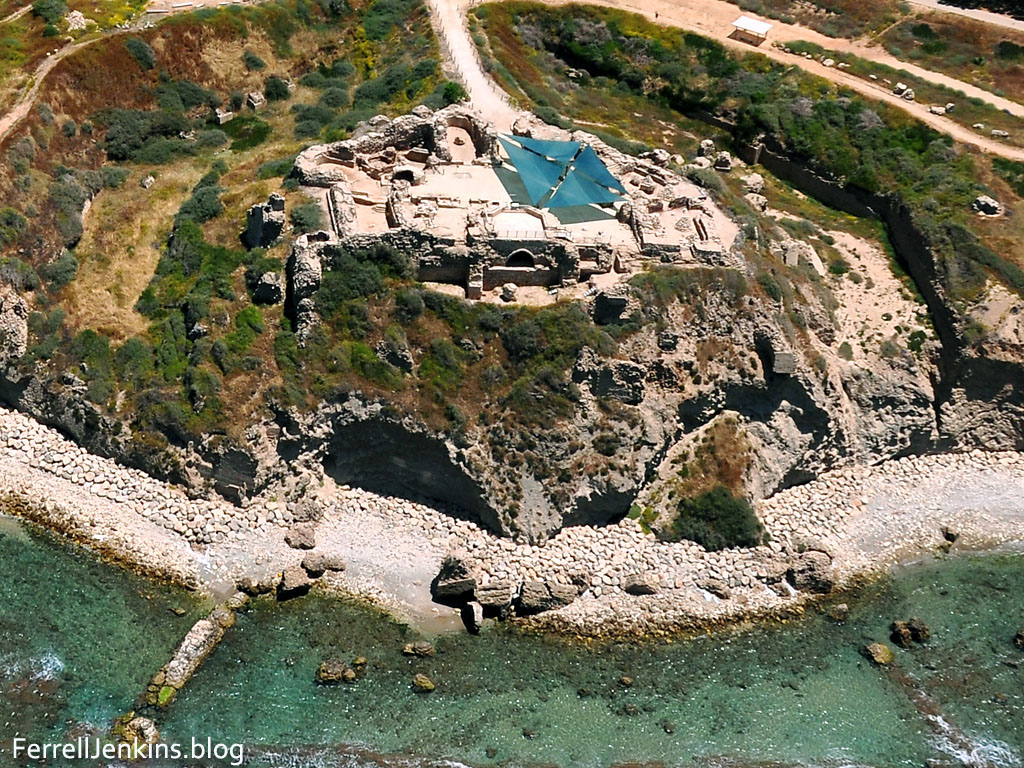
The second photo shows an aerial close up of the site of Tel Arsuf or Apollonia. This site is being damaged by the sea.

Aerial view of the Crusader fortress of Apollonia. Photo by Ferrell Jenkins.

Aerial view of the Crusader fortress of Apollonia. Photo by Ferrell Jenkins.

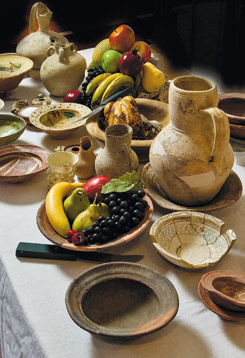
Ha’aretz English Language Edition Magazine reports on an exhibition at the Eretz Israel Museum, Tel Aviv, of the “Last Supper at Apollonia.”

Apollonia Final Supper of the Crusaders. Photo: Ha'aretz.

Apollonia Final Supper of the Crusaders exhibition. Photo: Ha’aretz, Leonid Pedrol.

The exhibition offers a first-time look at a collection of Crusader kitchen utensils. The Mameluke siege of the Crusader fortress began in late March 1265. Inhabitants of the area fled to the fortress.

During the few and far-between peaceful times in the Kingdom of Jerusalem, the fortress, built a generation earlier and leased to the Order of the Hospitallers just four years before its fall, was home to about 50 knights and their servants. At the start of the siege, which would go on for many bloody weeks, nearly 2,000 people were crammed into the fortress

Ronit Vered, author of the article, describes the siege.

During the five-week siege, more than 2,700 heavy boulders brought in from the Samaria hills were catapulted at the fortress walls. Some 1,200 iron-tipped arrows were fired at the defenders, and arrows wrapped in cloth and dipped in a flammable material were launched at the drawbridge and the heavy door, which was made of wood and bronze plates. The archers of the Order of the Hospitallers returned fire and even launched clay grenades filled with fiery materials at their enemies, but they had no defense against the tunnels dug by the Mamluks to undermine the wall’s foundations. On Thursday, April 29, the Mamluk fighters seized control of parts of the Arsur wall and raised their flag over it.

The Crusaders lost almost 1,000 men in the battle. Prof. Israel Roll led an excavation of the site in 1999. A cache of Crusader kitchen utensils were found. These are now exhibited for the first time at the Eretz Israel Museum.

The complete fascinating article may be read here. Larger images are available for those who may find them useful. Just click on the image above.

HT: Joseph I. Lauer

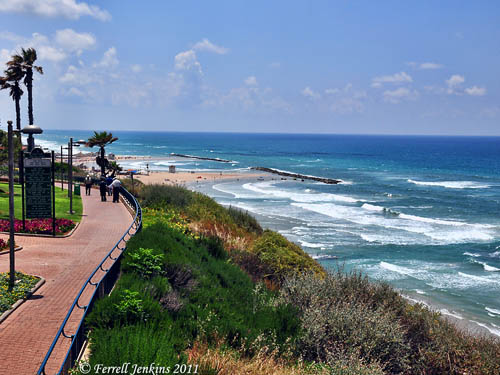
The Mediterranean coast along the Plain of Sharon

Today I am sharing a photo of the Mediterranean Sea made from the kurkar ridge of the Plain of Sharon at Netanya, Israel.

The Mediterranean Sea from the kurkar ridge at Netanya, Israel. Photo by Ferrell Jenkins.

The Mediterranean Sea from the kurkar ridge at Netanya, Israel. Photo by Ferrell Jenkins.

Biblical Israel was given the Great Sea as the western border of the promised land.

For the western border, you shall have the Great Sea and its coast. This shall be your western border. (Numbers 34:6 ESV)

In other texts the Mediterranean is simply called the western sea (Deuteronomy 11:24).

Memorial Day 2011

Memorial Day, originally called Decoration Day, is a day of remembrance for those who have died in our nation’s service. There are many stories as to its actual beginnings, with over two dozen cities and towns laying claim to being the birthplace of Memorial Day. (Memorial Day History)

When I was a kid, growing up in the American South, the day we now call Memorial Day was called Decoration Day. Families went to the local cemeteries to clean up the grave sites of relatives and leave fresh flowers. If it was known that there were no family members left in the community, those graves also were cleaned. I don’t recall when I first began to hear, or think, that the day was intended to honor those fallen in war.

Like many holidays, the original purpose has changed. Memorial Day, Independence Day, Labor Day, Christmas, Easter, and other holidays, have become times for picnics, trips, vacations, and assorted non-related practices. Every holiday has become a time for stores to have sales.

I like the idea of Memorial Day. I am pleased to join in the remembrance of troops fallen in battle, and all of the dead who have played a significant role in my life.

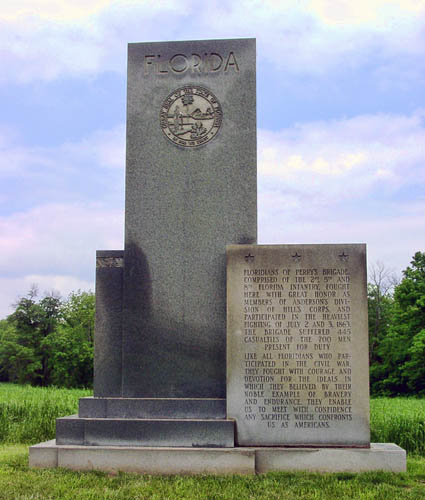
I have chosen a photograph that I made at the Gettysburg National Military Park of the monument erected to the men of Florida who fought in the American Civil War.

Gettysburg monument to Floridians who fought in the Civil War. Photo by Ferrell Jenkins.

Gettysburg monument to Floridians who fought in the Civil War. Photo: F. Jenkins.

On July 2 and 3, 1863, the 700 Floridians of Perry’s Brigade suffered 445 casualties. The monument reads this way:

Like all Floridians who participated in the Civil War, they fought with courage and devotion for the ideals in which they believed by their n0ble example of bravery and endurance. They enable us to meet with confidence any sacrifice which confronts us as Americans.

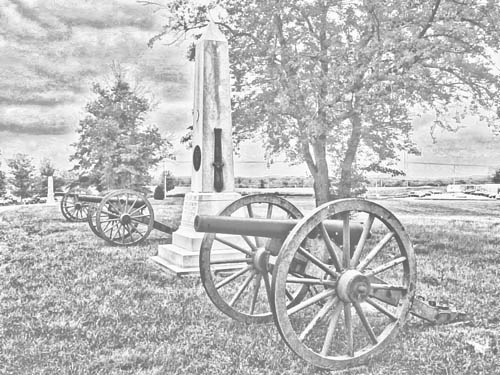
The photo below is another I made on the battlefield. It has been converted to a pencil drawing using a program called Topaz Adjust.

The Gettysburg Battlefield. Photo by Ferrell Jenkins.

The Gettysburg Battlefield. Photo by Ferrell Jenkins.

How good and pleasant it is when brothers live together in harmony! (Psalm 133:1 CSB)

The first portion of this post has been repeated from a year ago.