Category Archives: New Testament

Thessalonica on the Aegean

Thessalonica was located on the east-west Egnatian Way. The city was also located on the Bay of Thessalonica on the Aegean Sea. According to the records we have in the Book of Acts and Paul’s Epistles, Paul never used the sea port at Thessalonica.

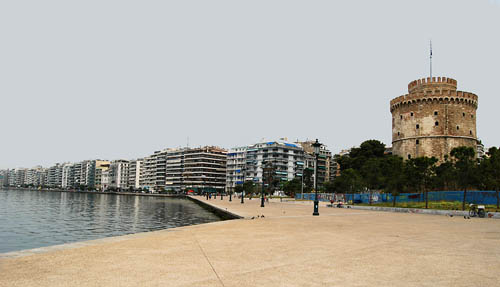
The waterfront of Thessalonica with the White Tower. Photo by Ferrell Jenkins.

The waterfront of Thessalonica with the White Tower. Photo by Ferrell Jenkins.

The tower, called the White Tower, was built in the 15th century by the Venetians or the Turks. It is probably the best known landmark of the city today.

Persecution of Christians in Thessalonica

Earlier we posted information about the Arch of Galerius. Galerius was the Roman Emperor from 305 to 311 A.D. The arch was erected in Thessalonica to commemorate his victory over the Persians in 297 A.D. The reliefs on the arch are about this victory.

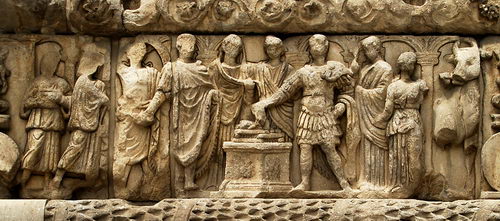
The most interesting portion of the relief to me is the one showing Galerius offering a sacrifice. The relief has been somewhat defaced, but it appears to me that he is pouring a libation on the altar. To the left, as we view the scene, is the Emperor Diocletian, the father in law of Galerius. The lady on the right is the wife of Galerius, daughter of Diocletian. Note the animal, awaiting his turn to be offered on a larger altar. The altar scene reminds us of the Emperor worship which was prevalent from the close of the first century onward.

Sacrifice scene on the Arch of Galerius in Thessaloniki. Photo by Ferrell Jenkins.

Sacrifice scene on the Arch of Galerius in Thessaloniki. Photo by Ferrell Jenkins.

Diocletian is noted for his decree in 303 A.D. that ordered the burning of all Bibles and church records. This is one reason we have so few manuscripts before the fourth century A.D. Some credit Galerius as the brain back of this decision. He was responsible for considerable persecution of Christians during his reign. This persecution would be that spoken of in the Book of Revelation that we associate with Emperor worship.

The Danish archaeologist Dyggve excavated a Palace, Hippodrome, and Mausoleum belonging to Galerius. He also was able to show that the Arch was part of the complex of buildings (Blue Guide Greece).

The Via Egnatia in Thessalonica

The Egnatian Way was one of the famous Roman roads used by the Apostle Paul in his travels to preach the gospel of Christ (Acts 16-17). F. F. Bruce gives a little history about the ancient road.

When Macedonia became a Roman province in 148 b.c., the Via Egnatia was constructed, running east from Dyrrhachium (modern Durres) and Apollonia (modern Poyani) on the Adriatic to Thessalonica, from which existing roads ran to the main Greek cities. The Via Egnatia was later extended farther to Neapolis (modern Kavalla), the port of Philippi, and later still to Byzantium on the Bosporus. When the Roman province of Asia was formed in 133 b.c., the Via Egnatia (with a short sea-crossing at either end) provided easy communication between Rome and the new province. (The Anchor Bible Dictionary, 6:649).

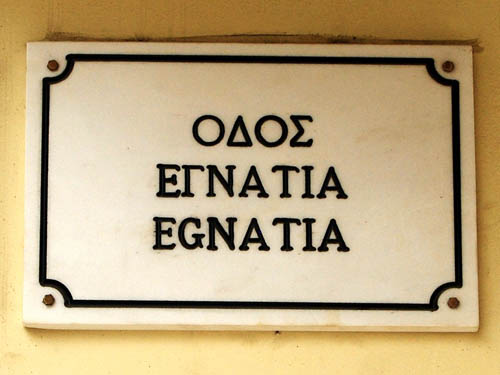
Very few remains from the first century have been exposed in Thessaloniki. Remember that the second largest city of Greece is built over the ancient city. One of the important streets running through the city is named Odos Egnatia (the Egnatian Way). The small street signs in Thessaloniki are located on building rather than on the corner of the street. This makes it difficult for a stranger to drive and read the street signs.

Street marker in Thessaloniki. Photo by Ferrell Jenkins.

Street marker in Thessaloniki. Photo by Ferrell Jenkins.

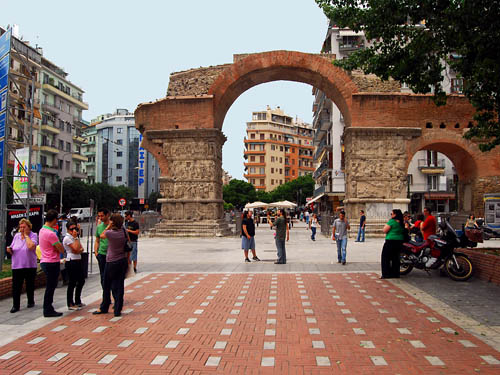
The Via Egnatia runs beside the monumental Arch of Galerius. This arch was built in A.D. 304 to commemorate the emperor’s victory over the Persians in A.D. 297 (Reddish & Fant 136).

Arch of Galerius (early 4th century A.D.). Photo by Ferrell Jenkins.

Arch of Galerius (early 4th century A.D.). Photo by Ferrell Jenkins.

Paul visited Thessalonica during his second journey

Paul came to Thessalonica on his second journey (A.D. 50-53; Acts 17). Paul describes the reception the Thessalonians gave to the gospel in these words:

For they themselves report about us what kind of a reception we had with you, and how you turned to God from idols to serve a living and true God, and to wait for His Son from heaven, whom He raised from the dead, that is Jesus, who rescues us from the wrath to come. (1 Thessalonians 1:9-10 NAU)

The church of the Thessalonians had many questions about the second coming of Christ. Paul addressed these questions in the two letters he wrote to the church from Corinth.

We know little of individuals associated with the church. Jason seems to be one of the earliest converts in Thessalonica (Acts 17:5-9). Aristarchus, a Macedonian of Thessalonica accompanied Paul on the voyage to Rome (Acts 27:2). He was one of the messengers who went with Paul on the return from the third journey (Acts 20:4). When Demas forsook Paul he went to Thessalonica (2 Timothy 4:10).

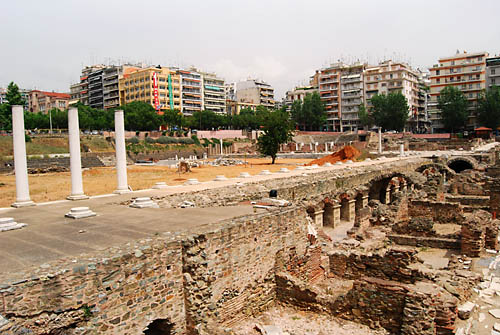
The photo below shows ruins of the Roman Forum in Thessaloniki, the second largest city of Greece. This area of the city was destroyed by a fire in 1917. During preparations for constructing new buildings these ruins were discovered. They date to the second and third century A.D. (See Fant and Reddish, A Guide to Biblical Sites in Greece and Turkey, 137). Perhaps there are older ruins below these. Notice how the modern city is built around the ancient ruins on a higher level. Can you imagine what might be underneath all of those buildings?

Roman Forum at Thessalonica. Photo by Ferrell Jenkins.

Roman Forum at Thessalonica. Photo by Ferrell Jenkins.

Mount Hermon is a source of water

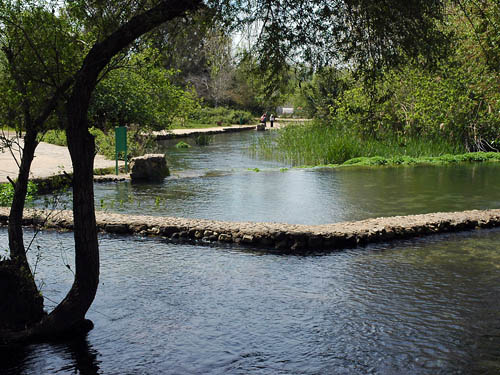
The land captured by Joshua and the Israelites included “Baal Gad in the valley of Lebanon at the foot of Mount Hermon” (Joshua 11:17). Today we call this valley to the east of Mount Hermon the Beka Valley. Some have suggested that Baal Gad might be the site later known as Paneas (now Banias), and later Caesarea Philippi. Dan is another important biblical town located at the foothills of Mount Hermon.

Source of the Jordan River at Caesarea Philippi. Photo by Ferrell Jenkins.

Source of the Jordan River at Caesarea Philippi. Photo by Ferrell Jenkins.

Brethren dwelling together in unity is said to be “like the dew of Hermon Coming down upon the mountains of Zion” (Psalm 133:3). Mount Hermon receives an annual average of about 60 inches of precipitation. In the winter the mountain is usually fully covered with snow.

The proximity of Mount Hermon to Caesarea Philippi, where Jesus was confessed to be the Christ, and where he promised to build the church, causes many scholars to suggest it as the “high mountain” of the transfiguration (Matthew 16:13 – 17:1-9).

Good deal on Bible study CD

From time to time I order Bible software from Rejoice Christian Software. I have no stock in the company, but am delighted to recommend some of their deals to others.

zondervant0310274486Rejoice has Zondervan’s Understanding the Bible Library 6.0 available as a special for only $35.95, less than the price of two volumes in print. You may read about the program details here, but you must go to a special link which I received by Email for the low price. Click here. The Email says it is o.k. to email it to a friend. This is my Email to you.

This program is published by Zondervan. Therefore it uses the Pradis format. This is the only way to get some of the Zondervan titles in digital format.

Here are a few of the significant titles in this program.

  • New International Bible Dictionary. Ed. F. F. Bruce.
  • New International Bible Dictionary. Ed. J. D. Douglas.
  • New International Dictionary of Biblical Archaeology. Ed. Blaiklock and Harrison.
  • New International Encyclopedia of Bible Difficulties. Archer.
  • New International Encyclopedia of Bible Words. Richards.
  • Asbury Bible Commentary.
  • Five Bible versions.

It is unfortunate that I have to open my Libronix program and my Pradis program when I am researching something, but that’s the way it is. Yes, I already have most of these in print, but I love being able to search the entire book on the computer.

The offer is valid through August 22, 2009.

Great source for periodical articles

Rob Bradshaw, over in the UK, has a passion for making available good, scholarly articles from old periodicals. This isn’t as easy as it may sound. He must know the literature, be able to locate a copy of the journal, obtain permission from the author or publisher, scan it, OCR, put into Word format, put it into a portable format such as PDF, post it online, etc.

Most recently I have downloaded J. A. Thompson’s 1964 booklet, The Ancient Near Eastern Treaties and the Old Testament. It is true that I have a copy of this booklet in my library, but I like having the material on my computer for easy searching. A couple of evenings ago I noticed that John R. W. Stott’s The Preacher’s Portrait. Some New Testament Word Studies was available. Now I have a copy on my computer. Did I mention that Rob sometimes scans books? Recently he has made available Carl F. H. Henry’s Revelation and the Bible. There are some great chapters in that book.

Use the search box to locate authors in which you may be interested. There is material by Edward J. Young, F. F. Bruce, et al.

Follow the link to this treasure of significant material: BiblicalStudies.org.uk. Thanks Rob.

World’s largest temple model

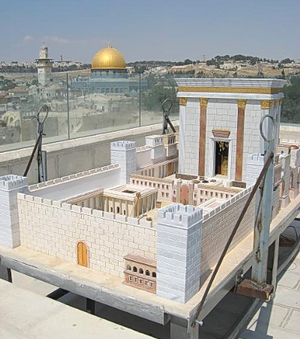
Arutz Sheva, Israel National News.com, reported the inauguration of the world’s largest model of the Second Temple (they mean Herod’s temple; not the one built by Zerubbabel in the days of the prophet Haggai).

The model, built at a scale of 1:60, was built by Michael Osanis for the Aish HaTorah Yeshiva in Jerusalem’s old city, and is displayed on the roof of its new museum, which at seven stories above the Western Wall plaza has a breathtaking view of the Temple Mount.

The photo of the model in place on the roof of Aish HaTorah’s new Exploration museum is impressive.

Largest temple model ignaurated August 5, 2009. Photo: Arutz Sheva.

Largest temple model inaugurated August 5, 2009. Photo: Arutz Sheva.

Read the full story here. There is a video showing the model being put into place.

Arutz Sheva reported July 30th on the building of the altar of the temple at Mitzpe Yericho. See article and photos here.

The Temple Institute has already built several of the Temple vessels such as the Ark and the menorah, and has now embarked on an ambitious project to build the altar, which will ultimately measure 3 meters wide by 3 meters long and 2 meters tall.

During Thursday’s ceremony, which took place in Mitzpe Yericho just east of Jerusalem, the Temple Institute laid the cornerstone for the altar and demonstrated how tar will be used to cement the stones together. The Institute plans on bringing the altar to its proper place on the Temple Mount when the Temple is rebuilt.

Mitzpe Yericho is in the wilderness of Judea near the Monastery of St. George.

There is some discussion between the Jews and Jesus about the building of Herod’s temple in the Gospel of John.

The Jews then said to Him, “What sign do You show us as your authority for doing these things?” Jesus answered them, “Destroy this temple, and in three days I will raise it up.” The Jews then said, “It took forty-six years to build this temple, and will You raise it up in three days?” But He was speaking of the temple of His body. So when He was raised from the dead, His disciples remembered that He said this; and they believed the Scripture and the word which Jesus had spoken. (John 2:18-22 NAU)

HT: Joseph I. Lauer.

Taking the family to the Explorations in Antiquity Center

We recently ran three posts about the Explorations in Antiquity Center, LaGrange, GA, here, here, and here. A couple of friends in Alabama were encouraged by the posts to take 9 of their grandchildren to visit the center. Olen and Jane have visited Israel and Jordan with me twice, and I think they have been in Turkey twice. So, they know what to look for, and they understood the value of such an experience as that provided by the Explorations in Antiquity Center for their grandchildren.

You may remember Jane from her Journeys With Jane blog. She described the experience in Georgia this way:

The experience was much more than we had even hoped for! It was a long (4 ½ hour) drive over there, included an overnight stay, and long drive back, but worth all the time involved. The exhibit itself is a bargain, and extremely educational for both adults and children. We are ready to go back whenever we have the opportunity. We are thankful for the safety during our travels on this brief “journey” and highly recommend it to anyone who is interested in the Bible or history of that era.

What was the best part?

The best part was the archaeological dig. We went to prepared areas and were instructed on archaeological techniques. Then we dug and sifted through our diggings to locate artifacts (some real and some replicas) which we would learn about later

She says they were honored to have Dr. James Fleming, the founder of the Center, explain about the artifacts they discovered on the dig, and relate them to different periods of history. Here, the kids listen intently as Dr. Fleming talks with them.
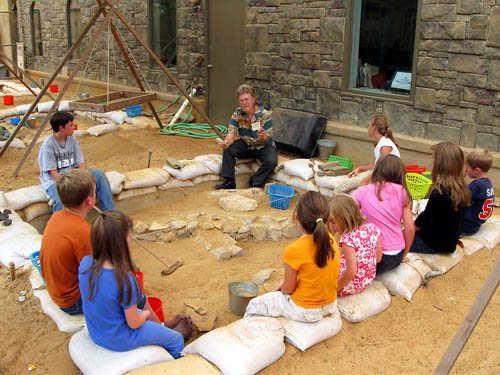
Dr. Fleming explains the archaeological artifacts to the kids.

Dr. Fleming explains the archaeological artifacts to the kids at the Explorations in Antiquity Center. Photo courtesy Journeys With Jane.

You might enjoy seeing the other photos Jane has posted on her blog here.

I have no connection with, or financial interest in, the Explorations in Antiquity Center, but I am delighted to promote such a wonderful teaching center. The link to the Center website is here.

Video on the City of David

The Israel Antiquites Department has released a nice 9-minute video featuring archaeologists Ronnie Reich and Eli Shukron showing some of the highlights of the City of David excavation. The film features the following places:

  • The water system and Warren’s Shaft
  • The Canaanite pool channel
  • Gihon Spring
  • Hezekiah’s Tunnel
  • The Pool of Siloam
  • The Herodian Street
  • The drainage channel

The video runs a little slow on my computer, but if you give it a little time to load it is certainly worth the wait. The link is here.

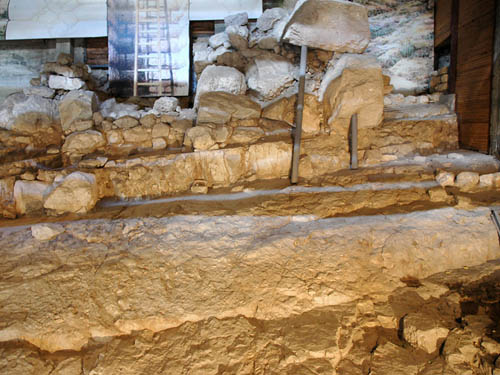
The photo below shows part of two towers that served as a fortification for the protection of Gihon Spring as early as the Canaanite time.

Foundation of the fortification tower at Gihon Spring. Photo by Ferrell Jenkins.

Foundation of the fortification towers at Gihon Spring. Photo by Ferrell Jenkins.

The information sign at the site says,

It was here that a rock-cut pool and the remains of the bases of two towers were located. These towers, built of large stones, constituted part of the fortifications protecting the pool and the spring as early as the Middle Bronze Age (18-15 centuries BCE). The spring water flowed through the channel to a large pool, from which scores of people could draw water simultaneously. The surplus water flowed through a channel to another pool in the south of the city.

This work has been carried out by Reich and Shukron.

HT: Joseph I. Lauer