Category Archives: New Testament

Uchisar in Cappadocia

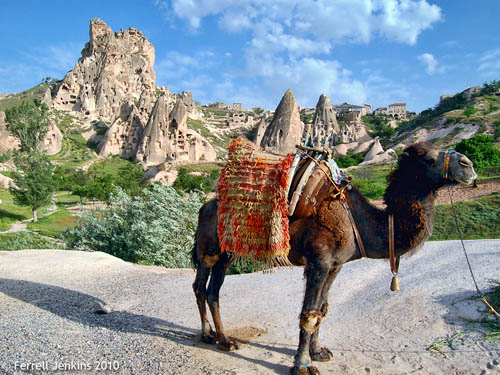
This photo was made in Uchisar in the region of Cappadocia in Turkey.

Uchisar in Cappadocia, Turkey

A camel at Uchisar in the region of Cappadocia. Photo by Ferrell Jenkins.

The Bible tells us that Jews of Cappadocia were present in Jerusalem on the day of Pentecost (Acts 2:9). Peter wrote his epistles to saints scattered throughout Cappadocia and other places in Roman Asia Minor (modern Turkey).

Peter, an apostle of Jesus Christ, To those who are elect exiles of the dispersion in Pontus, Galatia, Cappadocia, Asia, and Bithynia,  2 according to the foreknowledge of God the Father, in the sanctification of the Spirit, for obedience to Jesus Christ and for sprinkling with his blood: May grace and peace be multiplied to you. (1 Peter 1:1-2)

The ziggurat at Ur

The pyramids of Egypt are fairly well known to students in the Western world. Some study is made of them in the elementary grades. The ziggurats of Mesopotamia (mostly present day Iraq) are not as well known. In Egypt we have some pyramids, like the great pyramids of Giza, which are still standing to almost their original height. Having been made of stone, they have been fairly well preserved.

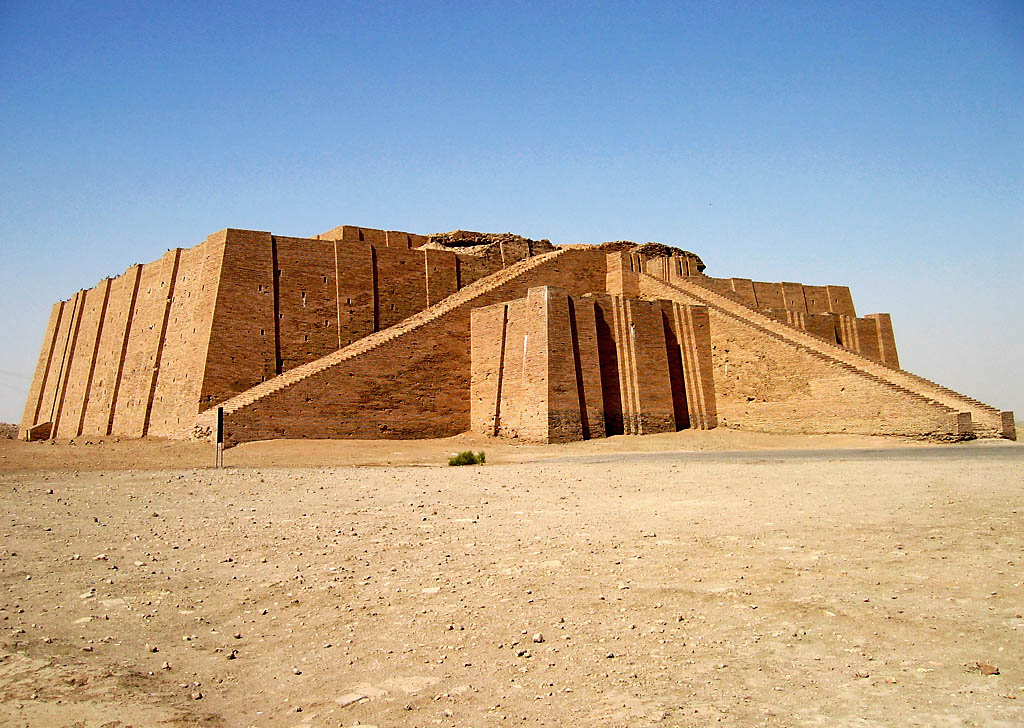
The ziggurats of Mesopotamia were made of baked bricks. Over the centuries they have tended to become piles of mud. The only one I saw during my only visit to Iraq in May, 1970, that had any semblance of a defined shape was the ziggurat at Ur. That was because it had been reconstructed up to about the fourth story.

The ziggurat was a staged temple tower. The temple at the top of the tower was considered the dwelling place of the particular god worshiped at a site. The kings of Ur are thought to have built the first ziggurat about the 27th century B.C., though some may have been erected on older structures going back to about 3100-2900 B.C. (The Middle East, Hachette World Guides, 1966). A model, like the one below from the Pergamum Museum in Berlin gives us a good impression of the original appearance of the ziggurats.

Ziggurat Model at the Pergamum Museum, Berlin. Photo by Ferrell Jenkins.

Ziggurat Model at the Pergamum Museum, Berlin. Photo by Ferrell Jenkins.

Every now and then I search the Internet for photos of Iraq. Sometimes I locate a nice photo made by a soldier who has been stationed there. One day I came across a really great photo on Flickr made by Josh McFall. It took a while to track down Josh and ask his permission to use the photo on the web site. He enthusiastically grated permission, only asking that I comply with the attached Creative Commons license. That, I was pleased to do. The Creative Commons license on this photo requires Attribution, Non-commercial Use, and No Derivative works. Josh, I am sure many of my readers thank you.

The ziggurat at Ur is attributed to the third dynasty of Ur (2124-2015 B.C.).
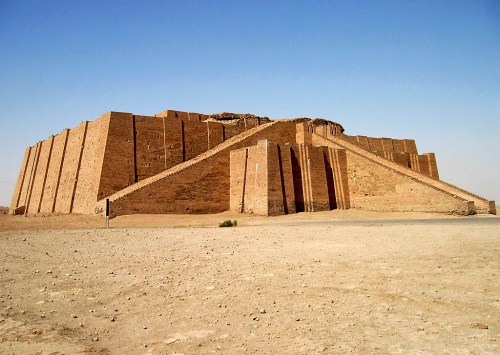
Ziggurat at Ur in Iraq. Photo by Josh McFall.

Reconstructed Ziggurat at Ur in Iraq. Photo by Josh McFall.

Perhaps we should think of something like the ziggurats when we study the account of the building of the tower of Babel in Genesis 11.

Then they said, “Come, let us build ourselves a city and a tower with its top in the heavens, and let us make a name for ourselves, lest we be dispersed over the face of the whole earth.” (Genesis 11:4 ESV)

And it might help with the understanding of what Jacob saw in his dream at Bethel.

And he dreamed, and behold, there was a ladder set up on the earth, and the top of it reached to heaven. And behold, the angels of God were ascending and descending on it! (Genesis 28:12 ESV)

When John calls attention to this scene he says the angels were ascending and descending on the “Son of Man” (John 1:51).

Both photos are available in presentation size for those who would like to use them. Just click on the image.

The potter’s right over the clay

In arguing that God has the right to do whatever He chooses, Paul uses the illustration of the potter and the clay.

But who are you, O man, to answer back to God? Will what is molded say to its molder, “Why have you made me like this?” Has the potter no right over the clay, to make out of the same lump one vessel for honorable use and another for dishonorable use? (Romans 9:20-21 ESV)

Potter molding a vessel at Avanos in Anatolia. Photo by Ferrell Jenkins.

Potter molding a vessel at Avanos in Anatolia. Photo by Ferrell Jenkins.

Our photo shows a potter molding a vessel, according to his own choosing, at Avanos in Turkey. Avanos, a town north of the region of Cappadocia, is famous for its potters. I am told that many homes have a potter’s wheel and the residents make some of the family income through pottery making.

The words of the LORD through the prophet Jeremiah are fitting:

Then the word of the LORD came to me: “O house of Israel, can I not do with you as this potter has done? declares the LORD. Behold, like the clay in the potter’s hand, so are you in my hand, O house of Israel. (Jeremiah 18:5-6 ESV)

We have included an image suitable for presentations for those who wish to use it in teaching.

Have no fear of the authorities

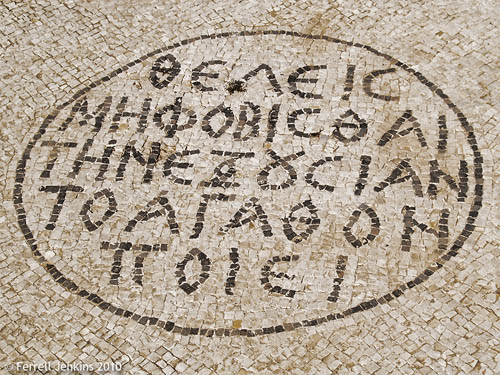
While reading Romans 13 I came to Paul’s admonition to the saints at Rome, ” Would you have no fear of the one who is in authority? Then do what is good.” My mind immediately turned to the mosaic which was discovered during the excavation of the Byzantine public area at Caesarea Maritima.

The context in Paul’s Epistle to the Romans reads this way.

For rulers are not a terror to good conduct, but to bad. Would you have no fear of the one who is in authority? Then do what is good, and you will receive his approval, for he is God’s servant for your good. But if you do wrong, be afraid, for he does not bear the sword in vain. For he is the servant of God, an avenger who carries out God’s wrath on the wrongdoer. (Romans 13:3-4 ESV)

The sign at the site describes the building where the mosaic was found as a Tax Archive. The original is said to be on display at the Kibbutz Sdot Yam Museum. The edifice is identified as “Byzantine government offices where clerks recorded tax revenues.”

Mosaic at Caesarea Maritima. Photo by Ferrell Jenkins.

Mosaic at Caesarea Maritima. Photo by Ferrell Jenkins.

I suppose they did not understand that this is politically incorrect!

Cupid cameo found in Jerusalem

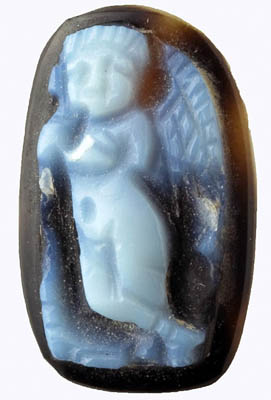
The 11th Annual City of David Archaeology Conference is scheduled for Wednesday, September 1. One item that will be discussed is the recently discovered 2,000 year old semi-precious cameo with an image of Cupid (the Eros of Greek mythology) on it.

Cupid Cameo found in Jerusalem.

Cupid Cameo found in Jerusalem. Photo IAA/Clara Amit.

This inlaid stone is of the “Eros in mourning” type, and is one of a group of visual motifs connected with the imagery of mourning practices. Jewelry bearing such motifs – earrings and rings, were not necessarily worn only in mourning rites, rather, they also served as memento mori, reminders of the fleeting nature of life.

The cameo, which is thought to have come from a piece of jewelry, is 0.39 in. long and 0.03 in. wide. It was discovered in the Givati Parking lot excavation under the direction of Dr. Doron Ben Ami and Yana Tchekhanovets.

We have noted other surprising discoveries in this area here and here. The area is not open to the public. Last May I made this photo through a hole which had been made (by someone else) in the metal fence surrounding the area. This site is immediately south of the old city wall, a few hundred feet east of Dung Gate. Needless to say, construction of the garage has been delayed. This is what happens when one begins to dig in Jerusalem.

Givati Garage Excavations. Photo by Ferrell Jenkins.

Givati Garage Excavations. Photo by Ferrell Jenkins.

Eros. William Barclay often mentions erōs when he comments on a text dealing with love. You recall the four words: agape, philia, storgé, and erōs. Barclay says,

There is the noun erōs and the accompanying verb eran. These words describe the love of a man for a maid; there is always passion in them; and there is always sexual love. Sophocles described erōs as “the terrible longing.” In these words there is nothing essentially bad; they simply describe the passion of human love; but as time went on they began to be tinged with the idea of lust rather than love, and they never occur in the New Testament at all. (The Gospel of Matthew at Matthew 5:43-48)

HT: Joseph I. Lauer

The Olive – first among the trees

The promised land, which the Israelites were about to enter, is described as a land of trees and crops.

a land of wheat and barley, of vines and fig trees and pomegranates, a land of olive trees and honey, a land in which you will eat bread without scarcity, in which you will lack nothing, a land whose stones are iron, and out of whose hills you can dig copper. (Deuteronomy 8:8-9 ESV)

Note that the land is a “land of olive oil.” In addition to using the olive for food, and in cooking, several other uses are mentioned in the Bible.

  • Oil for anointing the body – Deuteronomy 28:40.
  • Oil for anointing sheep – Psalm 23:5.
  • Medication – Isaiah 1:6; Mark 6:13.
  • Anointing priests, et al. – Exodus 29:7; Psalm 133.
  • Oiling the shields of war – Isaiah 21:5.

When an unworthy man by the name of Abimelech promoted himself to be the king of his people, Jotham went up on Mount Gerizim and spoke to the leaders of Shechem. The full story is in Judges 9. In Jotham’s parable (or fable) the trees of the forest called on various trees to rule over them. The trees first called on the olive tree to reign over them (v. 8). Look at the words of the olive tree as he excused himself.

But the olive tree said to them, ‘Shall I leave my abundance, by which gods and men are honored, and go hold sway over the trees?’ (Judges 9:9 ESV)

After that, the fig and the vine likewise excused themselves. Finally, the worthless bramble accepted their offer boasting of what he could do for them.

The photo below is a rather typical scene in the central mountain range of Palestine/Israel. Rather than the vast acres of olives trees in a row, like I have seen in Spain, these are scattered. A few other trees are mixed among the olives.

Scattered olive grove on a hill below Mar Elias Monastery. Photo by Ferrell Jenkins.

Scattered olive grove on a hill below Mar Elias Monastery. Photo by Ferrell Jenkins.

Mar Elias Monastery is located on the east side of the main road between Jerusalem and Bethlehem. One religious tradition from the Byzantine period has it that Mary rested at this place on her way to Bethlehem. Another has it that Mary stopped here for water on the flight to Egypt and water flowed from a rock. See The Holy Land by Murphy-O’Connor for more info.

The next photo is of terraced olive groves in the central mountain range south of Shiloh.

Terraced olive groves south of Shiloah. Photo by Ferrell Jenkins.

Terraced olive groves south of Shiloh. Photo by Ferrell Jenkins.

Presentation quality photos are available by clicking on the images above.

Paul’s illustration of the olive tree in Romans 11

The illustration used by Paul in Romans 11 to describe the relation between the Jews and the Gentiles is both memorable and instructive.

17 But if some of the branches were broken off, and you, although a wild olive shoot, were grafted in among the others and now share in the nourishing root of the olive tree,
18 do not be arrogant toward the branches. If you are, remember it is not you who support the root, but the root that supports you.
19 Then you will say, “Branches were broken off so that I might be grafted in.”
20 That is true. They were broken off because of their unbelief, but you stand fast through faith. So do not become proud, but fear.
21 For if God did not spare the natural branches, neither will he spare you.
22 Note then the kindness and the severity of God: severity toward those who have fallen, but God’s kindness to you, provided you continue in his kindness. Otherwise you too will be cut off.
23 And even they, if they do not continue in their unbelief, will be grafted in, for God has the power to graft them in again.
24 For if you were cut from what is by nature a wild olive tree, and grafted, contrary to nature, into a cultivated olive tree, how much more will these, the natural branches, be grafted back into their own olive tree. (Romans 11:17-24 ESV)

His point is simple. The Jews were cut off because of their unbelief. Gentiles were grafted in through their faith in Christ. The Jews may again be a part of the tree by accepting Christ. In the photo below we see that new branches have been grafted in the older, well-rooted stump.

Olive tree with grafts at Nazareth Village. Photo by Ferrell Jenkins.

Olive tree with grafts at Nazareth Village. Photo by Ferrell Jenkins.

In this close view one can see distinctly the grafting of the “wild olive shoot” into the old stump to be able to “now share the nourishing root of the olive tree.”

Grafts on an old olive stump. Photo by Ferrell Jenkins.

Grafts on an old olive stump. Photo by Ferrell Jenkins.

Paul addresses the problem of arrogance on the part of Gentile Christians. He reminds them that, as branches, they are dependent on the root.

do not be arrogant toward the branches. If you are, remember it is not you who support the root, but the root that supports you. (Romans 11:18 ESV)

Remember that Jesus is the root of David (Revelation 5:5; 22:16). He informed the woman of Samaria that “salvation is from the Jews” (John 4:22 ESV).

In directing tours I have encountered a few guides who think that a Christian group is interested only in “Christian sites.” This is far from true. In most of our churches the majority of the classes at any given time will be from the Old Testament.

For whatever was written in former days was written for our instruction, that through endurance and through the encouragement of the Scriptures we might have hope. (Romans 15:4 ESV)

Click on the photos for images large enough for use in your teaching.

More to come about the uses of the olive and oil production.

Recent photos from Magdala

Several times in the past three years we have called attention to the site of Magdala (Migdal). Last September we noted announcement by the Israel Antiquities Authority of the discovery of a synagogue from the Second Temple period (50 BCE—100 CE).

A synagogue from the Second Temple period (50 BCE—100 CE) was exposed in archaeological excavations the Israel Antiquities Authority is conducting at a site slated for the construction of a hotel on Migdal [Magdala] beach, in an area owned by the Ark New Gate Company. In the middle of the synagogue is a stone that is engraved with a seven-branched menorah (candelabrum), the likes of which have never been seen. The excavations were directed by archaeologists Dina Avshalom-Gorni and Arfan Najar of the Israel Antiquities Authority.

The town of Magdala is not mentioned in the Bible, but Mary Magdalene is mentioned a total of 12 times in the four gospels. This place may have been her birthplace or her home. A few late manuscripts mention Magdala (Matthew 15:39 KJV), but earlier manuscripts read Magadan. Magdala is located about 4 miles north of Tiberias on the western shore of the Sea of Galilee.

The Hebrew word Magdala means tower. In New Testament times the city had become Hellenized and bore the Greek name Tarichea because of the importance of the salted-fish industry there. Mendel Nun located a harbor at the site. He says,

“In ancient times, pickled sardines were an important element of diet throughout the country–especially for those who lived near the lake” (BAR, Nov/Dec 1993).

Josephus had his headquarters at Magdala during the first Jewish Revolt against Rome (A.D. 66-70). He was able to get a group of at least 230 boats to go from Magdala to Tiberias (Jewish Wars 2.635-637). Vespasian attacked the town from the sea and destroyed it.

Magdala with Mount Arbel to the West. Photo by Jim Joyner.

Magdala with Mount Arbel to the West. Photo by Jim Joyner.

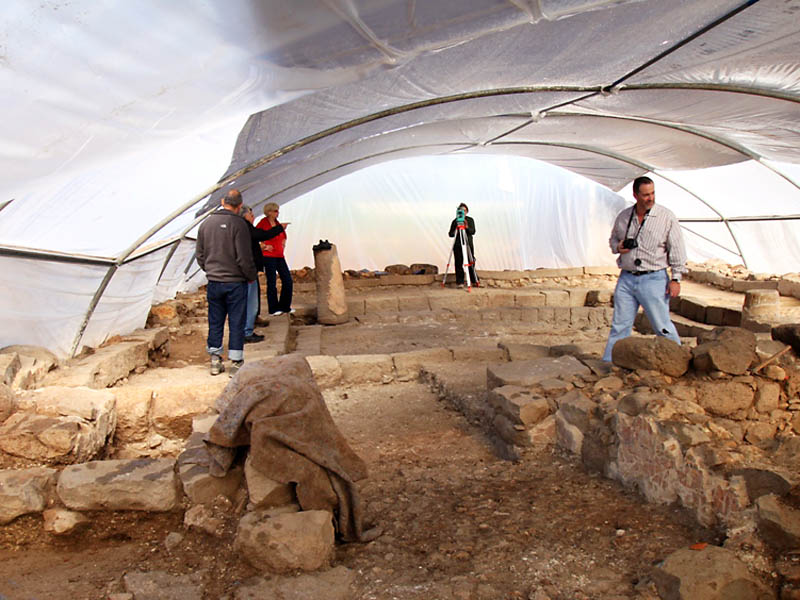
Recently Jim Joyner, one of our readers, offered to share a few of his photos made at Magdala earlier this year. The photo above shows part of the residential area of Magdala with Mount Arbel in the distance to the west. The synagogue excavation is under the tent in the distance. The Sea of Galilee would be to our back.

Jim explains,

The residences were first excavated. Eventually the remains of a synagogue were discovered. It was a magnificent discovery! The walls of the synagogue are clear, and the places where seats were located in the synagogue are obvious.  The walls were beautifully frescoed, and the remains of the colors are still obvious on the uncovered portions of the walls.

The Magdala/Migdal Synagogue. Photo by Jim Joyner.

The Magdala/Migdal Synagogue. Photo by Jim Joyner.

Thanks, Jim. We look forward to seeing more of these great photos.

We wrote about the Magdala Excavation Project here.

Friday variety

Israel Photos. J P vd Giessen has been posting photos from a trip to Israel over the past few weeks at his Aantekeningen bij de Bijbel [Notes on the Bible] blog. You will find photos of Megiddo, Caesarea Maritima, Capernaum, Gamla and other places. Start here. I know, the blog is in Dutch. I follow the blog regularly. When I see something that is of special interest I go to Google Translate and paste in the article for a translation. It is not ideal, but it helps.

Turkey Photos. Ben Witherington III is posting photos of a recent trip to Greece and Turkey at his Bible and Culture blog. You will find photos of Corinth (Acts 18), Sagalassos, Assos (Acts 20:13-14), Alexandria Troas (Acts 16:8), Patara (Acts 21:1), Myra in Lycia (Acts 27:5), Cappadocia (Acts 2:9; 1 Pet. 1:1), and others. The site is not very user friendly, but you may find something of interest. Start here and then use the search box.

Tell es-Safi/Gath. Prof. Aren Maeir has posted several aerial photos of Tell es-Safi/Gath made at the end of the 2010 archaeological excavation season. If you look soon you may just scroll back through the photos here.

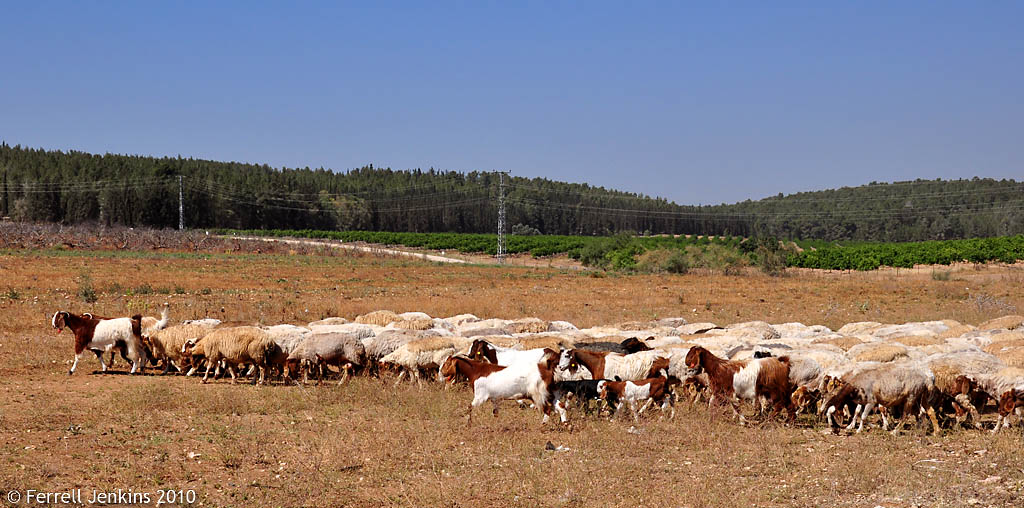
Our photo was made just below Tell es-Safi/Gath just after crossing the Elah brook. This shows the beginning of the coastal plain.

Sheep and goats at Tell es-Safi/Gath. Photo by Ferrell Jenkins.

Sheep and goats at Tell es-Safi/Gath. Photo by Ferrell Jenkins.

Greek, anyone? Rod Decker, a professor of Greek and New Testament, calls attention to some classic essays on using Greek in ministry. Perhaps some readers might find this helpful. Click here.

Jezreel Valley panorama

The header I am currently using is a panorama composed of three photos I made from the tell of Megiddo. The Jezreel Valley lies before us to the north (and slightly east). Nazareth is located in the mountains of lower Galilee. The valley continues east between the Hill of Moreh and Mount Gilboa to Beth-Shean, the Jordan Valley, and the mountains of Gilead. The valley was known by the Greek name Esdraelon in New Testament times.

Panorama of Jezreel Valley from Megiddo. Photo by Ferrell Jenkins.

Panorama of Jezreel Valley from Megiddo. Photo by Ferrell Jenkins.

Click on the photo for a hi-res image of this great plain for use in teaching. If you prefer a photo without labels, click here.

The vicinity of the Valley of Megiddo (Jezreel/Esdraelon) was the scene of many significant historical battles.

  • Thutmose III of Egypt fought Syrian forces – 1468 B.C.
  • Joshua defeated the King of Megiddo – Joshua 12:21.
  • Deborah and Barak defeated the Kings of Canaan – Judges 5:19.
  • Gideon defeated the Midianites – Judges 7.
  • Saul was defeated by the Philistines – 1 Samuel 28-31.
  • Ahaziah, king of Judah, died there – 2 Kings 9:27.
  • King Josiah was slain in a battle against Pharaoh Neco of Egypt – 2 Kings 23:29-30; 2 Chronicles 35:20-27.

Megiddo, the tell overlooking the valley, became typical of national grief and a symbol of decisive battles, similar to modern Waterloo, the Alamo, or Pearl Harbor. No wonder it provides the symbolism for the decisive battle in Revelation 16.  John’s Greek Har-Magedon becomes the English Armageddon.

The NAU transliterates harmagedon as Har-Magedon. Other English versions use something similar to the ESV.

And they gathered them together to the place which in Hebrew is called Har-Magedon. (Revelation 16:16 NAU)

And they assembled them at the place that in Hebrew is called Armageddon. (Revelation 16:16 ESV)

This valley has been significant even in modern times.

  • Napoleon advanced against the Turks in 1799.
  • General Allenby and the British defeated the German-Turkish coalition in 1918.
  • British officer Orde Wingate trained Jewish defense forces in this valley in the 1930s. Later leaders of the War of Independence (1948-1949), including Moshe Dayan and Yigal Alon, were trained by Wingate.

General Allenby read the historical survey about the importance of the valley in G. A. Smith’s Historical Geography prior to his battle against the German-Turkish coalition in 1918. Smith included that battle in later editions of his book.