
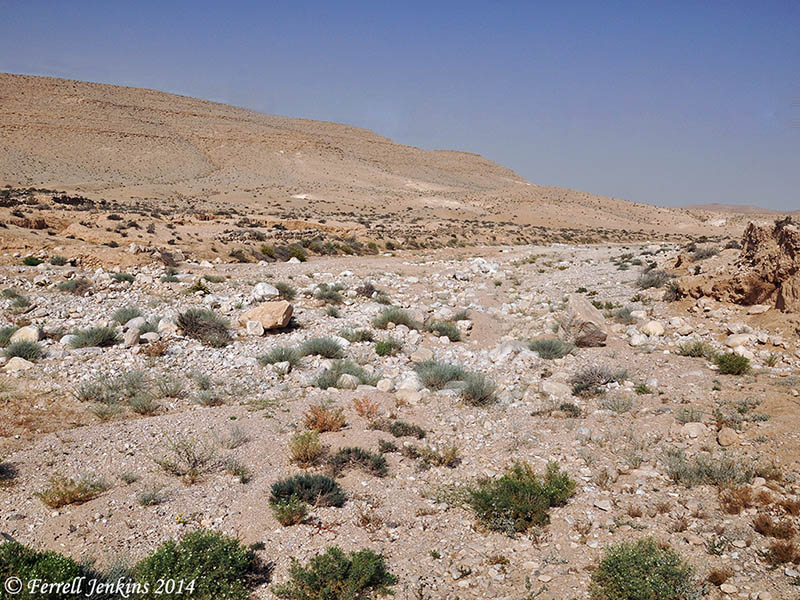
Isaiah prophesies the return of the redeemed to Zion, a promise that would be fulfilled with the return from the Babylonian exile. The illustration is one that would be vivid to those who lived on the ridge above the wilderness of Judah.
The wilderness and the dry land shall be glad; the desert shall rejoice and blossom like the crocus; it shall blossom abundantly and rejoice with joy and singing. The glory of Lebanon shall be given to it, the majesty of Carmel and Sharon. They shall see the glory of the LORD, the majesty of our God. (Isaiah 35:1-2 ESV)
Our aerial view was made toward the east from a location a few miles south of Jerusalem. In the distance you will see the Dead Sea and the Transjordan plateau. At this point it is the Biblical land of Moab.
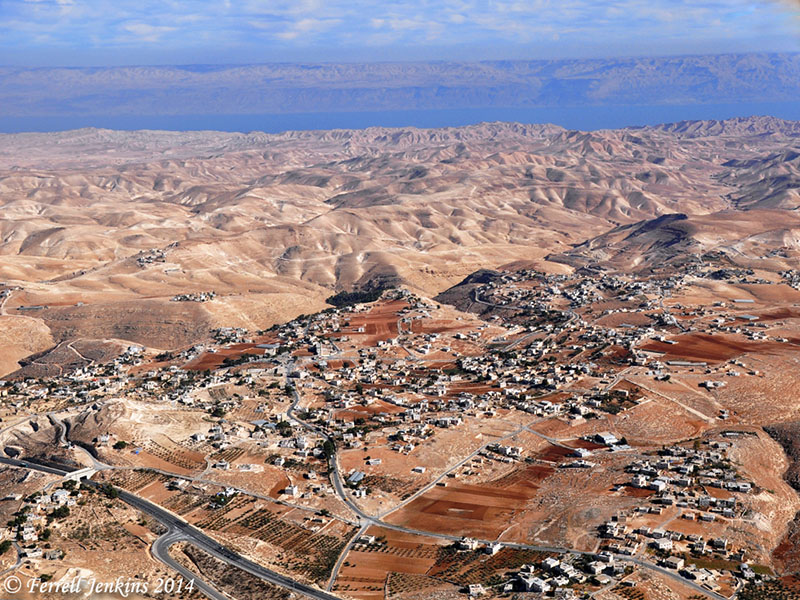
Aerial view east across the wilderness of Judah and the Dead Sea to the Transjordan Plateau. Photo by Ferrell Jenkins.
For illustrations of the streams in the desert, see here (Isaiah 35:5-7).
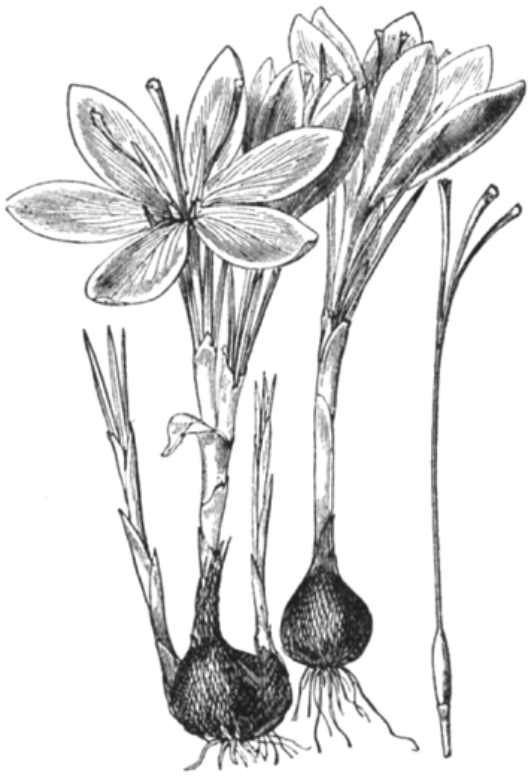
Saffron Crocus. The Illustrated Bible Treasury.
When I first began to travel, during the early days of the State of Israel, it was rather common for tour operators to include a phrase such as “See the desert blossom as a rose” in the tour brochure. The word rose came from the King James Version of Isaiah 35:1. The Hebrew term here is chabatstseleth. BDB defines it as a “meadow-saffron or crocus.”
Identifying plants and animals of Bible times is not easy. One common mistake is to find a plant of a certain name in our local language and identify it with one we read about in the Bible.
The point is rather simple. Places that were dry and barren would become watered and beautiful with the return of the redeemed.
 , is available free today in Kindle format.

 This book is available free in Kindle format today. Click on the book image for the link to the book.


 Ferrell's Travel Blog
Good reading for the weekend
Noah
There has been much discussion in the past few weeks about the Noah movie. In last Saturday’s roundup, Todd Bolen called attention to the blog of Dr. Brian Mattson. In a post entitled “Sympathy for the Devil” Mattson comments about the movie. He reminds us of the following important point: The Bible is not the text for this movie. Several writers, and speakers, have pointed out that about the only things in common between the Noah movie and the Noah/Flood story of the Bible are a man named Noah, an ark, and water.
Mattson claims and documents the philosophical background of the director of the movie in Gnosticism and Kabbalah. I am certain that many people will see the movie and have no awareness of that, just as many ready Paul’s epistle to the Colossians, and John’s epistles without understanding how they are responding to early Gnostic doctrines.
Here is the link to Mattson’s articles:
The Wife of Jesus, again.
It is almost Easter, so we can expect a rerun on various strange views about Jesus. I first called attention to this speculation about the wife of Jesus back in September, 2012, here. Todd Bolen recently commented on the same material that is now getting new attention. Here, he provides links to the article in the New York Times, and the Harvard Theological Review article by Dr. Karen King (available for download). The Times of Israel article is available here.
The GJW (Gospel of Jesus Wife) papyrus fragment possibly claiming that Jesus had a wife. Photo: Harvard University, Dr. Karen L. King.
Bolen summarizes the pertinent material, showing that the document tells us nothing about 1st century events:
Larry Hurtado has written three posts about the papyrus document. Begin here and then scroll back for the other two.
Wild Boar at Caesarea Philippi
Carl Rasmussen’s recent Israel student group encountered a herd of about 15 wild boar at Caesarea Philippi. He provides some nice photos to back up his claim, and discusses the various Biblical references about swine. Access the HolyLandPhotos’ Blog here.
Using Google Books
Rob Bradshaw is making many books and journals available in PDF format. I check his BiblicalStudies.org.uk site regularly for materials that might be helpful in my study. Recently he called attention to a short video by Tim Bulkeley on how to access Bible commentaries without a library. The helpful, brief video is here.
2 Comments
Posted in Bible Lands, Bible Study, Biblical Studies, blog, Books, Culture, Israel, New Testament, Old Testament, Photography, Travel
Tagged Commentaries, Noah, Todd Bolen, Wife of Jesus