Category Archives: Jordan

Absalom, rebel son of king David, caught his head in a great oak tree

While David was at Mahanaim, his son Absalom and those of Israel who were aligned with him camped in the land of Gilead (2 Samuel 17:26-27). David remained at the gate of the city while his men went out to fight the rebels. The Biblical account says,

So the army went out into the field against Israel, and the battle was fought in the forest of Ephraim. And the men of Israel were defeated there by the servants of David, and the loss there was great on that day, twenty thousand men. The battle spread over the face of all the country, and the forest devoured more people that day than the sword. And Absalom happened to meet the servants of David. Absalom was riding on his mule, and the mule went under the thick branches of a great oak, and his head caught fast in the oak, and he was suspended between heaven and earth, while the mule that was under him went on.  (2 Samuel 18:6-9 ESV)

Even though many trees have been used by various invaders over the centuries, some forests of oaks may still be seen in both Cisjordan (territory west of the Jordan River) and Transjordan (territory east of the Jordan River). The photos below were made in a grove of trees growing the Golan Heights a short distance south of the junction of Highways 98 and 99 south of Mas’ada.

These trees may be much smaller than the “great oak” in which Absalom caught his head, but they could be quite dangerous to a person trying to make a fast getaway on a mule.
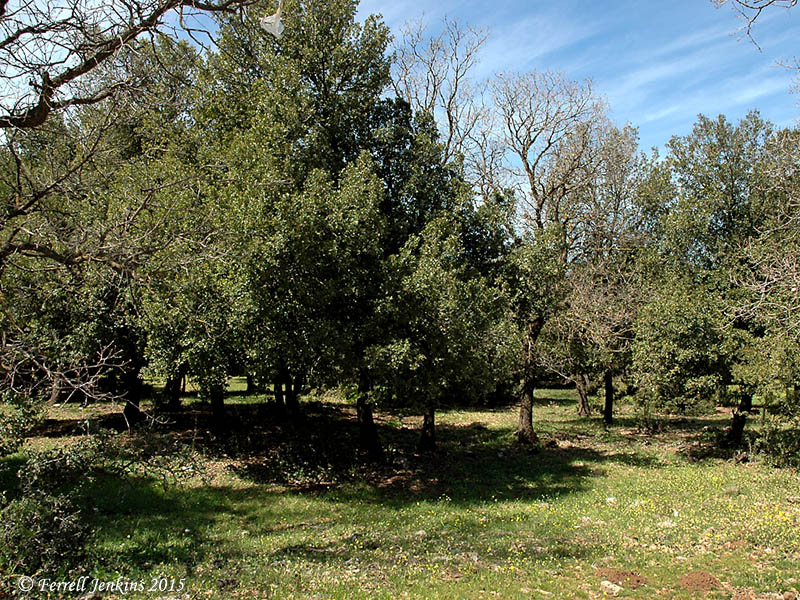
Oaks growing in the Golan Heights. Photo by Ferrell Jenkins.

Oaks growing in the Golan Heights. Photo by Ferrell Jenkins.

Here are the leaves of this variety of tree.
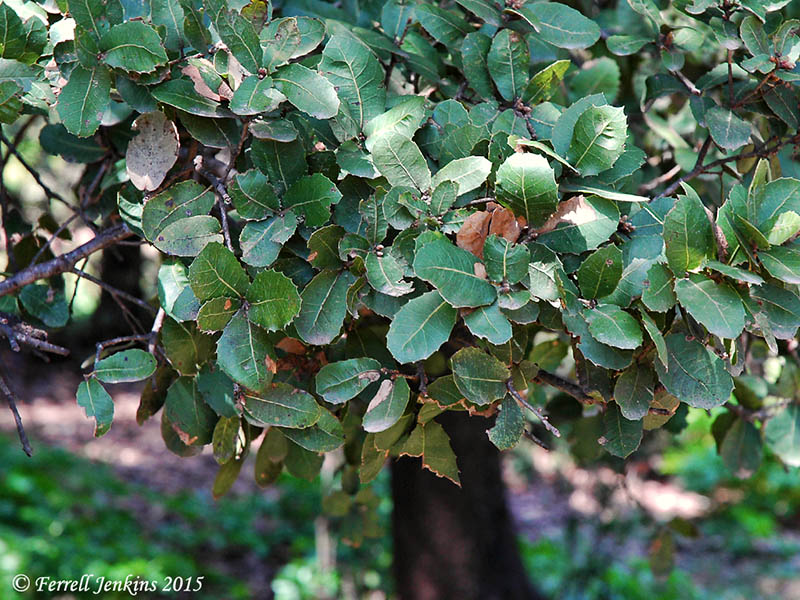
Close view of oaks growing in the Golan Heights. Photo by Ferrell Jenkins.

The leaves of oaks growing in the Golan Heights. Photo by Ferrell Jenkins.

And the large acorns it grows.
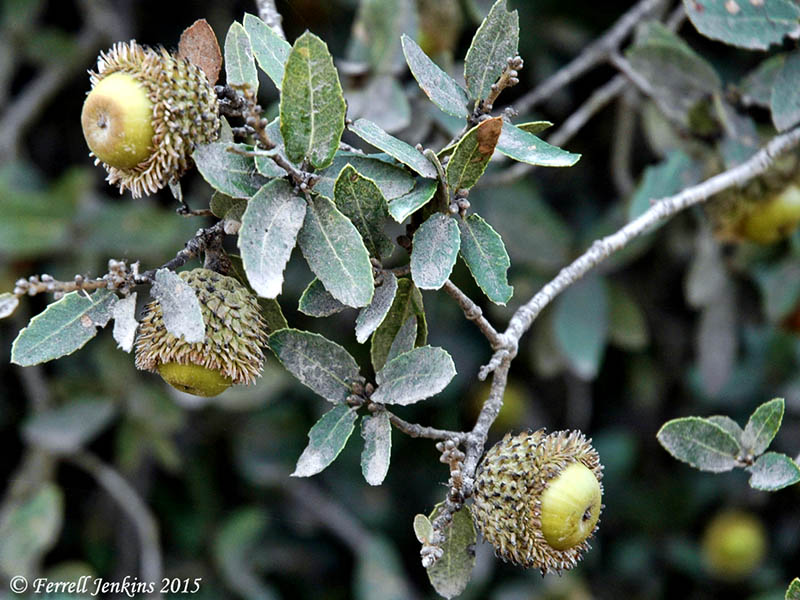
Acorns on the oaks of Bashan. Photo by Ferrell Jenkins.

Acorns on the oaks of Bashan. Photo by Ferrell Jenkins.

The oaks of Bashan are mentioned by the prophets of Israel several times (Isaiah 2:13; Ezekiel 27:6; Zechariah 11:2).

The technical name for the oak shown here is Querqcus ithaburensis, and is known as the Tabor oak. Dr. David Darom, in Beautiful Plants of the Bible, say this about the tree,

The Tabor oak, being a large deciduous tree that dominates its surroundings, was often associated with ritual and religious customs. Tabor oak forests once covered large areas of the northern Coastal Plain, the Lower Galilee, the Hulah Valley and
the slopes of the Golan. Most of the trees were cut down during the ages so their excellent wood could be used in buildings, furniture and boats. (p. 44)

William M. Thomson, back in 1880, described a walk in one of the “grand old forests” near the Crocodile River between Caesarea and Dor.

I had a delightful ramble early the next morning in those grand old forests, and then understood perfectly how Absalom could be caught by the thick branches of an oak. The strong arms of these trees spread out so near the ground that one cannot walk erect beneath them; and on a frightened mule, such a head of hair as that vain but wicked son polled every year would certainly become inextricably entangled: and it is interesting to know that the region east of the Jordan, that “wood of Ephraim” where the battle was fought, is still covered with thick oaks, tangled bushes, and thorny creepers growing over ragged rocks, and ruinous precipices, down which the rebel army plunged in wild dismay, horses and men crushing each other to death in remediless ruin. Thus twenty thousand men perished in that fatal wood, which “devoured more people that day than the sword devoured.” (The Land and the Book or Biblical Illustrations Drawn from the Manners and Customs, the Scenes and Scenery, of the Holy Land: Southern Palestine and Jerusalem. New York: Harper & Brothers, 1880. Print.)

To be precisely Biblical, it was Absalom’s head that caught in the oak, but the excessive hair might have contributed to his misfortune.

Absalom was killed by Joab and his armor-bearers (2 Samuel 18:14-15). Balwin comments on Absalom’s ignominious end:

All that remains is to bury there and then in the forest the body of the rebel, his grave marked only by a huge cairn of field stones, which would in a relatively short time cease to be identifiable. It was an ignominious end. (Baldwin, Joyce G. 1 and 2 Samuel: An Introduction and Commentary. Vol. 8. Downers Grove, IL: InterVarsity Press, 1988. Print. Tyndale Old Testament Commentaries.)
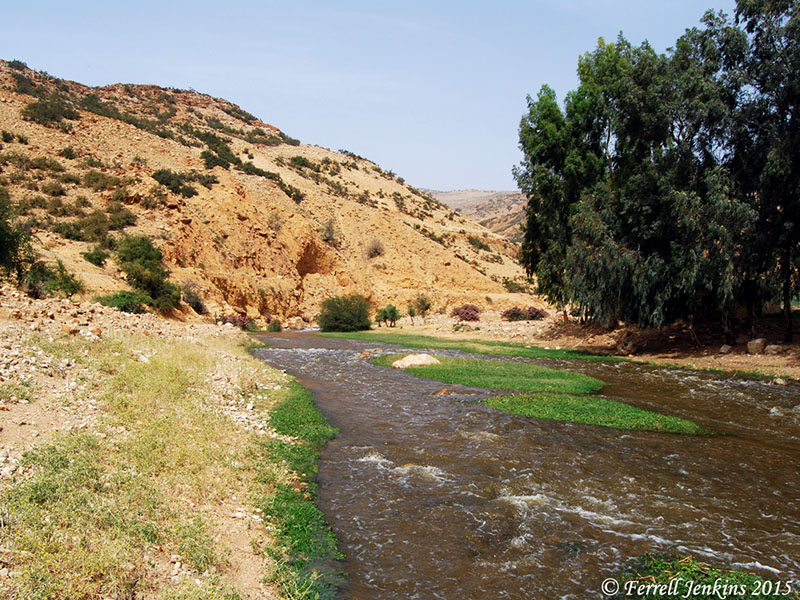
David stayed at Mahanaim when he fled from Absalom

The name Mahanaim is found 13 times in the Old Testament. The site is where Jacob and Laban met and made a covenant. Mahanaim seems to mean “two camps” (Genesis 32:2). This is where Jacob’s name was changed to Israel after he wrestled with a man (angel, Hosea 12:4). When morning came, Israel crossed over Penuel (Genesis 32:31).

Two large tells face each other and the Jabbok River flows in an S-curve between them. The tells are now named Tall adh-Dhahab East and Tall adh-Dhahab West. These tells are located a few miles east of the Plains of the Jordan and Tell Deir Allah (likely the site of biblical Succoth). Some scholars identify Dhahab West as Mahanaim and Dhahab East as Penuel. Other scholars reverse the identifications.

The Jabbok River near Mahanaim. Photo by Ferrell Jenkins.

The Jabbok River near Mahanaim. Photo by Ferrell Jenkins.

When Transjordan was divided among the tribes, Mahanaim was located in the territory of Gad on the boundary with East Manasseh (Joshua 13:26, 30). It was one of the cities allotted to the Levites (Joshua 21:38; 1 Chronicles 6:80).

Ishbosheth made king over Israel from Mahanaim

After the death of Saul, Abner made Ishbosheth, the son of Saul, king over all Israel from Mahanaim (2 Samuel 2:8, 12, 29).

David fled to Mahanaim

When David fled from his rebellious son Absalom he fled across the Jordan to Mahanaim (2 Samuel 17:24, 27; cf. 2 Kings 2:8). Absalom met his death in a nearby forest.

A Gileadite by the name of Barzillai took care of King David while he stayed at Mahanaim (2 Samuel 19:32). The city became one of Solomon’s administrative centers (1 Kings 4:14).

Song 6:13 describes gazing upon the Shulammite girl to be like looking on “the dance of the two camps” or “dance of two companies” (CSB, JPS, NAU, NKJ). Other translations use the expression “the dance of Mahanaim” (ASV, NIV, NJPS, TNIV) or “dance of the Mahanaim” (NET).

Recent excavations at Dhahab West, conducted by a German team, have revealed what they believe to be part of a monumental building of Herod the Great. They think this was the Hellenistic and Roman site described by Josephus as Amathus.

Tall adh-Dhahab East (left) and Tall adh-Dhahab West (right). These are thought to be the sites of Mahanaim and Penuel. Photo by Ferrell Jenkins.

Tall adh-Dhahab East (left) and Tall adh-Dhahab West (right). These are thought to be the sites of Mahanaim and Penuel. Photo by Ferrell Jenkins.

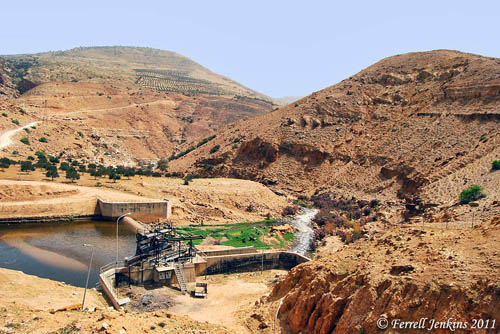
Our photo shows both tells. (Tall adh-Dhahab East is on the left. Tall adh-Dhahab West is on the right.) There is a pumping station on the Jabbok to provide agricultural irrigation. The Jabbok continues in the valley separating the two hills and tells.

Click on the photo for an image suitable for use in teaching presentations.

Joab and Uriah travel from Jerusalem to Rabbah

Last evening I was looking at the biblical account of David’s battles against the Ammonites (2 Samuel 10-11).

In the spring of the year, at the time when kings normally conduct wars, David sent out Joab with his officers and the entire Israelite army. They defeated the Ammonites and besieged Rabbah. But David stayed behind in Jerusalem. (2 Samuel 11:1 NET)

You probably know the rest of the story. David is attracted to Bathsheba, commits adultery, learns Bathsheba is pregnant, calls Uriah home in hope that he will spend the night with Bathsheba. Uriah acted in the true warrior way by not enjoying the benefits of the marriage bed while his companions were camping in the open field. David sent Uriah back to the battle with a letter to Joab to put Uriah in the forefront of the battle.

Have you thought about the journey made by Uriah and the other Israelite soldiers as they traveled from Jerusalem to Rabbah and back? You know where Jerusalem is located. It is situated on the eastern side of the water parting ridge of Israel at an elevation of about 2400 feet above sea level. Numerous times we have discussed the journey from Jerusalem to the Jordan Valley. See here and here.

The distance from Jerusalem to the Dead Sea is not more than 20 miles. The elevation drops from about 2600 feet at the Mount of Olives to (currently) about 1384 feet below sea level at the surface of the Dead Sea. The point of crossing at the Jordan River would be a little higher. From there one must go up into the Transjordan Tableland to reach Rabbah. The general elevation of the Transjordan Tableland is about 3000 feet above sea level. Amman is about 2500 feet above sea level. That makes this a difficult route of travel.

Rabbah (Rabbath), the capital of ancient Ammon, is the site we now know as Amman, capital of Jordan. During the Hellenistic period the city was renamed Philadelphia.

The total distance from Jerusalem to Rabbah is about 40 miles as the crow flies. Men rarely travel like crows. The distance by road is longer and more difficult.

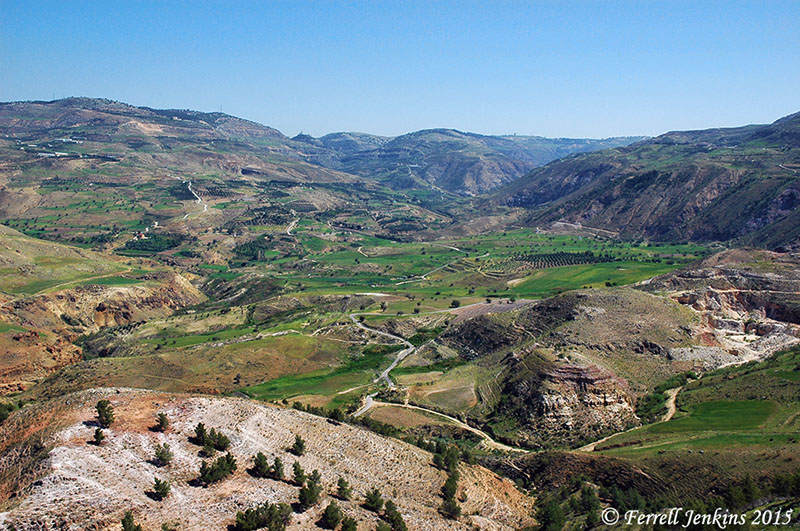
The photo I wish to share today was made in early April. It was made along a road a little east of the Jordan Valley and the Plains of Moab. From here you can see the terrain David’s men, including Joab and Uriah, had to travel on their way from Jerusalem to Rabbah. Modern Amman is located in the mountains we see on the horizon.

View looking east toward Amman. Photo by Ferrell Jenkins.

View looking east toward Amman. Photo by Ferrell Jenkins.

Learning routes of travel is one of the most important values in visiting the Bible lands. I hope this photo will help you with your study of the biblical account.

Reprint from 12/2/10.

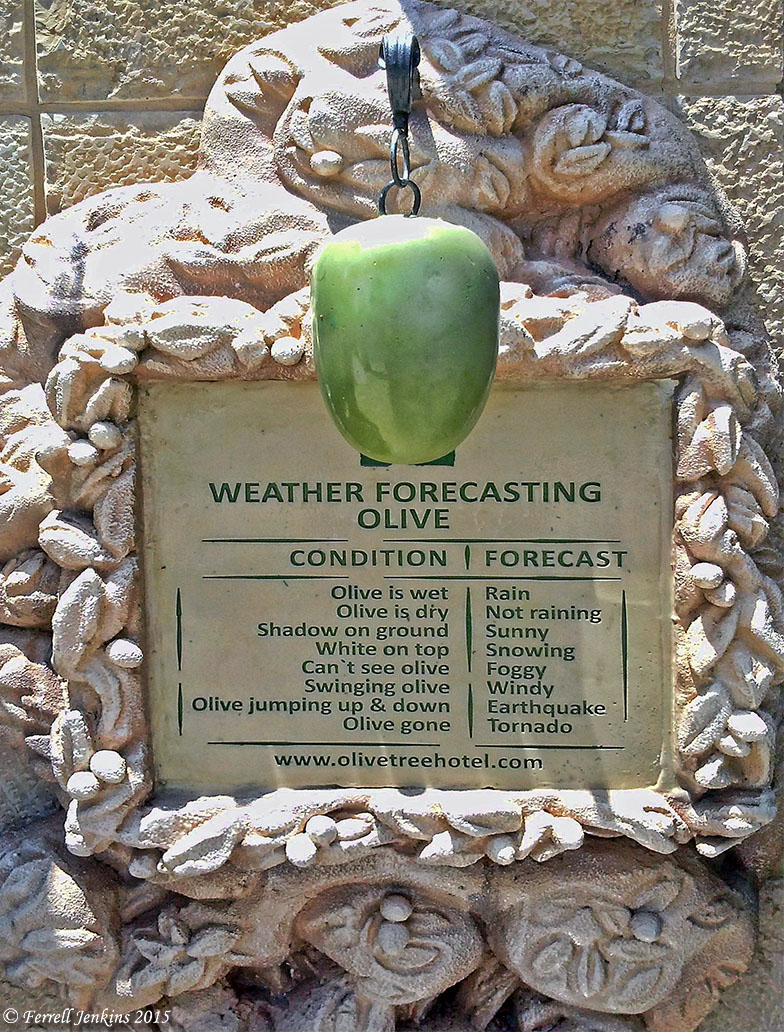
Weather Forecasting Olive

Two months ago tonight my wife and I returned from leading a tour of Alpine Europe and spending 10 days in Israel on a personal excursion. We knew before we arrived that our house had been flooded as the result of a break in the water line leading to the refrigerator. We now have new flooring. The kitchen cabinets are installed, but we must wait about two more weeks for the counter top and putting the cabinets into full use. Just this little misfortune has terribly disrupted our life; perhaps this has been reflected in the number of blogs we have posted. Breakfast of cereal and coffee is about the only meal we have been able to have consistently, and that required moving from room to room to locate the needed items. Lately we have also been able to have a sandwich and fruit in the evening. We have spent at least a dozen nights in local hotels when we have been unable to get in our bedroom or when the dirtiest work was going on. It might sound like a vacation, but it’s not.

The Tampa, Florida area where I live has made the national news in the past few days because of the rains and flooding. I was just watching some of the late evening news a few minutes ago. We are barely in August, but the weatherman said we have already had more rain than the yearly average. During the first three days in August we had 8.42 inches. This is more than the monthly average. Some neighborhoods, especially those near the Gulf, the bay, or along rivers, are still under water. I feel for those folks and the length of time it will take them to get back to normal.

When we made our first tour to the Bible lands in 1967, the Old City of Jerusalem and the West Bank were still part of the Hashemite Kingdom of Jordan. We crossed from Jordan into Israel through the Mandelbaum Gate. Today the Grand Court Hotel, the Olive Tree Hotel, and another hotel stand in that area.

In May I walked past the Olive Tree Hotel and noticed the sign outside the hotel with the title “Weather Forecasting Olive.” I grabbed a shot with my cell phone and thought you might enjoy it.

Weather forecasting olive at the Olive Tree Hotel, Jerusalem

Weather forecasting olive at the Olive Tree Hotel, Jerusalem.

Actually I have noticed that the shrubs in my yard provide the same forecast. Well, except for the snow. We have had one dusting in the fifty+ years we have lived here.

Maresha of the Shephelah

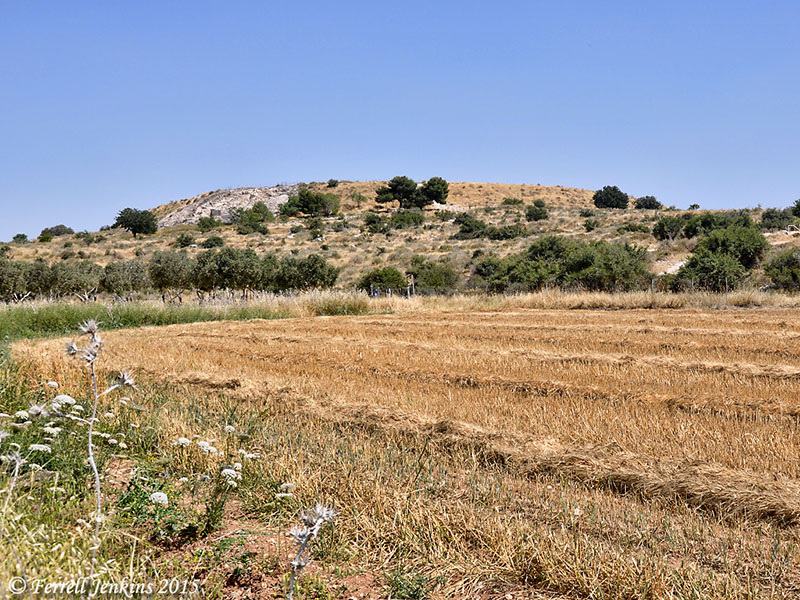
Tel Maresha (= Tell Sandahanna) is a large mound located south of Highway 35 between Bet Guvrin and Lachish.

View of the north side of Tel Maresha. Photo by Ferrell Jenkins.

View of the north side of Tel Maresha. Photo by Ferrell Jenkins.

Maresha [Mareshah in most English translations; Marisha] is listed among cities of the Shephelah (lowland) (Joshua 15:33, 44). See also 2 Chronicles 20:37 and Micah 1:15. Rehoboam, king of Judah (931/30 – 913 B.C.), fortified Maresha and several other cities of the Shephelah (2 Chron. 11:5-10). Asa, king of Judah (911/10 – 870/69 B.C.), fought Zerah the Ethiopian at Maresha (2 Chronicles 14:9-10).

The Assyrian king Sennacherib destroyed Maresha in 701 B.C., something the prophet Micah warned about.

Residents of Mareshah, a conqueror will attack you, the leaders of Israel shall flee to Adullam. (Micah 1:15 NET)

He says the leaders will flee to Adullam. Adullam is noted for its caves, and specifically as the place where David hid when he was fleeing from Achish, king of Gath (1 Samuel 22:1). His mighty men went to David at the cave of Adullam during a war with the Philistines (2 Samuel 23:13).

During the Hellenistic and early Roman periods, the Nabatean Arabs moved into the ancient territory of Edom. They were living in the region centered at Petra as early as 312 B.C. Much of their income was derived from the control of the spice trade.

The earlier inhabitants of Edom moved west into the territory south of Judah and north of the Negev. The term Idumea may be derived from Edom. Hubner says,

“The Edomites probably began emigrating increasingly into the S portions of the Judean territory following the destruction of Jerusalem by Nebuchadnezzar in 587 B.C.” (Anchor Bible Dictionary).

Hebron and Maresha became two of their most important cities. The Hasmonean ruler John Hyrcanus (135–104 B.C.) compelled the Idumeans to be circumcised and become Jews.

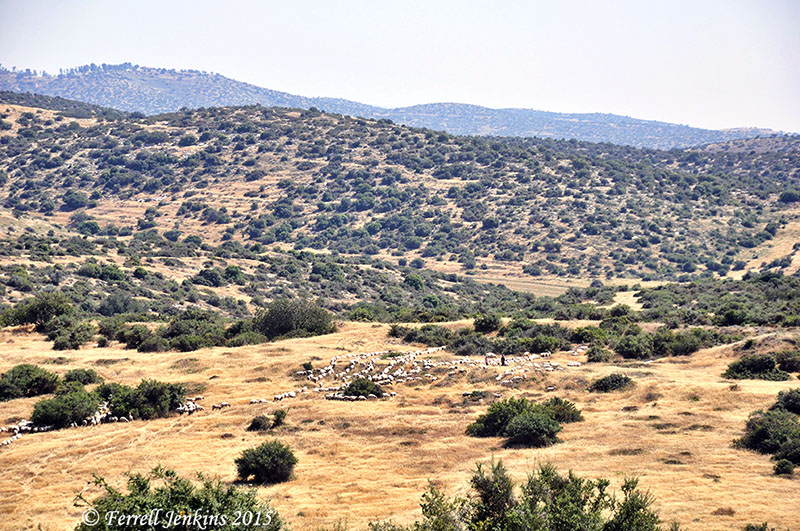
A view southeast of Maresha toward the central mountain range. Notice the shepherd with sheep. Photo by Ferrell Jenkins.

A view southeast of Maresha toward the central mountain range. Notice the shepherd with sheep. Click on the photo for a larger image. Photo by Ferrell Jenkins.

Antipater, a wealthy and powerful Idumean leader (63–43 BC), gained the favor of several Roman rulers. After the death of Antipater in 43 B.C., his son Herod was declared the King of the Jews. Some scholars suggest that Maresha was Herod’s birthplace.

The vicinity is noted for it underground chambers.

“The rock is Eocene chalk (kirton), which is very easy to work. Where the chalk was exposed to the air a hard crust (nari) formed, which provided a solid roof” (Murphy-O’Connor, The Holy Land).

After the Parthians destroyed Maresha (40 B.C.), the city moved to a nearby village known as Bet Guvrin. By A.D. 200, Bet Guvrin became a significant city known as Eleutheropolis. Murphy-O’Connor says, “The prosperity of the city at this period is underlined by an oval amphitheatre.”

Babylonian and Roman destruction of the Temple

Many of the Jewish people recently observed Tisha B’Av. This phrase, strange to Christians, means the Fast of the Ninth. The observance “is a day of mourning to commemorate the many tragedies that have befallen the Jewish people” (Judaism 101). According to this source, five terrible events took place on or near the ninth day of the month Av, the fifth month of the Jewish calendar.

The most significant of these events are the destruction of the Temple by the Babylonians in 586 B.C. (2 Kings 25:8-9; Jeremiah 52:12-13), and the destruction by the Romans in A.D. 70.

In the past half century a considerable amount of evidence has come to light concerning the destruction of Jerusalem by the Babylonians. The temple destroyed in 586 B.C. had been constructed by King Solomon in about 966 B.C. It was rebuilt by those who returned from the Babylonian Exile (530-516 B.C.).

Herod the Great began about 19/20 B.C. to rebuild the temple. This work was still in progress during the ministry of Jesus.

Then the Jewish leaders said to him, “This temple has been under construction for forty-six years, and are you going to raise it up in three days?” (John 2:20 NET)

Christians take seriously the prophecy of Jesus.

Now as Jesus was going out of the temple courts and walking away, his disciples came to show him the temple buildings. And he said to them, “Do you see all these things? I tell you the truth, not one stone will be left on another. All will be torn down!” (Matthew 24:1-2 NET)

There is no archaeological evidence of the temple building itself. The site where the temple once stood is now covered with paving stones and the Dome of the Rock which was constructed by the followers of Mohammed in the 7th century A.D.

The Dome of the Rock stands where Solomon's Temple was built. Photo by Ferrell Jenkins.

The Dome of the Rock stands where Solomon’s Temple was built. Photo by Ferrell Jenkins.

Vivid evidence of the Roman destruction of Jerusalem was discovered at the SW corner of the temple area in the Tyropean Valley. Some of the rubble can still be seen on the street which was probably built by Agrippa II in the 60s of the first century.

Stones that fell from the Temple Mount to the street below in A.D. 70. Photo by Ferrell Jenkins.

Stones that fell, or were pushed, from the Temple Mount to the street below in A.D. 70 at the time of the destruction by the Romans. Photo by Ferrell Jenkins.

Wayne Stiles recently wrote an article here on this topic with several excellent photos from the Burnt House in Jerusalem, a house burned during the Roman destruction in A.D. 70.

The Temple Mount – a Carta Guide Book

The writings and drawings of Leen and Kathleen Ritmeyer have brought to life many of the archaeological sites of the Bible Lands. They may know more about the Temple Mount that anyone else I know.

Now they have put that knowledge, accented by their fabulous drawings, in Jerusalem -The Temple Mount, a guide to the Temple Mount published by Carta in Israel.
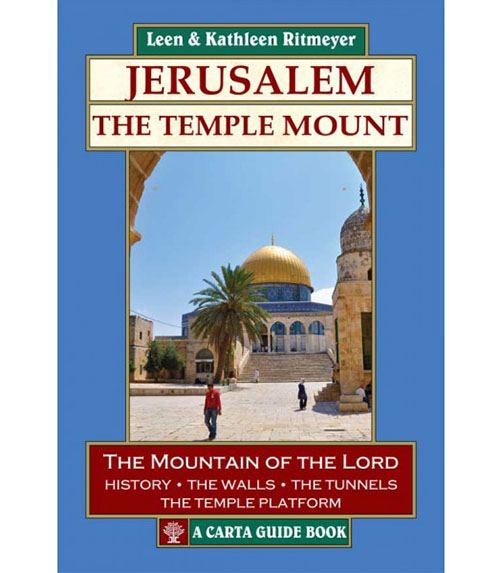
One never knows in advance whether the Temple Mount will be open to visitors. Whether you see it or not, this book of 160 pages provides helpful information for the Bible student in his/her studies.

Jerusalem - The Temple Mount

Jerusalem – The Temple Mount

This book sells for $25. That is the Amazon price, but if you have Prime the shipping will be free. You will find Jerusalem -The Temple Mount a helpful resource.

I have not received a review copy of this book, but I receive a very small commission from Amazon if you order through my site.

We keep a link to Ritmeyer Archaeological Design here.

World Heritage sites in Israel

The Sunday issue of The Jerusalem Post reports here that the Beit She’arim tombs in Western Galilee have been added to the UNESCO World Heritage List.

Beit She’arim, located in the Western Galilee about 20 km. southeast of Haifa, contains a necropolis filled with a series of catacombs built as early as the 2nd century C.E. The site served as the primary burial place outside Jerusalem following the failed second Jewish revolt against the Romans and boast “a treasury of artworks and inscriptions in Greek, Aramaic and Hebrew,” the World Heritage Committee said.

“Beit She’arim bears unique testimony to ancient Judaism under the leadership of Rabbi Judah the Patriarch, who is credited with Jewish renewal after 135 C.E.,” the committee added.

Beit She’arim is not a biblical site, but it illustrates the strength of Judaism in Galilee following the destruction of Jerusalem by the Romans in A.D. 70, and the failed Bar Kochba revolt in A.D. 135.

Facade of the "Sarcophagi Cave" at Beit She'arim. Photo by Ferrell Jenkins.

Facade of the “Sarcophagi Cave” at Beit She’arim. Excavators recovered 135 sarcophagi from this cave, according to Azaria Alon in Israel National Parks & Nature Reserves. Photo by Ferrell Jenkins.

Nine Israeli cities are now included on the World Heritage List.

…Masada; the Old City of Acre; the White City of Tel Aviv; the biblical tels of Megiddo, Hatzor [Hazor], and Beersheba; the incense route of desert cities in the Negev; Baha’i holy places in Haifa and the Western Galilee; and mostly recently, Beit Guvrin National Park

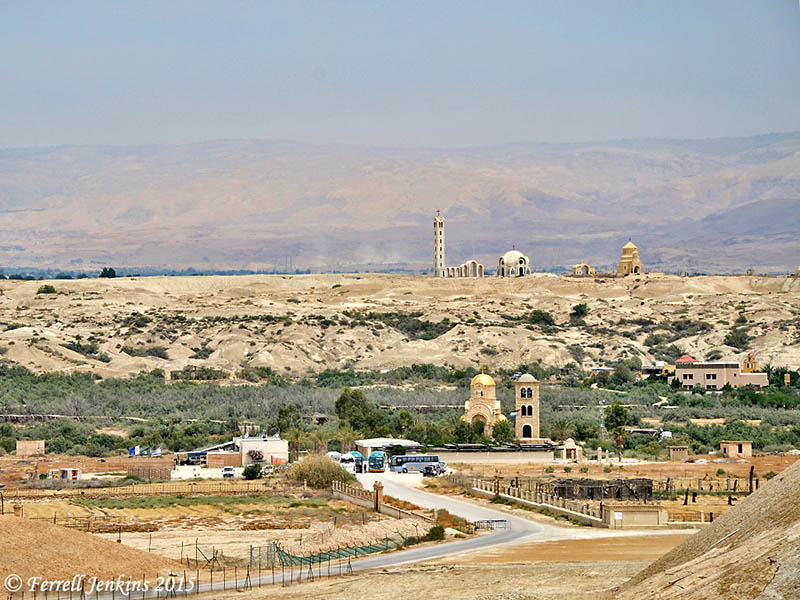
Bethany Beyond the Jordan (Al-Maghtas), the traditional place where John the Baptist worked, was also added to the World Heritage List this year.

These things took place in Bethany across the Jordan, where John was baptizing. (John 1:28 ESV)

I have visited Bethany Beyond the Jordan four times since 2002, and have seen the various church buildings multiply. In May, when we visited the Jordan River on the Israeli side, we were traveling by car and were able to stop for photos almost anywhere we wished. As we left Qasr el-Yahud and began to ascend from the Jordan River valley (the Zor), we turned to see a nice photo of the Jordanian side and a glimpse of most of the new religious buildings. The buses are parked on the Israeli side and the river is not visible. The two prominent buildings seen near the middle of the photo are near the bank of the Jordan River on the Jordanian side.

Baptism site on the Jordan River. View east to Bethany Beyond the Jordan. Photo by Ferrell Jenkins.

Baptism site on the Jordan River. View east to Bethany Beyond the Jordan. Photo by Ferrell Jenkins.

The last photo will provide some perspective. It was made from the Israeli side of the River with a view east toward the Jordanian side. You can see the two prominent religious building mention in the photo above.

View from Israeli side of the River to the Jordanian side. Photo by Ferrell Jenkins

View from Israeli side of the River to the Jordanian side. Photo by Ferrell Jenkins.

Petra is also on the World Heritage Site list in Jordan.

How many of these sites in Israel and Jordan have you visited?

Joseph was sold at Dothan

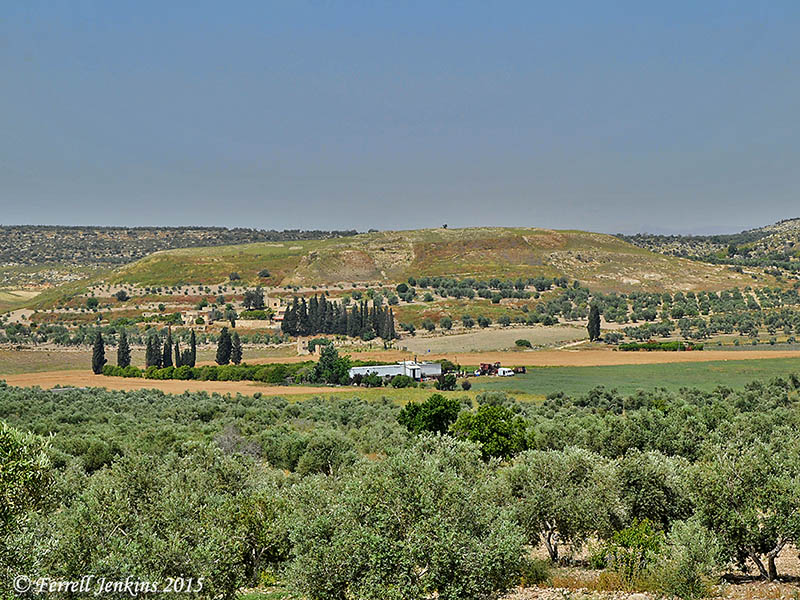
Dothan (Tell Dothan) is located about 11 miles north of Samaria on the east side of the modern highway. The impressive mound rises nearly 200 feet above the plain. The top of the Tell covers about 10 acres and the slopes cover almost 15 more.

Our first photo shows the view of Dothan to the east of the main highway. The mound is located in the region of Samaria in the fertile Dothan Valley.

A view of the west side of Tel Dotan. Photo by Ferrell Jenkins.

A view of the west side of Tell Dothan. Photo by Ferrell Jenkins.

Biblical Events at Dothan

The best known Biblical event at Dothan is the selling of Joseph. The seventeen-year-old went from the Valley of Hebron where he lived with his father Jacob to Dothan searching for his brothers. Motivated by envy they put him into one of the pits, later sold him to a caravan of Ishmaelites, from Gilead, on their way to Egypt (Gen. 37:16-28). Joseph P. Free said in 1975:

“Shepherds still come from southern Palestine to the region of Dothan to water and pasture their flocks, as they did 4000 years ago in the days of Jospeh’s brother. Some doubt has been expressed (Kraeling) on the Biblical record of shepherds traveling out of ‘the vale of Hebron’ eighty miles or more to the Dothan area. One spring week-end we counted ninety flocks on the road from Jerusalem to the Dothan area; many came from the region between Hebron and Jerusalem” (ZPEB  2:160).

Dothan was in Jordan at the time of Free’s work; it is now in the Palestinian West Bank. This is one factor that has complicated any continued excavations.

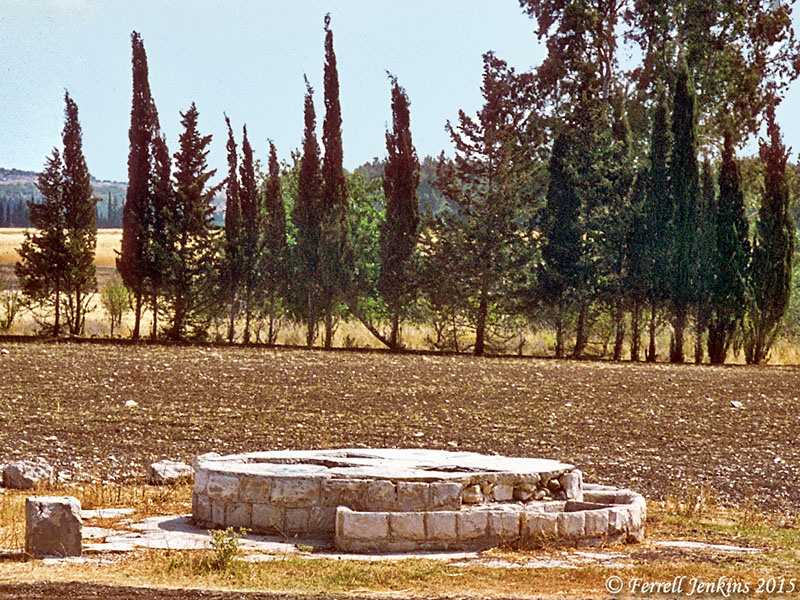
The next photo is one I made in 1979. On the west side of the main highway, across from Tell Dothan there was a cistern that was used by the shepherds to water their flocks. I was looking carefully to locate the cistern again, but discovered that a strip of small stores had been built in the area.

Joseph’s brothers put him in a dry pit. The term pit may be used of a cistern, or a pit of some other sort. From the first time I saw this cistern I was reminded of the episode of Joseph.

A cistern in the Dothan Valley in 1979. Photo by Ferrell Jenkins.

A cistern in the Dothan Valley in 1979. Photo by Ferrell Jenkins.

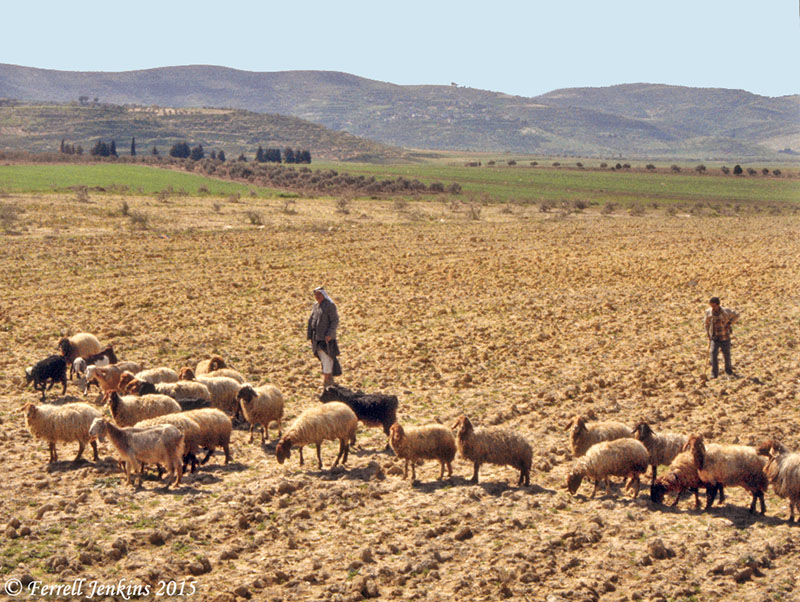
Next is a photo that I made of shepherds tending their flocks in the Valley of Dothan in 1979.

Shepherds watching their flock in the Valley of Dothan. Photo by Ferrell Jenkins.

Shepherds tending their flock in the Valley of Dothan. Photo by Ferrell Jenkins.

The Pictorial Library of the Bible Lands includes some nice photos of Dothan, including an aerial shot and a different picture of a well near the Tell.

Ben-hadad and Elisha. A lesser known event at Dothan is that of Syrian king Ben-hadad who surrounded the city seeking to capture the prophet Elisha. Instead, the Syrians were struck blind by the Lord and led to Samaria by Elisha (2 Kings 6:11-23).

Archaeological Excavations
Excavations were conducted from 1953 to 1962 by Joseph and Ruby Free (Wheaton Archaeological Expedition). You may read Free’s own brief account of the excavations in the Zondervan Pictorial Encyclopedia of the Bible 2:157-60.

The excavations revealed that Tell Dothan was occupied as early as 3000 B.C. Bowls and juglets were discovered from the Middle Bronze Age (2000 – 1500 B.C.), showing that the city was occupied during the patriarchal period. Upper levels of the excavation provided evidence of the city from the 9th century B.C., the time of Ben-Hadad and Elisha.

I decided to follow the example of Master in Dothan: Remains from the Tell (1953-1964) in using the term Tell rather than Tel as shown on Israeli maps.

New wine is for fresh wineskins

When Jesus was questioned by the scribes of the Pharisees about how His practices differed from those of John the Baptist, He gave three similar illustrations to teach the newness of His teaching and practice.

And Jesus said to them, “Can the wedding guests fast while the bridegroom is with them? As long as they have the bridegroom with them, they cannot fast. The days will come when the bridegroom is taken away from them, and then they will fast in that day. No one sews a piece of unshrunk cloth on an old garment. If he does, the patch tears away from it, the new from the old, and a worse tear is made.  And no one puts new wine into old wineskins. If he does, the wine will burst the skins– and the wine is destroyed, and so are the skins. But new wine is for fresh wineskins.” (Mark 2:19-22 ESV)

The third illustration is about putting new wine into old wineskins. As the wine ferments it expands and stretches the wineskin. If an old wineskin is used, the expansion will cause the wineskin to explode.

Our photo below shows an animal skin being use for churning, but it is easy to understand wine being placed in an animal skin like this.

A Bedouin at Petra using an animal skin for churning. Photo by Ferrell Jenkins.

A Bedouin at Petra using an animal skin for churning. Photo by Ferrell Jenkins.

Instead of using stone jars for storing new wine, Klinck says,

More likely, however, they would use wineskins for this purpose. These are the “bottles” of the Bible. A wine bottle was made out of a goatskin, sewn together where it had been cut to remove it from the carcass. This formed a sack that could be tied at the neck and hung up. The resilience of the new rawhide took up whatever expansion might result from the process of fermentation. Of course, no one would think of putting “new wine into old wineskins,” since the old dried and cracked skins from the previous year were unsafe (Matthew 9:17). (Klinck and Kiehl, Everyday Life in Bible Times, p. 54).

The Gibeonites tricked the Israelites with old wineskins that were “worn-out and torn and mended” (Joshua 9:4). They claimed that the wineskins “were new when we filled them, and behold, they have burst” (Joshua 9:13 ESV)

Elihu used the same illustration in defense of his much speaking.

I also will answer with my share; I also will declare my opinion. For I am full of words; the spirit within me constrains me. Behold, my belly is like wine that has no vent; like new wineskins ready to burst. I must speak, that I may find relief; I must open my lips and answer. (Job 32:17-20 ESV)