Category Archives: Jordan

My grandparents went to Israel …

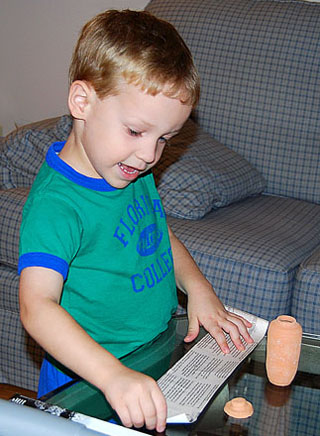
… and all I got was this little Dead Sea Scroll jar. (Of course, anyone acquainted with his grandmother knows differently!) After Grandmother read him the Mystery of the Dead Sea Scrolls, he promptly hid his jar in a secret place [behind the easy chair].

What a wonderful thing to learn about at his age. The Dead Sea Scrolls, discovered in 1947, are of great value to biblical studies.

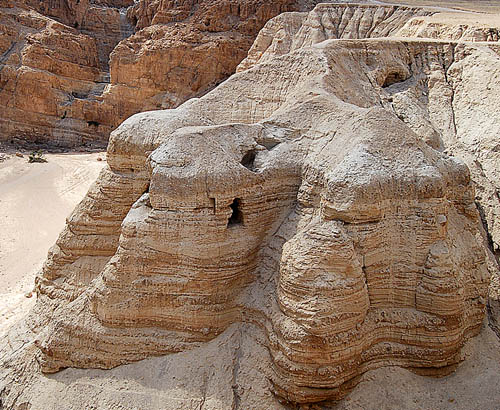
Below is a photograph of Cave 4 at Qumran, on the shores of the Dead Sea. Numerous fragments of the first five books of the Old Testament (Torah) were found in this cave. Qumran was in Jordan at the time of the initial discovery of the scrolls. Some of the scrolls are now displayed at the Shrine of the Book in Jerusalem.

Sound a ram’s horn

The ram’s horn was important in the history of Israel. One of the words often for the horn is shophar.

  • A long blast on the ram’s horn was used to alert the Israelites when they could approach Mount Sinai (Exodus 19:13).
  • The ram’s horn was sounded at the beginning of important feast days (Leviticus 25:9).
  • After Israel marched around Jericho they would hear a long blast on the ram’s horn (Joshua 6:5). The word horn in this verse is qeren, but the word shophar is translated trumpet.

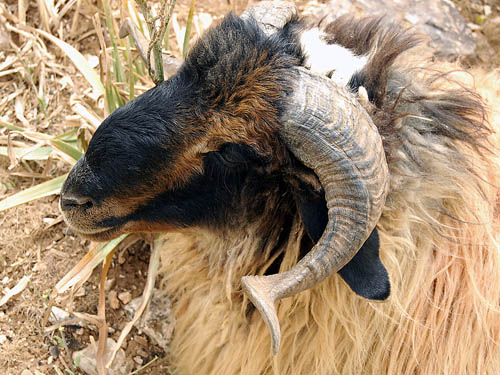
I have observed that shepherds are proud of the ram of the flock. This photo was made last week in northern Jordan not very far from Ramoth in Gilead and the border with Syria.

Wells of water

Without water it is impossible for men to survive. Many disputes throughout history have been about water and water rights. The importance of water during the time of the the biblical patriarchs is prominent in several Bible accounts.

  • Abraham made a covenant with Abimelech. He said, “I dug this well” (Genesis 21:30). This covenant was made at Beersheba (well of seven).
  • Isaac had to dig again the wells of water dug by Abraham because the Philistines had filled them with debris (Genesis 26:15-18).
  • The scene around the well where the servant of Abraham selected the bride for Isaac is especially impressive (Genesis 24).
  • The meeting of Jesus with the Samaritan woman at Jacob’s well (John 4).

The well was so important that the wise man used it as a euphemism to teach sexual purity.

Drink water from your own cistern And fresh water from your own well. (Proverbs 5:15)

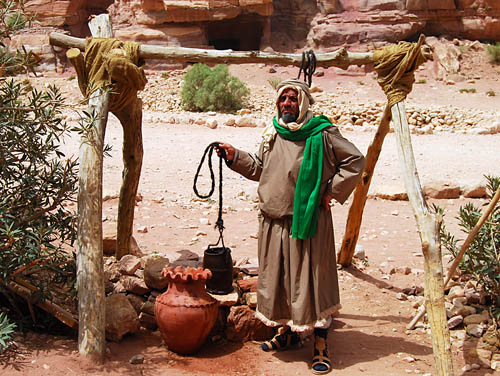
At Petra in Jordan, men dressed in antique costumes demonstrate life among the Bedouin. Here we have a man at the well. This may seem ancient to younger people, but I drew water from a well when I was a youngster (and it was not in the patriarchal period!).

A Bedouin at Petra, Jordan, illustrates the importance of the well. Photo by Ferrell Jenkins.

Watching the Roman soldiers at Jerash

Jerash was one of the cities of the Decapolis during the time of Christ. Today we visited the ruins of that city. It is an impressive site, and I think I have worked through the problem I was having in uploading photos from here. At least I have discovered one way it can be done.

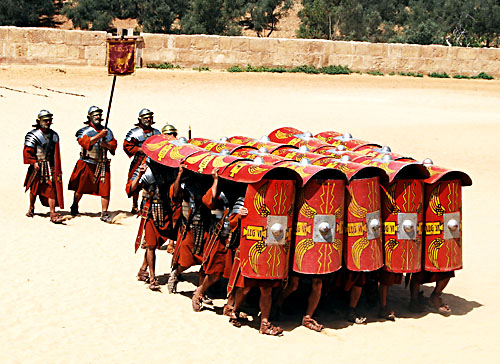
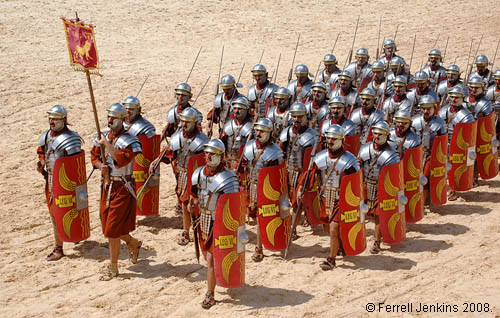
Here is a small photo of the Roman soldiers of the 6th Legion demonstrating the formation used in protecting the banner of the Legion.

Standing where Moses stood

One of the highlights of a tour to Jordan is a visit to Mount Nebo. This site is most famous because Moses went up to this mountain and looked at the land the LORD has promised to the descendants of Abraham.

Now Moses went up from the plains of Moab to Mount Nebo, to the top of Pisgah, which is opposite Jericho. And the LORD showed him all the land, Gilead as far as Dan, 2 and all Naphtali and the land of Ephraim and Manasseh, and all the land of Judah as far as the western sea, 3 and the Negev and the plain in the valley of Jericho, the city of palm trees, as far as Zoar. (Deuteronomy 34:1-3)

The view from Mount Nebo yesterday was the clearest I recall seeing in a long time. In our photo the northern end of the Dead Sea is visible.

Sorry, but the signal is too weak to post the photo.

Thursday evening at the Dead Sea. We enjoyed the visit of Petra and the trip to the Dead Sea. Tonight we are at a hotel on the shores of the Dead Sea. This is a beautiful location.

Hopefully I will be able to post photos soon.

At Petra in Jordan tonight

Today we left Israel, crossed the border into Jordan, and made our way to Petra for the night. We visited a site now being identified as Bethany Beyond the Jordan, Mount Nebo, Madaba, and then followed he Kings Highway and the Desert Highway to Petra. Here is the photo of the group. I know the photo is a little small, but if you know someone in the group you will probably be able to identify him/her. The photo is made from the Mount of Olives with the city of Jerusalem in the background.

Bible Land 2008 Group Photo from Mount of Olives with Jerusalem in the background.

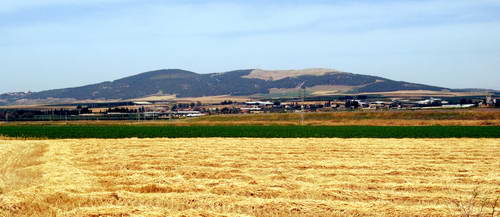
Here are a few photos I intended to upload earlier. The first one is of the Hill of Moreh. Moreh overlooks the Jezreel Valley, and is where Gideon defeated the Midianites.

Then Jerubbaal (that is, Gideon) and all the people who were with him, rose early and camped beside the spring of Harod; and the camp of Midian was on the north side of them by the hill of Moreh in the valley. (Judges 7:1)

Hill of Moreh where Gideon defeaed the Midianites. Photo by Ferrell Jenkins.

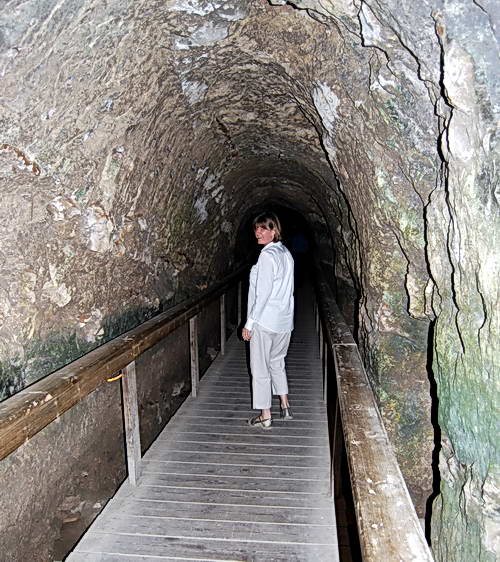
And finally, for tonight, here is a photo made in the Iron Age tunnel at Megiddo. Scholars often attribute this tunnel to the time of Ahab, king of Israel about 850 B.C. Walls, water, and food were the three most important necessary things in an ancient city. This tunnel connected the city to the spring that was outside the city.

The Iron Age water tunnel at Megiddo. Photo by Ferrell Jenkins.

Tomorrow night we probably will not have Internet access from the hotel at the Dead Sea. Perhaps I will be able to post another photo tomorrow morning before visiting Petra.

The lowest spot on earth

Today we visited Masada, the Dead Sea, Qumran (where the Dead Sea Scrolls were found), and Jericho. Everything is going well on our tour. Tomorrow we cross the Jordan River and go into Jordan. Perhaps there we will have better success with the Internet connection.

This is not to say that it would be impossible to find a place in Jerusalem to upload photos. It is just that he connection in this good hotel does not seem adequate.

In the air and on the road again

We are off to Israel and Jordan.

Soon we will be leaving our hotel and heading for Lufthansa at the JKF International Airport to meet our group. There were at least eight of us at this hotel last night. We have an intermediate stop at Frankfurt, and then on to Tel Aviv. If we arrive on time we will be able to visit Joppa before sunset. Our overnight stay will be at Netanya, along the beautiful Mediterranean.

If possible we will connect to the Internet at Frankfurt. Otherwise, expect our first post from Netanya. We hope to give you a brief behind the lense look at the places we visit in Israel and Jordan. Our time in Israel and Jordan will be seven hours ahead of EDT.

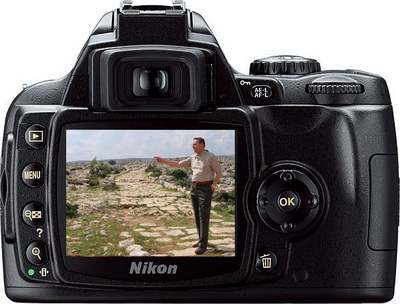
Nikon D40X and Ferrell Jenkins on Roman Road near Tarsus.

Greek NT Manuscripts Discovered in Albania

Daniel B. Wallace reports on the discovery of what is being called a “treasure trove” of Greek New Testament manuscripts. Wallace heads up the Center for the Study of New Testament Manuscripts (www.csntm.org). Last summer a team went to the National Archive in Tirana, Albania, to photograph some manuscripts.

According to Wallace, there are now 5752 New Testament manuscripts known and catalogued. These range from the small John Rylands fragment of the Gospel of John to complete manuscripts of the New Testament.

Seventeen formerly lost manuscripts were found to be in the Albanian archive. This was not the most exciting part of the discovery in Albania. Wallace explains,

This was not the only good news of the day, nor even the most momentous. The catalog revealed several other Greek New Testament manuscripts that had never been catalogued by western scholars. Simple arithmetic told us this: There were forty-seven Greek New Testament manuscripts listed in the National Archive catalog, while the K-Liste noted only thirty in Albania (thirteen plus the seventeen that had been presumed lost). Thus, Tirana was housing at least seventeen manuscripts unknown to western scholarship and as many as thirty-four! Since the dawn of the 21st century, an average of two or three Greek New Testament manuscripts is brought to light each year. A cache of 17 to 34 manuscripts is a remarkable find, regardless of the age and pedigree of the manuscripts.

Codex Beratinus from the 6th century was the oldest manuscript in the Archive.

The oldest manuscript in the collection is Codex Beratinus, a codex that had been dyed in purple, with silver and gold letters written on it. Containing only Matthew and Mark today, this codex, written in the sixth century, is very rare because it is a royal codex. Only a handful of purple biblical codices still exist.

You may read the complete account here.

Wallace mentions one of the manuscripts that does not contain the account of the woman taken in adultery (John 7:53-8:11). He gives us a good discussion of how textual critics deal with this question.

The Parchment and Pen blog has carried a series of articles on textual criticism. To find all of these worthwhile articles scroll down and look for Dan Wallace Contra Mundane in the left column. Click here and look for these good articles.

Back to travel. The whole issue of determining the original text of the New Testament comes down to some practical issues. A visit to Israel and Jordan might include the following places:

  • Bethany beyond the Jordan (John 1:28). Or should it be Bethabara?
  • The Pool of Betheda (John 5:2). Or should it be Bethzatha, Bethsaida, or Belzetha? And should that verse (4) about the stirring of the water even be in the text?
  • The country of the Gadarenes (Matthew 8:28). Or should it be Gergesenes or Gerasenes?

A news release about the Albanian manuscript discovery may be read here. A PDF copy is available here.

Added Note: Video report. WFAA, Dallas, aired a brief report about Dr. Wallace and the Albanian discovery. I could not get it to work in Firefox, but it is o.k. in Explorer. Click here. I wish TV and newspaper reporters could think of something better than “a modern Indiana Jones!”

Roman soldiers and chariot races at Jerash

If you have an opportunity to visit Jordan you should make an effort to see the RACE show at Jerash. RACE stands for Roman Army and Chariot Experience. You will see actors in authentic dress as armed legionaries, gladiators, and a short chariot race. The show takes place in the Roman hippodrome of Jerash. The view of the city ruins in the vicinity make this a wonderful setting for the performance. Full details may be found here.

Jerash was the second largest city of the Decapolis (after Damascus) in New Testament times. People from the Decapolis followed Jesus during His ministry in Galilee (Matthew 4:23-25). When Jesus traveled through the Decapolis he possibly visited the area around Jerash (Mark 7:31).

The photo shows the Roman soldiers of the 6th Legion from the time of the Emperor Hadrian (A.D. 117-138). A visit to this show provides several good photographs to illustrate New Testament times.

The 6th Roman Legion at Jerash, Jordan. Photo by Ferrell Jenkins.