Category Archives: Jordan

A view from Qumran

This morning I wanted to share a photo made from Qumran on the western shore of the Dead Sea. Weather conditions were fairly good that day. You can see across the Dead Sea to the mountains of Moab.

View east to the Dead Sea from Quman. Photo by Ferrell Jenkins.

View east across the Dead Sea to Moab. Photo by Ferrell Jenkins.

We associate the land of Moab with Ruth the grandmother of King David.

So Naomi returned, and with her Ruth the Moabitess, her daughter-in-law, who returned from the land of Moab. And they came to Bethlehem at the beginning of barley harvest. (Ruth 1:22)

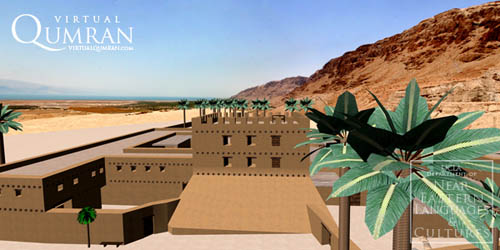
Virtual Qumran Reconstruction

Dr. Robert R. Cargill announced here that images and a movie of Virtual Qumran are available for free download. To view the images go directly to www.VirtualQumran.com. These images will be helpful in any teaching about Qumran and the Dead Sea Scrolls. Cargill is Chief Architect and Designer of the Qumran Visualization Project.

Virtual Qumran. North East View. UCLA Qumran Visualization Project.

Virtual Qumran. North East View. UCLA Qumran Visualization Project.

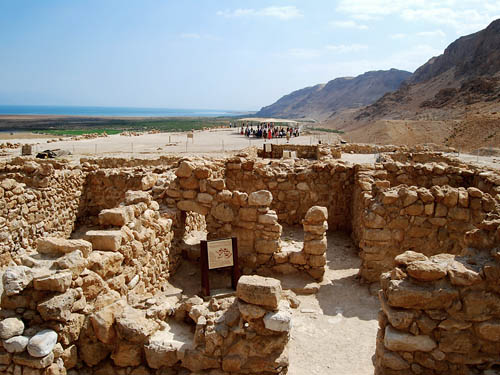
Here is a photo I made at the reconstructed ruins of Qumran.

View of proposed study room at Qumran. View NE. Photo by Ferrell Jenkins.

View of proposed study room at Qumran. View NE. Photo by Ferrell Jenkins.

The sign in the room reads,

The members of the Qumran Sect occupied themselves with studying the books of the Bible. Hundreds of pottery lamps were discovered in this room, validating the supposition that it was used for study during the night.

I am not sure this is a valid conclusion.

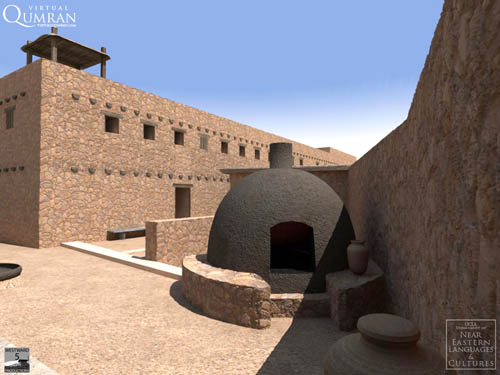
Qumran Potters Quarter. UCLA Qumran Visualization Project.

Qumran Potters Quarter. UCLA Qumran Visualization Project.

Check our earlier discussion of the Dead Sea Sect here.

Almond staff in the ark of the covenant

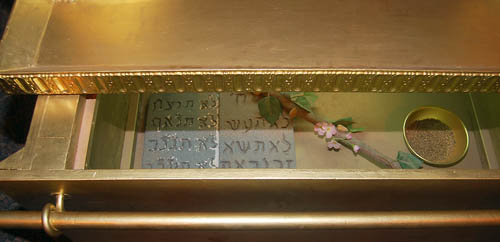
Three items from the period of the wilderness (desert) wandering of the children of Israel were considered significant enough to be included in the ark of the covenant.

Behind the second curtain was a second section called the Most Holy Place, having the golden altar of incense and the ark of the covenant covered on all sides with gold, in which was a golden urn holding the manna, and Aaron’s staff that budded, and the tablets of the covenant. Above it were the cherubim of glory overshadowing the mercy seat. Of these things we cannot now speak in detail. (Hebrews 9:3-5 ESV)

The picture below, made at the model of the Tabernacle in the Wilderness, shows a replica of the Ark of the Covenant with the contents mentioned by the writer of Hebrews. For more information about the model read here.

Replica of Ark of Covenant showing contents. Photo by Ferrell Jenkins.

Replica of the Ark of the Covenant showing contents. Photo by Ferrell Jenkins.

At Jerash in Jordan, young boys were selling small bags of green almonds. Not my preference, but apparently there is a market for them. “Jordan almonds” are famous for use at weddings. The fresh almond is bittersweet in taste, but the sugar coating adds sweetness. The “Jordan almonds” are still “Jordan almonds” even when they come from California!

Green almonds at Jerash, Jordan. Photo by Ferrell Jenkins.

Green almonds at Jerash, Jordan. Photo by Ferrell Jenkins.

Jerash is thought to be the site of Gerasa, one of the cities of the Decapolis (Matthew 4:25). Perhaps it is the city belonging to the country of the Gerasenes (Mark 5:1; Luke 8:26,37).

One sows and another reaps

Jesus took advantage of the opportunity to teach the woman of Samaria at the well where they met (John 4). She went into the city and told the men about Jesus (John 4:28-29). When the disciples of Jesus returned from the city where they had gone to buy food they encouraged Jesus to eat. He said, “I have food to eat that you do not know about.” The disciples misunderstood this, thinking He had reference to material food. This conversation led Jesus to say,

Do you not say, ‘There are yet four months, then comes the harvest’? Look, I tell you, lift up your eyes, and see that the fields are white for harvest. Already the one who reaps is receiving wages and gathering fruit for eternal life, so that sower and reaper may rejoice together. For here the saying holds true, ‘One sows and another reaps.’ I sent you to reap that for which you did not labor. Others have labored, and you have entered into their labor.” (John 4:35-38 ESV)

The disciples apparently did not know that Jesus had been teaching the woman, and that she had gone into the city to tell others about Him. Jesus is reminding the disciples of a common thing in the agricultural practices of that time. One sows and another reaps. It may have been sowing time, but some were ready to be reaped. The fields were ready to be harvested.

The words of the prophet Amos provide insight into this episode. He said,

“Behold, days are coming,” declares the LORD, “When the plowman will overtake the reaper And the treader of grapes him who sows seed; When the mountains will drip sweet wine And all the hills will be dissolved. (Amos 9:13 ESV)

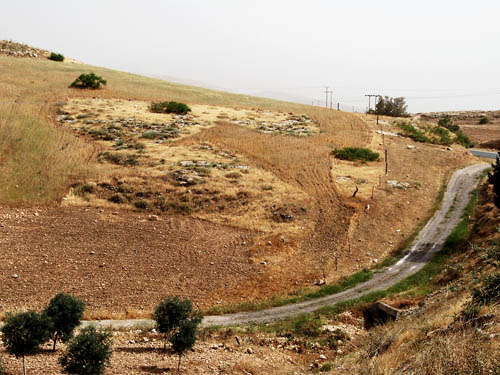
In modern times, with the use of some mechanical farm equipment, it is becoming difficult to find scenes exactly like the practices of the time of Jesus. But we still see things that remind us of these teachings. The photo below shows a field in Jordan just above the Jordan valley floor near Deir Allah. On a clear day one could see the valley.

The field has been plowed while grain grows nearby. Photo by F. Jenkins.

The field has been plowed while grain grows nearby. Photo by F. Jenkins.

Notice the rocks in the field. The plowman has worked around them. In the days of broadcast sowing, like in the parable of the sower (Luke 8), this scene has all of the elements. Good soil, rocky soil, road, and certainly thorns.

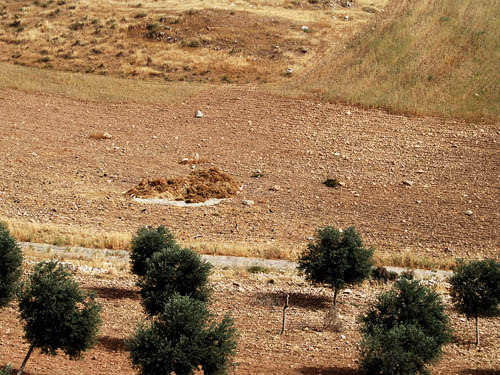
Extend our view to the left in the photo above. You will see, in the photo below, sheaves in the field that has been plowed. Indeed, the plowman overtakes the reaper.

Harvested grain in a field already plowed for sowing. Photo by Ferrell Jenkins.

Harvested grain in a field already plowed for sowing. Photo by Ferrell Jenkins.

It is true today in the preaching of the gospel. One plows and another reaps. Paul says, “I planted, Apollos watered, but God was causing the growth” (1 Corinthians 3:6).

If we had more sowing, there would be more reaping.

Churning produces butter

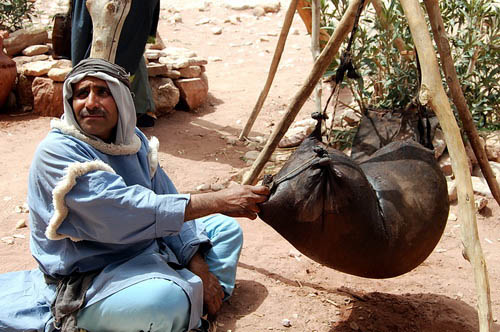
One of the new things I noticed in a visit to Petra last year was the Bedouin actors demonstrating various aspects of daily life. Many of these customs are similar to those we read about in the Bible. This photo shows a man using an animal skin as a churn.

Using an animal skin for producing butter. Photo by Ferrell Jenkins.

Using an animal skin for producing butter. Photo by Ferrell Jenkins.

The writer of Proverbs speaks of churning in giving advice about those who stir up strife.

If you have been foolish in exalting yourself Or if you have plotted evil, put your hand on your mouth. For the churning of milk produces butter, And pressing the nose brings forth blood; So the churning of anger produces strife. (Proverbs 30:32-33 NAS)

When the three men came to the Patriarch Abraham to announce the birth of Isaac, Abraham showed hospitality to them. He provided water so they could wash their feet. He told Sarah to prepare bread. He took a young calf from the herd and had the servants prepare it. Then the text says,

He took curds and milk and the calf which he had prepared, and placed it before them; and he was standing by them under the tree as they ate. (Genesis 18:8 NAS)

Read Genesis 18 for the complete account.

A visit to the Siegfried H. Horn Museum

Andrews University in Berrien Springs, Michigan, has long been associated with archaeological work, especially in Jordan. This work is carried out under the name of the Institute of Archaeology.

The interesting history of the Siegfried H. Horn Museum may be read here. The name of Siegfried H. Horn is well known to anyone who had read about biblical archaeology in modern times.

Last week I was at Valparaiso, Indiana, presenting a series of lessons on Bible History and Archaeology. I had long wanted to visit the Horn Archaeological Museum. When we learned that we were slightly more than an hour away, Mark Russell, Steve Wolfgang and I made the trip one morning. The Museum is hopeful of moving into a new facility as soon as the project can be funded. At this time the small museum is open only on Saturday afternoon, but they will open by appointment, as they did for us.

The Siegfried H. Horn Archaeological Museum houses over 8,500 artifacts, but only a small portion of those are on display. There are replicas of a few famous artifacts such as the Black Obelisk of Shalmannessar II and the Moabite Stone

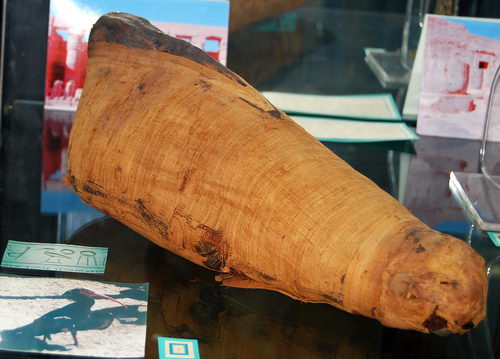
There are significant original pieces from most areas of the Bible world with Mesopotamia and Transjordan being featured. There is a mummified Ibis from Egypt. The Egyptian god Thoth was portrayed with the head of an Ibis. I never see representations of these gods without thinking of Paul’s description of the Roman world prior to the coming of Christ.

Claiming to be wise, they became fools, and exchanged the glory of the immortal God for images resembling mortal man and birds and animals and creeping things. (Romans 1:22-23 ESV)

Mummfied Ibis from Egypt. Photo by Ferrell Jenkins.

Mummified Ibis from Egypt. Photo by Ferrell Jenkins.

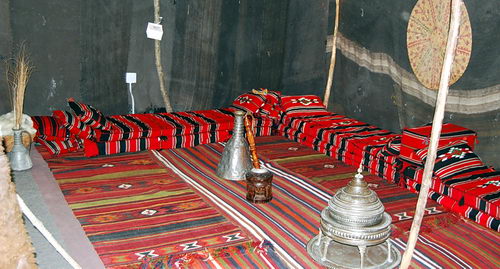
In the main exhibit hall there is a life-size Bedouin tent. This makes a good background for explaining patriarchal life.

Authentic Bedouin Tent at Horn Museum. Photo by Ferrell Jenkins.

Authentic Bedouin Tent at Horn Museum. Photo by Ferrell Jenkins.

By faith Abraham obeyed when he was called to go out to a place that he was to receive as an inheritance. And he went out, not knowing where he was going. By faith he went to live in the land of promise, as in a foreign land, living in tents with Isaac and Jacob, heirs with him of the same promise. For he was looking forward to the city that has foundations, whose designer and builder is God. (Hebrews 11:8-10 ESV)

Two other things should be mentioned. There are some wonderful models. One that impressed me was of the Roman rolling-stone tomb at Heshbon. The murals covering biblical and modern church history are impressive.

I recommend that anyone traveling in the vicinity of Berrien Springs, or those living within driving distance, take advantage of this opportunity to visit. Bible class teachers would do well to become familiar with this Museum and arrange for their students to see it.

Our thanks to Jody Washburn, an Administrative Assistant at the Institute of Archaeology, for her help in making our visit pleasant.

Mount Hor

The Scripture records that Aaron was buried on Mount Hor (Numbers 20:25-29). We wrote about this here. A few interesting questions have been left in a comment. I am away from home for the week and do not have access to all the materials I might check, but here is a brief response.

1. How long would it take to walk unaided up Mt. Hor? Are there clearly marked-out historical trails?

Hikers make the trek. My recollection is that one should allow between a half and a full day for the trip up and down. A guide book such as Lonely Planet would surely answer this question. Perhaps some reader has made the climb and will tell us.

2. Do you know anything about the history of the Muslim shrine at the summit? I’m sure there have been quite a bit of academic research into this over the years, but I’m hoping for a simple answer about how reliable is this tradition about the exact location of Mt. Hor?

Not really. There are many “traditional” places identified by Jews, Christian, and Muslims, but a large number of them are without any historical foundation. Todd Bolen has this comment, along with a nice photo, at Bible Places.

In Bedouin tradition, Jebel Haroun is Mt. Hor where Moses’ brother Aaron was buried.  Most scholars reject this, locating Mt. Hor near Kadesh-barnea to the west.

I trust this will be helpful.

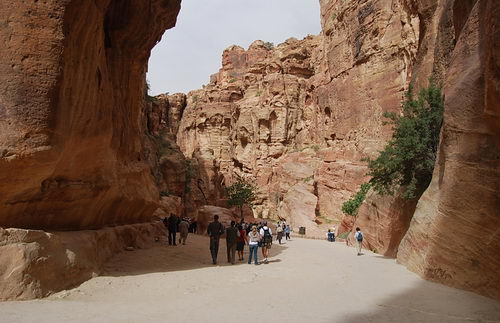
Here is a photo of the beginning of the Siq at Petra. Almost everyone likes to show the photos of the narrow part. It is beautiful, even from the beginning.

The beginning of the Siq at Petra. Photo by Ferrell Jenkins.

The beginning of the Siq at Petra. Photo by Ferrell Jenkins.

Longest underground Roman aqueduct

A recent article in Spiegel Online reports on the discovery of “The Ancient World’s Longest Underground Aqueduct.”

Roman engineers chipped an aqueduct through more than 100 kilometers of stone to connect water to cities in the ancient province of Syria. The monumental effort took more than a century, says the German researcher who discovered it.

When the Romans weren’t busy conquering their enemies, they loved to waste massive quantities of water, which gurgled and bubbled throughout their cities. The engineers of the empire invented standardized lead pipes, aqueducts as high as fortresses, and water mains with 15 bars (217 pounds per square inch) of pressure.

In the capital alone there were thousands of fountains, drinking troughs and thermal baths. Rich senators refreshed themselves in private pools and decorated their gardens with cooling grottos. The result was a record daily consumption of over 500 liters of water per capita (Germans today use around 125 liters).

However, when the Roman legions marched into the barren region of Palestine, shortly before the birth of Christ, they had to forgo the usual splashing about, at least temporarily. It was simply too dry.

The article by Matthias Schulz says,

This colossal waterworks project supplied the great cities of the ‘Decapolis’ – a league originally consisting of 10 ancient communities — with spring water. The aqueduct ended in Gadara, a city with a population of approximately 50,000. According to the Bible, this is where Jesus exorcized demons and chased them into a herd of pigs.

The full story may be read here. There are some nice photos and diagrams.

The identification of the “country of the Gadarenes” (Matthew 8:28-34), and the “country of the Gerasenes” (Mark 5:1; Luke 8:26-39), and the exact place where the swine rushed down the steep cliff into the Sea, is a difficult one.  And I don’t have the time to work on it today.

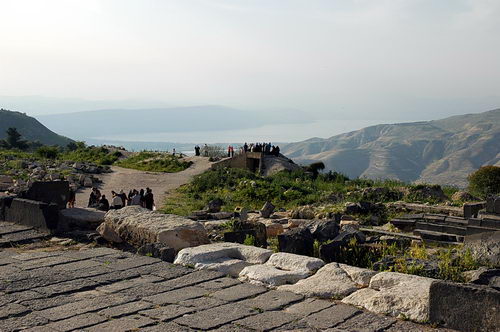
View of Sea of Galilee from Umm Queis. Photo by Ferrell Jenkins.

View of Sea of Galilee from Umm Queis. Photo by Ferrell Jenkins.

We know that Gadara had a port on the Sea of Galilee, and that Roman coins of the city portrayed ships.

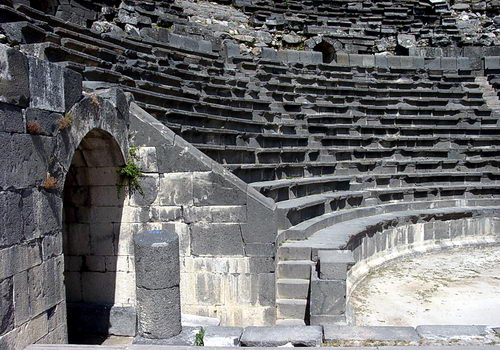
Here is a photo of the Roman theater of Umm Queis. The earliest buildings of this city are made of basalt, the volcanic rock common in the area.

The basalt theater at Umm Queis. Photo by Ferrell Jenkins.

The basalt theater at Umm Queis. Photo by Ferrell Jenkins.

HT: Joe Lauer

Kenyon

Einstein. That all we have to say. When it comes to the archaeology of Palestine the name Kenyon needs no supporting terms. Professor Magen Broshi, an archaeologist and historian, and the former curator of the Shrine of the Book in Jerusalem, wrote a review of Dame Kathleen Kenyon, Digging up the Holy Land, by Miriam C. Davis.

Here are a few interesting statements by Broshi:

She was, however, one of the most important archaeologists ever to dig in the Land of Israel.

That is not a negligible achievement, because more archaeological work has been done in the land between the Mediterranean Sea and the Jordan River, in other words in the State of Israel and the territories, than anywhere else in the world. There is no other country that has been so thoroughly researched, and the number of digs and surveys carried out here is incomparably greater than what has been done in far larger countries. Kenyon is not only one of the most important archaeologists to have worked here (and they number over 1,000), she is also the leading female archaeologist to have worked anywhere (along with the prehistorian Dorothy Garrod).

Kenyon dug at Samaria, Jericho, and Jerusalem. Broshi concludes,

The figure of Kenyon as portrayed in the book is a model of diligence and dedication. The book is based on thorough research, including written and oral testimony. It is well-written and the story is appealing. In my opinion it deserves high praise.

The complete review may be read on the Haaretz web site.

There are several articles on the Associates for Biblical Research web page about the excavations at Jericho. This one by Bryant G. Wood on “The Walls of Jericho” is a non-technical article that is helpful. Wood wrote a doctoral dissertation evaluating the evidence at Jericho. He discovered some oversights in Kenyon’s conclusions. Notice one of the concluding paragraphs of the popular article.

Jericho was once thought to be a “Bible problem” because of the seeming disagreement between archaeology and the Bible. When the archaeology is correctly interpreted, however, the opposite is the case. The archaeological evidence supports the historical accuracy of the Biblical account in every detail. Every aspect of the story that could possibly be verified by the findings of archaeology is, in fact, verified.

Both Garstang (excavated Jericho between 1930 and 1936) and Kenyon (excavated Jericho between 1952 and 1958) found evidence of pottery jars full of grain in destruction levels. Even with the constant deterioration of the exposed evidence, we still see fragments of jars in the side of the balk.
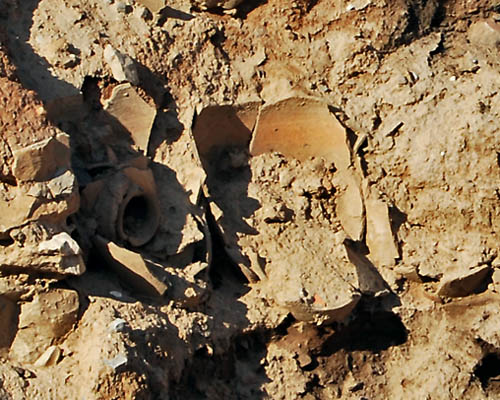
Pottery in the side of a trench at Jericho. Photo by Ferrell Jenkins.

Pottery in the side of a trench at Jericho. Photo by Ferrell Jenkins.

Wood argues that “this is a unique find in the annals of archaeology.” He says,

Grain was valuable, not only as a source of food, but also as a commodity which could be bartered. Under normal circumstances, valuables such as grain would have been plundered by the conquerors. Why was the grain left to be burned at Jericho?

The Bible says,

The city and all that is in it must be set apart for the LORD, except for Rahab the prostitute and all who are with her in her house, because she hid the spies we sent. But be careful when you are setting apart the riches for the LORD. If you take any of it, you will make the Israelite camp subject to annihilation and cause a disaster. All the silver and gold, as well as bronze and iron items, belong to the LORD. They must go into the LORD’s treasury.” (Joshua 6:17-19 NET)

But they burned the city and all that was in it, except for the silver, gold, and bronze and iron items they put in the treasury of the LORD’s house. (Joshua 6:24 NET)

HT: Joseph I. Lauer

After completing my comments, I see that Todd Bolen has commented on the review of the Kenyon biography here.

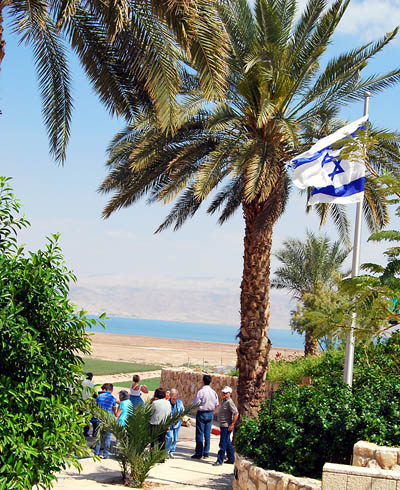
Albright – “dean of biblical archaeologists”

The Historical Handbook of Major Biblical Interpreters begins the entry on William F. Albright with these words:

Called the dean of biblical archaeologists in his last decades, William Foxwell Albright was also to become a well-known biblical interpreter.

Todd Bolen  calls attention to a new appreciation of William F. Albright by Thomas Levy and David Noel Freedman at The Bible and Interpretation. You may read Todd’s comments on The Legacy of William F. Albright at his Bible Places Blog. All of this is good reading.