Category Archives: Israel

More on flash floods

Flash floods in the Negev caught the attention of several bloggers in January. We noted them here. Harriett called my attention to an article in Al-Ahram weekly online about the flash floods in Egypt the same day.

As the dawn mists began to lift on 18 January in the small village of Atef Al-Sadat in the governorate of Northern Sinai, newlyweds Himdan Khalil and his wife found their tiny home swamped with water. They left their belongings behind to flee as the water inside their mud-brick house continued to rise, reaching a metre and a half.

“We are used to these floods but the watercourses that drain the floodwater were blocked by newly built chalets and clubs which resulted in the overflow into our homes,” Khalil told Al-Ahram Weekly. “The entire village was swamped and most villagers are now homeless””

Khalil’s devastated house was one of 3,645 homes destroyed in the governorates of North Sinai, South Sinai and Aswan. The floods left 10 people dead, two missing and 40 injured, according to government estimates. Seventy-two roads were destroyed and 13,000 olive trees uprooted. Sewage treatment stations and Arish hospital were badly damaged and part of the ceiling of Hall No. 2 at Sharm El-Sheikh Airport collapsed. In the southern city of Aswan strong winds overturned 80 high- pressure electricity towers, disrupting power supplies. Initial assessments of the cost of the damage are LE400 million.

Read the full report here.

A photo from the northern Sinai town of Arish shows damages caused by the torrential rains. Remember that this wadi was dust-dry a few hours earlier.

Damages caused by torrential rains in Arish. Al-Ahram weekly online.

Damages caused by torrential rains in Arish. Al-Ahram weekly online.

Arish is located one the Wadi el-Arish, generally thought to be the River [nahar] of Egypt, the southern boundary of the land promised to Abraham.

On that day the LORD made a covenant with Abram, saying, “To your offspring I give this land, from the river of Egypt to the great river, the river Euphrates…” (Genesis 15:18 ESV)

The Wadi el-Arish is a few miles south of Gaza in the northern Egyptian Sinai.

Laju Paul posted many photos of the flash flood in the Negev at Through the Land of Israel III January 18. Scroll down to that date.

Sitting in the gate

The practice of “sitting in the gate” may not be as understandable to our generation as it was to people of Bible times. During many biblical periods the gates were constructed of multiple chambers or rooms. The “Solomonic” Gate at Gezer has six chambers — three on each side of the entry. The photo below was made from inside the city of Gezer.  We see a nice bench made of individuals stones in the chamber at the bottom of the photo.

Note the seats (benches) in a gate chamber at Gezer. Photo by Ferrell Jenkins.

The practice of sitting in the gate is mentioned in numerous biblical references. Note a few.

  • Lot was sitting in the gate of Sodom (Genesis 19:1).
  • Abraham went to the gate to make arrangements to buy a burial place for Sarah (Genesis 23:10).
  • Boaz went to the gate of the city to make arrangements to marry Ruth (Ruth 4). One could easily find witnesses in the gate.
  • David sat at the city gate (2 Samuel 19:8).
  • When David was persecuted he said, “Those who sit in the gate talk about me” (Psalm 69:12). It was a good place to find the latest gossip.

What we see in these references is equivalent to what happens in many of our small towns when men of the city sit on benches around the court house or city center to talk about the weather, politics, religion, and whatever.

Ferrell Jenkins sitting in the gate at Gezer. Photo by Leon Mauldin.

Ferrell Jenkins sitting in the gate at Gezer. Photo by Leon Mauldin.

Wisdom is pictured as being beside the gate, at the opening of the city.

Beside the gates, at the opening to the city, At the entrance of the doors, she cries out: (Proverbs 8:3 NAU)

Ponder the path of your feet

From this narrow dirt path one can see the mountains that surround Samaria (Amos 3:9).

A path at Samaria. Photo by Ferrell Jenkins.

A path at Samaria. Photo by Ferrell Jenkins.

Ponder the path of your feet; then all your ways will be sure. Do not swerve to the right or to the left; turn your foot away from evil. (Proverbs 4:26-27 ESV)

The land of Gennesaret

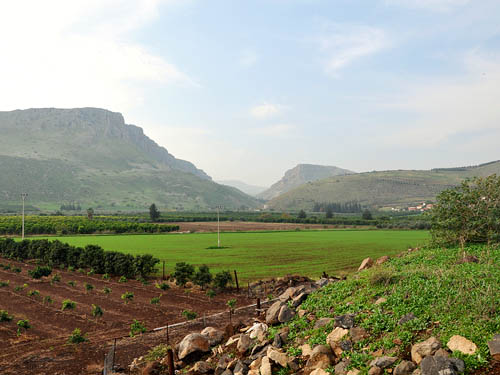
The Sea of Galilee is called the “lake Gennesaret” by Luke (Luke 5:1). The area on the northwest corner of the Sea of Galilee is called the “land at Gennesaret.” In the view below we see the land of Gennesaret and the Via Maris. The route here leads to the Beit Netofa Valley and the sites of (Khirbet) Cana, Sepphoris, Nazareth, and Yodfat (Jotapata). Yodfat was fortified by Josephus during the Jewish revolt against Rome. Josephus, commander of the Jewish rebels, surrendered to the Roman Emperor Vespasian at Yodfat.

The land of Gennesaret and the Via Maris. Photo by Ferrell Jenkins.

The land of Gennesaret and the Via Maris. Photo by Ferrell Jenkins.

Many of the miracles of Jesus were performed in this area.

When they had crossed over, they came to land at Gennesaret. And when the men of that place recognized Him, they sent word into all that surrounding district and brought to Him all who were sick; and they implored Him that they might just touch the fringe of His cloak; and as many as touched it were cured. (Matthew 14:34-36 NAU)

Fishing ban on the Sea of Galilee

Arutz Sheva reports a two year ban on fishing in the Sea of Galilee and its tributaries.

Minister of Agriculture Shalom Simchon has announced a ban on all fishing in the Sea of Galilee (Kinneret) for two years. The ban also extends to the part of the Jordan River that empties into the Sea of Galilee, and to all the other rivers that empty into the famous lake.

The authority to ban fishing is within the Minister of Agriculture’s authority according to the official Fishing Order, and the ban is set to take effect on March 1, 2010, extending until February 28, 2012. Minister Simchon has asked the Finance Ministry to allot NIS 15 million for enforcing the ban and compensating the fishermen who will be hurt by it.

Simchon explained that according to Agriculture Ministry statistics, the quantity of fish in the Sea of Galilee has plummeted in the past decade, and especially in the last two years, by tens of percentage points annually. It has now reached  a critical level, he said, and these statistics mean that the sea may be facing an ecological disaster in which all its fish would die out.

Simchon added that the ban on fishing is necessary, because it is both in the public’s interest and that of the fishermen that the Sea of Galilee be kept from turning into a fishless sea. However, the Ministry of Agriculture said that it realized that the fishermen would be bound to protest the move.

Read the full account here.

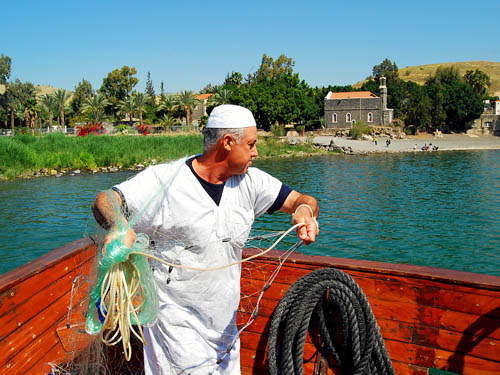
A fisherman readies to cast his net into an area near Taghba where warm water springs flow into the Sea of Galilee. For a photo of the net in the air click here. Commercial fishermen use large draw nets.

Fisherman readies to cast his net into the Sea of Galilee. Photo by Ferrell Jenkins.

Fisherman readies to cast his net into the Sea of Galilee. Photo by Ferrell Jenkins.

While walking by the Sea of Galilee, he saw two brothers, Simon (who is called Peter) and Andrew his brother, casting a net into the sea, for they were fishermen. (Matthew 4:18 ESV)

We wrote about the water level of the lake with photos to illustrate the low level here.

HT: Bible Places Blog.

William G. Dever on Solomon and the Revisionists

Benjamin Hawkins reports on a recent lecture  by William G. Dever at the Southwest Baptist Theological Seminary. The headline says, “Scholar counters attacks on existence of Solomon’s kingdom.”

Contesting the views of revisionist scholars, world-renowned archaeologist William G. Dever defended the existence of an Israelite state in Palestine during the 10th century B.C., the biblical era of Solomon’s reign.

Dever, a leading figure in biblical archaeology for nearly half a century, was the guest speaker for Southwestern Baptist Theological Seminary’s Biblical Archaeology Lecture sponsored by the seminary’s Charles D. Tandy Archaeology Museum and Tandy Institute of Archaeology.

“Tonight, I want to talk about the age of Solomon, but before I do that, I want to set it up by telling you something about a school of European biblical scholarship,” Dever said. “These people call themselves revisionists because they are rewriting the history of ancient Israel, but when they finish, there is no history. They call themselves revisionists. I call them nihilists.”

According to Dever, the revisionist scholars deny that an Israelite united monarchy, like the biblical kingdom that flourished under Solomon, ever existed. Dever contested this claim, arguing that the archaeological evidence confirms the existence of a centralized Israelite state in 10th century Palestine.

According to a “wonderful, detailed description” in 1 Kings 9:15-17, the Egyptian pharaoh attacked and destroyed the city of Gezer, Dever said. The pharaoh then gave the city as a dowry to his daughter when she married Solomon. The passage then states that Solomon fortified or refortified four sites: Hazor, Megiddo, Gezer and Jerusalem.

“Wouldn’t it be wonderful if we had archaeological evidence from those sites for an early stage? Well, we do,” Dever said. “And what do you suppose the revisionists make of this evidence? They just ignore it, because it is inconvenient for their theories.”

Dever reported that excavations, especially at Hazor, Megiddo and Gezer, have uncovered “monumental architecture” that cannot be explained without reference to a centralized government. The architecture of each of these cities is adapted to topography for strategic military advantage, but all the cities show the same structural patterns, such as six-chambered gates, double or casemate fortification systems, similar palace structures and Phoenician masonry (according to 1 Kings, Solomon utilized Phoenician craftsmen in his building projects).

These architectural structures can be dated to the 10th century B.C., Dever said, with reference to stratigraphy, ceramic typology and ancient Egyptian chronology. This process is aided by the discovery of destruction levels, filled with rubble and showing evidence of fires “so fierce that it melted the limestone and it flowed down like lava.” According to Dever, the destruction can be attributed to the military invasions of the Egyptian Pharaoh Sheshonq, that is, the biblical Shishak (1 Kings 14 and 2 Chronicles 12).

“At one time, there stood a monumental Egyptian inscription at the site of Megiddo celebrating the destruction by Shishak,” Dever said. Shishak was the first pharaoh in the 22nd Egyptian dynasty, and archaeological evidence shows that he raided Palestine in the late 10th century B.C. Amid the rubble of destruction, archaeologists also have discovered the hand-burnished pottery characteristic of the 10th century. According to Dever, this implies that the monumental architecture that Shishak and his army destroyed “must have been built a generation or so earlier — and that places us precisely in the middle of the reign of Solomon.”

Here is another of the aerial photos I made of Gezer in December. This one shows what many archaeologists have called the Solomonic Gate at the bottom of the photo. The new excavation under the direction of Steve Ortiz is Field A. Click for a larger image.
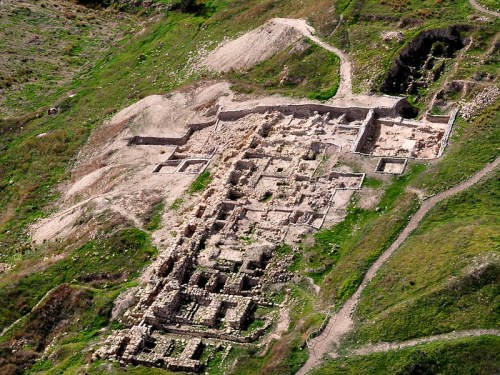
Solomonic Gate and Field A at Gezer. Photo by Ferrell Jenkins 2009.

Solomonic Gate and Field A at Gezer. Photo by Ferrell Jenkins 2009.

Dever explains why there isn’t evidence from the 10th century B.C. in Jerusalem.

“Of course, the revisionists argue that, ‘Well, you’ve never found anything from the 10th century, nothing monumental in Jerusalem.’ That’s true, because we never were able to excavate [in Jerusalem],” Dever said. Jerusalem was the fourth city that Solomon refortified, and it was the center of his kingdom. Despite the lack of access to the archaeological evidence that lies below modern Jerusalem, Dever argued that biblical descriptions of Solomon’s Temple resemble other 10th-century temples in the Middle East.

“All the descriptions in the Hebrew Bible,” Dever said, “make good sense in the light of what we know about ancient architecture.”

Revisionist scholars also contend that a centralized state could not have existed in 10th century Israel because literacy was not widespread, and the knowledge of reading and writing is necessary for the administration of a kingdom. Archaeological evidence like the Gezer calendar, however, has shown that even in rural areas young boys were learning to read during the 10th century and earlier, Dever said.

Encouraging Southwestern to remain involved in biblical archaeology, Dever said the seminary’s ongoing excavations at Tel Gezer would play an important role in affirming the existence of a united Israelite monarchy in 10th-century Palestine. Southwestern Seminary has led excavations at Tel Gezer under the supervision of Steven Ortiz, professor of archaeology and biblical backgrounds, since 2006.

While Dever affirmed the importance of ministerial training in his Nov. 3 lecture, he encouraged students to study archaeology and urged Southwestern to train biblical archaeologists who can challenge the skeptics in the field. Biblical archaeology, especially in the United States, is in “disarray,” he said. Many academic programs are floundering, and some have been shut down or replaced by academic programs emphasizing modern Middle Eastern studies.

“I always say to my Israeli colleagues, ‘The archaeology of Israel is too important to be left to you alone. This is our Holy Land, too.’ So we have to be involved, even though the Israelis dominate the field,” Dever said. “You have a unique opportunity at this particular juncture in time. Step in. There is not a lot of competition. Step in, and do something significant.”

Underscoring the need for rigorous academic training, Dever said, “Don’t ever apologize for your faith, or for the Bible, or for the Western tradition, or for being an American. Fight, and make sure you have the facts on your side.”

To learn more about Southwestern Seminary’s involvement in biblical archaeology, visit swbts.edu or gezerproject.org here.

One may not always agree with Dever, but one can not say that he did not make his point clearly. The gezerproject web site is out of date. I would like to see it updated soon.

The full report may be read here. © Copyright 2010 Baptist Press.

Jerusalem at 3800 feet altitude

In the last post about the aerial photos (January 18) we showed the mountains of Judea as we approached the central mountain ridge. Today’s photo shows the Old City of Jerusalem from about 3800 feet above sea level. The city itself is about 2400 to 2500 feet above (Mediterranean) sea level. The view is looking southeast across the Wilderness of Judea to the mountains of Moab in the Transjordan tableland.

Old City of Jerusalem - view toward SE. Photo by Ferrell Jenkins.

Old City of Jerusalem - view toward SE. Photo by Ferrell Jenkins.

In this photo one can see the proximity of Jerusalem to the Wilderness of Judea. The distance from Jerusalem to the Dead Sea is not more than 20 miles. The elevation drops from about 2600 at the Mount of Olives to (currently) about 1384 feet below sea level at the surface of the Dead Sea. The Transjordan Tableland is about 3000 above sea level.

As the mountains surround Jerusalem, So the LORD surrounds His people From this time forth and forever. (Psalm 125:2 NAU)

No honor among thieves

A headline in Haaretz says, Burglars swipe artifacts from ‘Antiquities Thieves’ exhibit.

Yanir Yagna writes:

In a display of what might be called ironic chutzpah, burglars broke into an Ashdod museum this week and stole silver coins from the Hellenistic period and other archaeological finds that were part of an exhibit called “Antiquities Thieves in Israel.”

The exhibit, at the Korin Maman Museum, displayed artifacts that the Israel Antiquities Authority had previously recovered from antiquities thieves. Now it seems the authority will have to begin its hunt all over again.

The burglars neutralized the alarm system Tuesday night and stole a bronze spear, two gold earrings, some pottery and the silver coins, which feature the image of Alexander the Great.

“It’s one of the weirdest things that ever happened here,” said a museum employee. “Someone actually went and stole the robbers display.”

The full report is here.

HT: Joe Lauer

Deadly flash floods in the Negev

Todd Bolen has been teaching in Israel for the past two or three weeks. He reports on heavy rains in the Negev that resulted in flooding in the area. Read the full report here.

Sometimes individuals fail to realize the force of the water and drive their vehicles into it. This often results in danger, and even death.

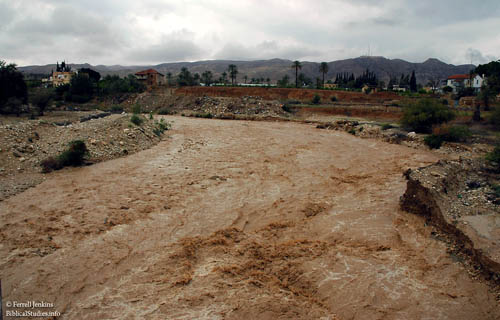
Nearly two years ago I wrote about Rivers in the Desert with photos showing a wadi after a night of rain. Read that article here. One of the photos I made the morning after a heavy rain in the mountains of Judea is included below. This photo show the normally dry Wadi Kelt (Qilt) at Jericho.

Wadi Kelt (Qilt) at Jericho after rain in the mountains of Judea. Photo by Ferrell Jenkins.

Wadi Kelt at Jericho after rain in the mountains of Judea. Photo by Ferrell Jenkins.

The Mountains of Judea

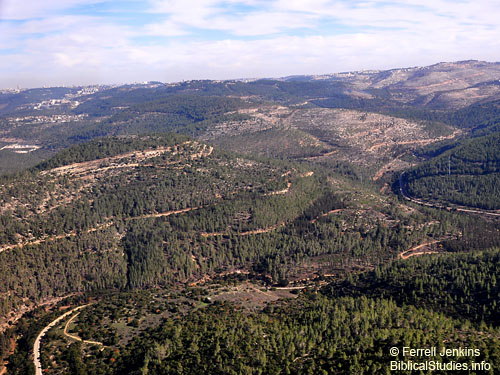
This photo shows the mountainous terrain southwest of Jerusalem. Our camera is pointed east and, in the left of the photo, we can see the tall buildings of Jerusalem along the central mountain range.

Judean Mountains SW of Jerusalem. Photo by Ferrell Jenkins.

Judean Mountains SW of Jerusalem. Photo by Ferrell Jenkins.

Throughout the Bible the writers speak of going UP to Jerusalem. This is because of the elevation of Jerusalem in the central mountain range, also called the water-parting route, that runs north to south in the country.

The timber for the temple was shipped from Lebanon to Joppa on rafts, then taken up to Jerusalem.

And we will cut whatever timber you need from Lebanon and bring it to you in rafts by sea to Joppa, so that you may take it up to Jerusalem.” (2 Chronicles 2:16 ESV)

In our series of aerial photos we have moved eastward from the coastal plain, to the shephelah (lowland; 2 Chronicles 26:10), to the mountains. This understanding of the topography of the country of Israel helps in understanding many biblical accounts.