Category Archives: Israel

Some suggested reading…

Wayne Stiles has a nice blog in which he connects the Bible and its Lands to life. He has suggested five other blogs for his readers here. I am honored to be included in his list. I appreciate these introductory words.

Where biblical events took place are more than throwaway mentions in the pages of Scripture. Often, they have significant bearing on God’s participation in the lives of His people.

Unfortunately, because we’re unfamiliar with geography we often miss these nuggets. I have found a lot of help in several Holy Land blogs that open up the Bible’s lands to my understanding.

Take a look at his list here. How many of them do you read?

My friend and neighbor Luke Chandler has participated in the archaeological excavations at Khirbet Qeiyafa for at least three years. Qeiyafa is a city overlooking the Valley of Elah. Luke reported recently that a massive building program at the nearby town of Beit Shemesh would bring new residential buildings “no more than 20 meters from Qeiyafa’s western gate and wall.” At the present time the entire area from Qeiyafa eastward is without housing. The houses that have been drawn in show the proposed construction. Progress is sometimes good, but this is sad.
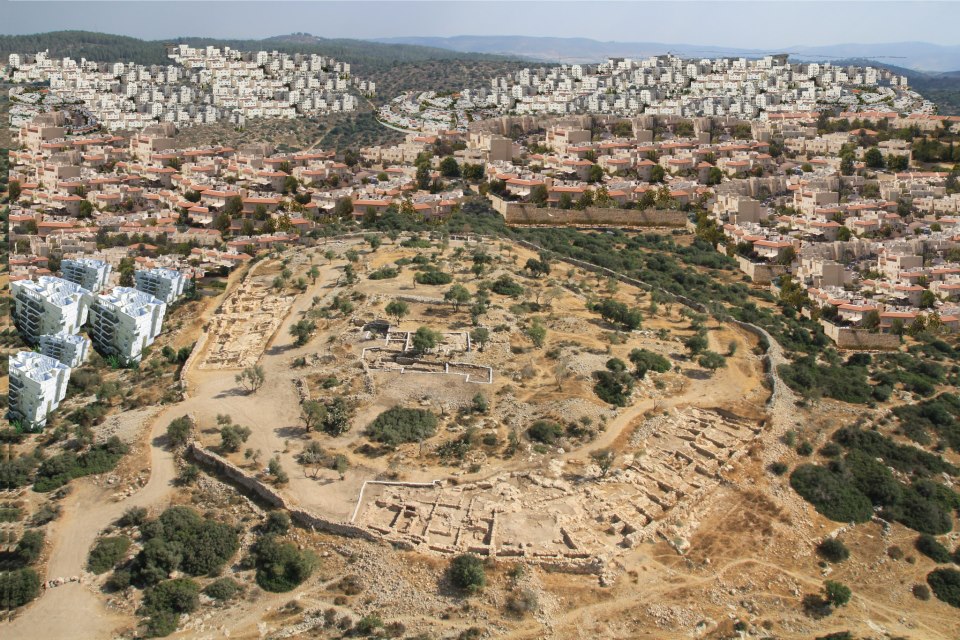
Proposed construction at Khirbet Qeiyafa.

The current plan for the expansion of Beit Shemesh. Some buildings are no more than 20 meters or so from the casemate wall and gate. The likelihood of damage to the site during and after construction would be significant. (Comment by Luke Chandler)

You can read Luke’s comments and see others photo here. Visit the Khirbet Qeiyafa: Save King David’s City Facebook page here. You will find more photos and diagrams.
The Great Pool at Gibeon

There are two references in the Bible to the pool of Gibeon. The first is in the account of a conflict between Abner and those aligned with King Saul, and Joab and the servants of David (2 Samuel).

Abner the son of Ner, and the servants of Ish-bosheth the son of Saul, went out from Mahanaim to Gibeon.  And Joab the son of Zeruiah and the servants of David went out and met them at the pool of Gibeon. And they sat down, the one on the one side of the pool, and the other on the other side of the pool.  (2 Samuel 2:12-13 ESV)

Arnold’s entry in The Anchor Yale Bible Dictionary says,

This “pool” undoubtedly refers to the impressive water system uncovered at el-Jib during recent archaeological excavations” [by Pritchard in the 1950s].

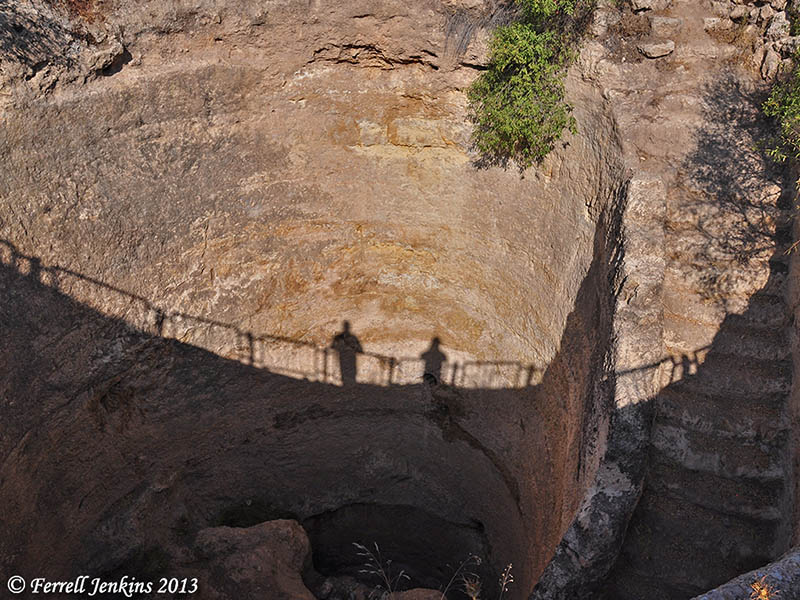
The pool had been constructed in the late 12th or early 13th century B.C. At first, it was thought to be a reservoir intended to hold water. Later it was learned that it served as a stairway leading to a source of water underneath the city.

After the destruction of Jerusalem by the Babylonians, the king of Babylon   made Gedaliah governor over the land. A rebellion led by a man named Ishmael killed Gedaliah at Mizpah (Jeremiah 41). The followers of Gedaliah and the men of Ishmael met at the great pool in Gibeon.

they took all their men and went to fight against Ishmael the son of Nethaniah. They came upon him at the great pool that is in Gibeon. (Jeremiah 41:12 ESV)

The great pool of Gibeon, cut from rock, measures 37 feet in diameter and 35 feet deep. Photo by Ferrell Jenkins.

The great pool of Gibeon, cut from rock, measures 37 feet in diameter and 35 feet deep. The steps led to the source of water located underneath. Photo by Ferrell Jenkins, whose shadow is visible, along with Leon Mauldin, standing at ground level.

For more information see James B. Pritchard’s Gibeon Where the Sun Stood Still (1962). For a ground level photo of the pool, see here.

Nabatean town of Avdat restored

Avdat is located in the Wilderness of Zin, about 50 miles south of Beersheba. The beautiful ruins were vandalized about three years ago. Six different Israeli ministries invested nearly $2 million to repair the damage. The city has been designated by UNESCO as a world’s cultural heritage site.

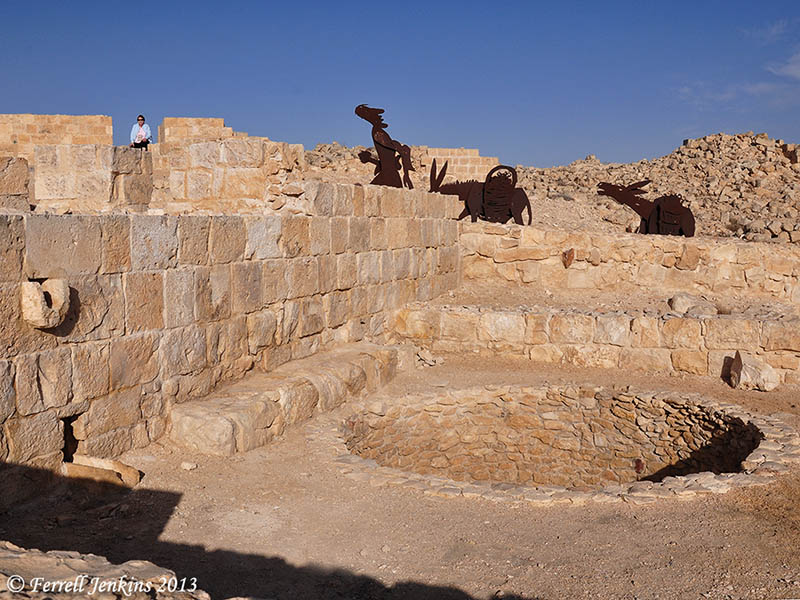
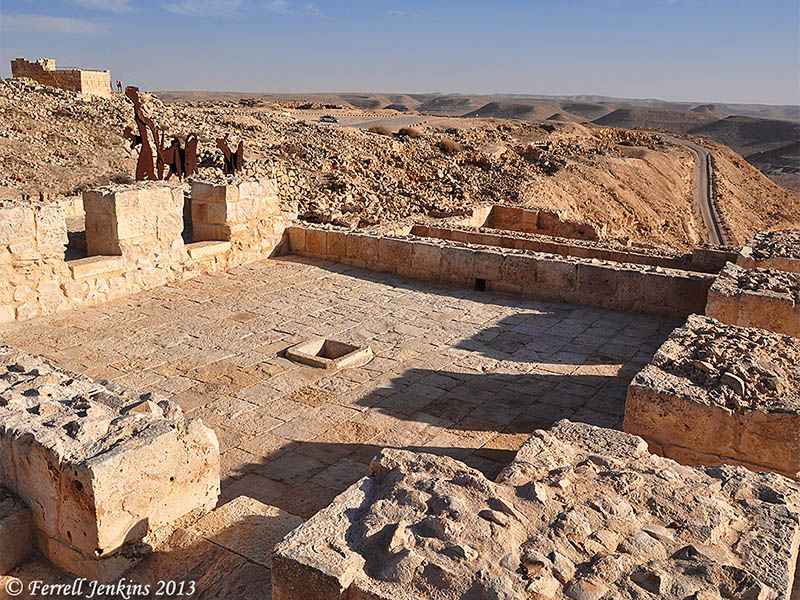
There are four wine presses at Avdat. The one I am showing below is a large Byzantine wine press.

Byzantine wine press at Avdat. Photo by Ferrell Jenkins.

Byzantine wine press at Avdat. Photo by Ferrell Jenkins.

Murphy-O’Connor describes the winepress.

The winepress has a square treading area into which grapes were fed from small storage rooms on three sides. On the fourth side is a round pit into which the grape juice flowed via a channel under the treading floor from a central sump. – The Holy Land, 201.

The next photo shows the round pit.

The round pit into which the juice flowed. Photo by Ferrell Jenkins.

The round pit into which the juice flowed. Photo by Ferrell Jenkins.

I have never been able to take a group to Avdat, but I have made personal visits twice. See here and here.

For more information on the restoration see here.

The new Satellite Bible Atlas

Todd Bolen announced Monday the publication of the Satellite Bible Atlas. This new work is by Bill Schlegel, Associate Professor of the Bible at IBEX in Israel. Bill has lived and taught in Israel since 1984. He taught at the Jerusalem University College (formerly the Institute of Holy Land Studies) before joining The Master’s College IBEX program in 1995.

According to Bolen,

This resource is ready for personal use, classroom use, and field trip use. The author, Bill Schlegel, has been teaching college and seminary students in Israel for 25 years. Everything in the Satellite Bible Atlas is field-tested by a professor who knows God’s land and loves God’s Word.

He continues to give 7 additional reasons why he loves the Satellite Bible Atlas. I will leave it for you to read more details at the Bible Places Blog here.

sba2000c-t

I have had the opportunity for several days to see the various materials associated with the Satellite Bible Atlas, but late Monday I received my beautiful copy and have found it to be an amazing production.

After 17 pages of beautiful satellite maps, the additional maps are printed on one page with a brief, numbered, commentary on the opposite page. For example, looking at map 5-1, Samuel’s Ministry, we see a marked map of the portion of the land where Samson was born, and the places of his activity. Map 9-4 shows Jesus’ Move from Nazareth to Capernaum. Map 10-1 shows Acts of the Apostles in Israel. While the emphasis is on the Promised Land and the history of Israel, Jesus and the Early Church, there are maps showing the Journeys of Paul, The First Revolt Against Rome (c. 66-73 AD), the Bar Kochva Revolt, Jerusalem, the modern Middle East, etc. Eighty-five maps in all.

This beautiful book is published in Israel. I am surprised that the book is available for $30 plus tax and $3 shipping (in the U.S.). You will also be granted access to download the maps.

More information and ordering instructions are available here. Sample Maps, Commentary, Study Questions, and an Index to Sites, are available for download. There are also some Teaching Videos, and more are expected from time to time.

“Every man under his vine” again

A few days ago I wrote here about a biblical way of describing a time of peace and prosperity.

And Judah and Israel lived in safety, from Dan even to Beersheba, every man under his vine and under his fig tree, all the days of Solomon. (1 Kings 4:25 ESV)

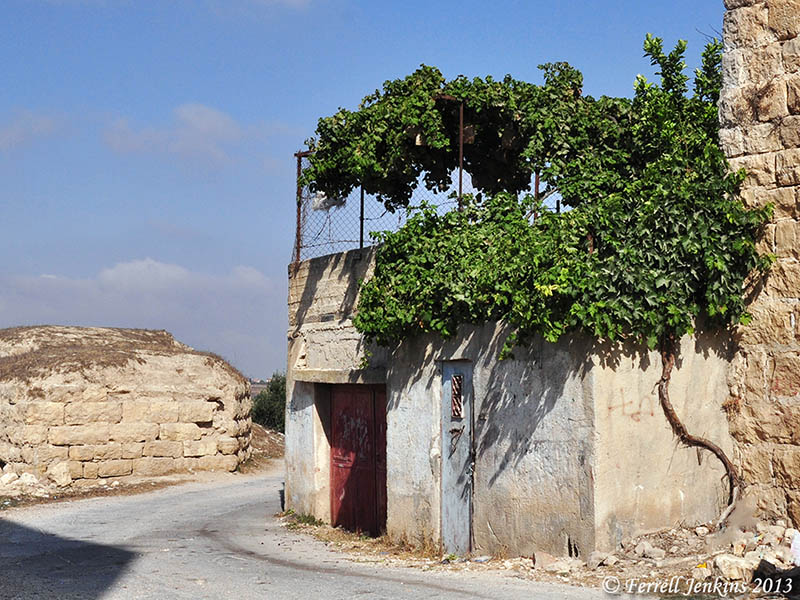
I mentioned that it is not uncommon in the Middle East to see a vine running up the side of a house to cover a porch on the roof. Since the last post I located one of my photos showing this practice. This photo was made at El Jib, the site believed to be Gibeon (Joshua 9; 2 Samuel 2).

A vine growing up the side of a house to provide shade on the roof. Photo by Ferrell Jenkins at Gibeon.

A vine growing up the side of a house to provide shade on the roof. Photo by Ferrell Jenkins at Gibeon (El Jib).

The Watchtower

The watchtower was sometimes used as a lookout for the enemy (2 Chronicles 20:24; Isaiah 21:8; 32:14).

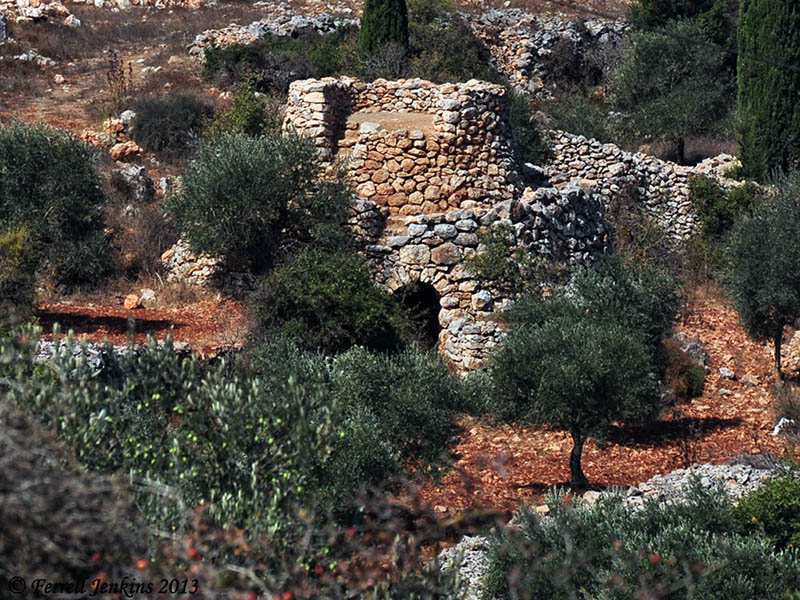
Watchtowers, or just towers, were also built in the fields. They might provide a place for a watchman to keep watch over the field (Isaiah 5:2; Matthew 21:33). Stones were picked up out of the fields to make the tower which also served as a place for workmen to go for shade in the heat of the day.

The only place we see watchtowers today is in the West Bank, and these are usually off the main roads. During the past few years I have photographed several of these old watchtowers. So far as I know they are no longer in use. I am sure that I have shown some watchtowers before, but I thought you might enjoy some of these new photos.

A watchtower in an olive orchard in the West Bank. Photo by Ferrell Jenkins.

A watchtower in an olive orchard in the West Bank. Photo by Ferrell Jenkins.

Herod the Great in the news

Herod is well known to students of the Bible. He is known especially as the king who was so frightened of losing his power that he ordered the death of the one who was born king of the Jews (Matthew 2).

Herod is also known from other historical records such as the Antiquities of the Jews and Wars of the Jews by Josephus.

We have learned much about Herod from the archaeological excavations at sites he is known to have built. We think of the Temple in Jerusalem with its platform and enclosure, the temples dedicated to Emperor Augustus at Caesarea Maritima, Samaria, and Caesarea Philippi (or Omrit), and the fortresses in several parts of the country, and the building at the Cave of Machpelah in Hebron.

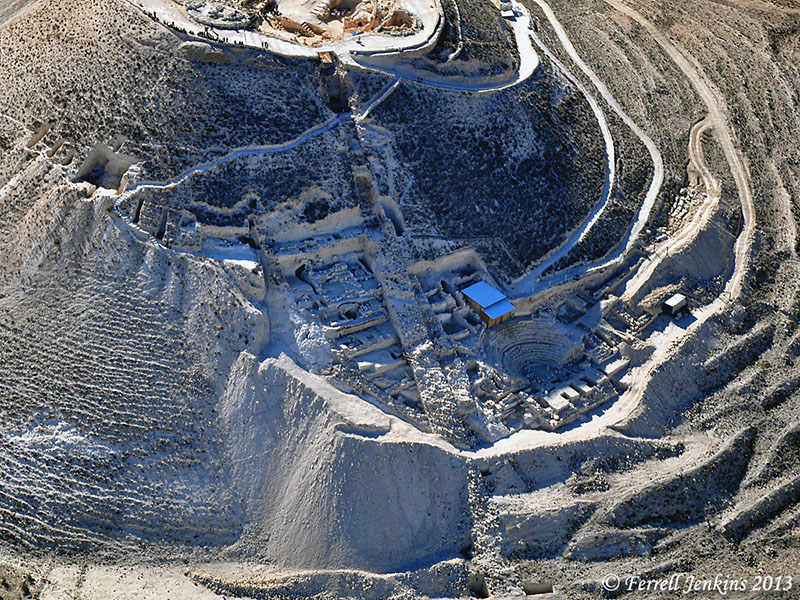
The Herodium has received much attention in recent years as a result of the archaeological excavation conducted by the late Prof. Ehud Netzer in his search for Herod’s tomb.

Aerial view of the Herodium with the area of Netzer's excavation visible.  Photo by Ferrell Jenkins.

Aerial view of the Herodium with the area of Netzer’s excavation visible. All of this was covered by earth just a few years ago. Photo by Ferrell Jenkins.

Now we are informed that the tomb of Herod at the Herodium is to be rebuilt.

The glory of King Herod, the Judean king famous for renovating the Temple Mount and building Masada, will rise again — or at least his tomb will — Israel announced Monday. As part of a new plan, a replica of his tomb at Herodium, situated outside the West Bank city of Bethlehem, will tower to 83 feet and will be visible from Jerusalem.

Herodium, an impressive feat of ancient engineering, is a conical artificial mound built between 23 and 15 BCE that housed a fortified royal palace and tomb. Its walls rose over 200 feet high and it contained elegant courtyards and baths. It was the only one of Herod’s many famed construction projects that bore his name, and was destroyed in 70 CE during the Great Revolt against Rome.

To read this report from the Times of Israel in its entirety, click here.

It must be the year of Herod. The Israel Museum is reconstructing the tomb of Herod in the museum for an exhibition opening February 12, 2013. I am definitely looking forward to seeing this. Read more about it here.

HT: Joseph I. Lauer

Being there is best

Reading and studying about the Bible lands is good, but being there is best. Last September as we traveled around at the end of the long dry season, even though I thought I had made it perfectly clear, one of the tour members asked, “Is it always this dry?” I tried to explain it again.

For a few tips on the rainy season in Israel, see here. For more information about what happens during the winter rains in Israel, see Rivers in the Desert here.

Somewhere I read a comment by a photographer that the best photo is the one when you have your camera. Lots of truth to that. But another idea is that the best photo is when you have your camera and something significant happens.

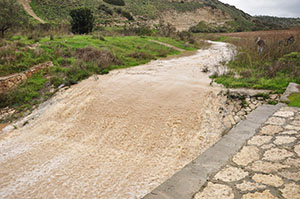
Brook of Elah after 3 days of rain. Photo: Carl Rasmussen.

Brook of Elah after 3 days of rain Jan. 9, 2013. Photo: Carl Rasmussen.

Well, Prof. Carl Rasmussen had his camera on January 9, and something significant had happened. He was in the Valley of Elah after three days of rain. The usually dry brook (nahal or wadi; 1 Samuel 17), of Elah was flowing with water. His photo shows Tel Azekah and the brook as it runs below it.

If you would like to see this beautiful photo in a large resolution, see here.

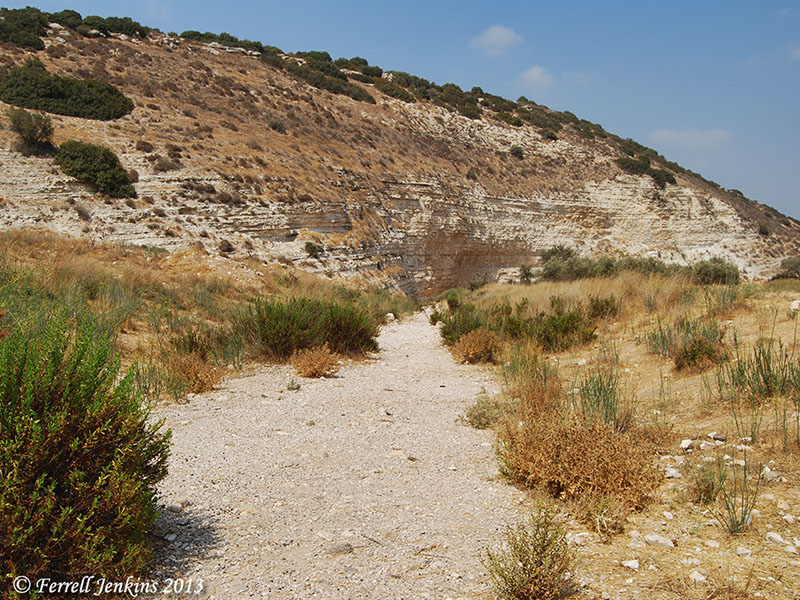
Here is a photo I made in August, 2008, showing the book  [brook] from the same position – dry as a bone. [see comments]

Brook of Elah below Azekah, August, 2008. Photo by Ferrell Jenkins.

Brook of Elah below Azekah, August, 2008. Photo by Ferrell Jenkins.

The land east of the Sea of Galilee

The land of Bashan is located east of the Sea of Galilee and the Hula Valley along the strip of land north of the Yarmuk River as far north as Mount Hermon. Bashan is mentioned no less than 60 times in the Hebrew Bible.

Og is designated as the king of Bashan about 20 times. Bashan is territory given to half of the Israelite tribe of Manasseh (Joshua 17:1). One of the cities of refuge was Golan in Bashan (Joshua 21:27).

Bashan was noted for its cattle, especially bulls (Psalm 22:12; Ezekiel 39:18). The prophet Amos calls the women of Samaria “cows of Bashan” (Amos 4:1). For sure, he was not a very popular prophet.

In recent history Bashan (Golan) was controlled by Syria, but was annexed by Israel in 1981.

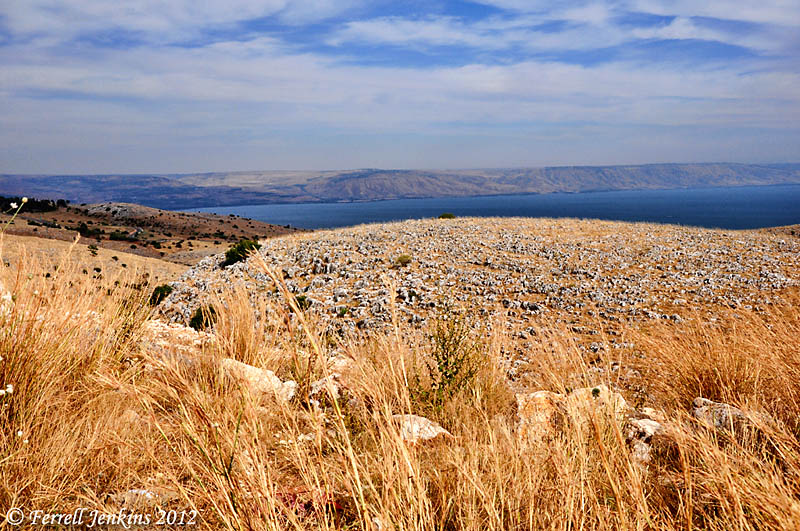
The photo below was made one afternoon as I approached the Sea of Galilee from the north. The view is to the southeast. The visible plateau on the east side of the Sea of Galilee is the southern part of the Golan Heights, the ancient land of Bashan.

The Sea of Galilee from the north. View toward Bashan in the east. Photo by Ferrell Jenkins.

The Sea of Galilee from the north. View toward Bashan in the east. Photo by Ferrell Jenkins.

In New Testament times the same territory, immediately east of the Sea of Galileee, and possibly a little south, was known as the land of the Gadarenes (Mark 5:1; Luke 8:26,37, KJV, NKJV), or the land of the Gergesenes in most modern English versions. These texts record the episode of the healing by Jesus of a man possessed with an unclean spirit. The unclean spirits entered into a herd of swine (pigs) and ran down the steep cliffs, visible in our photo, into the sea (Mark 5:11-13).

Ophel Excavation 2012

Amir Kohen Klonymus, Area A supervisor of the Ophel Excavation, shows a few of the items found in a fire pit at the Ophel Excavation in December. You may find it difficult to understand his English, but stay with the 11 minute video, past the family visit of some sponsors of the dig, to the summation by Prof. Eilat Mazar.
I think anyone who has seen any part of the excavation areas on the south side of the Temple Mount will enjoy this video.

This video and others are available on the blog of The Key to David’s City here.

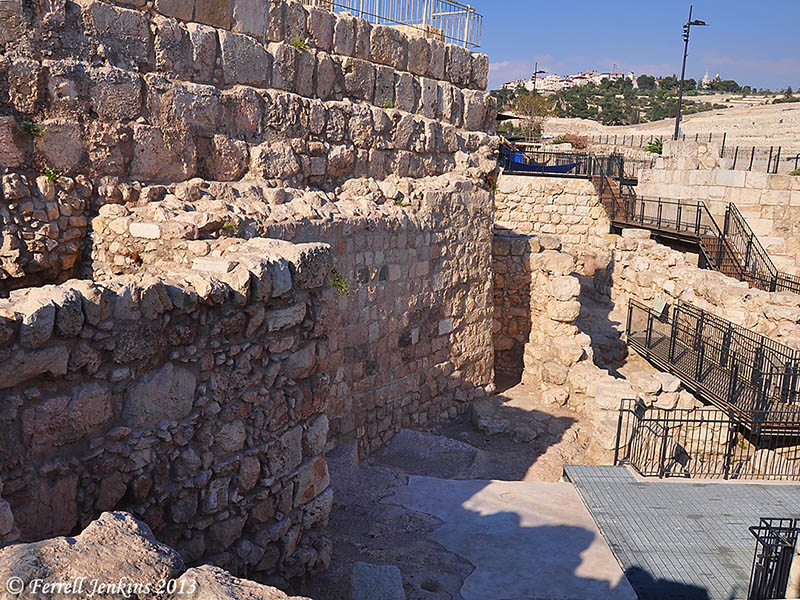
The photo below shows a portion of the Ophel Excavation.

Ophel Excavations - View East. Photo by Ferrell Jenkins.

Ophel Excavations – View East. Photo by Ferrell Jenkins.

Jothan, king of Judah (740-732 B.C.), is said to have built extensively in the area known as Ophel.

He built the Upper Gate to the LORD’s temple and did a lot of work on the wall in the area known as Ophel. (2 Chronicles 27:3 NET)

HT: Jack Sasson