Category Archives: Israel

Zaccheus climbed up into a sycamore tree

The sycamore (Ficus sycomorus) is a type of tree growing only in the Jordan Valley and near the Mediterranean coast. The sycamore is pictured as growing in abundance in the shephelah (lowland, 1 Kings 10:27). This is in contrast to cedars which Solomon planted in Jerusalem.

The sycamore is not the same as the tree by that name that grows in North America. The sycamore tree belongs to the nettle family, like the mulberry and fig trees. The fruit looks like a fig, but the taste is unpleasant. It is eaten by the poor. See Fauna and Flora of the Bible, 179-81.

Zaccheus climbed up into a sycamore tree at Jericho (Luke 19:4). Here is a sycamore tree at Ashkelon that reminded me of Zacchaeus. The limbs are low. Even a child could climb into the tree to get a better view.
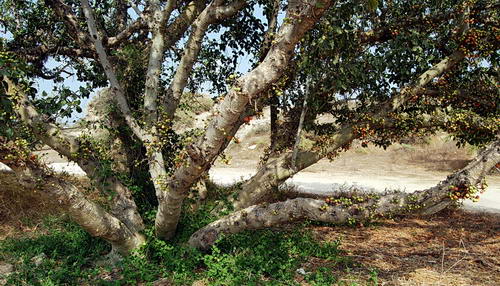
Sycamore tree at Ashkelon. Photo by Ferrell Jenkins.

Sycamore tree at Ashkelon. Photo by Ferrell Jenkins.

Amos the prophet, who lived at Tekoah on the edge of the Judean wilderness, spoke of working with the sycamore fruit.

Amos replied to Amaziah, “I was not a prophet by profession. No, I was a herdsman who also took care of sycamore fig trees. (Amos 7:14, NET Bible).

This photo shows the sycamore figs on the tree.

Sycamore figs. Photo by Ferrell Jenkins.
Sycamore figs. Photo by Ferrell Jenkins.
The Sower Went Out to Sow…

One of the best known parables of Jesus is the parable of the sower and the soils. Note the account recorded in Luke.

“The sower went out to sow his seed; and as he sowed, some fell beside the road, and it was trampled under foot and the birds of the air ate it up. “Other seed fell on rocky soil, and as soon as it grew up, it withered away, because it had no moisture. “Other seed fell among the thorns; and the thorns grew up with it and choked it out. “Other seed fell into the good soil, and grew up, and produced a crop a hundred times as great.” As He said these things, He would call out, “He who has ears to hear, let him hear.”  (Luke 8:5-8 NASB)

Jesus used this simple, easily understood illustration to teach about the word of God and the hearts of men. Read the full account in Luke 8:5-15, Matthew 13:3-23, and Mark 4:1-20.

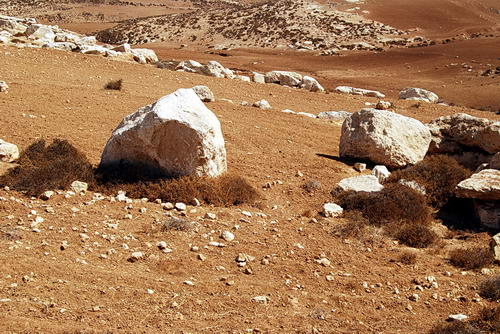
A few weeks ago I was traveling in the vicinity of Hebron and saw these fields that had been plowed and readied for planting. I would assume the crop would be barley or wheat. I was standing on the road. You can see the rocks (be sure the soil is rocky), the weeds (if not thorns), and the good ground. In the time of Jesus seed would be broadcast, scattered by hand. Seed would fall on all the areas, but only that which fell on good ground would bring forth an acceptable crop. Many of the fields in the central mountain range north of Bethlehem are much smaller, but each field has the four elements of good soil, rocks, thorns, and road. How would you describe your heart?

A field showing good soil, rocks, and weeds. Photo by Ferrell Jenkins.

A field showing good soil, rocks, and weeds. Photo by Ferrell Jenkins.

A Bible Land tour for less than $20.00

Journey Through the Holy Lands is a DVD featuring Michael Hasel of Southern Adventist University. Dr. Hasel is Director of the Institute of Archaeology and teaches archaeology at SAU in Collegedale, Tennessee.

In 2007 Hasel was filmed at important biblical sites providing a commentary about the significance of the site. The following sites are visited:

Jerusalem
Garden Tomb; Church of the Holy Sepulcher; the Cardo; Western Wall; Temple Mount; Sheep Gate (often called St. Stephen’s or Lion’s Gate); Pool of Bethesda; Damascus Gate; the First Century House in the Jewish Quarter.

The Dead Sea Area
Qumran, Dead Sea, Masada, Wadi Qelt; Jericho

Egypt and the Sinai
The Giza Pyramids; Saqqara; St. Catherine’s Monastery; Mount Sinai

This DVD is not one of those slick TV presentations. It is the film of a competent scholar who is well acquainted with the history and archaeology of the area telling his tour group about it. I was impressed that Hasel spelled out the facts about such competing sites as the Holy Sepulcher and the Garden Tomb. At some places the commentary was very brief. At Jericho he mentioned the relevant research but did not show any of the evidence on the tell. There is no visit of sites in the Galilee.

At St. Catherine’s, Hasel tells about the discovery of the Sinaiticus Manuscript. Attractive maps and artwork has been added to the film. The background noise at the Giza Pyramids is noticeable and a distraction. The narration could have been added in a studio back home, but it would have changed the character of the film.

It was a pleasure to view the video. I would recommend it to those who have visited these areas and would like an on site review. It would be good for those who will never visit the sites, or those who are preparing for a trip.

Journey Through the Holy Lands is available for $15.00. Shipping and Handling for 1 or 2 copies is $2.50 each. For 3 or more copies it is $5.00.  Payment must be made by money order or check payable to Southern Adventist University. Send order to: Institute of Archaeology, Southern Adventist University, P.O. Box 370, Collegedale, TN 37315.

The Institute of Archaeology operates the Lynn H. Wood Museum which is the repository of the William G. Dever Near Eastern Collection. Check the web page here. I plan to visit the museum if I have an opportunity to travel in the area.

Ask for the ancient path

The Bible, both Old Testament and New Testament, makes it clear that God’s people often depart from God’s way. There are numerous exhortation for His people who walk in the old paths.

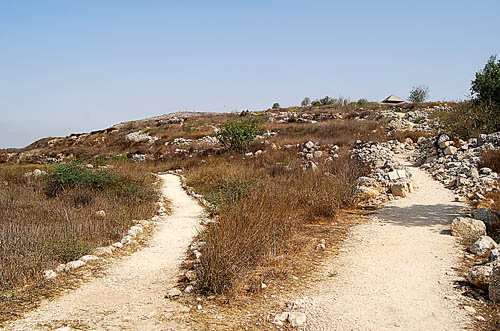
This scene showing two paths at the site of biblical Shiloh reminded me of the Lord’s plea through the prophet Jeremiah in the days of the Babylonian threat against Jerusalem and Judah. The tabernacle was located at Shiloh for many years after Israel entered the land of Canaan. I was just reading the first few chapters of 1 Samuel that tell of Samuel living there during his early years.

Two paths at Shiloh. Photo by Ferrell Jenkins.

Two paths at Shiloh. Photo by Ferrell Jenkins.

Thus says the LORD: “Stand by the roads, and look, and ask for the ancient paths, where the good way is; and walk in it, and find rest for your souls. But they said, ‘We will not walk in it.’ (Jeremiah 6:16)

To ask for the ancient path means to respect the revealed word of the Lord and follow it. This thought is similar to the teaching of Jesus in the Sermon on the Mount (Matthew 7:13-14).

Archaeology: The Bible as blueprint

The Jerusalem Post has been running a series of “People of the Year” articles. The most recent one was on Dr. Eilat Mazar. Mazar has been involved in a dig in the City of David over the last several years. The article says,

Mazar, who is both revered and reviled by some of her colleagues for being a “biblical archeologist,” says that the Bible is unquestionably the most important historical source for her work, since it contains a “genuine historical account of the past.”

“I work with the Bible in one hand and the tools of excavation in the other,” she says. “The Bible is the most important historical source.”

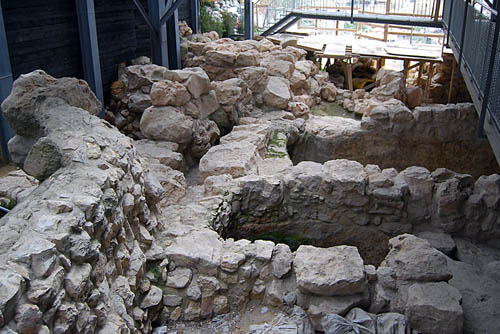
The area where Mazar believes she has found a palace that might have belonged to David, has been covered by a structure to protect it. Here is a photo I made in early April.

A portion of the City of David excavation. Photo by Ferrell Jenkins.

A portion of the City of David excavation. Photo by Ferrell Jenkins.

The full article may be read here.

HT: Joseph I. Lauer.

The Rivers of Damascus

Naaman was the commander of the army of the king of Aram (Syria). The biblical text says he was “esteemed and respected by his master” because of the victories he had given the country. Great people often have great problems as well as great acclaim. Naaman was a leper. The term leper is used throughout the Old Testament of a serious skin disease without a cure. Read the full account in 2 Kings 5:1-18.

A young girl who had been taken captive from Israel during one of the raids made by the Arameans was serving as an attendant to Naaman’s wife. She knew of the prophet [Elisha] in Samaria and was confident he could cure Naaman of his leprosy.

When Elisha send a messenger to Naaman to tell him to “Go and wash in the Jordan seven times” the commander was furious. He said,

Are not Abana and Pharpar, the rivers of Damascus, better than all the waters of Israel? Could I not wash in them and be clean?” So he turned and went away in a rage. (2 Kings 5:12 ESV)

These rivers, Abana and Pharpar, flow from the Anti-Lebanon range eastward into the desert. Here is a photo that I made of the Nahr Barada river a short distance west of Damascus (on the outskirts of the city). The river continues to flow through the city of Damascus. The Nahr Barada is often identified with the Abana of the Bible.

The Abanah River near Damascus. Photo by Ferrell Jenkins.

The Abanah River near Damascus. Photo by Ferrell Jenkins.

Naamam was cured of his leprosy only after he dipped in the Jordan seven times. We should not elevate our judgment (opinion) to the point that we can argue with the Lord about what ought to be done. He is the Creator; we are the creature.

Mount Carmel – site of a great conflict

Mount Carmel is not just a protrusion into the Mediterranean Sea as some sketch maps might suggest. It is a range about 14 1/2 miles long by 5 miles wide, consisting largely of limestone. The elevation of Mount Carmel is about 1500 feet above sea level. From the western promontory one can overlook the city and port of Haifa. The Roman general Vespasian, who later became emperor, offered sacrifices on Mount Carmel before the war against the Jews (A.D. 66-70) (Hoade, Guide to the Holy Land, 665).

Mount Carmel is best known to Bible students as the place where the prophet Elijah contended with the prophets of Baal (1 Kings 18:17-40). The traditional site for this event is shown at Muhraka on the eastern end of Mount Carmel. This photo was made near Muhraka.

View of part of Mount Carmel near Muraka. Photo by Ferrell Jenkins.

View of part of Mount Carmel near Muraka. Photo by Ferrell Jenkins.

Professor Avraham Biran

Dr. David Ilan, Director of the Nelson Glueck School of Biblical Archaeology, announced the passing of Professor Avraham Biran. Jack Sasson reports to the academic community the passing of Prof. Avraham Biran.

It is my sad duty to inform you that Prof. Avraham Biran passed away last night.  He was one month shy of his 99th birthday.

Avraham Biran, a third generation Israeli, received his Ph.D. at Johns  Hopkins University under William Foxwell Albright and was Thayer Fellow in the American Schools of Oriental Research, Jerusalem, 1935-37. Formerly Director of the Israel Department of Antiquities and Museums, he served as Director of Hebrew Union College-Jewish Institute of Religion’s Nelson Glueck School of Biblical Archaeology in Jerusalem from 1974-2003. He participated in the excavations of the  Uiversity of Pennsylvania in Iraq, at Tepe Gawra near Mosul, and at Hafaje near Baghdad. He accompanied Nelson Glueck in his epoch-making discoveries at the head of the Gulf of Eilat. Professor Biran directed the excavations of Anathoth, Tel Zippor, Ira, Aroer, the synagogue of Yesud Hama’alah, and the longest ongoing excavations in Israel at Tel Dan (under his direction from 1966 to 1999).

It was my pleasure on several occasions to hear Prof. Biran at professional meetings. I remember hearing him tell of the discovery of the House of David inscription. He always spoke with such enthusiasm; it was contagious. The last year I saw him at one of these annual meetings I was walking across the street from my hotel to the conference center. There was Prof. Biran. I spoke to him and more or less helped him across the street. 

The tremendous work done at Tel Dan seemed to me to be a testimony to his continuing work there. It takes a long time to do a lot of good things, especially archaeology.

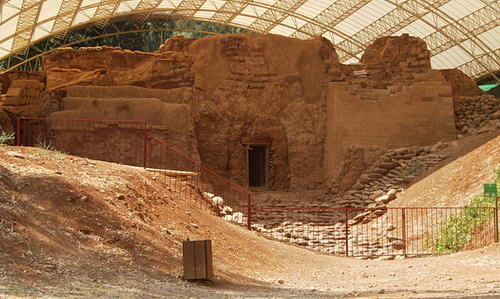
The significant discoveries at Dan are too numerous to mention just now. In 1979 a complete Middle Bronze city gate (19th/18th century B.C.) was found at Dan (ancient Laish). This gate illustrates that the city was strongly fortified at the time Abraham rescued Lot (Genesis 14:14). I made this photo of the preserved gate on August 31.

The Middle Bronze age city gate at Dan. Photo by Ferrell Jenkins.

The Middle Bronze age city gate at Dan. Photo by Ferrell Jenkins.

HT: Joseph I. Lauer

Azekah was an important fortified city of Judah

The biblical site of Azekah is identified with Tell ez-Zekariyeh which overlooks the Valley of Elah. Azekah is a town of the Shephelah and is mentioned seven times in the Bible. Here is a summary of the information:

  • Azekah is mentioned in the account of Joshua’s long day (Joshua 10:10-11).
  • It was assigned to the tribe of Judah (Joshua 15:35).
  • The Philistines camped at Ephes-Dammim, between Socoh and Azekah, at the time of the conflict between David and Goliath (1 Samuel 17:1).
  • It was one of the fortified cities of Rehoboam, king of Judah (2 Chronicles 11:9).
  • Upon return from Babylonian captivity some of the Jews settled in Azekah and its villages (Nehemiah 11:30).

Jeremiah states that only Lachish and Azekah remained of the fortified cities of Judah at the time of the Babylonian captivity of Judah in 586 B.C. (Jeremiah 34:7). This indicates that Jeremiah wrote shortly before Lachish Letter # 4 was written. The last portion of the letter reads this way:

And let (my lord) know that we are watching for the signals of Lachish, according to all the indications which my lord hath given, for we cannot see Azekah. (The Ancient Near East an Anthology of Texts and Pictures, 322)
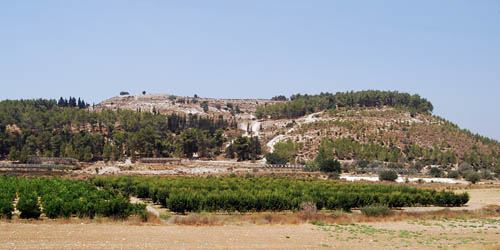
Here is a photograph of Azekah from the Valley of Elah.
Tel Azekah overlooks the Valley of Elah. Photo by Ferrell Jenkins.

Tel Azekah overlooks the Valley of Elah. Photo by Ferrell Jenkins.

A photograph of the Valley of Elah made from atop Tel Azekah may be seen here. An excavation conducted by Bliss and Macalister in 1898-99 showed that Azekah was occupied from Canaanite times. (The New International Dictionary of Biblical Archaeoogy, 83).

Second Temple wall of Jerusalem uncovered

The Israel Antiquities Authority announced last week the discovery of a wall below modern “Mount Zion” that dates from the time of the Hasmonean kings to the destruction about A.D. 70. Here are a few comments in the official press release.

An exciting discovery in Jerusalem constituting extraordinary remains of the wall of the city from the time of the Second Temple (second century BCE-70 CE) that was built by the Hasmonean kings and was destroyed during the Great Revolt, and also the remains of a city wall from the Byzantine period (324-640 CE) which was built on top of it, were uncovered in an extensive excavation that is currently underway on Mount Zion. The lines of these fortifications delineated Jerusalem from the south in periods when the ancient city had reached its largest size.

The new finds were presented today (Wednesday) at a press conference that was held on Mount Zion. The excavation has been in progress for the past year and a half, under the direction of archaeologist Yehiel Zelinger of the Israel Antiquities Authority, in cooperation with the Nature and Parks Authority and with financial support provided by the Ir David Foundation.

You may read the entire news release at the IAA web page.

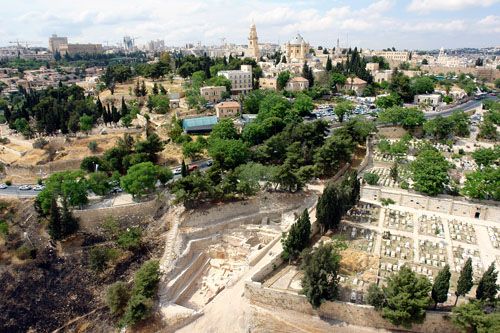
Here is an aerial photograph of the excavation, Mount Zion Valley. Photograph: Skyview, courtesy of the Israel Antiquities Authority.

Aerial photo of Mount Zion valley. Skyview. Courtesy of Israel Antiquities Authority.

Aerial photo of Mount Zion valley. Skyview. Courtesy of Israel Antiquities Authority.

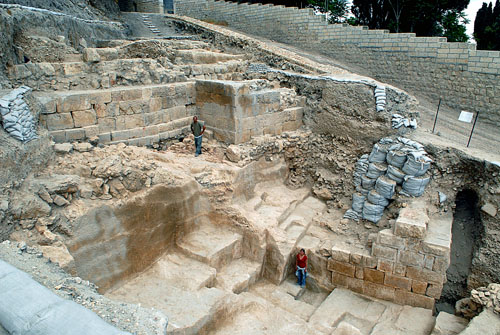
This pictures shows the excavation area.

Tsilla Sagiv. Courtesy of the IAA.

The excavated area. Photo: Tsilla Sagiv. Courtesy of the IAA.

Todd Bolen provides a concise summary of the information on this discovery at his BiblePlaces Blog.