CNN posted a nice, short video on the Canaanite fortification we reported on yesterday. The link is here.
HT: Dan

CNN posted a nice, short video on the Canaanite fortification we reported on yesterday. The link is here.
HT: Dan
Posted in Archaeology, Israel, Old Testament
According to a press release from the Israel Antiquities Authority, “An Enormous 3,700 Year Old Fortification was Exposed in the City of David.”
The fortification rises to a height of c. 8 meters [about 26+ feet], and it seems that the Canaanites used it to defend the path that led to the spring.
The excavations are being conducted by the Israel Antiquities Authority in the “Walls Around Jerusalem National Park and are underwritten by the ‘Ir David Foundation.
A huge fortification more than 3,700 years old, which is ascribed to the Canaanites (Middle Bronze Age 2 [2000-1500 BC]), was uncovered in archaeological excavations the Israel Antiquities Authority is currently conducting in the “Walls Around Jerusalem National Park” in the City of David, with funding provided by the ‘Ir David Foundation.
According to the director of the excavation, Professor Ronny Reich of the University of Haifa, together with Eli Shukron on behalf of the Israel Antiquities Authority, “This is the most massive wall that has ever been uncovered in the City of David, and it rises to a height of 8 meters. We are dealing with a gigantic fortification, from the standpoint of the structure’s dimensions, the thickness of its walls and the size of the stones that were incorporated in its construction. The walls appear to be a protected, well-fortified passage that descends to the spring tower from some sort of fortress that stood at the top of the hill. The construction of a protected passage such as this is a plausible solution that explains the innate contradiction of the situation whereby the spring – which is a source of life from the standpoint of the fortress’ inhabitants in time of emergency – is located in the weakest and most vulnerable place in the area. The construction of a protected passage, even though it involves tremendous effort, is a solution for which there are several parallels in antiquity, albeit from periods that are later than the remains described here. A small section of the fortification was discovered in 1909, and it has been ascertained in the present excavations that it was part of an enormous wall. This is the first time that such massive construction that predates the Herodian period has been discovered in Jerusalem.”
During this period Jerusalem and the fields around it were an independent political entity with self-rule, similar to its neighbors Shechem to the north and Jericho to the east. Massive walls resembling the one that was just exposed in Jerusalem are known from Canaanite Hebron (Tel Rumeida), Shechem (Tell Balata) and Gezer.
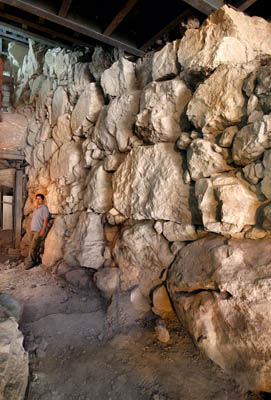
Middle Bronze II Fortification. Photo: Vladimir Naiahin, IAA.
Professor Reich comments on the fortification:
“Even though it would seem we are dealing with impressive fortifications, the walls were after all primarily used to defend against marauding desert nomads who wanted to rob the city. These are the earliest fortifications in the region and they bear witness to the fact that from this point on the settlement had became an urban entity with a ruler who had the capability and resources to build such a structure. A small settlement would have been unsuccessful in organizing such construction”.
The known section of the fortification is 24 meters long; however, it is thought the fortification is much longer because it continues west beyond the part that was exposed, at the top of the hillside. Professor Reich adds, “The new discovery shows that the picture regarding Jerusalem’s eastern defenses and the ancient water system in the Middle Bronze Age 2 is still far from clear. Despite the fact that so many have excavated on this hill, there is a very good chance that extremely large and well-preserved architectural elements are still hidden in it and waiting to be uncovered”.
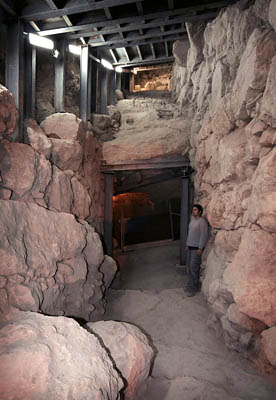
Middle Bronze II Fortification. Photo: Vladimir Naiahin, IAA.
What does this mean for the Bible student? The Middle Bronze II period is the period of the Biblical Patriarchs. It was possibly during that period when Melchizedek, king of Salem and priest of God Most High, went out to bless Abraham after his return from rescuing Lot (Genesis 14:18). We have no way to know if this fortification was in existence at that time.
Assuming this fortification was still in use at the time when David captured the stronghold of Zion from the Jebusites, it helps explain the arrogance of the local residents (2 Samuel 5:6-7).
Take a look at the City of David website here.
HT: Joseph I. Lauer
Posted in Archaeology, Bible Places, Bible Study, Israel, Old Testament
Tel Aviv University reports on the discover of a rare Egyptian artifact dating to around 3000 BC from Tel Bet Yerah on the shore of the Sea of Galilee. The link to the report is here. The brief report from the Jerusalem Post is probably adequate here.
Although Egyptian-Israeli relations have been frosty in recent years, ties between the two lands were vibrant around 3,000 BCE during the Early Bronze Age – at least according to Tel Aviv University and University College London archeologists who discovered a rare, four-centimeter-long stone fragment at the point where the Jordan River exits Lake Kinneret.
The piece, part of a carved stone plaque bearing archaic Egyptian signs, was the highlight of the second season of excavations at Tel Bet Yerah (Khirbet el-Kerak). The site lies along an ancient highway that connected Egypt to the wider world of the ancient Near East.

Fragment of Egyptian plaque - c. 3000 BC - from Tel Bet Yerah.
. . . . . .
Earlier discoveries, both in Egypt and at Bet Yerah, have indicated that there was direct interaction between the site – then one of the largest in the Jordan Valley – and the Egyptian royal court. The new discovery suggests that these contacts were of far greater local significance than had been suspected.
The archeologists noted that the fragment – which depicts an arm and hand grasping a scepter and an early form of the ankh sign – was the first artifact of its type ever found in an archaeological site outside Egypt. It has been attributed to the period of Egypt’s First Dynasty, at around 3000 BCE.
. . . . . .
This year’s excavations also provided new insights into contacts between the early town and the distant north, when large quantities of “Khirbet Kerak Ware” (a distinctive kind of red/black burnished pottery first found at Tel Bet Yerah) were found in association with portable ceramic hearths, some of them bearing decorations in the form of human features.

One end of a decorated portable hearth - Khirbet Kerak Culture (c. 2700 BC)
“The hearths are very similar to objects found in Anatolia and the southern Caucasus,” noted Greenberg, “and most were found in open spaces where there was other evidence for fire-related activities.
“The people using this pottery appear to have been migrants or descendants of migrants, and its distribution on the site, as well as the study of other cultural aspects, such as what they ate and the way they organized their households, could tell us about their interaction with local people and their adaptation to new surroundings.”
. . . . . .
The tel was once described by influential American biblical archeologist William F. Albright as “perhaps the most remarkable Bronze Age site in all Palestine.” It presents the most complete sequence of the transition from village to city life in ancient Canaan.
Built on a raised peninsula near an important crossroads and a fertile valley, Tel Bet Yerah became a major regional center, and its fortification systems, city gate, streets and houses reveal elements of advanced urban planning.
Modern archeological research on the mound began in the early 1920s, when E.L. Sukenik (father of the late archeologist and politician Prof. Yigael Yadin) examined finds from the section of the old Samak (Tzemah)-Tiberias road that traversed the mound along its entire length.
At about the same time, Albright conducted his own investigation of the site; he was the first to identify and define the pottery known as Khirbet Kerak Ware.
The first archeological excavation was conducted in 1933, when the modern Tzemah -Tiberias highway was constructed. Over the next 70 years, about 20 excavation licenses were issued for Tel Bet Yerah and some 15,000 square meters were excavated, most of them in Early Bronze Age strata.
I think this type of information illustrates why the Lord placed His people on this land bridge between the great powers of the ancient world. It would continue to remain that way through the days of the Assyrians, Babylonians, Persians, Greeks, and Romans. And beyond.
HT: Joe Lauer
Posted in Archaeology, Bible Study, Culture, Egypt, Israel, Travel
Tel Dor sits on a promontory on the Mediterranean coast between Caesarea Maritima and Mount Carmel.
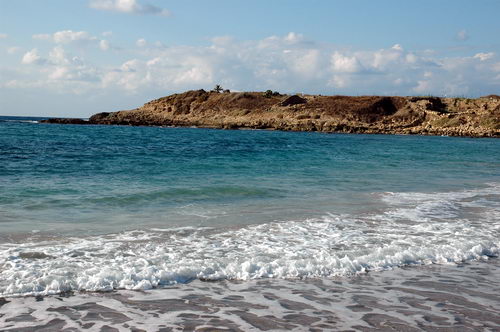
View of Tel Dor from the south. Photo by Ferrell Jenkins.
The site of Dor seems to have been inhabited at least from the Late Bronze Age (1550-1200 B.C.). The Tel Dor Excavation site says,
The documented history of the site begins in the Late Bronze Age (though the town itself was founded in the Middle Bronze Age, c. 2000 BCE), and ends in the Crusader period.
Here is what we know about Dor from the biblical accounts:
Posted in Archaeology, Bible Places, Bible Study, Israel, Old Testament
Israel National News reports the discover of a rare miniature carving of Alexander the Great. The article by Nissan Ratzlav-Katz says,
Excavations in Tel Dor have turned up a rare and unexpected work of Hellenistic art: a precious stone bearing the miniature carved likeness of Alexander the Great. Archaeologists are calling it an important find, indicating the great skill of the artist.
The Tel Dor dig, under the guidance and direction of Dr. Ayelet Gilboa of Haifa University and Dr. Ilan Sharon of Jerusalem’s Hebrew University, has just ended its summer excavation season. For more than 30 years, scientists have been excavating in Tel Dor, identified as the site of the Biblical town of Dor. The town’s location, on Israel’s Mediterranean Sea coast some 30 kilometers south of Haifa, made it an important international port in ancient times.
“Despite the tiny proportions – the length of the gemstone (gemma) is less than a centimeter and its width less than half a centimeter – the artist was able to carve the image of Alexander of Macedon with all of his features,” Dr. Gilboa said. “The king appears as young and energetic, with a sharp chin and straight nose, and with long, curly hair held in a crown.”
According to the archaeologists involved in the Tel Dor excavations, the discovery of the miniature Alexander gemstone carving in Israel is fairly surprising. The Land of Israel was not, for the Greek Empire, a central or major holding.
The article concludes,
Historically, Alexander himself passed through Dor in 332 BCE, during his voyage to Egypt. It appears that the city fell to him without resistance. Since that time until its conquest by the Hasmonean Jewish King Alexander Yannai around 100 BCE, Dor served as a stronghold of non-Jewish Hellenists in the Land of Israel.
The full article may be read here.
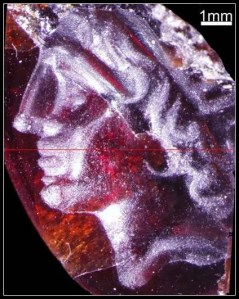
Carving of Alexander from Tel Dor.
Dor is mentioned in several Old Testament references including Joshua 17:10-11.
HT: Joseph I. Lauer
Posted in Archaeology, Bible Places, Culture, Greece, Israel, Travel
This morning I wanted to share a photo made from Qumran on the western shore of the Dead Sea. Weather conditions were fairly good that day. You can see across the Dead Sea to the mountains of Moab.
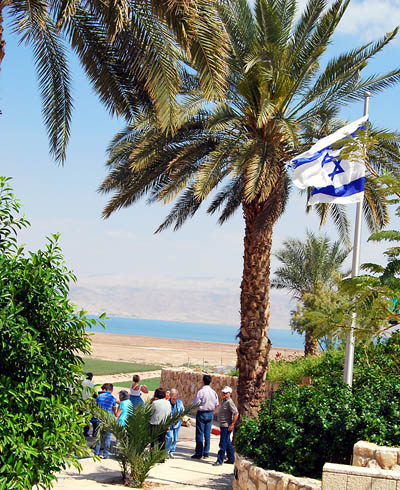
View east across the Dead Sea to Moab. Photo by Ferrell Jenkins.
We associate the land of Moab with Ruth the grandmother of King David.
So Naomi returned, and with her Ruth the Moabitess, her daughter-in-law, who returned from the land of Moab. And they came to Bethlehem at the beginning of barley harvest. (Ruth 1:22)
Posted in Bible Places, Bible Study, Israel, Jordan, Old Testament
We have had several things to say about Luke Chandler and his participation in the archaeological dig at Khirbet Qeiyafa (the Elah Fortress) a few weeks ago. This is because Luke is a friend and a former student. Luke has been interviewed by Gordon Govier on The Book and the Spade program. That interview emphasized the role of volunteers in archaeology.

Willner & Selevan
Now he has been interviewed for the Judean Eve program on Israel National Radio to discuss the use of blogs in reporting on archaeological work. To hear this interview you must look for the program entitled Tell Me About Digs. Click on Part 2 to listen or download the mp3 file. Follow this link for the interview. Luke’s blog may be found at lukechandler.wordpress.com.
There is another interview on the same program with some guy named Herschel Shanks.
Khirbet Qeiyafa is an important site historically because of the part it plays in the account of the conflict between Israel and the Philistines (David and Goliath). See 1 Samuel 17 for the full story.
The land captured by Joshua and the Israelites included “Baal Gad in the valley of Lebanon at the foot of Mount Hermon” (Joshua 11:17). Today we call this valley to the east of Mount Hermon the Beka Valley. Some have suggested that Baal Gad might be the site later known as Paneas (now Banias), and later Caesarea Philippi. Dan is another important biblical town located at the foothills of Mount Hermon.
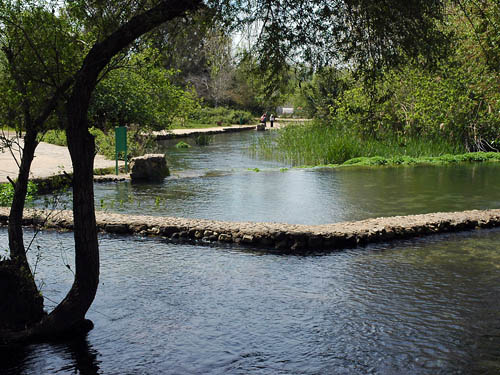
Source of the Jordan River at Caesarea Philippi. Photo by Ferrell Jenkins.
Brethren dwelling together in unity is said to be “like the dew of Hermon Coming down upon the mountains of Zion” (Psalm 133:3). Mount Hermon receives an annual average of about 60 inches of precipitation. In the winter the mountain is usually fully covered with snow.
The proximity of Mount Hermon to Caesarea Philippi, where Jesus was confessed to be the Christ, and where he promised to build the church, causes many scholars to suggest it as the “high mountain” of the transfiguration (Matthew 16:13 – 17:1-9).
Posted in Bible Study, Israel, New Testament, Old Testament
Tagged Ministry of Jesus, Photos
Luke Chandler reports on the last full day of excavation at Khirbet Qeiyafa (the Elah Fortress) here. Several good photos are included with the post. Thanks to Luke for the reports and photos.
I call attention to these reports to give our readers who may not be aware an idea of the difficulty and slowness of an archaeological dig. Information is accumulated over many years. The archaeologists may have some conclusions at the end of the season, but they may change next year as new information comes to light.
Now we must await a full report by the director of the dig. There may be a press relase within the next month or two, but the next step is the presentation at the annual meetings of the American Schools of Oriental Research and the Society of Biblical Literature in November. Maybe a popular article or two will follow. In the background there may be lab studies, calling in of experts in various fields to look at artifacts, etc.
There will likely be more questions than answers. In the years to come other scholars will interact with the conclusion drawn by the excavator. Hopefully this will provide background for a better understanding of the story of David and Goliath (the Israelites and the Philistines).
Posted in Archaeology, Bible Places, Israel, Old Testament
Arutz Sheva, Israel National News.com, reported the inauguration of the world’s largest model of the Second Temple (they mean Herod’s temple; not the one built by Zerubbabel in the days of the prophet Haggai).
The model, built at a scale of 1:60, was built by Michael Osanis for the Aish HaTorah Yeshiva in Jerusalem’s old city, and is displayed on the roof of its new museum, which at seven stories above the Western Wall plaza has a breathtaking view of the Temple Mount.
The photo of the model in place on the roof of Aish HaTorah’s new Exploration museum is impressive.
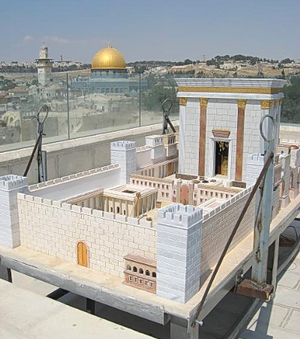
Largest temple model inaugurated August 5, 2009. Photo: Arutz Sheva.
Read the full story here. There is a video showing the model being put into place.
Arutz Sheva reported July 30th on the building of the altar of the temple at Mitzpe Yericho. See article and photos here.
The Temple Institute has already built several of the Temple vessels such as the Ark and the menorah, and has now embarked on an ambitious project to build the altar, which will ultimately measure 3 meters wide by 3 meters long and 2 meters tall.
During Thursday’s ceremony, which took place in Mitzpe Yericho just east of Jerusalem, the Temple Institute laid the cornerstone for the altar and demonstrated how tar will be used to cement the stones together. The Institute plans on bringing the altar to its proper place on the Temple Mount when the Temple is rebuilt.
Mitzpe Yericho is in the wilderness of Judea near the Monastery of St. George.
There is some discussion between the Jews and Jesus about the building of Herod’s temple in the Gospel of John.
The Jews then said to Him, “What sign do You show us as your authority for doing these things?” Jesus answered them, “Destroy this temple, and in three days I will raise it up.” The Jews then said, “It took forty-six years to build this temple, and will You raise it up in three days?” But He was speaking of the temple of His body. So when He was raised from the dead, His disciples remembered that He said this; and they believed the Scripture and the word which Jesus had spoken. (John 2:18-22 NAU)
HT: Joseph I. Lauer.
Posted in Culture, Israel, New Testament, Old Testament
 Ferrell's Travel Blog
You must be logged in to post a comment.