Category Archives: Greece

Paul quotes hometown poet in Athens speech

As Paul taught the Areopagus about the God that could be known, he cited two Greek poets who had indicated belief in a supreme being.

for in Him we live and move and exist, as even some of your own poets have said, ‘For we also are His children.’  “Being then the children of God, we ought not to think that the Divine Nature is like gold or silver or stone, an image formed by the art and thought of man.  (Acts 17:28-29 NAU)

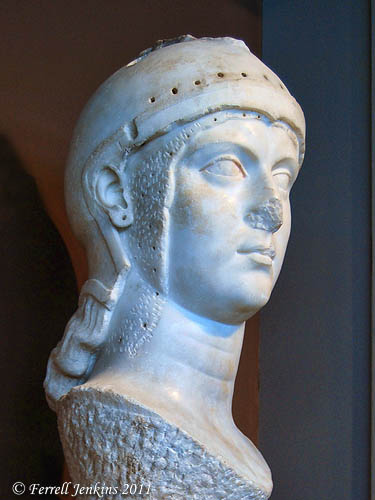
The first quotation is attributed to the Cretan poet Epimenides. The second quotation is attributed to Aratus of Cilicia, which was also Paul’s home (Acts 21:39). These poets certainly did not have in mind the same God that Paul was preaching, but they acknowledged that there was a supreme power back of the universe.

The photo below shows a bust of Aratus displayed in the British Museum.

The Cilician poet Aratus. British Museum. Photo by Ferrell Jenkins.

Cilician poet Aratus. British Museum. Photo: Ferrell Jenkins.

If Paul needed a weather report in Athens

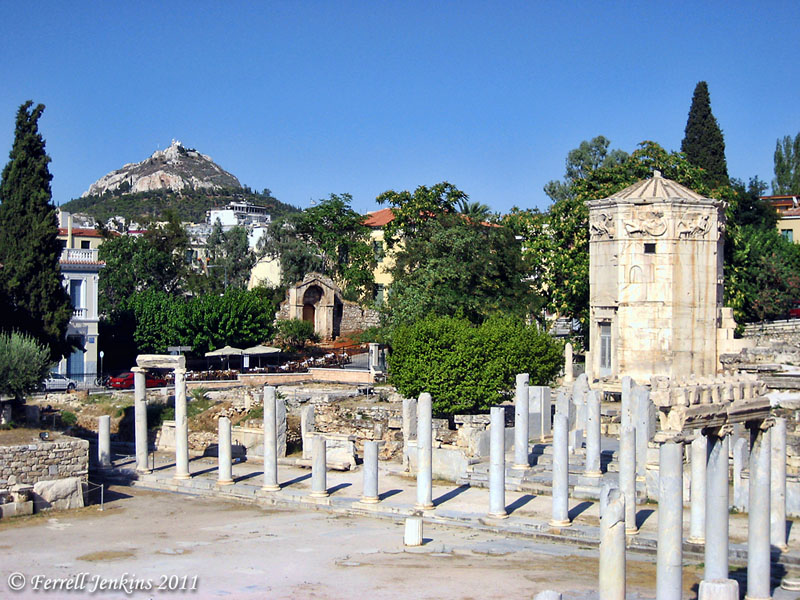
The Roman Forum is located north of the Acropolis in Athens. If you are walking in the ancient Agora you could wander into the Roman Forum without realizing the difference. The Tower of the Winds in the Roman Forum might have been seen by the Apostle Paul during his stay in Athens (Acts 17:15-34).

The Tower of the Winds was built about 40 B.C. by Andronicus to serve as a sundial, water-clock, and weather-vane. Fant and Reddish describe the structure this way:

… the Tower of the Winds on the east side of the forum, named for the reliefs of the Eight Winds on the frieze about the top of the tower. Originally the tower was a complete ancient weather station, designed by a famous Macedonian astronomer, Andronikos of Kyrrhos. Sundials were mounted on the exterior sides of the building, a water clock operated inside the tower, and the bronze weather vane on top indicated the wind direction over the applicable image of one of the Eight Winds. (A Guide to Biblical Sites in Greece and Turkey, 32)

In the photo below you will see the Tower of the Winds on the right in the Roman Forum. The hill in the distance is known as Mount Lycabetus. It is the highest point in the city of Athens.

Tower of the Wind. Mount Lycabetus in distance. Photo by Ferrell Jenkins.

Tower of the Wind in Roman Forum. Mt. Lycabetus in distance. Photo by Ferrell Jenkins.

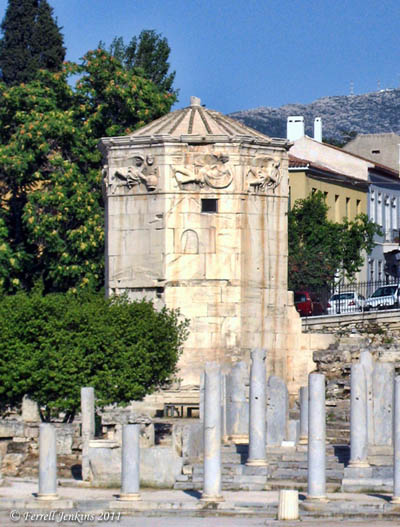
Here is a larger image of the Tower of the Winds.

Tower of the Winds in the Roman Forum of Athens. Photo by Ferrell Jenkins.

Tower of the Winds in the Roman Forum. Photo by Ferrell Jenkins.

Athens — the Agora and the Areopagus

A few days ago we discussed Paul’s appearance in the midst of the Areopagus here. We noted that several classical and New Testament scholars indicate that the Areopagus (the court) of Athens originally met on the hill commonly called Mar’s Hill or the Areopagus, but that the court later met in the agora.

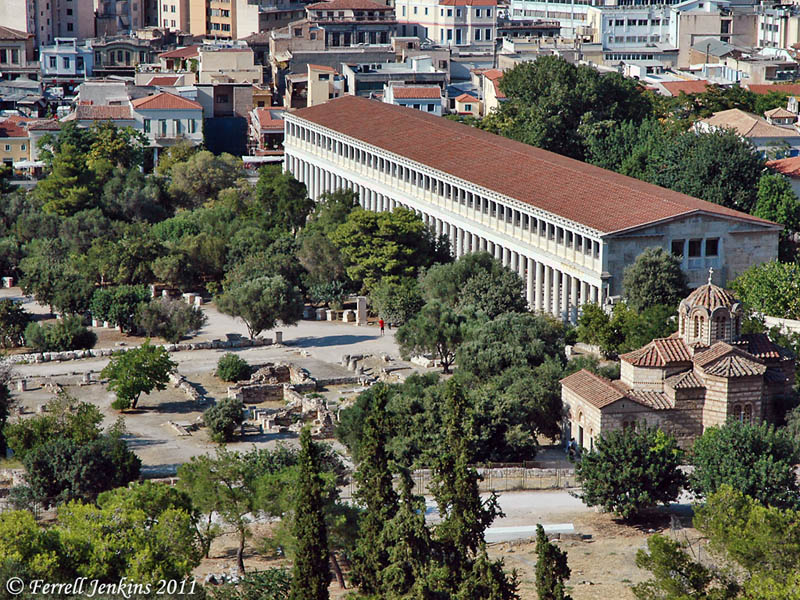
Our photo below was made from atop the Areopagus. It shows a small part of the ancient agora and the Stoa of Attalus in the center of the city of Athens.

View from Mars Hill (Areopagus) of the agora and the Stoa of Attalus in Athens. Photo by Ferrell Jenkins.

View showing a portion of the agora and the Stoa of Attalus. Photo by Ferrell Jenkins.

The Stoa of Attalus was built by King Attalos II of Pergamum (159-138 B.C.). It has been reconstructed and now serves as the Agora Museum.

In Roman times the court held most of its meetings in the Royal Portico (stoa basileios) in the agora, but we still don’t know whether Paul addressed the court in the Royal Portico or on the Areopagus (Bruce, Paul: Apostle of the Heart Set Free, 238).

The Parthenon — in Athens, Greece, and in Athens of the South

The Parthenon in Athens, Greece, is one of the most famous architectural landmarks on earth. The building was erected on the Acropolis in the fifth century B.C. According to Fant and Reddish, “the cult statue of Athena stood in the east cella, surrounded by a colonnade of twenty-three columns and an entrance portico with six columns.”

Completed in 438 B.C.E. the statue of Athena was designed and constructed by Phidias himself. On its base it stood nearly 40 feet tall, supported by a massive post. The face and hands were of ivory. According to Thucydides, more than 40 talents of gold (approximately 250 lbs.) were used to plate the remainder of the enormous statue. These plates were removable so that the weight of the gold could be checked periodically. The goddess stood upon a large platform upon which the Pandora myth was depicted. Her left hand rested upon her shield, her spear leaned against her left shoulder, and in her right hand she held a small image of Nike. The statue eventually was carried off to Constantinople and destroyed there in 1203 C.E. (Fant and Reddish, A Guide to Biblical Sites in Greece and Turkey, Oxford, 30-31)

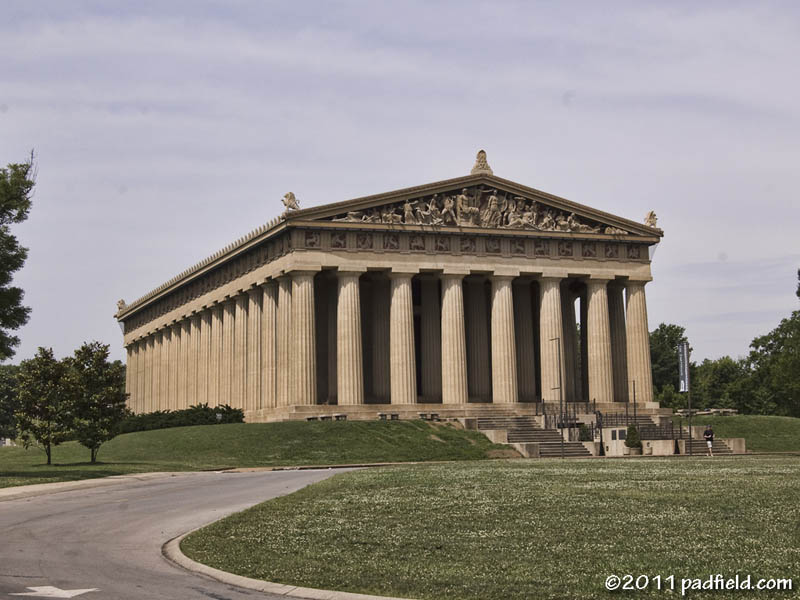
Nashville, Tennessee, had nicknamed itself the Athens of the South by the mid 19th century. In 1897 a replica of the Greek Parthenon was built in Nashville’s Centennial Park. After yesterday’s post about the original Parthenon, my friend Ken Green, who lives in Nashville, wrote that he was sure I had seen the Parthenon, but wondered if I had seen the 42-foot statue of Athena which was unveiled to the public in 1990. In earlier years I have lived in Alabama and Kentucky, with frequent trips through Nashville, but I have not seen the Athena statue. Fortunately, my friend David Padfield visited Nashville last year and made some nice photos (as usual). He has graciously allowed me to share a couple of these photos with our readers.

The first photo shows the exterior of the Nashville Parthenon.

The Parthenon in Nashville, Tennessee. Photo by David Padfield.

The Parthenon in Nashville, Tennessee. Photo by David Padfield.

The next photo shows the statue of Athena as it is displayed in the Parthenon.

Athena in the Parthenon in Nashville, Tennessee. Photo by David Padfield.

Athena in the Parthenon in Nashville, Tennessee. Photo by David Padfield.

Think of the glory of the original Parthenon and the statue of Athena on the Acropolis in Athens. Paul certainly saw the building and may have seen the statue of Athena that was then inside the building.

Now while Paul was waiting for them at Athens, his spirit was being provoked within him as he was observing the city full of idols. (Acts 17:16 NAU)

“Being then the children of God, we ought not to think that the Divine Nature is like gold or silver or stone, an image formed by the art and thought of man. (Acts 17:29 NAU)

You may read more about the Nashville Parthenon at the official city website here.

Athens — a “city full of idols”

While the Apostle Paul waited for his companions to come from Macedonia his spirit was provoked or upset because he observed “the city full of idols” (Acts 17:16).

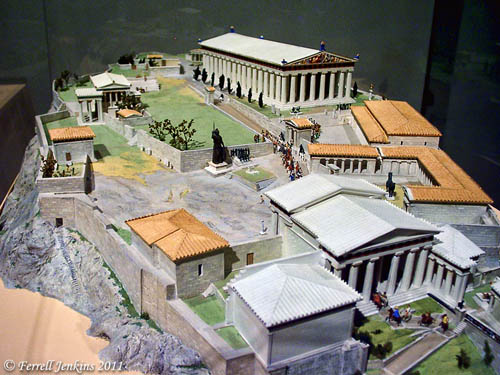
There were many idols in Athens, but none more impressive than those on the Acropolis. The word acropolis means the “high point of the city.” The name was applied to any fortified strong hold or citadel overlooking a populated area. It served as a place of refuge and defense. The Acropolis is 512 ft. high.

The Royal Ontario Museum in Toronto has a nice exhibit of Greek artifacts and a helpful model of the Acropolis with its magnificent buildings. Click on the photo for an image suitable for use in teaching.

Athens - Acropolis - ROM, Toronto.

Model of the Acropolis at Royal Ontario Museum. Photo by Ferrell Jenkins.

Here is a list of significant monuments Paul might have visited:

  1. The Parthenon where the goddess Athena was worshiped was built between 447 and 438 B.C.
  2. Temple of Athena Nike (Wingless Victory, 5th cent. B.C.).
  3. The Erechtheion with its porch of Caryatids was built between 421 and 406 B.C. An olive tree beside the building commemorates the first olive tree planted by Athena.
  4. Temple of Rome and Augustus.

Temples were built to Athena all over the Roman Empire. This photo of a bust of Athena was made in the Archaeology Museum of Thessalonica (Thessaloniki, Greece).

Athena. Archaeology Museum of Thesaloniki, Greece. Photo by Ferrell Jenkins.

Athena. Archaeology Museum of Thesaloniki. Photo by Ferrell Jenkins.

Paul described gods and goddesses like Athena as having been formed by man.

Being then the children of God, we ought not to think that the Divine Nature is like gold or silver or stone, an image formed by the art and thought of man. (Acts 17:29 NAU)

As Paul writes to the Corinthians, he says,

For even if there are so-called gods whether in heaven or on earth, as indeed there are many gods and many lords,  yet for us there is but one God, the Father, from whom are all things and we exist for Him; and one Lord, Jesus Christ, by whom are all things, and we exist through Him. However not all men have this knowledge;  (1 Corinthians 8:5-7a NAU)

Paul in the midst of the Areopagus in Athens

When Paul arrived in Athens, the intellectual capital of his day, he had some time alone in the city to view its monuments.

So Paul, standing in the midst of the Areopagus, said: “Men of Athens, I perceive that in every way you are very religious. For as I passed along and observed the objects of your worship, I found also an altar with this inscription, ‘To the unknown god.’ What therefore you worship as unknown, this I proclaim to you. (Acts 17:22-23 ESV)

Luke tells us that Paul stood in the midst of the Areopagus which was the most venerable of Athenian institutions (Bruce, Paul: Apostle of the Heart Set Free, 238). It derived its name from the original meeting place on the Areopagus, the hill of Mars (Ares), west of the Acropolis. Tenney says,

Whether the `areopagus’ of Acts 17 referred to the hill or to the court which in Paul’s day met in one of the colonades near the Agora cannot be determined exactly (Tenney, New Testament Times, 265).

In Roman times the court held most of its meetings in the Royal Portico (stoa basileios) in the agora, but we don’t know whether Paul addressed the court in the Royal Portico or on the Areopagus (Bruce 238).

Blaiklock says,

the Court of the Areopagus seems to have exercised some supervision over itinerant preachers, and the invitation to Paul was by way of being a courteous command (Cities of the New Testament, 52).

The first recorded convert in Athens was Dionysius the Areopagite (a member of the court) (17:34). Tradition has it that Dionysius became bishop of Athens and suffered martyrdom during the persecutions of Domitian. He is today venerated as the patron saint of Athens by the Eastern Greek Orthodox Church.

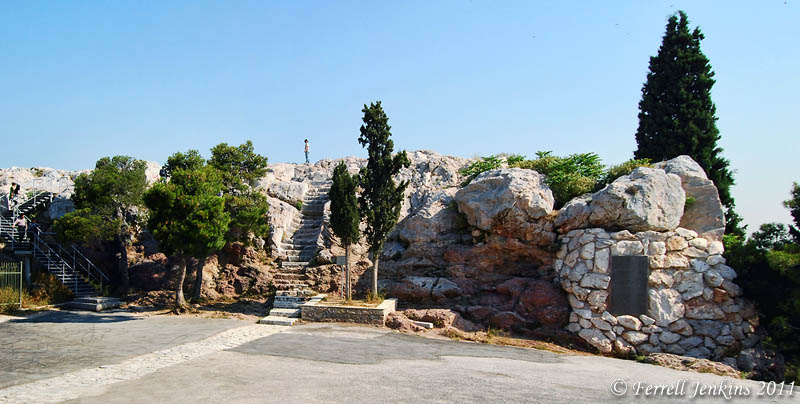
Our photo shows the traditional Areopagus at the base of the Acropolis. From the top of the hill there is a wonderful view of the buildings of the Acropolis and of the agora where Paul may have spoken.

The traditional Areopagus at the base of the Acropolis in Athens. Photo by Ferrell Jenkins.

Traditional Areopagus at the base of the Acropolis in Athens. Photo by Ferrell Jenkins.

On the right side of the photo you will see a bronze plaque in the rocks with Paul’s speech in Greek.

Monday Meandering — October 10

More about Paul’s Shipwreck on Malta. Gordon Franz reviews Robert Cornuke’s recent video on the claimed evidence for the shipwreck.  The review is available at the Associates for Biblical Research site here, or Gordon’s Life and Land blog here.

Gordon also exposes the photos purporting to show giant human skeletons from Greece here.

Shiloh. Leon Mauldin wrote about our recent visit to Shiloh here, here, here. The tabernacle was located at Shiloh for many years after ancient Israel came into the promised land. See Joshus 18; 1 Samuel 1-4, et al.

Recent excavations at the base of Tel Shiloh. Photo by Ferrell Jenkins.

Recent excavations at the base of Tel Shiloh. Photo by Ferrell Jenkins.

Jezreel Excavation. A well-trained team of archaeologists, headed by Norma Franklin and Jennie Ebeling, announces renewal of excavations at Jezreel. Details here.

The new website describes the importance of the location of Jezreel.

We are returning to Jezreel because it is an amazing site with a long history that reflects the rich cultural heritage of the area

Perched on the foothills of the Gilboa mountain range it commands an unparelled view over the valley below. The famous sentry site of Megiddo, Biblical Armageddon, lies 15 kms to the west and to the east the renowned city of Bet Shean (Scythopolis).

Reliability of the New Testament Manuscripts. Barry Creamer comments on the “debate between Bart Ehrman and Daniel Wallace on whether the text of the New Testament is trustworthy. Both are world class scholars in textual criticism.” Some interesting comments on the different approach taken by the two textual critics to the problem of no original manuscripts. Read here.

HT:  Bible Place Blog; Bible X.

The diolkos of ancient Corinth

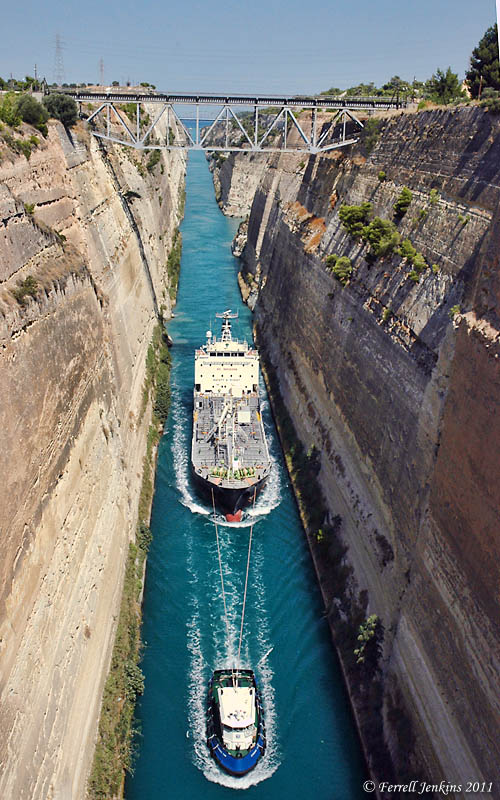
Surely a greater percentage of tourists who have visited ancient Corinth have stopped at the Corinth Canal for a photograph. The canal was constructed between 1881 and 1893. A much smaller number probably recall that there was an ancient paved road, called the diolkos, on which smaller boats could be dragged across the isthmus.
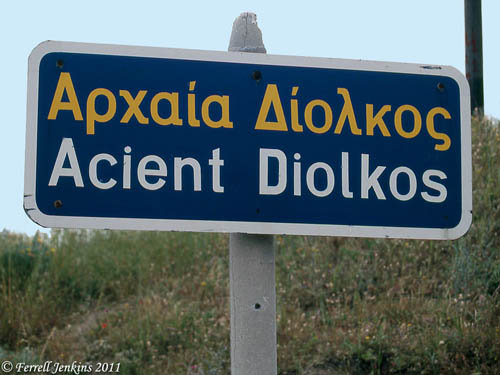
Ancient Diolkos Sign. Photo by Ferrell Jenkins.

Ancient Diolkos Sign. Photo by Ferrell Jenkins.

Pettigrew (Corinthian Matters) says that Strabo uses the term diolkos of the narrow land strip, rather than a physical road.

Interestingly, the modern use of the term “diolkos“ is one of the great misnomers of modern scholarship.  Strabo uses the word in a geographic sense to describe a land strip visible from Acrocorinth and equivalent to the narrowest part of the Isthmus.  No one in antiquity associated the term with the physical road.
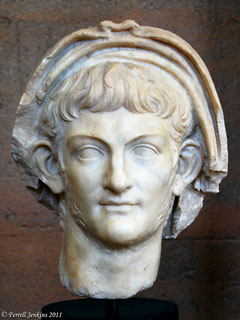
Bust of Neo. Corinth Museum. Photo by Ferrell Jenkins.

Bust of Neo. Corinth Museum.

The cargo of larger ships was unloaded and carried across the isthmus and reloaded. Ships that could be dragged across the land bridge avoided the 200 mile journey around the Peloponnesus. Nero abandoned his attempts to dig a canal across the isthmus in A.D. 67. Josephus records that 6,000 of the strongest men involved in the Galilean revolt were sent to Nero, “to dig through the Isthmus [of Corinth]” (JW. 3.540).

David Pettigrew recently spent two days touring the diolkos. He includes some nice photos (here) that are large enough for use in presentations. He also includes a plan allowing identification of each photo.

Yesterday I received a new scanner and decided to pull out my old slides of the diolkos. The date is so faded on the slide frame that I am unable to read it. I think the photos were made in the early 1970s. Compare this will Pettegrew’s recent (first) photo of the same area.
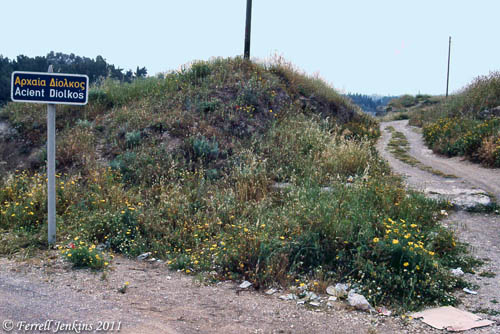
Diolkos Sign and a portion of Sector G. Photo by Ferrell Jenkins.

Diolkos Sign and a portion of Sector G. Photo by Ferrell Jenkins.

Here is a closer view of the same sector. In Pettegrew’s photos this area has been cleared of dirt to show more of the paving.
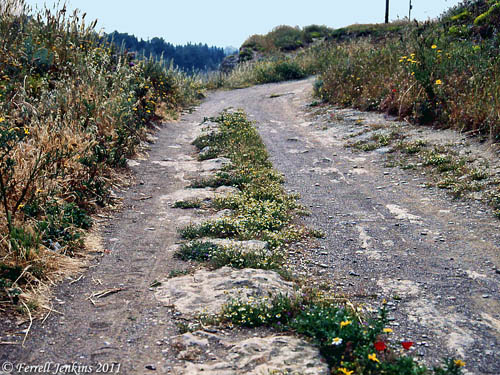
Diolkos Sector G. Photo by Ferrell Jenkins in 1970s..

Diolkos Sector G. Photo by Ferrell Jenkins in the 1970s.

Below is my photo of Sector E from the early 1970s. Compare with Pettegrew’s photo (which appears to have been made earlier than his other photos). Leon Mauldin has a photo made in early 2010 here.
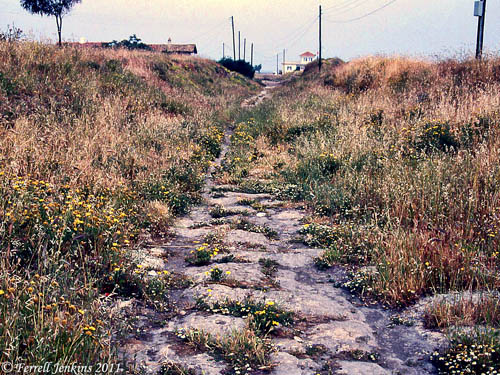
Diolkos - Sector E in the 1970s. Photo by Ferrell Jenkins.

Diolkos - Sector E in the 1970s. Photo by Ferrell Jenkins.

Dr. Pettegrew was able to visit Sector K, the only section on the north side of the Corinth canal. His post documents the damage being done to the diolkos by ships passing through the Corinth canal. In addition to the new photos here, he has a section dealing with the diolkos under the heading Isthmus.

The diolkos was in use during the time Paul was at Corinth. The commercial benefit to Corinth, as well as to the port cities of Lechaion and Cenchrea, was significant.

And he stayed a year and six months, teaching the word of God among them. (Acts 18:11 ESV)

In addition to the video’s at Corinthian Matters, there is one here featuring comments by Sophia Loverdou.

Friday’s findings

Looking for Joshua’s Ai. Gary Byers, administrative director of the Khirbet el-Maqatir excavation, has already posted info on six days of the dig. Because I assume this series will continue, I suggest you begin with Day One here. The expedition has posted photos on Facebook here. This will give prospective diggers some idea what goes on during a dig. Information about the purpose of the dig, a project of the Associates for Biblical Research, is posted here. Dr. Bryant Wood, and others associated with this dig, are looking for an alternative site for Ai.

Hidden Pyramids. Dr. Zahi Hawass has called in question the BBC program about the work of Dr. Sarah Parcak using satellite imagery to discover 17 new pyramids and other structures.

Although satellite imaging is useful for discovering new sites and monuments, interpretation of the images is not straightforward. No one can say with certainty that the features displayed under the sand are actually pyramids. Such anomalies could be houses, tombs, temples, pyramids, buried cities or even geological features. The only way we can definitely identify what is there is by excavating it – by investigating it physically. This was not made clear in the article.

Read the complete article here. See our earlier report here.

Corinth Matters. David Pettegrew, assistant Professor of History at Messiah College near Harrisburg, PA., has started a blog called Corinth Matters. Pettegrew completed a dissertation on Corinth on the Isthmus. The new blog deals with the ancient city of Corinth, the Isthmus, the Diolkos, and other things Corinthian. You will find readings lists, links to conferences, info on excavations, maps and images relating to Corinth and the Corinthian correspondence.

Dr. Pettegrew currently is traveling in Albania, the location of ancient Illyricum, visiting Corinthian colonies from the pre-Christian period. Paul made reference to preaching as far as Illyricum.

by the power of miraculous signs and wonders, and by the power of God’s Spirit. As a result, I have fully proclaimed the good news about the Messiah from Jerusalem all the way around to Illyricum. (Romans 15:19 CSB)

Corinth Canal - Photo by Ferrell Jenkins.

A ship is towed through the Corinth Canal. View west toward the Gulf of Corinth. Photo by Ferrell Jenkins.

Having taught the Corinthian correspondence for several year, I find this blog especially interesting.

Walking on Roman roads

Gordan Franz, Life and Land Seminars, recently led the 2011 Talbot Bible Lands study tour of Turkey and Greece. He writes about the Roman roads used by Paul in his journeys. See here.

Photos are included of the following roads, portions of which still exist.

  • The Via Taurus, “a beautifully preserved road between Tarsus and the Cilician Gates” (Acts 15:36).
  • The Via Sebaste (“Emperor’s Road”) connecting Iconium and Pisidian Antioch (Acts 13:51; 14:21-23).
  • The Roman Road west of Assos (Acts 20:22-23).
  • The Roman Road inside the city of Alexandria Troas leading to the harbor (Acts 16:8-11).
  • The Via Egnatia which connected Neapolis and Philippi (Acts 16:11-12; 20:6).
  • The Appian Way (Acts 28:14-16).

The link to photos made by one of the tour members is given at the bottom of the article. At this moment you will need to copy the link and paste it into your browser. There is an extra http// in the embedded code.

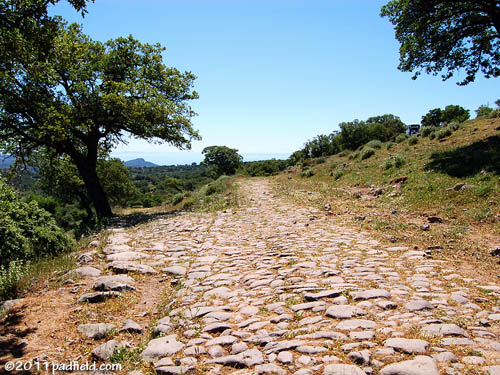
The photo below is one provided by friend David Padfield of the Roman road near Assos.

Roman Road near Assos. Photo by David Padfield.

Roman Road near Assos. Photo by David Padfield.

I have been on journeys many times, in dangers from rivers, in dangers from robbers, in dangers from my own countrymen, in dangers from Gentiles, in dangers in the city, in dangers in the wilderness, in dangers at sea, in dangers from false brothers… (2 Corinthians 11:26 NET)