Category Archives: Egypt

Scribes kept important records

The picture below shows a scribe from ancient Egypt. The statue from Saqqara dates to the 4th or 5th dynasty — about 2600 to 2350 B.C. The limestone statue is painted with encrusted eyes of rock crystal. The statue is on display in the Louvre.
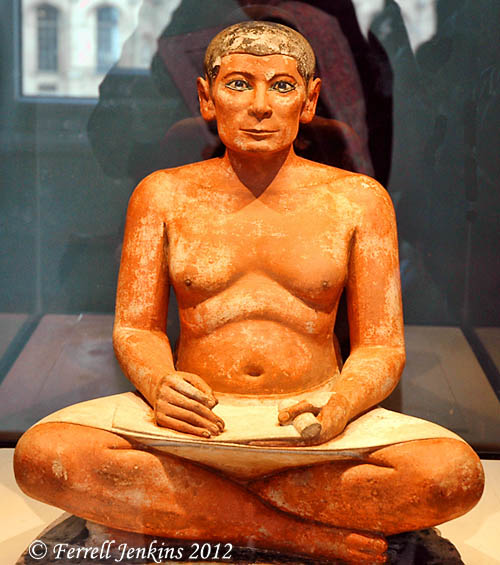
Scribe from Saqqara displayed in the Louvre. Photo by Ferrell Jenkins.

Scribe from Saqqara displayed in the Louvre. Photo by Ferrell Jenkins.

We do not have a great number of examples of writing from ancient Israel, but the Bible is abundant with references to writing and record keeping. The entry on the Hebrew word katab in the Theological Wordbook of the Old Testament says,

katab is the only general word for “write” and it is widely used. Curiously, it is not used in Genesis. Moses wrote on a scroll God’s curse on the Amalekites (Exo 17:14 ). God himself wrote the Ten Commandments (Exo 31:18). Moses also is specifically said to have written the Book of the Covenant (Exo 24:4), the Sinai legislation (Exo 34:27), the names of the leaders of the tribes (Num 17:2-3), the wilderness itinerary (Num 33:2), the law “from beginning to end” (Deut 31:9, 24) and Moses’ final song (Deut 31:22, 24). It is quite possible that the general references of Deut 31:9  and Deut 24 refer to the whole of the Pentateuch (cf. Deut 28:58-61; Deut 29:20-21) although critical scholars refer it only to Deut and question even that.

I think the reference to Moses writing the wilderness itinerary of the Israelites is interesting.

Moses wrote down their starting places, stage by stage, by command of the LORD, and these are their stages according to their starting places. (Numbers 33:2 ESV)
Akrotiri archaeological site reopens after seven years

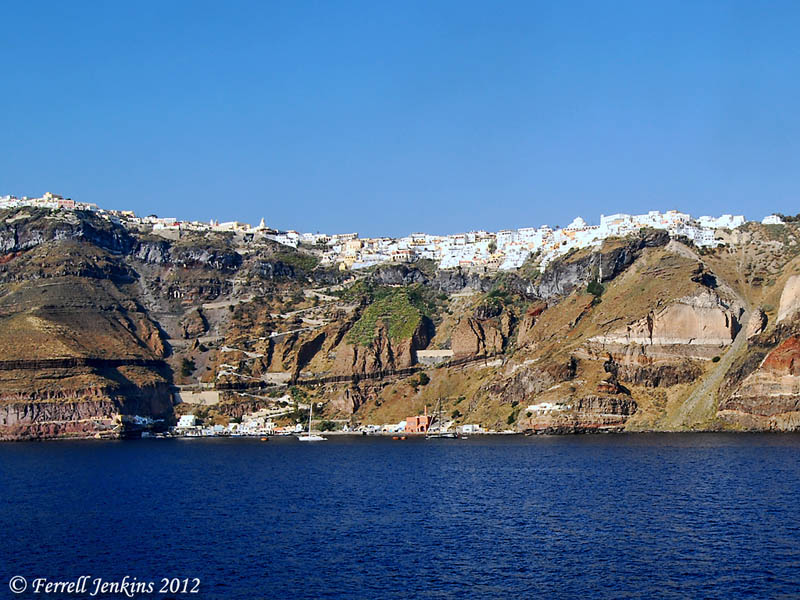
The volcanic island of Santorini, also known as Thira, is a popular stop on Aegean cruises. Eruptions are known to have occurred about 1600 B.C., 1475 B.C., and in the twelfth century B.C. The cruise ships float around in the crater and the passengers are taken by tinder to a place where they have a choice of cable car or donkey to reach the rim.

A view from inside the crater at Santorini. Photo by Ferrell Jenkins.

A view from inside the crater at Santorini. The town of Fira sits perched upon the rim of the volcanic crater. Photo by Ferrell Jenkins.

I have been to Santorini several times on my Steps of Paul and John tours. It is a “necessary” stop on the cruise that allows visits to the biblical sites of Patmos, Rhodes, and Crete. Prior to 2005 a visit to the archaeological site of Akrotiri was worthwhile. A brief description of Akrotiri is given at Wikitravel here.

Akrotiri, in the south, a roughly 3,500 year old Minoan town preserved in volcanic ash like Pompeii, is one of Santorini’s “must-sees”. The excavation site is covered by a roofing system, which makes it something that you can comfortably visit no matter what time of year. The ruins, are extremely well preserved. Streets, buildings, stairs and even second floors of buildings are still visible. Visitors can stand in the ruins and look at Minoan pottery and frescoes, and with a little imagination, feel what it would have been like to live in ancient Greece. Due to an accident in September 2005, the excavation site is still closed to the public.

Word comes from the China Post that the archaeological site reopened last Friday. I look forward to visiting it again next month. I am sure I recall making slides there, but have been unable to locate any in my files.

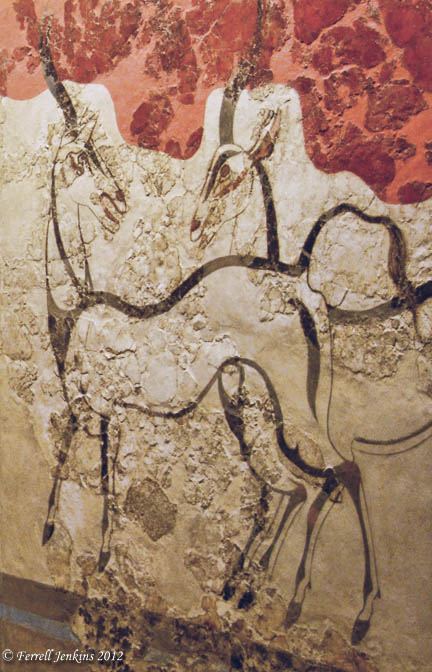
The Athens National Museum has a wonderful exhibit of fresco’s and other artifacts from Akrotiri on the second floor of the museum. The photo here is of the Antelopes fresco.

The Antelopes fresco from Akrotiri. Athens National Museum. Photo by Ferrell Jenkins.

The Antelopes fresco from Akrotiri displayed in the Athens National Museum. Photo by Ferrell Jenkins.

Professor Hans Goedicke proposed that the Exodus and the drowning of the Egyptian army was an historical event in 1477 B.C. According to the theory, a tsunami produced by volcanic eruption in the Mediterranean was responsible for the flooding that drowned the Egyptian Army. See Shanks, “The Exodus and the Crossing of the Red Sea, According to Hans Goedicki.” BAR 07:05 (Sept/Oct 1981). The dating does not fit what I understand to be the date of the Exodus, but I am unable to comment further on the theory at this time.

HT: Jack Sasson

Satet — the female god of Elephantine

We noted earlier that there were three major gods worshiped on Elephantine Island and the nearby region — Khnum, Satet, and Anqet. Khnum was the river or water god and was considered the god of the Nile. Satet was his female counterpart.

Her most important role was as the goddess of the inundation (yearly flooding of the Nile). According to myth, on the “Night of the Teardrop” would shed a single tear, which was caught by Satet and poured into the Nile, causing the inundation. (Ancient Egypt Online)

Budge says that at one period,

she must have been regarded as the goddess of the inundation, who poured out and spread over the land the life-giving waters of the Nile, and as the goddess of fertility. (The Gods of Egypt, II:55)

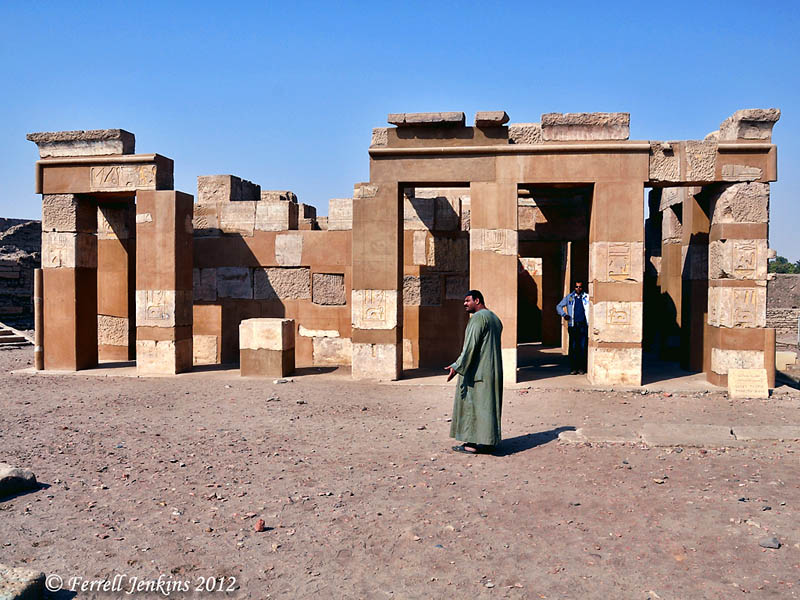
The ruins shown below belong to the Temple of Satet from Egyptian Dynasty XVIII. This was the time of Thutmose III (roughly around 1500 B.C.), during what is designated the New Kingdom Period.

Satet Temple on Elephantine Island. Photo by Ferrell Jenkins.

Satet Temple on Elephantine Island. Photo by Ferrell Jenkins.

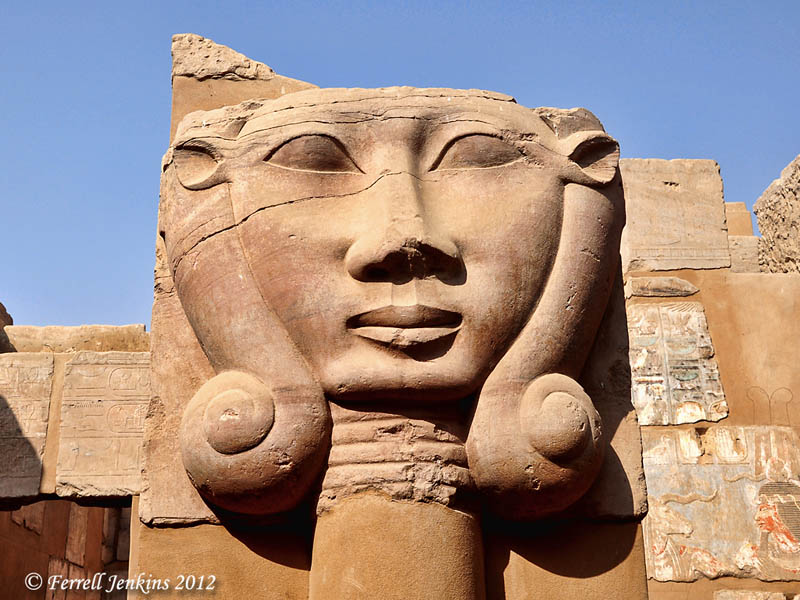
A broken relief of the head of Hathor may be seen in the ruins. Hathor portrayed herself with the head of a cow, with two horns, and a solar disc between the horns. Sometimes she was portrayed in the form of a cow.

Hathor in the Ptolemaic Satet Temple on Elphantine Island. Photo by Ferrell Jenkins.

Hathor in the Satet Temple on Elephantine Island. Photo by Ferrell Jenkins.

Temples honoring Satet continued on the island into the Ptolemaic and Roman periods.

Israel had been warned at the time of the Exodus that they should not return to Egypt.

Only he must not acquire many horses for himself or cause the people to return to Egypt in order to acquire many horses, since the LORD has said to you, ‘You shall never return that way again.’ (Deuteronomy 17:16 ESV)

After the Exile of Judah to Babylon, some of the Judeans who remained in the land of Judah returned to Egypt taking the prophet Jeremiah with them. Jeremiah continued to warn of the dangers of serving the gods of Egypt. In fact, the women of Judah are accused of leading their husbands into worshiping the gods of Egypt (Jeremiah 44).

The gods of Elephantine Island

Khnum (also Khnoum and Khnemu) was the chief Egyptian god in a region stretching from Thebes (modern Luxor) to Philae. Philae is a short distance south of Aswan and Elephantine Island.

According to Budge,

… the principal sanctuaries of the god were at the two ends of the First Cataract, i.e., on Elephantine on the north and on Philae and the adjoining islands on the south. He [Khnum] was the god par excellence of the First Cataract, throughout which, with his female counterpart Satet and the local Nubian goddess Anqet, he was worshipped from the earliest dynasties … (The Gods of the Egyptians, II:50).

Recently I learned of Ancient Egypt Online. This well-constructed site describes Khnum:

Khnum was originally a water god who was thought to rule over all water, including the rivers and lakes of the underworld. He was associated with the source of the Nile, and ensured that the inundation deposited enough precious black silt onto the river banks to make them fertile. The silt also formed the clay, the raw material required to make pottery. As a result he was closely associated with the art of pottery. According to one creation myth, Khnum moulded everything on his potters wheel, including both the people and the other gods.

Budge sums up the essence of the god when he says that Khnum “was originally a water or river-god, and that in very early times he was regarded as the god of the Nile and of the annual Nile-flood…”

A courtyard and an impressive granite doorway mark the location of the Late Khnum Temple on Elephantine Island. This gate, belonging to Dynasty XXX,  was constructed in the reign of Nectanebo II (c. 350 B.C.). The Wikipedia entry says he was the last native ruler of ancient Egypt.

Ruins of the Khnoum Temple on Elephantine Island. Photo by Ferrell Jenkins.

Granite doorway of the Khnoum Temple on Elephantine Island. Photo by Ferrell Jenkins.

The Book of Exodus quotes the LORD saying that, in the plagues of Egypt, he would execute judgment on the gods of Egypt.

I will pass through the land of Egypt in the same night, and I will attack all the firstborn in the land of Egypt, both of humans and of animals, and on all the gods of Egypt I will execute judgment. I am the LORD. (Exodus 12:12 NET; cf. Numbers 33:4).

Khnum was the god of the Nile. Not much left today.

Elephantine Island

There are numerous ways to describe the location of Elephantine Island. It is an island in the Nile River at Aswan (= Syene in Ezekiel 29:10 and 30:6). Or we might say that the island is located at the first cataract of the Nile.

According to Budge, the earlier name for Elephantine was Abu. One way of writing the name of the island included the drawing of an elephant (E. A. Wallis Budge, The Gods of the Egyptians, II:51).

Various suggestions have been made regarding the origin of the name Elephantine. Some say the smooth rocks of the first cataract remind one of an elephant back. Others say, the island is shaped like an elephant tusk. Or, the island was the center of ivory trading in the past.

A small granite statue of an elephant has been uncovered on the extreme south end of the island. Aswan, you likely recall, was noted for its granite.

Granite Elephant on Elephantine Island, Aswan, Egypt. Photo by Ferrell Jenkins.

Granite Elephant on Elephantine Island, Aswan, Egypt. Photo by Ferrell Jenkins.

In the Septuagint Old Testament and in the New Testament the word elephantinos is translated ivory. You can think of Samaria’s famous beds of ivory, made from the tusks of elephants (Amos 6:4), or the unsold cargoes of the merchants who could no longer trade with the fallen Babylon [Roman Empire] (Revelation 18:12).

New discoveries at the Colossi of Memnon

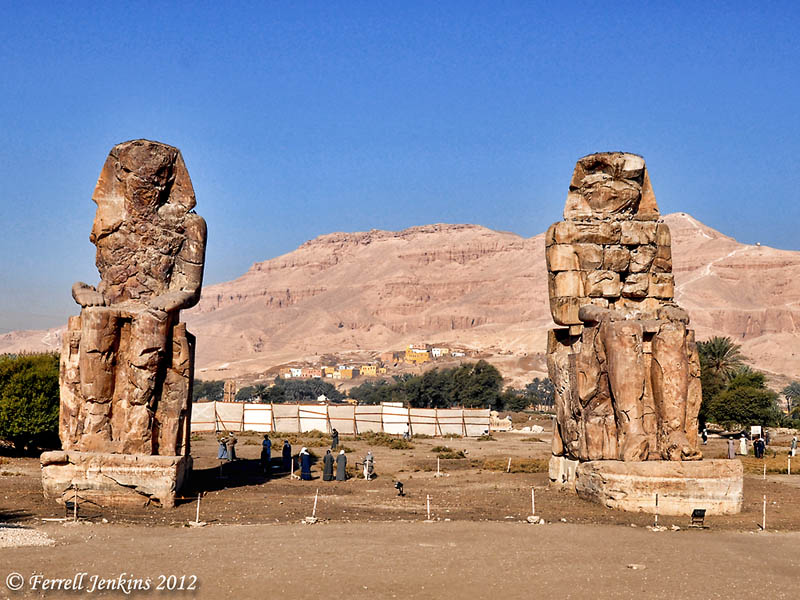
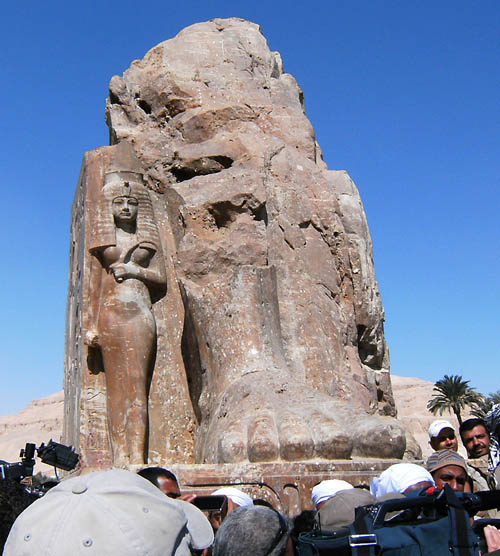
On the way from Luxor to the Valley of the Kings on the West Bank of the Nile one passes two huge statues known as the Colossi of Memnon. The statues are nearly 60 feet tall, and once stood at the entrance to the funerary temple of Amenhotep III (also known as Amenophis III). With their crowns, each statue would have been about 66 feet tall. Amenhotep III ruled Egypt during the 18th Dynasty (14th century B.C.).

During the time of the Roman Empire the statues were mistakenly associated with “Memnon, son of Eos and Tithonus, who was killed by Achilles during the Trojan War” (Baedeker’s Egypt).

Travelers since the time of the Emperor Nero have carved their name in these sandstone statues.

The photo below was made January 17, 2011. A fence may be seen in the background where archaeologists were working to restore new statues that have been found over the past few years.

The Colossi of Memnon in the West Bank of the Nile. Photo by Ferrell Jenkins.

The Colossi of Memnon in the West Bank of the Nile. Photo by Ferrell Jenkins.

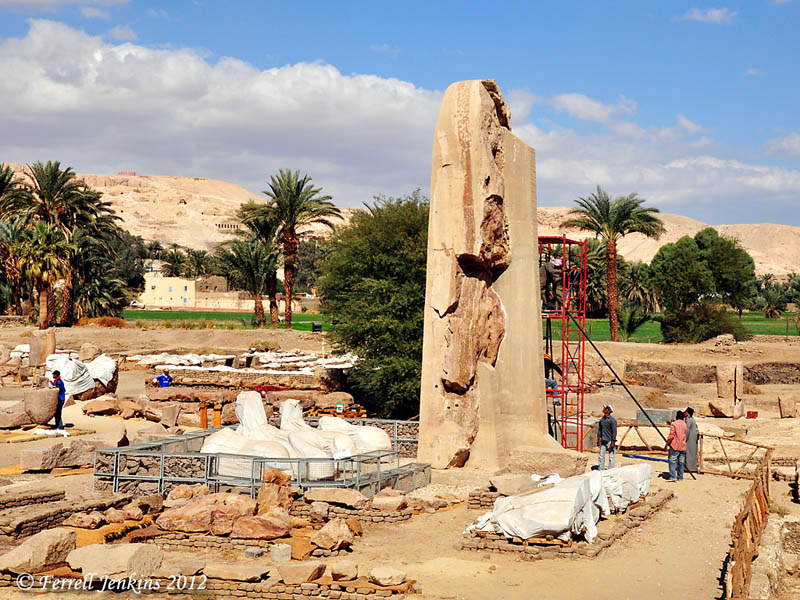
I was able to get a few photos of the area where the workers were restoring some of the statues recently uncovered. Notice some items covered with white, and others lined up on the right side of our photo.

Temple of Amenophis III - West Bank of the Nile. Photo by Ferrell Jenkins.

Temple of Amenophis III - West Bank of the Nile. Photo by Ferrell Jenkins.

In the next photo you will see several pieces covered. One shows the distinct appearance of a giant arm in my original photo.

Temple of Amenophis III - West Bank of the Nile. Photo by Ferrell Jenkins.

Temple of Amenophis III - West Bank of the Nile. Photo by Ferrell Jenkins.

In addition to what I was able to see, the Luxor Times reported the unveiling of yet another new statute that has been restored. Here is one of the photo from that report. The brief news report with several photos may be read here.

Colossian statue of Amenhotep III - Luxor Times.

Colossian statue of Amenhotep III - Luxor Times.

Discovery of 20 mummies & wooden sarcophagus at Aswan, Egypt

Euro Weekly announces,

ARCHAEOLOGISTS from [the Spanish] Jaen University found some 20 mummies and a wooden sarcophagus at a site in Aswan, Egypt.

The report says,

The main find is a tomb built for a provincial governor from the XII dynasty (1830BC) and a wooden sarcophagus in which a high-ranking person was buried.

The brief article may be read here.

Aswan is famous for its granite quarries. An unfinished obelisk, which would have been 137 feet long and weighing 1152 tons, remains in the quarry lying on its side. Holes were drilled into the stone at intervals of about 2 ½ feet and wooden pegs were placed in them. As water was poured over the pegs they expanded to separate the obelisk from the surrounding stone.

Aswan Quarry with the unfinished obelisk. Photo by Ferrell Jenkins.

Aswan Quarry with the unfinished obelisk. Photo by Ferrell Jenkins.

Aswan is known as Syene in Ezekiel 29:10 and 30:6. The expression, “from Migdol to Syene and even to the border of Ethiopia” is similar to the familiar “from Dan to Beersheba.” Migdol was in the far northeast of the country, and Syene was near the southern border. The writer means the entire country.

HT: Jack Sasson

Luxor in Egypt has a long history

Luxor was known as Thebes in Old Testament times. Both Jeremiah and Ezekiel prophesied the Lord’s judgment of the city. Jeremiah says,

The LORD of hosts, the God of Israel, says, ‘Behold, I am going to punish Amon of Thebes, and Pharaoh, and Egypt along with her gods and her kings, even Pharaoh and those who trust in him’” (Jeremiah 46:25; see also Ezekiel 30:14-16 NET).

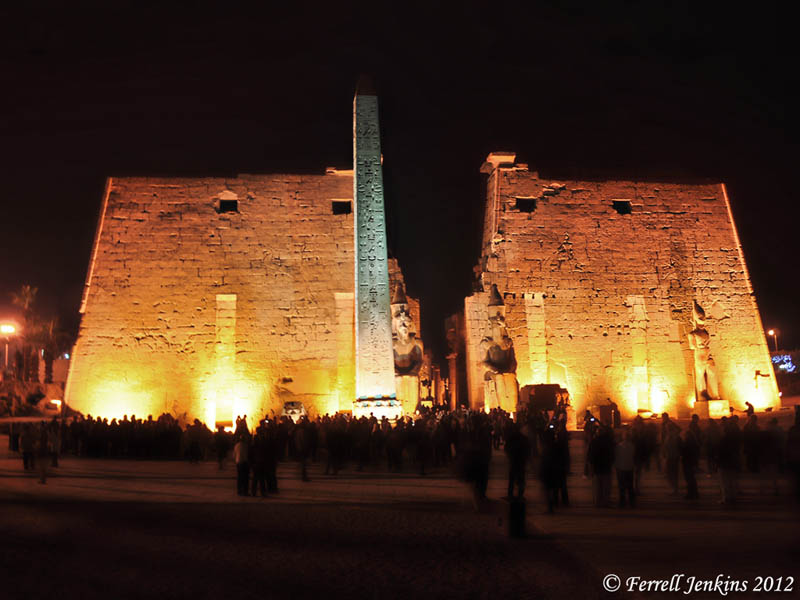
A visit to the ruined and unoccupied temples of Karnak and Luxor, where Amon (or Amun) was worshiped as a great god, certainly convinces us of the fulfillment of this prophecy. Shortly after the time of Jeremiah (about 586 B.C.), Egypt and Thebes began to decline as a world power.

Luxor Temple facade at night. Photo by Ferrell Jenkins.

Luxor Temple facade at night. Photo by Ferrell Jenkins.

In 663 B.C. the Assyrian king Ashurbanipal had already conquered Thebes (Hebrew, No Amon). The prophet Nahum, in prophesying the fall of Nineveh, calls attention to this event (3:8ff.).

Jeremiah and Ezekiel prophesied during the Babylonian period of world dominance. Darius the Great (521-486 BC), who befriended the Judeans, helping them rebuild the temple in Jerusalem, depicted himself as a Pharaoh on a shrine door now displayed in the British Museum.

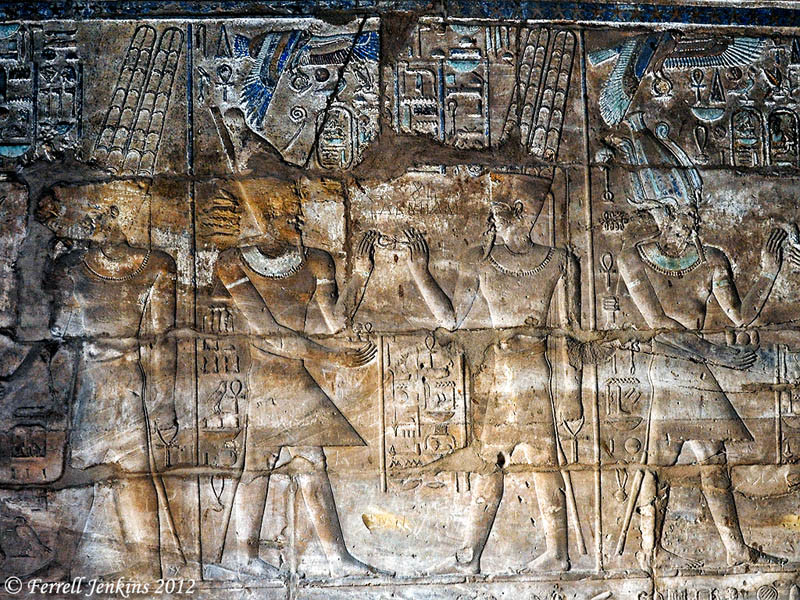
The young Alexander of Macedon came to Thebes in 336 BC and left reliefs of himself portrayed as a Pharaoh making offerings to the god Amon. Cassander rebuilt the city in 315 B.C. The later Ptolemaic kings who succeeded Alexander built temples to the gods at Edfu and Kom Ombo and regularly pictured themselves as worshiping the gods of Egypt. Likewise, the Roman emperors built temples beside the ancient temples of the Pharaoh. The temple of Philae has a small temple to the Roman Emperor Augustus ( 30 B.C. to A.D. 14) and another to Emperor Trajan (A.D. 98-117).

The photo below is from the chapel of Alexander the Great in the Karnak Temple. It was originally built by Thutmose III, and later decorated with these reliefs by Philip Arrhidaeus, the brother of Alexander the Great.

Relief of Alexander making an offering at Karnak. Photo by Ferrell Jenkins.

Relief of Alexander making an offering at Karnak. Photo by Ferrell Jenkins.

If a reader can provide more specific information about this relief, I would appreciate it.

John wore a garment of camel’s hair

Now John wore a garment of camel’s hair and a leather belt around his waist, and his food was locusts and wild honey.  (Matthew 3:4 ESV)

Emmerson comments on the type of garment worn by John:

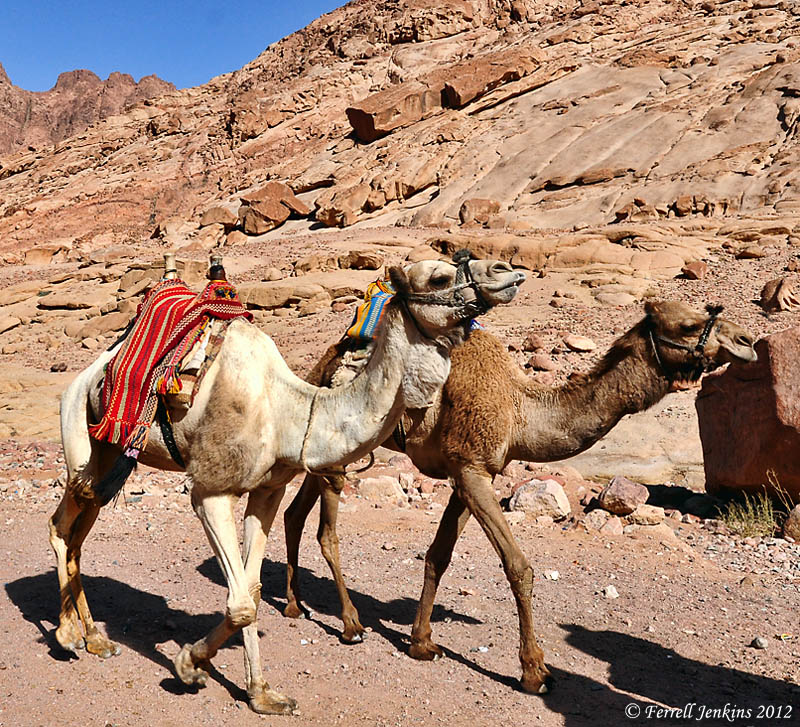
Hair from the back and hump of the camel was woven into a harsh material, and a softer cloth was produced from the finer hair taken from underneath the animal. The natural variations in the color of the hair could be woven into a pattern. (The International Standard Bible Encyclopedia Revised, 1:584).

Camels in the Sinai Peninsula. Photo by Ferrell Jenkins.

Camels in the Sinai Peninsula. Photo by Ferrell Jenkins.

John did not wear the soft clothing typical of those who dwell in royal palaces.

What then did you go out to see? A man dressed in soft clothing? Behold, those who are dressed in splendid clothing and live in luxury are in kings’ courts. (Luke 7:25 ESV)

Bible students immediately remember similarities between John and the prophet Elijah (2 Kings 1:8; cf. Luke 1:7).

The Patriarchs lived in the Negev

English Bibles translate the Hebrew word negev in a variety of ways.

  • South — KJV; NKJV
  • “the South [country]” is the Translator’s Note in the NET Bible. A study note says, “Negev is the name for the southern desert region in the land of Canaan.”
  • Negeb — ESV
  • Negev — most modern English versions.
  • eremos — the word for desert or wilderness is used in the LXX. This word does not describe the Negev precisely enough.

I am away from home and most of my resources, but I recall hearing the late Anson Rainey describe the Negev like the figure 8. Turn the 8 horizontal with Beersheba in the center. The area is one that is often subject to drought and famine.

The Patriarchs, Abraham, Isaac, and Jacob spent much time in the Negev (Genesis 12:9; 13:1,3; 20:1; 24:62).

The Israelite spies were sent by Moses from the Sinai to investigate Canaan. The text makes it clear that they had to go through the Negev to get to the hill country and Hebron. Hebron is only about 25 miles north of Beersheba. Once we head south from Hebron we begin to notice a change from the hill country to a more dry clime.

When Moses sent them to investigate the land of Canaan, he told them, “Go up through the Negev, and then go up into the hill country (Numbers 13:17 NET)

When they went up through the Negev, they came to Hebron… (Numbers 13:22 NET)

The Canaanite king of Arad lived in the Negev (Numbers 21:1). Arad is located east of Beersheba as the land slopes down to the Dead Sea.

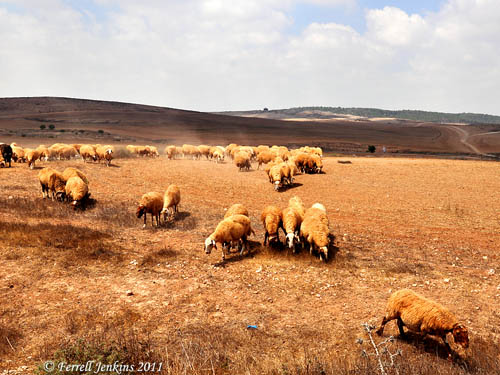
Our photo today was made a few miles north of Beersheba. I think it illustrates the typical dryness of the region.

Sheep in the Negev. Photo by Ferrell Jenkins.

Sheep in the Negev. Photo by Ferrell Jenkins.