Category Archives: Egypt

Museum exhibitions

Babylon: Myth and Reality runs until March 15, 2009, at the British Museum in London. Details, along with videos and photos available here. This exhibition brings together artifacts from the British Museum, Berlin, the Louvre, and other museums. If you have an opportunity to go, be sure to download our brief list of Some Biblically Related Artifacts in the British Museum here.

Tutankhamun and the Golden Age of the Pharaohs runs through May 17 at the Dallas [Texas] Museum of Art. Details here.

Tutankhamun: The Golden King and the Great Pharaohs runs through May 22 at the Civic Center in Atlanta, Georgia. Details here.

The Michael C. Carlos Museum at Emory in Atlanta has an exhibition called Wonderful Things: The Harry Burton Photographs and the Discovery of the Tomb of Tutankhamun. It runs through May 25. Details here.

Excavating Egypt is a major exhibition from the Petrie Museum of Egyptian Archaeology. This exhibition runs at the University of Kentucky, Lexington, from March 14 through June 14, 2009. Details here.

We wrote of a King Tut exhibition in Vienna, with a nice photo, here.

Pompeii and the Roman Villa (Art and Culture Around the Bay of Naples) continues at the National Gallery of Art in Washington, D.C. through March 22. Details here. Videos, audios, and other material online.

The photo below is one I made in 2001 of the altar at the Temple of Vespasian at Pompeii. Vespasian was the Roman general who led the attack on the Jewish rebels beginning in A.D. 66. Upon learning of the death of Nero he headed back to Rome. Later he became Emperor. Pompeii was covered with volcanic ash in A.D. 79. This altar shows a sacrificial scene.
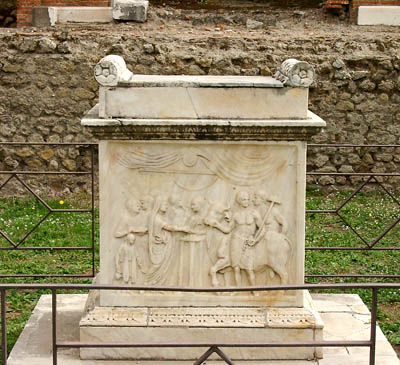
Sacrificial altar, Temple of Vespasian, Pompeii. Photo by Ferrell Jenkins.

Sacrificial altar, Temple of Vespasian, Pompeii. Photo by Ferrell Jenkins.

Art and Empire: Treasures From Assyria in the British Museum continues through January 4 at the Museum of Fine Art in Boston. Details here. We wrote about visiting this exhibition here.

Most of these exhibition are listed in the Nov./Dec. 2008 issue of Saudi Aramco World.

Travel is fun

One of the perils of travel is dealing with the hawkers. There is the guy who approaches a person with a Nikon Digital SLR trying to sell him postcards of the monument he just photographed. I remember a boy in Damascus in 1967 hawking those little inlaid boxes for “Just one lousy American dollar.” We were on a boat taking the canal tour in Bangkok when suddenly a boy comes up out of the dirty water into the moving boat.

Egypt is probably the worst place for hawkers. One thing is for sure. If you ever take an item in your hand it will be difficult to get rid of it. You may say, “I don’t need that.” He say, “Why you no need this?”

I like this refreshing sign in a shop at Ephesus. No doubt here!

Genuine fake watches in a shot at Ephesus. Photo by Ferrell Jenkins.

Genuine fake watches in a shop at Ephesus. Photo by Ferrell Jenkins.

Text and Canon in Providence, RI

For the past few days I have been in Providence, RI, attending meetings of the Evangelical Theological Society (ETS) and the Near East Archaeological Society (NEAS). The theme for the ETS annual meeting was Text and Canon. I attended the four plenary session papers. These were extremely worthwhile. Here are the topics and speakers:

  • Old Testament Text – Peter J. Gentry
  • Old Testament Canon – Stephen Dempster
  • New Testament Text – Daniel B. Wallace
  • New Testament Canon – Charles E. Hill

Current, scholarly, material on these topics are needed among God’s people today.

I also attend several sessions of the NEAS. I heard Bryant Wood present evidence suggesting that Mount Sinai possibly should be identified with Gebel Khashm et-Tarif, and calling for more research in the area. This site is located about 22 miles north-northwest of the Gulf of Aqaba/Eilat in the Wilderness of Paran on the current Egyptian side of the border. For more information check the Associates for Biblical Research website here.

In one session I heard Rex Geissler present some of the historical evidence for the area of ancient Urartu as the place associated with Noah’s Ark. Rex is president of Archaeological Imaging Research Consortium (ArcImaging). Over at the Biblical Studies Info Page I have several links to good photos by Rex in various parts of the world. You can get to his material at the ArcImaging page.

Bill Crouse presented material to bolster the case for an identification of the landing place of the ark with Mount Cudi in southereastern Turkey. I think Gordan Franz presented material in defense of this view also, but I was unable to be present.

There were two reports on the excavations this year at Tel Gezer in Israel.

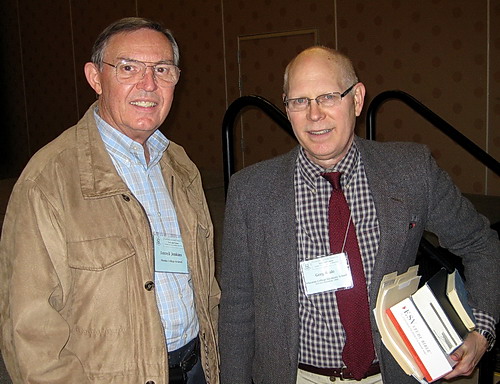
Crossway, publisher of the English Standard Version of the Bible, has been sponsoring a special lecture for the past few years. The lecture this year featured Gregory K. Beale of Wheaton College on The Authority of Scripture: A Biblical Theology According to John’s Apocalypse. This was a great paper. Beale is author of The Book of Revelation: A Commentary on the Greek Text (New International Greek Testament Commentary). I had heard Beale speak before, but it was a pleasure to hear him again and visit for a few moments. I am honored that my The Old Testament in the Book of Revelation is mentioned in a footnote of this commentary.

Ferrell Jenkins and Gregory K. Beale at ETS Annual Meeting. Photo by Leon Mauldin.

Ferrell Jenkins and Gregory K. Beale at ETS Annual Meeting. Photo by Leon Mauldin.

The book display at ETS has grown substantially over the years I have been attending the annual meetings(since 1975). The professors and others who attend get an opportunity to buy the recent publications in biblical studies at a sizable discount. I buy very few these days, but I have taken advantage of this opportunity over the years.

Well, its on to Boston for more meetings.

For a Florida guy, I must say that it is cold up here.

Medinet Habu in the Valley of the Kings

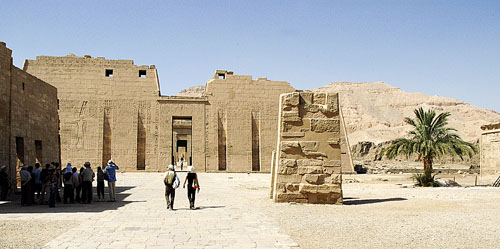
It is easy to bypass he temple at Medinet Habu when visiting the Valley of the Kings at Thebes (Luxor), Egypt. The site is definitely worth a visit.

Entrance to Medinet Habu temple. Photo by Ferrell Jenkins.

Entrance to Medinet Habu temple. Photo by Ferrell Jenkins.

Rameses III reigned from 1186 to 1155 B.C. Structures built by the Pharaoh to serve as an administrative complex and funerary temple may still be visited today at Medinet Habu. The most interesting aspects of the temple to me are the reliefs of the Sea Peoples that the king claims to have subjugated. We usually understand that the Philistines of the Old Testament were Sea People. The five major cities of the Philistines were Ashdod, Gaza, Ashkelon, Gath, and Ekron (1 Samuel 6:17).

This photo from the British Museum is a cast of one of the Sea Peoples (Philistines).

British Museum cast of one of the Sea People. Photo by Ferrell Jenkins.

British Museum cast of one of the Sea People. Photo by Jenkins.

118th Pyramid Found at Saqqara

A pyramid believed to be the tomb of Queen Sesheshet, the mother of Pharaoh Teti, has been discovered below 23 feet of sand near Saqqara. The pyramid, dating to about 2300 B.C., is the second pyramid found this year. It is the 118th pyramid discovered in Egypt.

Read a news release here. National Geographic News includes photos and a video here. Zahi Hawass, secretary general of Egypt’s Supreme Council on Antiquities is quoted as saying, “I always say you never know what the sands of Egypt might hide.”

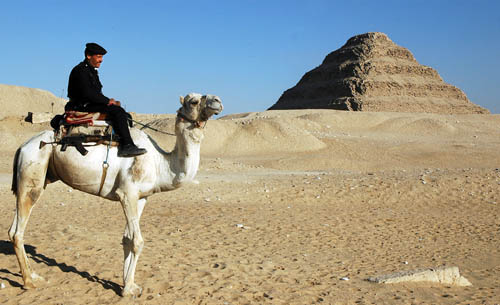
Tourists typically visit the Step Pyramid of Zoser (or Djoser) at Saqqara. This oldest freestanding stone building in the world is dated to about 2600 B.C., and is the work of the vizier and physican Imhotep.

Step Pyramid of Zoser at Saqqara. Photo by Ferrell Jenkins.

Step Pyramid of Zoser at Saqqara. Photo by Ferrell Jenkins.

These pyramids, and those of Giza, were built long before any of the biblical characters made their way to Egypt. It is conceivable that Joesph and Moses would have been familiar with these pyramids.

Then Pharaoh named Joseph Zaphenath-paneah; and he gave him Asenath, the daughter of Potiphera priest of On, as his wife. And Joseph went forth over the land of Egypt. (Genesis 41:45 NASB)

Moses was educated in all the learning of the Egyptians, and he was a man of power in words and deeds. (Acts 7:22 NASB)

Iron Age stele speaks of soul apart from body

The New York Times reports here on the discovery of an interesting stele at Sam’al/ Zincirli (ZIN-jeer-lee), an ancient site in southeastern Turkey.

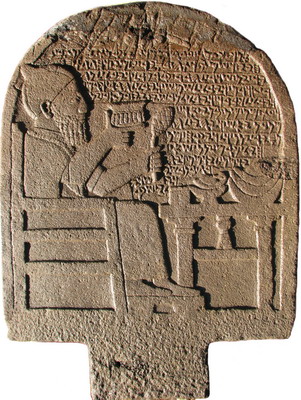
In a mountainous kingdom in what is now southeastern Turkey, there lived in the eighth century B.C. a royal official, Kuttamuwa, who oversaw the completion of an inscribed stone monument, or stele, to be erected upon his death. The words instructed mourners to commemorate his life and afterlife with feasts “for my soul that is in this stele.”
…..
“Normally, in the Semitic cultures, the soul of a person, their vital essence, adheres to the bones of the deceased,” said David Schloen, an archaeologist at the university’s Oriental Institute and director of the excavations. “But here we have a culture that believed the soul is not in the corpse but has been transferred to the mortuary stone.”

A translation of the inscription by Dennis Pardee, a professor of Near Eastern languages and civilization at Chicago, reads in part: “I, Kuttamuwa, servant of [the king] Panamuwa, am the one who oversaw the production of this stele for myself while still living. I placed it in an eternal chamber [?] and established a feast at this chamber: a bull for [the god] Hadad, a ram for [the god] Shamash and a ram for my soul that is in this stele.”

Here is a photograph of the stele provided by the University of Chicago.

University of Chicago.

Stele from Zincirli in which the king says that his soul is in this stone. Photo: University of Chicago.

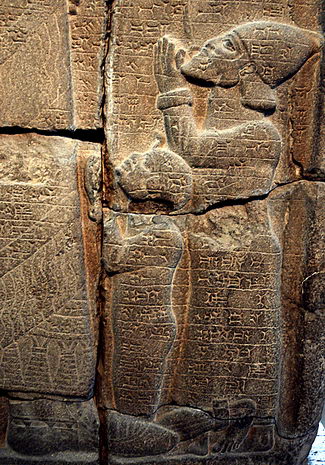
A well known monuments discovered at Zincirli in 1888 depicts the Assyrian king Esarhaddon holding ropes leading to Tirhakah, king of Egypt and Ethiopia [Cush], and Ba’alu of Tyre. Tirhakah is the kneeling figure with negroid features befriended King Hezekiah of Judah against the Assyrians (2 Kings 19:9). The photo below shows the two captives on the lower portion of the stele. It is now displayed in the Pergamum Museum in Berlin.

Esarhaddon stele showing Tirhakah and the king of Tyre. Photo by Ferrell Jenkins.

Esarhaddon stele showing Tirhakah and the king of Tyre. Photo by Ferrell Jenkins.

Copper smelting in 10th century B.C. Edom

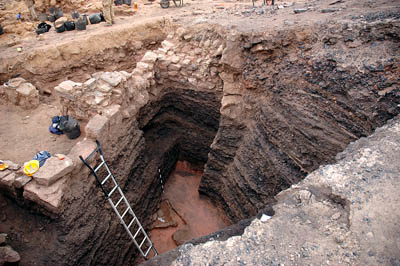
Several sources are reporting the discovery of copper smelting operations in Jordan dating to the 10th century B.C. This is the time of Solomon. The discovery was made at a site called Khirbat en-Nahas about 30 mile south of the Dead Sea on the eastern side of the Arabah. The photo below is by Thomas Levy, UC San Diego.

Industrial copper slag mound at Khirbat en-Nahas. Photo Thomas Levy.

Industrial copper slag mound at Khirbat en-Nahas. Photo Thomas Levy.

This is the ancient territory of Edom. Scholars have known for 30 or more years that there was metalworking there in the 7th century B.C. Researchers, led by Professor Thomas E. Levy of the Department of Anthropology at UC San Diego, and Mohammad Najjar of Jordan’s Friends of Archaeology, dug deeper into the site to find evidence of smelting from the 9th and 10th century.

Naysayers who seem frightened that some modern archaeological discovery might “confirm” the biblical record are already at work. Israel Finkelstein of Tel Aviv University is quoted as saying that the stories of the Old Testament “depict the concerns, theology and background of the time of the writers” which he says belong to the 5th century B.C. They cannot be accepted as factual according to Finkelstein.

From his study in Florida, Ferrell Jenkins said,

Instead of immediately linking a discovery such as this to a biblical character or event, would it not be better to think of the discovery in the terms of shedding light on the biblical record?

An Egyptian scarab from Tanis or the eastern delta and an amulet of the Egyptian goddess Mut caused Levy to suggest that these artifacts might be associated with the Egyptian pharaoh Sheshonq I. Pharaoh Sheshonq I is known as Shishak in the Bible. Here is a summary of the biblical references to Shishak.

  • Provided refuge to Jeroboam for a few years prior to the death of Solomon (1 Kings 11:40).
  • Invaded Israel (Canaan) in the fifth year of King Rehoboam (926 B.C.) and took away treasures from the temple in Jerusalem (1 Kings 14:25-26; 2 Chronicles 12:2-9).

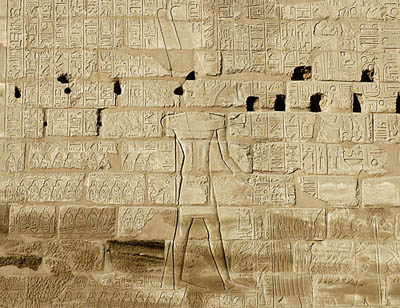
Shishak left a record of his invasion of Canaan on the walls of the temple of Amum at Karnak (modern Luxor, Egypt). Here is a photo of the relief at Karnak showing Shishak holding lines to the 156 Canaanite cities he claims to have captured.

Pharaoh Shishak I of Egypt. Photo by Ferrell Jenkins.

Pharaoh Shishak I of Egypt. Photo by Ferrell Jenkins.

The Bible says that Israel would be able to dig copper from the hills of the country to which they were going (Deuteronomy 8:9). See also Job 28:1-2.

We have known for some time that copper was smelted by the Egyptians at Timna, about 25 miles north of Eilat. Here is a photo showing a reconstruction of the process for copper smelting there in the 13-12th century B.C.

Model of copper smelting installation at Timna. Photo by Ferrell Jenkins.

Model of copper smelting installation at Timna. Photo by Ferrell Jenkins.

More details about this discovery may be found at the following sites: UC San Diego News Center. At the Los Angeles Times there is a nice 12 minute video about the discovery narrated by Thomas Levy.

HT: Joseph I. Lauer

Update [later in the day]: Todd Bolen has added three great photos taken at Khirbat en-Nahas at his Bible Places Blog.

A look at two prodigal sons

Every Bible reader knows the story of the prodigal son. He became dissatisfied with things at home, asked his father for his part of the inheritance, and took off for a distant country. There he wasted his estate on wild living. See Luke 15 for details of the story.

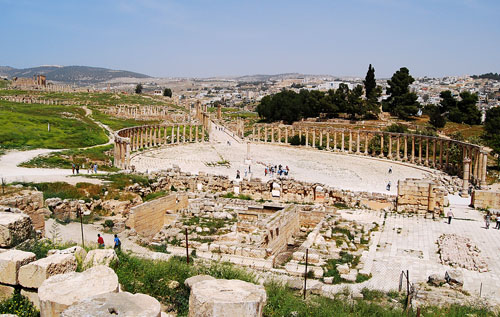
I have often wondered if the young prodigal went away to the region of Decapolis. A city like Jerash doesn’t seem that far today, but we must remember that most people likely walked or used donkey transportation in those days. Jerash would provide a wonderful opportunity for a boy away from home for the first time to become involved in loose living. Most of the ruins at Jerash belong to the second century, but it is not difficult to imagine an impressive city there in the first century.

The forum at Jerash. Photo by Ferrell Jenkins.

The forum at Jerash. Photo by Ferrell Jenkins.

Another story worth considering has come to my attention. About 100 years ago Adolf Deissmann wrote Light From the Ancient East. He demonstrated how the Egyptian papyri illustrates New Testament teaching. In fact, he showed that the language of the New Testament was generally the koine (common) Greek of the day.

The papyrus about which Deissmann writes comes from the second century A.D. It tells of a young man named Antonius Longue from the village of Caranis in the Fayum of Egypt. He quarreled with his mother, left home, engaged in loose living, and running up debts.

Eventually Antonius learns that his mother has come to town to search for him. He writes her to plead for reconciliation. One must still question his character, for he hints that his mother might pay his debts. In his letter written to his mother he says,

I beseech thee, mother, be reconciled to me! I know that I have sinned.

Deissmann comments on the value of an account like this in the study of the New Testament.

There can be no doubt that this letter is one of the most interesting human documents that have come to light among the papyri. This priceless fragment, rent like the soul of its writer, comes to us as a remarkably good illustration of the parable of the Prodigal Son (Luke 15:11 ff.).

He also points out that the term reconciled is the same one used in the New Testament in texts like Matthew 5:23-24.

If therefore you are presenting your offering at the altar, and there remember that your brother has something against you, leave your offering there before the altar, and go your way; first be reconciled to your brother, and then come and present your offering. (NASB)

Mohammed Ali Mosque in Cairo

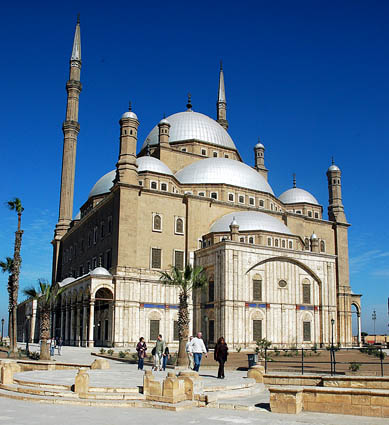
Mohammed (or Mohammad) Ali Alabaster Mosque in Cairo. No, not the boxer. He took the same name. Mohammed Ali was an Albanian who played a prominent role in the history of Egypt during the 19th century. He brought numerous reforms to Egypt and his influence continued until the middle of the 20th century.

Mohammed Ali Alabaster Mosque in Cairo. Photo by Ferrell Jenkins.

Mohammed Ali Alabaster Mosque in Cairo. Photo by Ferrell Jenkins.

My first visit here was in 1967. I vividly recall sitting on the floor of the mosque with the others of my group listening to our guide, Ahmad, explain about the history of the mosque and answering any questions we had about the Muslim religion. Someone asked him if one was free to be a Christian in Egypt. He said, “Yes, if you are born a Christian you are free to be a Christian.” He went on to say that one would not make a change of religion unless there was some bad motive involved.

In many countries the preaching of the gospel of Christ is not freely allowed. The very nature of the gospel assumes that one must make a change in order to be acceptable to God. Jesus makes this clear in his discussion with the Jewish leader Nicodemus. A spiritual birth is necessary for one to become a Christian.

Jesus answered, “I tell you the solemn truth, unless a person is born of water and spirit, he cannot enter the kingdom of God. (John 3:5 NET)

Temples along the Nile River

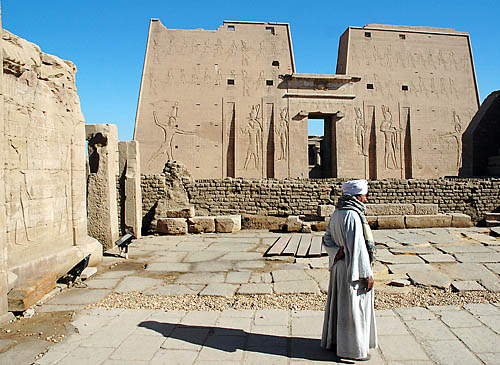
The temple of the sun god Horus at Edfu. Photo by Ferrell Jenkins.

The temple of the sun god Horus at Edfu. Photo by Ferrell Jenkins.

Edfu Temple. This is the temple of the sun god Horus who is represented by a falcon. The temple was begun by Ptolemy III in 237 B.C. and completed by 57 B.C. Ptolemy is portrayed repeatedly on the temple walls.

The Ptolemies were generally favorable to the Jews, whereas the Seleucids of Syria treated them unkindly during the period between the testaments. Ptolemy and Seleucus were generals of Alexander the Great who succeeded him in these area.