Category Archives: Egypt

Ties between Mesopotamia, the Mediterranean, and Egypt

Folks who study the Bible have understood that the people of the ancient near east traveled through Canaan as they made their way from Mesopotamia to Egypt, and back.

Several discoveries illustrating the contact between these ancient lands have recently been made. We commented on discoveries at Tell el-Da’ba in Egypt showing contacts between Babylon and Egypt here.

Word has come of a Syrian-German expedition “working in the Katana Kingdom ruins at Tel el-Mesherfeh archaeological site in Homs.”

Prof. Peter Pfalzner said the archeological finds in the site during the past two days indicate that Katana Kingdom enjoyed influence and important international and trade ties.

He added the finds reveal the existence of cultural relations between Katana Kingdom and the Pharaohs and Mesopotamia, in addition to trade relations with Mediterranean countries

The news report, which may be read here, continues,

Pfalzner underlined the importance of Katana kingdom during the Middle Bronze Age in the 2nd Millennium BC, adding that the royal palace in it was one of the greatest in Syria. He also noted that the archeological sites in Syria are filled with treasures waiting to be uncovered.

The Middle Bronze Age (about 2100 to 1550 B.C.) is the period of the biblical Patriarchs. Assume for a moment that Abraham and his family came from Ur in southern Mesopotamia (modern Iraq), rather than from northern Mesopotamia (Genesis 11:28 — 12:5). The map from Bible Atlas shows some of the places we will mention below.
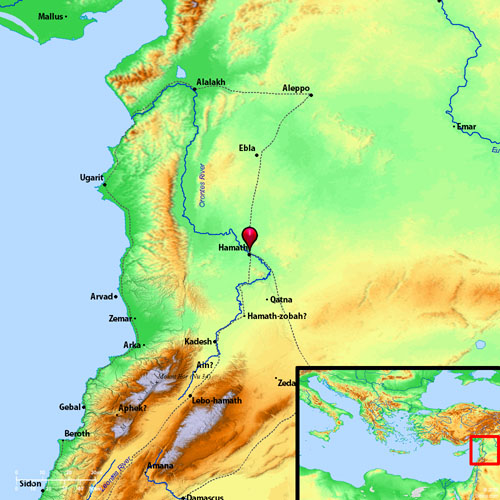
Map showing Hamath and Kedesh. BibleAtlas.org.

Map showing Hamath and Kedesh. Courtesy of BibleAtlas.org.

The route taken by Abraham from Haran to Shechem in Canaan would most likely take him through the Syrian towns we know as Aleppo, Ebla, Hama and Homs. Homs would be at approximately the point referred to in the Bible as the entrance of Hamath (= modern Hama; 1 Kings 8:65). Several of these references indicate that Israel’s territory extended that far north during certain historical periods (2 Kings 14:25; Amos 6:14).

A few miles south of Homs are two significant sites illustrating the movement of ancient kingdoms. Tell Nebi Mend is the site of the battle of Kadesh where Rameses II and the Hittites fought. Another site nearby is Riblah where Nebuchadnezzar made his headquarters when he destroyed Jerusalem.

Then they captured the king and brought him up to the king of Babylon at Riblah, and they passed sentence on him. They slaughtered the sons of Zedekiah before his eyes, and put out the eyes of Zedekiah and bound him in chains and took him to Babylon. (2 Kings 25:6-7 ESV)

Here is a photo I made of Tell Nebi Bend. The Orontes River is to our back in this photo, and the valley of the battle of Kadesh is on the opposite side of the tell. There were a few houses of a modern village on the tell, but most of them were empty.

Kadesh - Tell Nebi Mend in Syria. Photo by Ferrell Jenkins.

Tell Nebi Mend (=Kadesh) in Syria. Photo by Ferrell Jenkins.

The Bible informs us that 4 kings of the east engaged the 5 kings of the region of Sodom and Gomorrah (Genesis 14).

And all these joined forces in the Valley of Siddim (that is, the Salt Sea). (Genesis 14:3 ESV)

The new information we are learning shows that such movement was not all that uncommon.

HT: Joseph Lauer
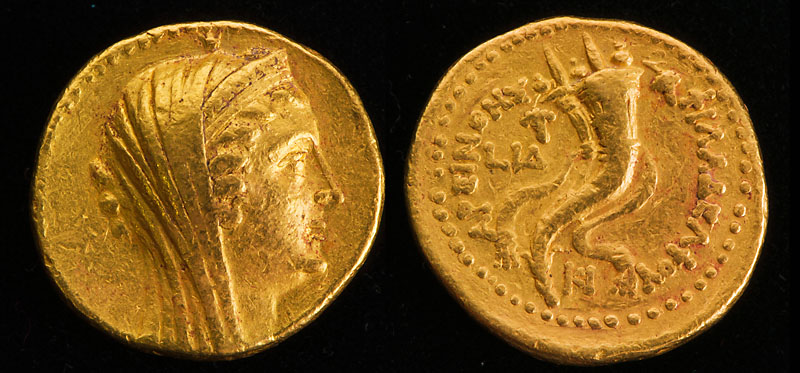
The Queen of the coin

Last week we posted a note about the discovery of a rare Ptolemaic gold coin at Tel Kedesh in northern Israel. See here.

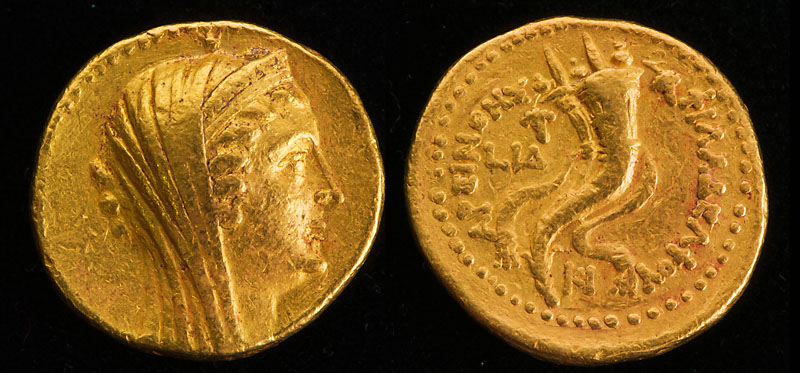
Gold coin of Arsinoë Philadelphus (II) discovered at Tel Kedesh. Photo by Sue Webb, courtesy IAA.

Gold coin of Arsinoë Philadelphus (II) discovered at Tel Kedesh. Photo by Sue Webb, courtesy IAA.

If you would like to read about a truly mixed up family, I suggest you read Judith Weingarten’s post on “The Uppity Queen Arsinoë II” at Zenobia: Empress of the East blog here. I think this story tops almost anything I have read. It is too complicated for me to try to retell it in a few words. It will be especially helpful in speaking with those who think today’s culture is the worse the world has ever known.

HT: Paleojudaica

Ptolemaic gold coin found at Tel Kedesh

Announcement was made today that the excavation at Tel Kedesh has uncovered a gold coin dating to 191 B.C. The coin was minted in Alexandria by Ptolemy V and bears the name of the wife of Ptolemy II, Arsinoë Philadelphus (II).

According to Dr. Donald T. Ariel, head of the Coin Department of the Israel Antiquities Authority, “This is an amazing numismatic find. The coin is beautiful and in excellent preservation. It is the heaviest gold coin with the highest contemporary value of any coin ever found in an excavation in Israel. The coin weighs almost one ounce (27.71 grams), while most ancient gold coins weighed 4.5 grams. In Ariel’s words, “This extraordinary coin was apparently not in popular or commercial use, but had a symbolic function. The coin may have had a ceremonial function related to a festival in honor of Queen Arsinoë, who was deified in her lifetime. The denomination is called a mnaieion, meaning a one-mina coin, and is equivalent to 100 silver drachms, or a mina of silver.

The obverse (‘head’) of the coin depicts Arsinoë II Philadelphus. The reverse (‘tail’) depicts two overlapping cornucopias (horns-of-plenty) decorated with fillets. The meaning of the word Philadelphus is brotherly love. Arsinoë II, daughter of Ptolemy I Soter, was married at age 15 to one of Alexander the Great’s generals, Lysimachus, king of Thrace. After Lysimachus’ death she married her brother, Ptolemy II, who established a cult in her honor. This mnaieion from Tel Kedesh attests to the staying power of the cult, since the coin was minted a full 80 years after the queen’s death.

The Israel Antiquities Authority press release is currently available here.

Gold coin of Arsinoë Philadephus (II). Discovered at Tel Kedesh.

Gold coin of Arsinoë Philadelphus (II) discovered at Tel Kedesh. Photo by Sue Webb, courtesy IAA.

The Oriental Institute at the University of Chicago displays a statue base with the same name as that on the coin. The top of the statue has the name incised in hieroglyphs and the front shows the name in Greek.

Statue base showing name of Arsinoë Philadelphus. OIUC.

Statue base showing the name of Arsinoë Philadelphus. OIUC. Photo: Ferrell Jenkins.

Tel Kedesh, in Upper Galilee, is near the Lebanon border. This Kedesh was located in the territory of the Israelite tribe of Naphtali (Joshua 19:37). It is probably best known as one of the six cities of refuge assigned to the tribe of Levi (Joshua 20:7; 21:32).

So they set apart Kedesh in Galilee in the hill country of Naphtali, and Shechem in the hill country of Ephraim, and Kiriath-arba (that is, Hebron) in the hill country of Judah. (Joshua 20:7 ESV)

Deborah went with Barak to Kedesh, where he called out the men of Zebulun and Naphtali to go with him to fight Jabin’s army (Judges 4). The Assyrians captured Kedesh about 732 B.C. (2 Kings 15:29).

The excavations at Tel Kedesh are being conducted by the University of Michigan and the University of Minnesota. Some miscellaneous information about the excavation is available at the Kelsey Museum of Archaeology Dig Diaries here.

Tel Kedesh in northern Galilee. Photo by Ferrell Jenkins.

View to the NE of Tel Kedesh in northern Galilee. Photo by Ferrell Jenkins.

HT: Joseph I. Lauer

3,500 year old bracelet found in upper Galilee

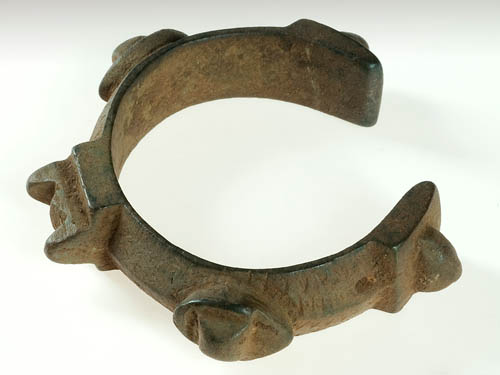
A bronze bracelet dating to the Late Bronze Age (ca. 1550–1200 BC) has been found during an excavation at Ramat Razim in the vicinity of Zefat (Tsefat, Safad). Karen Covello-Paran, director of the excavation, says,

“We discovered a wide rare bracelet made of bronze. The ancient bracelet, which is extraordinarily well preserved, is decorated with engravings and the top of it is adorned with a horned structure. At that time horns were the symbol of the storm-god and they represented power, fertility and law. The person who could afford such a bracelet was apparently very well off financially, and it probably belonged to the village ruler. It is interesting to note that in the artwork of neighboring lands gods and rulers were depicted wearing horned crowns; however, such a bracelet, and from an archaeological excavation at that, has never been found here.”

Rare bronze 3,500 year old bracelet. Photo: Clara Amit, courtesty IAA.

Rare bronze 3,500 year old bracelet. Photo: Clara Amit, courtesy of the Israel Antiquities Authority.

Large Canaanite cities, such as Megiddo and Hazor, have been excavated, but this is the first time a village of the Late Bronze Age has been excavated in the north of Israel. This site, Ramat Razim, is located southeast of Zefat, and is thought to have “constituted part of the periphery of Tel Hazor,” according to Covello-Paran.

The Late Bronze Age is the period of Moses, the Exodus, and the Conquest in biblical history.

The IAA news release may be read in its entirety here. A hi-res image is available here.

HT: Joseph I. Lauer

Radar Imaging Detects Hyksos Town in Nile Delta

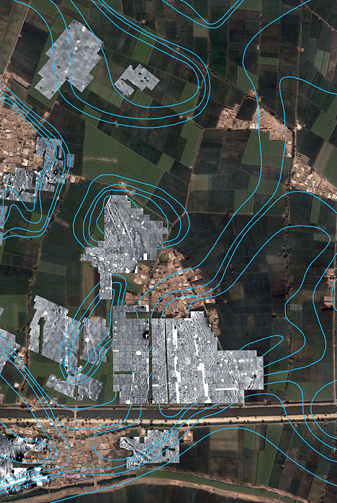
Rossella Lorenzi reports on the use of radar imaging to discover a Hyksos town buried under the modern Egyptian town at the site of Tell el-Daba.

Radar imaging in Egypt’s Nile Delta has unveiled the outlines of a buried city that was the stronghold of foreign occupiers some 3,500 years ago, Egypt’s Supreme Council of Antiquities announced Monday.

Discovered by a team of Austrian archaeologists in Tell el-Daba in the northeastern Nile Delta, the ruins belong to the southern suburban quarters of Avaris, the capital of the Hyksos kings who formed Egypt’s 15th dynasty.

Known as the “rulers of foreign countries” (probably of Asiatic roots),  the Hyksos infiltrated Egypt and came to dominate the Nile valley for over a century during the Second Intermediate Period (1664-1569 B.C.).

The article continues to mention the importance of the Hyksos to the trade in the Ancient Near East and the Mediterranean world.

The technique used in this discovery is explained.

Using a combination of geophysical survey and excavation techniques, the Austrian archaeologists led by Irene Forstner-Müller investigated approximately 2.6 square kilometers (1 square mile) of the ancient buried city.

The resulting computer-generated images showed a very detailed layout, complete with houses, streets, cemeteries and palaces.

The team has also identified temples where the Hyksos worshipped the god Seth, a possible harbor area and a series of pits of different sizes whose function has not yet been determined.

Avaris was then captured by King Ahmose I (ruled about 1570-1546 B.C.), who ended the Hyksos rule and founded the glorious 18th dynasty, which included pharaohs such as Hatshepsut, Amenhotep III, Akhenaten and Tutankhamun.

Color satellite image with radar imaging in monochrome showing the outlines of streets, houses and temples buried under the modern town of Tel al-Daba. Courtesy of Egypt’s Supreme Council of Antiquities (SCA).

The eastern portion of the Nile Delta is known as the Land of Goshen in the Bible. This was the home of the Israelites for many years.

Joseph went and told Pharaoh, “My father and brothers, with their flocks and herds and everything they own, have come from the land of Canaan and are now in Goshen.” (Genesis 47:1 NAS)

The article may be read in its entirety here in Discovery News.

We have mentioned other discoveries at Tell el-Daba, and the work of the Austrian archaeologists here and other places which you may locate by placing the word Goshen in the search box.

HT: Brooks Cochran

The first cataract of the Nile

Aswan is the location of the first cataract of the Nile River. This made it an ideal location for the Aswan Dam which was built between 1898 and 1902. This created a small lake south of the dam, but it was nothing to compare with Lake Nasser which has been formed as a result of the building of the new high dam at Aswan between 1960 and 1971.

The new high dam was constructed at a time when the Soviet Union was providing technical, economic and military support to Egypt. I remember staying in a hotel in Egypt in 1973 filled with Soviet tourists. In the years following we saw none of them. Lake Nasser stretches south for more than 300 miles. Many of the Nubians who lived in this area were resettled by the Egyptian government.

Our photo was made below the new high dam from a Nubian settlement. Click on the photo for a larger image.

The first cataract of the Nile at Aswan. Photo by Ferrell Jenkins.

The first cataract of the Nile at Aswan. Photo by Ferrell Jenkins.

Some scholars identify the Arabic name Aswan with the Syene of Ezekiel 29:10 and 30:6. It may be identified with the Sinim of Isaiah 49:12.

I am against you and your waterways. I will turn the land of Egypt into an utter desolate ruin from Migdol to Syene, as far as the border with Ethiopia. (Ezekiel 29:10 NET)

The Hebrew word translated Ethiopia (or Cush) in some English versions is Kush (Cush).

Look, they come from far away! Look, some come from the north and west, and others from the land of Sinim! (Isaiah 49:12 NET)

The Text Critical note in the NET Bible explains,

The MT reads “Sinim” here; the Dead Sea Scrolls read “Syene,” a location in Egypt associated with modern Aswan. A number of recent translations adopt this reading: “Syene” (NAB, NRSV); “Aswan” (NIV); “Egypt” (NLT).

Goshen and the Great Bitter Lake

The land of Goshen is fascinating because it is much different from the Egypt that so many of us studied in elementary school. Instead of sand, river, and pyramids, Goshen is a flat agricultural region in the eastern Nile Delta.

Perhaps Goshen is most fascinating as the long-time home of the sons of Israel. Joseph told his brothers,

You shall dwell in the land of Goshen, and you shall be near me, you and your children and your children’s children, and your flocks, your herds, and all that you have. (Genesis 45:10 ESV)

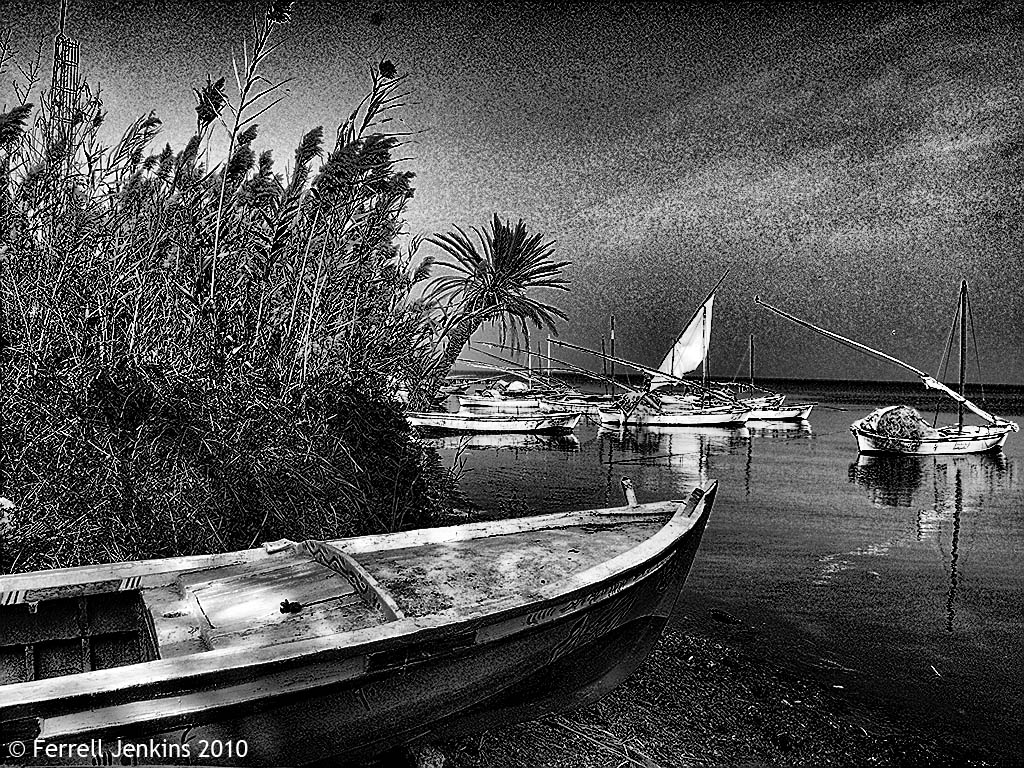
The photo below  shows reeds (bulrushes) growing on the banks of the Great Bitter Lake. This is the largest of a chain of lakes through which the Suez Canal runs. I have used a Photoshop plug-in called Topaz Adjust to turn this photo into a sketch that more resembles a photo made at night. If you think it might be useful in a lesson, you may click on the photo for a larger image.

Reeds (bulrushes) growing in the Great Bitter Lake. Photo by F. Jenkins.

Sketch of Reeds (bulrushes) growing in the Great Bitter Lake. Photo by F. Jenkins.

There are several good suggestions for the place of the exodus recorded in Exodus 14. This vicinity may be the sea described in Exodus 14:9.

Then the Egyptians chased after them with all the horses and chariots of Pharaoh, his horsemen and his army, and they overtook them camping by the sea, beside Pi-hahiroth, in front of Baal-zephon.

Other scholars suggest a location associated with Lake Timsa which is a few miles to the north.

Sadat of Egypt died in the pursuit of peace

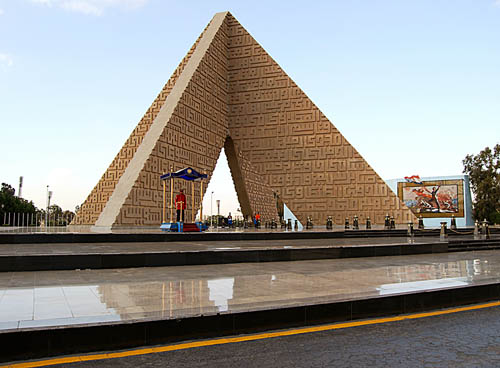
My schedule is full, but I ran across this photo that I thought I would share. Anwar El Sadat was the third president of Egypt in modern times. He served from 1970 until his assassination October 6, 1981. Sadat made peace with Israel on March 26, 1979.

This photo shows the beautiful monument to Sadat that stands across the street from the viewing stands where he was assassinated.

Sadat Monument in Cairo. Photo by Ferrell Jenkins.

Sadat Monument in Cairo. Photo by Ferrell Jenkins.

Pictures of Ancient Egypt

A slide show of nearly photos of Ancient Egypt in Pictures is maintained at Fox News here. I have called attention to this before, but continue to receive the link from readers. In about two months the number of photos has increased from 47 to 58. I assume it may continue to grow as new discoveries are made.

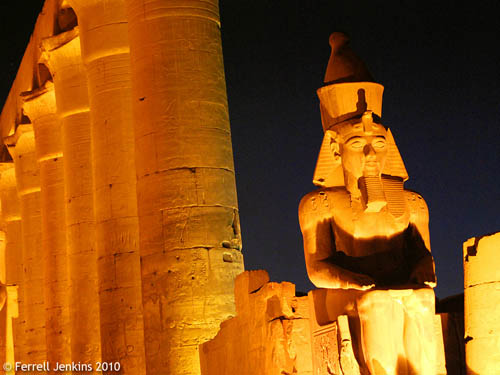
This gives me an opportunity to share a photo I made at Luxor in 2009.

Rameses at floodlight. Luxor Temple. Photo by Ferrell Jenkins.

Rameses by floodlight. Luxor Temple. Photo by Ferrell Jenkins.

Luxor was known as Thebes in Old Testament times. Both Jeremiah and Ezekiel prophesied the Lord’s judgment of the city. Jeremiah says,

The LORD of hosts, the God of Israel, says, ‘Behold, I am going to punish Amon of Thebes, and Pharaoh, and Egypt along with her gods and her kings, even Pharaoh and those who trust in him’” (Jeremiah 46:25; see also Ezekiel 30:14-16).

A visit to the ruined and unoccupied temples of Karnak and Luxor, where Amon (or Amun) was worshipped as a great god, certainly convinces us of the fulfillment of this prophecy. Shortly after the time of Jeremiah (about 586 B.C.), Egypt and Thebes began to decline as a world power.

HT: David Padfield (has 3 collections of Egypt photographs online); Brooks Cochran

Hoard of coins from time of Ptolemy III discovered

The Egyptian Supreme Council of Antiquities announced Thursday the discovery of a hoard of 383 bronze coins dating to the time of King Ptolemy III (ruled 246–222 B.C.). The well-preserved coins, found in the Fayoum about 50 miles southwest of Cairo, depict the Egyptian god Amun-Zeus on one side and the words Ptolemy and king in Greek on the other.

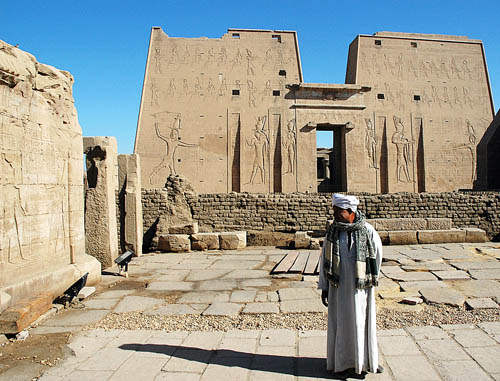
The Edfu Temple begun by Ptolemy III. Photo by Ferrell Jenkins.

The Edfu Temple begun by Ptolemy III. Photo by Ferrell Jenkins.

The famous Alexandria Library was established in the 4th century B.C. by Ptolemy Soter I, or a few years later by his son. The Hebrew scriptures were translated into Greek under the Ptolemaic rulers, beginning about 280 B.C. This Greek version was in common use in the first century. More than half of the quotations from the Old Testament in the New Testament come from the Septuagint (Greek) version. For example, this is the version the man of Ethiopia was reading about the suffering servant:

So Philip ran to him and heard him reading Isaiah the prophet and asked, “Do you understand what you are reading?” (Acts 8:30 ESV)

Philip the evangelist began at that Scripture and preached Jesus to him.

HT: Joseph I. Lauer; various media reports.

Update: Todd Bolen has posted a beautiful photo here of Lake Qarun near the site of the discovery.