Category Archives: Culture

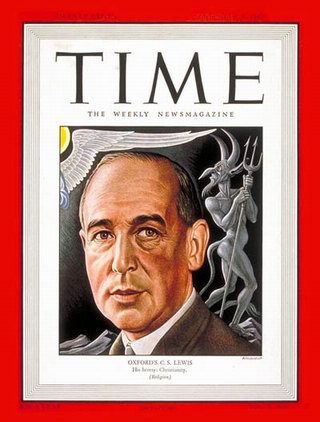
C. S. Lewis on the cover of Time

Time announced Vladimir Putin as Person of the Year today.

Many do not know that C. S. Lewis was featured on the cover of Time, September 8, 1947. The article about him was titled, “His heresy: Christianity.” If you have enjoyed the Narnia books and movie, or if you have read his apologetic books, I think you would enjoy our pictorial essay on sites associated with Lewis at Oxford, England. Click here.

C. S. Lewis on the cover of Time.

You may view the first trailer for The Chronicles of Narnia: Prince Caspian here.

I Hope You Won’t Get Jerusalem Syndrome

Journalist Ari Rabinovich has written about the Jerusalem Syndrome here. He briefly describes JerSyn in these words:

Only about a dozen Jerusalem tourists per year suddenly get agitated, imagine themselves to be characters from the Bible, fashion makeshift togas out of hotel sheets and go out to holy sites to recite the Psalms, sing hymns or harangue passers-by to repent.

It is a fascinating article, and also has a link to another article he has written, “Come to Jerusalem, see the Messiah?”

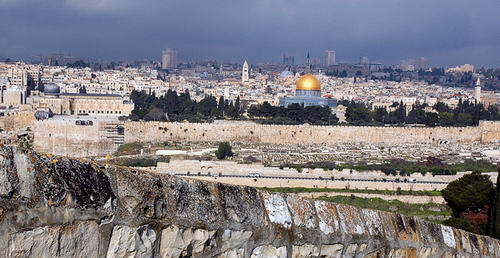
Jerusalem From the Mount of Olives

I think you will admit that the view of Jerusalem from the descent of the Mount of Olives is breathtaking. It is even more so when you see it in person.

The Arrogance of Atheism

The study of apologetics or evidences for the defense of Christianity has been a special interest of mine for half a century now. While there has been opposition to Christianity as a divinely revealed religion, and to the Bible as the special revelation of the mind of God all along, much of it has been subtle. Of late we have begun to notice that Atheism has become evangelistic in their opposition to the Faith.

Time publishes a list of Top 10 this and that at the end of the year. I took a look at the Top 10 Religion Stories. Number 7 in that list is “The Roar of Atheist Books.” Here is a brief summary:

Statistics may or may not show that there has been an actual increase in the number of Americans who believe there is no God. But one thing is certain: Conservative religious influence riled up enough secular authors to produce a slew of skeptical literature, and enough readers were intrigued to turn Richard Dawkins (The God Delusion) and Sam Harris (Letter to a Christian Nation) into bold-faced names and turn Christopher Hitchens (God Is Not Great: How Religion Poisons Everything), bold-faced already, into a one-man literary cottage industry.

Christians must not hide their heads in the sand and hope no one notices these works. Even in New Testament times, Peter urged the Christians who were living in a society a lot like ours to be set for the defense of the Gospel.

But set Christ apart as Lord in your hearts and always be ready to give an answer to anyone who asks about the hope you possess. Yet do it with courtesy and respect, keeping a good conscience, so that those who slander your good conduct in Christ may be put to shame when they accuse you. (1 Peter 3:15-16, NET Bible)

At BiblicalStudies.info, there are many good links under Apologetics that will help you prepare to answer attacks on the faith. Become acquainted with these materials.

The arrogance of atheism is astounding. Imagine a person who lives on one square meter of the earth (at any given time) for a total of 60 to 100 years, being able to make pronouncements about eternity and all things. The writer of Hebrews says, “For every house is built by someone, but the builder of all things is God” (Hebrews 3:5, NET Bible). It is amazing that individuals who attribute everything to chance think they are so smart. And if they are right, we can’t help being believers!

This morning Time has an article about Sunday School for Atheists. The children in our Bible classes need to learn Bible stories, but they also need to learn the evidences that help to sustain the faith against various cultural attacks.

You might want to take a look at the Blog of Dr. Albert Mohler, president of the Southern Baptist Seminary. He regularly writes blogs dealing with these cultural issues. Be sure to note what he has said about The Golden Compass.

Movie and TV writers plan strike

That is the “very latest” as they say on TV.

Comment: There are writers?

A Remembrance: Sputnik I launched 50 years ago today

The NASA web page says,

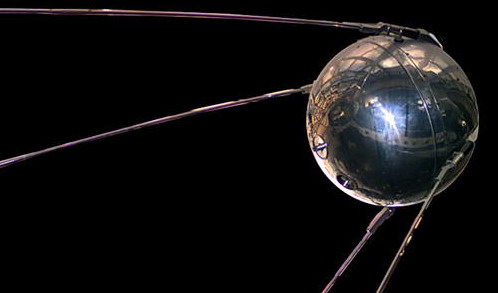
History changed on October 4, 1957, when the Soviet Union successfully launched Sputnik I. The world’s first artificial satellite was about the size of a basketball, weighed only 183 pounds, and took about 98 minutes to orbit the Earth on its elliptical path. That launch ushered in new political, military, technological, and scientific developments. While the Sputnik launch was a single event, it marked the start of the space age and the U.S.-U.S.S.R space race.

Read more details on the NASA web site.

If you have forgotten the sound transmitted by Sputnik as it passed overhead, listen to a short WAV file on the NASA site.

Sputnik I - 1957

Having completed four years of college at Florida Christian College (now Florida College) in Temple Terrace, FL, a few months earlier I had moved to preach in Auburn, Kentucky. A college friend was spending the summer preaching in nearby Morgantown. Elizabeth and I drove up to visit him. My recollection of the town at that time is that there were businesses on only one side of the square (meaning across from the county court house). Lawson informed us that many of the people there believed that the whole thing about Sputnik was some kind of a trick. Nothing was up there, according to them. Later, when astronauts walked on the moon, there were some in numerous places who said it was all filmed in the Arizona desert.After Russia began manned, tethered space walks, one of the atheistic astronauts is reported to have said that he walked in space, but did not see God. Someone suggested that if he had cut his tether he might have seen God. In the intervening years we have learned so much about the expanding universe that it difficult to countenance the ignorance and arrogance of men claiming to know there is no God.

Space exploration has probably benefited each of us in many ways through the developments and products we now use. There currently seems to be a common view that the program is going to eventually prove once and for all that all this universe is a product of naturalistic, chance evolution. Not so fast.

Dr. Robert Jastrow, an astronomer, who admitted that he was an agnostic in religious matters, wrote:

“It is really very surprising that the labors of the astronomers, studying the Universe through their telescopes, should have brought them to the conclusion that the world had a beginning. Scientists feel more comfortable with the idea of a Universe that has existed forever, because their thinking is permeated with the idea of cause and effect. They believe that every event that takes place in the world can be explained in a rational way as the consequence of some previous event. If there is a religion in science, this statement can be regarded as its main article of faith. But the latest astronomical results indicate that at some point in the past the chain of cause and effect terminated abruptly. An important event occurred–the origin of the world–for which there is no know cause or explanation” (Until the Sun Dies. 1977. 27).

“A sound explanation may exist for the explosive birth of our Universe, but if it does, science cannot find out what the explanation is. The scientist’s pursuit of the past ends in the moment of creation; the origin of the world is a fact that he can never hope to explain” (Until the Sun Dies. 1977. 28).

In another book, Dr. Jastrow said,

“Now we see how the astronomical evidence leads to a biblical view of the origin of the world. All the details differ, but the essential element in the astronomical and biblical accounts of Genesis is the same, the chain of events leading to man commenced suddenly and sharply, at a definite moment in time, in a flash of light and energy” (God and the Astronomers. 2nd ed. 1992. p. 14).

Here are a few helpful comments regarding the origin of the universe.

The Psalmist David said,

“The heavens declare the glory of God, and the sky above proclaims his handiwork” (Psalm 19:1 ESV).

The writer of the Epistle to the Hebrews says,

“For every house is built by someone, but the builder of all things is God” (Hebrews 3:4 NET).

Paul expressed the value of the natural creation even to men who do not have the light of propositional revelation (the gospel, Romans 1:16).

“For since the creation of the world His invisible attributes, His eternal power and divine nature, have been clearly seen, being understood through what has been made, so that they are without excuse” (Romans 1:20 NASBu).

The “Do Not Call” List

Are you sometime bothered by unwanted phone calls from salespersons and companies you have never heard about? You can register your phone number, including you cell phone, on the government list. Full information is available at the Do Not Call page. We had this service in Florida before the federal service became available. Within a month of registering you will probably be able to complete your meal without an interruption. This is a free service.

Normally I am more than 1 year behind!

A few hours after posting about the Beloit College Mindset list, I noticed that I had used the 2010 list. Oh, well, you probably did not know that either. Here are a few interesting things about travel and knowledge of the world from the 2011 list.

  • 1. What Berlin wall?
  • 15. Russia has always had a multi-party political system.
  • 53. Tiananmen Square is a 2008 Olympics venue, not the scene of a massacre.

And here is one of general interest.

  • 43. Being a latchkey kid has never been a big deal.

What they don’t know

Beloit College, for several years, has posted a list of things that incoming Freshmen (class of 2011) do not know. When I was teaching I always found this interesting and helpful. Preachers, who think they are making themselves clear, might learn something from examining the full list. We frequently take for granted that our listeners understand our illustrations. Many of the items from the Beloit list are humorous, but I have chosen a few pertaining to travel.

  • 1. The Soviet Union has never existed and therefore is about as scary as the student union.
  • 6. There has always been only one Germany.
  • 12. Smoking has never been permitted on U.S. airlines.
  • 51. Disneyland has always been in Europe and Asia.

These are thought provoking:

  • 30. Non-denominational mega-churches have always been the fastest growing religious organizations in the U.S.
  • 41. They have always been able to watch wars and revolutions live on television.

But still know nothing about the problem in the Middle East (or even where it is).

Mission Accomplished — Turkey is done

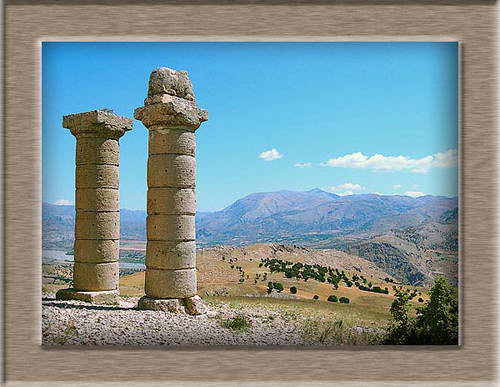
This morning we left the hotel in Kahta about 10 a.m. and headed back toward Mount Nemrut to visit the Karakus Tumulus. This site was built in 36 B.C. by King Mithridates II as a burial mound for three female relatives. This, like Nemrut, was part of the Kingdom of Commangene. From here we had a nice, distant view of Mount Nemrut. This photo shows the mound at Karakus. Nemrut is the high pointed peak.

Karakus Tumulus. Mount Nemrut in distance. Photo by Ferrell Jenkins.

We continued a few miles to see a Roman bridge over the Cendere River that was built in the 2nd century A.D. in the time of Septimius Severus. Some of the limestone blocks in this bridge we made from columns that once surrounded the Karakus Tumulus.

Then we drove to the Gaziantep airport to wait for our flight to Istanbul. Lord willing, tomorrow morning we will depart for home.

I am writing this blog in a restaurant in the airport while eating spaghetti.

During the Ancient Crossroads tour the group traveled 1953 miles by coach. On the excursion to Eastern Turkey we drove 1376 miles. That’s a total of 3328 miles. We did not see an accident during the entire 3 weeks. It is also significant that we did not encounter anything unpleasant except for kids at some locations who tried to become our guide.

David Padfield says that Ferrell drives surprisingly well for a man of his age. Is that a slam, or what?

We did not expect the hotels in the East to be as good as we have used in the western and central part of the country. Our hotels ranged from the less than desirable one at Mount Ararat to a 5-star hotel in Gaziantep. Every hotel (for the three weeks had wireless Internet available except for the one at Mount Ararat. This was very nice, and allowed me to keep this blog fairly current every day. It is time consuming. Most nights I only got about 6 to 6 1/2 hours sleep. I need to get home and rest a while!

We are thankful to the Lord for the safety of our travel. We are thankful to have been able to make this trip and to have shared it with you. We hope to be able to share it with our brethren in many ways in the coming years.

We arrived safely in Istanbul and are now in the Airport Hotel. We have to be up at 3 a.m. to make the flight to the USA.

Gaziantep Museum, Mayberry, and Mount Nemrut

This morning we visited the Muze in Gaziantep. This museum contains many of the mosaics and some statues from the Roman city of Zeugma. Zeugma has been covered by the waters of the Euphrates River due to one of the dams built by the Turkish government to provide hydro-electric power and water for irrigation for southeastern Turkey. Archaeologists worked diligently over a period of years to preserve as much of the material as possible. The small mosaic below had been called Gypsy Girl. I think it would rival the Mona Lisa.

Gypsy Girl from Zeugma in Gaziantep, Turkey, Museum. Photo by Ferell Jenkins.

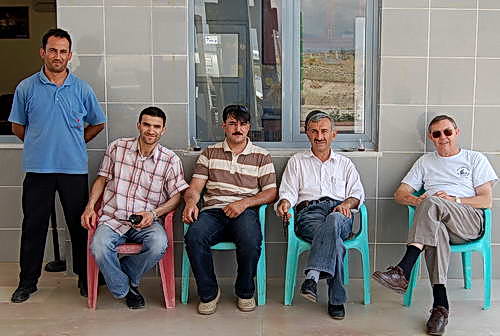
By 11 a.m. we headed for Mount Nemrut. We stopped at a gas station in Bezni for a comfort break. The locals who were sitting around talking did their best to communicate with us. Everyone we meet is friendly. I call this photo “Mayberry, Turkey.”

“Mayberry” Turkey. Ferrell with men at Besni. Photo by Gene Taylor.

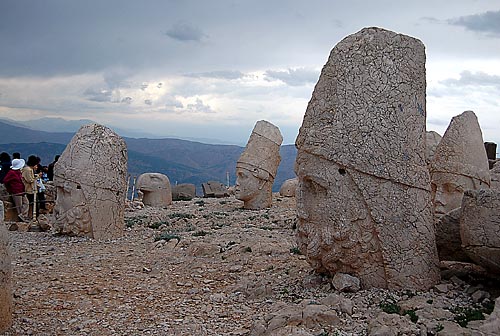
After checking in at the Zeus Hotel in Kahta, we arranged for transportation to Mount Nemrut. In 1995 I drove to the parking lot in a rental car, but decided that it would be best to leave the driving to someone else. It took about 1 1/2 hours to get to Nemrut Dagi. This mountain is part of the Anti Taurus range and is more than 7000 feet above sea level. This area was known as the Kingdom of Commangene in the three centuries preceding the Christian ear. It served as a buffer between the Seleucids and the Parthians in the third century B.C. In the first century B.C. it served as a buffer between the Romans and the Parthians. The most famous ruler was Antiochos I Epiphanes (ruled 64-38 B.C.). In 72 A.D. Vespasian made the Commangene part of Roman Asia. Being away from home I have relied on LonleyPlanet Turkey (April, 2007) for some of the facts. The sunset was not very brilliant this evening. In fact we left a little early because of an approaching shower. The tumulos was made of loose stones in the form of a pyramid. Antiochus ordered this built as a burial site for himself and some relatives. The remaining tumbled statues of rulers and gods are impressive. Some of the heads are between 6 and 7 feet tall. Take a look at the people beside one of them. The site overlooks the Euphrates River to the East.

Mount Nemrut (Nemrut Dagi). Photo by Ferrell Jenkins.

By 8:30 our driver had us back to the hotel and we enjoyed the evening meal. We thought Leon would have arrived in the USA, so we called him to tell him that this was the best day of the tour!