Category Archives: Culture

Harran – Home of Abraham

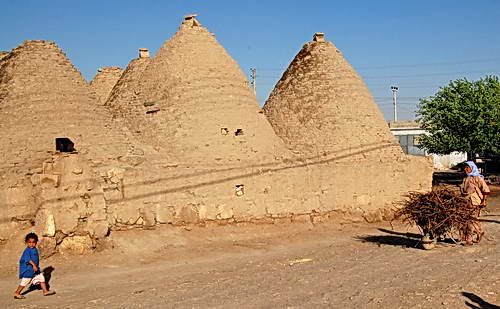
Yesterday afternoon we visited Harran (some English Bible versions use Haran). Harran is located in biblical Padan-Aram (Genesis 25:29, et al). Abraham and his family lived in the area (Genesis 11:21). The city has a long history which I will not go into now. For the past two hundred years the people who live here have built mud brick conical, beehive-shaped houses. We also see some of these houses in northern Syria. Here is a photo showing one of the houses. Due to the heat in this area we waited until late in the afternoon to visit. The lines you see going across the buildings are made by the shadow from the power lines. An oven can be seen to the right of the boy. The woman is bringing a load of pruned grape vines to be used in her oven.

Beehive Type Houses in Harran.

Today we visit Sanliurfa, claimed by the Muslims to be the birthplace of Abraham, and the Euphrates River.

Van to Batman

We left Van this morning and drove along the lake to the place where we could take a boat to Akdamar Island in Lake Van. This is where we find an early 10th century Armenian church. The church has undergone an expensive restoration and reopened by the Turkish government a little over two months ago as a museum. Too much to explain about the Armenians and this church at this time. There are some marvelous paintings and carvings of Bible stories inside and outside the church. Here is a photo I made this morning as we approached the island.
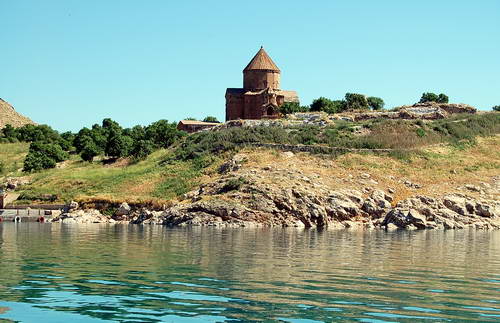
Akdamar Armenian Church on an island in Lake Van. Photo by Ferrell Jenkins.

Later we enjoyed one of those unexpected moments when we saw a group of men adding a room to a typical (of the area southwest of Van) stone house. There are many similarities between this house and those of Bible times in Israel. This photo shows the steps (ladder) going up to the roof that is made of timbers covered with earth. The people here were absolutely thrilled that we stopped to visit a while.
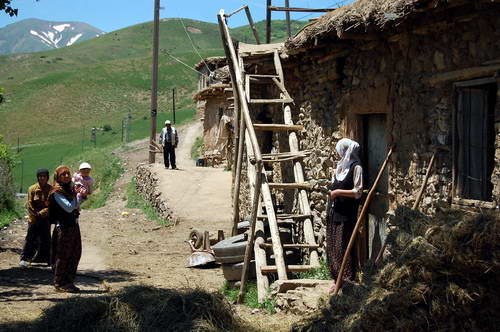
House south of Lake Van in Turkey. Photo by Ferrell Jenkins.

We arrived at Batman by about 4 p.m. and headed south to Hasankeyf. This is the area of Southeast Anatolia. Batman is a center of oil production. It is a thriving Kurdish town. Our hotel is probably 3-star. It is nice and clean and the staff is very helpful. There is a new mall across the street with a large grocery, and Burger King, and several other stores. Hasankeyf has a history associated with the Seljuks and the Ottoman Empire. I still need to spend some time studying about the site. There are old cave dwellings similar to those one sees in Cappadocia.The guard at one of the archaeological sites told me that Hasankeyf is an Arab town. He said that Batman (only about 20 miles away is a Kurdish town. My main interest in the old city is that it is built on the Tigris River (call Dicle in Turkish). The Tigris begins in the mountians of ancient Ararat and flows into the Persian Gulf. The Tigris is mentioned twice in the Bible. It is said to be the third of the rivers flowing out of the garden of Eden. It flows on the east side of Assyria (Genesis 2:14). The river is also mentioned in Daniel 10:4. The prophet stood beside “the great river, the Tigris.” This likely would have been far south of here. Ancient Nineveh was built on the Tigris.
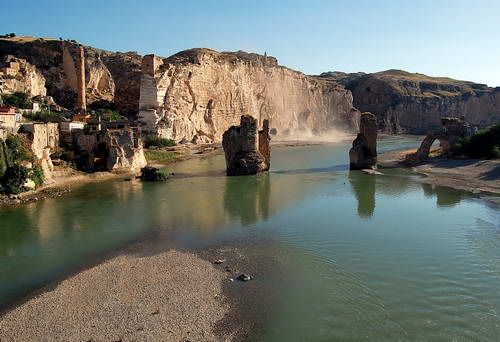
Hasankeyf on the Tigris (Dicle) River in southeastern Turkey. Photo by Ferrell Jenkins.

The building of a dam on the Tigris threatens the existence of Hasankeyf. It is difficult to stop “progress,” but it is a shame to see history like this flooded. It has happened to other sites in Turkey such as Zugma on the Euphrates.

Tomorrow we head for Sanliurfa and Harran.

Derbe and Lystra

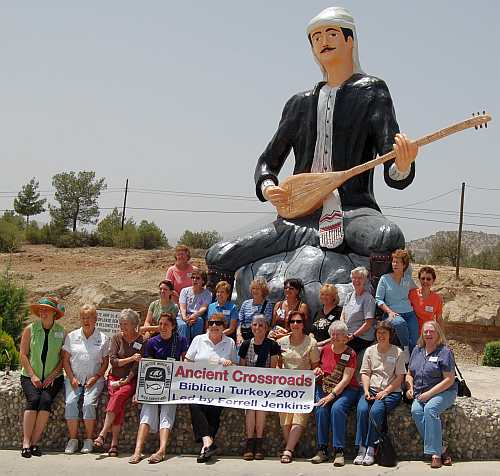
We left Adana and traveled along the beautiful Tuquoise Coast passing Mersin, Pompeipolis, Corycos and Silifke. The Mediterrenean coast is the real fruit bowl of Turkey. At Silifke we headed north and drove through another of the important passes in the Taurus Mountain highest point was about 5000 feet above sea level. We saw some Cedars of Lebanon growing in the area. That is about the same altitude of the great Cedars in Lebanon. Near Karaman we stopped for a lunch break. The ladies of the group posed under an image of one of Turkey’s famous folk musicians from the area.

The Ancient Crossroads Women near Karaman, Turkey. Photo by Ferrell Jenkins.

We visited the tell of Derbe (Kerti Huyuk; Acts 14:20-21; 16:1; 20:4). We made a short stop at the Museum in Karaman to see one of the inscriptions which helped to identify the site of Derbe. After that we headed for the mound of Lystra (Zordula) of Lycaonia near the village of Hatunsaray. It was here that the priest of Zeus wanted to offer a sacrifice to Paul and Barnabas (Acts 14:6-20). This was the home of Lois, Eunice, and young Timothy (Acts 16:1-4). These cities were in the province of Galatia (Gal. 1:2) in New Testament times. Both Derbe and Lystra await the archaeological spade.

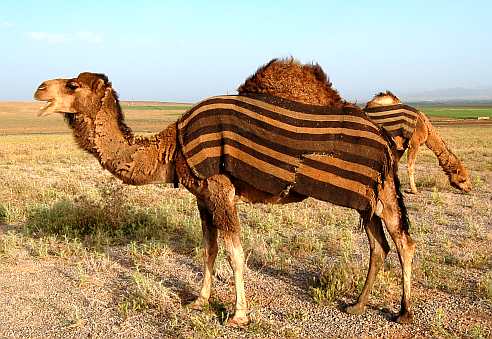
Along the way we saw a large flock of goats (several hundred) and some camels grazing in a field. The nomad family, consisting of a mother and three or four girls, had brought the animals from the Coast over a two month period. The young lady watching the camels did not know her age. She might have been between 14 and 16 told our guide they would go back “when the first snow flakes fall.” This was a good reminder of Patriarchal days of the Bible.

Migratng camels with nomads near ancient Lystra in Turkey. Photo by Ferrell Jenkins.

Thursday we plan to visit the archaeological museum in Iconium (Konya) and Pisidian Antioch before heading for Antalya (Attalia of the New Testament).