Category Archives: Culture

Memorial Day

Memorial Day (Monday) honors all the men and women who have died in military service in the defense of our country. There were 1,465 USA deaths in the Battle of Normandy. In addition, 2,700 UK soldiers and 500 Canadian soldiers died. It is estimated that between 4,000 and 9,000 German soldiers died.

D-Day, June 6, 1944, is a very important day in American history. Here is one of the photos I made at the American Cemetery at Normandy in 2002.
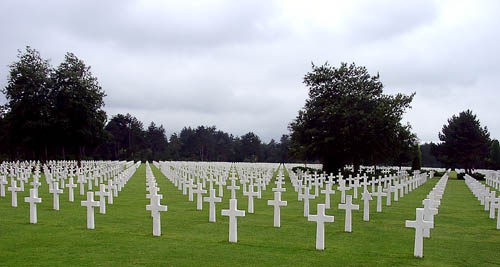
A visit to this cemetery, or any other military cemetery, helps us realize what a great debt we owe to those who gave their lives while fighting for freedom. A few years ago, prior to his death, I visited regularly with a veteran of World War II who was at Normandy. I enjoyed hearing him talk about the war, and asking him questions. I was always encouraged when I left his home.

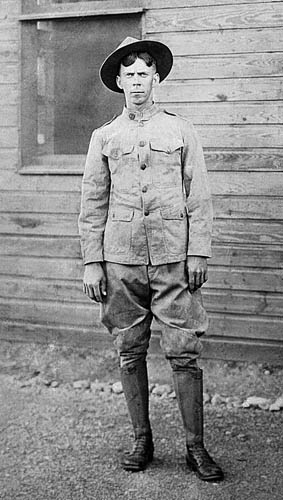
My wife’s father was in World War I. Here is a photo (after a few Photoshop enhancements to take out scratches) of Karl Wayne Williams made in 1917. Thankfully he made it aback alive. Elizabeth says he was born 114 years ago. We honor his memory along with others who have touched our lives.
When I was a youngster Memorial Day was called Decoration Day because folks decorated the graves of those who died in war. In addition, graves of family members were decorated. Not a bad custom.

The Encyclopedia Britannica’s Guide to Normandy 1944 has some good maps and charts. Take a look.
Aslan

We had a nice day in Istanbul. Sightseeing included the Blue Mosque, the Hagai Sophia, Topkapi Palace, and the Archaeological Museum. We toped off the day with a cruise on the Bosphorus. This is the strategic waterway that connects Russia (and the countries that were formerly part of the USSR) and the Mediterranean and the rest western world.

After I review my photos I will try to upload an additional one or two for your enjoyment. Below is something I wrote a few days ago about Aslan. Read and enjoy.

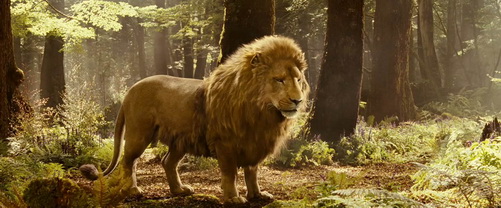
Everyone familiar with the Chronicles of Narnia remember that Aslan is the name of the lion. Note this paragraph about Aslan from Wikipedia.

Aslan is a word meaning lion. Lewis came up with the name during a trip to the Ottoman Empire, where he was impressed with the Sultan’s elite guards also called Aslan because of their bravery and loyalty.

I noticed a restaurant in Istanbul with the name Aslan. You may also recall that Edmund was tempted by Turkish delight. It is good stuff.

The Disney movie, Prince Caspian, opens May 15. The official website is here.

Check our page about C. S. Lewis here.

Wells of water

Without water it is impossible for men to survive. Many disputes throughout history have been about water and water rights. The importance of water during the time of the the biblical patriarchs is prominent in several Bible accounts.

  • Abraham made a covenant with Abimelech. He said, “I dug this well” (Genesis 21:30). This covenant was made at Beersheba (well of seven).
  • Isaac had to dig again the wells of water dug by Abraham because the Philistines had filled them with debris (Genesis 26:15-18).
  • The scene around the well where the servant of Abraham selected the bride for Isaac is especially impressive (Genesis 24).
  • The meeting of Jesus with the Samaritan woman at Jacob’s well (John 4).

The well was so important that the wise man used it as a euphemism to teach sexual purity.

Drink water from your own cistern And fresh water from your own well. (Proverbs 5:15)

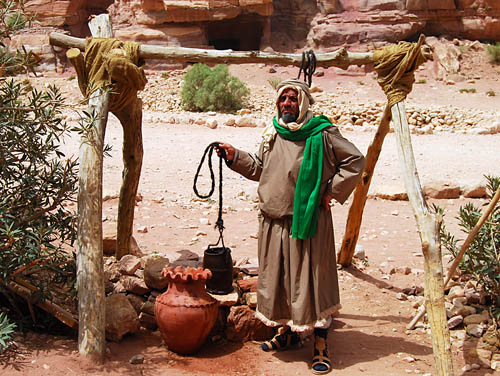
At Petra in Jordan, men dressed in antique costumes demonstrate life among the Bedouin. Here we have a man at the well. This may seem ancient to younger people, but I drew water from a well when I was a youngster (and it was not in the patriarchal period!).

A Bedouin at Petra, Jordan, illustrates the importance of the well. Photo by Ferrell Jenkins.

Visting the land of Moab

Today we visited Heshbon, Tell Al, Dibon, and Macherus. Tell Al is thought to be the biblical site of Elealeh, a site always mentioned (Numbers 32:3). Macherus is the site of a fortress built by Herod the Great overlooking the Dead Sea on the east side. It is sort of a companion site to Masada on the western side of the sea. According to Josephus this is where John the Baptist was put to death by the order of Herod Antipas.

He sent and had John beheaded in the prison. (Matthew 14:10).

As a photo for today I want to share a picture I made at Heshbon in the ancient land of Moab. When we arrived the shepherd was beginning to lead his sheep out to pasture. Note the large number of lambs among the flock. Another interesting observation is that the shepherd is behind the flock. This is a something we see often in this part of the world.

The shepherd leads his flock out to green pastures. Photo by Ferrell Jenkins.

The LORD used this illustration many times to show His ooncern for His people. His appointed leaders were likened to shephers who would lead the flock. The text below speaks of the appointment of Joshua to take the place of Moses.

“May the LORD, the God of the spirits of all flesh, appoint a man over the congregation, who will go out and come in before them, and who will lead them out and bring them in, so that the congregation of the LORD will not be like sheep which have no shepherd.” (Numbers 27:16-17)

This will likely be the last post of the current trip until I am back in the comfort of my study. Prayers of the faithful are always appreciated.

Hazor, Dan, Caesarea Philippi, Golan Heights

Today we visited sites north of the Sea of Galilee. We began at Hazor, a site overlooking the Hulah Valley. The Israelites came to this large city and defeated the inhabitants and burned the city.

However, Israel did not burn any cities that stood on their mounds, except Hazor alone, which Joshua burned. (Joshua 11:13)

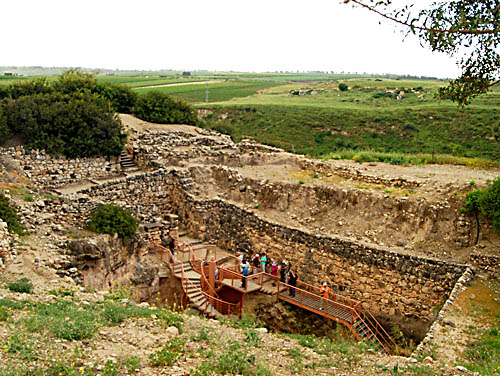
This photo shows the water shaft due in the days of King Ahab of Israel. Gates and walls were for protection, and food and water were a necessity for survival.

The water shaft at Hazor. Photo by

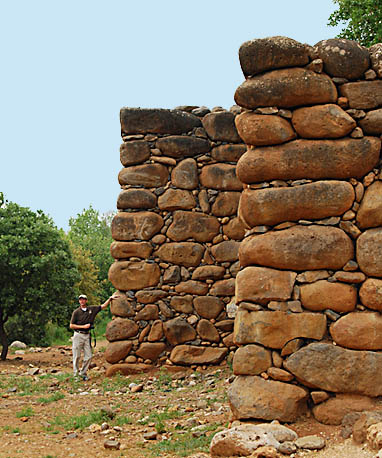
We continued north to the Israeli-Lebanese border at Metulla. Afterwards we went to Tel Dan. In order to get to the tel it is necessary to walk through a nature park, much of it along the Dan River, the strongest source of the Jordan River. Here is a photo of a stretch of reconstructed wall near the city gate.

Reconstruction of the City Wall at Tel Dan. Photo by Ferrell Jenkins.

We continued a short distance east to Banias, the biblical Caesarea Philippi, where Jesus made His promise to build the church upon His own deity.

Now when Jesus came into the district of Caesarea Philippi, He was asking His disciples, “Who do people say that the Son of Man is?” And they said, “Some say John the Baptist; and others, Elijah; but still others, Jeremiah, or one of the prophets.” He said to them, “But who do you say that I am?” Simon Peter answered, “You are the Christ, the Son of the living God.” And Jesus said to him, “Blessed are you, Simon Barjona, because flesh and blood did not reveal this to you, but My Father who is in heaven. “I also say to you that you are Peter, and upon this rock I will build My church; and the gates of Hades will not overpower it. “I will give you the keys of the kingdom of heaven; and whatever you bind on earth shall have been bound in heaven, and whatever you loose on earth shall have been loosed in heaven.” (Matthew 16:13-19)

We made a short stop at Birket Ram, a lake in an extinct crater below Mount Hermon. There was almost no snow on the mountain today. Often a small amount of snow can still be seen by this time of year. We continued to Tiberias through the Golan Heights (biblical Bashan), where one of the cities of refuge was located (Joshus 20:8).

We closed the tour day with a short visit to Mount Arbel for a view of the Sea of Galilee.

The Shabat (Sabbath) has begun in Israel. Jews pour into the hotels for the Shabat to have their meal prepared for them by someone else. We are near a pedestrian street with a number of restaurants. The music is loud, indicating very little in the way of a spiritual significance to the Sabbath. A far cry from the commands of the Torah.

The Suez Canal and Egyptian peddlers

USA Today has an AP report today that a ship under contract to the U.S. Navy fired shots at a small Egyptian boat. The article explains why the small boats would approach a ship going through the canal. The full article is here.

Small boats selling cigarettes and other products often swarm civilian ships moving through the canal. These waterborne merchants know not to approach military vessels but the Global Patriot looked like a civilian vessel, said the security official, speaking on customary condition of anonymity.

Egyptian peddler’s are among the most persistent in the world. Many Americans are caught off guard, and even frightened, by the persistence of these men (and children). Americans are accustomed to going into a store, picking up what they want, and saying “How much?” It isn’t that way in many parts of the world, especially in Egypt. You may say, “I don’t need that,” or “I don’t want that.” “Leave me alone.” The response you get is like that of a three-year old, “Why you don’t need that?” And the persistence continues until you are safely inside the security of the tour bus and driving away. Even then the salesman may hold on to the side of the bus as it leaves his area.

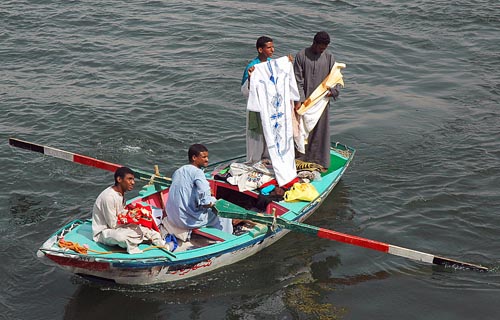
The photo below was made at Edfu during a Nile Cruise. I think these men are Nubians, but I have several other photos of Egyptians doing the same thing.

Nubian peddlers on the Nile River at Edfu. Photo by Ferrell Jenkins.

Is there a “third Jesus”?

If you have been impressed by seeing Deepak Chopra on TV telling about his new book, The Third Jesus (the Christ we cannot ignore), I suggest you read this post by Ben Witherington. Click here.

Postmodern man is unwilling to accept the Jesus of the Bible, but he still needs to believe, and wants to believe. This is what makes all of the cable TV programs about the mysteries of Jesus, the unknown years, and those dealing with the claims of the Gnostic literature so popular.

Here are a few Scriptures that might be helpful as you think of Jesus.

In the beginning was the Word, and the Word was with God, and the Word was God. (John 1:1)

And the Word became flesh, and dwelt among us, and we saw His glory, glory as of the only begotten from the Father, full of grace and truth. (John 1:14)

For many deceivers have gone out into the world, those who do not acknowledge Jesus Christ as coming in the flesh. This is the deceiver and the antichrist. (2 John 1:7)

… concerning His Son, who was born of a descendant of David according to the flesh, 4 who was declared the Son of God with power by the resurrection from the dead, according to the Spirit of holiness, Jesus Christ our Lord… (Romans 1:3-4)

“Therefore let all the house of Israel know for certain that God has made Him both Lord and Christ– this Jesus whom you crucified.” (Acts 2:36)

Peter’s great confession of Jesus took place at Caesarea Philippi.

Simon Peter answered, “You are the Christ, the Son of the living God.” (Matthew 16:16)

The photo below was made at Caesarea Philippi, one of the major sources of the Jordan River. This was the site of Peter’s great confession.

Source of the Jordan River at Caesarea Philippi. Photo by Ferrell Jenkins.

Understanding Postmodernism

What does this have to do with travel? Well, it is travel of the mind, and the road of history that has brought us to the place we are now in the early part of the 21st century.

I do try to stay on target with this blog, but I regularly check a blog called Parchment and Pen. There is a short video explaining, with a visual illustration, what Postmodernism is, and how we got to this place in modern thinking. I think you will profit by taking the time to listen to this discussion about Scripture, Tradition, Reason, and Postmodernism.

Here is the link to the video produced by Reclaiming the Mind Ministries. You may watch it online or download it to watch.

Hopefully this will help clear up some fuzzy thinking!

Theology Matters . . . It Always Matters

Dr. Albert Mohler, president of Southern Baptist Seminary, writes some excellent material relating to Christianity and modern culture; that is, the Christian Worldview as it relates to other Worldviews.

In his most recent blog, Mohler reviews a book by George Weigel, a prominent Catholic intellectual and commentator. Weigel’s book, Faith, Reason, and the War Against Jihadism, shows the importance of taking theology seriously in dealing with the threat of jihadism. I recommend that you read Dr. Mohler’s comments here.

January 3rd in (my) History

I am sure that many significant things have happened on January 3rd, but the one most important to me was my birth on this day. One day I was looking for some photos of the old cotton mills from Huntsville, Alabama, and ran across a site that also had a vintage post card of the City Hospital. This is the way I remember the hospital when I was a kid.

Huntsville, AL, city hospital on an old postcard.

My parents lived in the New Hope area when I was born. About three years later we moved to Harvest, a rural community with a population of about 200. I attended a four-room school for the first 8 years of schooling. There were 2 grades in each room with one teacher. When I was about 10 years of age I was back in the hospital overnight to have a tonsillectomy.

Little could I have imagined in those formative years that I would be able to travel around the world (1995), and to many diverse and exotic places. I don’t even remember when I first learned about China or Egypt or Russia. There was no State of Israel back then, only a Zionist dream. My first remembrance of hearing about Japan was on December 7, 1941, the day of the infamous attack on Pearl Harbor.

I wish my Mother, now 94, could still remember this day in our history.